In commercial loan servicing operations, the loan servicing specialist is the person who keeps a loan correct and current after it closes: setting the loan up from the signed agreement, processing draws and repayments, applying rate resets, running the periodic billing, answering the borrower's questions about the bill and correcting it when it is wrong. On a consumer or mortgage desk one person may do all of it. On a commercial desk, where one credit agreement can carry a term loan, a revolver, letters of credit, a pricing grid and a syndicate, the work is split across four seats — and in the solution's sample bank those four are the people a quarterly billing run passes through.
This page describes the desk as it actually works: what each seat decides, what it may never decide, what examiners ask about it, and what a billing run looks like when every bill has been rebuilt from its own agreement before anyone opens it. The four people named are fictional characters in the sample data; the occupational figures and the supervisory guidance are published and linked.
The nearest published occupation to this desk
169,100
people employed in 2025 as loan interviewers and clerks — the occupation this seat sits inside
Decline
projected employment change 2025–2035, at −1% or lower, and 10,500 shown for projected openings, 2025–2035
What is a loan servicing specialist?
The job is defined by the phase of the loan rather than by any one task. Origination ends at closing; servicing runs from closing to payoff. The OCC defines servicing as the upkeep of each loan from closing until it is paid off, and its list of what that generally includes is a fair inventory of what lands on the desk: “processing of draws and revolving credit advances”, “interest rate adjustments for variable rate loans, including commercial loans with performance-based pricing”, “periodic loan billing” and “processing participation loan payments” (OCC, Comptroller's Handbook, Lending and Loan Portfolio Risk Management).
Two phrases in that list separate a commercial desk from a consumer one. “Performance-based pricing” means the rate itself moves with a ratio the borrower certifies each quarter, so the bill cannot be produced without reading a document. “Participation loan payments” means money the bank collects is not all the bank's: a share belongs to other institutions and has to be computed and remitted to the day. Neither has an equivalent on a car loan.
The four seats around one quarterly billing run
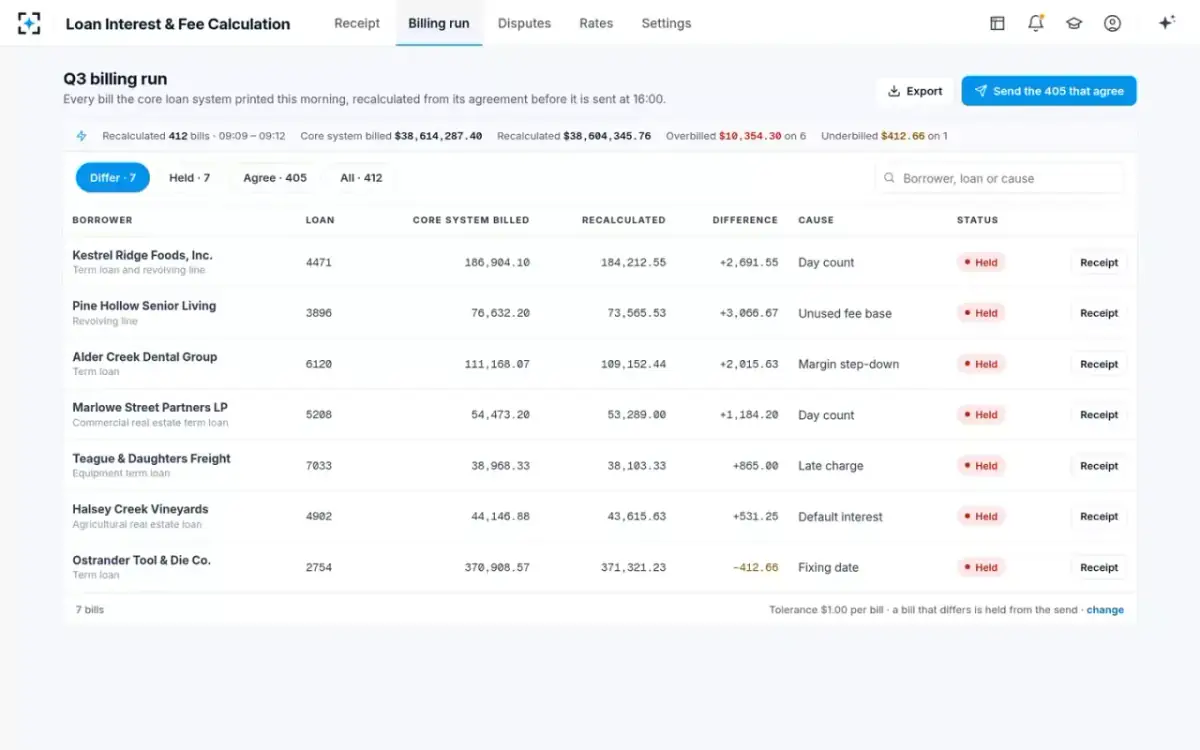
In the sample bank the quarterly run prints 412 bills at nine in the morning and they are due to go out at four. Between those two moments the run passes through four seats, each of which can stop it.
One billing run, four seats
Today
Starts the run, takes whatever the core system printed, and spends the quarter rebuilding individual bills in a spreadsheet whenever one is questioned.
With agents
Starts with every bill in the run already recalculated from its own agreement, and a short list of the ones that differ, each with a named cause.
Still theirs: Owning the run and the send window, and deciding what gets held
Today
Signs bills there is no time to check, and finds out about the wrong ones from the borrower’s controller.
With agents
Opens each held bill with the clause, the fixing and the arithmetic already on the page, and decides whether to correct, credit or release it.
Still theirs: The decision, and signing credits up to the limit
Today
Rebuilds a participant’s share by hand when a participant bank says it was shorted, hunting for the day the share changed.
With agents
Gets the claim checked day by day from the recorded effective date of the assignment, with the arithmetic attached.
Still theirs: The relationship with the participant banks, and the remittance
Today
Asked to co-sign credits with no way to see the clause, the rate and the arithmetic behind them in the time available.
With agents
Co-signs with all three on the page, and approves a set-up change knowing which other loans carry the same mistake.
Still theirs: Co-signature above the officer’s limit, and approval of set-up changes
The honest claim about agents and this desk is the narrow one. They do not remove a seat. They remove the reconstruction work that fills the gap between seats — the half-day of spreadsheet building that has to happen before the officer can decide anything at all.
What does a commercial loan servicing specialist do all day?
Outside billing weeks, the day is set-up and maintenance: boarding new facilities from signed agreements, processing draws and repayments, applying rate resets as fixings publish, posting payments, chasing compliance certificates and handling payoff quotes. In billing weeks it is the run, the exceptions and the send window. Across both, the task that swallows the most time per item is the disputed bill.
Where about eight hours go on one disputed commercial bill, rebuilt by hand
One disputed bill · about 8 hours end to end
- Finding the agreement, amendments and pricing terms · 18.8%
- Looking up the fixings for every reset · 12.5%
- Rebuilding draws, repayments and letters of credit · 18.8%
- Rebuilding every accrual period in a spreadsheet · 31.3%
- Finding the term that caused the difference · 12.5%
- Writing the answer or the correction · 6.3%
Read the bars from the right. The task that produces the answer, writing it, is the smallest slice. Everything to its left is reconstruction: finding documents, finding rates, finding transactions, rebuilding arithmetic somebody's system already did once. That is the shape of work a desk should want to automate, and it is also the shape of work that is easiest to get wrong by hand at half past four on a Thursday.
The morning queue: 412 bills recalculated, seven held
The billing analyst: the run, the exceptions, the send window
The analyst owns the clock. A quarterly run has a send window — in the sample bank, four in the afternoon — and everything else is organised around it: what has to be checked before then, what can be held back, and who has to be found to sign.
The hardest part of the seat is not arithmetic, it is triage. Without a recalculation there is no principled way to choose which of 412 bills to look at, so desks fall back on proxies: the largest balances, the most recently converted loans, the borrowers who complained last time. Those proxies find some errors and systematically miss the small persistent ones — a fee base slightly wrong, a day count wrong by two days a month — which are precisely the errors that have been running longest.
The agency services associate: the seat nobody writes about
When a bank sells participations in a loan or acts for a syndicate, somebody has to divide every payment among the holders in proportion to what each held on each day, and to re-divide it when a participation is assigned mid-period. That is the agency services seat, and its disputes are the most arithmetic-heavy on the desk because they turn on effective dates rather than on documents.
In the sample book a participant claimed $1,030.15 after an assignment. Rebuilt by day from the recorded effective date — fourteen days at the old 20% share, sixteen at the new 22.5% after the 15 September assignment — the right answer was $549.41. The claim was not fabricated; it was computed on the new share for the whole period, which is a common participant error and a hard one to argue about without the daily arithmetic in front of both parties.
The run, seat by seat, with the two signatures at the end
Agent
Read the agreementPulls every pricing and fee term from the credit agreement and its amendments in date order, each with its clause.
Never: fills in a term the documents do not state
Agent
Collect the fixingsWorks out each fixing date the agreement defines and takes the published rate for it, then tests the floor.
Never: estimates or interpolates a rate
Agent
Read the transactionsTakes draws, repayments, amortization, letters of credit and payments from the loan’s own history.
Never: uses the system’s billed interest as an input
Agent
Rebuild every periodSplits the period wherever the balance or the rate changes and recalculates each accrual period, rounded as the agreement says.
Agent
Explain the differenceFinds the term whose set-up differs and replays it to confirm the printed bill is reproduced to the cent.
Never: closes a difference it cannot reproduce
A person decides
The servicing officer decidesReads the held bill with its clause and arithmetic, and corrects, credits or releases it. Signs credits up to the limit.
A person decides
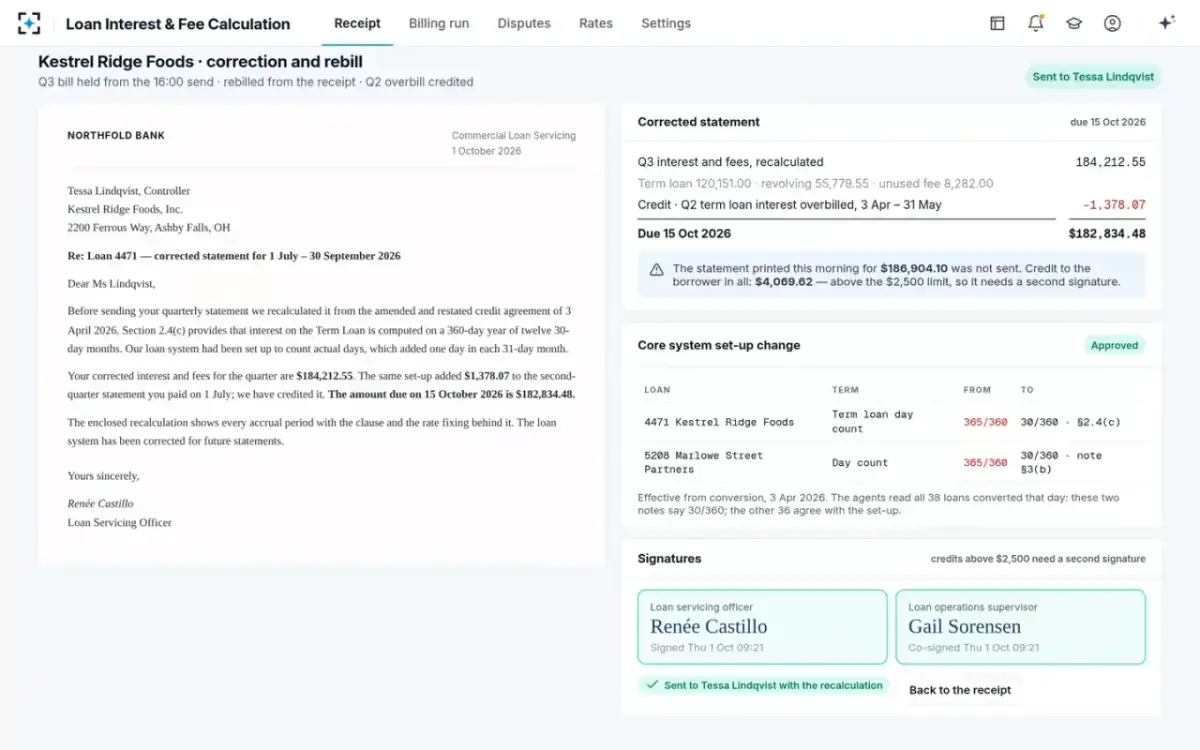
The supervisor co-signsCo-signs credits above the officer’s limit and approves any change to the core system’s set-up before loan operations applies it.
The supervisor's seat: signing limits and set-up changes
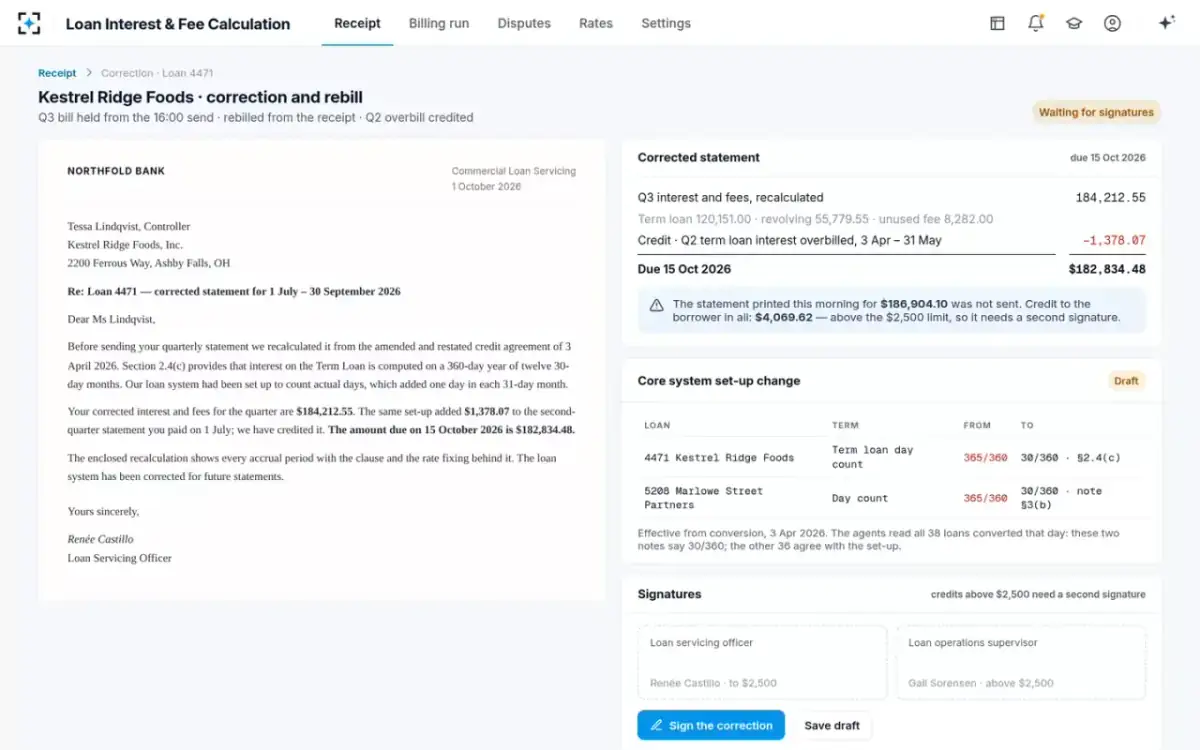
A supervisor's authority on a commercial servicing desk is usually two specific powers: co-signing credits above the officer's limit, and approving changes to how a loan is set up in the core system. The second is the one with portfolio consequences. A day-count field changed on one loan fixes one borrower's bill; the same field is wrong on every loan boarded by the same process on the same day, which is why the sample set-up change covered two loans and why all thirty-eight notes converted that day were read before it was proposed.
Supervisors are also the last line of a simple control: a correction is drafted, not sent. In the sample solution a $4,069.62 credit crossed a $2,500 officer limit and therefore needed a second signature, and the set-up change went up with it rather than separately — so the person approving the money and the person approving the cause were the same person, looking at the same evidence.
Signed, co-signed, and only then sent
What examiners ask about this desk — and why it is a separation-of-duties question
Examination procedures for commercial loans go at this desk from the control side. The internal control questionnaire asks, in terms, whether “the subsidiary commercial loan records reconciled daily with the appropriate general ledger accounts, and are reconciling items investigated by persons who do not also handle cash?” (OCC, Comptroller's Handbook, Commercial Loans). The point is not the reconciliation; it is the “persons who do not also”.
The general principle sits in the internal control booklet, which lists among a bank's control activities “Independent checks on whether jobs are getting done and recorded amounts are accurate”, with examples including “account reconciliation, computer-programmed controls, management review of reports that summarize account balances, and user review of computer-generated reports” (OCC, Comptroller's Handbook, Internal Control). A computed check belongs in that list — but only if it is genuinely independent of the thing it is checking.
That is the design constraint behind the whole approach on this desk. A recalculation that took the core system's billed interest as an input would be a reconciliation of a number with itself. Rebuilding from the signed agreement, the published fixings and the transaction history keeps the check independent, which is what makes it worth anything to an examiner — and the same logic is why a cause is only named once replaying the system's own set-up reproduces the printed bill exactly.
What each seat decides, what it may never decide, and who signs with it
| Seat | Decides | May never decide | Signs with |
|---|---|---|---|
| Billing analyst | What is held from the send, and the order the exceptions are worked | Whether a bill is right; whether a credit is due | Nobody — holds are operational |
| Loan servicing officer | Correct, credit or release; the wording of the answer to the borrower | A credit above the officer’s limit; a change to the core system’s set-up | The supervisor, above the limit |
| Agency services associate | The participant share for each day, and what is remitted | Whether the underlying bill was right | The officer, on any adjustment to a borrower |
| Loan operations supervisor | Credits above the officer’s limit; approval of set-up changes | The arithmetic — a conclusion still has to be reproduced, not asserted | The officer, who signs first |
Headcount, and where the servicing work is going
The published occupation that comes closest to this seat is loan interviewers and clerks, with 169,100 people employed in 2025 and projected employment declining through 2035 at −1% or lower (O*NET, 43-4131.00). The occupation is broad, covering consumer loan interviewing and clerical processing as well as commercial servicing, so the commercial billing desk is a fraction of it — but the direction is the direction, and O*NET's 10,500 projected openings for 2025–2035 on a declining base, which it counts from growth and replacement together, describe a replacement-driven market.
For comparison, loan officers — 283,000 people — are projected to grow slower than average at 1% to 2% (O*NET, 13-2072.00). The two numbers together describe a familiar pattern: the seat that decides is holding, and the seat that reconstructs is shrinking. That has implications for how a desk should be staffed, and for what it should train for.
The defensible skills are the ones that survive the reconstruction work going away: reading a credit agreement and finding the clause that governs a number, knowing which conventions are market defaults and which are deal terms, understanding participations and effective dates, and writing an answer to a borrower that concedes what is conceded and holds what is held. None of those is clerical, and all of them are harder to learn when the quarter is spent in a spreadsheet.
What changes when the arithmetic is rebuilt before the send
The clearest change is in the order of the conversation. Today, a wrong bill is usually found by the borrower's controller, which means the bank's first position is defensive and its first act is reconstruction under time pressure. When every bill in the run has been rebuilt from its own agreement before four o'clock, the wrong ones are found by the bank, and the first contact with the borrower is a correction rather than a reply.
The second change is what a dispute costs. The eight hours above become about a quarter of an hour, and almost all of what remains is the officer reading and deciding. The third is less obvious and probably the most valuable: underbills surface. A difference that favours the borrower never generates a complaint, so a desk that only investigates what borrowers query will never see it — and in the sample run one of the seven held bills was $412.66 too low.
The correction, the credit and the proposed set-up change, drafted together
None of that changes who is accountable. The officer still decides; the supervisor still co-signs; the associate still owns the participants. What changes is that the quarter stops being spent rebuilding arithmetic and starts being spent on the decisions the seats exist for. The mechanics behind those decisions are worked through in detail elsewhere in this series — the day count and what it costs, the four terms that set a floating rate, the fee base and the day a default rate starts. To see the whole run, start from Loan Interest & Fee Calculation.
Questions people ask
What is the difference between a loan servicing specialist and a loan officer?
Phase and accountability. A loan officer originates: sources the borrower, structures and prices the credit, and takes it through approval and closing. A servicing specialist takes it from closing to payoff — set-up, draws, resets, billing, corrections and payoff.
What does an agency services associate do?
Divides money among the holders of a loan. When a bank sells participations or acts for a syndicate, every payment has to be split in proportion to what each institution held on each day, and re-split when a participation is assigned mid-period. The arithmetic turns on recorded effective dates: in the sample book a claim for $1,030.15 came to $549.41 once the fourteen days at the old share and the sixteen at the new one were worked out separately.
Is commercial loan servicing headcount shrinking?
The clerical part of it is not. O*NET projects employment in the loan interviewer and clerk occupation to decline through 2035, at −1% or lower, with 10,500 projected openings for the period, which on a shrinking base can only come from replacing people who leave. The judgement part — reading agreements, deciding corrections, handling participants and examiners — is what remains, and it is where a desk's value is heading.
Who signs a correction to a commercial loan bill?
The servicing officer, within a signing limit set by the bank, and a supervisor above it. The sample bank sets the officer's limit at $2,500 and sends anything larger to the loan operations supervisor, who also approves any change to how the loan is set up in the core system. The important part is not the figure; it is that the signature belongs to a person and the evidence is in front of them when they give it.
What should a commercial servicing desk train for?
Reading a credit agreement well enough to find the clause behind a number; knowing which conventions are market defaults and which are deal-specific terms; understanding participations, assignments and effective dates; being precise about dates generally, because many billing errors are date errors; and writing clearly to a borrower who is annoyed. Spreadsheet work is useful and is the part of the job most likely to be automated.