A regulatory labelling and artwork specialist is the person who makes sure that what a medicine's carton, label and leaflet actually say matches the text a regulator approved, in every market and every language, before the printing plates are cut. It is hard because the approved words and the printed object are produced by different people on different clocks: regulatory affairs owns the text, a pre-press supplier draws the file, a printer books a slot weeks ahead, and one storage-condition change can touch dozens of packs at once. Botminds' Labeling & Artwork Proofreading is software for that work — six specialist agents read every panel of each artwork, compare every character with the approved text for that market and language, check the Data Matrix, the Braille and the type size, and draft a cited proof report that a named labelling lead signs.
The job title is one seat; the work is five. This guide walks each of them, names which signature carries legal weight and which is a company's own control, and shows the one place a rule anywhere actually says two people. The worked examples come from a fictional sample company — Veltara Therapeutics and its product Ostravel 20 mg — as it runs through the solution; the people, suppliers and printers named in it are invented. The regulations and the recall counts are real and linked where they appear.
Three clocks a labelling and artwork seat runs against
135
US drug recall events in six years whose stated reason began "Labeling:"
FDA enforcement data, 2020–2025, counted by us
90days
for the European Medicines Agency to accept or refuse a labelling and leaflet notification
6months
for approved new packaging components to reach packed stock certified for release, in the UK
What does a regulatory labelling and artwork specialist do?
The specialist turns an approved text into a correct printed pack and proves it. In practice the day divides into four things: finding every artwork a text change touches, briefing the change to whoever draws the file, reading the returned proof against the approved text panel by panel, and recording the result so that someone can sign it and the pack can be released to a printer. The title varies — labelling and artwork specialist, artwork coordinator, packaging artwork officer, labelling manager — and so does the split, which is why two people with the same job title at two companies often own quite different work.
What does not vary is the inventory. Each pack carries the particulars Article 54 of Directive 2001/83/EC lists, the leaflet carries its own, and in a European market the carton also carries a two-dimensional code, the product name in Braille, and whatever a single member state requires in its own boxed area. All of it has to be right at once, and all of it has to be right in every language on the pack.
The rule that sits closest to the work is a quiet one. The European Commission's readability guideline opens its labelling chapter by saying that "those involved in the design of labelling should consider the following sections prior to submission to the competent authority" — an instruction addressed to whoever is involved, without naming a role. No European or US rule names a labelling and artwork specialist, describes the seat, or says how many people should look at a carton. The company decides, and the decision is usually invisible until something prints wrong.
What is the difference between labelling and artwork?
Labelling is the text; artwork is the object the text is printed on. The distinction is not pedantry — it is the reason a company needs the seat at all. Labelling in the European sense is the particulars that must appear on the outer and immediate packaging, approved as part of the marketing authorisation and held as Annex IIIA to the decision. Artwork is the print-ready file: a flat die line with panels, bleed, varnish-free zones, a code area, Braille dots, a colour build and a version number. One is a regulatory asset; the other is a manufacturing asset.
The regulators have a word for the thing in between. The Commission's packaging-information guideline defines a mock-up as "a copy of the flat artwork design in full colour, presented so that, following cutting and folding where necessary, it provides a replica of both the outer and immediate packaging so that the three dimensional presentation of the labelling text is clear", and a specimen as "a sample of the actual printed out outer and immediate packaging materials and package leaflet". A mock-up is reviewed as part of an application; the Agency "will perform a general check of mock-ups and specimens from the viewpoint of readability in order to contribute to the safe use of medicines (e.g. lay-out and design, font-sizes, differentiation between strengths, etc)".
That sentence is worth reading twice, because it describes the limit of the regulator's check. It is a readability check on a representative pack at authorisation — not a proofread of every carton, every pack size and every language, at every version, for the life of the product. Everything after that is the company's own work, and the company's own evidence.
The five seats between an approved text and a printed pack
Five things have to be right about a pack, and in most companies five different people hold them: the words, the layout, the codes, the market extras, and the release. They do not map onto one job description, and they rarely sit in one department.
The five seats, what each owns, and what no agent takes from them
Today
Files the variation, publishes the approved text per market and language, then answers questions from the artwork chain by email for weeks.
With agents
Publishes the approved text once, versioned, with the variation it came from; every proof afterwards names the version it was checked against.
Still theirs: The approved words, and the decision to accept any deviation from them
Today
Briefs each change by hand, tracks which supplier has which version in a spreadsheet, and chases the print slot.
With agents
Sees every artwork a change touches, with its status and what is still awaited, and is copied on each return with the difference already marked.
Still theirs: The brief, the supplier relationship and the print booking
Today
Draws the file from a brief, returns a proof, and finds out what was wrong from an email thread.
With agents
Receives a return that names the panel, the approved wording and the version, so the next file is drawn once.
Still theirs: The file itself — the artwork is theirs, and nothing on our side edits it
Today
Reads every panel against the approved text, twice, aloud, against the clock.
With agents
Reads what the comparison flagged, decides what it means, and spends the hour on judgement rather than on characters.
Still theirs: The verdict on every difference, and the signature on the proof
Today
Certifies the batch, relying on the packaging records in front of them and on everyone upstream having read carefully.
With agents
Certifies against a signed proof report that names the approved text version, the checks and the person who approved them.
Still theirs: Certification of the batch for release — delegated to nobody and nothing
Read down that list and the asymmetry is obvious. Four of the five seats hold something a company invented: who briefs, who draws, who reads, who coordinates. One holds something written into law. That is why the same error finds the same crack in company after company — the crack is in the part nobody was told to design.
Who writes the approved labelling text, and why nothing starts without it
Regulatory affairs writes it, and in Europe a change to it is a filing in its own right. In the Agency's own definition, a 61(3) notification covers a change to the labelling or package leaflet text that has no connection with the summary of product characteristics, and it is valid only where the change affects the annexes alone and where the English text changes with consequential amendments to every other language version. The Agency's examples of what falls inside the scope include a change of abbreviation for the batch number, harmonised leaflet wording, the introduction of a QR code, and — relevant to artwork more often than teams expect — adding, removing or changing the Braille.
Then the clock. "Upon submission, the Agency will inform the marketing authorisation holder (MAH) within 90 days whether the proposed changes are accepted or not." Ninety days is the regulatory clock; it is not the artwork clock, and the two are usually run by people who do not share a calendar. The artwork clock starts the day the text is approved and ends at the printer's slot, and it is almost always the shorter of the two.
This is the practical reason an artwork chain must be anchored on a version, not on an email. If a proof cannot name the approved text version it was checked against, nobody can say afterwards what it was checked against — not the labelling lead, not quality, not an inspector. In the solution that anchoring is a rule rather than a habit: the change wave planner will not open a proof without the approved text version it is to be checked against, and the proof report carries that version on its face.
The coordinator's job: briefs, versions and the print slot
The artwork coordinator owns the part of the work that has no regulation and all of the deadlines. A single approved-text change fans out into every carton, label and leaflet that carries the changed statement, by market, by language and by pack size; each one needs a brief, a version, a proof, sometimes a return, and a place in a printer's schedule. In the fictional sample company one tightened storage condition becomes 64 artworks across 22 countries and 18 languages, with every printer needing final files inside five weeks.
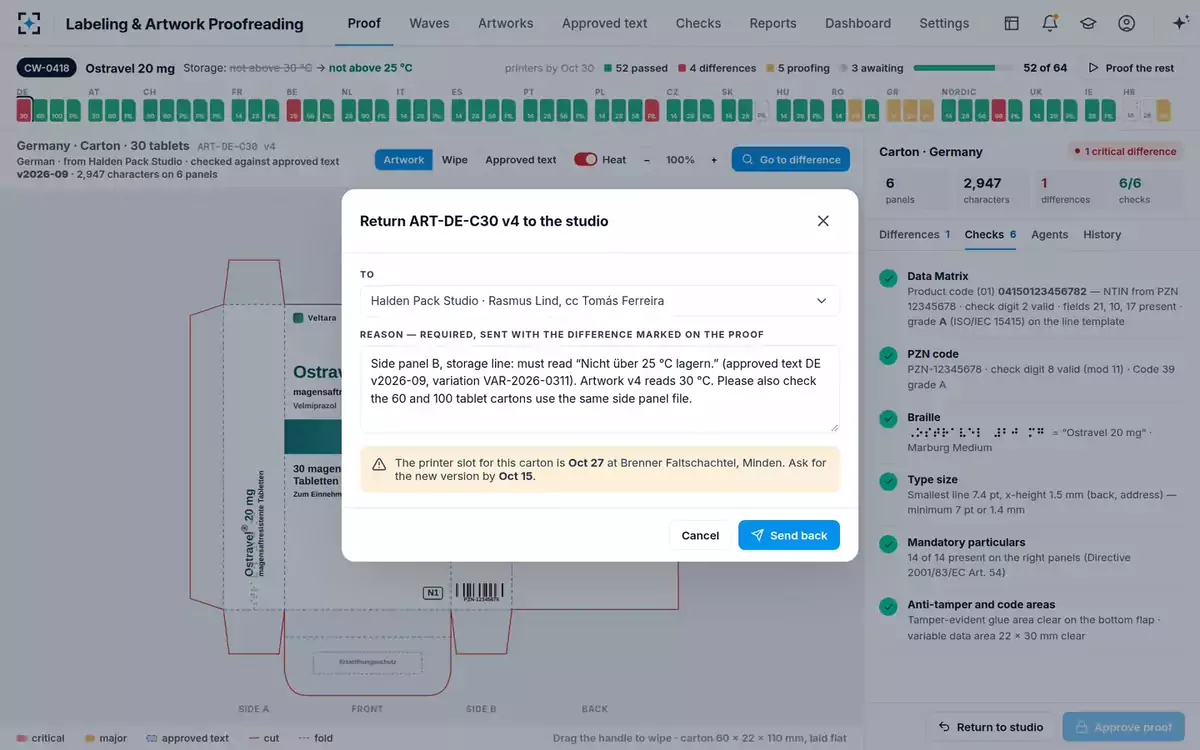
Two failure modes live here, and neither is a reading error. The first is a missed sibling: the change is applied to the 30-tablet carton and the leaflet, and the 60- and 100-tablet cartons share a side-panel file that nobody opened. The second is the return that loses its reason — a proof goes back with "storage wrong on side B", the supplier fixes one panel, and the second version comes back with the same problem somewhere else because the brief never said which file was shared.
Good practice for the second is unglamorous and specific: write the panel, the approved wording, the approved text version and the variation into the return itself, and ask explicitly about the files you suspect are shared. In the solution the reason field is required and pre-filled with exactly those four things, which is less a feature than a refusal to let a return leave without them.
One artwork from approved text to printer, marked by who does each step
A person decides
Regulatory affairs publishes the approved textThe variation is approved; the text is published per market and language, with a version number and the variation it came from.
Agent
Find every artwork the change touchesGroups every carton, label and leaflet that carries the changed statement by market, language and pack, with each printer's deadline.
Never: Never opens a proof without the approved text version it is checked against, and never approves one
A person decides
The coordinator briefs the artwork houseSends the change, the affected components and the date the new version is needed to meet the print slot.
Agent
Read the print-ready file, panel by panelReads live and outlined text on every panel in reading order, with font, size and position for every line.
Never: Never edits the artwork file; unreadable text goes to a person
Agent
Compare every character with the approved textReports every inserted, deleted or changed character, grades it by the company's severity rules, and cites the version, the panel and the line.
Never: Never dismisses a difference, and ignores nothing beyond the ignore list
A person decides
The labelling lead decides and returns or approvesReads each difference, returns the artwork with the reason written, or approves and signs the proof with its meaning.
A person decides
The Qualified Person certifies the batchCertifies the packed batch for release to market, with the signed proof report among the records behind it.
The proofreader's hour, and the one rule that names a second person
Somebody has to read the pack. In most labelling teams that means a first reader, a read-aloud with a second person, and a signature — a routine learned from whoever held the seat before, written into a standard operating procedure, and defended at audit on the grounds that it is what careful companies do.
There is one place in the rules where a second person is actually required, and it is narrower than the folklore. Under 21 CFR 211.122(g), a company using cut labelling for immediate container labels or unit cartons must apply one of four special control procedures: dedicating the labelling and packaging lines to each strength of each product; electronic or electromechanical 100% examination; visual 100% examination of hand-applied labelling, which the rule requires one person to perform and a second to verify independently; or an automated technique that physically prevents incorrect labelling from being processed. The second person belongs to the third option, applies on the packaging line rather than at the proofreading desk, and is explicitly an alternative to doing the job by machine.
Two consequences follow for the seat. First, a company that reads a print-ready file twice by eye is not satisfying that rule — it is doing something the rule does not reach, as a control of its own. Second, because it is the company's own control, the company owns the evidence for it, and what two readers actually catch, and what they miss, is a measurable question rather than a matter of principle.
The other rule that bites here is about the paper itself rather than the reading. European good manufacturing practice says that "particular attention should be paid to printed materials. They should be stored in adequately secure conditions such as to exclude unauthorised access. Cut labels and other loose printed materials should be stored and transported in separate closed containers so as to avoid mix-ups". The proofreading seat and the storeroom are solving one problem — the wrong words reaching the right product — from opposite ends.
Does the Qualified Person check artwork?
No — the Qualified Person certifies the batch, and the artwork reaches them as a record rather than as a proof to read. The QP's job is to certify that a batch has been manufactured and checked in accordance with the authorisation and good manufacturing practice, which includes satisfying themselves that the packaging records are complete and correct. Nobody expects a QP to compare 2,947 characters against an approved text; they expect the proof to have been done, documented and signed by someone competent.
Where the QP's own obligation touches artwork directly is on timing. The MHRA's guidance is unusually blunt about it: once new packaging components have been approved, "these must be introduced into packed stock being certified for release to the market by the Qualified Person within six months, unless MAHs have been advised of the need for earlier introduction of the new components for safety reasons", and "the Qualified Person should not certify a medicinal product for release to the market if the packaging components, at the time of certification, have not been updated within six months of approval."
Read that against the artwork clock and the seat's real problem appears. An approved text change gives the company roughly six months to get the new component into certified stock — which has to absorb the brief, the drawing, the proof, any return, the plates, the print run and the packing. A chain in which each proof takes two working days, and a meaningful share of them come back twice, does not have six months of slack; it has weeks — and nobody can say which share, because almost nobody measures it. The six-month rule is the reason a slow proofreading step eventually becomes a release problem, and what each returned carton costs, in hours and in the clocks it eats, is the same arithmetic from the coordinator's side.
What each signature means, and what it does not
Signatures on an artwork chain carry very different weight, and conflating them is an easy governance error to make. Of the five below, three are a company's own controls, one rests on good manufacturing practice's on-line control during packaging, and one is a legal act. All five should say what they mean on their face, because a signature whose meaning is implied is a signature nobody can defend two years later.
Five signatures on one pack, and what each one actually asserts
| What is signed | Who signs it | What the signature asserts | Where it comes from |
|---|---|---|---|
| The approved text version | Regulatory affairs | These are the approved words for this market and language, and this is the variation they came from. | The company's own control, anchored on the filing |
| The proof of one artwork version | The labelling lead | This artwork matches its approved text and may go to the printer. | The company's own control — no rule requires it or describes it |
| An accepted deviation | Regulatory affairs | This difference from the approved text is accepted, for this stated reason. | The company's own control; the reason is the whole artifact |
| The printed proof at the press check | Packaging quality | What the press is producing matches the approved artwork version. | Good manufacturing practice: on-line control during packaging |
| Certification of the packed batch | The Qualified Person | This batch was made and checked in accordance with the authorisation and good manufacturing practice. | A legal act under EU law, personal to the QP |
Notice what the proof signature does not assert. It does not say the approved text is right — that is the first signature. It does not say the printed carton will match the file — that is the press check. And it does not certify anything for release — that is the QP. A labelling lead who signs a proof is saying one narrow thing precisely, which is what makes the signature worth having.
The proof the labelling lead signs, with the whole change beside it
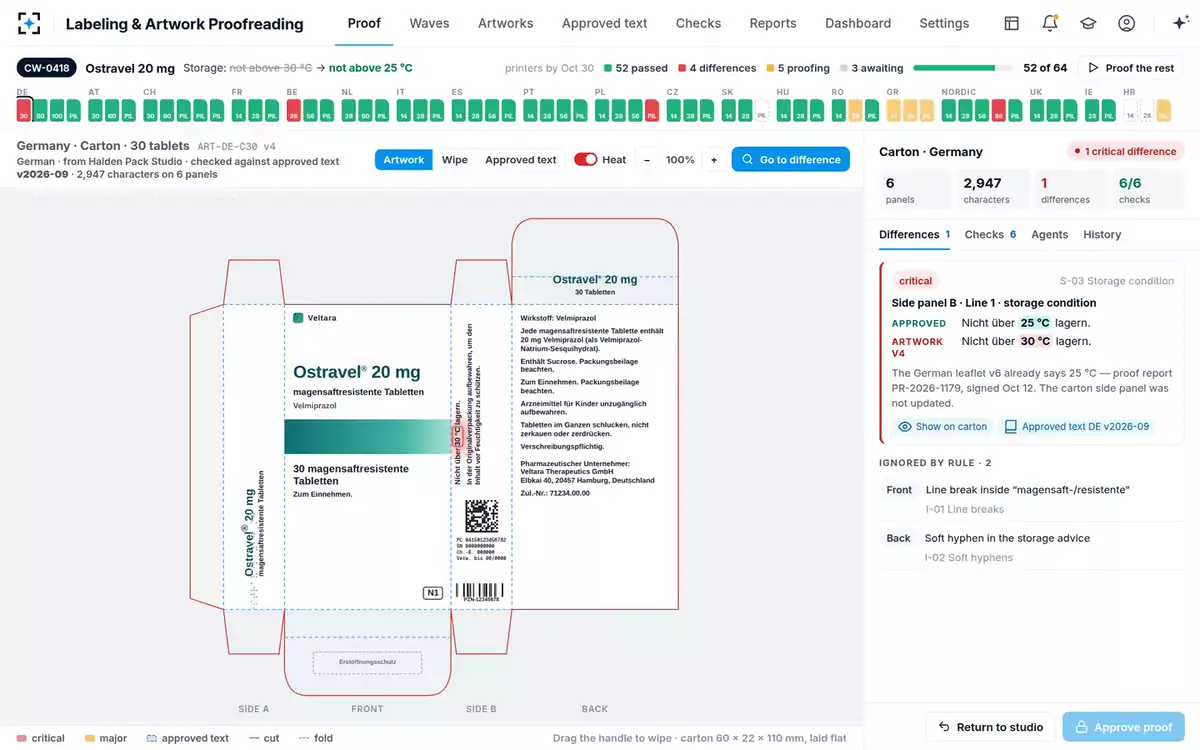
What changes when agents read every panel first
The honest claim is narrow: nothing on this list moves a decision. What moves is the reading. Six agents find every artwork a text change touches, read every panel of the print-ready file in reading order, compare every character with the approved text, decode the code and the Braille, measure the type size, and draft a report that cites its sources. Then a person reads what was found and decides.
That re-division changes the shape of the proofreader's hour rather than its existence. In the fictional sample company's own estimate of a hand proof, about four of roughly sixteen hours go to the second reader and the read-aloud; the solution's design target puts half an hour there, and the hours that remain are spent on differences that need a judgement — whether a shrunken translation is acceptable, whether a punctuation change is worth a new version, whether a deviation should be accepted and by whom. Those are the parts of the work that were always underserved, because the character-by-character reading ate the day.
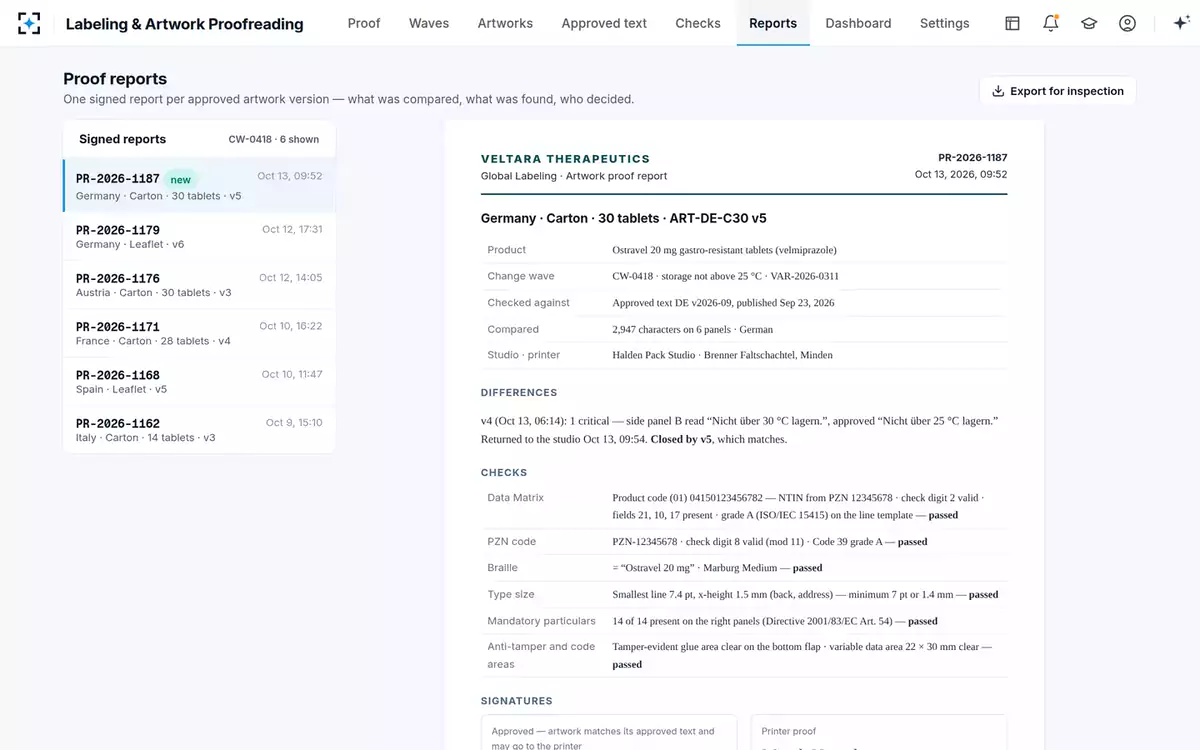
It also changes what the chain can prove. A proof report that names the approved text version, the artwork version, the panel and line of every difference and the result of every check is evidence; a signed checklist saying "proofread by two readers" is an assertion. The first can be re-read by an auditor two years later and still mean something.
A return that cannot leave without a reason
Five questions that find the seat nobody in your company holds
- Who can name the approved text version every live artwork was checked against?
If the answer is "it is in the email thread", the chain has no anchor. Ask for one product, one market, one pack size, in writing.
- When a text change lands, who lists every pack size and language it touches?
Shared side-panel files between pack sizes are the most common missed sibling. Name the person, not the spreadsheet.
- What does the proof signature in your procedure say it means?
If it says "approved" and nothing more, two people can reasonably read it two ways at an inspection.
- Who may accept a difference from the approved text, and in what document?
A deviation accepted in a meeting is a deviation nobody signed. It belongs to regulatory affairs, with a written reason.
- How many hours sit between a new approved text and a printer's final file, at your worst market?
Compare it with the six months the Qualified Person has to get new components into certified stock, and with how often a proof comes back twice.
- What is your own measured rate of differences found at the press check rather than on the file?
A company that cannot answer this cannot tell whether its proofreading step is working, let alone judge anything that replaces it.
The proof report as the record the next person reads
The seat, then, is not a proofreading seat. It is the seat that holds a chain together between two departments that do not share a clock, and the reading was only ever the part of it that could be measured in hours. For the rest of the inventory a carton has to be right about, start with what the Data Matrix carries and how it is checked, or with Labeling & Artwork Proofreading itself.
Questions people ask
Who is legally responsible for the accuracy of a medicine's labelling?
The marketing authorisation holder. Labelling and the package leaflet form part of the authorisation, so the holder is answerable for the text appearing as approved, and for notifying changes to it — in Europe, through a 61(3) notification where the change touches only the labelling and leaflet. Within the company, that responsibility is normally discharged by regulatory affairs for the words and by the Qualified Person for what is certified and released.
Does the Qualified Person have to approve artwork?
No rule asks a QP to proofread artwork. The QP certifies the packed batch, and the packaging records behind that certification should show the artwork version used and that its proof was done and signed. The MHRA's guidance does give the QP a direct artwork obligation on timing: a product should not be certified for release if its packaging components have not been updated within six months of the Agency approving new ones.
How many people should check a carton before it goes to print?
No regulation sets a number for a print-ready file. The only place a second person appears is 21 CFR 211.122(g)(3), which covers visual 100% examination of hand-applied cut labelling on the packaging line, and names it as one of four alternative control procedures. Everything a company does at the proofreading desk is its own control, which means the useful question is not how many readers but what the readers demonstrably catch.
What is the difference between a labelling specialist and an artwork coordinator?
Usually the text against the object. A labelling specialist works on the approved particulars, their translations and the filings that change them; an artwork coordinator works on the files, the suppliers, the versions and the print slots. Many companies combine them in one role, and the combination is where the seat tends to be over-loaded: regulatory judgement and production scheduling have very different rhythms.
What skills does a labelling and artwork job need?
Four, in rough order of how hard they are to hire for: reading precisely under a deadline, including in languages you do not speak, by comparing against a source rather than against sense; knowing which rules are rules and which are guidance, so a difference can be graded rather than argued; enough production literacy to read a die line, a code area and a Braille brief; and the nerve to hold a release while a difference is open. The first is the one most often treated as a personality trait rather than as a process that can be designed.
Is an artwork house or a pre-press supplier allowed to approve the proof?
It should not be. The supplier draws the file and has every reason to believe it matches the brief it was given; approval is an assertion about the approved text, which the supplier does not own. Keeping the two apart is why a proof chain works at all: the party that produced the artwork and the party that accepts it against its source should not be the same party.