Pharma labeling and artwork proofreading, explained.
Every word on a medicine's box and leaflet was approved by a regulator. Artwork proofreading is the check that the file going to the printer says exactly those words, in that country's language, with the right digits, Braille, barcode and type size. A single wrong digit reaches every pack in the print run, and the same check has to be repeated on every affected pack each time the approved text changes.
This guide is for anyone who proofs, approves, prints or pays for pharmaceutical packaging: labeling leads, artwork coordinators, regulatory affairs managers, packaging quality reviewers, and leaders deciding whether to automate the check. No background needed.
Imagine you are the global labeling lead at Veltara Therapeutics, a mid-sized European drug maker. New stability test results have tightened the storage line on Ostravel 20 mg gastro-resistant tablets: from not above 30 °C to not above 25 °C. The change was approved on September 22, 2026. It reaches 64 artworks, the print files for 43 cartons and 21 leaflets, in 22 countries and 18 languages, and the printers need final files by October 30.
It is Tuesday, October 13. 52 artworks have passed. You open the German 30-tablet carton, version 4: 2,947 characters on six panels. The German leaflet was corrected and signed yesterday. On side panel B of the carton, one line still reads like this.
Approved text · German, v2026-09
Where
Side panel B, line 1
Statement
Storage condition
Wording
Nicht über 25 °C lagern.
Carton artwork · v4
Where
Side panel B, line 1
Statement
Storage condition
Wording
Nicht über 30 °C lagern.
30 °C on the carton25 °C approvedone number in 2,947 characters, in a sentence that reads perfectly well.
Everything else on that carton is right: the square Data Matrix code, the Braille, the smallest type at 7.4 points. A reader checking whether the storage line is there would find it there. Three other artworks in the same rollout fail for reasons nobody was looking for: a missing Braille number sign, a line shrunk to 6.5 points, and a leaflet date left at 03/2025.
Careful proofreading catches the one wrong number before the printing plates are made, when fixing it costs a new file and a new proof.
Proofing a medicine's carton and leaflet: the five layers, the rules, the checks and the evidence
What the work is, which rules apply, how each check is done with real arithmetic, what public data shows when it fails, and how teams run it today, explained without selling anything. If you are new to pharmaceutical packaging, start here.
01 · In plain words
Artwork proofreading explained: one approved text, a flat carton and a very small margin for error
Before a medicine can be sold, a regulator approves what its packaging says: the name, the strength, how to take it, how to store it, the warnings. That approved wording is called the labeling. It lives in a regulatory document, written by the company's regulatory affairs team, in each language of each market.
The box itself starts as a computer file. A designer at an artwork house lays the approved words onto a flat shape with side panels, flaps and fold lines, adds the barcode, the Braille dots and the logo, and exports a print-ready PDF. That file is the artwork. The text and the artwork come from different teams working to different schedules, so a person has to prove that they say the same thing.
That proof is artwork proofreading. Traditionally one person reads the approved text aloud while another follows the carton with a finger, then they swap, and someone signs. A carton in the worked example of this guide carries 2,947 characters across six panels. A two-page leaflet in the same example carries about 25,000. Many readers are checking languages they do not speak, which is why they compare shapes of letters instead of reading for sense.
Then the approved text changes. A tighter storage temperature, a new company address or a new pack size has to reach every carton, label and leaflet that carries it, in every country, before each printer's booked slot. The hard part is finding all 64, proofing each one, and showing an inspector two years later what each proof was checked against.
One storage change, from a filed variation to a pack on the shelf
Regulatory affairs gets the change approvedSeptember 22: the regulator approves a variation, the formal filing that changes a medicine's license. New stability data tightens storage from 30 °C to 25 °C. The approved text is published in 18 languages the next day.
The change is traced to every artworkSomeone lists every carton and leaflet carrying the line. In the example, 64 artworks in 22 countries.
The artwork house redraws the filesNew versions come back one by one, some of them with new errors the change itself caused.
Each artwork is proofed against its approved textEvery character, plus the Braille, barcode and type size. This is where 30 °C on one side panel is caught, or printed.
The printer runs, and packaging quality signs the press proofA press proof is the printer's sample from the real press. First batches with the new text follow on December 1. Old stock has to be destroyed and the destruction recorded.
Step 4 is the subject of this guide. The company, product and figures in this example are fictional.
Why a printed carton can pass every line check and still be wrong, and three more surprises
A line check can pass a wrong carton
Examination on the packaging line confirms that labels match what the batch record, the production file for one run, specifies.1,2 If the approved file itself carries last version's storage line, every pack matches and every pack is wrong. The desk proof is the step that compares the file with the regulator's words.
The famous two-reader rule is about something else
The one place US regulation names a second person is the visual examination of hand-applied labels on a packaging line.1 No rule we found sets how many people read a print-ready file. That number is your own control, and you own the evidence for it.
Reading aloud reaches only part of a pack
It reaches printed words in a language the readers can pronounce. It does not reach Braille dots, what a Data Matrix (a square 2D code) encodes, or how tall the letters are, and those are where several expensive errors sit.
Labeling's share of recalls depends on who counts
Published shares run from 14.9% to 19%, on other samples and definitions.3,4 We counted FDA's own enforcement data for report dates 2020 to 2025: labeling is 7% to 9% of recall events by the wording of FDA's reason, and a raw word search reaches 13%.5 Section 8 shows the method.
Approved text, artwork, proof and change wave: the four words to learn first
Approved text
The labeling wording a regulator accepted, held per market and language, with a version and the filing it came from.
Artwork
The print-ready file for one carton, label or leaflet: a flat layout with panels, codes, Braille and a version number.
Proof
The check of one artwork version against its approved text, ending in a signature that says what it means.
Change wave
One approved-text change and every artwork it reaches, tracked together against the printers' dates.
What a pack has to get right: words, digits, Braille, codes and type size
In shortA carton is five checks stacked on one sheet: the words, the numbers inside the words, the Braille, the codes and the size of the type. Four methods are in use to prove it, and they differ most in which layers they reach and in what they leave behind for a reviewer. Comparing with the previous artwork answers a useful question, and a different one from comparing with the approved text.
People tend to think of proofreading as reading. On a pharmaceutical carton, reading covers one layer. The other four need a different tool each, and an error in any of them can stop a batch.
Layer 1
The words
Every statement on every panel, in the right order, on the right panel, in each language. On a multilingual pack "the same particulars" must appear in all the languages used.6
Layer 2
The digits inside the words
Strength, storage temperature, dose, pack count, dates. A number inside correct grammar reads as correct, which is why these are the characters most worth comparing one by one.
Layer 3
The Braille
The name, and the strength where there is more than one, in raised dots on European outer packs.7,8 Few of the people signing the proof can read it.
Layer 4
The codes
A Data Matrix carrying the pack's unique identifier in the EU, a linear barcode with the National Drug Code in the US, national codes such as Germany's pharmacy number, the PZN.9,10,11
Layer 5
The type size
Measured on each line, because a longer translation is usually absorbed by shrinking something. A correct sentence at 6.5 points is still a finding.7
Four ways to prove a carton, and which layers each one reaches
Only a dedicated check reaches Braille, codes and type size
What each method can settle on a print-ready file
Misses itPartlyReaches it
WordsDigitsBrailleCode contentsType sizeAn old errorTwo readers, read-aloudReaches itPartlyMisses itMisses itMisses itPartlyCompare with last versionPartlyPartlyPartlyPartlyMisses itMisses itCompare with approved textReaches itReaches itMisses itMisses itMisses itReaches itCompare, plus code, Braille and type checksReaches itReaches itReaches itReaches itReaches itReaches it
Our reading of the sources1,7,9,12 · "An old error" is a mistake already present in earlier versions. Our classification of what each method does; test it on your own carton.
Show the numbers
Words
Digits
Braille
Code contents
Type size
An old error
Two readers, read-aloud
Reaches it
Partly
Misses it
Misses it
Misses it
Partly
Compare with last version
Partly
Partly
Partly
Partly
Misses it
Misses it
Compare with approved text
Reaches it
Reaches it
Misses it
Misses it
Misses it
Reaches it
Compare, plus code, Braille and type checks
Reaches it
Reaches it
Reaches it
Reaches it
Reaches it
Reaches it
The first method, read-aloud proofreading, needs no software and is the only one of the first three that notices when a sentence makes no sense. It leaves behind a signature, with no record of what was compared. The second overlays version 5 on version 4 and shows what moved. It is fast and worth keeping, because a correction can push a line onto another panel. But the previous version has no authority: a storage line wrong in versions 3, 4 and 5 gives a clean result every time.
The third aligns the artwork's text with the approved text for that market and reports each inserted, deleted or changed character. The authority is now the right one, so an error inherited from version 1 appears on the first run.
Its weakness is what extraction can read: print-ready files often carry type converted to outlines (letter shapes with no text behind them), or a language block placed as an image. A tool that reads only live text can report a clean comparison on a panel it never read. The fourth adds the layers that are not text at all.
A proof says one narrow thing. Regulatory affairs' signature covers whether the approved text is right. The press check covers whether the printed carton matches the file. The Qualified Person in the EU and UK (the named expert who certifies each batch), or the quality unit in the US, covers release to the market. The proof covers whether this file says what that text says, and its value lies in saying exactly that.
03 · The rules and their dates
The labeling rules behind a proof, from 21 CFR 211.122 to the 2026 NDC rule and draft Annex 22
Status as of November 2026
In shortNo rule in the US or EU says how to proofread an artwork file. The rules govern what a pack must say, how printed materials are controlled and how signatures work, and the company designs the proof to meet them. Five moved in 2026, among them FDA's National Drug Code (NDC) rule and the labeling guidance from the UK regulator (MHRA). Annex 22, the draft EU good manufacturing practice (GMP) annex on AI, and the EU pharma package are not yet final.
Five labeling texts moved in 2026, and two more are still unfinished
Jan 2009EU readability guideline, Rev. 1
7 points or a 1.4 mm x-height on labels, 9 points on leaflets. Still current.
Jan 1, 2025UK Only label
UK-wide licensing; EU safety features no longer apply in Northern Ireland.
Mar 5, 202612-digit NDC final rule
Published. New labeling cannot be used before March 7, 2033.
Jun 2026MHRA labeling guidance
New best-practice guidance with the six-month rule for packed stock.
Jul 10, 2026Safety features answers, Version 22
A code at print quality 1.5 is presumed to comply, with no duty to reach that grade.
Aug to Oct 2026Packaging guideline and notification page
Rev. 14.9 in August; the European Medicines Agency's Article 61(3) notification page updated October 6.
Sep 28, 2026EU pharma package, Council position
Adopted at first reading; Parliament's vote still to come. Not yet law.
Oct 2, 2026Annex 22 workshop report
Draft annex on AI still unfinished; its line on language models is under review.
What each text asks of a carton, a leaflet or a signature
Text
What it asks
Status
21 CFR 211.122
Written procedures for receiving, examining and using labeling. "Obsolete and outdated labels, labeling, and other packaging materials shall be destroyed." For cut labeling (labels supplied as separate pieces), one of four special controls.1
Current
21 CFR 211.125
"Strict control" over labeling issued; each batch's labeling "carefully examined for identity and conformity"; reconciliation (the count of labels issued, used and returned), waived for 100-percent machine examination.2
Current
21 CFR 211.130
Written procedures so the correct labels are used; materials examined for suitability and correctness before packaging, recorded in the batch record.19
Current
21 CFR 201.25
A linear barcode with the NDC, "surrounded by sufficient blank space so that the bar code can be scanned correctly".10
A signed electronic record shows the printed name, the date and time, and the meaning of the signature.20
Current
FDA carton labeling guidance
Avoid thin or condensed fonts; published references recommend a larger size "such as 12-point sans serif"; separate blocks of text to avoid crowding.21
May 2022; a recommendation
Directive 2001/83/EC, Art. 63
Particulars in the official language of each market. Several languages are allowed "provided that the same particulars appear in all the languages used".6
Type size, uncontracted Braille (every letter spelled out), the Marburg Medium cell size "highly recommended", and when to test a leaflet with users.7
Rev. 1, January 12, 2009
Safety features answers
The Commission's answers on the EU's anti-counterfeit code and seal. A 2D Data Matrix with the unique identifier, readable throughout the supply chain; print quality 1.5 gives a presumption of conformity.9
Version 22, July 10, 2026; not legally binding
EU GMP Chapter 5
Printed materials stored securely and issued by authorized staff; obsolete material "destroyed and this disposal recorded"; suppliers qualified; discrepancies investigated before release.22
In operation since March 1, 2015
MHRA best-practice guidance
Critical information together "in the same field of view"; new components in packed stock within six months of approval.15
Published June 2026
The one sentence that names a second reader
A US firm using cut labeling, labels supplied as separate pieces, must pick one of four controls: dedicated lines, 100-percent machine examination, 100-percent visual examination of hand-applied labels, or an automated technique that physically prevents wrong labels from being processed. The third adds a person: "Such examination shall be performed by one person and independently verified by a second person."1 That sentence is about finished labels on a line. A procedure that cites it as authority for a two-person read-aloud of an artwork file cites the wrong thing.
The rule also rewards the machine route. Reconciliation, the count showing that labels issued, used and returned add up, "is waived for cut or roll labeling if a 100-percent examination for correct labeling is performed in accordance with § 211.122(g)(2)", which is machine examination.2 The visual route earns no such waiver.
What the unfinished EU pharma package would change on a pack
Not yet law. The Council adopted its first-reading position on September 28, 2026; Parliament has still to act on it, and a vote signaled for the autumn has no confirmed date.18,23,24
Article 66
A paper leaflet, plus an electronic one
The Council's text keeps a paper leaflet in the pack and adds an electronic version. A member state may, after consulting patients and professionals, require only the electronic version, and a printed copy must then be available on request, free of charge.18
Article 74
More on the Braille line
It would put the pharmaceutical form in Braille as well as the name and strength, "if appropriate".18
Timing
24 months to reach national law
The directive gives member states 24 months to write it into national law once it enters into force.18
Electronic product information (ePI) is still being prepared: the page of the European Medicines Agency (EMA), updated September 16, 2026, lists a draft roadmap, guidance that will apply at go-live and user testing, and gives no go-live date.25
04 · The documents behind a proof
What a proof compares: the approved text, the print-ready file, the item master and your own rules
In shortA proof needs five inputs: the approved text as a named version, the print-ready artwork, the printed-material rules for that market, the product codes from the item master, and your written severity rules. The approved text is the one that usually causes trouble, because it often lives as a document where a check needs versioned statements mapped to panels.
Input
Who owns it
What it looks like
Where it goes wrong
Approved text
Regulatory affairs
Per market and language, with a version and the filing behind it
A Word file emailed around; nobody can say which version a proof used
Artwork
Artwork house, for the coordinator
Print-ready PDF: flat layout, fold lines, bleed, live and outlined type
Outlined text a tool cannot read; a shared side-panel file used by sibling packs
Item master
Supply chain or master data
Product codes and national numbers per pack
A spreadsheet copy, so the first mismatch is read as an artwork error
Market rules
Regulatory and packaging
Type size, Braille standard, code fields, the member state's "blue box" of national information6
Held in people's heads; a brief says "nothing below 7 pt" and forgets x-height and spacing
Severity rules
Labeling lead and quality
What is critical, major, minor; what may be ignored and what never may
Unwritten, so each difference becomes an argument under deadline
The mock-up a regulator sees, and the pack you print
The Commission's packaging guideline defines a mock-up as "a copy of the flat artwork design in full colour", cut and folded where necessary to show the text in three dimensions, and a specimen as "a sample of the actual printed out" packaging.6
For centrally authorized medicines, those licensed for the whole EU through EMA, the agency "will perform a general check of mock-ups and specimens from the viewpoint of readability", looking at layout, font sizes and differentiation between strengths.6 That is a readability check of representative packs. Every other pack size, language and version is the company's own work and the company's own evidence.
A change to the labeling text can itself be a filing. For a centrally authorized medicine, an Article 61(3) notification covers labeling or leaflet changes not connected with the summary of product characteristics (the prescriber's reference document), and EMA answers within 90 days. Its own list of examples includes "Change in Braille (inclusion/deletion/change)" and the introduction of QR codes.16 Adding a strength to the Braille line is therefore a regulatory act, whatever it looks like on a designer's screen.
Where the 14 mandatory particulars sit on one flat carton
The law lists what a pack must carry, and those required items are called its particulars. This is how the 14 on the example's German carton sit on the flat sheet, with what can go wrong on each panel.
Top flap
Name and pack size
Words not updated with the front
Side A
Name and form repeated, Braille
Braille cells, and space for a long name
Front
Name, strength, form, active substance, pack size, route
Words, digits; prominence of the critical items
Side B
Storage line, the variable data area for the Data Matrix, the Code 39 PZN
The 30 °C figure; code contents; clear space
Back
Composition, warnings, company name and address, authorization number
Smallest type on the pack, 7.4 points; address changes
Bottom flap and glue flap
Tamper-evident area, kept clear of print
Text placed where it will be torn or glued
The layout is the fictional Ostravel carton. Real carton layouts differ by product and market, but the list of things that can go wrong on them repeats.
05 · One change, many artworks
How one storage change becomes 64 artworks, and what that does to a labeling team's calendar
In shortLabeling change management starts with a fan-out: a single approved statement spreads by market, language, pack size and component. Proofed by hand at 16 working hours each, the example's 64 artworks take 1,024 hours inside 27 working days, close to five people doing nothing else. Three clocks sit above the team: the printer's slot, the regulator's clock and the six-month limit on packed stock.
The Ostravel storage change touches 43 cartons and 21 leaflets. Germany alone has three carton sizes and a leaflet. Switzerland has three leaflets, one per national language. A shared Nordic carton carries four languages, and a Belgian one carries three.
German appears on 13 of the wave's artworks, and 18 languages have to change
Artworks carrying each language in the fictional Ostravel wave
German13 artworks
French9 artworks
Italian6 artworks
Dutch6 artworks
Swedish5 artworks
Danish5 artworks
Finnish5 artworks
Norwegian5 artworks
English5 artworks
Spanish4 artworks
Portuguese4 artworks
Polish4 artworks
Czech3 artworks
Slovak3 artworks
Hungarian3 artworks
Romanian3 artworks
Greek3 artworks
Croatian3 artworks
Fictional example from this guide · These add up to 89, more than the 64 artworks, because a multilingual pack counts once per language.
Show the numbers
Language
Artworks
German
13 artworks
French
9 artworks
Italian
6 artworks
Dutch
6 artworks
Swedish
5 artworks
Danish
5 artworks
Finnish
5 artworks
Norwegian
5 artworks
English
5 artworks
Spanish
4 artworks
Portuguese
4 artworks
Polish
4 artworks
Czech
3 artworks
Slovak
3 artworks
Hungarian
3 artworks
Romanian
3 artworks
Greek
3 artworks
Croatian
3 artworks
Twelve of the 64 artworks still lack a clean proof with 17 days to go
Where the fictional wave stands on Tuesday, October 13
In the wave64 artworks
Drawn and delivered61 artworks
Proof finished56 artworks
Proof finished with no differences52 artworks
Fictional example from this guide · 3 await artwork, 5 are being proofed and 4 have differences. Printers need everything by October 30.
Show the numbers
Stage
Artworks
In the wave
64 artworks
Drawn and delivered
61 artworks
Proof finished
56 artworks
Proof finished with no differences
52 artworks
The example has 36 calendar days between the wave opening and the printers' date
Sep 22, 2026Variation approved
New stability data; storage tightens to 25 °C. Matching filings cover non-EU markets.
Sep 23Approved text published
18 languages, version v2026-09, with a named owner.
Sep 24Change wave opened
64 artworks listed by market, language and pack.
Oct 13Today in the example
52 passed, 4 with differences, 5 being proofed, 3 awaiting artwork.
Oct 27Printer's slot, German carton
The date the return has to meet.
Oct 30All printers' date
Every artwork final.
Dec 1First batches with the new text
The change reaches packed product.
Fictional example from this guide
Show the numbers
When
What
Sep 22, 2026
Variation approved
Sep 23
Approved text published
Sep 24
Change wave opened
Oct 13
Today in the example
Oct 27
Printer's slot, German carton
Oct 30
All printers' date
Dec 1
First batches with the new text
The arithmetic of a change wave at 16 hours an artwork
Step
Calculation
Result
Proofing load, by hand
64 artworks × 16 hours
1,024 hours
Working days available
September 24 to October 30, weekdays
27 days
People needed full time
1,024 ÷ (27 × 8)
4.7 people, doing nothing else
The same wave at 3 hours an artwork
64 × 3 = 192; 192 ÷ (27 × 8)
0.9 of a person
The 16 hours is the fictional company's estimate and the 3 hours is a design target. Neither is a measurement. No public source publishes hours per artwork proof; section 18 shows how to find yours.
Three clocks a late artwork has to beat
The printer
A booked slot
Set weeks ahead and hard to move. Everything else is measured against it. In the example, October 27 for the German carton.
The regulator
90 days on a notification
EMA tells the holder within 90 days whether a 61(3) change is accepted.16 That clock is run by regulatory affairs, and artwork rarely shares its calendar.
The release
Six months to packed stock
The MHRA says new components "must be introduced into packed stock" within six months of approval, and the Qualified Person "should not certify" a product whose components have not been updated in that time.15
06 · The checks, worked through
Type size, x-height, check digits and Braille cells: each carton check worked with real numbers
In shortEach check on a pack is arithmetic someone can do by hand. A 6.5-point line fails because 1.2 mm of x-height (the height of a lower-case x) is under the 1.4 mm floor. A Data Matrix product code is valid only if its last digit computes. Ostravel 20 mg in Marburg Medium takes about 86.5 mm of a 110 mm panel. A dropped number sign turns "20" into "bj".
Why a line can pass on points and fail on millimeters
The European floor for labels has two forms: "at least 7 points (or of a size where the lower case "x" is at least 1.4 mm in height), leaving a space between lines of at least 3 mm".7 The MHRA repeats it and adds that it applies to small containers and blister foils too.15
One point is 25.4 ÷ 72 = 0.3528 mm, so a 7-point line has an em (the full height of the type) of 2.47 mm. To reach 1.4 mm at exactly 7 points, a typeface's lower case must be at least 1.4 ÷ 2.47 = 57% of the point size. Many common text faces are smaller than that, which is why a specification should say which test it holds the artwork to.
The Belgian line fails both tests: 6.5 points and a 1.2 mm x-height
Smallest x-height on two fictional cartons, against the 1.4 mm floor
German carton, 7.4 pt (back panel, address)1.5 mm
Belgian carton, 6.5 pt (Dutch storage line)1.2 mm
The floor in the EC guideline1.4 mm
Fictional example from this guide · Check the Belgian line: 6.5 × 0.3528 = 2.29 mm of em, and 1.2 ÷ 2.29 = 52% of the point size.
Show the numbers
Line
x-height
German carton, 7.4 pt (back panel, address)
1.5 mm
Belgian carton, 6.5 pt (Dutch storage line)
1.2 mm
The floor in the EC guideline
1.4 mm
Two details get lost in briefs. The guideline's 9 points for leaflets is "as measured in font 'Times New Roman', not narrowed", so a condensed cut does not qualify; the older 8-point allowance applied to applications until February 1, 2011.7 And its 3 mm between lines is not defined as baseline to baseline or as clear space, so write down which you use and measure it the same way each time.
In the US, FDA's 2022 guidance gives prescription cartons recommendations and no numeric floor. Over-the-counter Drug Facts labeling has a floor: "no smaller than 6-point type", at least 0.5-point leading (the space between lines) and no more than 39 characters per inch.26,21
Two check digits on one German carton
A check digit is the last digit of a code, calculated from the others, so a mistyped code fails the sum.
PZN, modulo 11
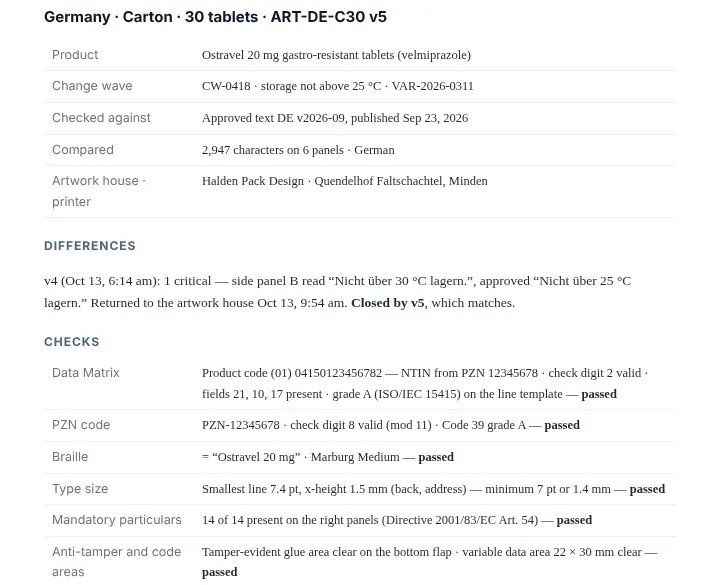
Germany's national number on the example carton is PZN 12345678. Multiply the first seven digits by 1, 2, 3 and so on up to 7: 1 + 4 + 9 + 16 + 25 + 36 + 49 = 140. Divide by 11: remainder 8. The last digit must be 8, and it is.27 The example carton also prints it as a Code 39 barcode, which IFA, the body that issues the number, says can be omitted on packs marketed since February 9, 2019.11,28
Product code, modulo 10
The Data Matrix carries 04150123456782, built from that PZN. GS1 computes this digit modulo 10:29 multiply the first 13 digits alternately by 3 and 1, starting with 3, and the total is 88. The next multiple of ten is 90, so the check digit is 2. A digit dropped by a spreadsheet changes the total, and this catches it.
The company is fictional. These two numbers are the sample PZN and product code GS1 Germany prints in its own guideline.29 A check digit catches most typing errors. It does not tell you the code belongs to this pack, which is why the code is also compared with the item master.
What the Data Matrix must carry, and what a file can never tell you
The unique identifier holds a product code, serial number, batch number and expiry date, with a national number where a member state requires one, and manufacturers "can choose the order of the data elements".9 Serial numbers and batches are printed on the packaging line, so on an artwork file you can only check that their place exists.
The rule on print quality sets a result the printed code has to achieve: the code must stay readable until at least one year after expiry or five years after release for sale, whichever is longer. "The use of a printing quality of 1.5 or higher gives a presumption of conformity."9 In plain words, a code printed at that quality is assumed to meet the rule. For a pack with a 36-month shelf life, that means five years.
A print grade is a measurement on a printed sample with an instrument. It depends on ink, board, press and geometry. A PDF cannot show it. What a file can settle is the contents, the digits, the fields, the human-readable headers, the size and the clear space around it. Any company that writes "grade B or better" in its specification has made a stricter choice of its own, measured at the press, and should say so in those words.
The Braille arithmetic, and why digits are the trap
The MHRA publishes the numbers for Marburg Medium, the recommended Braille cell size: a 1.6 mm dot, "exactly 2.5mm" between dot centers, 6.0 mm between characters, 10.0 mm between lines and 12.0 mm for a word space.8 The guideline asks for uncontracted Braille, with every letter spelled out, and "In case of multilingual packaging, the name in Braille has to be printed in all the different languages concerned".7
"Ostravel 20 mg" in cells
Spacing
Length
O-s-t-r-a-v-e-l, eight cells
Seven steps of 6.0 mm
42 mm
Word space
12.0 mm
12 mm
Number sign, 2, 0: three cells
Two steps of 6.0 mm
12 mm
Word space
12.0 mm
12 mm
m, g: two cells
One step of 6.0 mm, plus the last cell's width of about 2.5 mm
8.5 mm
Total, on a 110 mm panel
About 86.5 mm
Braille has no separate digits. The first ten letters do double duty, and a number sign in front switches them to numbers. Leave out that one cell, and 2 and 0 read as b and j: "Ostravel bj mg". No reader of the printed side would see the difference, since the printed side is correct. Exemptions exist for packs that only professionals handle, with vaccines as the guideline's own example.7,8
One missing cell turns 20 into bjThe same Braille line, drawn dot by dot, on the fictional Ostravel carton. Dark dots are raised.
Approved · reads "Ostravel 20 mg"
Ostravel#20mg
Number sign lost · reads "Ostravel bj mg"
Ostravelbjmg
Blind patients' hardest problem is the one thing Braille on a box rarely carries
Share of 95 blind patients in one Saudi survey who reported difficulty
Identifying the expiry date92%
Recognizing the dose82%
Identifying the drug75%
Source30 · One country, one survey, published 2015; 91% of the same patients said Braille labeling would help. The EU guideline calls Braille expiry dates welcome and leaves them voluntary.
Show the numbers
Item
Value
Identifying the expiry date
92%
Recognizing the dose
82%
Identifying the drug
75%
07 · What readers miss
The four kinds of artwork error a careful proofreader's eye is built to skip
In shortThe errors that survive to print are small and specific: a number inside correct words, a difference in a layer nobody reads, a measurement, and something that was never supposed to change. Published evidence on second checkers is thin and comes from neighboring tasks. Nobody has published what two readers catch on artwork, so the only number you can defend is one you measure yourself by planting errors.
A number inside correct words
"Nicht über 30 °C lagern." is a grammatical, expected sentence. A reader checking that the line is present finds it. Only a comparison finds the wrong number. This is the German carton.
A layer nobody reads
The Braille is approved text coded into dots, and a read-aloud does not reach it. The Nordic carton's number sign is missing, while all four printed languages are right.
A measurement, where the words are correct
The Belgian carton has exactly the approved Dutch line, set at 6.5 points because the three-language block was shrunk. Reading it aloud confirms the words and says nothing about height.
Something nobody changed
The Polish leaflet carries the revision date 03/2025 where 09/2026 was approved. Readers checking a change read the change, and this date sits far from it.
Three of those four errors sit nowhere near the sentence that changed, where nobody was told to look. That is why a check aimed at the change misses them, and why more training rarely helps. Other common causes include a shared side-panel file used by sibling pack sizes, a translation pushing a mandatory line onto another panel, and a code rebuilt by hand.
What published studies of second checkers can and cannot tell you
About 3 in 100 clinical double checks turned up anything
22 of 690
nurse double checks of chemotherapy in three Swiss hospitals found 28 inconsistencies. This is a neighboring task to artwork proofing
nurse double checks of chemotherapy in three Swiss hospitals found 28 inconsistencies. This is a neighboring task to artwork proofing
3.2 of 100
We found no study that measures read-aloud proofreading on pharmaceutical artwork. The closest observational work followed 690 double checks of chemotherapy. Half the inconsistencies came from comparing the order with the label, and half from the nurses using their own knowledge. Three in four traced back to inappropriate orders, made much earlier.31 Applied with care to a proofreading desk, it suggests a split: the comparing half is mechanical, and the knowing half is a person noticing that a pack size and a count disagree.
Pack design research points the same way. In one experiment, 84 adults judged from images whether two different packs held the same active substance. Error rates were 41% for younger and 68% for elderly participants, and fell to 8% and 16% with packs redesigned to highlight the substance.32 That is a laboratory study on generic packs, and it shows that meeting a type-size floor does not prove a pack works.
A review of look-alike labeling found 16 studies, 13 in a laboratory; of 11 on Tall Man lettering (capitals inside look-alike names), six found lower error rates and one found higher.33
How large a seeded-error test has to be before a clean result means anything
A company cannot infer its detection rate from the errors it happens to catch, because that sample says nothing about the ones it missed. The fix is a seeded-error test: plant known differences in real retired artworks, run them through your normal process, and count. It also tells you how much a clean result proves. If a method misses none of n planted errors, the true miss rate could still be as high as 1 − 0.051/n at 95% confidence.
Twenty planted errors, all caught, still allows a 14% miss rate
Highest miss rate consistent with zero misses, at 95% confidence
20 planted errors, none missed13.9%
50 planted errors, none missed5.8%
100 planted errors, none missed3%
300 planted errors, none missed1%
Illustrative · replace with your own numbers · Standard statistics for zero failures, assuming each planted error is independent. Report each error class separately, because Braille and body text behave differently.
Show the numbers
Test size
Miss rate could be as high as
20 planted errors, none missed
13.9%
50 planted errors, none missed
5.8%
100 planted errors, none missed
3%
300 planted errors, none missed
1%
08 · What FDA recall data shows
What FDA recall data says about labeling errors: 135 events in six years, and a share that depends on the definition
Our count, November 3, 2026
In shortWe counted FDA's own enforcement data for report dates 2020 to 2025. Reasons beginning "Labeling:" cover 135 of 1,901 recall events, about 7%, steady at 20 to 26 a year, and 33 of them include a Class I product. Other wordings of the same reason bring it to about 9%. A raw word search reaches 13%, inflated by phrases such as "below label claim". Label mix-ups are the largest group, and we read most of those as line and material failures that a desk proof cannot prevent.
Labeling is 7% to 9% of drug recall events by FDA's reason; a raw word search says 13%
Share of 1,901 FDA recall events, report dates 2020 to 2025
Reason begins "Labeling:" (135 events)7.1%
Reason begins "Labeling" in any form (159)8.4%
Adds wordings such as "Mislabeling" and "Label mix-up" (168)8.8%
Word search: label, carton, package insert, leaflet (251)13.2%
Our reading of the sources5 · Our count of the public API, drug enforcement reports, data updated October 28, 2026. Its 6,074 rows, one per recall number, collapse into 1,901 event IDs, and an event counts if any of its rows qualifies. By rows, "Labeling:" is 211 of 6,074, or 3.5%. We read the 83 events the word search adds: about six describe a wrong label, and the rest use the word as a yardstick or name the wrong product in a labeled bottle. openFDA warns that its data is unvalidated.
Show the numbers
Definition
Share of events
Reason begins "Labeling:" (135 events)
7.1%
Reason begins "Labeling" in any form (159)
8.4%
Adds wordings such as "Mislabeling" and "Label mix-up" (168)
8.8%
Word search: label, carton, package insert, leaflet (251)
13.2%
Why other published shares run higher. They count something else. One paper reports 14.9%: 29 of 195 drug items on FDA's page of recall announcements, market withdrawals and safety alerts from January 2017 to September 2019, a list it groups across prescription, over-the-counter, supplement, biologic, animal and other products.3 Another reports 19% for labeling and packaging together, on FDA recall data from 2012 to 2023.4 Use the enforcement data, state your definition, and expect the share to move with it.
Label mix-ups lead the 135 labeling recall events; strength errors sit closest to the proofing desk
Label mix-up45 events
Not elsewhere classified26 events
Incorrect or missing lot or expiry date23 events
Missing label, or a label lacking a warning14 events
Error on declared strength14 events
Incorrect or missing insert or leaflet7 events
Illegible label3 events
Wrong or incorrect barcode3 events
Our reading of the sources5 · Our grouping of the words FDA's reasons use. Another reader could move a few events between groups.
Show the numbers
Cause
Events
Label mix-up
45 events
Not elsewhere classified
26 events
Incorrect or missing lot or expiry date
23 events
Missing label, or a label lacking a warning
14 events
Error on declared strength
14 events
Incorrect or missing insert or leaflet
7 events
Illegible label
3 events
Wrong or incorrect barcode
3 events
Read that chart as a map of where the chain breaks, and resist reading it as a verdict on proofreaders. A mix-up is usually the right words on the wrong product, which is what dedicated lines and machine examination exist to stop. Lot and expiry errors are variable data added during packing. A desk that reads files has little influence on those 68 events.
It has more influence on declared strength, missing warnings and wrong inserts: about 35 of the 135. Even for those, the public text rarely says whether the artwork was wrong or a correct artwork went onto the wrong run.
The yearly count barely moves: 20 to 26 labeling recall events
232020
262021
212022
242023
212024
202025
Our reading of the sources5 · Our count. Reason beginning "Labeling:", each event dated by its earliest report.
Show the numbers
Period
Value
2020
23
2021
26
2022
21
2023
24
2024
21
2025
20
About 1 in 4 of those events reached FDA's most serious class
33 of 135
include a Class I product: "a reasonable probability" of "serious adverse health consequences or death"
include a Class I product: "a reasonable probability" of "serious adverse health consequences or death"
24 of 100
One Class I reason from August 2024 reads like a proof that never happened: "Label Error on Declared Strength; Some cartons were incorrectly labeled as 0.125 mg instead of 0.25 mg. The blister strips inside the product carton reflect the correct strength of 0.25 mg."5 The blisters were right and the carton was wrong. These numbers cover the US only. We found no matching public count for the EU, where defect reports are handled by member states.
09 · Inspection and supply risk
What inspectors cite on labeling controls, and what a late artwork does to supply
In shortFDA's published inspection observations (Form 483) show that labeling sections draw few citations, 37 of 2,837 drug citations in fiscal 2025, and only one on examining materials before packaging. That low count is no evidence of good artwork: the citations concern the physical control of labels, and few ever look at how a file was proofed. The larger risks are a recall, destroyed stock, and a release blocked by a missed six-month date.
Labeling controls drew 37 of FDA's 2,837 drug citations in fiscal 2025
Citations by regulation section, Form 483 observations, drugs
Procedures not in writing or not followed, 211.22(d)243
Investigations of discrepancies, 211.192164
Absence of written procedures, 211.100(a)162
Laboratory controls, 211.160(b)121
All labeling sections, 211.122, .125, .130, .13437
Examining labeling before packaging, 211.130(d)1
Source35 · Our sums. Fiscal 2024: 34 of 2,483. Citations count how often a section was cited, across sites, with no measure of how many errors exist. FDA says these lists come from its electronic inspection tools and are not comprehensive.
Show the numbers
Section
Citations
Procedures not in writing or not followed, 211.22(d)
243
Investigations of discrepancies, 211.192
164
Absence of written procedures, 211.100(a)
162
Laboratory controls, 211.160(b)
121
All labeling sections, 211.122, .125, .130, .134
37
Examining labeling before packaging, 211.130(d)
1
Why few citations should not reassure a labeling lead
The labeling sections cited most in fiscal 2025 are about the physical object: strict control over labeling issued, ten times; label storage access, five. Examination before packaging appears once, and correct labels during finishing operations once.35
An inspector usually meets artwork as a record. So the question an inspection can ask is what evidence exists: which approved version this carton was checked against, who signed, and what the signature meant. A signed checklist saying "proofread by two readers" is an assertion. A report naming the version, the panel and each difference can be reread two years later and still mean something.
Signed electronic records must show "The printed name of the signer", the date and time, and "The meaning (such as review, approval, responsibility, or authorship) associated with the signature".20 The MHRA's data integrity guidance describes the expectation as ALCOA: attributable, legible, contemporaneous (recorded at the time), original and accurate, with "+" adding complete, consistent, enduring and available.36 A file named "final_v3_FINAL.pdf" on a shared drive is hard to defend under any of those words.
What it costs when a wrong artwork is found, by when it is found
A recall, a regulator's questions, a patient at risk34
The whole company
We found no public source that prices these steps, so this table gives no figures. Section 18 shows how to cost your own.
Printed components are controlled material. EU GMP says outdated printed material "should be destroyed and this disposal recorded", and suppliers of it "shall be accorded attention similar to that given to starting materials".22 Any significant discrepancy in reconciliation "should be investigated and satisfactorily accounted for before release".22 US rules read the same way.1,2 A wrong carton found after the run therefore costs more than the board and the ink: it costs a run that has to be destroyed, recorded and replaced while the product waits.
For the patient, critical information has to be found and read correctly, and the MHRA's stated purpose is to help users select and use the right medicine and minimize medication errors.15 FDA's guidance lists crowded labels and hard-to-read text among the design problems that lead to errors.21
10 · The 12-digit NDC program
The 12-digit NDC: the label change every US drug labeler now has to plan
Status as of November 2026
In shortFDA's final rule moves every National Drug Code to 12 digits from March 7, 2033, with a three-year transition. New labels cannot be used before that date, but they can be drawn and proofed now. FDA expects 95% of updates to ride a change a firm was making anyway, which only works if you know which packs have a change coming.
Today's NDC has one of three shapes. Under the rule, "all FDA-assigned NDCs will be required to be 12 digits in length", with a 6-digit labeler code, 4-digit product code and 2-digit package code.14 An existing code converts by adding leading zeros, and the rule treats that as an administrative change, so the product keeps its identity. On one carton it is a one-line edit and a new barcode. Across a portfolio it is a labeling program.
FDA expects 95 in 100 label updates to ride another change
95 in 100
of about 271,655 listed drug packages. The other 5%, 13,583 labels, change on their own
of about 271,655 listed drug packages. The other 5%, 13,583 labels, change on their own
95 of 100
FDA's own arithmetic
"We assumed that each label change would take a respondent 1 hour" because only a slight change is needed, for 13,583 hours in all.14 Treat that as a paperwork estimate. It leaves out the proof, the second reader, the code check and the signature. It also counts about 1,324 respondents filing annual reports that summarize labeling changes.14
What to do now, when nothing may be printed until 2033
Inventory
Every pack that prints the code
Group each by the change it can ride. Only the group with no change coming costs a cycle of its own, and nobody is already working on those.
Decide once
One barcode or two
The rule allows linear or nonlinear codes, and "the 2D data matrix barcode could satisfy both sets of barcode requirements".14 Dropping one code frees panel space, and it is a real artwork change.
Prove early
A proofed file on the shelf
"Although the new labeling cannot be used before the effective date", firms can prepare it now.14 A digit dropped by a spreadsheet survives every check that treats the pack as a picture.
Other changes that arrive as artwork waves
UK-market packs have carried "UK Only" since January 1, 2025, and EU safety features no longer apply in Northern Ireland.13 Medical device makers moved to FDA's Quality Management System Regulation on February 2, 2026, which incorporates ISO 13485:2016.37 A new company address, a new pack size or a change in product text each fans out the same way, and QR codes on packs raise their own notification question.16 Each of them is a list of artworks with a deadline.
11 · The market
What the pharma artwork market looks like, and the numbers no one publishes
In shortWe found no regulator or dataset that publishes the size of the artwork proofreading market, the cost of an artwork error, versions per artwork or a proofreader's catch rate. Vendor figures come without a dataset, so we left them out. The solid numbers are about scale: 271,655 listed US packages, and one change reaching dozens of artworks.
271,655
listed drug packages in the US, by FDA's count in its 2026 NDC rule.14
Federal Register, March 5, 2026
18+
languages a single EU-wide wave can reach. Each member state sets the official languages for its market.6
Fictional wave; rule from the Commission's guideline
135
US labeling recall events in six years, with a reason beginning "Labeling:".5
Our count of openFDA, 2020 to 2025
Numbers you may be quoted, and how to treat them
Number
What we found
What to do instead
Market size of artwork software
No public figure with a dataset behind it
Budget from your own artwork count
Cost of a recall
Round figures in vendor roundups, with no shared method
Cost one of your own past reprints line by line
Hours per proof
No public figure; FDA's "1 hour" is a paperwork estimate for a slight change14
Time ten of your own proofs
First time right
Vendor case studies, with denominators rarely stated
Fix a definition and report it per artwork house
Reader accuracy
No study on artwork; adjacent clinical work only31
Run a seeded-error test
Why more change is coming to the same teams
Portfolio-wide events such as the NDC format are on the calendar.14 Regulators keep revising the texts a carton has to reflect.6,15 EU reform and electronic product information are in preparation, with no date you can plan a pack around yet.23,25 Meanwhile, a labeling change is rarely anyone's main job, and the people who proof it are usually also running the next one.
12 · AI and the regulators
AI in artwork proofreading: what draft Annex 22, FDA and EMA ask, and where the limits sit
Status as of November 2026
In shortSoftware can read, compare and measure every character without tiring. It cannot judge whether a deviation is acceptable, and a regulator will expect a named person to decide. The most useful text is a draft: EU GMP's Annex 22 says acceptance criteria must be at least as high as the process replaced, so you must first know how good your readers are. Its line on language models is under review.
The draft annex's clauses that reach an artwork desk
Text
What it says
What it means at an artwork desk
Scope
Applies to models "with a deterministic output". Generative AI and language models "should not be used in critical GMP applications".12
Ask which steps are a plain character comparison and which use a language model, then decide whether your quality system treats that step as critical.
No decrease
Acceptance criteria "should be at least as high as the performance of the process it replaces. This implies, that the performance should be known".12
Run a seeded-error test on your current readers before you judge any tool.
Human in the loop
Where testing was reduced because a person decides, the operator's "training and consistent performance" should be monitored "like any other manual process".12
A reviewer who confirms differences becomes part of the control, and is trained and checked as one.
Undecided
Low-confidence output should be flagged as "undecided", in place of "potentially unreliable predictions".12
Text a tool cannot read goes to a person. A clean result on an unread panel is the worst failure.
The annex addresses models embedded in computerized systems used in manufacturing, so artwork proofreading sits beside its scope. We apply it here by analogy, on purpose.
Annex 22 is a draft, and it may change. It is a consultation text from July 2025. EMA says the 2025 consultation "suggested support for potentially enabling the use of technologies such as generative AI", and it held an expert workshop on June 30 and July 1, 2026 on control measures within a risk-based approach; the report came out on October 2, 2026.17 A trade summary of the inspectors' work plan targets finalization by the end of 2026.38 We found no adopted text as of November 2026.
Other AI and software texts, with their exact reach
Text
Status
Reach
FDA draft guidance on AI for regulatory decisions
January 2025, draft, "not for implementation"
AI that produces data to support decisions on safety, effectiveness or quality, using a risk-based credibility framework.39 A carton proof is a manufacturing control, so read it for its method.
FDA Computer Software Assurance
Final, issued February 3, 2026; supersedes the September 24, 2025 version
Software "used as part of medical device production or the quality management system".40 Written for device makers. Drug firms may find the thinking useful, but it does not govern them.
Moves stand-alone high-risk duties to December 2, 2027 and AI in regulated products to August 2, 2028.42 Check with counsel how your use is classified.
GAMP Guide: Artificial Intelligence
ISPE, July 2025
Industry guidance for AI-enabled computerized systems in regulated settings, used alongside GAMP 5.43 A reference, with no regulatory force.
What software changes, and what stays with people
Software fits the steps that are frequent and mechanical; people keep the judgments
Our reading of the sources12 · Our judgment, using the draft annex's distinction between input to a decision and the decision itself.
Show the numbers
Item
How mechanical the step is (0–1)
How often it recurs (0–1)
Compare
0.80
0.72
Read codes
0.80
0.58
Measure
0.80
0.28
List packs
0.80
0.12
Grade
0.12
0.72
Approve
0.12
0.58
Deviations
0.12
0.20
No regulator approves proofreading tools. A company validates its own use of one: intended use written down, acceptance criteria set before testing, test data kept independent of anything used to tune the tool, change control, and monitoring in operation.12
Drift, a change in what the tool is given or reads over time, is concrete in this work: a new artwork house, a new language, or a new export setting in a design tool can change what extraction reads. No software can certify your compliance with Part 11, Annex 11 (the EU GMP annex on computerized systems) or GMP. It can only give you controls that support it.
13 · How teams do it today
How labeling teams proof artwork today: who holds what, and where a proof's 16 hours go
In shortFive roles hold the chain: the text, the file, the proof, the press and the release. Only the last is written into law. A proof by hand usually takes two readers and a sign-off, tracked in a spreadsheet, and most of its hours go to reading. Teams run it in house, through an outside service, or with software, and most combine them.
Regulatory affairs to Qualified Person: who holds which part of a pack
RA
Regulatory affairs manager
Owns the approved text per market and the filing behind it. Approves any accepted deviation.
Cares about: nothing but the filed text being treated as the source.
AC
Artwork coordinator
Briefs the artwork house, chases versions, books print slots, keeps the rollout tracker.
Cares about: which artwork is wrong, why, and by what date it can be fixed.
LL
Labeling lead or proofreader
Reads or reviews the proof against the approved text and signs it.
Cares about: the whole rollout, and knowing a carton is right before it prints.
PQ
Packaging quality reviewer
Signs the printer's proof at the press check; examines materials before packaging.19
Cares about: codes that will scan on the line, and no surprises at the press.
QP
Qualified Person (EU and UK)
Certifies the batch. Sees artwork as a record, and is bound by the six-month rule on new components.15
Cares about: packaging records that are complete and correct.
Apart from the Qualified Person, no European or US rule we found describes these roles. Titles and splits vary from company to company, and a medical device or generics firm may fold several into one person. The artwork house draws the file and should not approve it: approval is a claim about the approved text, which the house does not own.
From approved text to press proof: where the hand-offs happen
An artwork passes through five hands between approved text and press
1Text published
Approved text per market and language, with its version.
Regulatory affairsDay 0
2Artwork briefed
List affected packs; send the brief and files.
Artwork coordinatorDays
3File drawn
New version, for each pack, language and panel.
Artwork houseDays to weeks
4Proofed
Two readers, read-aloud; code, Braille, type checks; differences marked.
Labeling leadAbout 2 days a proof
5Returned or signed
A return restarts the proof from the first character.
Labeling lead, regulatoryEach cycle
6Press proof signed
Printed proof checked before the run.
Packaging qualityAt the slot
Illustrative · replace with your own numbers · A typical shape, in our words. Times are illustrative.
Show the numbers
Step
What happens
Who
Time
Text published
Approved text per market and language, with its version.
Regulatory affairs
Day 0
Artwork briefed
List affected packs; send the brief and files.
Artwork coordinator
Days
File drawn
New version, for each pack, language and panel.
Artwork house
Days to weeks
Proofed
Two readers, read-aloud; code, Braille, type checks; differences marked.
Labeling lead
About 2 days a proof
Returned or signed
A return restarts the proof from the first character.
Labeling lead, regulatory
Each cycle
Press proof signed
Printed proof checked before the run.
Packaging quality
At the slot
A hand proof's 16 hours, step by step
Reading and the read-aloud take 9 of about 16 hours in a hand proof
Working hours per artwork
Reading every panelSecond reader, read-aloudBarcode, Braille, type checksReturns and re-proofingMatching, report and signature
By hand, about 16 hours54223
Illustrative · replace with your own numbers · An estimate for a fictional company, built from the solution's sample data. No public study measures this. Time your own.
Show the numbers
Reading every panel
Second reader, read-aloud
Barcode, Braille, type checks
Returns and re-proofing
Matching, report and signature
By hand, about 16 hours
5
4
2
2
3
A return restarts the reading, because a corrected file can move a line break, reflow a column or shrink a three-language block, and the new version has to be read in full. The re-proof of the German carton's version 5 compares the same 2,947 characters as the first pass, for one corrected number.
In-house readers, an outside service or artwork proofing software
In house
Readers, a PDF and a tracker
Flexible, and it builds product knowledge. The weak points are fatigue, languages the readers do not speak, and a record that says who looked but not what was compared.
Outsourced
An artwork or labeling service
Moves the hours and adds language coverage. The company still owns the result: a service's proof is your control, under your procedures, and your suppliers must be qualified.22
Software
Workflow, compare or both
Artwork lifecycle management systems answer where a file is and who approved it. Text compare tools answer whether its words are the approved words. Buying the first and assuming it does the second is a common and expensive mistake.
Part B · See it working
Botminds Labeling & Artwork Proofreading on a 64-artwork storage change at a fictional drug maker
Part A described the work without naming a product. This part shows how Botminds does it, at a fictional company tightening a storage condition across 22 countries and 18 languages. Every company, person, code, number and document in the screens is sample data.
14 · One carton, start to finish
The German 30-tablet carton: from a wrong temperature on side panel B to a signed proof report
In shortThis is the example from the top of the page, inside the product. Six specialist agents, software workers with one job each, find every affected artwork, read it, compare it and check it. Annika Brandt, the global labeling lead, sees the whole rollout on one strip, opens the German carton on its difference, returns it to the artwork house with the reason already written, and signs the corrected version with the meaning of her signature.
1
All 64 artworks of one storage change on one strip
Annika's proof screen opens on change wave CW-0418. Each tile is one artwork, grouped by market from Germany to Croatia: 52 passed, 4 with differences, 5 being proofed, and 3 awaiting artwork from Halden Pack Design. The first red tile is the German 30-tablet carton.
Above the tiles sits the change itself, not above 30 °C to not above 25 °C, and the date that matters: printers by October 30.
The change wave and the proof. Each carton and leaflet is a tile, colored by status. Below, the selected artwork lies flat with its differences beside it.
2
"Go to difference" stops on the 30 °C
ART-DE-C30, version 4, lies flat with its panels and flaps. 2,947 characters on six panels have been compared against approved text DE v2026-09. A heat layer marks what differs, and a wipe moves between the artwork and the approved text set in the same place.
The view zooms and stops on side panel B. Approved: "Nicht über 25 °C lagern." Artwork: "Nicht über 30 °C lagern." Critical. The note beside it says the German leaflet, version 6, already says 25 °C and was signed on October 12. Two items were ignored by rule, a line break and a soft hyphen, and each is listed.
A difference, with its source. The panel and line, the approved wording against the artwork, the version it was checked against, and what was ignored by rule.
3
The rest of the carton passes, check by check
Six of six checks pass on this carton. The Data Matrix product code decodes as 04150123456782 and its check digit computes. The PZN's check digit computes too. The Braille cells read "Ostravel 20 mg" in Marburg Medium. The smallest line is 7.4 points with a 1.5 mm x-height. All 14 mandatory particulars are on the right panels, and the tamper-evident and variable data areas are clear.
The sample data shows a print grade taken from the line template. In practice a grade is measured on a printed sample, and your setting holds it to the minimum you chose.
Checks on one carton. Each check with what was read, the rule behind it and the result.
4
Returned with the reason already written
Approval stays locked while a difference is open. Annika returns version 4 to Rasmus Lind at the artwork house, copying Tomás Ferreira, the artwork coordinator. The reason is required and arrives pre-filled: the panel, the approved wording, the approved text version and the variation.
The reason also asks the artwork house to check that the 60- and 100-tablet cartons use the same side panel file, the line a reader focused on one file would forget. The dialog also shows what is at stake: the printer's slot on October 27 at Quendelhof Faltschachtel, with the new version needed by October 15.
Return to the artwork house. The reason is required, and the difference travels marked on the proof.
5
Version 5 is read in full again, then signed
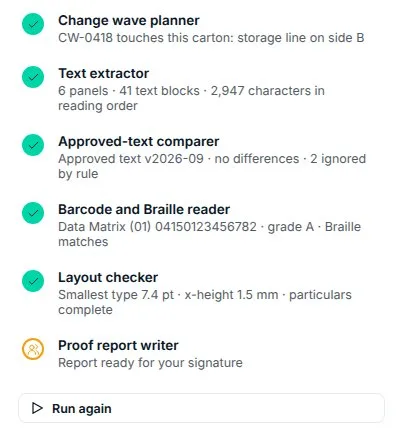
When version 5 arrives, all six agents run again from the first character: the planner confirms the storage line on side B, the extractor rebuilds 41 text blocks and 2,947 characters in reading order, and the comparer finds no differences. The run takes 4 minutes 12 seconds on the sample data, and the proof report is left ready for her signature.
The signature dialog shows the artwork, the version it was checked against, the result, and the meaning: "Artwork matches its approved text and may go to the printer." Annika enters her password and signs.
Sign with its meaning. Name, date and time, and the meaning are recorded with the signature.20
Approved and signed. The tile turns green and the wave moves to 53 of 64. The other three differences stay red until they are closed.
The solution's design target is about 3 hours per artwork proof, against about 2 days by hand. It is a target, to be measured on your own artworks.
15 · Every screen
A lost Braille number sign, a shrunken line, a stale date: the other errors in the wave, and the screens that track them
In shortThese screens show the other three kinds of error the wave catches, then the rollout by language and market, the source text, the checks across the wave, the signed record, the numbers over a year, and the rules you set yourself.
A Braille difference. The Nordic 98-tablet carton has lost the number sign before "20", so the cells read "Ostravel bj mg". All four printed languages are correct.
A type-size difference. The Dutch wording is right. It was set at 6.5 points with a 1.2 mm x-height when the three-language block was shrunk to fit a longer French line.
A date nobody changed. Section 5 of the Polish leaflet carries 25 °C. Its revision date was left at 03/2025. Unchanged text appears as gray blocks so the eye goes to what matters.
Change waves. Each wave with its filing and deadline, what changed in each language, and a market-by-component grid where a dot opens its proof.
Approved text. Statements mapped to panels and leaflet sections, per language, with the filing and its owner. A new version starts a change wave and never alters a signed proof.
Artworks. Every version with its market, languages, pack, character count and status, in the order it needs attention.
Checks across the wave. Data Matrix, Braille, type size, particulars, dates and clear zones, each with its rule's source and the artworks that did not pass.
Each agent's step on version 5. What it read and found, with the report left for a person to sign.
The signed proof report. What was compared, what was found and how it closed, and every check. One for each approved artwork version, ready to export for an inspection.
The year in numbers. Sample data: hours per proof by month, differences by type and severity, first time right by artwork house, and every wave against its date.
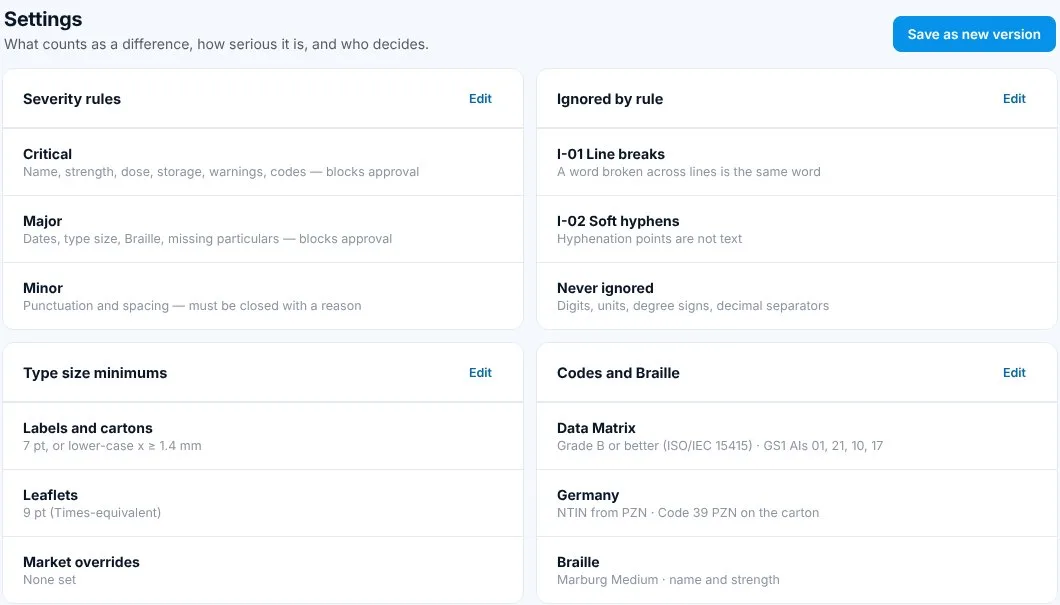
Your rules. Severity, the ignore list, type-size minimums and code and Braille rules. Each change is saved as a new version, and a signed proof keeps the rules it used.
Select a screen to open it larger. The company, products, people, codes and figures are fictional. A rule's name on a screen is a pointer to the rule; the rule's real wording is in section 3.
Twelve months of proofs on the sample data
Median hours per proof fell from 16.2 to 3.1 over the sample year
051015203.1
NovJanMarMayJulSep
Fictional example from this guide · The solution's sample data, for a fictional company, and no customer's result. Measure your own in a pilot.
Show the numbers
Hours per artwork proof
Nov
16.2
Dec
9.4
Jan
6.1
Feb
4.8
Mar
4.2
Apr
3.9
May
3.6
Jun
3.4
Jul
3.3
Aug
3.2
Sep
3.1
Oct
3.1
Punctuation is the most frequent difference; storage, strength and codes carry the critical ones
212 differences on 1,486 artworks, sample data
Punctuation and spacing50
Storage and handling41
Dates and versions37
Type size33
Braille21
Strength and dose wording18
Codes (Data Matrix, PZN)12
Fictional example from this guide · 38 of the 212 were graded critical, on the sample data.
Show the numbers
Item
Value
Punctuation and spacing
50
Storage and handling
41
Dates and versions
37
Type size
33
Braille
21
Strength and dose wording
18
Codes (Data Matrix, PZN)
12
16 · Agents, and who signs
Six agents read, compare and measure every artwork; a labeling lead signs every proof
In shortEach agent has one job and limits it does not cross. None of them edits an artwork, dismisses a difference, passes a code below the set grade or signs. A difference closes in only two ways: a new version that passes, or an accepted deviation with a reason, approved by regulatory affairs. Nothing goes to a printer without a signed proof report.
Change wave planner to proof report writer: six jobs on one artwork
Change wave planner
Turns one approved-text change into a change wave: every carton, label and leaflet that carries the changed text, by market, language and pack, with the printers' deadline.
Never starts a proof without the approved text version it is checked against.
Text extractor
Reads every panel of the print-ready PDF, live and outlined text, and puts it in reading order with font, size and position for each line.
Never edits the artwork. Text it cannot read goes to a person.
Approved-text comparer
Compares every character with the approved text for that market and language, and grades each difference by your rules, citing the version, the panel and the line.
Never dismisses a difference, or ignores anything beyond the ignore list.
Barcode and Braille reader
Decodes the Data Matrix and linear codes, checks the product code against the item master and the check digits, and reads the Braille cells against the approved Braille text.
Never passes a code below the grade you set.
Layout checker
Measures point size and x-height on every line against the market minimum, checks each mandatory particular sits on the right panel, and that tamper and code areas stay clear.
Never moves or resizes anything.
Proof report writer
Writes the proof report: what was compared, each difference and how it closed, every check, each citing the approved text version, artwork version and panel.
Never signs, or files a report without the labeling lead's signature.
Labeling lead signs the proof; regulatory accepts a deviation; quality signs the press proof
Signs every proofLabeling leadApproves with an electronic signature: "Artwork matches its approved text and may go to the printer." Approve stays locked while a difference is open.
Accepts a deviationRegulatory affairs managerOwns the approved text. A difference may stand only with a written reason and this approval.
Signs the printer's proofPackaging quality reviewerSigns at the press check, on the printed proof, once the file's proof is signed.
Every artwork version, approved text version, proof and signature is kept, with agent steps and human decisions shown apart. The solution offers controls that support your compliance work under 21 CFR Part 11 and EU GMP Annex 11; your validation of its use stays yours. Botminds is SOC 2 Type II audited and manages information security to ISO 27001.
Annika, Tomás, Ines and Marek: the four people on the Ostravel wave
Fictional, from the sample data
AB
Annika Brandt · global labeling lead
Owns every Ostravel artwork and approves every proof.
"I want to see the whole rollout, and know the German carton is right before it prints."
TF
Tomás Ferreira · artwork coordinator
Briefs the artwork house, chases versions and books print slots.
"Tell me which artwork is wrong and why, and I'll have it fixed today."
IK
Dr. Ines Kovač · regulatory affairs manager, EU
Publishes the approved text per market and language, and approves any accepted deviation.
"The approved text is the variation we filed. Nothing else is the source."
MN
Marek Nowak · packaging quality reviewer
Signs the printer's proof at the press check, at the Tarnów site.
"If the Data Matrix grades below B, it doesn't go on my line."
17 · What goes in and out
Print-ready artwork and approved text in; graded differences, checks and signed proof reports out
In shortThe solution reads the files your labeling chain already produces, and it leaves your artwork house, printers and systems of record in place. What it adds is one cited, signed report per approved artwork version, a rollout view of each change, and numbers you can hold each artwork house to.
From your labeling chain
Print-ready PDFs of cartons, labels and leaflets
Approved labeling text per market and language, versioned, with its filing
The printer's proof
From your rules and data
Severity rules and the ignore list
Type-size minimums and market overrides
Data Matrix and national code rules, Braille standard
Item master: product codes and national numbers
Approvers, artwork houses and printers
Agents find, read, compare and checkEvery panel of every artwork, against your approved text, under your rules
The labeling lead signs each proof
Each difference cites version, panel and line
Outputs
Differences between artwork and approved text, graded by severity
Data Matrix, Braille, type size and particulars checks
A signed proof report for each approved artwork version
The change wave: every affected artwork and its status
Export for inspection
What changes for the team
Differences to decide, each already located and cited
Returns that carry their reason
A rollout visible on one strip
Systems an artwork proofing rollout connects to
Regulatory information systemApproved text, filings
Artwork lifecycle systemBriefs, versions, tasks
Document managementControlled procedures, signed reports
Item master or ERPProduct codes, national numbers
Quality management systemDeviations, supplier records
Artwork housesNew versions in, returns out
PrintersRelease with the signed report
Identity and accessRoles, separation of duties, single sign-on
For each, check whether it has an API, a file feed, or only screens, and who owns it.
Your artwork house, your printers and your lifecycle system stay
Your approved text
Regulatory affairs still owns it. Each proof names the version it was checked against, and nothing downstream can edit it.
Your artwork houses
They still draw the files. A correction is always a new version from them, and each gets its own first-time-right number.
Your printers
They receive released artwork with its signed report. The press check and the printer's proof stay with packaging quality.
Your lifecycle system
It keeps routing briefs and tasks. The comparison and the cited report sit beside it, answering a different question.
Your line controls
Line equipment keeps examining finished labels and over-printing, as your procedures say.1,22
Your quality system
Deviations, supplier qualification and change control carry on under your own procedures, with the proof report as evidence.
Every difference cited and held open until closed, and every proof signed by a named person
1
Every difference names its source
Approved text version, panel and line, one click away for the lead, the artwork house and an inspector.
2
A difference closes in two ways only
A new version that passes, or a deviation with a reason and a regulatory approver. Digits, units, degree signs and decimal separators are never ignored.
3
Agents check; people decide
Agents read, compare, measure and draft. A named labeling lead signs, with the signature's meaning on the record.
Part C · Are you ready to automate?
Automating artwork proofreading: what it costs you today, what it returns and how to test it
You proof artwork, or manage the people who do, or answer for what reaches the printer. This part is written for you: what errors and delays cost, what automating the proof could return, whether your team is ready, and what to ask any vendor of artwork proofing software, including us.
18 · What errors and delays cost
What a hand-proofed artwork costs you in hours, reprints and missed print slots
In shortStart from your own costs, because the numbers that decide your case are yours. A few public figures frame them: how often labeling reaches a recall, how serious those recalls are, and how many packs a portfolio-wide change touches.
135
FDA recall events in six years with a reason beginning "Labeling:", about 7% of all drug recall events.5
Our count of openFDA, 2020 to 2025
33 of 135
of those events include a Class I product, FDA's most serious class.5,34
Our count of openFDA, 2020 to 2025
13,583
labels FDA expects to change on their own for the 12-digit NDC, at an assumed hour each before any proof.14
91 FR 10749, March 5, 2026
Most of the hours are in reading, and returns shrink least
Working hours per artwork proof
By hand (the sample company's estimate)With automation (design target)
Matching to the approved version1 hour0.1 hours
Reading every panel5 hours0.5 hours
Second reader, read-aloud4 hours0.5 hours
Barcode, Braille, type checks2 hours0.3 hours
Returns and re-proofing2 hours1 hour
Report and signature2 hours0.6 hours
Illustrative · replace with your own numbers · Neither column is a measurement. Time ten of your own proofs; measure the target in a pilot.
Show the numbers
By hand (the sample company's estimate)
With automation (design target)
Matching to the approved version
1 hour
0.1 hours
Reading every panel
5 hours
0.5 hours
Second reader, read-aloud
4 hours
0.5 hours
Barcode, Braille, type checks
2 hours
0.3 hours
Returns and re-proofing
2 hours
1 hour
Report and signature
2 hours
0.6 hours
What nobody publishes. We found no public figure for hours per artwork proof, versions per approved artwork, the catch rate of two readers, plate and run costs, or the cost of an artwork-driven recall. Round numbers for these circulate in vendor material without a dataset. Measure your own.
Timing ten proofs and pricing one reprint: finding your baseline in a week
Cost
Where it hides
How to find your number in a week
Reader time
First reader, second reader, read-aloud, across several people's calendars
Log minutes on ten proofs: one carton, one leaflet, one multilingual pack, by step
Returns
Each one restarts the proof, and no one counts it as rework
Versions per approved artwork, from the last 50 approvals
Tracking
A coordinator's rollout spreadsheet and chasing emails
Ask coordinators for their hours during the last wave
Print slots
Slots lost or moved because an artwork was late
Count them from your printers' records for the last year
Errors after sign-off
Found at the press, on the line or in the market; often recorded as a printer or line issue
Deviation and complaint records that name labeling; cost one in full
What you do not catch
Nowhere, until you look
Plant 20 differences in retired artworks and run your normal process
Costs a proofreading calculator will not count
The launch or supply date that slipsA market waits for a carton that missed its slot, while old stock runs out.
Release held at the last stepComponents not updated in time, and a Qualified Person who should not certify.
The patient holding the wrong boxA strength or storage line that misleads, with no second chance to read it.
The person who knows every packWhen a senior proofreader leaves, the unwritten severity rules leave too.
An inspection answered from memoryReconstructing what a two-year-old proof was checked against.
19 · Your return
What faster proofs return when you count reader hours and late catches against the tool's yearly cost
In shortPut in your own numbers. The calculator asks how many artworks you proof a year, the hours each takes, what an hour costs, how many errors reach the press or later, and what the tool and your validation cost. No input has a public benchmark, so every default is marked illustrative or a design target.
Reader hours, returns and late catches: where artwork proofing saves
Reader time
A cited list of differences to decide
Every character is compared before anyone opens the proof, and the person works from a located, cited list.
artworks × hours saved × loaded hourly cost
Returns
Fewer cycles per artwork
A return that carries its panel, wording and version is easier to fix the first time, and it can ask for sibling packs to be checked with it.
returns avoided × hours per re-proof × hourly cost
Late catches
Found on the file
A wrong digit found before plates costs a version. Found after the run, it costs the run.
late catches avoided × your cost of one
Rollout
One wave, one view
One shared view can replace a coordinator's tracker, so a forgotten pack shows up sooner.
coordinator hours per wave × waves × hourly cost
Suppliers
Numbers per artwork house
First time right by supplier, which each one can act on.
change in first time right, per artwork house
Inspections
The record is the proof
Each signed report names its version and differences, so less has to be reconstructed.
hours assembling evidence, before and after
Artworks a year, proof hours and your cost of a late catch
No public benchmark exists for any of these inputs. The 16 and 3 hours come from the solution's sample estimate and design target. Every input marked illustrative is an assumption to replace.
Your volumeHours per artwork proofErrors found lateYour cost
Illustrative yearly value
Proofing time today, valued$0
Time released, valued$0
Late catches avoided, valued$0
After your yearly cost$0
Person-hours released a year0
Artworks a year to cover your cost on time alone0
Formulas, per year: Proofing time today = artworks × hours today × hourly cost Time released = artworks × (hours today − hours with automation) × hourly cost Late catches = errors found late × your cost of one, assuming a proof would have caught them all; lower it to match your test After your cost = time released + late catches − yearly cost Break-even artworks = yearly cost ÷ (hours saved × hourly cost); a very large number means the hours saved never cover the cost
Not counted: returns avoided, coordinator hours, print slots, and evidence for inspections. Released hours are value only when you decide what they are for: more waves without more people, earlier deadlines, or review of the differences that need judgment.
The hours saved per proof decide how many artworks pay for the tool
Artworks a year to cover $250,000 of yearly cost, at $75 an hour, on time alone
Saves 13 hours a proof256 artworks
Saves 6 hours a proof556 artworks
Saves 3 hours a proof1,111 artworks
Illustrative · replace with your own numbers
Show the numbers
Hours saved
Artworks a year
Saves 13 hours a proof
256 artworks
Saves 6 hours a proof
556 artworks
Saves 3 hours a proof
1,111 artworks
If your proofs already take four hours with a good text-compare tool, your saving is far smaller than the default, and the case rests on Braille, codes, type size and the record. A company with a few dozen artworks a year probably should not buy this, and should say so before a demonstration.
Start where many languages meet frequent artwork changes
Artwork changes a year →
Compare first
Pilot here
Leave for now
Checks later
Global brandEU genericsLocal vialRegional OTCNordic packs
Languages and markets per product →
Illustrative · replace with your own numbers · Replace these example families with your own portfolio.
Show the numbers
Item
Languages and markets per product (0–1)
Artwork changes a year (0–1)
Global brand
0.80
0.72
EU generics
0.30
0.60
Local vial
0.12
0.28
Regional OTC
0.30
0.10
Nordic packs
0.80
0.20
Start here20 · Readiness check
How ready your labeling team is: artwork volume, approved text, severity rules, measurement and sign-off
In shortPick the answer closest to your team today. Eight questions score 0 to 2; the last is for reflection. The meter adds up your score as you go, and each question says why it matters and what a strong answer sounds like.
1
Artwork volume
How many artwork versions does your team proof in a year?
Why it mattersVolume turns hours per proof into capacity. Below a certain number, a tool will not pay for itself on time.
A strong answer"About 1,500 versions, counting returns, across ten products."
2
Markets and languages
How many languages and markets does a typical change reach?
Why it mattersA fan-out, and languages your readers do not speak, are where comparison beats reading most clearly.
A strong answer"A typical storage or address change reaches 15 languages and several shared multilingual packs."
3
Approved text as a source
Can you hand over the approved text per market and language, versioned, with the filing behind it?
Why it mattersA proof can only cite a version that exists. Getting approved text into shape is usually the biggest part of the work.
A strong answer"Regulatory affairs publishes each version in one place, and the proof names it."
4
Severity rules
Are your rules for critical, major and minor differences written down, along with what may never be ignored?
Why it mattersThey become settings. Unwritten, each difference turns into an argument under deadline.
A strong answer"Written and approved: digits, units and decimal separators are never ignored."
5
Your baseline
Do you know your hours per proof, versions per approved artwork, and what your readers catch?
Why it mattersNo public benchmark exists, and the draft Annex 22 says a replaced process's performance "should be known".12
A strong answer"We ran a seeded test last quarter: 94 of 100 planted differences found, Braille the weakest."
6
Print-ready files
Do your artwork houses deliver consistent files, with known handling of outlined text and Braille layers?
Why it mattersA new export setting can change what extraction reads, so suppliers' habits affect the result.
A strong answer"Two qualified houses with one file specification, and we know which panels arrive as outlines."
7
Ownership and budget
Is there one owner for labeling operations across regulatory, packaging and quality, with a budget?
Why it mattersThe chain crosses departments that do not share a calendar. Without one owner, a pilot stops at the first boundary.
A strong answer"The head of global labeling owns it and has a budget line, and quality has agreed to review."
8
Validation and AI approval
Does your quality system have a path to validate a computerized system with AI in it, and to place artwork proofing as critical or not?
Why it mattersThat classification decides what the draft Annex 22 would expect, and it is yours to make.12,17
A strong answer"Quality has a procedure, a named validation lead and a written view on this step."
9
Vision · for reflection
If an inspector picked one carton from last year, what would have to be true for you to show what it was checked against, every difference found and who decided, in under five minutes?
Why it mattersYour answer lists the gaps. Each gap is a candidate job for software or for a procedure.
A strong answerA short, specific list, for example: "one approved text version per proof, every difference cited, every signature with its meaning, and no reports kept in email."
From 0 to 16: version your approved text, pilot on one product, or plan the portfolio
0–6
Explore
Build the baseline first: time ten proofs, write down your severity rules, and get approved text into one versioned place. A seeded-error test on your current process is useful whatever you decide next.
7–11
Ready to pilot
Run a measured pilot on one real multilingual product, with planted differences in copies of its files. Compare catches, false alarms and hours with your current process, and keep your people signing throughout.
12–16
Ready to implement
Plan the portfolio by product family: approved text, rules as settings, artwork house and printer links, your validation and change control, and first-time-right reporting by supplier.
21 · Questions for any vendor
What to ask artwork proofing software vendors about outlined text, Braille, approved text and validation
In shortAsk each vendor, including us, to show the answers on your own carton. A demonstration on the vendor's file proves little. Look for three things: what happens to text it cannot read, what the system refuses to do, and what evidence it leaves behind.
A
Outlined text, placed images and what it cannot read
A1
Does it read outlined text, and what happens when recognition is uncertain?
Why it mattersA clean result on a panel it never read looks identical to a real pass.
Strong answer · warning sign
Uncertain text goes to a person, and is listed.
"It always works on our files."
A2
How does it keep reading order across panels and flaps?
Why it mattersFile-order extraction produces false differences, and false differences train people to click through.
Strong answer · warning sign
Panel by panel, shown on the flat carton.
A long list with no location.
B
Approved text as the authority, with a named version
B1
What is each artwork compared against: a last version, a copy deck, or a named approved text version?
Why it mattersOnly the last can find an error that has been there since version 1, and say what it was checked against.
Strong answer · warning sign
Each difference cites version, panel and line.
The report names two PDFs.
B2
What can never be ignored, whatever the settings say?
Why it mattersPressure to widen the ignore list starts in the first week.
Strong answer · warning sign
Digits, units, degree signs and decimal separators.
"Everything is configurable."
C
Braille cells, Data Matrix contents and print grade
C1
Does it decode Braille into characters, or only confirm that dots exist?
Why it mattersA missing number sign leaves every dot well formed.
Strong answer · warning sign
Cells read against an approved Braille string.
A picture overlay.
C2
What exactly does a "grade" on your screen measure, and on what object?
Why it mattersPrint quality is measured on a printed sample. A claim made from a PDF describes a measurement nobody took.
Strong answer · warning sign
Contents and digits on the file; grade from a printed sample.
"We grade your barcode from the PDF."
C3
Does it measure x-height and line spacing as well as point size, and in which method?
Why it mattersThe two tests give different answers on the same file.
Strong answer · warning sign
Both, on every line, with the method written down.
A single number per document.
D
Models, test evidence and who signs
D1
Which steps are a plain character comparison, and which use a language model?
Why it mattersThe draft Annex 22 treats them differently, and your classification depends on the answer.12
Strong answer · warning sign
Step by step, in writing.
"It's all AI."
D2
Can we have the intended use, acceptance criteria and test results, with the test data characterized?
Why it mattersThe draft says the regulated user reviews this documentation even when a supplier provides the model.12
Strong answer · warning sign
Handed over, with results by subgroup.
One accuracy percentage.
D3
What will the system refuse to do?
Why it mattersWritten limits are what separate a check from a decision.
Strong answer · warning sign
It never edits artwork, dismisses a difference or signs.
"It can be set up to approve automatically."
D4
Is your product "GxP certified" or "Part 11 compliant"?
Why it mattersGxP is the family of good-practice quality rules, and Part 11 is the US rule on electronic records. Those labels do not exist for a product. A company validates its own use.
Strong answer · warning sign
"No one can claim that. Here are the controls and the audit reports."
"Yes, fully certified."
22 · How to start
Test artwork proofreading on your own cartons with planted differences, then decide on three numbers
In shortMeasure your current readers, plant known differences in real files, run them through both processes, and decide with three numbers. Plan about eight weeks on one product. None of these steps commits you to a vendor.
Time ten proofs, by step, and count versions per approved artwork over the last year.
Choose one real product: a multilingual carton, a leaflet, and one market with an awkward rule, with approved text as it exists today.
Plant known differences in retired copies: a digit, a look-alike character, an unchanged date, a line below the type minimum, a dropped Braille cell. Keep them away from anyone who tunes the tool.
Run both processes in parallel with the people who do the work, and with your people signing every proof.
Decide with three numbers: catch rate by error class, false alarms on clean files, and hours to a signed report.
An eight-week pilot ends with a decision on three numbers
Your teamVendor
Time ten proofs; seeded test on current readers
Gather approved text, files and rules
Load approved text, severity rules, codes
Proof the seeded files, both ways
Live change on one product, in parallel
Report by error class and artwork house
Quality review and decision
Week 02468
Illustrative · replace with your own numbers
Show the numbers
Activity
From
To
Time ten proofs; seeded test on current readers
0
2
Gather approved text, files and rules
0
3
Load approved text, severity rules, codes
1
3
Proof the seeded files, both ways
3
5
Live change on one product, in parallel
4
7
Report by error class and artwork house
6
7
Quality review and decision
7
8
Catch rate by error class, false alarms and hours to a signed report
Measure
How
Why
Catch rate by error class
Planted differences caught ÷ planted, per class, with the number planted
One percentage hides the Braille
False alarms
Differences flagged on clean files, in reviewer minutes
A tool that flags everything catches every plant
Unread text
Panels and lines sent to a person, by file type and artwork house
Shows what extraction reached
Hours to a signed report
Stopwatch from file received to signature
The cost case rests on it
First time right
Versions that pass on first proof, per artwork house, one fixed definition
Only a per-supplier number changes behavior
Data preparation
Hours spent getting approved text and rules ready
This number predicts the project better than any estimate
A falling count of differences can mean better artwork or a weaker check, and the count alone cannot tell you which. Pair it with the severity mix and a seeded file every few months. A test with 20 planted errors of one class, all found, still allows a 14% miss rate (section 7), so size the test to the decision.
The working-session questions: ten deeper questions for labeling, quality and regulatory
Bring regulatory affairs, labeling, packaging quality, the Qualified Person, IT and procurement into one room.
E
Second reader, deviations and legacy artwork
E1
What does our procedure cite as the authority for two readers?
Why it matters211.122(g)(3) concerns hand-applied labels on a line.1
Strong answer · warning sign
"It is our own control, justified by this test."
"The FDA requires it."
E2
If comparison is exhaustive, what should the second person do instead?
Why it mattersHalf the inconsistencies in the clinical study came from the nurses' own knowledge.31
Strong answer · warning sign
Sense, consistency between pack and leaflet, hard judgments.
Re-reading the same text.
E3
Who may accept a deviation under deadline, and what do they write?
Why it mattersThe first one sets the pattern for all later ones.
Strong answer · warning sign
A named function, a reason on the record.
An email saying "OK to print".
E4
How far back do we load history, and how do we describe older proofs?
Why it mattersOlder proofs are a signature and a folder.
Strong answer · warning sign
A stated cut-off.
"We'll migrate everything."
F
Suppliers, drift and the next portfolio change
F1
Which pack files are shared between sibling sizes?
Why it mattersOne error in a shared asset is one error in every pack using it.
Strong answer · warning sign
Listed, per product family.
Found when a return comes back.
F2
Will artwork houses accept a measure of first time right on their work?
Why it mattersIt is the number they can act on.
Strong answer · warning sign
In the quality agreement.
A blended company figure.
F3
What happens when a supplier changes its export settings?
Why it mattersThis is the input drift the draft annex asks you to monitor.12
Strong answer · warning sign
Monitored by items sent to a person.
Noticed by chance.
F4
Which of our US packs have a change coming between 2033 and 2036?
Why it mattersRiding a change needs knowing the changes.14
Strong answer · warning sign
An inventory, grouped by the change each pack can ride.
"That's years away."
F5
Which step would we never let software take alone?
Why it mattersIt tells you where the signatures belong.
Strong answer · warning sign
Approval, deviations and release to a printer.
No answer.
F6
What would we do with the hours released?
Why it mattersReleased hours are value only if they are used.
Strong answer · warning sign
More waves with the same team, or earlier briefs.
"They'll figure it out."
23 · Frequently asked questions
Artwork proofreading questions answered: two readers, Braille, Data Matrix, NDC and AI
In shortThe questions labeling teams and buyers search for most, each answered on its own.
What is pharma artwork proofreading?
Pharma artwork proofreading is the check that a print-ready carton, label or leaflet says what its approved labeling text says, for that market and language, before it goes to the printer. It usually also covers the Braille, the barcode or Data Matrix and the type size. It ends with a signature from a person accountable for the proof.
What is the difference between labeling and artwork?
Labeling is the approved text: the particulars a regulator accepted for a medicine's packaging and leaflet. Artwork is the print-ready file that carries that text on a flat layout with panels, codes and Braille. Regulatory affairs usually owns the first, and an artwork house draws the second.
Do two people have to check a drug label?
Not as a general rule. Under 21 CFR 211.122(g), a firm using cut labeling must adopt one of four special controls, and only the visual examination of hand-applied labeling requires a second person. We found no US or EU rule that sets how many people read a print-ready file. That number is a company's own control, so measure what it catches.
What is the minimum font size on a medicine label in Europe?
The Commission's readability guideline says at least 7 points, or a size where the lower-case "x" is at least 1.4 mm high, with at least 3 mm between lines. For the package leaflet it says at least 9 points, measured in Times New Roman, not narrowed. These are guideline figures, and the MHRA applies the 7-point figure to small containers and blister foils too.
Does the FDA set a minimum font size for drug labels?
For over-the-counter Drug Facts labeling, yes: 21 CFR 201.66 sets at least 6-point type for body text, with 0.5-point leading, the space between lines. For prescription container labels and cartons, FDA's May 2022 guidance gives recommendations and no numeric floor: avoid thin or condensed fonts, and it notes that published references recommend sizes such as 12-point sans serif.
What does the Braille on a medicine box have to say?
In the EU and UK, the name of the medicine, followed by its strength where it comes in more than one, in uncontracted Braille. Marburg Medium is highly recommended, and a multilingual pack needs the name in all its languages. Products only professionals administer, such as vaccines, are exempt. The US has no equivalent federal requirement that we found for prescription cartons.
What does the Data Matrix on a medicine pack contain?
In the EU it carries the unique identifier: a product code, a serial number, a batch number and an expiry date, plus a national number where a member state requires one. Print quality must keep it readable until at least one year after expiry or five years after release, whichever is longer. A quality of 1.5 under ISO/IEC 15415 gives a presumption of conformity.
Can artwork proofing software grade a barcode from a PDF?
It can check a code's contents, check digits, fields, headers and surroundings on the file. A print quality grade is a measurement of a printed pack, taken with an instrument under set conditions, so it belongs to the press check and incoming inspection. Ask any vendor exactly what its "grade" measures, and on which object.
When does the 12-digit NDC take effect?
FDA's final rule, published March 5, 2026, takes effect March 7, 2033, with a three-year transition. New labeling cannot be used before the effective date, but firms can prepare artwork now. FDA expects 95% of the updates across about 271,655 listed packages to ride a labeling change firms were making anyway.
What percentage of drug recalls are caused by labeling errors?
It depends on the definition. In FDA's enforcement data for report dates 2020 to 2025, about 7% of recall events have a reason beginning "Labeling:" (135 of 1,901), and about 9% once other wordings of that reason are added (168), by our count. A raw word search reaches 13%, inflated by phrases such as "below label claim". Published studies report 14.9% and 19% on other samples and definitions, so check the denominator of any number you are quoted.
How do you measure proofreading accuracy?
Plant known differences in real retired artworks, run them through your normal process, and count what is found, by error class. You cannot infer a catch rate from the errors you happen to catch. Twenty planted errors all found still allows a true miss rate of about 14% at 95% confidence, so size the test to the decision you need to make.
Can AI approve pharmaceutical artwork?
It should not. Approval takes responsibility for what prints, which is why a signed record carries its meaning. Software can read, compare and measure, and a named person decides. Draft EU GMP Annex 22 says generative AI and language models should not be used in critical GMP applications, though EMA is reviewing that line as of November 2026.
Is artwork proofreading software GxP validated or Part 11 compliant?
Neither label belongs to a product. GxP is the family of good-practice quality rules, and Part 11 is the US rule on electronic records. Regulators do not approve proofreading tools, and a company validates its own use of one: intended use, acceptance criteria set in advance, independent test data, change control and monitoring. A vendor can offer controls that support your compliance, along with documentation and audit reports. Treat a claim of certification as a warning sign.
Do I need an artwork management system or a proofreading tool?
They answer different questions. A lifecycle system answers where a file is, who has it and who approved it. A proofreading method answers whether the words are the approved words and whether the codes, Braille and type size pass. Many companies need both. A review step in a workflow system is usually a person looking at a PDF.
24 · One-page summary
Pharma artwork proofreading on one page: the method, the November 2026 rules and the terms
Print this page
In shortThe whole guide on one screen: the method, the rules as of November 2026, the readiness scale and the terms.
The method
From each approved-text change, list every artwork it reaches, by market, language and pack.
Prove each artwork against a named approved text version, character by character, on every panel.
Check the layers reading misses: Braille cells, code contents and check digits, type size and x-height, clear areas.
Grade each difference by written rules; never ignore digits, units, degree signs or decimal separators.
Close a difference only with a new version that passes, or an accepted deviation with a reason.
Sign each proof with its meaning, and measure your process with planted errors.
Readiness: score 0–2 on eight questions: 0–6 explore · 7–11 pilot · 12–16 implement.
As of November 2026: 12-digit NDC effective March 7, 2033 · Safety features answers, Version 22 · MHRA guidance, June 2026 · Packaging guideline Rev. 14.9 · Draft Annex 22 not final · EU pharma package not yet law · ePI not yet live.
13 terms
Approved text
The labeling wording a regulator accepted, per market and language.
Artwork
The print-ready file for one carton, label or leaflet.
Mock-up
A full-color copy of the flat artwork, folded to show the pack in three dimensions.
Proof
The check of one artwork version against its approved text, with a signature.
Change wave
One approved-text change and every artwork it reaches.
x-height
The height of a lower-case "x"; 1.4 mm is the EU's alternative to 7 points.
Marburg Medium
The recommended Braille cell size on European packs.
Data Matrix
The square 2D code carrying a European pack's unique identifier.
Unique identifier
Product code, serial number, batch and expiry, plus any national number.
NDC
National Drug Code, moving to 12 digits from March 7, 2033.
Blue box
The single boxed area on a pack for one member state's own information.
Article 61(3)
The EU notification for labeling text changes not tied to the product summary.
First time right
The share of artwork versions passing their first proof; define it, and report by supplier.
25 · Sources
Sources
Accessed November 2026. Regulatory status statements are as of November 2026. The CFR text was read in its 2025 annual edition (revised as of April 1, 2025), the newest on govinfo on November 3, 2026; check the current text before relying on a section.
21 CFR 211.122, Materials examination and usage criteria. CFR 2025 edition, revised as of April 1, 2025, the newest on govinfo on November 3, 2026. govinfo.gov
21 CFR 211.125, Labeling issuance. CFR 2025 edition, revised as of April 1, 2025, the newest on govinfo on November 3, 2026. FDA's medical gas rule (89 FR 51738, June 18, 2024) revised paragraph (c) from December 18, 2025; the waiver quoted here stays. govinfo.gov
Livingston AN, Mattingly TJ, "Drug and medical device product failures and the stability of the pharmaceutical supply chain", Journal of the American Pharmacists Association, 2021;61(1):e119-e122. pmc.ncbi.nlm.nih.gov
Ghijs S, Wynendaele E, De Spiegeleer B, "The continuing challenge of drug recalls: Insights from a ten-year FDA data analysis", Journal of Pharmaceutical and Biomedical Analysis, 2024;249:116349; abstract. pubmed.ncbi.nlm.nih.gov
openFDA, Drug Enforcement Reports API, data updated October 28, 2026. Our count, downloaded November 3, 2026, query report_date:[20200101 TO 20251231]: 6,074 rows (product type Drugs), 1,901 distinct event IDs; an event counts if any row's reason_for_recall qualifies. openFDA states its data is unvalidated. The count is repeatable from the public API. open.fda.gov
European Commission, Notice to Applicants, "Guideline on the Packaging Information of Medicinal Products for Human Use Authorised by the Union", Final, Revision 14.9, August 2026. health.ec.europa.eu
European Commission, "Guideline on the Readability of the Labelling and Package Leaflet of Medicinal Products for Human Use", Revision 1, January 12, 2009. health.ec.europa.eu
MHRA, "Guideline for the Naming of Medicinal Products and Braille Requirements for Name on Label", June 2019. gov.uk
European Commission, "Safety Features for Medicinal Products for Human Use: Questions and Answers", Version 22, published July 10, 2026. Not legally binding. health.ec.europa.eu
21 CFR 201.25, Bar code label requirements. CFR 2025 edition, revised as of April 1, 2025, the newest on govinfo on November 3, 2026. Amended by the NDC rule above from its effective date. govinfo.gov
IFA, codes on pharmaceutical packaging: PZN and Code 39, Data Matrix and the PPN. ifaffm.de
MHRA press release, "The MHRA issues final call to comply with Windsor Framework arrangements for medicines from January 2025", November 29, 2024. gov.uk
FDA, "Revising the National Drug Code Format and Drug Label Barcode Requirements", final rule, 91 FR 10749, March 5, 2026. govinfo.gov
MHRA, "Best Practice Guidance on Labelling and Packaging of Medicines", published June 2026. gov.uk
European Medicines Agency, "Changing the labelling and package leaflet (Article 61(3) notifications)", updated October 6, 2026. ema.europa.eu
European Medicines Agency, "Good manufacturing practice: multistakeholder workshop on expert contributions to artificial intelligence guidance development (Annex 22)", June 30 and July 1, 2026; report first published October 2, 2026. ema.europa.eu
Council of the European Union, Position at first reading on the Directive on the Union code relating to medicinal products for human use, document 7106/2/26 REV 2, adopted September 28, 2026: Articles 66, 74 and 222. Not yet law. consilium.europa.eu
21 CFR 211.130, Packaging and labeling operations. CFR 2025 edition, revised as of April 1, 2025, the newest on govinfo on November 3, 2026. govinfo.gov
21 CFR 11.50, Signature manifestations. CFR 2025 edition, revised as of April 1, 2025, the newest on govinfo on November 3, 2026. govinfo.gov
FDA, "Safety Considerations for Container Labels and Carton Labeling Design to Minimize Medication Errors", guidance for industry, May 2022. fda.gov
EudraLex Volume 4, Chapter 5: Production, in operation from March 1, 2015. health.ec.europa.eu
CMS, "EU Pharmaceutical Package: what the Council's revised texts mean for companies", October 2, 2026. cms.law
ECA Academy, "EU Pharma Package: Council Adopts New Rules", October 14, 2026. gmp-compliance.org
European Medicines Agency, "Electronic product information (ePI)", updated September 16, 2026. ema.europa.eu
21 CFR 201.66, Format and content requirements for over-the-counter drug product labeling. CFR 2025 edition, revised as of April 1, 2025, the newest on govinfo on November 3, 2026. govinfo.gov
DACON Datenbank Consulting, pharmazie.com glossary, "PZN": modulo 11 with weights 1 to 7. go.pharmazie.com
IFA, "Technical Information regarding PZN Coding: PZN in Code 39", V 2.1, February 25, 2019. ifaffm.de
GS1 Germany, "Guidelines for the Serialisation of Medicinal Products", Version 2.0, February 2018: the NTIN structure with prefix 4150, sample PZN 12345678, sample NTIN 04150123456782, check digit modulo 10. gs1-germany.de
Kentab BY, Al-Rowiali KZ, Al-Harbi RA, Al-Shammari NH, Balhareth WM, Al-Yazeed HF, "Exploring medication use by blind patients in Saudi Arabia", Saudi Pharmaceutical Journal, 2015;23(1):102-106. pmc.ncbi.nlm.nih.gov
Pfeiffer Y, Zimmermann C, Schwappach DLB, "What do double-check routines actually detect? An observational assessment and qualitative analysis of identified inconsistencies", BMJ Open 2020;10(9):e039291; figures from its abstract. doi.org
Endestad T, Wortinger LA, Madsen S, Hortemo S, "Package Design Affects Accuracy Recognition for Medications", Human Factors 58(8):1206-1216; figures as reported in the news release; we did not read the journal article itself. doi.org
Larmené-Beld, Alting and Taxis, "A systematic literature review on strategies to avoid look-alike errors of labels", European Journal of Clinical Pharmacology, 2018. doi.org
21 CFR 7.3, Definitions (recall classification). CFR 2025 edition, revised as of April 1, 2025, the newest on govinfo on November 3, 2026. govinfo.gov
FDA, Inspection Observations, Drugs sheet of the fiscal 2024 and fiscal 2025 spreadsheets, from FDA's electronic inspection tools; FDA says they are not comprehensive. Our sums of the sections named in the text. fda.gov
MHRA, "'GXP' Data Integrity Guidance and Definitions", March 2018. gov.uk
FDA, Quality Management System Regulation page. fda.gov
PharmOut, "EMA 2026-2028 GMP work plan", a trade summary, updated May 1, 2026. pharmout.net
FDA, "Considerations for the Use of Artificial Intelligence To Support Regulatory Decision-Making for Drug and Biological Products", draft guidance, January 2025. fda.gov
FDA, "Computer Software Assurance for Production and Quality Management System Software", guidance issued February 3, 2026, superseding the version of September 24, 2025. fda.gov
European Medicines Agency, reflection paper on the use of artificial intelligence in the medicinal product lifecycle, EMA/CHMP/CVMP/83833/2023, first published September 30, 2024. ema.europa.eu
Legal 500, "EU Digital Omnibus on AI enters into force", on Regulation (EU) 2026/1744. legal500.com
ISPE, GAMP Guide: Artificial Intelligence, July 2025. ispe.org
Next step
See it on your own cartons and leaflets.
Explore the solution, or bring one real multilingual carton, its leaflet and your approved text, with a few differences planted in them, and we will proof them with you.
We use essential cookies to make this site work, and cookieless, anonymised analytics to understand how it's used. "Accept all" also turns on Google Analytics, which sets cookies. Privacy policy