Artwork lifecycle management is the discipline of running a packaging artwork from a labelling change through brief, drawing, review, approval and printing, and keeping every version of it afterwards. The systems sold for it are good at that: they answer where a file is, who has it, what state it is in, who approved it and when. What they do not usually answer, and what buyers often assume they answer, is whether the words on the file are the approved words. Those are two different jobs, and the gap between them is where many labelling errors live. Botminds' Labeling & Artwork Proofreading does the second job — it compares every character of a print-ready artwork with the approved labelling text for that market and language, and checks the code, the Braille and the type size — and this guide is about how the two fit together, what to ask before you buy either, and what you will have to bring on day one.
It is written for the person writing the requirements and the person who will have to put the data in, who are often the same person and should be. The screens are the solution's fictional sample data. The regulatory references are to the rules that actually bear on artwork and printed components, quoted and linked where they are specific.
Eleven questions for an artwork system, and the answer that should worry you
- What does the system compare the artwork against?
Worrying: “the previous version”. Ask instead for a demonstration against an approved text version, naming the variation it came from.
- Where does approved labelling text live, and in what shape?
Worrying: “you attach the document”. Ask whether a statement can be mapped to the panels and leaflet sections that carry it.
- What happens when one approved statement changes?
Worrying: a task per file. Ask to see the list of every artwork carrying the statement, by market, language and pack, produced from the change itself.
- Who can approve, and what does the signature say?
Worrying: a workflow step called “approved”. Ask whether the signature records its meaning, and what blocks it while a difference is open.
- Can a difference be closed without a new version?
Worrying: yes, by anyone, with a comment. Ask who approves a deviation and what the record shows afterwards.
- Does it check Braille, codes and type size, or route them elsewhere?
Worrying: silence. Ask what a green result means when those three checks are outside the system.
- Whose rules are the severity rules?
Worrying: the supplier’s, fixed. Ask to change one in front of you, and to see what happens to proofs already signed.
- What does the system hold about suppliers and printers?
Worrying: a contact list. EU GMP expects suppliers of printed packaging materials to be selected, qualified, approved and maintained.
- What comes out at the end, per artwork version?
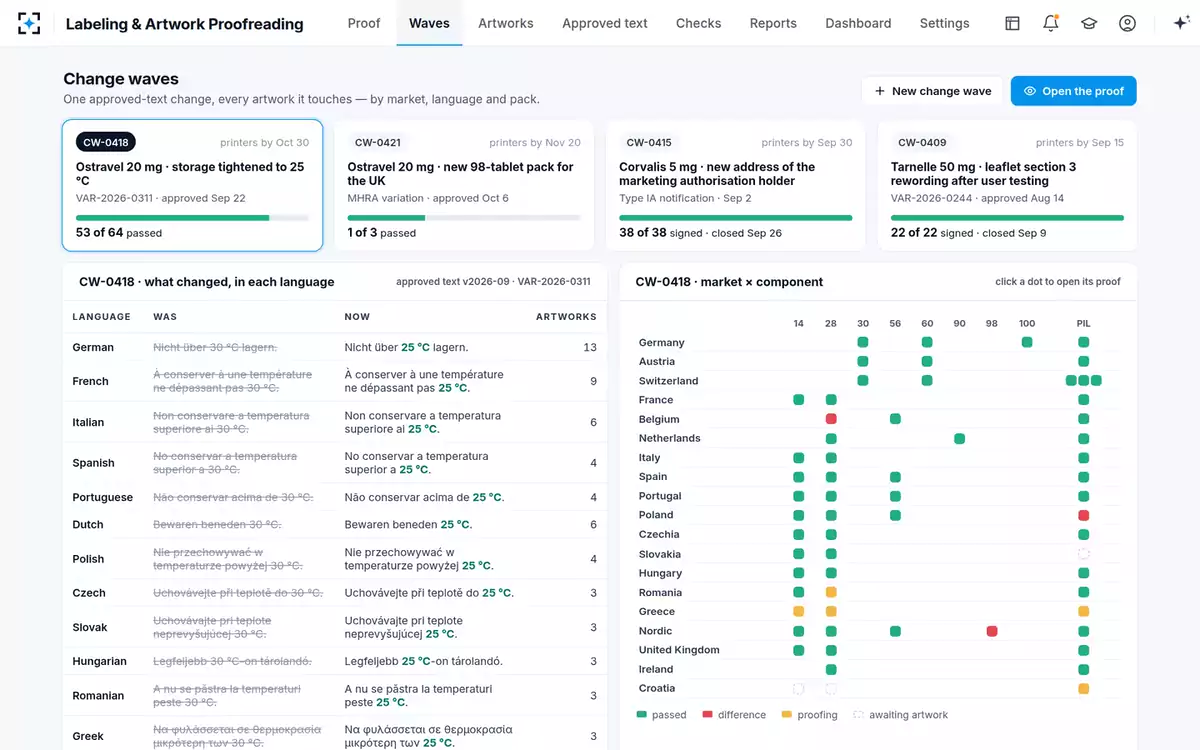
Worrying: a status. Ask for the artefact: what was compared, every difference and how it closed, every check with its result, and who signed.
- How does it behave when the file is awkward?
Worrying: a demonstration on a clean file. Bring your worst multilingual carton with outlined type and watch.
- What do we have to bring, and by when?
Worrying: “we’ll handle the data”. The list below is the real answer, and most of it is yours to produce.
What is artwork lifecycle management?
It is the management of an artwork as an object with a life: created from a brief, drawn, reviewed, corrected, approved, printed, superseded and retired. The lifecycle framing matters because the expensive problems in pharmaceutical packaging are not creation problems; they are state problems. Which version is current in this market. Which version was printed on the batch now in the warehouse. Whether the component in the stockroom is still the approved one. Whether the leaflet and the carton agree.
The regulations say the same thing in their own vocabulary. EU GMP Chapter 5 treats printed packaging material as a controlled material rather than a design asset: it asks for particular attention to printed materials, storage secure enough to keep out unauthorised people, and cut labels and loose printed items kept and moved in separate closed containers so they cannot be mixed up. A system that tracks files and not states is tracking the easy half.
What does an artwork lifecycle system do?
Five things, well, and one thing not at all.
It holds the briefs and the versions, so there is one place that knows what was asked for and what came back. It routes work, so a file moves from the house that drew it to the people who have to look at it, with due dates attached. It collects approvals and holds the electronic signatures. It keeps the history, so a question asked two years later has an answer. And it holds the relationships: which supplier draws which product family, which printer prints which pack.
What it usually does not do is read the artwork. The review step in a lifecycle system is typically a person looking at a PDF with markup tools, sometimes helped by a version compare. That is why the categories are bought separately and should be evaluated separately: a lifecycle system's quality is judged on how little friction it adds; a proofreading method's quality is judged on what it can prove. Four ways to prove a carton, compared is the other half of this decision.
A system of record, against a proofreading method — and why Labeling & Artwork Proofreading is the second
An artwork management system: Where is this file, what state is it in, who has it, who approved it, and what did it look like in 2024?
A proofreading method: Does this file say what the approved labelling text says, and do its code, Braille and type size pass?
An artwork management system: Briefs, versions, tasks, due dates, suppliers, printers, approvals, signatures, history.
A proofreading method: Approved text as versioned statements, severity rules, the ignore list, market minima, and a cited result per artwork version.
An artwork management system: That a process was followed and by whom.
A proofreading method: That the content was compared, against what, and with what result.
An artwork management system: Whether the words are right. A file can pass every step of a perfect workflow with 30 °C on a panel that should read 25 °C.
A proofreading method: Where the file is, who owes what, or whether the printer has the latest version. It is a check, not a work manager.
An artwork management system: The coordinator, the supplier and anyone chasing status.
A proofreading method: The labelling lead who signs, the quality reviewer, and whoever has to answer a question about a pack two years later.
An artwork management system: The proof stays manual, so the cycle time stays where it is and the errors it misses stay missed.
A proofreading method: Status stays in a spreadsheet, which is survivable for one product line and painful across a portfolio.
The five things such a system has to hold
Approved labelling text as statements, not documents. A PDF attached to a record is a document; what a check needs is a set of statements with a version, a language, a market and the variation that approved them, mapped to the panels and leaflet sections that carry them. This is the single biggest difference between a system that can prove something and one that can only store things.
Artwork versions, with the file that was actually printed. Not the latest file, not the approved brief, but the version released to the printer, and which batches used it.
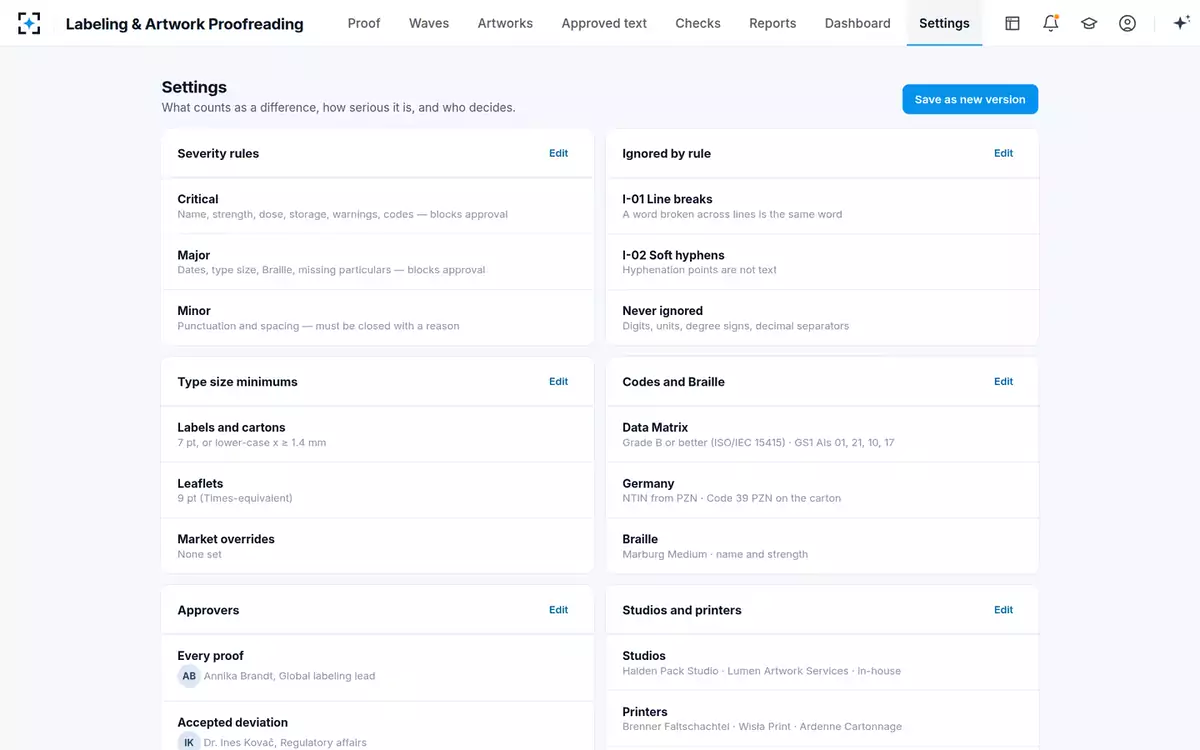
The rules, versioned. Severity grading, the ignore list and what is never ignored, type-size minima and market overrides, code grade and fields, Braille standard. These are the company's quality decisions. They must be changeable by the company and they must be versioned, because a signed proof has to keep the rules it was run under — otherwise an old proof report means whatever today's settings say.
Suppliers and printers, as qualified parties. EU GMP is explicit that “the selection, qualification, approval and maintenance of suppliers of primary and printed packaging materials shall be accorded attention similar to that given to starting materials.” A contact list is not that.
One artefact per approved artwork version. A signed proof report naming what was compared, every difference and how it closed, every check with its result, and who signed. If the system holds everything else and not this, every question later is answered by reconstruction.
A sample year in Labeling & Artwork Proofreading
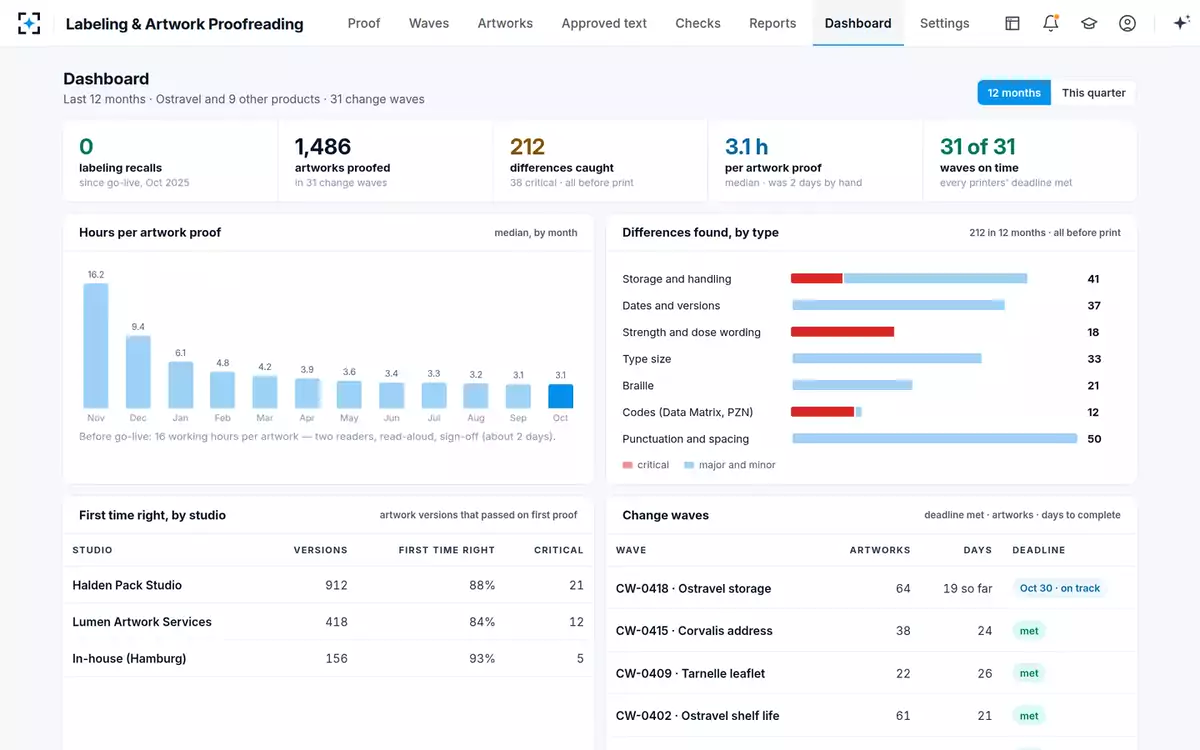
31change waves
one approved-text change each, fanned out to every artwork that carried it
1,486artworks
proofed against their approved text across ten products and twelve months
212differences
caught before print, 38 of them critical — the measure a buyer should ask to see
What it must connect to, and in which direction
Direction matters more than the connector list, because a connection that pushes where it should pull creates two sources of truth.
In, from regulatory affairs: approved labelling text per market and language, with its version and the variation it came from. Pull, always, and never editable downstream.
In, from the artwork house: print-ready PDF of cartons, labels and leaflets. Out, in the same channel: new versions requested, returns sent back with the difference marked and a reason.
In, from the item master: product codes and national codes the Data Matrix is checked against. Pull from the system of record for product data, not a spreadsheet copy, or the first disagreement will be read as an artwork error.
In, as rules: code and Braille and type-size rules, which look like configuration and behave like controlled documents.
Out, to printers: release only with a signed proof report, and the printer's proof back for signature at the press check. This is the direction people under-specify, and it is the one with a regulation behind it: 21 CFR 211.130(d) requires “examination of packaging and labeling materials for suitability and correctness before packaging operations, and documentation of such examination in the batch production record”.
A sixth connection is often forgotten: to whoever plans labelling changes. A portfolio programme — a new marketing authorisation holder address, a safety update, a code-format change — is the case where a wave is worth more than a workflow. The 12-digit NDC programme is a portfolio change every US labeler faces.
What data does an artwork system need on day one?
More than a supplier's implementation plan usually says, and most of it is yours. The table below is the honest list, with where each item normally lives and why it is harder than it looks.
What you bring on day one
Approved labelling text, per market and language, versioned
Where it lives todayRegulatory affairs, usually in a submission system or a set of documents attached to variations
Why it is hardText that exists as a document is not text that a check can compare against. It has to be statements, with the version and the variation they came from.
Print-ready artwork for every pack
Where it lives todayThe artwork house, and a shared drive; sometimes only the house has the current one
Why it is hardFinding the file that was actually printed, rather than the last one someone saved, is often the longest task in the whole project.
The item master: product codes, national codes, pack sizes
Where it lives todayERP, and a spreadsheet maintained beside it
Why it is hardThis is what a code on a carton is checked against. If it disagrees with ERP, the check reports a difference that is really a data problem.
Severity rules, and what is never ignored
Where it lives todayNowhere written down; it lives in the heads of two or three proofreaders
Why it is hardWriting them down is the most valuable week of the project, and the one most likely to be skipped.
Type-size minima by market, and the market overrides
Where it lives todayThe readability guideline, plus national rules and a long memory
Why it is hardOverrides are the detail that decides whether a Belgian or a Greek carton passes, and they are rarely in one list.
Code and Braille rules: grade, fields, standard, exemptions
Where it lives todayPackaging technology, and the safety-features documentation
Why it is hardWhich packs are exempt, and which carry a national code as well, is pack-by-pack knowledge.
Approvers, artwork suppliers and printers
Where it lives todayThe quality system and the procurement system, separately
Why it is hardApprover roles have to match the signatures the quality system expects, not the job titles people use.
One item on that list deserves its own paragraph. Writing down the severity rules — what makes a difference critical rather than major, what may be ignored, what may never be ignored — is the task projects tend to defer, and the one that costs most when they do. It cannot be delegated to a supplier, because it is a quality decision about your own products. Done early, it makes every later argument short: a difference arrives already graded, and the discussion is about the artwork rather than about the rule.
The rules, as settings the company owns
Is an artwork system a GMP system?
It depends what it touches, and the honest answer for most companies is “partly, and the part that is matters”.
Nothing in GMP regulates the drawing of artwork. What is regulated is printed packaging material and the operations that use it. 21 CFR 211.122(a) requires written procedures covering the receipt, identification, storage, handling, sampling, examination and testing of labelling and packaging materials, and 211.122(c) requires records for each shipment received. EU GMP Chapter 5 requires printed materials to be stored securely, issued only by authorised personnel, reconciled, and destroyed when superseded. A system whose output is the release of a component to a printer, or the record of the examination before packaging, sits inside that perimeter whatever it is called.
Where a model is embedded in such a system, the draft Annex 22 on artificial intelligence — a consultation text published in July 2025, not law — adds the model-specific expectations on top of the existing ones for computerised systems: an intended use described in advance, acceptance criteria set before testing, independent test data, change control before deployment, and monitoring for drift in the input data once it is running. For artwork, drift is concrete: a new artwork house, a new language, a new export setting from a design tool.
Practically, scope it the way you would any computerised system: which records it creates, which decisions depend on it, and what happens if it is wrong or unavailable. Then validate that, rather than the brochure.
How to run a pilot on your own cartons
A demonstration on a supplier's file proves nothing. A pilot has to run on packs you recognise, with the people who will do the work, and it should be scoped tightly enough to finish.
Pick one product with a real multilingual carton, one leaflet, and one market with an awkward rule. Take six artworks: two clean, two with known historical errors you still have the evidence for, and two awkward files — outlined type, a placed image block, a Braille layer drawn as shapes. Supply the approved text as it actually exists in your company, not a tidied version, because tidying it is the work you are trying to size.
Then measure four things and nothing else: what it found against what you know is in those files; how long each proof took from file to signed report; what the output names for each difference; and how much of the week went into getting the inputs ready. The fourth is the number that predicts the project, and it is the one a supplier's estimate is least likely to include.
A pilot and a rollout, drawn to scale
- Rules and inputs5 w
- Six artworks3 w
- Load the market4 w
- A live change, end to end8 w
- Onboard by change volume24 w
- Measure by supplier8 w
How do you measure whether it worked?
Four measures, and they should be visible to the people doing the work rather than assembled for a steering committee.
Hours per proof, by month. The cycle time of one artwork from file to signed report. It is the measure that moves first and the one people believe.
Differences by type and severity. Not a total. A falling total can mean the artwork got better or the check got weaker; a severity mix tells you which. If critical differences stop appearing entirely, test the check with a seeded file before celebrating.
First time right, by supplier. Attributed, or it changes nobody's behaviour. A house can act on its own number; a blended figure tells no one anything. What first time right should be measured against works through the three definitions in use.
Every wave against its deadline. The only measure the business actually feels, because it is the one that answers whether the change landed on the date.
The measures, on one screen
The six months after go-live
The project ends and the system starts, and four things happen in the first half-year that nobody plans for.
The ignore list gets argued about. Early proofs produce differences that are not errors — a soft hyphen, a line break, a non-breaking space — and the pressure to ignore more is immediate. Hold the line on the category that is never ignorable: digits, units, degree signs and decimal separators. A wrong storage temperature, strength or decimal lives in that category.
A supplier's output changes. A new designer, a new export setting, a new template, and suddenly a file that used to extract cleanly does not. This is the drift the draft annex asks to be monitored for, and in practice it shows up as a sudden rise in items escalated to a person.
The first deviation is requested. Somebody needs a carton to print with a known difference, under deadline. The system's value in that moment is that the path exists and is narrow: a reason, approved by regulatory affairs, recorded against the proof. If the first deviation is handled by an exception, the second one will be too.
Somebody asks about a pack from before go-live. Decide early how far back you will load history, and be honest that artworks approved before the system have a proof report that is a signature and a folder, not a cited report.
One last framing, from the regulator's own vocabulary. The Commission's packaging-information guideline describes a mock-up as a full-colour copy of the flat artwork that, once cut and folded, reproduces the outer and immediate packaging so the labelling text can be seen in three dimensions. A flat file that folds into a real pack is exactly the object an artwork system manages and a proofreading method reads — and the reason both matter is in that last idea: what the patient sees is a three-dimensional object assembled from panels that each have to be right.
One signed report per approved artwork version
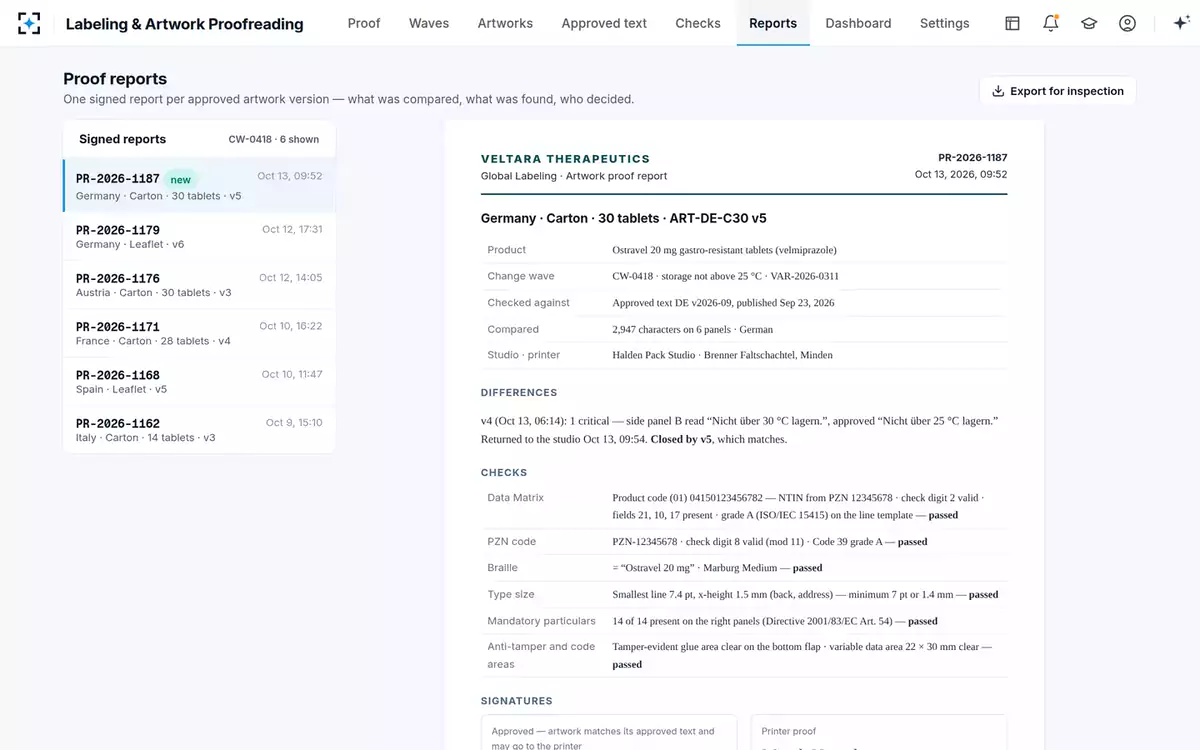
Change waves, each against its own deadline
To see the rules, the proof and the signed report on one carton, start from Labeling & Artwork Proofreading; for who carries each step of it, the seats in a labelling change.
Questions people ask
Do I need an artwork system or a proofreading tool?
They answer different questions. A system of record answers where a file is, who has it and who approved it; a proofreading method answers whether the words on it are the approved words and whether the code, Braille and type size pass. Many companies need both. The failure mode to avoid is buying the first and assuming the review step inside it does the second's job — that step is usually a person looking at a PDF.
What should an artwork system integrate with?
Approved labelling text from regulatory affairs, pulled and never editable downstream; the artwork house, in both directions, for new versions and returns; the item master for the codes a Data Matrix is checked against; and the printers, in one direction only, with release conditional on a signed proof report. Add whoever plans labelling changes, because a portfolio change is a wave rather than a queue of files.
How long does it take to implement an artwork system?
The configuration is rarely the long pole. More often it is getting approved text into a shape a check can compare against, and writing down severity rules that currently live in two or three people's heads. Plan a pilot of about eight weeks on one product, one live market change over the following quarter, then the portfolio by family — and size the data preparation from the pilot, not from an estimate.
Is an artwork system a GMP system?
The part that touches printed packaging material usually is. GMP regulates the receipt, storage, handling and examination of labelling and packaging materials and the release of components to packaging operations — not the drawing of artwork. Scope it by what records it creates and what decisions depend on it, then validate that, and treat any embedded model as an additional layer on top of the normal expectations for a computerised system.
How do you measure whether it worked?
Hours per proof by month; differences by type and severity, never a bare total; first time right attributed to each supplier; and every change wave against its deadline. Pair the severity mix with an occasional seeded file, because a falling difference count can mean better artwork or a weaker check and the count alone cannot tell you which.
What data do you need before the first proof?
Approved labelling text per market and language with its version and variation; the print-ready artwork that was actually printed; the item master for product and national codes; your severity rules and the list of what is never ignored; type-size minima with market overrides; code and Braille rules; and the approvers, artwork suppliers and printers. Six of those seven already exist somewhere in the company — the work is making them usable, not finding them.