Artwork approval software is the system that routes a carton, label or leaflet from the approved labelling text to the printer: who drafts, who checks, who approves, and what is recorded at each step. It is bought as a routing system and judged as a control, which is why the feature list matters less than one question — which steps may a machine take without a person, and who still signs. Pharmaceutical packaging makes that question sharp, because the artwork carries statements a regulator approved and an error reaches patients. Europe's draft rule for artificial intelligence in medicines manufacturing draws the line in three clauses: it covers trained models with a deterministic output used in critical applications, it sets their acceptance criteria at least as high as the process they replace, and it says generative AI and large language models should not be used in critical applications at all — with qualified, trained people responsible for their output where they are used in non-critical ones. Botminds' Labeling & Artwork Proofreading is built on that division, and this guide walks a labelling change task by task to show where the line falls.
Two honesty points before the argument. The draft Annex 22 quoted throughout is a public consultation text from July 2025, not law, and nothing here should be read as a settled requirement. It addresses models embedded in computerised systems used in the manufacture of medicinal products and active substances; artwork proofreading sits beside that boundary rather than squarely inside it, so this page is reading across deliberately and says so each time. The worked change is fictional sample data, and no regulatory approval, qualification or inspection history is claimed for any software here.
One labelling change, and what actually moved
6agents
read, compare, check and draft on one change wave — and not one of them approves anything
0decisions
moved from a person to a machine: every judgement in the list below is still somebody’s
2signatures
before a carton ships: the labelling lead on the proof, packaging quality on the printer’s proof
July 2025
the draft Annex 22 on AI in GMP manufacturing went out for public consultation — a draft, not law
What is artwork approval software?
Three different products are sold under the phrase, and a buyer who does not separate them will compare prices for unlike things.
The first is a review and markup tool: a place to put a PDF, draw on it, comment, and collect approvals. It is useful and it proves nothing about the content — the approval records that people looked, not that the carton matches its approved text.
The second is a workflow and system of record for artwork: briefs, versions, tasks, suppliers, due dates, an audit trail and an electronic signature at the end. This is what most artwork lifecycle systems are, and it answers where a file is and who has it. What such a system holds, and what it cannot check, is a guide of its own.
The third adds the content check to the approval: the artwork is compared with its approved labelling text before a signature is possible, and the signature carries the result. That is the category this page is about, because it is the only one where the question “which steps may a machine take?” arises at all.
Who signs off artwork in an approval workflow?
In practice, a short chain with one owner. Regulatory affairs owns the approved labelling text and the variation it came from. An artwork coordinator owns the brief and the relationship with the house that draws the file. A labelling lead owns the proof and approves it. Packaging quality signs the printer's proof at the press check. The Qualified Person does not approve artwork, but inherits the consequence of it — the MHRA's best-practice guidance expects approved packaging components to reach packed stock being certified for release within six months of approval.
Nothing in that chain is created by software, and nothing in it is removed by software. The regulations that name people in labelling control name them for the packaging line rather than the artwork file: 21 CFR 211.122(g) requires one of four special control procedures for cut labeling, among them a 100-percent examination by appropriate equipment or, for hand-applied labelling, a visual inspection performed by one person and independently verified by a second. The principle carried into the artwork step is that the check is independent of the person who made the thing being checked. Who checks labelling artwork, seat by seat maps the whole chain.
Every task in one labelling change, re-divided between agents and people
The useful way to evaluate artwork approval software is not to read its feature list but to write down the tasks your own labelling change contains, and then ask, for each one, who does it now, who would do it after, what checks the output, and who signs. Done honestly the exercise is uncomfortable, because most of the tasks turn out to be mechanical and most of the decisions turn out to be few.
One labelling change, task by task: who did it, who does it now, who signs
Finding every artwork that carries the changed statement
Who did itAn artwork coordinator, from a spreadsheet of presentations and a memory of which pack uses which file
Who does it nowA planner, from the approved text: every carton, label and leaflet carrying the statement, by market, language and pack
Who signsNobody signs the list; the labelling lead signs each proof it produced
Matching an artwork to the approved text version it is checked against
Who did itBy hand, at the start of each proof, from a folder name or an email
Who does it nowRefused as a starting condition: no proof opens without the approved text version it is checked against
Who signsRecorded on the proof report, not signed separately
Reading every panel of the print-ready file in reading order
Who did itA proofreader, panel by panel, with a ruler and a printout
Who does it nowAn extractor: live text and outlined text, in reading order, with font, size and position for every line
Who signsUnreadable content goes to a person rather than into the comparison
Comparing every character with the approved text
Who did itTwo readers and a read-aloud, in the language of the market
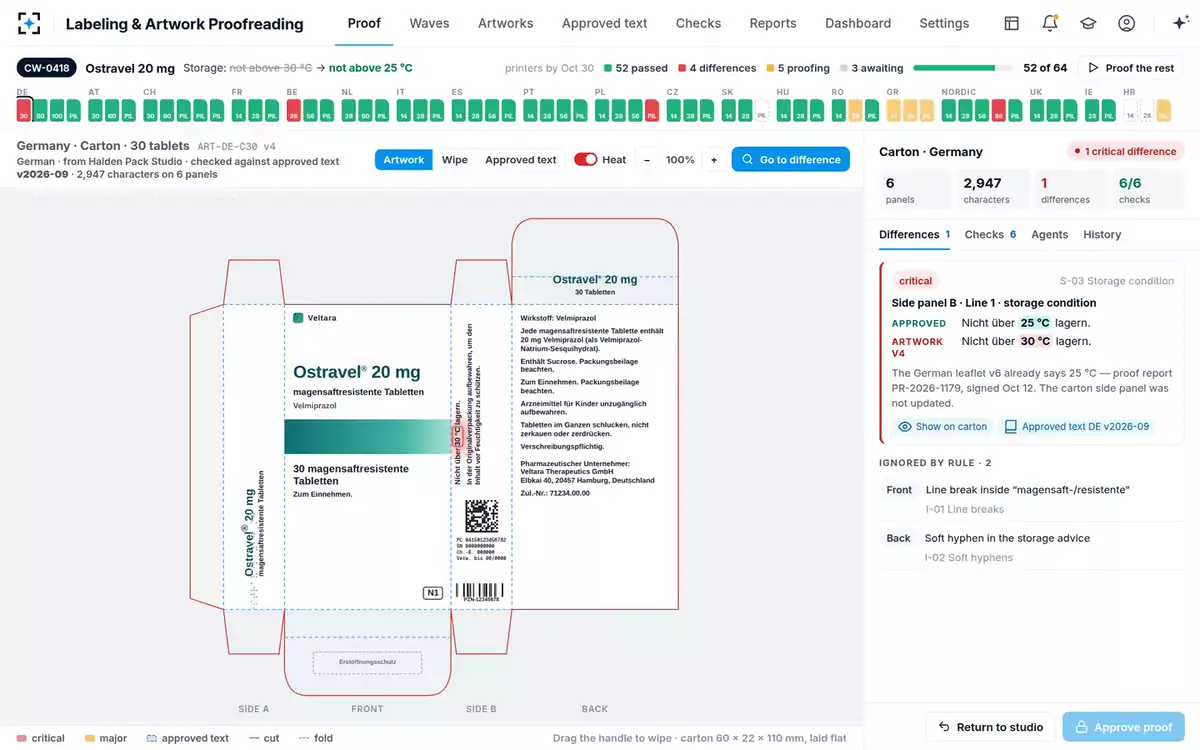
Who does it nowA comparer, character by character, citing the approved text version, the panel and the line for each difference
Who signsThe labelling lead reviews every difference before approving
Grading how serious a difference is
Who did itA judgement at the desk, written into an email
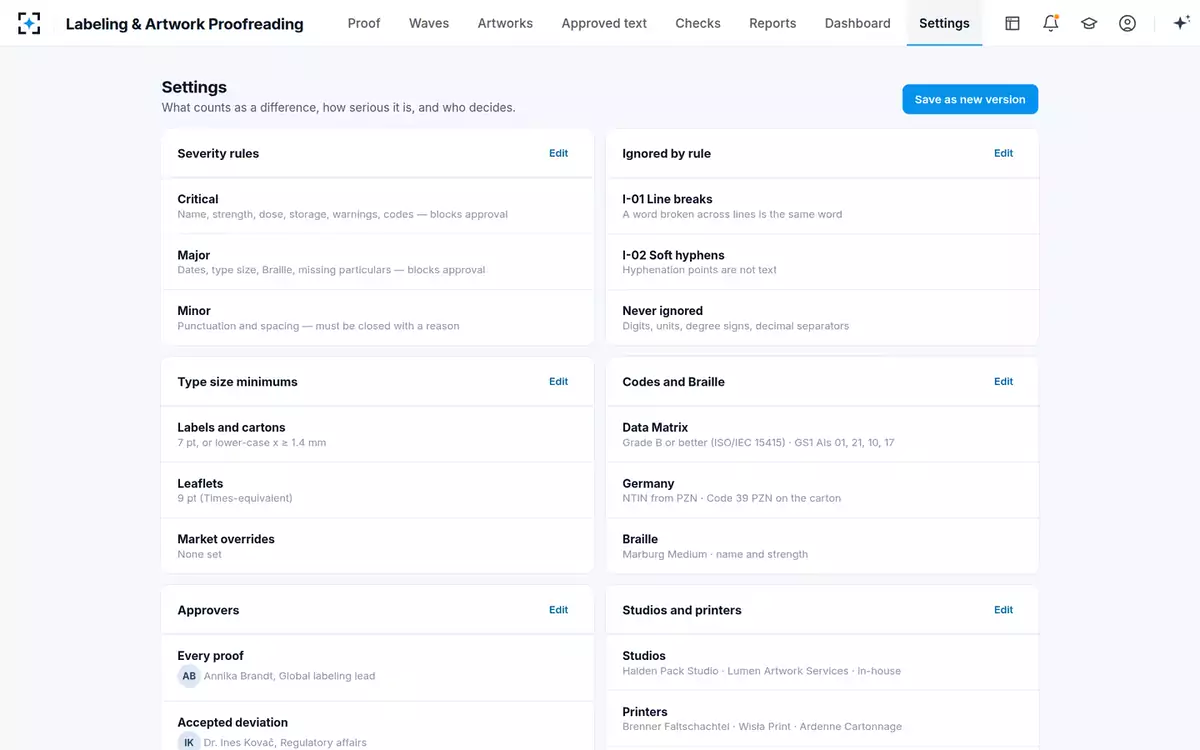
Who does it nowThe company’s own severity rules, applied consistently and named on each difference
Who signsThe rules are a versioned setting; quality owns them
Checking the code, the Braille and the type size
Who did itA scanner, a Braille reader if one was available, and a loupe
Who does it nowA reader and a layout checker: code decoded and checked against the set grade, Braille cells read, point size and x-height measured line by line
Who signsA code below the set grade does not pass; nobody can wave it through
Deciding whether a difference is accepted as a deviation
Who did itA person, usually under deadline pressure
Who does it nowA person — unchanged. No agent may dismiss a difference
Who signsRegulatory affairs approves the deviation, with the reason recorded
Returning the artwork to the house that drew it
Who did itAn email with a marked-up PDF
Who does it nowA return whose reason is required and pre-filled from the difference, sent with it marked on the proof
Who signsThe labelling lead sends it; approval stays locked while it is open
Writing the proof report
Who did itA person, afterwards, from notes
Who does it nowA writer, from the proof itself: what was compared, every difference and how it closed, every check
Who signsNever filed without the labelling lead’s signature
Approving the proof and releasing the artwork to the printer
Who did itThe labelling lead
Who does it nowThe labelling lead
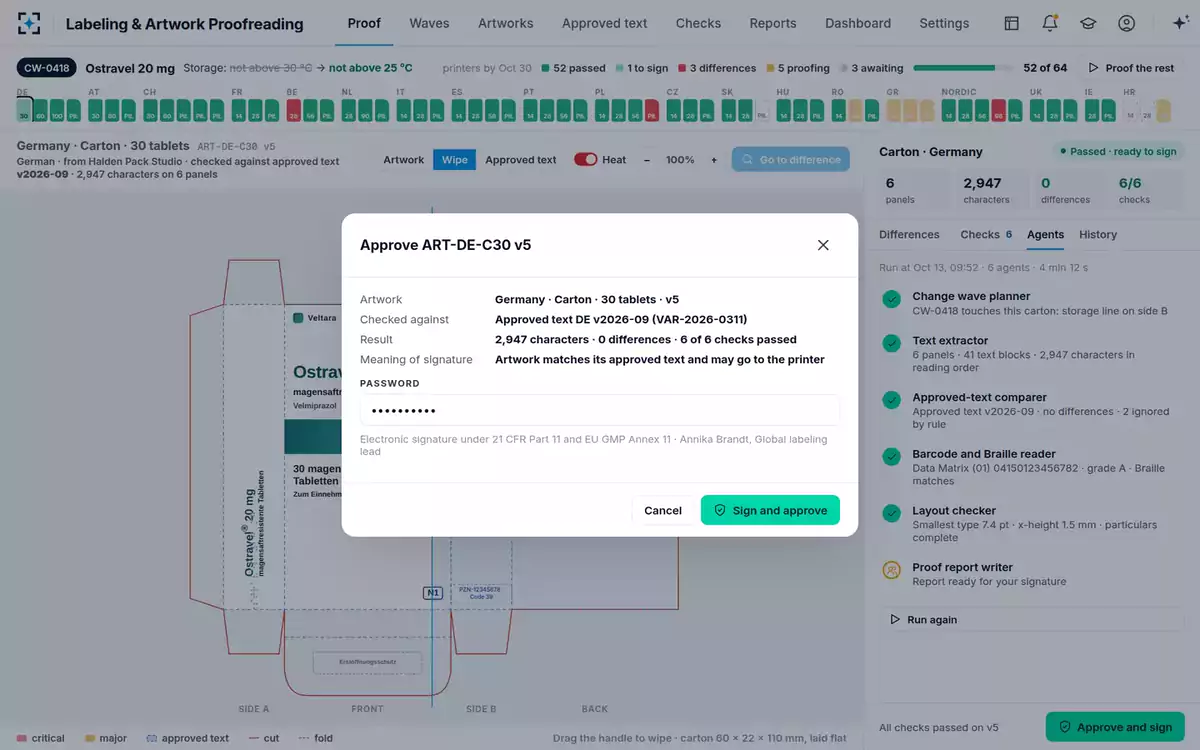
Who signsAn electronic signature that records its meaning: this artwork matches its approved text and may go to the printer
Signing the printer’s proof at the press check
Who did itPackaging quality, at the press
Who does it nowPackaging quality, at the press
Who signsUnchanged, and outside the software entirely
Two patterns are worth naming. The first is that every task an agent takes is a reading task or a measuring task — extract, compare, decode, measure, draft — and every task that stays is a judging task: is this difference acceptable, is this deviation justified, may this carton print. The second is that one task is removed rather than reassigned: matching an artwork to the approved text version it is checked against stops being work and becomes a precondition, because a proof cannot start without it.
Can AI approve artwork?
No, and the reason is worth stating precisely rather than defensively. Approval is not a classification; it is an assumption of responsibility. Somebody is saying that this carton may be printed and that they stand behind it, which is why the signature in a controlled system records its meaning rather than merely its time. A model can produce the evidence the signature rests on. It cannot be the signature.
The draft annex arrives at the same place from the other direction. Its scope covers models used “in critical applications with direct impact on patient safety, product quality or data integrity, e.g. to predict or classify data”, and it excludes several classes of model from critical applications entirely — dynamic models that keep learning in use, models whose output is probabilistic rather than deterministic, and generative models.
Following the above, the document does not apply to Generative AI and Large Language Models (LLM), and such models should not be used in critical GMP applications. If used in non-critical GMP applications … personnel with adequate qualification and training should always be responsible for ensuring that the outputs from such models are suitable for the intended use, i.e. a human-in-the-loop (HITL).
EudraLex Volume 4, draft Annex 22 (public consultation, July 2025), §1 Scope
For critical applications that paragraph is a prohibition, and it reaches further than the final decision: the draft keeps generative models and large language models out of critical GMP applications altogether, not just out of the signature. Where it allows them — in non-critical applications — it requires qualified, trained people to be responsible for the output. So the first question to put to any artwork tool that uses a language model is whether your quality system classes the proofing step as a critical application. If it does, the draft would keep such a model out of that step whoever signs afterwards; a design in which agents read, compare and draft and a named person decides is the shape the draft describes for non-critical use, not a way round it for critical use.
What the draft annex puts inside its scope, and what it keeps out of critical applications
In scope, with controls: Static machine-learning models with a deterministic output, which got their functionality by training on data, used to predict or classify.
Kept out of critical applications: Dynamic models that keep learning in use; models with probabilistic output; generative models and large language models.
In scope, with controls: A documented intended use, acceptance criteria set before testing, an independent test set, recorded test execution, and monitoring in operation.
Kept out of critical applications: If used at all, only in non-critical applications, with qualified, trained people responsible for the output.
In scope, with controls: With the regulated user, including for documentation produced by a supplier.
Kept out of critical applications: With the person in the loop, whose training and consistent performance are monitored like any other manual process.
In scope, with controls: Extraction, comparison, code decoding, grading and measurement can be described, tested and monitored like any other control.
Kept out of critical applications: Nothing that writes or accepts labelling text on its own, and no model deciding that a carton may print.
Is AI allowed in GMP?
There is no rule forbidding it, and there is now a draft describing how it would be controlled — which is a more useful answer than either “yes” or “no”. The draft annex's own framing is that it “provides additional guidance to Annex 11 for computerised systems in which AI models are embedded”: the existing expectations for computerised systems still apply, and the annex adds what is specific to a model that learned its behaviour from data rather than being programmed.
What follows for a buyer is a change of question. Instead of asking whether a supplier's software is allowed, ask whether what it does in your process is a critical application, what its intended use is in writing, and whether you could describe, test and monitor it the way you would any other control. A supplier who answers that with a certification claim rather than documentation has misunderstood the question: regulators do not certify proofreading software, and the company validates its own use of it.
What a model has to beat before it takes a task
The clause that decides most arguments is three lines long. Under the heading “No decrease”, the draft sets a model's acceptance criteria at no lower than the performance of the process the model replaces — and draws the consequence itself: the performance of that process has to be known first.
The second sentence is the expensive one. A labelling team can only state the measured performance of its current proofreading process if someone has counted what two readers and a read-aloud find and miss on a known set, and that count is rarely made. Without that figure there is nothing for a model's criteria to be “at least as high as”, and the comparison becomes a conversation about impressions.
The fix is small and worth doing before any procurement: take twenty retired artworks, plant a known set of differences across them — body text, digits, look-alike characters, a line below the type minimum, a dropped Braille character — and run your current process over them with the people who do the work. You now have a baseline, and a test set. What a baseline for two readers looks like works through the method. Everything downstream becomes easier: acceptance criteria stop being invented, supplier claims become checkable, and the decision to automate a task has a number attached to it.
The draft asks for two further things about that test set which are easy to get wrong. It asks that the data used to test a model be kept independent of anything used to develop, train or validate it, by procedural or technical means. And it asks for subgroups: the input space should be divided by characteristics that matter — for artwork, the script, the file construction, the number of languages on the panel — because a single blended score hides the subgroup you were worried about.
Human in the loop, written down as somebody's responsibility
“Human in the loop” has become a phrase people use to mean “a person is around somewhere”. The draft gives it a sharper meaning: where a model gives an input to a decision made by a human operator, and the effort to test the model has been reduced on that basis, “the description of the intended use should include the responsibility of the operator. In this case, the training and consistent performance of the operator should be monitored like any other manual process.”
Read that twice, because it cuts both ways. If you lean on the person to catch what the model misses, the person becomes part of the control, and a control has to be described, trained, monitored and recorded. The draft's operation section adds the record: where a model informs a human decision and testing was reduced accordingly, records should be kept, and depending on criticality this may mean a consistent review or test of every output.
In the solution that is concrete rather than rhetorical. Approval is locked while any difference is open, so the person cannot sign past an unresolved item. The labelling lead sees every difference with its citation, not a summary. A difference closes only when a new artwork version passes, or as an accepted deviation with a reason approved by regulatory affairs. And nothing reaches a printer without a signed proof report.
What the person is actually signing for
What an inspector will ask about the model
Nobody can promise what any inspector will ask, and the draft annex is not yet a standard anyone is inspected against. But its structure is a fair guess at the shape of the conversation, because it is what the assessors who wrote it think matters. The questions below follow its sections in order.
Have these answered before anyone asks
- What is the intended use, in writing, and who approved it?
The specific tasks the model assists or automates, the input it is meant to cope with, and its limitations — approved before acceptance testing began.
- What were the acceptance criteria, and when were they set?
Set before testing, by a process subject matter expert, and justified against the performance of the process being replaced.
- What was the test data, and how do you know it is independent?
Where it came from, how its labelling was verified, and the technical or procedural controls that kept it out of development and training.
- Which subgroups did you test separately?
For artwork: scripts, file construction, outlined type, multilingual panels, small packs. A blended figure is not an answer.
- What does the system do when it is not sure?
The threshold, and whether a low-confidence item is flagged as undecided and routed to a person rather than resolved.
- Who is responsible for the output, and how is that person monitored?
Named in the intended-use description, with training and consistent performance monitored like any other manual process.
- What documentation do you hold from the supplier, and who reviewed it?
The draft annex asks the regulated user to review it whether the model was built in-house or bought.
- What happens when the model, the system or the process changes?
Change control before deployment, an evaluation of whether retesting is needed, and a justification for any decision not to retest.
- How do you know it still performs?
Metrics monitored in operation, and monitoring for drift in the input data — new artwork houses, new languages, new file settings.
- Show me one carton, end to end.
The approved text version, the artwork version, every difference and how it closed, every check with its result, and the signature with its meaning.
The last item is the one that separates systems. A product that can produce one carton end to end — text, codes, Braille, type size, every difference with its citation, and the signature with its meaning — has answered most of the other nine by construction. One that produces a workflow history has answered none of them.
What to ask a supplier, and what to ignore
Ask for the three documents the draft annex asks the regulated user to review: the description of intended use, the acceptance criteria with their justification, and the test results with the test data characterised. Ask what the system refuses to do — a product with no written limits has not thought about this. Ask how your own severity rules, ignore list and type-size minima are configured, and what can never be ignored whatever the settings say; digits, units, degree signs and decimal separators should be in that second category. Ask what happens to a signed proof when the rules change afterwards: the honest answer is that a signed proof keeps the rules it used, and a rule change takes effect on the next proof.
Ignore, in return, three things. Ignore any claim of regulatory approval for a proofreading product, because regulators do not approve them; qualification and validation are the company's own work. Ignore accuracy percentages without a test set, a denominator and a subgroup breakdown behind them. And ignore comparisons in which a supplier characterises a competitor's method; the useful comparison is between methods on your own carton, which you can run yourself.
The rules are the company's own, and they are versioned
One proof, with every difference and every check in one state
The European Medicines Agency's own practice is a reminder of where the boundary of any of this sits: at authorisation it performs a general check of mock-ups and specimens from the point of view of readability, looking at layout, design, font sizes and differentiation between strengths (packaging information guideline, Rev. 14.9). Checking that a pack is readable, and checking that a carton matches the text it was approved with, are different jobs; software does the second, and people with a product in their hands do the first. To see the division on one carton, start from Labeling & Artwork Proofreading, and for the methods underneath it, four ways to prove a carton.
Questions people ask
Can AI approve artwork?
No. Approval is an assumption of responsibility, not a classification, which is why a controlled signature records its meaning. A model can produce the evidence an approval rests on — every character compared, every check run, every difference cited — and a named person still signs. The draft Annex 22 reaches the same place from another direction: it says generative AI and large language models should not be used in critical GMP applications at all, and that where they are used in non-critical ones, qualified and trained people stay responsible for the output.
What is human in the loop in GMP?
More than “a person is involved”. The draft annex says that where a model gives an input to a human decision and the testing effort was reduced on that basis, the intended-use description should state the operator's responsibility, and the operator's training and consistent performance should be monitored like any other manual process. In other words, the person becomes part of the control and is managed as one.
How do you qualify an AI model for a GMP task?
Describe the intended use and the input it must handle, set acceptance criteria before testing and justify them against the measured performance of the process being replaced, build a test set that is demonstrably independent of training and validation data, test by subgroup, record the execution, then put the model under change control and monitor it in operation. The sequence is the draft annex's; the hard part is usually the baseline.
What should be automated in artwork approval?
The reading and measuring: finding every artwork a change touches, extracting every panel in reading order, comparing every character with the approved text, decoding codes and checking them against the set grade, reading Braille cells, measuring type size and panel placement, and drafting the report. What should not be automated is every step that ends in a judgement — accepting a deviation, dismissing a difference, approving a proof, releasing to a printer.
Will AI replace regulatory labelling jobs?
On the evidence of what the tasks are, it changes their content rather than their number. The mechanical hours — matching, reading, measuring, transcribing — are the ones that move, and they are the hours nobody was promoted for. The work that remains is judgement under a deadline: which difference is critical, which deviation is acceptable, which supplier keeps sending the same error, and whether a pack may print.
Does artwork approval software need to be validated?
If it is part of a control in a regulated process, yes, like any other computerised system — and where a model is embedded in it, the draft annex adds the model-specific expectations on top of the existing ones for computerised systems. The practical minimum is a written intended use, acceptance criteria set in advance, an independent test set, recorded results, change control and monitoring in operation.