Read-aloud proofreading is the practice of having one person speak a text while a second follows the source, so that a difference is caught by ear as well as by eye — and on a medicine's carton or leaflet it is usually paired with a four-eyes rule and a signature. It is hard to defend not because anyone doubts that careful readers catch things, but because almost no company can say what its own readers catch: the method is folklore, written into standard operating procedures, and measured almost nowhere. Botminds' Labeling & Artwork Proofreading sits squarely in this argument — its approved-text comparer reads every character of a print-ready artwork against the approved text and cites the version, the panel and the line for each difference — and the honest case for it begins with knowing what the people do today.
This page therefore does three things. It states exactly what the rules require, which is narrower than the folklore. It gathers the published evidence on second-person checking, which is thinner than the practice deserves. And it gives you a way to measure your own readers in an afternoon, because a European draft rule on models in manufacturing would make that measurement a precondition rather than a nicety. Figures describing the solution come from a fictional sample company and its sample data; the research is linked where it appears.
Three numbers behind an unmeasured control
3.2%
of 690 observed clinical double checks turned up any inconsistency at all
Pfeiffer and colleagues, BMJ Open, 2020
135
US drug recall events in six years whose stated reason began "Labeling:"
our count of the FDA's own enforcement data, 2020–2025
45
of those 135 were a label mix-up — the single largest cause
Does reading aloud help proofreading?
Probably — and we could find no study that has measured it on pharmaceutical artwork. The mechanism people describe is plausible and specific: reading aloud forces a serial pass over every character, which defeats the eye's habit of taking a familiar block of text in at a glance. The Commission's own readability guideline leans on the same observation when it discourages large blocks of capitals: readers recognise a written word by its outline, it says, which is why long passages belong in lower case. A practice built on stopping word-shape recognition from doing the reading is working on a real effect.
What is missing is the measurement. Our search of the published literature found experimental work on label design and on confusable drug names, and observational work on double checking in clinical settings, and nothing that measures read-aloud proofreading of artwork against its approved text. That absence is not an argument against the practice. It is an argument against treating it as a known quantity — and, as the last section of this page shows, a European draft rule now makes that distinction consequential.
It is also worth being precise about what a read-aloud reaches. It reaches printed text in a language the two readers can pronounce. It does not reach the Braille, the two-dimensional code, the type size, the position of a particular on a panel, or a colour build. On a modern carton those are a large fraction of what can be wrong, and all of them sit outside the method entirely.
What the rule actually requires, and where
One rule, in one jurisdiction, names a second person — and it is about the packaging line, not the proofreading desk. Under 21 CFR 211.122(g), a company using cut labelling for immediate container labels or unit cartons must adopt one of four special control procedures: dedicating lines to a single strength of a single product; electronic or electromechanical 100% examination; visual 100% examination for hand-applied labelling; or an automated technique, such as differentiation by labelling size and shape, that physically prevents incorrect labelling from being processed. The second person appears only in the third.
Use of visual inspection to conduct a 100-percent examination for correct labeling during or after completion of finishing operations for hand-applied labeling. Such examination shall be performed by one person and independently verified by a second person.
21 CFR 211.122(g)(3), Materials examination and usage criteria
Read it as the regulation reads: a second person is the price of choosing the human option, where labelling is applied by hand, at finishing. It is not a general statement that two people must read a medicine's text, and it says nothing about how an artwork file should be proofed months earlier. Any company whose procedure cites this paragraph as the authority for its artwork read-aloud has cited the wrong paragraph.
The neighbouring sections set out the rest of the control, and they are worth knowing because they are where the trade-offs are visible. Labelling materials issued for a batch "shall be carefully examined for identity and conformity to the labeling specified in the master or batch production records", and reconciliation of issued, used and returned labelling "is waived for cut or roll labeling if a 100-percent examination for correct labeling is performed in accordance with § 211.122(g)(2)" — that is, by the electronic or electromechanical route, not the human one. The regulator has already priced the difference between a machine reading every unit and a person doing it: the machine buys you a waiver, the person does not.
In Europe the equivalent obligations sit in good manufacturing practice and are about the line rather than the file. On-line control during packaging "should include at least checking the following: i. General appearance of the packages; ii. Whether the packages are complete; iii. Whether the correct products and packaging materials are used; iv. Whether any over-printing is correct; v. Correct functioning of line monitors." Again: the correct materials, correctly over-printed. Nothing about how the materials came to be correct.
What is a 100 percent examination of labeling?
It is an examination of every unit, rather than of a sample, carried out during or after finishing operations to confirm that each one carries the right labelling. The phrase belongs to the packaging line, which is the main reason artwork teams misapply it. Four routes satisfy the requirement where cut labelling is used, and a company picks one: a dedicated line, machine examination, visual examination with an independent second person, or an automated technique that makes the wrong label physically impossible to process.
The distinction that matters for an artwork chain is between examining units and examining a design. A 100% examination confirms that the labels on the line match what the batch record specifies. It takes the specified labelling as correct. If the approved file itself carries last version's storage condition on one side panel, every pack will be examined, every pack will match the specification, and every pack will be wrong. The proofreading step is the only place that error can be caught, and no 100% examination will ever reach it.
That is worth saying because it reframes the whole argument about two readers. The desk proofread is not a redundant duplicate of a line control. It is the only check in the chain that compares the artwork with the source the regulator approved — which makes it both the most valuable step and the least specified one.
What the evidence on a second checker shows
The most useful published work comes from an adjacent task: nurses double checking prepared chemotherapy against the order. It is adjacent rather than identical, and the difference should be held in mind — but it is a rare case of somebody watching a second-person check happen, many times, and recording what it found.
The study observed 690 double checks on oncology wards and in ambulatory infusion centres at three Swiss hospitals. Its headline result: "In 22 of 690 double checks (3.2% of double checks), 28 chemotherapy-related inconsistencies were detected". The authors are equally direct about why the work was needed: "Double checking has long been performed to improve medication safety in catching errors, specifically in the preparation and administration of high-risk drugs such as chemotherapy. However, evidence of its effectiveness to do so has not been established satisfactorily to date."
Two findings inside that study matter more to an artwork team than the headline. Half of the inconsistencies "related to non-matching information between order and drug label, while the other half was identified because the nurses used their own knowledge" — that is, half of the value came from comparison and half from a trained person noticing that something was implausible. And 75% of the inconsistencies traced back to inappropriate orders: the second check was largely catching errors made much earlier, in a different step.
Transpose that to a proofreading desk and it suggests the split a labelling team should expect. The comparison half is mechanical — does this character match that character — and is the part a machine can do exhaustively. The knowledge half is a person noticing that a storage condition does not match the stability data, that a strength is expressed in a way this market does not use, that a pack size and a count do not agree. Those are judgements, and no character comparison produces them.
The literature on label design points the same way. A systematic review of strategies to avoid look-alike errors found sixteen studies, thirteen of them in a laboratory and three in a healthcare setting; of eleven evaluating Tall Man lettering, "in six studies, lower error rates were found for the Tall Man letter strategy; one showed significantly higher error rates", and the review concludes that "more evidence, especially from real-life setting is needed to support safe labeling strategies". Even the best-studied intervention in this area has a thin, mixed evidence base. A company's own read-aloud has none at all unless the company makes some.
The four kinds of difference a reader's eye is built to skip
Across the sample change wave, the differences that survived to a proof fall into four groups. They are not a psychological taxonomy; they are the categories that a careful reader, reading a familiar panel for the second time that week, is structurally unlikely to produce.
A number inside correct words. "Nicht über 30 °C lagern." is a grammatical, expected, entirely plausible sentence. So is the same line with 25. A reader checking whether the storage statement is present will find it present. Only a reader comparing character by character against the approved text will find it wrong. In the solution's settings this is why digits, units, degree signs and decimal separators sit on the never-ignored list, next to the two things that may be ignored — line breaks and soft hyphens, and nothing else.
A difference in a layer nobody can read. The Braille on a carton is approved text encoded into dots. A read-aloud does not reach it, and neither does a second reader. On the sample company's Nordic carton a dropped number sign turned a strength into letters, and the Braille check that would have caught it is a different kind of check entirely.
A measurement rather than a word. A Dutch line set at 6.5 points with a 1.2 mm x-height says exactly the right thing. Reading it aloud confirms the words. Nothing about the method asks how tall the letters are, which is why a type-size difference survives a proof that was done properly.
Something that did not change. The hardest class of all: a revision date left at the previous version, an address that moved, a legacy line on a panel that this change did not touch. A reader checking a change naturally reads the change. The sample company's Polish leaflet carried a revision date of 03/2025 instead of 09/2026 — a difference nobody was looking for, in a field that had been right for years.
The four-eyes sequence as it is really run, and what each step can see
A person decides
First reader works the panelsReads every panel of the proof against the approved text, in the language of that market, and marks what looks wrong.
A person decides
Read-aloud with a second personOne speaks, one follows the source. Catches printed characters in a language both can pronounce; cannot reach Braille, codes, type size or panel position.
A person decides
Second reader verifiesIndependently confirms the first reader's work — the step the US rule names, for hand-applied labelling on the line rather than for a file.
Agent
Character comparison against approved textCompares every character on every panel with the approved text for that market and language, grading each difference and citing the version, panel and line.
Never: Never dismisses a difference, and ignores nothing beyond the ignore list
Agent
Code, Braille and type-size checksDecodes the code and the Braille cells, and measures point size and x-height on every line against the market minimum.
Never: Never passes a code below the set grade, and never moves or resizes anything
A person decides
The labelling lead decides and signsReads what was found, judges what it means, returns the artwork or approves it with an electronic signature that records the meaning of the signature.
How do you measure proofreading accuracy?
By counting what your readers find against what was actually there — which means you have to know what was actually there, which means planting it. There is no way around this. A company cannot infer its own detection rate from the errors it happens to catch, because that sample contains no information about the errors it did not.
Public data gives you the other half of the picture: what reaches the market when a chain fails. The FDA publishes its own enforcement reports, and the field describing the defect is documented as "reason_for_recall: Information describing how the product is defective and violates the FD&C Act or related statutes". Many of those reasons are written in the agency's own classification, beginning "Labeling:" followed by a cause.
We counted them. Over report dates from 1 January 2020 to 31 December 2025 the data holds 6,074 enforcement report rows; 211 of those rows have a reason beginning "Labeling:", and because one recall event usually produces several product rows, collapsing them by event identifier gives 135 distinct recall events. Grouping those 135 by the cause the agency named gives the shape below. The counts have been steady year to year — 23, 26, 21, 24, 21 and 20 — and 33 of the 135 included at least one product classified Class I, the agency's most serious category.
What 135 labelling recall events were actually about
Read that chart as a map of where the chain breaks rather than as a verdict on proofreaders. The largest category, a label mix-up, is a line and materials-control failure — the right words on the wrong product — and it is the one the four special control procedures of 211.122(g) exist to prevent. Lot and expiry errors are variable data applied at packing. Declared strength and missing warnings are closer to the proofreading desk. A desk that reads cartons has very little influence on 45 of these 135, and a great deal of influence on perhaps 20.
A seeded-error test you can run in an afternoon
The measurement your own chain needs is a seeded-error test: a known set of planted differences, read by your actual readers under your actual conditions, with the result written down. It is cheap, it is uncomfortable, and it is the only thing that converts an opinion about your proofreading into a number.
The seeded-error test, step by step
- Take a real artwork and its real approved text
Not a specimen built for the test. The familiarity of a panel is part of what you are measuring.
- Plant ten differences across the four classes
Two or three digits inside correct sentences; one unit or degree sign; one date that should have changed and did not; one legacy line on a panel the change did not touch; one too-small line; one Braille or code difference; two differences in a language the reader does not speak.
- Record what each planted difference is, before anyone reads
Write the list down and seal it. A list reconstructed afterwards is not a baseline.
- Run your normal method, with your normal people, at a normal time of day
First reader, read-aloud, second reader, sign-off — unchanged. A test run by your best reader on a quiet Friday measures nothing you can use.
- Record detections and the time each reader took
How many of the ten were found, by whom, at which step, and how long the whole proof took. The time is half the number.
- Repeat on a second artwork with a different planted set
One run on one carton is an anecdote. Two or three give you a range you can quote.
- Write down the result as a baseline, with its date and its conditions
This is the figure any future change — a new procedure, a new supplier, a new tool — has to beat. Without it there is nothing to beat.
Two things are worth watching for when you run it. The first is how much of the detection rate is carried by the reader's familiarity with the product rather than by the method — the knowledge half the clinical study found. The second is how long a proper proof actually takes. The fictional sample company's own estimate, for an artwork proofed by hand, puts about four of roughly sixteen working hours into the second reader and the read-aloud alone, against a design target of half an hour for the same step with agents doing the comparison. Those are an estimate and a target for the sample company's own work, not measured customer results — but the shape of them is familiar to anyone who has sat through the method.
What a regulator expects you to know before a model takes the task
This is where an unmeasured control stops being a quiet habit. The European Commission's draft Annex 22 on artificial intelligence in good manufacturing practice, issued for public consultation in July 2025, sets an acceptance rule that reaches straight back into the old process.
The acceptance criteria of a model, should be at least as high as the performance of the process it replaces. This implies, that the performance should be known for the process which is to be replaced by a model
EudraLex Volume 4, draft Annex 22 (public consultation text), §4.3 No decrease
The second sentence is the one with teeth. A company that cannot state what its two readers catch cannot set acceptance criteria for anything that replaces them, and therefore cannot demonstrate that it has met this expectation. The draft is a consultation text and not yet in force; treating it as a prompt to measure now is considerably cheaper than treating it as a problem later.
Its scope is also narrower than the word "AI" suggests. The draft covers models with a deterministic output — identical inputs, identical outputs — and says that generative AI and large language models should not be used in critical GMP applications at all, and that where they are used in non-critical ones, qualified people stay responsible for the output. A buyer should therefore ask any proofreading tool, this one included, which steps are a deterministic character comparison and which use a language model, and should keep every decision on a difference with a named person.
The same draft is specific about how performance should be expressed. "Suitable, case dependent test metrics, should be defined to measure the performance of the model according to the intended use. As an example, suitable test metrics for a model used to classify products (e.g. 'accept' or 'reject') may include, but may not be limited to, a confusion matrix, sensitivity, specificity, accuracy, precision and/or F1 score." A seeded-error test produces exactly the raw material those metrics need — true positives, false negatives — for the human process as well as for the model.
And it is specific about keeping the test honest: "Effective measures consisting of technical and/or procedural controls should be implemented to ensure the independency of test data, i.e. that data which will be used to test a model, is not used during development, training or validation of the model." The artwork equivalent is straightforward and easily broken: the files you measure your readers on, and the files you use to demonstrate a tool, should not be the files anyone tuned the rules against.
What the second reader should be doing instead
The claim worth making for a character comparison is narrow and checkable: it reads every character, it never tires, it cites the approved text version and the panel for every difference it reports, and it is configured to dismiss nothing. The claim not worth making is that it is more accurate than two careful readers, because nobody has measured either side properly — which is precisely the point of the last two sections.
What the division does change is where the people's hours go. If the comparison half of the work is exhaustive and cited, the second reader's time is freed for the half that the clinical study attributed to the nurses' own knowledge: is this plausible, does it agree with the rest of the pack, does this market express a strength this way, does the leaflet say the same thing as the carton. The sample company's estimated split shows the shift bluntly — about four hours on the second reader and the read-aloud before, a target of about half an hour after, with the saved time not disappearing but moving to differences that need a decision.
A difference presented as a decision, not as a flag
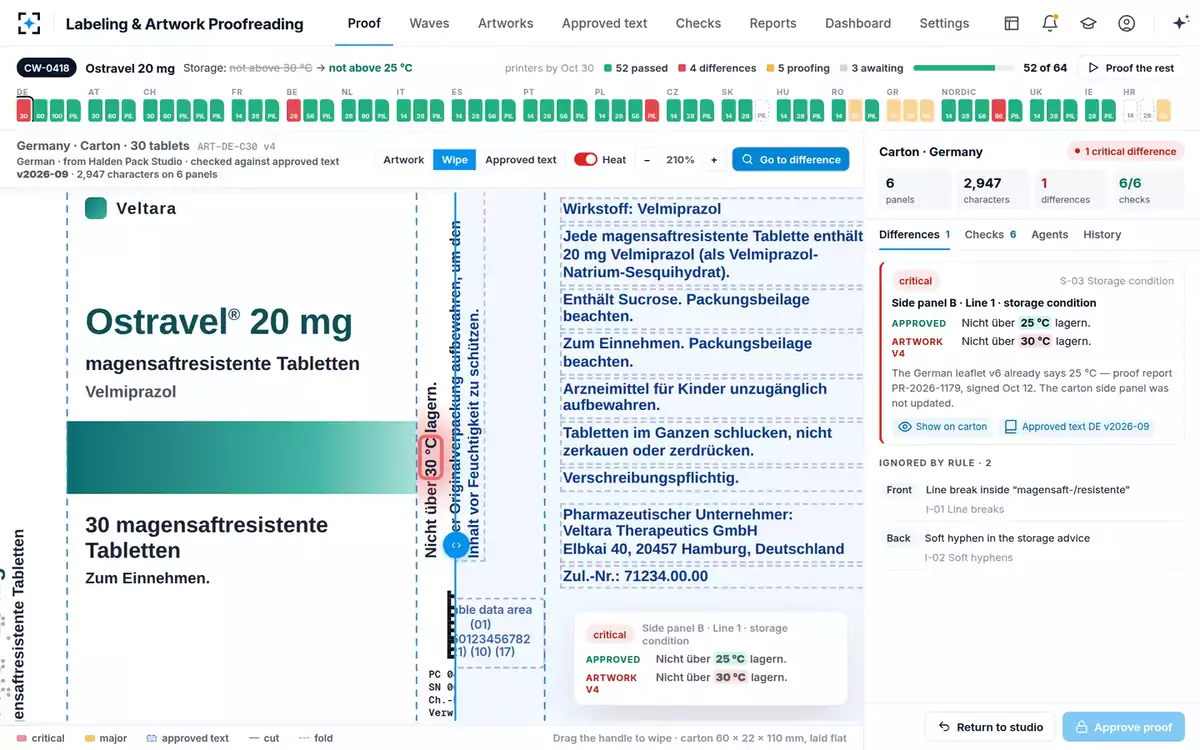
The governance around that is the part a quality manager should look at hardest. A difference closes only two ways: a new artwork version that passes, or a deviation accepted with a written reason by regulatory affairs. Approval stays locked while a difference is open. The comparer is configured never to dismiss a difference and to ignore nothing beyond the ignore list. None of those are statements about accuracy; they are statements about who is allowed to make a problem go away, which is a different and more auditable property.
The signature, and what it is a signature for
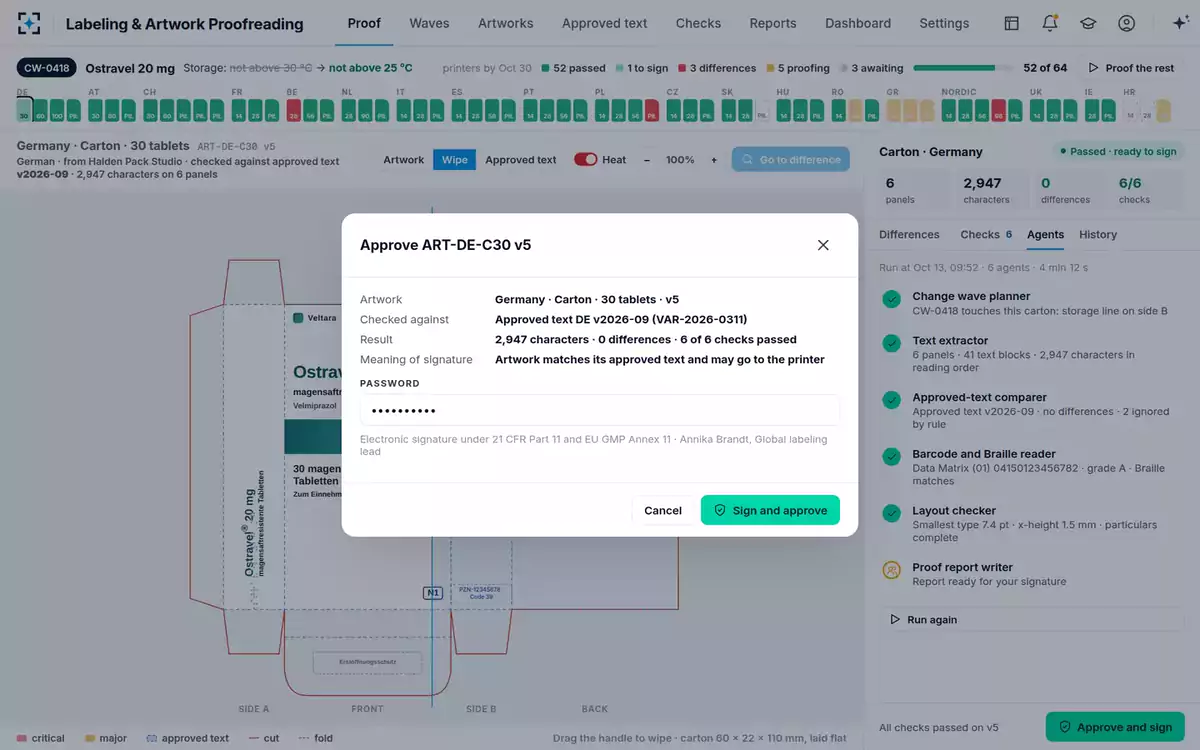
The re-proof, where a second version earns its approval
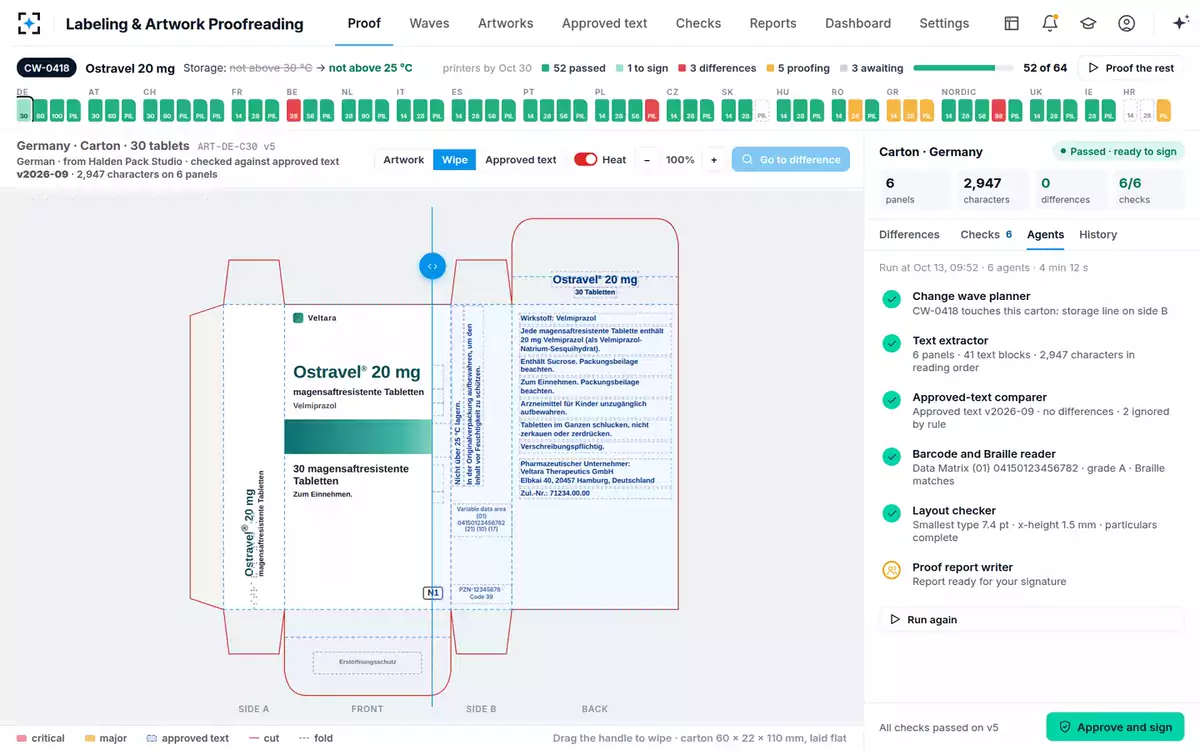
The conclusion is not that read-aloud proofreading should stop. It is that a company which cannot say what its readers catch is holding an unmeasured control at the single point in the chain where the approved text and the printed object are compared — and it will not be able to judge anything that is offered to replace it, including this one. Measure the method first. For what each returned artwork costs while that measurement is still missing, see what sends a carton back; the solution itself is at Labeling & Artwork Proofreading.
Questions people ask
What is the four-eyes principle in pharmaceutical labelling?
It is the convention that a second person independently verifies a first person's work before it is accepted. In labelling it usually means a second reader on every artwork proof, often with a read-aloud. The only place it appears in the rules for labelling is 21 CFR 211.122(g)(3), where visual 100% examination of hand-applied cut labelling must be "performed by one person and independently verified by a second person" — one of four alternative control procedures, on the packaging line. Everything a company does at the proofreading desk is its own control.
Do two people have to check a drug label?
Not as a general rule. A company using cut labelling must adopt one of four special control procedures, and only one of them involves a second person; the others are a dedicated line, machine examination, or an automated technique that physically prevents the wrong label being processed. Choosing the machine route also waives labelling reconciliation, which the human route does not. For artwork proofing before print, no rule sets a number of readers at all.
How accurate is a second reader?
We could find no published figure for artwork proofreading. The closest evidence comes from an observational study of 690 nurse double checks of chemotherapy, where 3.2% of checks turned up any inconsistency, half of them from comparing the order with the label and half from the nurse's own knowledge; the authors note that the effectiveness of double checking "has not been established satisfactorily to date". The only accuracy figure you can rely on for your own desk is one you measure, with a seeded-error test.
Is automated text comparison allowed instead of two readers?
For artwork proofing, there is no rule to be allowed by — the step is a company control, so the company decides, documents and defends the method. What is changing is the evidence expected when a model is involved: the European draft Annex 22 says a model's acceptance criteria should be at least as high as the performance of the process it replaces, which implies knowing that performance first. On the packaging line the position is different and longstanding: electronic or electromechanical 100% examination is one of the named control procedures, and it is the one that waives reconciliation.
What errors do proofreaders most often miss?
In the artworks behind this page, four kinds. A number inside otherwise correct words, such as a storage temperature. A difference in a layer no reader can read, such as the Braille. A measurement rather than a word, such as a line shrunk below the type-size minimum. And something that should have changed and did not, such as a leaflet revision date. The last is the hardest, because a reader checking a change reads the change.
What is a 100 percent examination of labeling, and does it replace proofreading?
It is an examination of every unit during or after finishing, confirming that each carries the labelling the batch record specifies — and no, it does not replace proofreading, because it takes the specified labelling as correct. If the approved artwork itself carries a wrong line, every unit will be examined and every unit will match. The desk proofread is the only step in the chain that compares the artwork with the text the regulator approved.