The 12-digit NDC format is the single shape FDA has chosen for every National Drug Code: twelve digits in three segments — a six-digit labeler code, a four-digit product code and a two-digit package code — replacing the three configurations in use today. The final rule was published on 5 March 2026 and takes effect on 7 March 2033, with a three-year transition after that. On one carton the change is a one-line edit and a new barcode. Across a company's packs it is a labelling programme with a hard date at the end of it, and the hard part is not the digits: it is knowing which of your packs carry the code, which of them already have a change coming, and proving that each new artwork says what it is meant to say. Botminds' Labeling & Artwork Proofreading is the part that does the last of those — it compares every character of each changed artwork with its approved text before the pack reaches a printer.
This guide is written for a US labelling or regulatory operations lead turning one rule into a plan. The rule's own words and numbers are quoted and linked throughout. The screens are from the solution's fictional sample data, which is a European storage change rather than a US code change — they are here to show how a change wave works, not to claim an NDC example.
The rule in three numbers
12digits
in one uniform format: a 6-digit labeler code, a 4-digit product code, a 2-digit package code
271,655packs
listed drug packages in FDA’s drug listing database, all of which the rule assumes carry an NDC on the label
7years
from publication on 5 March 2026 to the effective date of 7 March 2033, then a 3-year transition
What is the 12-digit NDC format?
Today an NDC is ten or eleven digits in one of three configurations. The rule states the problem and the answer in a sentence: NDCs are currently in one of the configurations “4-4-2, 5-3-2, or 5-4-1”, and under the final rule “all FDA-assigned NDCs will be required to be 12 digits in length with 3 distinct segments and 1 uniform format. The first segment is a 6-digit labeler code, the second segment is a 4-digit product code, and the third segment is a 2-digit package code.”
Two consequences matter more than the arithmetic. The first is that the labeler code grows from five digits to six, which is the actual engineering reason for the change: FDA says a five-digit labeler code gives it 90,000 codes and it expects to run out. The second is that an existing code is not re-issued. A 10-digit NDC converts by adding leading zeros to whichever segments are short, and FDA treats that conversion as “a ministerial, administrative change and not the assignment of a ‘new’ NDC”. The same product keeps the same code; the code is written out in full.
That distinction is worth holding on to when you brief an artwork house, because it decides what else on the pack has to move. A ministerial reformat changes the characters in one field and anything that encodes them. It does not change the product, the strength, the presentation or any other particular on the carton.
When does the 12-digit NDC take effect?
The rule is effective 7 March 2033. FDA set that date deliberately, “delaying the effective date of the final rule for a period of 7 years following its publication to allow interested parties time to develop and implement such systems” — the systems being every database, prescription record, claim format and scanner between a manufacturer and a pharmacy shelf.
Behind the effective date sits a transition. The rule “allows for a 3-year transition period following the effective date”, during which firms using 10-digit NDCs assigned before the effective date “should begin updating their labeling to replace the 10-digit NDC format with the new 12-digit NDC format by adding leading zeros … as soon as possible”, and FDA “does not intend to object to continued use of such 10-digit NDCs on the labeling of products remaining in interstate commerce after the effective date during the 3-year transition period”. The stated purpose is to avoid forcing a reprint of labels for product already in the chain.
Read the two together with what FDA said in answer to comments, and the shape of the work becomes clear. The new format cannot be printed early. FDA's words: “Although the new labeling cannot be used before the effective date, manufacturers will know how each existing 10-digit NDC will be converted to the new format. Thus, they can begin preparing new labels and packaging before the start of the transition period.” The seven years are for preparing and proving the artwork; the three years after 7 March 2033 are when every pack has to change. And the edge of the transition is sharper than it looks: FDA says unexpired product labelled with a 10-digit NDC and put into interstate commerce before the effective date will not face enforcement action, but product put into commerce with a 10-digit NDC after the effective date is open to enforcement action if it is still in commerce when the transition ends.
Published 2026, effective 2033, transition to 2036 — and where the artwork work actually sits
- Publication to effective date7 years
- Transition: 10-digit codes tolerated on product in commerce3 years
- Inventory, grouping and template workyear 1
- Drawing and proving the 12-digit artwork, held until the effective dateyears 2–7
- Printing: riding transition-period changes, and the packs changed on their ownyears 8–10
What changes on the pack, and what does not
Four things on a US pack are touched by this rule, and it is worth being precise about each, because the brief an artwork house receives decides how many versions it takes to get right.
Field by field: the US pack before and after the 12-digit NDC
The printed NDC
TodayTen or eleven digits in one of three shapes — 4-4-2, 5-3-2 or 5-4-1 — often with a hyphen pattern a reader has learned to decode.
AfterTwelve digits in one shape: a 6-digit labeler code, a 4-digit product code, a 2-digit package code. Existing codes convert by adding leading zeros.
For the artworkFDA calls the conversion “a ministerial, administrative change and not the assignment of a ‘new’ NDC”.
The linear barcode
TodayRequired to carry at least the NDC, in a linear barcode meeting EAN/UCC or HIBCC standards, or another standard a Center Director has approved.
AfterThe same requirement, but the rule permits non-linear carriers: the NDC may be encoded “into either a linear or nonlinear barcode” that complies with § 201.25.
For the artworkA change of carrier is a layout change, not a text change — it moves clear space, not words.
The 2D product identifier
TodayRequired under the Drug Supply Chain Security Act for certain prescription packages: NDC, serial number, lot and expiry, in a 2D data matrix.
AfterUnchanged in purpose, but it now carries a 12-digit NDC — and FDA notes the 2D code “could satisfy both sets of barcode requirements”.
For the artworkWhere it does, the pack may be able to carry one code instead of two.
The annual report entry
Today§ 314.81(b)(2)(iii)(c) already requires a summary of labelling changes since the last annual report.
AfterThe same route carries the NDC change, which is why riding an existing change is the cheap path.
For the artworkFDA counted roughly 1,324 respondents and 11,593 active approved applications in this estimate.
What does not change is as important. The rule does not touch the established name, the strength, the statement of ingredients, the warnings or any other particular. It does not change where the code sits, beyond the existing requirement in 21 CFR 201.25(c) that the barcode be “surrounded by sufficient blank space so that the bar code can be scanned correctly” and “remain intact under normal conditions of use”. And it does not, on its own, require a redesign: FDA's own burden estimate rests on the assumption that no redesign is needed.
Does the barcode have to change for the 12-digit NDC?
The encoded value changes; the carrier may change, and that is the part worth planning. The existing requirement is that “each drug product described in paragraph (b) of this section must have a bar code that contains, at a minimum, the appropriate National Drug Code (NDC) number in a linear bar code that meets European Article Number/Uniform Code Council (EAN/UCC) or Health Industry Business Communications Council (HIBCC) standards or another standard or format that has been approved by the relevant Food and Drug Administration Center Director.” The eCFR text of that section already carries a note linking to the amendment published at 91 FR 10770.
Under the final rule, FDA says that after the effective date a manufacturer or repackager “will be able to encode the NDC into either a linear or nonlinear barcode that complies with the requirements of § 201.25”, and that where the same label also needs a Drug Supply Chain Security Act product identifier, “the 2D data matrix barcode could satisfy both sets of barcode requirements … because the 2D data matrix barcode includes encoding of the NDC”.
For a crowded carton that is the most valuable sentence in the rule. A pack that today carries both a linear barcode and a 2D data matrix may be able to carry one code, which frees panel space on exactly the packs that have none. It is also a real artwork change rather than a text edit: removing a carrier moves clear space, changes the quiet zone and changes what the layout check has to look at. FDA's own guidance on container labels and carton labeling asks sponsors to keep the linear barcode away from other codes and to give it enough contrast against its background to scan — dark ink on white is its example. What the 2D code already carries, field by field, is a guide of its own.
How many packs: FDA's own count, and what it assumed
The Paperwork Reduction Act analysis is where the rule becomes a programme. FDA states that “there are approximately 271,655 listed drug packages” and assumes “that all listed drug packages include the NDC format on their label and that 95 percent of the label updates with the new NDC format will be made in coordination with a periodic labeling change that respondents intend to make unrelated to this rule during the transition period”. The remaining five per cent — “13,583 labels” — “will not be made in coordination with a periodic labeling change, resulting in an estimated one-time burden of 13,583 hours”, because the agency assumed each change takes one hour.
Where FDA expects the 271,655 label updates to happen
Two cautions before anyone uses the one-hour figure in a business case. It is FDA's paperwork-burden estimate for the label update, not the cost of a pharmaceutical artwork cycle: it excludes the proof, the second reader, the code and type checks and the signature. And it assumes a slight change rather than a substantial redesign, which is true of a code reformat and untrue of a pack that uses the free space to drop a carrier. What each of those label changes actually costs in cycles is the other half of the arithmetic.
Riding the label changes you are already making
FDA's whole estimate rests on riding: 95% of the updates are assumed to travel, during the transition period, with a labelling change the firm intended to make anyway. That is the agency's model of efficient implementation, and it is good advice, but it has a precondition. Riding requires knowing, for every pack in the portfolio, whether a change is coming between March 2033 and March 2036, and when — and most companies hold that knowledge in several places: a regulatory system that knows about variations, a packaging system that knows about artwork versions, and a commercial plan that knows about presentations being withdrawn.
The practical move is to build the inventory once and group it three ways. Group one: packs with a labelling change already planned for the transition window, where the NDC reformat becomes a line item on an artwork brief that will exist anyway. Group two: packs with a scheduled renewal or periodic update in that window, where the change can be scheduled rather than created. Group three: packs with nothing coming, which are the only ones that need a change of their own — and which, on FDA's own assumption, are one pack in twenty.
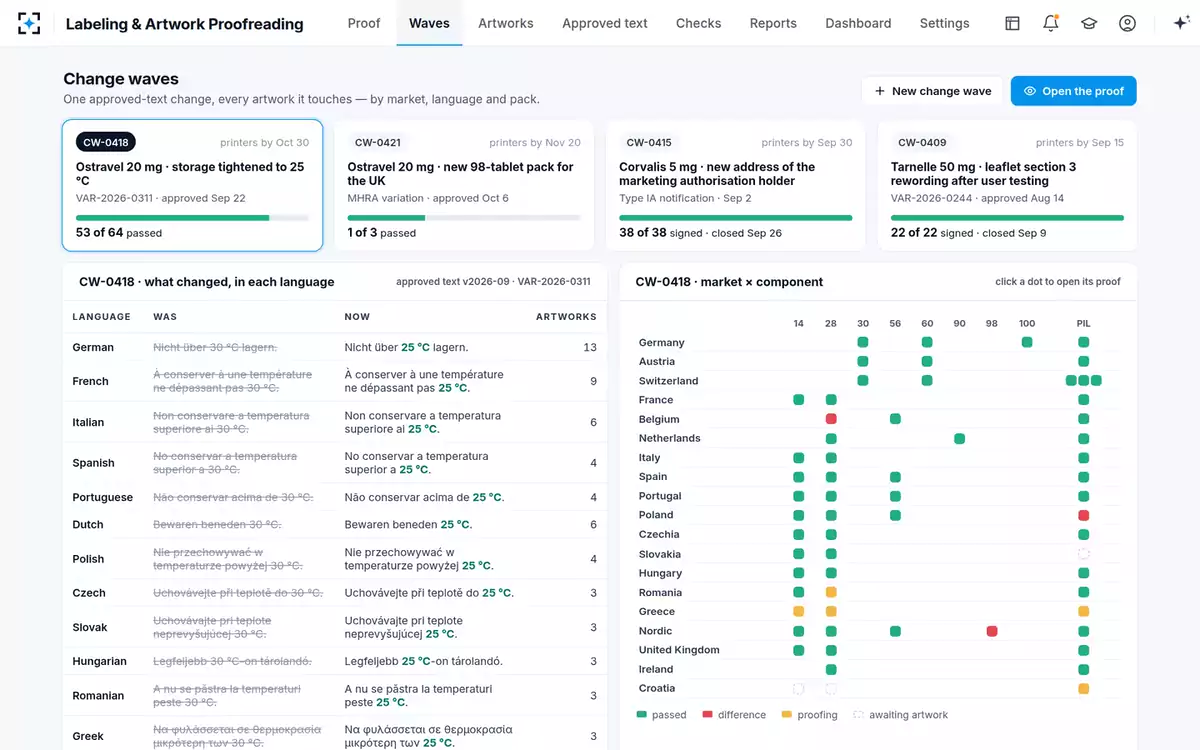
The mechanism that makes group one and two cheap is the same one that makes any multi-market labelling change manageable: one approved statement, and a list of every artwork that carries it. In the solution that is a change wave, and the fictional sample wave shows the shape — one storage change becoming 64 artworks across 22 countries and 18 languages, each with its own proof and its own deadline. A US NDC programme has the same shape with different axes: one field, every pack that prints it, grouped by the change it can ride.
A change wave in Labeling & Artwork Proofreading: one statement, every artwork that carries it
The reporting that travels with each label change
A reformat is still a labelling change, and labelling changes are reported. FDA's estimate is built on the existing route: § 314.81(b)(2)(iii)(c) “requires firms to submit an annual report that includes a summary of any changes in labeling since the last annual report”, and the agency counted roughly 1,324 respondents, 11,593 active approved applications and about 117,367 identifiable product packages under an approved NDA or ANDA when it sized the burden.
What that means in practice is that the reporting cost of the reformat is close to zero if it rides, because the summary is a summary either way. It also means the record you need per pack is specific: which approved labelling text version the new artwork was proved against, which application it belongs to, and the date the change took effect. A programme that can produce that list on demand has already written most of its annual report; one that cannot will reconstruct it from emails.
A plan that works backwards from one date
Work backwards from the end of the transition, not forwards from today. For each pack the date that matters is the first labelling change it will make after 7 March 2033 — or, where none is coming, a change of its own early enough that it is printed, packed and shipped well inside the three years. Then add the lead times that do not compress — the artwork house's turnaround, the proof, the press slot, and the 10-digit stock that has to run down before the new component reaches packed product.
Two decisions belong at the front of the plan because they are expensive to revisit. The first is the carrier decision: whether packs that carry both a linear barcode and a 2D data matrix will keep both, and on which packs the freed space will be used for something else. Decide it portfolio-wide, once, or you will make it pack by pack at an artwork house's hourly rate. The second is the template decision: whether the code field and its quiet zone live in a shared asset across presentations of the same product, so that a correction lands once rather than on each pack.
A twelve-month plan for the 12-digit NDC change
- Inventory every pack that prints an NDC
Product, presentation, market, application, current code and its configuration, and which carriers the pack holds. This is the list everything else is grouped on, and the one that takes longest to get right.
- Group each pack by the change it can ride
A labelling change planned for the transition window, a scheduled renewal, or nothing. FDA assumes one pack in twenty is in the third group; your own figure is the one that matters.
- Decide the carrier question once, portfolio-wide
Whether packs carrying both a linear barcode and a 2D data matrix keep both after the effective date, and what happens to the space if they do not.
- Fix the artwork template before the first pack
The code field, its quiet zone and the human-readable string as a shared asset per product family, so one correction does not become twenty returns.
- Write the proof rules for the new field
What the comparer must treat as a difference in a code field: digits, leading zeros and segment boundaries are never ignorable, however the ignore list treats line breaks elsewhere.
- Set the reporting route per application
Which annual report each pack’s change belongs to, and what the record has to name: the approved labelling text version, the artwork version, the effective date.
- Run one market end to end before scaling
One product, one presentation, one pack: brief, artwork, proof, signature, press. Count the cycles it took, and use that number — not a vendor’s — for the plan.
- Measure the packs with nothing coming, separately
They are the only ones that will cost a cycle of their own, and they are the ones that slip, because nobody is already working on them.
What to do in the next twelve months
Nothing on a pack may change before March 2033, and that is exactly why the next years decide the cost. The work that is cheap now and expensive later is the inventory, the grouping and the artwork itself: a 12-digit version of a pack that has been drawn and proved in advance is ready to print on the day, while one that has not joins a three-year queue with every other pack in the portfolio.
Start the inventory, make the two portfolio decisions, and put one line in every artwork brief issued from now on: whether a 12-digit version of this pack can be drawn and proved alongside the current one, held until the effective date. It cannot be printed before then, so the gain is a proved file waiting on the shelf, not an early print run. Where the pack's template is being rebuilt anyway, that is the cheapest moment to make the code field and its clear space fit both formats.
The last piece is proving each changed artwork. A code field is the easiest thing in the world to get subtly wrong — a transposed digit, a leading zero dropped by a spreadsheet, a human-readable string that no longer matches what the barcode encodes — and the error survives every check that reads the pack as a picture. Four ways to prove a carton compares the methods; what they have in common is that the useful ones compare characters against an approved source rather than against the previous version of the same file.
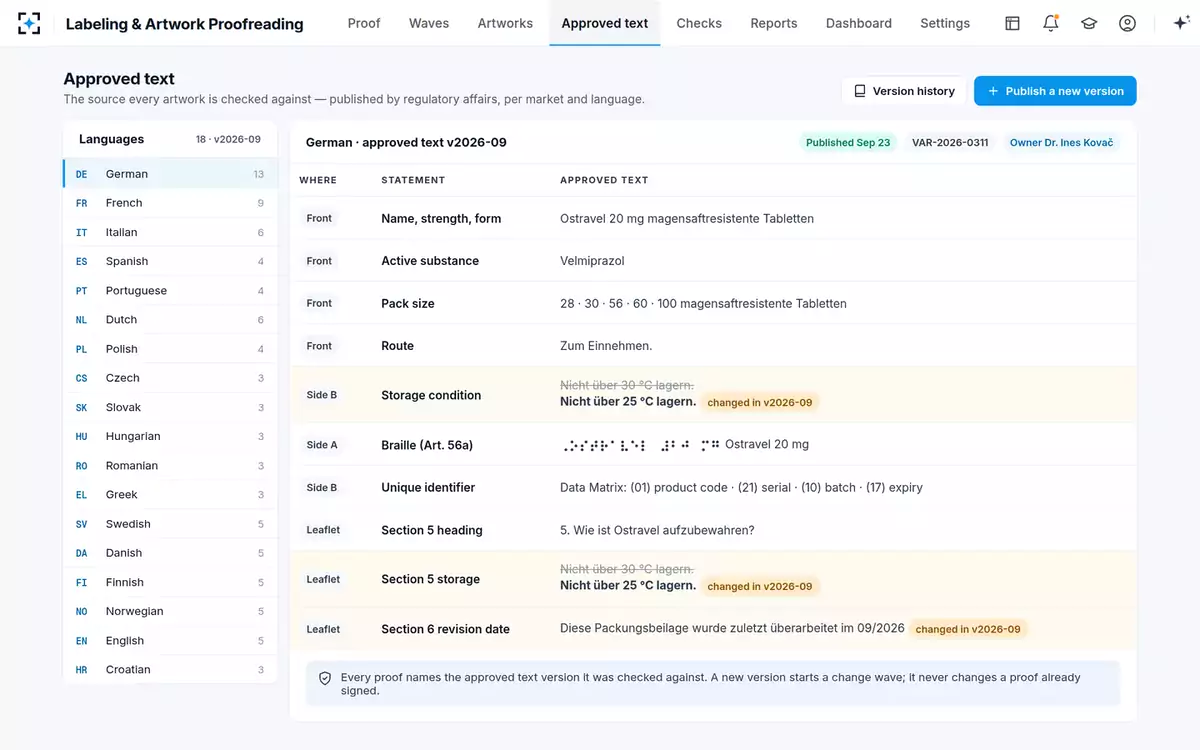
Approved text, mapped to the panels that carry it
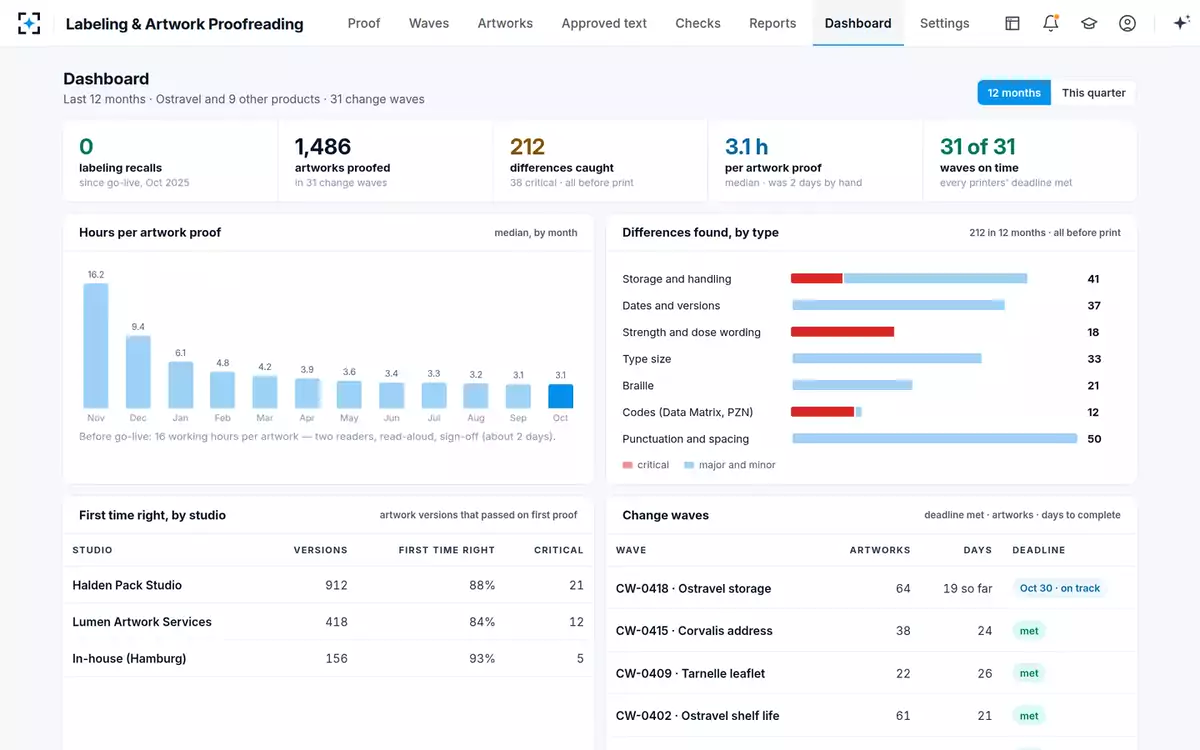
Every wave against its deadline
To see the wave, the proof and the signed report on one pack, start from Labeling & Artwork Proofreading.
Questions people ask
Do I have to change my drug labels for the new NDC?
Yes, but not before 7 March 2033: FDA says the new labelling cannot be used before the effective date, though the artwork can be prepared now. From that date existing 10-digit codes convert by adding leading zeros, and firms should move their labelling to the 12-digit format as soon as possible. FDA does not intend to object to 10-digit labelling on product remaining in interstate commerce during the three-year transition, but product put into commerce with a 10-digit NDC after the effective date is open to enforcement action if it is still in commerce when the transition ends.
Can I still use a 10-digit NDC?
Until 7 March 2033, yes — it is the only format you may print. During the three-year transition after that, FDA says it “does not intend to object to continued use of such 10-digit NDCs on the labeling of products remaining in interstate commerce after the effective date”. That is forbearance for product in the chain, not permission to keep printing the old format, and systems should be able to handle both formats throughout.
How many drug packages are affected by the NDC change?
FDA's own count is approximately 271,655 listed drug packages, and it assumes every one of them carries the NDC on its label. It also assumes 95% of the updates will ride a labelling change the firm was making anyway, leaving 13,583 labels to be changed on their own at an assumed hour each.
Do I need to report an NDC label change to FDA?
For products under an approved application, the existing annual report route carries it: § 314.81 requires a summary of labelling changes since the last annual report, and FDA's burden estimate for this rule is built on that route. Check your own change against your application type and your market's rules rather than generalising from the estimate.
How do you plan a label change across a whole portfolio?
Build the pack inventory once, group every pack by the change it can ride, make the carrier and template decisions portfolio-wide before any artwork is drawn, and then treat each group as a wave with its own deadline. The only group that costs a full cycle each is the one with no change coming — identify it early, because nobody is already working on those packs.
Does the 12-digit NDC change the product identifier under DSCSA?
Not in structure. The product identifier is still the NDC, serial number, lot and expiry in a 2D data matrix; the NDC inside it is simply twelve digits. What the rule adds is flexibility on the § 201.25 barcode: because the 2D code already encodes the NDC, FDA says it could satisfy both sets of barcode requirements, which may let a crowded pack carry one code instead of two.