Artwork rework is the second pass — and often the third and the fourth — through a packaging artwork after a proof finds something wrong on it: a new version from the artwork house, a new proof against the approved labelling text, a new signature. In pharmaceutical packaging it is a routine part of the work rather than a rare exception, because one carton, label or leaflet carries dozens of statements that have to match a text a regulator approved, in every market and language the pack is sold in. What makes a return expensive is not the designer's afternoon. It is that the return restarts a cycle, and the cycle has to fit inside clocks somebody else set: the printer's slot, the ninety days of a labelling notification, the six months a Qualified Person has to get approved components onto packed stock. Botminds' Labeling & Artwork Proofreading compares every character of a print-ready artwork with its approved text before the proof goes out, so the differences that cause the return are found in the first cycle instead of the third.
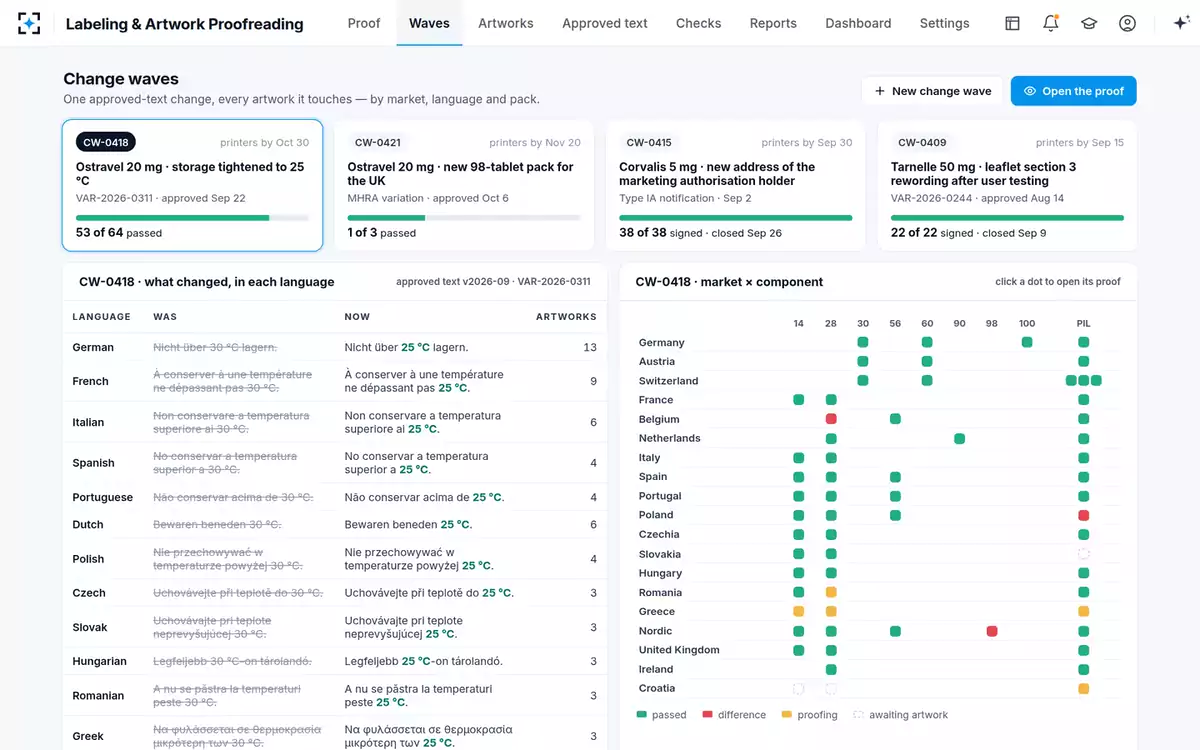
The worked example on this page is a fictional sample change: Veltara Therapeutics tightens the storage condition on a tablet product from 30 °C to 25 °C, and the change reaches 64 artworks in 22 countries and 18 languages. The company, the people, the artwork house and the printers are invented sample data. The research figures are from regulators and their own published data, linked where they appear.
What one label change is worth, on three public numbers
1hour
FDA’s own assumption for the work of carrying one small code change onto one label
13,583labels
FDA expects to change on their own, outside any change a firm was already making
33of 135
US labelling recall events of 2020–2025 classified Class I — a reasonable probability of serious harm or death
What is artwork rework?
Artwork rework is any work that repeats because a version did not pass. A proofreader compares the print-ready file with the approved labelling text and the market's rules, finds a difference, and the file goes back to the artwork house with the difference marked. The house issues a new version. The proof starts again — not at the line that was wrong, but at the first character of the first panel, because a correction can move a line break, reflow a column, shrink a three-language block or push a mandatory particular onto the wrong panel.
That is the part most rework counts miss. A return is not a one-line edit; it is a new object that has to be proved from scratch. On the sample German 30-tablet carton, the re-proof of version 5 compared 41 text blocks and 2,947 characters again, and found no differences — the full read, for one corrected statement.
The vocabulary varies by company. Some call it a revision, some a version bump, some a change request; quality systems that count it at all usually call it rework or first-time-right failure. What matters for measurement is what you are counting: versions per approved artwork, returns per proof, or cycles per change. They give different numbers and different arguments, and a company that has not decided which it means cannot tell whether it is improving.
The reasons a proof fails, in order
Across a labelling change, the differences that send an artwork back fall into a short list, and the list tends to repeat because it follows the structure of the work rather than the skill of the people. A statement changes in the approved text and reaches some carriers of it but not all. A translation is longer than the one it replaces and the layout absorbs the difference by shrinking the type. A code or a Braille string is rebuilt by hand and one character is lost. A date or a version marker is left from the previous issue.
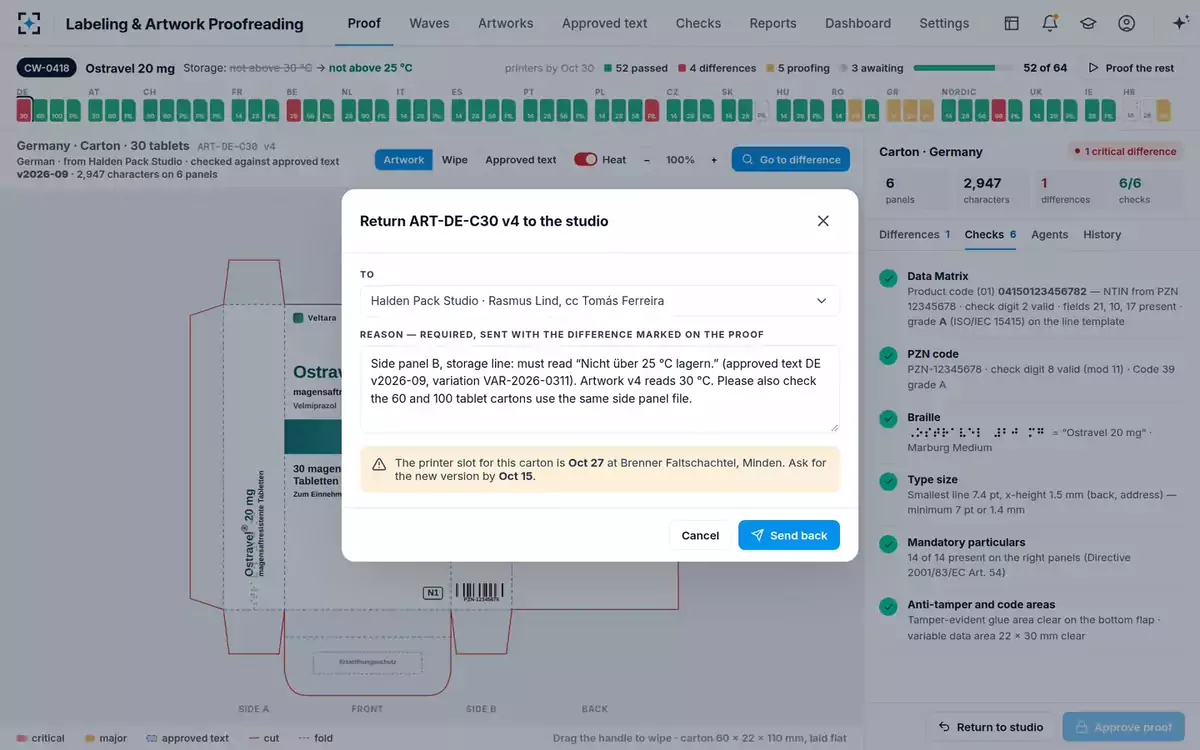
In the sample change wave, four of the 64 artworks came back, and the four are one of each kind:
- The statement that did not travel. The German leaflet was updated to 25 °C; side panel B of the German carton still said 30 °C. Graded critical: the pack would have carried two storage conditions.
- The translation that did not fit. The Belgian 28-tablet carton had the correct Dutch storage wording, set at 6.5 pt with a 1.2 mm x-height, because the three-language block had been shrunk to make room. The European readability guideline asks for at least 7 points, or an x-height of at least 1.4 mm, with 3 mm between lines.
- The code rebuilt by hand. The Nordic 98-tablet carton lost the Braille number sign before “20”, so the cells read “Ostravel bj mg” rather than the strength.
- The marker left behind. The Polish leaflet still carried the revision date 03/2025 instead of 09/2026.
Three of the four are invisible to a reader who is checking the changed statement, because three of them are not in the changed statement. That is the structural reason artwork rework resists training: the error is usually somewhere nobody was told to look. What two readers and a read-aloud actually catch takes that argument apart on the human side.
Where the hours of one artwork proof go, by hand and with Labeling & Artwork Proofreading
By hand — about 16 hours per artwork proofed (estimated)
- Matching the artwork to its approved text version · 6%
- Reading every panel against the approved text · 31%
- Second reader and read-aloud · 25%
- Code, Braille and type-size checks · 13%
- Returning differences and re-proofing the new version · 13%
- Writing the proof report and signing it · 12%
With the solution — a 3-hour target per proof
- Matching the artwork to its approved text version · 3%
- Reading every panel against the approved text · 17%
- Second reader and read-aloud · 17%
- Code, Braille and type-size checks · 10%
- Returning differences and re-proofing the new version · 33%
- Writing the proof report and signing it · 20%
The second row is the point of the figure, and it is counter-intuitive. When the reading gets faster, the return shrinks least — on the estimate, from two hours to one — because a new version still has to be received, logged, compared in full and signed. So rework rises as a share of the work even as it falls in hours, and the way to reduce it stops being “proof faster” and becomes “return less”.
What does an artwork error cost?
We found no credible published average; the figures that circulate come from people selling the fix. What can be stated honestly is what the work is made of, and the regulator has put a number on the smallest possible version of it. In the Paperwork Reduction Act analysis of its 2026 National Drug Code rule, FDA assumed “that each label change would take a respondent 1 hour because only a slight change and not a substantial redesign would be needed”. That is the floor: one hour of respondent effort for a change the agency itself describes as slight, on a label that already carries the field being changed.
A pharmaceutical artwork return is not that change. It is that change plus a full re-proof of every panel, plus the second reader, plus the code and type checks, plus a new signed report. Count it in those units and you can price it in your own company's hours without borrowing anyone's average. Count it in cycles and it is simpler still: a return is one cycle, and a cycle is the distance between two signatures.
The cost that is not in hours at all is the one that decides whether a change lands. Printed components are a controlled material: EU GMP Chapter 5.48 requires that “outdated or obsolete primary packaging material or printed packaging material should be destroyed and this disposal recorded”, and 21 CFR 211.122(e) says the same in one line — “obsolete and outdated labels, labeling, and other packaging materials shall be destroyed.” A return caught before the plates are cut costs a cycle. A return caught after the run costs the run.
The three clocks a return breaks
A change programme does not fail because a cycle is long. It fails because a cycle lands across a date, and three dates are set by people who will not move them.
The first is the printer's slot. In the sample wave it is 27 October at a fictional folding-carton printer in Minden, with the whole wave due at printers by 30 October; the labelling lead asks the artwork house for the corrected version by 15 October because the slot is what everything else is measured against.
The second is the regulatory clock on the change itself. For changes to the labelling or the leaflet that are not connected to the summary of product characteristics, Article 61(3) of Directive 2001/83/EC, quoted in the Commission's packaging-information guideline, provides that “if the competent authorities have not opposed a proposed change within 90 days following the introduction of the request, the applicant may put the change into effect”. Ninety days sounds generous until a programme has spent sixty of them in artwork cycles.
The third is the clock that starts when the change is approved, and it is the one that catches companies by surprise. The MHRA's best-practice guidance on labelling and packaging gives approved new packaging components six months to reach the packed stock a Qualified Person certifies for release, unless safety calls for sooner, and tells the Qualified Person not to certify a product whose components have not been updated within six months of approval. Approval does not end the work; it starts a six-month countdown that ends at a signature somebody else gives.
Three clocks, drawn to one scale, with a single return inside the shortest
- Proofs21 d
- Return · 4 d
- Print13 d
- The 90 days the competent authorities have to oppose the change90 d
- From approval of the new components to the Qualified Person’s certification~180 d
The return, with the reason the next version will be proved against
What a regulator's own estimate says one label change takes
The clearest public arithmetic on label change work sits inside a rule about something else. FDA's 2026 final rule moving the National Drug Code to a uniform 12-digit format had to estimate the paperwork burden of the change, and in doing so published the three numbers every labelling programme wants: how many packs there are, how many of them will need a change of their own, and how long one change takes.
FDA puts the number of listed drug packages at about 271,655. It assumed 95% of the updates would ride a labelling change the firm was making anyway, leaving 5% — 13,583 labels — to be changed on their own, for an estimated one-time burden of 13,583 hours (91 FR 10749). One hour each, because the change is slight.
Two things follow for a labelling team. The first is that the regulator's own model of efficient label change is riding: in FDA's estimate, a change that travels with one you were making anyway adds no separate burden, and one that travels alone costs an hour — which, in a pharmaceutical artwork chain, means a cycle. The second is that riding requires knowing which packs have a change coming, which is a portfolio question, not an artwork question. The 12-digit NDC programme is the worked case.
The far end: what a labelling recall looks like in the public record
Rework is what a company pays to avoid the other outcome. FDA publishes every drug recall as an enforcement report with the firm's stated reason, and the reasons are classified, so the labelling ones can be counted. Across the six years 2020 to 2025 there are 211 enforcement reports whose reason begins “Labeling:”. They resolve to 135 distinct recall events — one event can cover many package records — and the yearly count barely moves.
US drug recall events with a labelling reason, 2020–2025
A Class I recall is, in the words of 21 CFR 7.3(m)(1), “a situation in which there is a reasonable probability that the use of, or exposure to, a violative product will cause serious adverse health consequences or death”. Thirty-three of the 135 labelling events of those six years include a product with that classification, and the reasons read like the reasons a proof fails. One Class I event reported in August 2024: “Label Error on Declared Strength; Some cartons were incorrectly labeled as 0.125 mg instead of 0.25 mg. The blister strips inside the product carton reflect the correct strength of 0.25 mg.” The blisters were right. The carton was wrong. That is an artwork difference that nobody caught, and the distance between it and a return is one proof.
How do you reduce artwork errors?
Four moves change the number, in rough order of how much they move it.
Make the comparison exhaustive rather than targeted. Most artwork proofs are read against the change. The sample wave's four returns are the argument for reading against the whole approved text every time: three of the four differences were nowhere near the statement that changed. Comparing every character of every panel costs nothing extra once the comparison is mechanical, and it is the only way a check can find what nobody predicted.
Name the version the artwork is proved against. A proof that cannot name the approved text version, the panel and the line behind each difference produces arguments rather than corrections. The approved-text comparer in the solution cites all three on every difference, which is also what makes the return reason self-explanatory: the artwork house gets a statement and a location, not a note saying “storage wrong”.
Close the loop on the sibling packs. The sample return asks the artwork house to check whether the 60- and 100-tablet cartons use the same side-panel file. One error in a shared asset is one error in every pack that uses it, and a return that fixes one of them has bought a second return.
Reconcile and destroy. The far end of rework is printed material that exists and should not. EU GMP Chapter 5.61 requires that “any significant or unusual discrepancy observed during reconciliation of the amount of bulk product and printed packaging materials and the number of units produced should be investigated and satisfactorily accounted for before release”. A superseded carton that stays in stock is one route to the label mix-ups in the recall record.
One return on one carton: by hand, and in Labeling & Artwork Proofreading
By hand, with a file-compare tool: Two readers compare the changed statement against the approved text, then read the rest of the panels for anything that looks wrong.
With the solution: Every character of every panel is compared with the approved text for that market and language; each difference is graded by the company’s own severity rules.
By hand, with a file-compare tool: A comment on a PDF, or an email: “storage line wrong on the side panel”.
With the solution: The approved text version, the variation, the panel and the line, the approved wording and the artwork wording, and the rule that graded it.
By hand, with a file-compare tool: An email to the artwork house, with the file attached and the approver copied.
With the solution: A return with a required reason, pre-filled from the difference and sent with it marked on the proof; approval stays locked while the difference is open.
By hand, with a file-compare tool: Remembered, or not.
With the solution: The change wave already lists every artwork carrying the same statement, by market, language and pack.
By hand, with a file-compare tool: The full read again, usually by the same two people, usually against the clock.
With the solution: The full read again, automatically: on the sample carton, 41 text blocks and 2,947 characters, no differences, six of six checks passed.
By hand, with a file-compare tool: An email thread and a marked-up PDF.
With the solution: One signed proof report per approved artwork version, naming what was compared, every difference and how it closed.
What first time right should be measured against
First time right is a common claim in artwork services and software, and the denominator is rarely stated. Three definitions are in common use, and they are not interchangeable: the share of artworks approved at version 1; the share of proofs that found no difference; and the share of change waves that reached the printer without a return. The first flatters a company that issues careful briefs. The second flatters a company that checks lightly. Only the third measures the thing the business cares about, which is whether the change landed on the date.
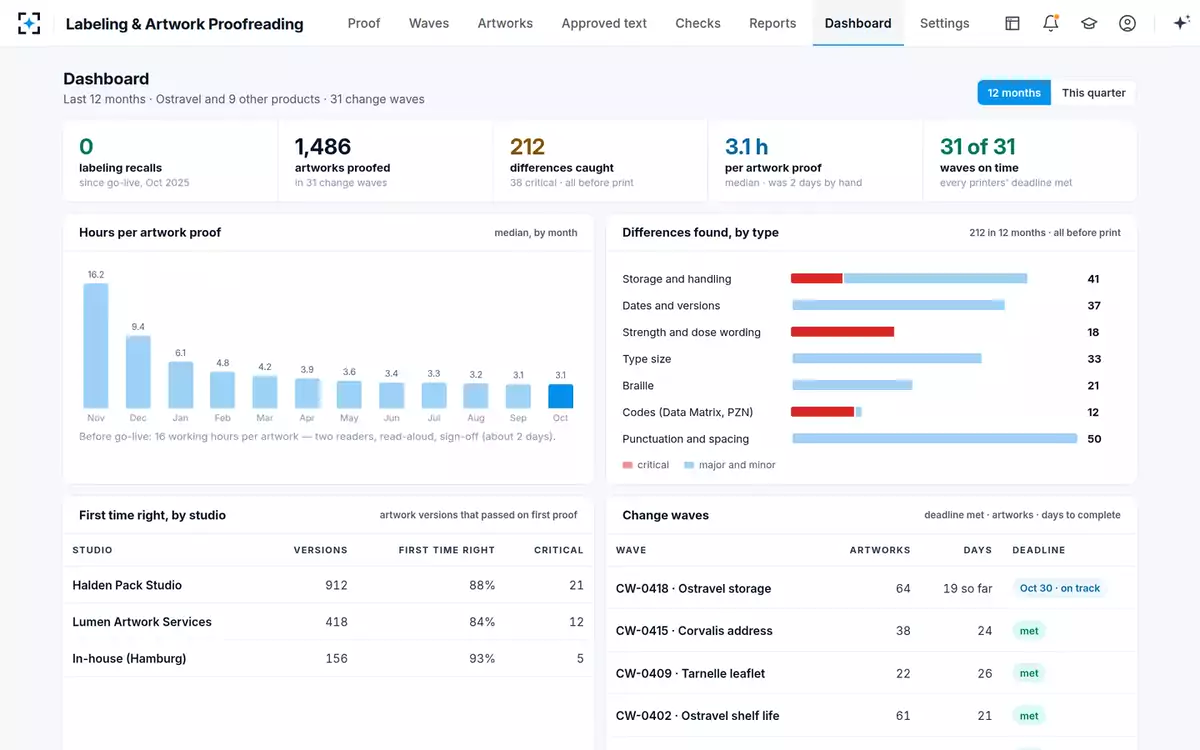
Measure all three and attribute them. The sample dashboard breaks first time right down by artwork house, which is the only version of the measure that changes anyone's behaviour — a supplier can act on its own number, and a company that reports one blended figure has told nobody anything. Over the sample year it shows 31 change waves, 1,486 artworks proofed and 212 differences caught before print, 38 of them critical, with the median proof time falling from 16.2 hours to 3.1 across the twelve months. Those are figures from the solution's own sample data, not a customer's result.
One warning about the headline measure. A falling return rate can mean the artwork is better or the proof is weaker, and the two are indistinguishable from the rate alone. Pair it with a severity mix — how many of the differences you did catch were critical — and with a seeded check, where a known difference is planted in a file and the process has to find it. What to measure after go-live sets out the rest of the dashboard.
The change wave: one statement, every artwork that carries it
A year of change waves, proofs and differences
To see the return, the re-proof and the signed report on one carton, start from Labeling & Artwork Proofreading; who carries the return covers the seats this work actually sits in.
Questions people ask
How many versions does a pharma artwork go through?
We found no published figure, and a number quoted without a denominator tells you little. Count it yourself in one of three ways — versions per approved artwork, returns per proof, or change waves that reached the printer without a return — and keep the definition fixed. In the fictional sample wave on this page, 4 of 64 artworks came back once each, and the four returns were four different kinds of error.
How long does it take to re-proof an artwork?
As long as the first proof, because a corrected version has to be read in full: a correction can move a line break, reflow a column or push a particular onto another panel. On the sample German carton the re-proof compared the same 41 text blocks and 2,947 characters as the first pass. That is why the honest unit of rework is a cycle, not an edit.
What happens if a labelling change misses its deadline?
It depends which deadline. Missing a printer's slot costs the slot and whatever the next one is. Missing the six months the MHRA allows for approved packaging components to reach packed stock has a sharper consequence: its guidance says the Qualified Person should not certify a product for release if the components have not been updated within six months of approval. The change stops being a labelling problem and becomes a release problem.
Does a returned artwork have to be re-approved by the regulator?
Usually not. A correction that brings an artwork back into line with its already-approved text is an internal matter. A change to the text itself goes through a notification or variation — in the EU, Article 61(3) for labelling and leaflet text not connected with the summary of product characteristics, with its 90-day period — and for centrally authorised products the EMA asks that major changes of layout, design or colour be discussed with it case by case. Check the specific change against your market's rules rather than assuming either answer.
What is first time right in packaging artwork?
The share of artworks that pass their proof without a return. It is worth tracking per supplier rather than in total, because only a supplier-level number tells anyone what to do differently, and it is worth pairing with the severity of what you caught: a rate that improves while critical differences stay flat usually means the proof got lighter, not the artwork better.
Why is reducing rework worth more than speeding up the proof?
Because the return is the part that shrinks least. When the reading gets faster, receiving, comparing and signing a new version still takes time — on our estimate it only halves, from two hours to one — so rework rises as a share of the remaining work even as it falls in hours. On our estimate the same return is about an eighth of a 16-hour manual proof and about a third of a 3-hour one.