An insurance compliance team answers to every insurance department where its carrier is licensed, and the NAIC is governed by the chief insurance regulators of 50 states, the District of Columbia and five territories: 56 in all. Its capacity is not set by how fast it reads. It is set by how many changes it carries at once, which is the number of relevant publications arriving each week times the days each one stays open until a named owner has accepted a changed paragraph. Most of those days go on two tasks: finding which paragraph of which company policy a bulletin changes, and finding the person who owns it. Botminds' Regulatory Change Management for Insurers drafts the map from the regulator's passage to the company's paragraph and proposes the owner, so the team spends its time on the decisions that need it.
This guide is for the chief compliance officer and the regulatory change lead who size and run the team. The product examples are sample data on a fictional carrier, Corliss Ridge Insurance Group, which writes personal auto, homeowners, small business and umbrella in 14 states; regulatory figures come from the regulators' own pages, linked where they appear.
The inflow an insurance compliance team is sized for
56
insurance regulators whose chiefs govern the NAIC: 50 states, DC and five territories
29
jurisdictions that adopted the NAIC AI model bulletin by 3 November 2026, each by its own instrument
16
commissioner bulletins from one state, Texas, in 2025, six of them data calls
12
enacted 2025 Texas bills for which the department said it will adopt rules: a second publication still to come
How big does an insurance compliance team need to be?
Big enough to carry the changes in flight without any reaching its effective date unowned, and there is no published ratio that answers it for a given carrier. The number depends on the footprint of states and lines, on how many publications in a week actually touch the carrier, and on how many working days each takes from publication to an owner who has accepted the change. Those three numbers a team can measure; a headcount benchmark from another carrier, with another footprint, tells it little.
The arithmetic is simple once the inputs are known. On average, the changes open at once equal the relevant publications arriving per working day times the working days each stays open. In the sample week on the solution's screens, 23 publications arrived from the carrier's sources and 9 touched its states and lines, about 1.8 a working day. If each takes 9 working days to reach a named owner, the team is carrying about 16 changes at once before any of them is rewritten; at 2 working days, about 4. The same people can carry the second load with time left for the hard ones.
Regulatory change load, in terms a compliance team can measure
Inflow
publications per week from every source watched
Bulletins, rules, orders, circular letters, emergency directives, data calls and NAIC drafts
Regulatory change lead
Relevance
share that touches the states and lines written
Each screened-out item keeps a reason that can be shown later
Compliance analyst
Days open
working days from publication to an owner’s acceptance
Split into reading, matching earlier adoptions, finding paragraphs and finding the owner
Regulatory change lead
Changes in flight
relevant per working day × days open
Sample week: 1.8 a day × 9 days ≈ 16; × 2 days ≈ 4
Chief Compliance Officer
Where the inflow comes from: one state's year
One state's output is enough to size the reading. The Texas Department of Insurance listed 16 commissioner bulletins for 2025 on its own index, from title insurance data calls to FAIR Plan assessment guidance (TDI, bulletins 2025). Six of the 16 are data calls or calls for data, each a deadline for someone in the company and none a change to a statute. The legislative session adds a second stream: Bulletin B-0012-25 of 5 August 2025 summarises the session's insurance legislation and tells companies that "TDI-regulated individuals and entities must comply with any legislation that affects them" (TDI B-0012-25).
That bulletin carries the detail that matters for capacity. Most of the bills it lists took effect on 1 September 2025, others on 20 June 2025 or 1 January 2026, and for 12 of them the department noted "TDI will adopt rules". Each of those twelve is a change the team handles twice: once when the statute takes effect and again when the rule is published. A carrier in 14 states reads 14 bulletin indexes, 14 sets of session laws, rule dockets and emergency orders after every storm.
What one state published in a year, by kind: most of it is not a new rule
Texas commissioner bulletins, 2025 · 16
- Data calls · 6 · 37.5%
- New legislation · 5 · 31.25%
- Rates and filing · 3 · 18.75%
- Disaster, FAIR Plan · 2 · 12.5%
Why one NAIC model becomes 29 pieces of work
A model law or bulletin multiplies the reading rather than reducing it. The NAIC adopted its model bulletin on the use of AI systems by insurers on 4 December 2023. By 3 November 2026 its adoption map listed 29 adopting jurisdictions, from Alaska in February 2024 to North Dakota in October 2026, each through its own instrument: a bulletin, a memorandum, a guidance document, an insurance notice, an administrative letter or a technical assistance advisory (NAIC adoption map). California, Colorado, New York and Texas appear separately, with insurance-specific rules of their own.
For a team, each adoption is a separate publication with its own number and date, and most repeat text the company has already implemented. The work is finding the sentences that differ, and that is where an unsupported team loses days: re-reading a near-identical bulletin from the top because nobody can show which sections were already covered by which earlier change. The adoptions are listed one by one in the NAIC AI model bulletin adoption map, and how to read each state's version against the model is set out in how states adopt NAIC model laws.
Dates: why one statute can open three pieces of work
A team's load depends as much on dates as on documents. One enactment can carry an effective date, a later date from which it applies to policies issued or renewed, and a rule the department has yet to publish. In Texas's 2025 session alone, bills listed in Bulletin B-0012-25 took effect on 20 June 2025, 1 September 2025 and 1 January 2026, and the department flagged 12 of them for rules to come (TDI B-0012-25). Each date can land on a different owner: underwriting for new business, policy services for renewals, claims for losses after a given day.
Maps and summaries do not settle the dates for a team. The NAIC's adoption map says plainly that it "does not reflect a determination as to whether the pending or enacted legislation contains all elements of the model" (NAIC adoption map), so a jurisdiction listed as adopted may have changed a deadline, a scope or a definition. The capacity consequence is that dates must be copied from the instrument itself, never inferred from a summary, and each change carries every date that applies to it. The solution's rule reader works that way: dates are copied, never inferred, and no summary appears without the passage beside it.
Who sits on an insurance compliance team, and who signs?
Four seats carry a regulatory change, and the signatures sit with officers. The compliance analyst reads, scopes and maps; the regulatory change lead confirms the map and assigns the owner; the policy owner in claims, underwriting or records accepts the changed paragraph; and the chief compliance officer signs what the regulator asks an officer to sign. The regulators' own forms draw that line. Connecticut's AI certification asks an insurer to certify it "is in receipt of and has reviewed the Department's Bulletin No. MC-25" and that "Upon the Department's request, Insurer will make available all information and documentation requested", and it is signed by an "Authorized Representative (Officer)" (Connecticut Insurance Department).
Other regulators name the officer directly. New York vests each insurer's complaint function in "a corporate officer who is also to be entrusted with the duty of executing the Department of Financial Services' directives" (11 NYCRR 216.4). Texas's AI bulletin of 12 June 2026 says "All regulated entities using AI should be able to furnish procedures and protections upon request by TDI" (TDI B-0003-26). Each sentence is a demand for evidence the team must be able to produce on request, with the version in force on the date asked about.
Four seats around one regulatory change, before and after the reading is drafted
Today
Reads each publication cold, decides if it touches the states and lines written, then searches the policy library and emails the business to find an owner.
With agents
Reviews a drafted map: the passage, the paragraph it changes, the earlier change that already covers part of it. Confirms or corrects.
Still theirs: the judgment that a publication applies, and the map itself
Today
Chairs a weekly meeting to find out what is unowned and how close each effective date is.
With agents
Sees every open change with its owner and date; spends the meeting on the few at risk.
Still theirs: owner assignment and escalation
Today
Receives a forwarded bulletin and a request to “assess impact”.
With agents
Receives the regulator’s passage beside their own paragraph, with the smallest change drafted.
Still theirs: accepting, editing or returning the change
Today
Signs certifications and committee reports assembled by hand from trackers.
With agents
Signs a report drafted from the live list of changes, owners and dates.
Still theirs: the signature, and what it means
Where a regulatory change's working days go
Most of a change's days go on searching, not reading. On Botminds' estimate per change, from publication to a named owner by email: a day and a half reading and deciding whether it touches the states and lines written, a day checking it against the model and earlier adoptions, two days finding the policy paragraphs it changes, four days finding an owner by email, and half a day for the lead to confirm. Nine working days in all, of which the decisions take a fraction.
From publication to a named owner: the searching shrinks, the decisions do not
- Read1.5 d
- Model1 d
- Paragraphs2 d
- Owner by email4 d
- OK0.5 d
- Map0.5 d
- Owner1 d
- OK0.5 d
The owner search is the largest single block, and it is a structural problem rather than a staffing one. A team that has to discover, change by change, who owns the claims letter template or the vendor oversight procedure will spend those four days however many analysts it hires. A routing table from topic to policy to owner, kept current, removes most of it. In the sample carrier's settings, a named owner is due within 2 working days, the owner is reminded on day 2, and the chief compliance officer is told on day 4 or 30 days before the effective date, whichever comes first.
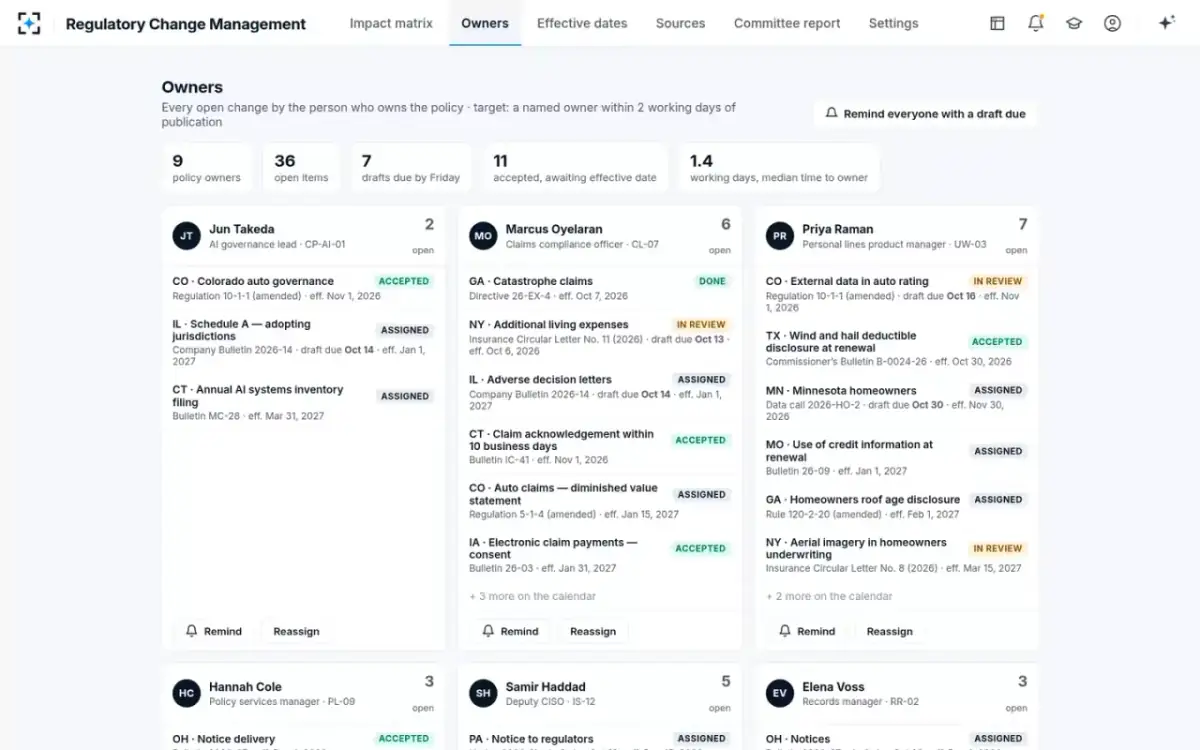
Every open change by the person who owns the policy
What should a compliance team report to its committee?
Three numbers and one list: changes opened, changes accepted, the median working days to a named owner, and every change taking effect in the next 90 days with its owner and status. The list is the one that protects the officer, because a change that reaches its effective date without an accepted paragraph is the finding an examiner will make. The sample carrier's owners screen shows 36 open items across 9 owners, 11 accepted and awaiting their effective dates, and a median of 1.4 working days to a named owner.
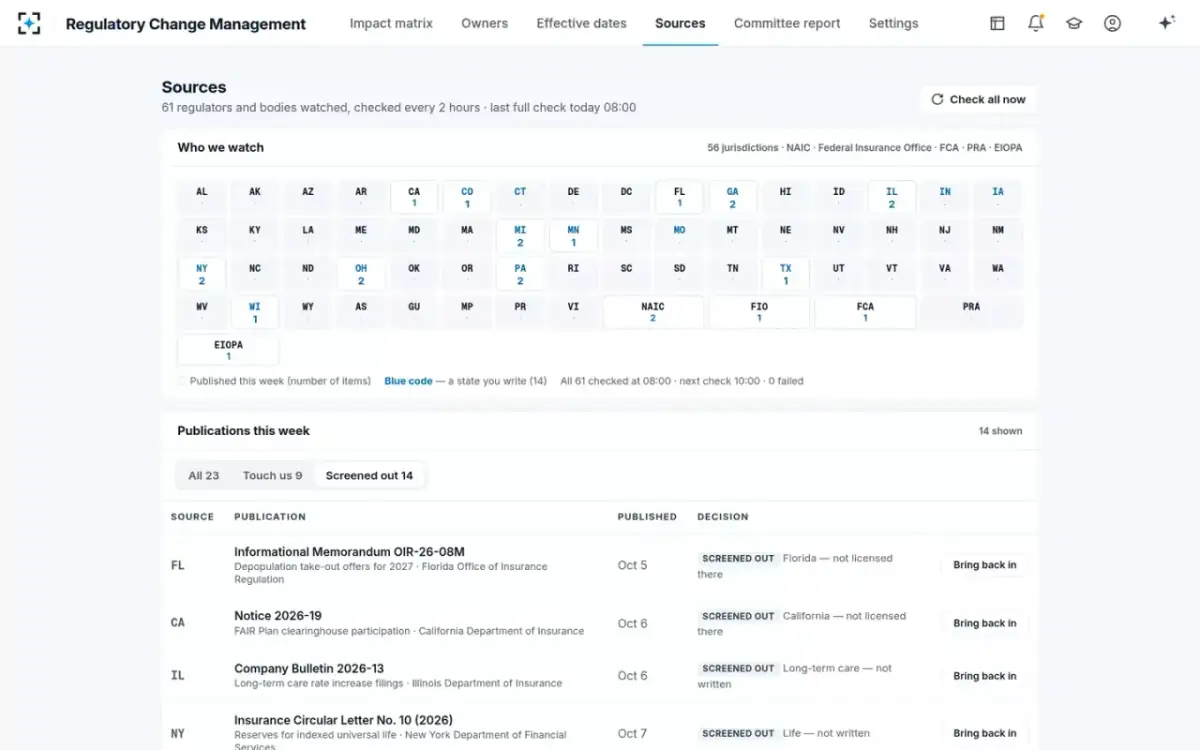
A committee report should also show what was screened out and why. In the sample week, 14 of 23 publications were set aside, each with a reason such as a state not written or a line not sold, and each can be brought back if the footprint changes. A team that cannot show why it ignored a publication has not ignored it; it has missed it. How a tracker can show every row closed while a claim letter still lacks a required notice is set out in an insurance compliance tracker in Excel.
Eight working rules for an insurance compliance team
- Watch every source in the footprint, and show when each was last checked
A source that fails to load is unchecked, not quiet.
- Screen out with a reason
State not written, line not sold, already covered by a named change.
- Always keep emergency orders, moratoriums and data calls
Whatever a relevance score says, in any state written.
- Match each adoption against the earlier ones
Any wording difference counts as new; a covered section names the change that covered it.
- Map to a paragraph number, not a department
The regulator’s passage beside the company’s paragraph.
- Name an owner within a fixed number of working days
With a reminder and an escalation date, including 30 days before the effective date.
- Close a change only when the new version is accepted
Closed means the paragraph changed, not that someone replied.
- Keep every version with its dates
Examiners test files against the text in force when each file was handled.
Where Regulatory Change Management for Insurers fits
The solution takes the reading, matching and searching off the team and leaves every decision with it. Six agents watch 61 sources every two hours on the sample carrier, screen each publication against the states and lines written, read it into obligations with the passage beside each, match it section by section against earlier adoptions, draft the change to the policy paragraph it affects and propose an owner. Their limits are written into them: the router "Never assigns without the regulatory change lead's confirmation" and "Cannot accept a draft; only the policy owner can", and the matcher treats any wording difference as new. One bulletin's run is traced in AI regulatory change management for insurance companies.
It does not decide that a publication applies, interpret what a regulator meant, or sign anything. A carrier should size its team on its own measured inflow, relevance and days open, before and after, rather than on any vendor's ratio, and should expect the saving to show up as fewer changes in flight and fewer reaching their dates unowned, not as a reading speed.
Who the agents watch, and what they screened out
Questions people ask
What does an insurance compliance team do?
It turns what regulators publish into changes the company can prove it made: scoping each bulletin, rule, order and data call, mapping it to the policies and procedures it changes, tracking it to an owner's accepted change before the effective date, and preparing the evidence behind officer certifications.
How many regulators does a US insurer answer to?
Up to 56: the insurance departments of the 50 states, the District of Columbia and five territories, whose chief regulators govern the NAIC. A carrier answers to each department where it is licensed, and to NAIC models once each state adopts its own version.
How many publications does one state insurance department issue?
The Texas Department of Insurance listed 16 commissioner bulletins for 2025, six of them data calls, plus a bulletin summarising the session's insurance legislation, for 12 of which it said it would adopt rules. Rules, orders and dockets come on top.
Who signs regulatory certifications at an insurer?
An officer. Connecticut's AI certification is signed by an "Authorized Representative (Officer)", and New York vests the complaint function in a corporate officer charged with executing the department's directives. The team prepares the evidence; the officer signs.
How long should it take to assign a regulatory change to an owner?
No regulator sets a number; it is the team's own service level. Botminds estimates about 9 working days by email, with 4 of them spent finding an owner, and the solution's design target is 2; the sample carrier's median is 1.4 working days.
Why does one NAIC model create so much work?
Because each state adopts it through its own instrument, on its own date, often with small wording changes. The NAIC AI model bulletin had 29 adoptions by 3 November 2026, each of which a multistate carrier must read against what it already implemented.