Recall readiness has a definition in FDA's own guidance, and a list of preparations to go with it: named people with authority, trained, a communications plan, known reporting obligations, product coding, distribution records and written procedures. Most quality units can show all of it. They still stall on the day, because the slow part of a recall is not the notification letters — it is the written assessment of how much harm the product issue could cause, the health hazard evaluation that three functions have to sign before anyone decides anything. Botminds' Health Hazard Evaluation attacks that part specifically: it reads the case as one document set, drafts the evidence sections with a citation on every sentence, and declares what is not yet known instead of reasoning around it.
The regulatory material below is quoted and linked. Figures about cases, settings and hours describe the solution running on its own demonstration data, and the readiness-exercise timings are our illustration of a well-run exercise rather than a measurement.
What readiness is up against
6
general preparations FDA names in its guidance on initiating voluntary recalls
plus written procedures
96%
of device recalls over five fiscal years began with the manufacturer identifying the issue itself
3,788 of 3,934 — GAO analysis
100%
of consignees must be contacted at Level A, the highest effectiveness-check level a recall strategy can set
21 CFR 7.42(b)(3)(i)
17,000+
drug products recalled between 2012 and 2025, on the agency’s own count
CDER Office of Compliance, 2025 annual report
What 'recall ready' means in the agency's own words
The phrase is not industry shorthand; it comes from a final guidance of March 2022 on initiating voluntary recalls, which opens its preparation section by saying that "it is critical for firms in a product distribution chain to be 'recall ready'" and then listing what a firm should have in place in advance of when a recall may be needed.
Two things about that framing are worth noticing. The guidance addresses the whole distribution chain, not only manufacturers, so your direct accounts' readiness is part of yours. And it is written as advance preparation — the things you cannot acquire once the clock is running. The test of any item on the list is whether you could produce it within an hour on a Friday evening.
The preparations the guidance asks for, item by item
Six general preparations, then written procedures for initiating a recall. Each is paired below with the single artefact that proves you have it, because readiness assessments that collect policies rather than evidence are the reason programmes pass on paper and stall in practice.
FDA's recall-ready preparations, and the evidence that proves each one
- Identify appropriate personnel
Named people with recall responsibilities and the authority to take the steps needed. Alternates considered; for complex chains, a recall team with a coordinator. Evidence: the names, with the delegation that gives them authority when the first choice is unreachable.
- Train personnel on their responsibilities
Regular training so people understand the procedures they will be asked to perform; the guidance suggests mock recalls where complexity warrants. Evidence: the training record, and the output of the last exercise.
- Establish a recall communications plan
Internal communications, communications with FDA, and communications to direct accounts or the public, with contacts identified in advance and draft templates held ready. Evidence: the templates, dated.
- Identify any reporting requirements for distributed products
Know in advance which reports a problem with your product would trigger — for devices, the correction and removal report. Evidence: a one-page map from product family to obligation.
- Use adequate product coding
Coding sufficient for positive lot identification, so the recall reaches all violative lots and no others. Evidence: a code read back to production and distribution data for one real lot.
- Maintain distribution records
Records that let you find the product, identifying direct accounts by name, delivery address and telephone number, retained beyond shelf life. Evidence: a lot queried end to end, today.
- Write the procedures for initiating a recall
Responsibility and steps for ceasing distribution, developing a recall strategy under 21 CFR 7.42 and notifying direct accounts. Evidence: the procedure, and the last time anyone followed it.
The strategy itself has a shape the regulation sets out. 21 CFR 7.42 says a recall strategy will address depth, public warning and effectiveness checks, and it defines the check levels — including "Level A—100 percent of the total number of consignees to be contacted", down through partial levels to Level E, no checks at all. Which level you are on is decided by the hazard, which is decided by the evaluation, which is why the written assessment sits upstream of nearly every cost in a recall.
You need not wait for the investigation to finish
The most expensive readiness failure is cultural rather than procedural: a belief that you cannot start until you know what went wrong. The guidance removes it in one sentence. Having asked for a prompt evaluation by a qualified person against established criteria, it says: "The recalling firm need not delay initiation of a voluntary recall pending completion of the investigation."
A few pages later it removes the other common excuse, saying that a firm need not delay initiation pending FDA's review of its recall strategy or communications either. Taken together, the two sentences mean readiness is not the ability to produce a complete answer quickly. It is the ability to produce a defensible partial answer quickly — one that states what is known, what is not, who is chasing it and when it is expected.
The five things that are never ready
Programmes that pass every item on the agency's list still lose days, and the losses tend to cluster in five places. None of them is on any readiness checklist, because each belongs to a function that does not think of itself as part of the recall process.
Five things that are never ready, and the fix for each
| What is not ready | Who actually owns it | The symptom on the day | The fix, in about a quarter |
|---|---|---|---|
| Distribution figures by lot that reconcile | Supply chain — not quality, and usually not anyone named in the recall plan. | The likelihood section waits, and the figure that eventually arrives disagrees with the one in the enterprise system. | Agree one authoritative extract, name an owner and a deputy, and rehearse the query against a real lot every quarter. |
| A risk management file current enough to read severity from | Risk management, on a revision cycle that has nothing to do with your complaint volume. | Severity gets re-argued in a meeting because the file predates the design change the complaints are about. | List the top twenty product families by complaint volume and check each file is newer than the last change to the product. |
| Supplier investigations with a committed date | Supplier quality, through a contract that rarely sets one. | Root cause is “with the supplier”, with no date, for three weeks. | Put a response time for safety investigations into the quality agreement at the next renewal, and chase against it. |
| An evaluation form with somewhere to write what you do not know | Quality systems, who wrote the template years ago. | A blank section, or worse, an estimate that loses its qualifier by the third draft. | Add a declared-gap field to each section: what is missing, why, who owns it, when it is expected. |
| A rehearsed answer to “what is the rate?” | Nobody, which is the problem. | Four people produce four different numbers from three different denominators within the same hour. | Write the rate definition down — numerator, denominator, period — and test it on three past cases. |
What the five have in common is that they are owned outside the function that will be blamed. That is also why they are fixable in a quarter rather than a year: none requires a system, and each has a named person who can be asked for a commitment.
Distribution records: the reconciliation nobody rehearses
FDA's guidance asks for distribution records that identify direct accounts by name, physical delivery address and contact telephone number, retained for longer than the product's shelf life. Most firms have them. What most firms have never done is reconcile the figure those records give against the figure the enterprise system gives, for one lot, under time pressure.
The two can disagree: returns, destructions, samples, inter-company transfers and re-labelling each move units in ways the two systems record differently. On an ordinary Tuesday the difference is an accounting curiosity. In a hazard evaluation it is the denominator, and a denominator that two systems disagree about is a figure you cannot put your name to. Which denominator you can actually defend is a question to settle before the day, not during it.
The rehearsal is cheap. Pick a lot shipped eighteen months ago, ask for units distributed by market between two dates, and time it. If the answer takes longer than a day, or arrives without a source, you have found the item that will set your recall's pace.
Is your risk management file current enough to read severity from?
Severity should be read from the risk management file, not reconstructed in a meeting. That only works if the file is current enough to be worth reading. A file written before the design change the complaints concern will not contain the harm at issue, and the severity will come from the room instead.
There is a second, subtler version of the same problem: the file is current, but the field disagrees with it. A harm the file rates improbable is being reported more often than that, or a harm the file rates minor is producing reports of something worse. Both are findings, and both belong with risk management rather than in the evaluation's margin. In the solution every harm rated higher in the field than in the file is sent to risk management with its basis; risk management decides, and no agent edits the file.
For readiness purposes the check is simple and worth running this quarter: for your twenty highest-volume product families, is the risk management file newer than the last change to the product, and does it carry the harms your complaint codes actually describe?
What does a readiness exercise have to produce?
Many mock recalls produce a traceability result — the percentage of product located within a target time — and stop. That tests the distribution records and nothing else. An exercise that tests readiness for the decision has to produce a written evaluation of harm, with severities sourced, a rate computed or declared impossible, and three signatures.
A readiness exercise that tests the decision, hour by hour
- Trigger and stand-up2 h
- Assembling the documents3 h
- Identifying the harms2 h
- Sourcing each severity2 h
- Computing the rate4 h
- Declaring and chasing gaps6 h
- Drafting the sections3 h
- Three signatures2 h
Score the exercise on what it produced, not on how it felt. Did every severity come from a cited source? Was a rate computed, and if not, was the gap declared with an owner and a date? Did three people sign, and did each know what their signature meant? An exercise that ends with a draft nobody would sign has still succeeded — it has found the reason, which is the point.
Who has the authority to initiate, and at what hour of the night?
The guidance says specific personnel should, and sometimes must, be assigned recall responsibilities and possess the authority to take the steps needed, and that alternates should be considered. The second half is where plans fail. Naming a vice-president is easy; the test is who can stop distribution at two in the morning in August when that person is unreachable.
The people a readiness exercise actually tests
Today
Owns problem definition and likelihood, and is handed rates quoted on part of the affected lots.
With agents
Signs those sections once every declared gap is closed or consciously accepted, and can see days to signature and hours per evaluation.
Still theirs: the decision to accept a gap rather than wait
Today
Signs last and writes the recommended class, often without knowing what is missing.
With agents
Sees what the other two signed, the sentences cited and the gaps declared before signing the class.
Still theirs: the recommended class and the reporting decisions
Today
Chases supplier investigations by email and cannot say when one will arrive.
With agents
Receives one named request for the file the evaluation is waiting on, and attaching it is enough.
Still theirs: the relationship with the supplier, and the date
Today
Learns late that the field rates a harm higher than the file does.
With agents
Receives every field-versus-file difference with its basis, for review.
Still theirs: the decision to update the file
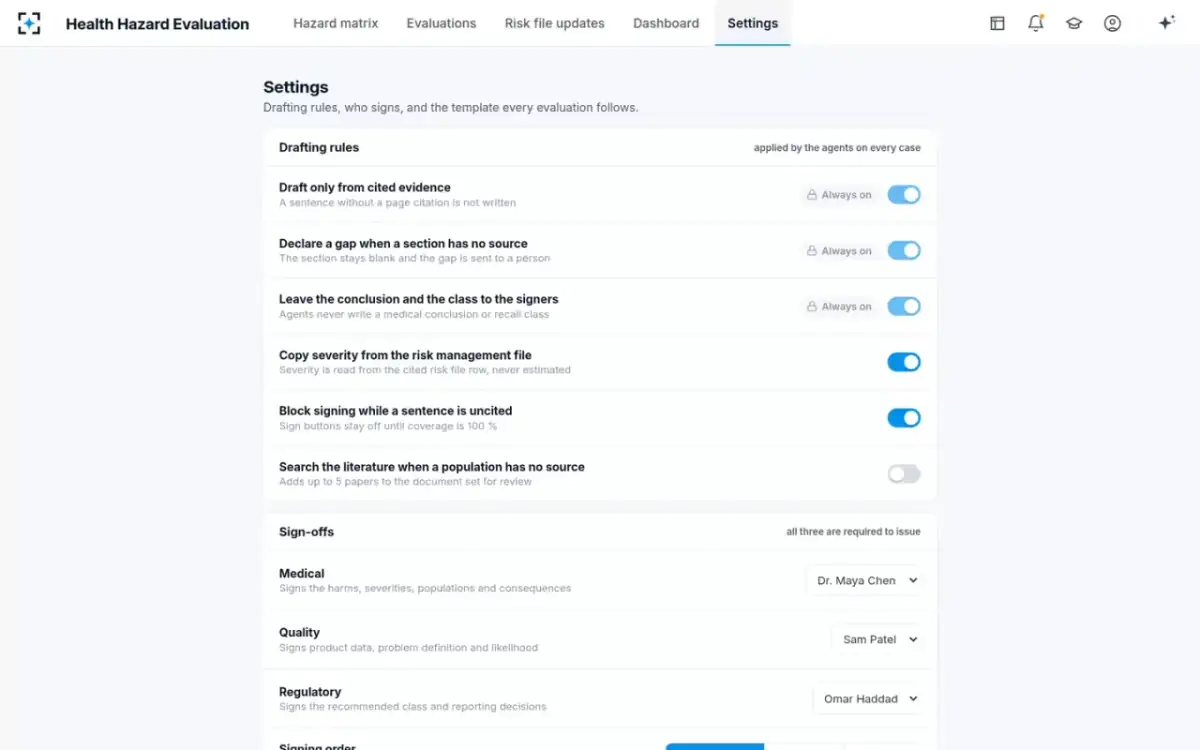
Health Hazard Evaluation settings: the template, the signers, the order and the clock
What the UK and EU add to the same list
A readiness plan written only against the United States guidance has two gaps that matter for anyone selling into Europe or the United Kingdom.
The first is the clock. European and UK vigilance deadlines run from the manufacturer's awareness of a serious incident, not from the decision to act, and they are short — as little as two calendar days for a serious public health threat. A readiness exercise that begins at the decision to recall never tests them; the six clocks that run on one product issue sets them out.
The second is the document itself. The UK regulator's guidance on vigilance is explicit about what the final report on a serious incident should include when a field safety corrective action is planned: "Where FSCA is planned, a copy of the CAPA report and health hazard evaluation should be provided." The evaluation is not an internal working paper; it is an attachment, submitted through the regulator's reporting system, read by someone who did not attend your meeting. That changes how it should be written — every assertion sourced, every unknown declared — and it is worth telling the people who draft it that this is where it goes.
What you bring on day one, and what goes live first
The last readiness question is about the tooling rather than the programme, and it has a short answer: the solution is built from your own material. Your evaluation form, your risk policy with its scales and zones, your risk management files, and a set of past cases to test it against. Those four inputs are the day-one ask, and the first three are things a mature quality unit already has.
It goes live once every quality check has passed, and the sensible first exercise is not a live product issue. It is one of your own past cases, run end to end, with the output compared against the evaluation your team actually wrote at the time. That comparison is the most honest readiness assessment available: it shows where the evidence was thin, which severities were sourced and which were remembered, and how many of the sections would survive the citation rule.
The hazard matrix in Health Hazard Evaluation, every placement carrying its evidence
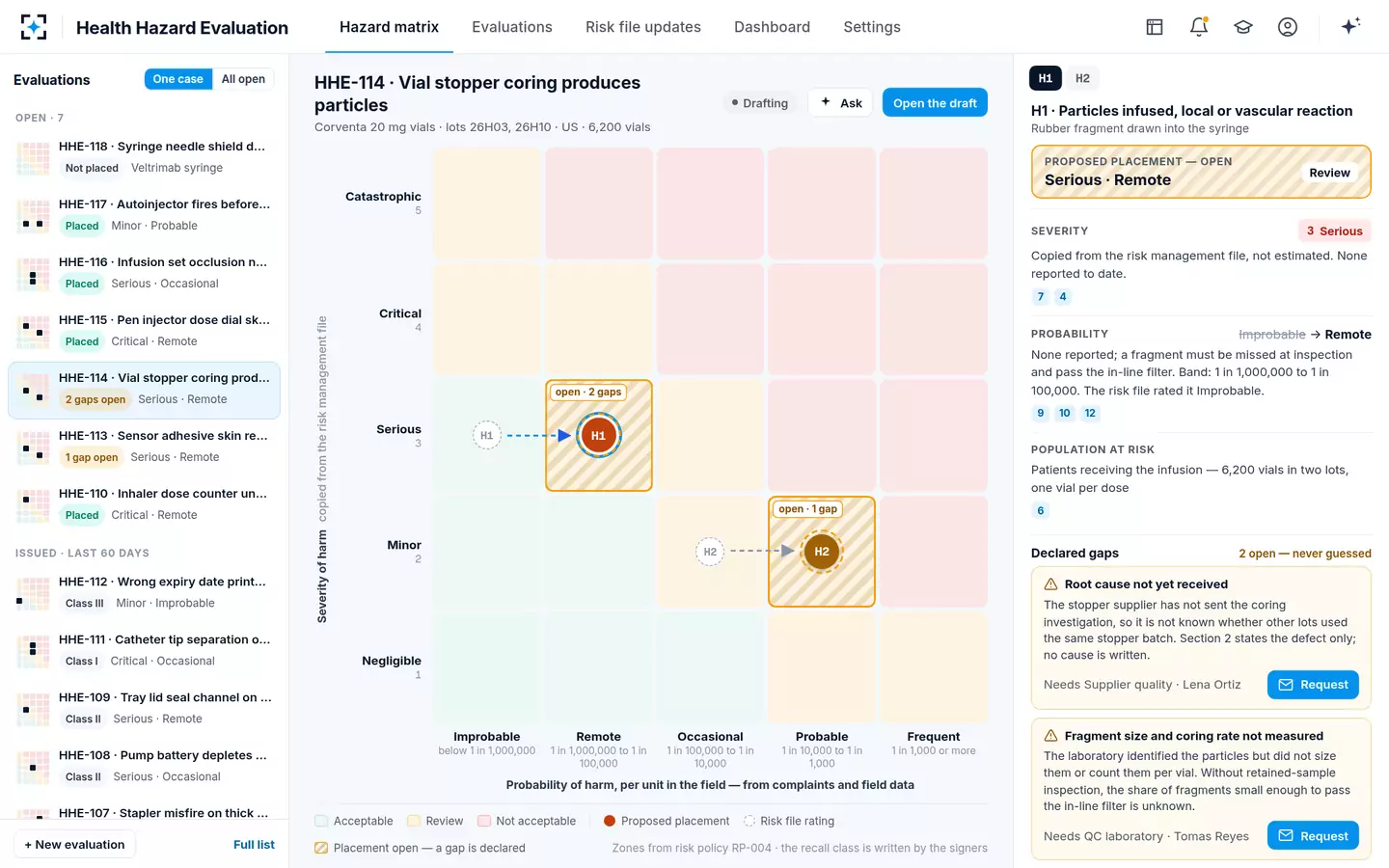
If a selection is running alongside the readiness work, what a surveillance system must hand the hazard call covers the data side of the same exercise. To see the form, the signers and the clock as settings, start from Health Hazard Evaluation.
Questions people ask
What does recall ready mean?
It is FDA's own phrase, from its March 2022 guidance on initiating voluntary recalls, which calls it critical for firms in a product distribution chain to be recall ready and lists the preparations to make in advance: named personnel with authority, training, a communications plan, known reporting obligations, adequate product coding, maintained distribution records, and written procedures for initiating a recall.
What should a recall plan contain?
Responsibility and steps for ceasing distribution, developing a recall strategy under 21 CFR 7.42, and notifying direct accounts with instructions for what to do with the product. The strategy addresses depth of recall, whether a public warning is needed, and the level of effectiveness checks — from Level A, 100% of consignees contacted, down to Level E, none.
Who needs authority to initiate a recall?
Specific named personnel, who the guidance says should and sometimes must be assigned recall responsibilities and possess the authority to take the steps needed. Alternates should be considered, and for complex distribution chains a recall team with a coordinator may be appropriate. The real test is whether somebody can halt distribution outside office hours when the first-named person is unreachable.
What does a recall readiness exercise have to produce?
More than a traceability percentage. To test readiness for the decision rather than for the logistics, it has to produce a written evaluation of harm: each harm identified, each severity read from a cited source, a rate computed or declared impossible with an owner and a date, and three signatures with their meanings. An exercise that stops at notification letters has not tested the part that takes longest.
Do you need distribution records by lot to be recall ready?
Yes, and in two senses. FDA asks for distribution records that identify direct accounts by name, address and telephone number, retained beyond shelf life, so the product can be found. Separately, you need units distributed by lot and period as the denominator of any frequency statement in the hazard evaluation — a different query, usually from a different system, and the one most often missing.
How current does the risk management file have to be?
Current enough that severity can be read from it rather than argued. In practice that means newer than the last change to the product, and carrying the harms your complaint codes actually describe. Where the field rates a harm higher than the file does, that difference belongs with risk management as a proposal with its basis — it is a finding, not a margin note.