An FDA recall classification is the numerical designation — I, II or III — that the agency assigns to a recall to show the relative degree of health hazard. It is set by the centre recall unit on the strength of a health hazard evaluation, and the three definitions that decide it fit in a single paragraph of 21 CFR 7.3(m). The whole scheme turns on two phrases: "reasonable probability" and "serious adverse health consequences". Get those two right about your own product and you can predict the class; argue about anything else and you are arguing about something the rule does not ask. Botminds’ Health Hazard Evaluation is the software for the evaluation the class is set from.
The class matters because it is not a verdict on your company. It is a statement about a population's exposure, and it drives the operational decisions that follow — the level in the distribution chain the recall reaches, whether a public warning issues, and how many consignees have to be checked and counted. It also arrives late. The worked examples and screens below come from Health Hazard Evaluation, whose cases, products, lots and people are fictional sample data; the research figures are the regulators' and the Government Accountability Office's, linked where they appear.
What the record shows about the class and the clock
88%
of device recalls in fiscal years 2020 to 2024 were Class II — 3,468 of 3,934
45→ 32
average business days from initiation to classification for Class I device recalls, 2020 and 2024
2days
the agency’s own internal target for its hazard committee, and again for the recall unit
321
drug recall events FDA’s drug centre classified in 2025, covering 755 recalled products
Class I, II and III, in the regulation's own words
The definitions are short enough to quote whole, and worth reading in full once, because almost every summary of them loses a qualifier that matters.
Class I is a situation in which there is a reasonable probability that the use of, or exposure to, a violative product will cause serious adverse health consequences or death.
21 CFR 7.3(m)(1), Definitions
Class II "is a situation in which use of, or exposure to, a violative product may cause temporary or medically reversible adverse health consequences or where the probability of serious adverse health consequences is remote". Class III "is a situation in which use of, or exposure to, a violative product is not likely to cause adverse health consequences".
Read them as a set and the structure appears. Class II is defined twice over: it covers harms that are real but reversible, and it also covers serious harms whose probability is remote. That second limb is easy to forget, and it is the reason a product capable of killing someone can still be a Class II recall — if the evidence shows the route to that harm is remote. Class III is defined by the absence of likely consequences rather than by the absence of a violation; a Class III recall is still a recall of a product the agency considers violative.
The two phrases the whole scheme turns on
"Reasonable probability" is a likelihood test, and the regulation does not put a number on it. The agency's own worksheet does the next best thing: it offers the hazard committee five bands for the probability of an adverse event occurring — every time, reasonable probability, remote, unlikely, and unknown — with "reasonable probability" sitting second from the top, below only "every time". That is a far stronger claim than a casual reading of the words suggests, and it is a useful corrective when a draft of your own evaluation reaches for the phrase to describe a handful of complaints in a large distribution.
"Serious adverse health consequences" is a severity test, and it is the hinge between Class I and Class II. The agency's guidance for its own hazard committees asks the seriousness question in five levels: life threatening, where death could occur; severe, meaning permanent significant disability; moderate, transient but significant disability or permanent minor disability; limited, transient minor disability or annoying complaints; and none. The top two sit closest to what "serious" is describing. A harm that resolves with treatment and leaves nothing behind sits lower, which is the territory of Class II's first limb: temporary or medically reversible consequences.
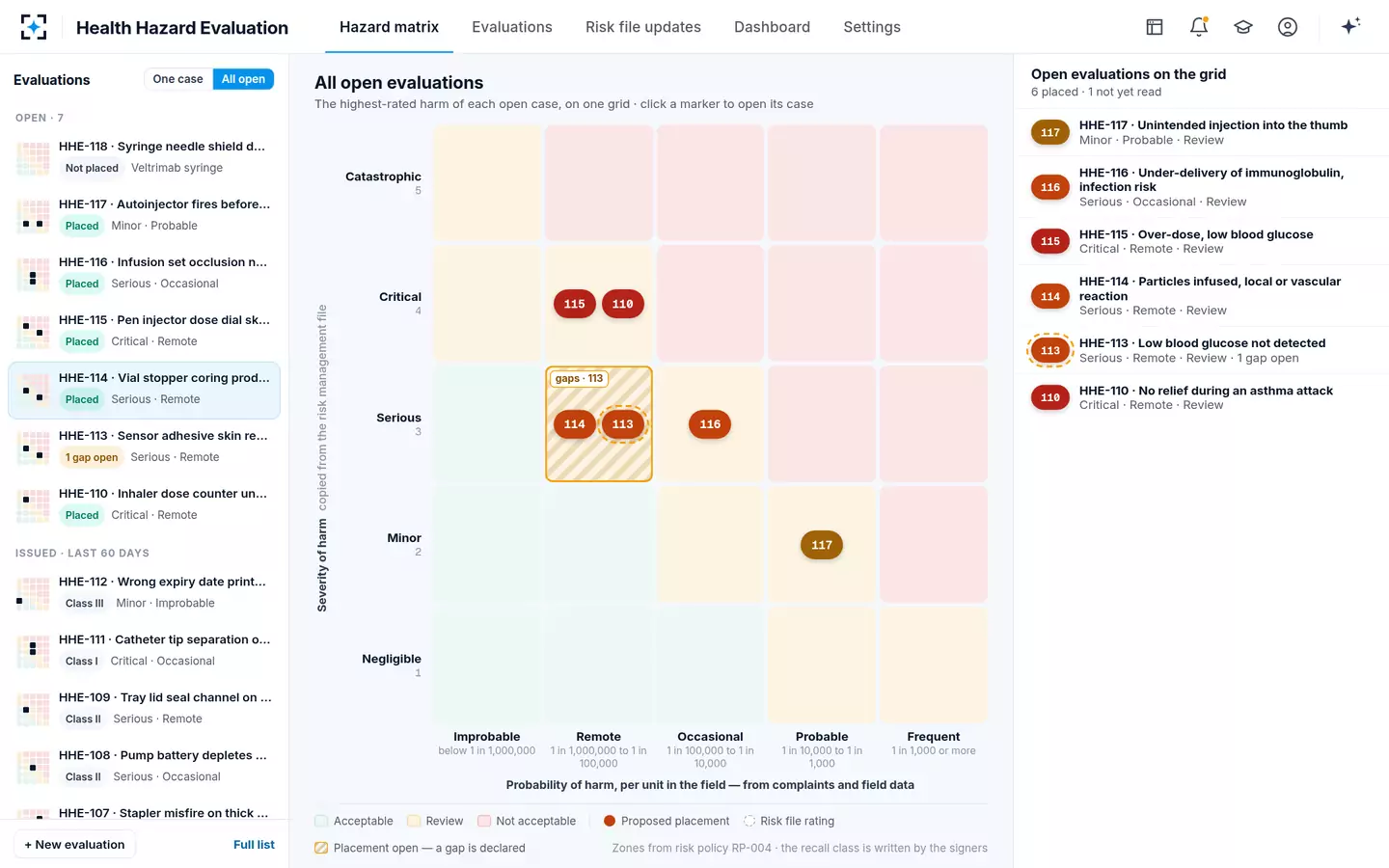
Those two axes are the same two your own hazard grid uses, which is why how a severity and probability matrix misleads is not an academic question in this work. If your grid compresses either axis, your recommended class is being produced by the compression rather than by the evidence.
Who assigns the recall classification, and on what document?
The agency does, and it is specific about which desk. The centre recall unit initiates the health hazard evaluation, finalises the recall strategy, determines that the firm's action is a recall, classifies it, and for Class I recalls prepares an action memorandum for the centre director's concurrence. The evaluation behind it is the hazard committee's, recorded on the agency's Health Hazard Evaluation Worksheet; approval of voluntary firm-initiated Class I recalls has been delegated to centre directors, while the recall unit may classify Class II and III recalls without management review, although "unusual and/or potentially high profile recall issues should be brought to center management's attention" (FDA RPM chapter 7, § 7-6-2).
Your own evaluation does not assign the class, and a firm whose template says otherwise has mislabelled its most important section. What it does is recommend one, and carry the evidence that recommendation rests on. In the software that distinction is enforced rather than advised: no agent proposes a recall class, the conclusion and recommended class are left for the three signers, and the assistant, asked point blank for a class, returns the evidence the signers would have to sign against instead.
Five years of device recalls: almost all of them start with the firm's own evaluation
The ratio in the first two bars is the argument for taking your own evaluation seriously. Ninety-six per cent of device recalls in those five years began with a manufacturer identifying its own issue. In almost every case the agency's committee is reading a situation the firm found, described and assessed first — which makes the quality of the firm's description one of the largest inputs into the class the agency assigns.
How long does FDA take to classify a recall?
The procedures and the measured data give two very different answers. The manual gives the hazard committee two working days to complete, endorse and forward the evaluation after receiving a recall recommendation, and five working days where the product is no longer in distribution channels; the recall unit then "will normally classify recalls within two days after receiving the health hazard evaluation or confirming the classification through precedent review".
The measured interval is roughly ten times longer. The Government Accountability Office analysed FDA data for fiscal years 2020 to 2024 and found that, on average, "the number of business days between initiation and classification for class I recalls ranged from 45 in 2020 to 32 in 2024. In contrast, class III recalls ranged from a high of 81 business days in 2021 to a low of 33 days in 2024." FDA officials gave GAO one reason in plain terms: manufacturers "might not provide all the required information in the early phases, which can result in FDA taking longer to classify the recall" (GAO-26-107619). The trend is downwards, which is good news, and the level still means that for the first month or two of a real product issue there may be no class to act on.
The clock the procedures set, and the clock the data measured
- Hazard committee completes the worksheet2 working days
- Recall unit classifies2 days
- Measured interval45 business days
- Measured interval32 business days
- High, 202181 business days
- Low, 202433 business days
That gap is the operational case for writing your own evaluation to a standard. For the first weeks of an issue the only assessment of harm that exists is yours, and every decision taken in that window — whether to stop shipping, whether to notify, how far to reach — is taken on it.
What the class then decides: depth, public warning, effectiveness checks
21 CFR 7.42(b) lists the three elements of a recall strategy, and all three scale with hazard. The strategy is not a mechanical function of the class, though: the manual is explicit that recall strategies "are based on the individual recall circumstances and are not necessarily dependent on the recall classification", and the same section lists the other factors the agency weighs — the type or use of the product, the ease of identifying it, how obvious the deficiency is to a user, and how much of the product remains unused.
The three elements of a recall strategy, and what each costs you
Depth of recall
What the rule saysThe strategy specifies the level in the distribution chain the recall reaches: consumer or user level, retail level, or wholesale level.
How it usually runsIn general, Class I may extend to the consumer or user level, Class II to the retail level and Class III to the wholesale level.
What it costs youEvery level added multiplies the notifications, the returns and the people who must be reached and counted.
Public warning
What the rule saysIts purpose is "to alert the public that a product being recalled presents a serious hazard to health", and it is reserved for urgent situations where other means appear inadequate.
How it usually runsIssued through general news media, or through specialised media such as the professional press, physicians or hospitals.
What it costs youThe agency ordinarily issues it in consultation with the firm; a firm issuing its own is asked to submit the wording and the distribution plan first.
Effectiveness checks
What the rule saysThey verify that every consignee at the chosen depth was notified and acted. The strategy names the level, A to E.
How it usually runsLevel A reaches 100% of consignees; B a case-by-case share above 10% and below 100%; C 10%; D 2%; E none at all.
What it costs youLevel A on a wide distribution is a heavy operational commitment, and it is often planned before anyone knows the class.
The effectiveness-check row is where the arithmetic bites. Level A means contacting every consignee and confirming each one acted; Level D means 2 per cent; Level E means none. A firm that has not modelled what Level A looks like across its own distribution — how many hospitals, how many wholesalers, who holds the lot-level records — discovers the answer during the recall, when every missing address is a consignee nobody can reach.
'Not yet classified' on an FDA recall, and why it appears first
The Enforcement Report is "an online weekly publication of all recalls monitored by FDA once they are classified (21 CFR 7.50)", and it may also list an action before classification once the agency determines that the firm's removal or correction meets the definition of a recall. Those entries are called, in the manual's own words, "not yet classified" records. When the class is set, the recall unit updates the entry to show it.
So "not yet classified" does not mean the agency is undecided about whether the product is a problem — it has already decided the action is a recall. It means the hazard evaluation is not finished, or the recall unit has not yet acted on it. For a hospital pharmacist or a distributor reading the report, the practical reading is: treat it as at least as serious as the firm's own notification letter says, because the only thing missing is the agency's grading.
Recall, correction, market withdrawal, stock recovery: four different things
The four are defined separately in 21 CFR 7.3 and they are not degrees of the same thing. A recall is "a firm's removal or correction of a marketed product that the Food and Drug Administration considers to be in violation of the laws it administers and against which the agency would initiate legal action, e.g., seizure", and the definition adds the exclusion in the next sentence: "Recall does not include a market withdrawal or a stock recovery."
A correction is "repair, modification, adjustment, relabeling, destruction, or inspection (including patient monitoring) of a product without its physical removal to some other location" — so a field correction that never moves a unit is still a recall when the product is violative. A market withdrawal is the removal or correction of a distributed product involving "a minor violation that would not be subject to legal action" or no violation at all. A stock recovery, under 7.3(k), concerns product that was never marketed or never left the firm's direct control.
Calling an action a market withdrawal when it is a recall is among the most consequential naming decisions in this field, and it is one a firm makes on its own. For devices, 21 CFR 806.20 is the rule that makes the reasoning auditable: records of corrections and removals not reported under 806.10 must contain the events giving rise to the action and a "justification for not reporting the correction or removal action to FDA, which shall contain conclusions and any followups, and be reviewed and evaluated by a designated person" (21 CFR 806.20(b)). A decision not to report is a document with a named reviewer, not a silence.
Every open case on one grid in Health Hazard Evaluation, highest-rated harm first
How many recalls are class I? What five years of device data show
Fewer than most people expect. Across fiscal years 2020 to 2024, Class II accounted for 88 per cent of all device recalls — 3,468 of 3,934. Class I and Class III share the remaining 12 per cent between them. The drug side runs at a different scale and a different cadence: FDA's drug compliance office classified 321 recall events in 2025, covering 755 recalled products, and reports that more than 17,000 drug products were recalled between 2012 and 2025.
The Class II dominance has a quiet consequence for how an evaluation should be written. If the overwhelmingly likely answer is Class II, then the sections that distinguish your case from that default — the severity evidence that could push it to Class I, or the absence of likely consequences that could make it Class III — are the ones a reviewer reads hardest. An evaluation that spends its effort on product description and its last page on seriousness has allocated the effort backwards.
When a class changes: new injuries, and the fortnightly re-evaluation rule
The agency's evaluation is not a one-time document. The committee "must promptly reevaluate the initial health hazard when additional data regarding injury, illness, medical, or scientific findings is received by the center", and where data is arriving continuously the committee is "to routinely meet and reevaluate the health hazard at least biweekly". A recall running while complaints keep arriving is a recall whose hazard assessment is formally under review every fortnight.
That rhythm is worth mirroring. If your own evaluation was written once, signed and filed, you have no mechanism to notice that the twelfth complaint changed the probability band the eleventh supported. FDA's benefit-risk guidance makes the same point about its own decisions, noting that uncertainty about an adverse event rate falls "as experience with the device increases, if the number of adverse events and the number of implantations are accurately tracked" (FDA benefit-risk factors guidance, 2016). Accurate tracking is the precondition, and it is held by desks that do not report to quality — which is why the path a complaint takes matters more to the class than the signature queue does.
What your own evaluation should recommend, and what it must not
It should recommend a class, name the two findings the recommendation rests on — the severity band and the probability band, each with its evidence — and say what would change it. It must not assert the class as a conclusion, merge your internal severity scale with the agency's, or use the words "reasonable probability" as a synonym for "possible". And it must not leave the recommendation unattributed: the agency's own rule accepts a conclusion supported by scientific documentation or by a statement that it is the opinion of the people making the determination, and nothing in between.
In the software the three signatures carry exactly those meanings, in a fixed order. Medical confirms the harms, severities, populations at risk and consequences. Quality confirms the product data, the problem definition and the likelihood, and that every declared gap is closed or accepted. Regulatory signs last, after both, confirming the recommended class and the reporting decisions that follow from it — and signing is blocked while any sentence in the draft is uncited.
Three signatures, each with its own meaning, in Health Hazard Evaluation
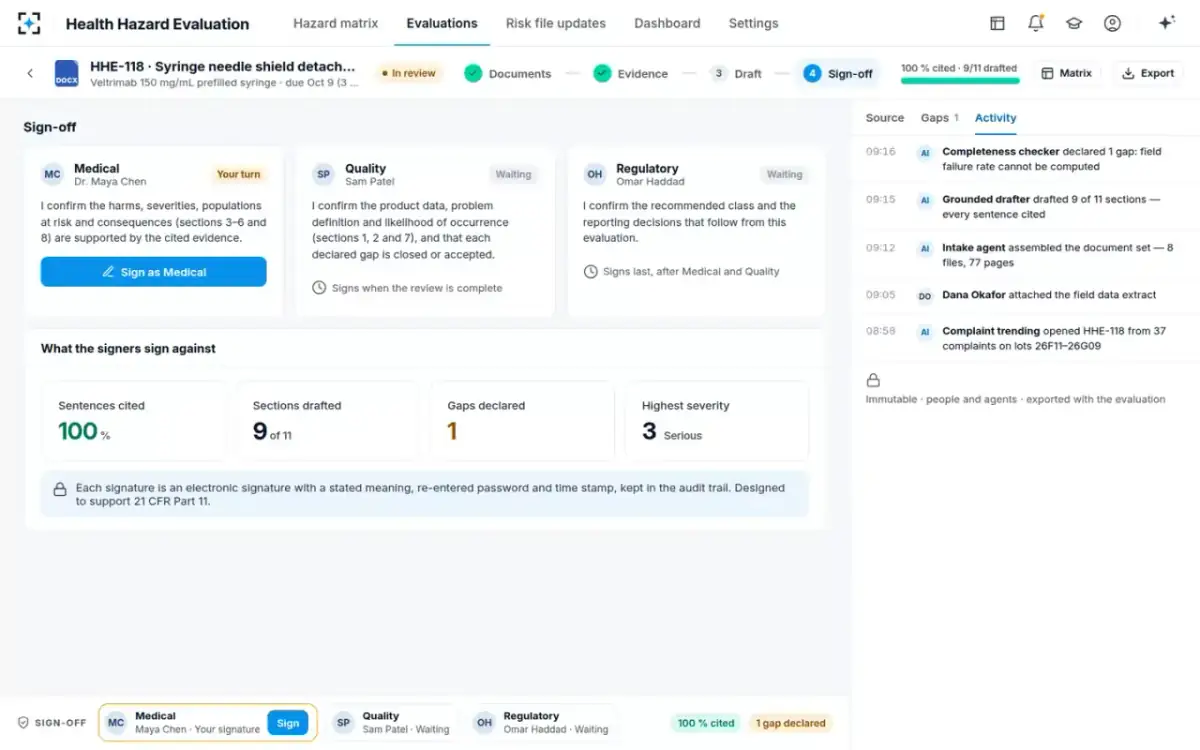
Written that way, the recommended class is a position your firm can hold through an agency review, a fortnightly re-evaluation and, if it comes to it, an inspection. Written any other way, it is a number somebody chose. The difference is visible in the template the sections come from, long before anyone disagrees about it.
Questions people ask
What is the difference between a class 1, class 2 and class 3 recall?
Class I means there is a reasonable probability that use of or exposure to the violative product will cause serious adverse health consequences or death. Class II means it may cause temporary or medically reversible consequences, or that the probability of serious consequences is remote. Class III means it is not likely to cause adverse health consequences at all. All three are recalls of products the agency considers violative; the class grades the hazard, not the violation.
Who assigns the recall classification?
FDA does. The centre recall unit classifies the recall on the basis of a health hazard evaluation prepared by that centre's hazard committee. Class I recalls carry an action memorandum for the centre director's concurrence; Class II and III recalls may be classified by the recall unit without management review. A manufacturer recommends a class in its own evaluation and lives with the one the agency assigns.
Can a recall be reclassified after it is announced?
The evaluation behind the class is explicitly open to revision: the hazard committee must promptly re-evaluate when new injury, illness, medical or scientific data reaches the centre, and must meet at least every two weeks where data is arriving continuously. Guidance for the committees describes collecting further data during a recall "either to confirm or revise the health hazard evaluation". A changed evaluation is the route by which a classification changes.
Does the recall class decide whether there has to be a press release?
Not by itself. 21 CFR 7.42(b)(2) reserves a public warning for urgent situations "where other means for preventing use of the recalled product appear inadequate", and FDA ordinarily issues it in consultation with the firm. A firm that decides to issue its own is asked to submit the proposed wording and the distribution plan for review and comment first. Hazard drives the decision; the class is evidence of hazard, not a trigger.
What is the difference between a recall and a market withdrawal?
A recall concerns a product the agency considers violative and would act against; a market withdrawal concerns a minor violation that would not be subject to legal action, or no violation at all — normal stock rotation, routine equipment adjustments. The distinction is made in 21 CFR 7.3(g) and (j); a correction is defined separately in 7.3(h). For devices, a decision not to report a correction or removal must be justified in writing and reviewed by a designated person under 21 CFR 806.20.
Does the class change what the company actually has to do?
Mostly through the recall strategy. Depth usually follows the class — Class I to the consumer or user level, Class II to retail, Class III to wholesale — and the effectiveness-check level, from 100 per cent of consignees down to none, is set in the same strategy. But the manual is clear that strategies depend on the individual circumstances and are not necessarily dependent on the classification, so a Class II recall of an easily missed defect can be worked harder than a Class I recall of an obvious one.