AI in post-market surveillance is usually sold as a capability and should be bought as a boundary. The useful question is not whether a model can read complaints, extract harms or draft a section — it plainly can — but which decision it is making, how much of the evidence behind that decision comes from the model, and what happens if the decision is wrong. Deciding how much harm a product issue could cause is the step that ends in a recall or no recall, three signatures and a position the firm has to defend for years, so it sits at the hard end of that question. Botminds' Health Hazard Evaluation is built to the opposite of the usual pitch: six agents gather, extract, place, map, draft and check the evidence, and every judgement that moves the answer stays with a person whose name is on it.
Two kinds of statement follow. The regulatory material — FDA's draft artificial intelligence guidance, the NIST risk management framework and the recall regulation — is quoted and linked where it appears. Everything about cases, documents and signatures describes the solution running on its own demonstration data, with invented products and invented colleagues.
What AI is actually doing in post-market surveillance today
Strip away the category names and there are four jobs on offer. Reading: turning complaint narratives, laboratory reports and supplier investigations into structured facts. Finding: retrieving the paragraph in a risk management file or a paper that bears on a question. Watching: detecting that a signal has crossed a threshold. Writing: assembling a draft from material already assembled.
Three of those four are search and transcription problems, and a model is genuinely good at them. The fourth is where products diverge, because writing a draft can mean composing sentences from cited facts, or it can mean producing a plausible paragraph about a subject the model knows in general. Those are different products that demonstrate identically. The difference only shows when a fact is missing: the first leaves a hole, the second fills it.
FDA's two axes: model influence and decision consequence
In January 2025 FDA published a draft guidance on using artificial intelligence to support regulatory decision-making, for drug and biological products. It is a draft, it carries the agency's standard "Draft — Not for Implementation" marking, and it is not a device guidance. It is nevertheless one of the clearest published statements of the right question, and it generalises.
The guidance sets out a seven-step credibility assessment framework whose third step is to assess model risk — and it defines model risk not as a property of the model but as the combination of two separate judgements.
The model risk moves from low to high as decision consequence or model influence increases.
FDA, draft guidance on AI to support regulatory decision-making, January 2025 — draft, not for implementation
The first factor, model influence, is how much the evidence produced by the model contributes to answering the question, set against the other evidence used. The second, decision consequence, is how significant the harm would be if a wrong decision were made on that question. The guidance then adds a clarification that is easy to skim past: the risk it means is that the model's output leads to an incorrect decision with an adverse outcome, "and not risk intrinsic to the model". Model risk is therefore not a score you can read off a benchmark. It is a function of the job you have given the model, which means it is something a buyer controls by design rather than something a vendor certifies.
The practical consequence is a lever. Of the two axes, only one is negotiable. You cannot make the consequence of a wrong recall decision smaller. You can make the model's contribution to the evidence smaller — and the way you do that is by deciding, task by task, which outputs the model may produce.
Why a hazard call is always high decision consequence
Set the consequence axis first, honestly. 21 CFR 7.41 lists what a health hazard evaluation weighs — injuries already reported, conditions that could lead to a hazard, the populations at risk, the seriousness and the likelihood of the hazard, and its consequences — and then says that "on the basis of this determination" the agency assigns the recall its class. The evaluation is the input to a decision about whether product comes off the market.
An incorrect answer is bad in both directions and the two are not symmetric. Overstate the harm and a firm withdraws product that patients need, at a cost measured in supply and in clinical risk. Understate it and product stays in use that should not. FDA's own benefit-risk guidance is explicit that "there is never 100% certainty regarding the safety, effectiveness, or quality of a device" at any point in the life cycle, and treats uncertainty as a factor to be weighed rather than a defect to be hidden. Any system that reduces that uncertainty to a confident sentence has made the consequence axis worse, not better.
So the consequence is fixed at high. Everything useful happens on the other axis.
FDA's model risk test applied to the six tasks inside one hazard evaluation
| The task | Model influence if automated | Decision consequence | How it is handled |
|---|---|---|---|
| Assembling the case as one document set | Low — the model selects what to read, and a person can see everything it did not. | High, like every task here. | Automated. The agent reads only documents linked to the case or its product, and asks a named person for anything missing. |
| Extracting facts, each with its page | Low — every output is a quotation that can be opened at its source. | High. | Automated. Severity is copied from the cited risk management file row and never estimated. |
| Computing a rate from cited figures | Low where both figures are cited; very high where either is inferred. | High. | Automated only when both numerator and denominator are cited. Otherwise refused, and a gap is declared. |
| Mapping facts to the sections of the form | Low — the mapping is visible and every section shows which facts reached it. | High. | Automated. Sections with no facts are reported as empty rather than filled. |
| Drafting the sections from mapped evidence | Moderate — wording shapes how a reader weighs a fact. | High. | Automated with a hard rule: a sentence without a citation is removed, and no fact may come from general knowledge. |
| Writing the conclusion and recommending a class | Maximum — this is the answer itself. | High. | Not automated, ever. Section 11 is reserved for the signers and the rule cannot be switched off. |
Can AI decide a recall classification?
No — and for a United States recall the question is partly answered by who owns the decision. Under 21 CFR 7.41(b) it is FDA that assigns a recall its class, on the basis of the hazard determination. What a manufacturer produces is the evaluation and, usually, a recommended class inside it. That recommendation is a medical and regulatory judgement with a person's name against it.
There is a second reason, which holds even where a firm's own procedure lets it classify internally. A recommended class is the one output where model influence would be total: it is not derived from evidence the reader can check line by line, it is the conclusion the evidence is supposed to support. Automating it puts maximum influence against maximum consequence, which is precisely the corner of FDA's matrix the framework exists to keep you out of.
In the solution this is a locked rule rather than a default: the conclusion and recommended class are left to the signers, and the setting cannot be turned off. Asked directly what class a case should get, the assistant declines and offers the evidence the signers will sign against instead — the highest severity with its source, what has been reported, and which likelihood figure is still missing. How a class is actually decided sets out the rest.
Three limits that keep model influence low
Lowering model influence is not a matter of trusting the model less. It is a matter of changing what the model is asked to produce, so that its outputs are checkable artefacts rather than opinions. Three limits do most of the work.
Six agents, three signatures, and the one thing each agent may never do
Agent
IntakeAssembles the case as one document set — complaint summary, current risk management file, instructions for use, field data by lot, supplier and engineering investigations — and lists what is missing.
Never: reads anything not linked to the case or its product
Agent
Evidence extractorRecords each harm with its hazardous situation, the population at risk, the events reported to date, and the severity from the cited risk file row.
Never: estimates a severity, or makes a medical judgement
Agent
Hazard placerPlaces each harm on the severity by probability grid, computing the rate from cited complaint and distribution figures and showing the risk file rating beside it.
Never: places a harm on a rate it cannot compute, or proposes a recall class
Agent
Section mapperMaps each cited fact to the sections of the evaluation form and reports which sections no fact reached.
Never: invents a section’s content
Agent
Grounded drafterWrites the evidence sections in plain language from the mapped facts, with a citation on every sentence.
Never: writes the conclusion or the recommended class
Agent
Completeness checkerConfirms a cited source behind every field of the form and declares each gap with the data needed and the person who owns it.
Never: infers a value instead of declaring a gap
A person decides
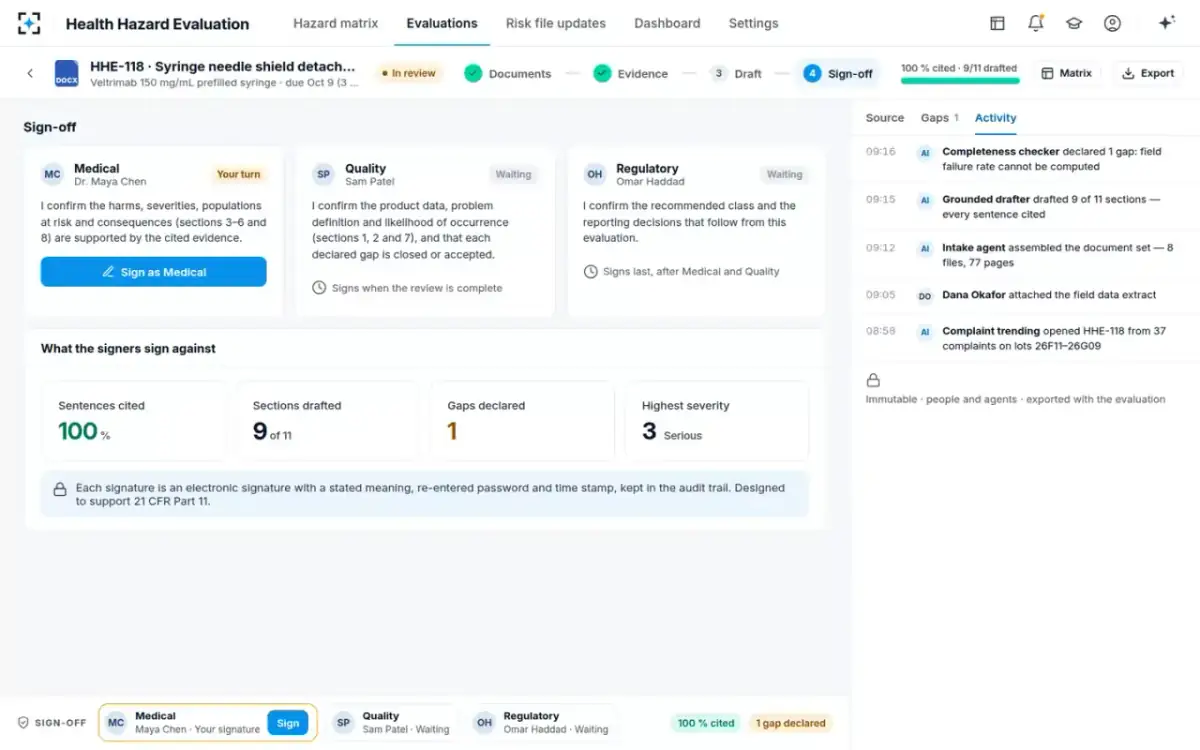
Medical signerConfirms the harms, their severities, the populations at risk and the consequences, and writes the medical assessment.
Never: signs while a sentence is uncited
A person decides
Quality signerConfirms product data, problem definition and likelihood, and that every declared gap is closed or consciously accepted.
Never: accepts a rate whose denominator is unstated
A person decides
Regulatory signerSigns last, seeing what the other two signed, and owns the recommended class and the reporting decisions that follow.
Never: delegates the class to the draft
The first limit is that severity is read, not reasoned. It comes from the cited row of the risk management file on the scale that file was written against, and no agent may change it. That single rule removes the most consequential inference a model could make in this work, because severity is the axis that decides whether a harm is tolerable at any frequency.
The second is that no placement is made on a rate that cannot be computed. If the complaint count is cited and the distribution figure is not, the harm stays unplaced and the cell stays open. A model that would otherwise reach for a neighbouring lot, an annual average or a remembered figure simply cannot, because the denominator that sets the class is treated as evidence rather than as a parameter.
The third is that a sentence without a citation is removed rather than kept with a caveat. This is stricter than it sounds. It means the draft cannot contain a true general statement about the device class, a sensible clinical observation, or a reasonable inference — all of which a competent human writer would include, and all of which are indistinguishable from invention to the reviewer reading at speed.
Declaring a gap instead of inferring a value
Every system that drafts regulated documents meets the same fork: a required field has no source. One branch estimates and flags. The other declares and stops. They look similar in a demonstration and behave completely differently in an inspection.
The regulation points at the second branch. For the report that follows a correction or removal, 21 CFR 806.10(c)(13) requires that where information is not immediately available, the report state "why it is not available and when it will be submitted". An unknown with a reason and a date is a compliant answer; an estimate that lost its qualifier in editing is not.
What makes a declared gap useful rather than merely honest is what travels with it: the data needed, the sign-off it blocks, and a named person who can close it. In the solution's demonstration cases a missing fragment-size result and an outstanding supplier investigation each become a request to the colleague who owns it, the affected grid cell stays hatched, and when the files arrive the agents re-read only what is new.
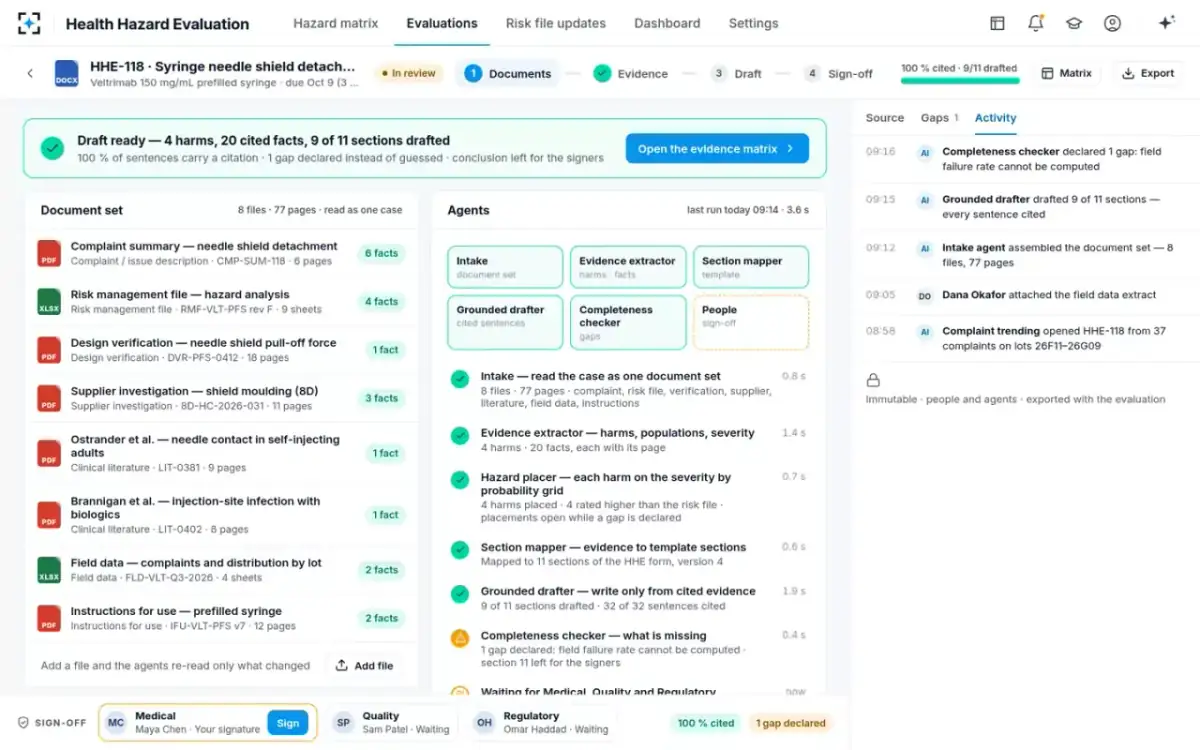
Health Hazard Evaluation on a new case: what each agent found, and what it could not
What has to be on the file for an inspector
An inspector does not audit a model. They audit a document and the trail behind it, and they ask the questions they have always asked: where did this number come from, who decided this, and what did you do about what you did not know. A system that uses AI has to make those three answers easier, not harder.
What to require before an agent touches a hazard evaluation
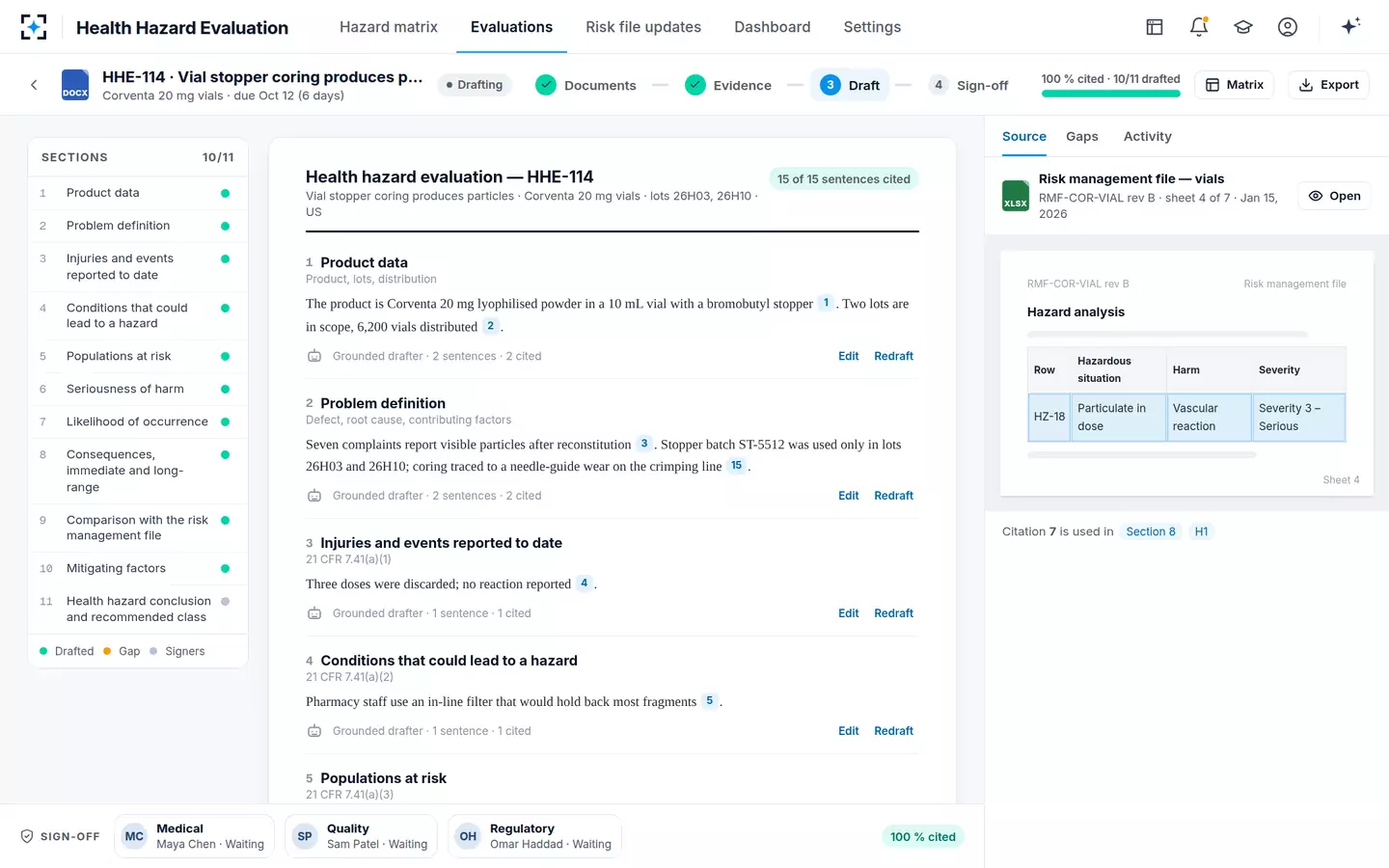
- A citation on every sentence, opening at the passage
Not a document list at the end. A reviewer should be able to click a sentence and land on the page it came from.
- Severity read from a named source, never estimated
The risk management file row, cited, on the scale that file uses. If the system can produce a severity without a source, it can produce a wrong one.
- A refusal behaviour when a figure is missing
Ask the vendor to delete a distribution figure during the demonstration and show you what the system then writes in the likelihood section.
- Signing blocked while any sentence is uncited
A rule that cannot be overridden by the person in a hurry is the only kind that survives a bad week.
- A complete history of actions by people and agents
Exported with the evaluation, not held in a console somebody has to be given access to.
- A named person against every judgement
Each signature with its stated meaning: who confirmed the harms, who confirmed the likelihood, who owns the recommended class.
One more thing belongs on the file and is often missing: what the model was not allowed to do. A procedure that states the limits — severity is copied, placements require a computable rate, the conclusion is written by a person — turns a set of product behaviours into a controlled process, and gives the inspector something to test against rather than a demonstration to admire.
How do you validate a model whose job is to quote?
Validation is where most AI conversations in quality organisations stall, because the word is doing two jobs. NIST's AI risk management framework uses the formal definition: validation is the "confirmation, through the provision of objective evidence, that the requirements for a specific intended use or application have been fulfilled". The phrase that matters is "for a specific intended use". You do not validate intelligence; you validate a stated job.
That turns an impossible task into an ordinary one. If the stated job is "every sentence in the draft is supported by the cited passage", the test is a set of past evaluations, a reviewer and a count of sentences whose citation does not support them. If the job is "a missing denominator produces a declared gap rather than a value", the test is a set of cases with figures removed. Both are measurable, repeatable and intelligible to an auditor, and neither requires anyone to reason about the model's internals.
NIST's framework also asks, in its measurement function, that "the AI model is explained, validated, and documented, and AI system output is interpreted within its context". For this work, context means the evaluation it feeds: the same draft that would be a helpful summary in a research setting is an assertion about patient harm in a recall file. The acceptance criteria belong to the second reading.
A citation on every sentence, and the source page open beside the draft
Questions to put to a vendor, and the answers that should worry you
Six questions separate systems that quote from systems that compose. Ask them in the demonstration, with the vendor driving, and ask for the behaviour rather than the roadmap.
Six questions for a post-market AI demonstration
What a good answer looks like: Copied from a cited row of our risk management file, on our scale, and no agent can change it.
The answer that should end the conversation: The model assesses severity from the clinical description, and you can review it.
What a good answer looks like: The placement stays open, the section stays blank, and a gap is declared with the data needed and its owner.
The answer that should end the conversation: It estimates from similar lots and marks the estimate as low confidence.
What a good answer looks like: Every sentence opens at its passage; a sentence without a citation is not written at all.
The answer that should end the conversation: A list of the source documents appears at the end of the draft.
What a good answer looks like: The signers. The rule is locked on and cannot be switched off by a user.
The answer that should end the conversation: The model proposes one and a person approves it, which is faster.
What a good answer looks like: Signing is blocked while any sentence is uncited; the block is a setting the quality unit owns.
The answer that should end the conversation: A warning appears, and the person signing can dismiss it.
What a good answer looks like: The evaluation, its citations, the declared gaps and the full history of actions by people and agents.
The answer that should end the conversation: The finished document; the history stays in the system.
Two of them are worth insisting on live. The deleted-figure question cannot be answered convincingly in a slide, and the citation question cannot be faked at speed. Everything else can wait for the written response. If you are also running a wider selection, what a surveillance system must hand the hazard call covers the data side of the same exercise.
Where agents genuinely change the week
The honest version of the benefit is narrow and worth more than the broad version. Agents do not make the hazard judgement better; they remove the hours between the judgement being possible and the judgement being made.
In the solution's demonstration cases, a new case of eight documents and 77 pages is read in one pass in 3.6 seconds, with four harms placed and nine of eleven sections drafted from cited evidence. Those are figures from sample cases, not customer results, and the two undrafted sections are the point: one of them is the conclusion, which no agent writes. Across the same sample set, an evaluation that took about 26 hours by hand has a design target of about 12, with review and judgement time rising rather than falling.
What that buys is not a cheaper document. It is a shorter interval between a complaint trend crossing a threshold and three people being able to sign something defensible — and in post-market work, that interval is measured in product still shipping. The clocks that run on one product issue are where the saving actually lands.
Three signatures in Health Hazard Evaluation, each with its stated meaning
To see the limits working on a case — a refused placement, a declared gap and a section left for a person — start from Health Hazard Evaluation.
Questions people ask
Can AI be used in post-market surveillance?
Yes, and it already is, for reading, retrieval, trending and drafting. What matters is which decision the model is making. FDA's draft AI guidance frames model risk as the combination of model influence — how much of the evidence comes from the model — and decision consequence. Keep influence low on high-consequence decisions by restricting the model to outputs a reviewer can check against a source.
Can AI decide a recall classification?
No. For a United States recall, 21 CFR 7.41(b) has FDA assign the class on the basis of the hazard determination; the manufacturer's recommendation is a medical and regulatory judgement that a named person signs. It is also the output where model influence would be total against a consequence that cannot be reduced, which is the corner of the risk matrix the framework exists to avoid.
What does FDA say about using AI to support regulatory decisions?
Its January 2025 draft guidance, for drug and biological products, sets out a seven-step risk-based credibility assessment framework. Step three assesses model risk as the combination of model influence and decision consequence, and the guidance is explicit that model risk is about an incorrect decision leading to an adverse outcome, not about risk intrinsic to the model. It is a draft and marked not for implementation.
How do you validate an AI model used in post-market surveillance?
Validate the stated job, not the intelligence. NIST's framework defines validation as objective evidence that requirements for a specific intended use have been fulfilled. State the job narrowly — every sentence supported by its cited passage; a missing denominator produces a declared gap — and test it on past cases with a reviewer counting failures.
How do you stop a model inventing a number?
By making an invented number impossible to write rather than easy to spot. Three rules do most of it: severity is copied from a cited source and never estimated, no placement is made on a rate that cannot be computed, and a sentence without a citation is removed rather than flagged. Test the second one in the demonstration by deleting a distribution figure.
What evidence does an inspector expect when AI drafted a document?
The same evidence as always, more easily found: where each statement came from, who decided what, and what was done about the unknowns. In practice that means a citation on every sentence that opens at its passage, declared gaps with owners and dates, signatures with stated meanings, and a complete history of actions by people and agents exported with the evaluation — plus a written procedure stating what the agents are not allowed to do.