Search for health hazard evaluation and FDA together and you will find two answers that do not fit each other, because three different documents share the name. FDA's is written under 21 CFR 7.41(a) by an ad hoc committee of the agency's own scientists, on the agency's own worksheet, and it produces the recall class. Your firm writes a second one first, because 21 CFR 7.46(a)(3) asks a firm that is removing or correcting a distributed product for an "evaluation of the risk associated with the deficiency", and the UK regulator says in as many words that this analysis "is also known as a health hazard evaluation". The third belongs to NIOSH, is about workplace exposures, and has nothing to do with recalls at all. Knowing which one you were asked for is the first hour of a product issue. Botminds’ Health Hazard Evaluation is built for the one your firm owes.
Health Hazard Evaluation reads the case as one document set, places each harm on a severity by probability grid with the evidence for both axes, drafts the form section by section with a citation on every sentence, and declares what is missing instead of reasoning around it. The screens and figures on this page come from its sample data: the products, lots, people and documents in them are invented, and the research figures come from the regulators and the published reports linked where they appear.
Four numbers behind the name
6factors
listed in 21 CFR 7.41(a) for the agency’s evaluation to take into account
The rule has not changed since 1978
2days
the agency gives its own hazard committee to return the worksheet, after a recall recommendation
3,934
device recalls FDA oversaw in fiscal years 2020 to 2024, 96% of them identified by the manufacturer
152requests
to the unrelated NIOSH workplace programme of the same name in 2025
Three documents, one name: which one were you asked for?
The three are not variants of one practice. They have different authors, different legal homes and different outputs, and the only thing they share is a phrase. A quality engineer told to "do the HHE" on a complaint trend is being asked for the third row below. An executive who heard the term in a recall meeting probably heard about the second. A plant manager handed a letter about air quality on a production line received the first.
Three documents called a health hazard evaluation, and what each one decides
NIOSH Health Hazard Evaluation
Who asks for itAn employee, an employer or a union representative asks for it
The rule behind itThe NIOSH Health Hazard Evaluation Program, a free federal workplace service
Who writes itNIOSH investigators, who may visit the workplace
What it decidesWhether a workplace exposure is harming the people who work there. Nothing about a product in the market.
FDA's recall health hazard evaluation
Who asks for itThe centre’s recall unit starts it when a recall looks possible
The rule behind it21 CFR 7.41(a), with the procedures in Chapter 7 of the Regulatory Procedures Manual
Who writes itAn ad hoc committee of FDA scientists, on the agency’s own worksheet
What it decidesThe recall class — I, II or III — which the agency publishes.
The evaluation your firm writes
Who asks for itYour own quality system, as soon as a product issue looks like a field action
The rule behind it21 CFR 7.46(a)(3) asks for it; the MHRA asks for it by name when a field action is planned
Who writes itMedical, Quality and Regulatory, on your firm’s own template
What it decidesNothing on its own. It is the evidence everything after it rests on.
The cost of the confusion is not embarrassment. It is that the third document, the one your firm owes, has no published template and no agency deadline of its own, so it is the one that gets started last. By the time it is written, the complaint trend may be months old and the laboratory may have discarded the retained samples that would have answered its hardest section.
Who conducts the health hazard evaluation — FDA, or you?
Both, on different documents, in a fixed order. The agency's regulation is explicit about its own author: the evaluation "will be conducted by an ad hoc committee of Food and Drug Administration scientists". The Regulatory Procedures Manual adds the machinery. The centre recall unit initiates the evaluation; if no up-to-date precedent covers the situation, it forwards the information to that centre's Health Hazard Evaluation Committee, which records its work on the Health Hazard Evaluation Worksheet and returns the completed form "within two (2) working days after receiving a recall recommendation unless additional information is required" (FDA RPM chapter 7, § 7-6-1). Where the product is no longer in distribution channels the committee has five working days instead.
Your firm's document comes first, and it is the one the committee reads. For a firm-initiated recall, 21 CFR 7.46(a) sets out what the agency will ask for, and the third item on that list is an "Evaluation of the risk associated with the deficiency or possible deficiency", alongside the identity of the product, the reason and circumstances of the discovery, the total amount produced and the total "estimated to be in distribution channels" (21 CFR 7.46(a)). Nothing in the rule describes the shape of that evaluation. Everything in your reviewer's reading of it depends on the shape you chose.
The agency's health hazard evaluation beside the one your quality unit writes
FDA's evaluation: An ad hoc committee of FDA scientists in the relevant centre, with written concurrence from the reviewers.
Yours: Your Medical, Quality and Regulatory signers, from the complaint file, the risk management file, supplier and laboratory investigations, literature and field data.
FDA's evaluation: The recall class — I, II or III — assigned by the centre recall unit on the basis of the evaluation.
Yours: The evidence the class rests on, plus a recommended class your Regulatory signer is willing to defend.
FDA's evaluation: The agency's own Health Hazard Evaluation Worksheet, Attachment D of chapter 7: nine numbered questions, a seven-line hazard scale and a five-band probability scale.
Yours: Your own template. There is no published form for it, which is why most firms build one from the agency’s.
FDA's evaluation: Two working days inside the centre for the committee, then normally two days more for the recall unit to classify.
Yours: No clock of its own — but 21 CFR 806.10 gives a device firm 10 working days from initiating a correction or removal to report it.
FDA's evaluation: The classification, in the agency’s Enforcement Report, which shows "not yet classified" until it is set.
Yours: Nothing. It is read by your reviewers, your regulator and, if things go badly, an inspector.
What 21 CFR 7.41 actually asks, factor by factor
The rule is one paragraph long, and it is worth reading whole before writing to it. It names six factors, and it says they are a floor rather than a ceiling — the committee will take them into account "but need not be limited to" them.
An evaluation of the health hazard presented by a product being recalled or considered for recall will be conducted by an ad hoc committee of Food and Drug Administration scientists and will take into account, but need not be limited to, the following factors.
21 CFR 7.41(a), Health hazard evaluation and recall classification
The six are: whether disease or injuries have already occurred from use of the product; whether existing conditions could contribute to a clinical situation exposing humans or animals to a hazard; an assessment of the hazard to various segments of the population, "with particular attention paid to the hazard to those individuals who may be at greatest risk"; an assessment of the degree of seriousness; an assessment of the likelihood of occurrence; and an assessment of the consequences, immediate or long-range.
Two things in that list are easy to miss. The second factor carries its own evidential standard in the same breath: any conclusion "shall be supported as completely as possible by scientific documentation and/or statements that the conclusion is the opinion of the individual(s) making the health hazard determination". An unattributed assertion is not one of the two permitted kinds of sentence. And the third factor is about segments, not about an average patient — the whole point of naming children, surgical patients, pets and livestock is that the hazard is to be assessed for the group most exposed and least able to tolerate it. A template built from the agency's form turns each of the six into a section with a question you can answer.
The worksheet the agency fills in, and why you should write to it
Chapter 7 of the Regulatory Procedures Manual publishes the worksheet the committee uses. It opens with product identification, the firm, and the nature of the problem, then asks whether adverse reaction reports or other indications of injury have been reported for this problem and for similar situations, and whether the problem is easily identified by the user. It asks what the risk is to the general population, which segments are most at risk and why, and whether particular conditions or diseases make individuals more or less at risk. Only then does it ask for the hazard itself — with an instruction to "explain and cite literature references when applicable" — and for the probability of an adverse event occurring.
Writing your own document in that order is free and it changes how it reads. A reviewer working down the worksheet finds each answer where they expect it, which means the judgement in your evaluation is read as judgement rather than hunted for. The reverse is also true: a firm's evaluation organised around its own internal process, with the population at risk buried in an appendix, forces the committee to reconstruct the case before it can assess it, and a reconstruction is where a difference of opinion is born.
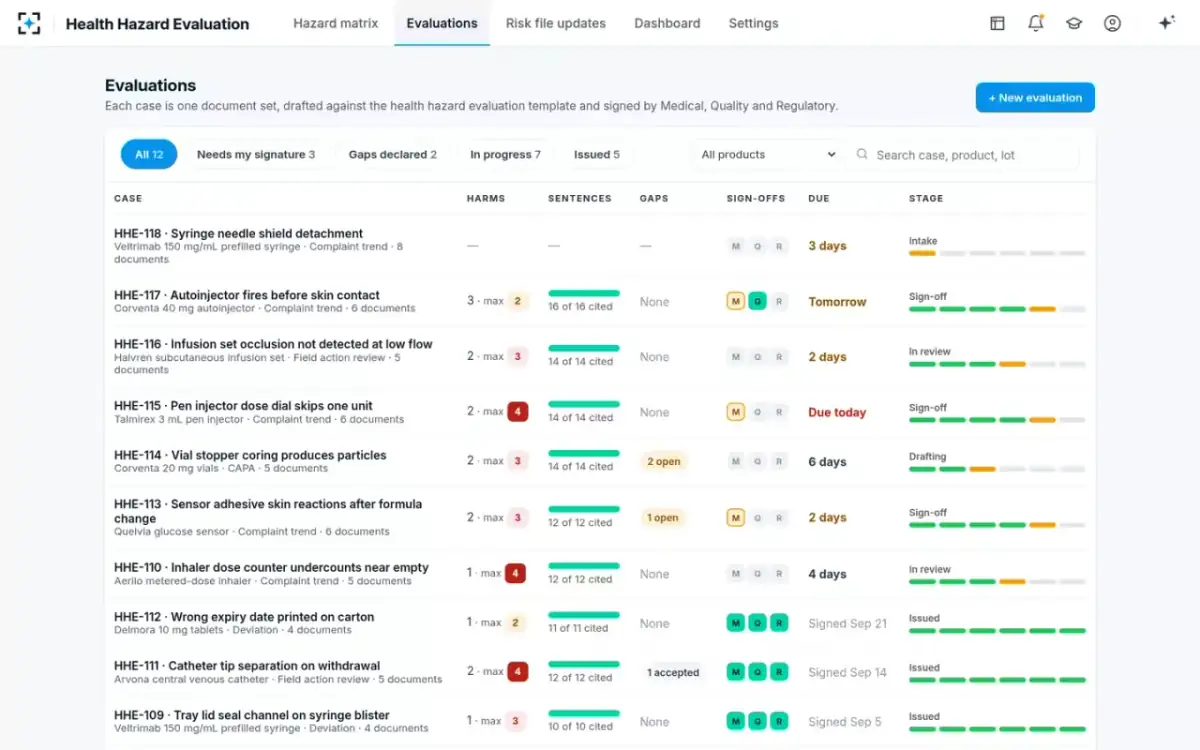
Every open case in Health Hazard Evaluation, with its harms, citations and declared gaps
Where your own obligation comes from: 7.46(a)(3), 806.10 and the UK's FSCA form
No rule in Title 21 uses the phrase "the manufacturer shall conduct a health hazard evaluation". The obligation is assembled from three places, and the assembly is why firms argue about whether they have one.
First, 21 CFR 7.46(a)(3), the risk evaluation a firm removing or correcting a distributed product is asked to provide. Second, 21 CFR 806.10, which requires a device manufacturer or importer to report a correction or removal initiated "to reduce a risk to health posed by the device" within 10 working days, and to include a description of the events giving rise to it and the action taken. Third, and most explicitly, the UK. The MHRA's vigilance reporting requirements tell manufacturers to "undertake a detailed analysis and evaluation of the identified risk and the actions proposed to address the issue" and then state plainly: "This is also known as a health hazard evaluation." Field safety corrective actions are notified on the FSCA report form through its MORE system, and where a reported serious incident leads to a planned field action, the final incident report should include it too: "Where FSCA is planned, a copy of the CAPA report and health hazard evaluation should be provided" (MHRA, updated 5 September 2025).
So a firm selling in both markets ends up writing one document that a British regulator expects by name and an American one expects by function. That is an argument for writing a single evaluation that satisfies the stricter reader, not two that satisfy neither.
The NIOSH programme that shares the name
The National Institute for Occupational Safety and Health runs a programme called, exactly, the Health Hazard Evaluation Program. It has nothing to do with products in the market. "NIOSH receives requests from employees, employers, and union representatives who are seeking an evaluation of potential health hazards in their workplace," its 2025 annual report explains, and "the NIOSH HHE Program does these evaluations at no cost to the requestor." In 2025 it received 152 requests and made 14 site visits and emergency response deployments, publishing 18 final reports.
It is worth knowing about for two reasons. It often sits at the top of search results for the bare phrase, which is why a new quality engineer sent to find "the HHE guidance" comes back with a workplace exposure manual. And if your own plant has an air-quality or ergonomic problem, it is genuinely the right door — free, independent and nothing to do with your recall file.
Is a health hazard evaluation required by law?
For the agency, yes: 21 CFR 7.41(a) is written in the future indicative, and the Regulatory Procedures Manual commits the agency to "conduct or obtain health hazard evaluations (HHE) for each recall scenario". For your firm, the honest answer is that the document is not named in the US rule, but the agency asks for its content under 21 CFR 7.46(a)(3), the UK regulator asks for it by name, and a field action without one is very hard to explain.
The explaining is the part firms underestimate. In an October 2026 warning letter to a device manufacturer, FDA's inspectors wrote that a corrective action opened in October 2023 saw no action taken "as the Health Hazard Evaluation was canceled on January 31, 2024, because it was deemed not necessary based on complaint incident rates and without considering the potential harm to patients"; the recall came in November 2024, "over a year later" (FDA warning letter, 7 October 2026). The citation was not for failing to write a document. It was for letting a rate stand in for an assessment of harm — which is the one substitution the six factors are designed to prevent, and the subject of the path a complaint takes to a recall decision.
What happens to your evaluation after you hand it over
It goes to the centre recall unit, which decides whether a precedent evaluation already covers the situation and, if not, forwards it to the hazard committee. The committee works on its own worksheet, not on yours, but it works from your facts. Where the facts are complete it has two working days of reading to do; where they are not, it has the right to stop and ask, and the manual tells the committee to notify the recall unit when further information is needed. Every such question adds days to the classification.
The committee's obligation does not end at the first answer. It "must promptly reevaluate the initial health hazard when additional data regarding injury, illness, medical, or scientific findings is received", and where data is arriving continuously it is to "routinely meet and reevaluate the health hazard at least biweekly". If your own evaluation is a document written once and filed, you will be the last to know that the agency's view of your product has moved.
Precedent evaluations: when the agency does not write a new one
Not every recall gets a fresh evaluation. "Precedent HHEs will be used where the product is identical or similar with basically the same defect or violation as a recall action previously classified," the manual says, and those precedents are "re-evaluated and updated periodically". Established precedent recall policies, such as those set by the device centre, may also be used.
This has a practical consequence that rarely gets said out loud. If your defect resembles one the agency has already classified, the class may effectively be decided before anyone reads your evaluation — which makes the sections that establish how your situation differs the most valuable ones you will write. Distribution, population at risk and mitigations are where a genuine difference lives. A general assertion that "this case is different" is not a difference; a cited figure showing that the exposed population here is monitored in hospital rather than self-administering at home is. How a recall's class is decided follows the rest of that sequence.
What a defensible evaluation looks like while the evidence is still arriving
The hardest fact about a product issue is that the decision and the evidence do not arrive together. Complaints come in weekly, the supplier's investigation takes a month, the laboratory has not yet characterised the defect, and distribution by lot is held by a different function. The old answer is to wait, and then to write the missing figure from experience when waiting runs out. 21 CFR 806.10(c)(13) offers a better one: where required information is not immediately available, the report carries "a statement as to why it is not available and when it will be submitted". A stated gap with an owner and a date is a compliant answer. A guessed number is not.
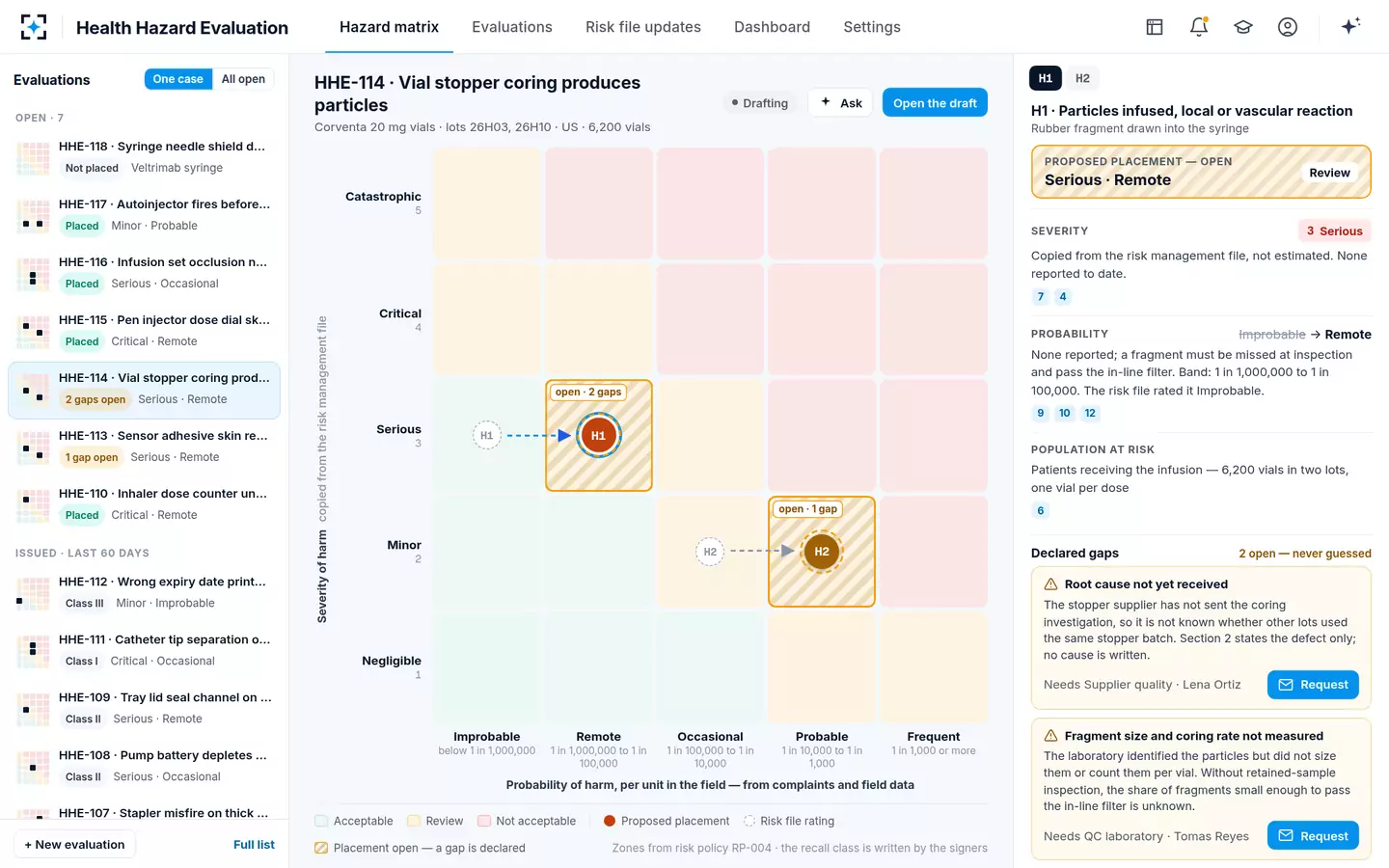
That is the rule the software is built around. A harm is placed on the grid only when both axes have cited evidence; where a figure is missing, the cell stays hatched, the section stays blank, and the request goes to the person who holds the file, by name. In the sample case below the two open gaps are a supplier's coring investigation and a laboratory measurement of fragment size — neither of them a matter of opinion, both of them answerable by someone who is not in the room.
A harm held open in Health Hazard Evaluation, because two figures have not arrived
Written that way, your evaluation answers the committee's worksheet question by question, states what it does not know and who is getting it, and leaves the conclusion and the recommended class to the three people whose names are on it. That is the whole of the discipline, and it is why the severity and probability grid is the part most worth arguing about before a case opens, not during one.
Questions people ask
What is a health hazard evaluation?
It is an assessment of how much harm a product issue could cause, made before a recall decision. In FDA's sense it is the evaluation 21 CFR 7.41(a) requires, conducted by an ad hoc committee of agency scientists and weighing six factors: injuries already reported, existing conditions that could lead to a hazard, the hazard to each segment of the population, the seriousness of the harm, its likelihood and its consequences. In a manufacturer's sense it is the risk evaluation a firm writes about its own product issue, which the MHRA calls a health hazard evaluation outright.
What is the FDA health hazard evaluation board?
No body of that name exists. The regulation describes "an ad hoc committee of Food and Drug Administration scientists", and the Regulatory Procedures Manual calls the committee in each centre the Health Hazard Evaluation Committee. The committee records its work on the agency's Health Hazard Evaluation Worksheet and the health hazard evaluation form "must be prepared by knowledgeable center personnel and should reflect their written concurrence".
Do you have to send your health hazard evaluation to FDA?
In the United States you send what 21 CFR 7.46(a) asks for, which includes the evaluation of the risk associated with the deficiency, and for a device correction or removal you report under 21 CFR 806.10 within 10 working days. In the United Kingdom the MHRA asks for it by name: where a reported serious incident leads to a planned field safety corrective action, the final incident report should include a copy of the CAPA report and health hazard evaluation.
Can FDA reuse a health hazard evaluation from an earlier recall?
Yes. The manual says precedent evaluations "will be used where the product is identical or similar with basically the same defect or violation as a recall action previously classified", and that those precedents are re-evaluated and updated periodically. Where a precedent applies, the centre recall unit can confirm a classification without a new committee review, so the sections of your own evaluation that establish how your case differs carry unusual weight.
Does a health hazard evaluation apply to drugs as well as devices?
Yes. 21 CFR part 7 covers products the agency regulates generally, and each centre runs its own hazard committee under the same chapter of the Regulatory Procedures Manual. The reporting rules around it differ — 21 CFR 806 is the device correction and removal rule, and a drug recall is handled through the drug centre's own compliance processes — but the six factors and the worksheet are the same, and the manual commits the agency to conduct or obtain an evaluation "for each recall scenario", not for each device recall.
What is the difference between a NIOSH health hazard evaluation and an FDA one?
Everything except the name. NIOSH evaluates potential health hazards in a workplace at the request of employees, employers or union representatives, at no cost to the requestor, and publishes its reports. FDA's evaluates the hazard presented by a product being recalled or considered for recall, and produces the recall class. One is about the people who make the product; the other is about the people who use it.