Post-market surveillance software is almost always chosen on the strength of its intake and its reporting: how easily complaints arrive, how the trends look, how fast a regulatory report can be produced. Those are real requirements and they are the easy half. The hard morning comes when a trend crosses a threshold and somebody has to say how much harm this could cause and how often — the health hazard evaluation that decides whether there is a recall. Botminds' Health Hazard Evaluation drafts that document from the evidence a firm already holds, which makes it an unusually direct test of a surveillance system: it can only cite what the system can produce, and everything the system cannot produce becomes a declared gap with somebody's name on it.
What follows is a buyer's guide rather than a product tour. The regulatory expectations are quoted and linked; the research figures come from a government audit and a peer-reviewed study. Figures about cases, documents and facts describe the solution running on its own demonstration data.
The volume and the stakes behind one surveillance system
2–4M
adverse event reports FDA officials say the agency receives and reviews each year
GAO, December 2025
88%
of device recalls over five fiscal years were class II — moderate risk, and the ordinary case
GAO analysis, FY2020–2024
35.2%
of high-risk therapeutic devices approved 2014–2023 had at least one serious (class I or II) recall
JAMA Health Forum, August 2026
2.6years
median from approval to the first serious recall, among the devices recalled
IQR 1.5–4.6 years
What the hazard call asks of your surveillance system
A hazard evaluation is not a report the surveillance system produces. It is a document assembled from evidence the system should be able to hand over, and the handover is where most systems are found out. The evaluation needs each harm with its hazardous situation and the population exposed to it, a severity with a source, a frequency with a denominator, the state of the investigation, what the labelling said at the time, and a clear account of what is not yet known.
Notice what is not on that list: a dashboard, a count of open complaints, a status, a trend line. Those are management information. The evaluation needs citable material — a passage, a row, a figure, with a document and a page behind it — because every sentence in it has to survive a reviewer asking where that came from.
That peer-reviewed study is worth sitting with, because it is unusually direct about why this matters. Having found that more than a third of high-risk therapeutic devices were subject to serious recalls, and that device, evidence and regulatory characteristics were not consistently associated with which ones, its authors conclude that "robust postmarket surveillance is needed to ensure patient safety". If you cannot predict which products will be recalled, the system that watches all of them is the control.
Proactive, not reactive: what the 2025 EU guidance now expects
In December 2025 the Medical Device Coordination Group published guidance on post-market surveillance that puts weight on a single word in the regulation. Its reading of "proactive" is a requirement rather than an aspiration: "'Proactive' emphasizes the manufacturer's obligation to actively seek out available information and not merely wait for it to arrive through channels such as complaints."
The guidance names what seeking out looks like in practice — customer surveys, gathered clinical experience, user feedback, screening of scientific literature, registers, post-market studies — and says the methods should be tailored to the device rather than copied from a template. It also sets an expectation that quietly rules out a large class of systems: "when assessing the data, it is important that data from different sources is compared, and conflicting data identified and evaluated."
Comparing sources and surfacing conflict is a different capability from aggregating them. A system that merges a complaint narrative, a laboratory result and a supplier's investigation into one summary has destroyed exactly the disagreement a hazard evaluation needs to see. When the laboratory says the fragments are 180 to 600 micrometres and the risk file assumed they were small enough to pass a filter, the conflict is the finding.
The six things a hazard evaluation needs, in citable form
Judge a candidate system against this list rather than against a feature matrix. Each item has a system that normally holds it, a form it has to arrive in, and a consequence when it does not.
Six inputs, where each one lives, and what happens downstream when it is missing
- The complaint or issue set, harm by harm
Held in complaint handling. Must arrive as narratives and coded events that can be quoted, not as a count. Missing: the evaluation describes the defect and never reaches the harm.
- The risk management file row behind each harm
Held in risk management, often outside the surveillance system entirely. Must arrive as an identified row on a stated scale. Missing: severity gets re-argued from memory, one of the costliest failures in this work.
- Supplier and laboratory investigations
Held by supplier quality and the testing laboratory. Must arrive as the report itself with a committed date when it is outstanding. Missing: root cause stays unknown and the affected population cannot be bounded.
- Distribution by lot
Held in supply chain or the enterprise system, rarely in surveillance. Must arrive as units by lot for a stated period. Missing: no rate, and no honest likelihood section.
- Literature on the population at risk
Held nowhere by default. Must arrive as papers with the passage marked. Missing: the population section is written from general knowledge, which a citation rule will then delete.
- The labelling in force at the time
Held in labelling or regulatory affairs, versioned by date. Must arrive as the version current when the affected lots shipped. Missing: mitigating factors are argued from today’s instructions for use rather than the patient’s.
The second and fourth items are the two that are usually manual, and they are manual in different ways. The risk management file is manual because it lives in a different discipline with a different release cycle. Distribution by lot is manual because, as the next section argues, nobody owns it for this purpose.
Where the twenty cited facts of one worked case came from
One evaluation · 8 documents · 77 pages · 20 cited facts
- Complaint summary · 30%
- Risk management file · 20%
- Supplier investigation · 15%
- Clinical literature, two papers · 10%
- Field data by lot · 10%
- Instructions for use · 10%
- Design verification · 5%
Thirty percent is the headline. Even in a case that begins with a complaint trend, seven facts in ten come from somewhere other than the complaint system — which is the whole argument against judging a surveillance system on how well it holds complaints.
Distribution by lot: the figure nobody owns
Every quality unit can tell you how many complaints it has. Far fewer can tell you, inside a day, how many units of lots 26G02 and 26G09 went to which markets between two dates. The figure exists — it is in an enterprise system somewhere — but no one is accountable for producing it in the form a hazard evaluation needs, and the request usually arrives as an email to a person rather than as a query against a system.
This is not a small gap. Without it there is no denominator, and without a denominator the likelihood section is either blank or invented; the arithmetic and its four candidate denominators is worth reading before any selection, because it tells you exactly what to ask a vendor for. Two questions settle it: can the system hold units by lot by period, and if not, can it name the system that does and record what it was told, with a date and a person.
FDA's own rules make the second answer acceptable. For the report that follows a correction or removal, 21 CFR 806.10(c)(13) allows information that is not immediately available to be declared with "a statement as to why it is not available and when it will be submitted". A system that can record a declared, owned, dated gap is doing something compliant. A system that leaves a required field blank with no owner is doing something that reads as an oversight.
Trending, and the threshold that opens a case
Trending is the one surveillance capability that is genuinely an obligation rather than a convenience, and the European guidance states the test it has to meet: non-serious incidents and expected undesirable side effects should be analysed for any statistically significant increase in the frequency or severity of those events, and an increase that could significantly affect the benefit-risk profile is subject to trend reporting.
Two design decisions follow, and vendors answer them very differently. The first is what the increase is measured against — the previous period, a baseline rate, or a fixed count. Only a rate survives a change in volume; a count-based threshold fires every time sales grow. The second is what crossing the threshold does. If it raises an alert in a queue, the clock on the real work does not start until somebody reads it. If it opens a case with an owner and a due date, it does.
Ask to see a threshold configured during the demonstration, and ask what happens on the day it fires. The answer tells you whether you are buying detection or buying response.
Does the system link a harm to a risk file row?
This is the question that separates good systems from very good ones, and it is easy to leave out of a selection. A hazard evaluation states a severity for each harm. That severity has to come from the risk management file, identified by row, on the scale that file uses. If the surveillance system cannot point at the row, the severity will be typed in by a person from memory — and once typed, it looks exactly as authoritative as one that was read.
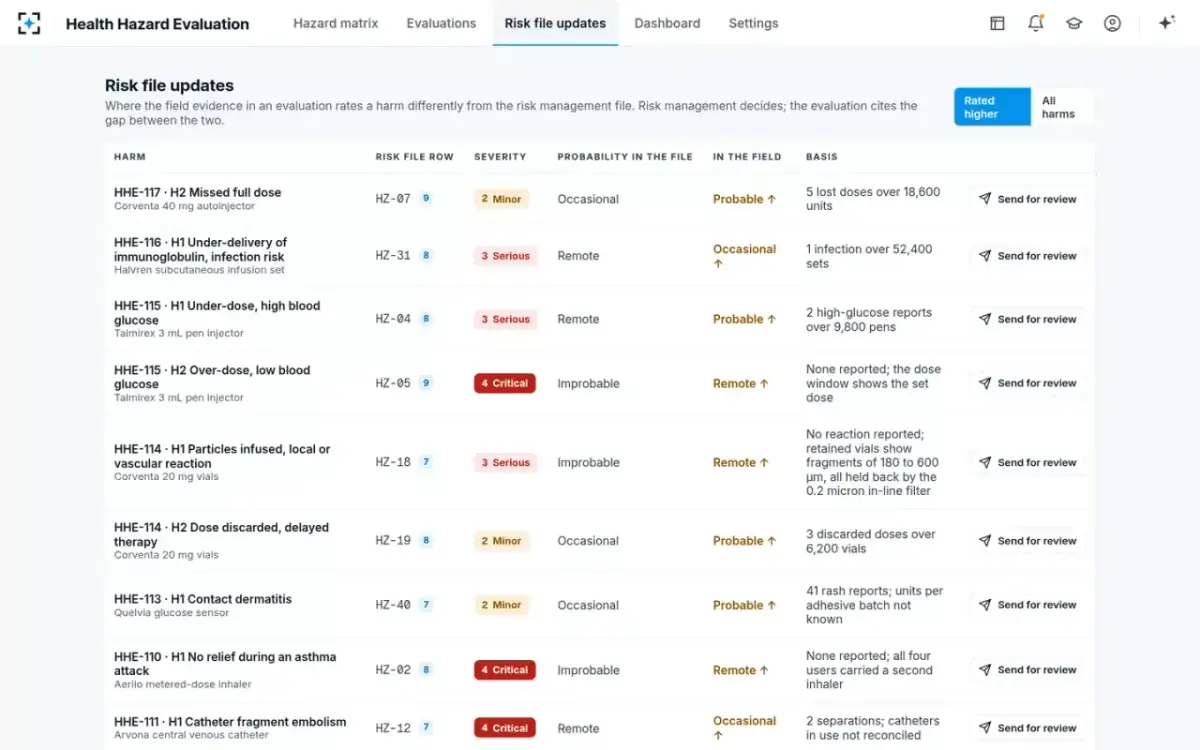
The link has to work in both directions. Field evidence can rate a harm higher than the risk file does, and when it does, risk management needs to know. In the solution, every harm whose field rating exceeds its risk file rating is sent to risk management with its basis, for that function to decide; no agent edits the risk file. That is the correct division of labour, and it is worth writing into your requirements rather than leaving to a later integration. How the two axes actually behave explains why severity is the one that must never be re-argued.
Health Hazard Evaluation sends every harm rated higher in the field than in the risk file for review
Build, buy, or make the system you already have answer
Three options are usually on the table and the honest answer is often the third. Most firms already have a complaint system, a risk management repository, a supplier quality process and distribution data. What they lack is not storage; it is the ability to assemble those into one citable case within hours of a trend firing.
Building has one real attraction — your data model, your vocabulary — and two reliable costs: the validation burden falls entirely on you, and the integrations you did not build are the ones you will need during a recall. Buying a full replacement moves a working complaint process onto new ground, usually in the middle of a year that has other plans. The third option, leaving each source where it is and adding the layer that reads them and produces the evaluation, is the smallest change that affects the morning that matters.
That is deliberately how this solution is positioned. It reads the complaint or issue description, the risk management file, supplier and laboratory investigations, clinical literature, field data by lot and the instructions for use — the records a product issue already has — and it does not replace the complaint system that produced the first of them.
Integration: what it must read rather than replace
Write the integration requirement as a reading list and a service level, not as a list of connectors. For each of the six inputs, say which system is authoritative, what form the evaluation needs it in, how it arrives today, and how long it currently takes to get. The last column is the one that will embarrass you, and it says more about how long your evaluations take than most software features do.
One more requirement belongs in the document and is routinely left out: what is exported when the evaluation is finished. A hazard evaluation is not an internal artefact. The UK regulator's guidance on the final report following a serious incident says that "where FSCA is planned, a copy of the CAPA report and health hazard evaluation should be provided", submitted through its reporting system. The document leaves the building. Its citations, its declared gaps and its signatures should leave with it.
A collect-and-report system beside one that can answer the hazard call
Collects and reports: Counted, coded and trended; narratives searchable.
Can answer the hazard call: Quotable harm by harm, with the passage and page a sentence can cite.
Collects and reports: Not held. Supplied by email when someone asks.
Can answer the hazard call: Units by lot by period, from a named source, recorded with the date it was extracted.
Collects and reports: A reference field a person fills in.
Can answer the hazard call: The identified row, on its own scale, opened beside the harm.
Collects and reports: Attached when they arrive.
Can answer the hazard call: Tracked as an outstanding input with an owner and a committed date, blocking what depends on it.
Collects and reports: Current version available.
Can answer the hazard call: The version in force when the affected lots shipped.
Collects and reports: Produces a figure from what it has, or an empty field.
Can answer the hazard call: Declares a gap with the data needed, the owner and the sign-off it blocks.
Twelve questions to put to a vendor
Run these in the demonstration, with the vendor driving and your own worst case in mind. The fourth column is not a trick; each of those answers describes a system that will be perfectly satisfactory until the morning it is not.
Twelve questions, what each is really testing, and the answer to walk away from
| The question | What it is really testing | Ask to see | The answer that should end the conversation |
|---|---|---|---|
| Can it hold units distributed by lot and period? | Whether a rate is possible at all. | A lot queried live, with the figure and its source date. | “That comes from the enterprise system when you need it.” |
| Where does severity come from? | Whether the risk file is linked or retyped. | A harm opened beside its risk file row. | “The user selects it from a drop-down.” |
| What happens when a required figure is missing? | Declared gap, or an invented value. | A figure deleted, and the section that follows. | “It estimates and marks it low confidence.” |
| Can every statement be traced to a page? | Citable evidence, or a document list. | A sentence clicked through to its passage. | “All source documents are attached to the case.” |
| How is a threshold defined? | Rate-based, or count-based and volume-sensitive. | A threshold configured and fired. | “Ten complaints in a month.” |
| What does crossing a threshold create? | An alert, or a case with an owner and a date. | The object created, and who it goes to. | “It appears on the trend dashboard.” |
| Does it compare conflicting sources? | Whether disagreement survives aggregation. | Two sources that disagree, side by side. | “It summarises all the evidence into one view.” |
| How does a harm get back to risk management? | Whether field-versus-file differences are routed. | A harm rated higher in the field than in the file. | “The risk team can run a report.” |
| What is exported with the finished evaluation? | Whether citations, gaps and history travel. | The export itself, opened. | “A PDF of the document.” |
| Who signs, in what order, and what does each signature mean? | Whether sign-off is modelled or merely recorded. | The signature meanings as configured. | “An approval step in the workflow.” |
| What is the labelling version used for mitigating factors? | Whether labelling is versioned by date. | An evaluation on a historical lot. | “The current instructions for use.” |
| What can the system not do that we will need? | Whether the vendor knows its own boundary. | A straight answer. | A pause, followed by a feature roadmap. |
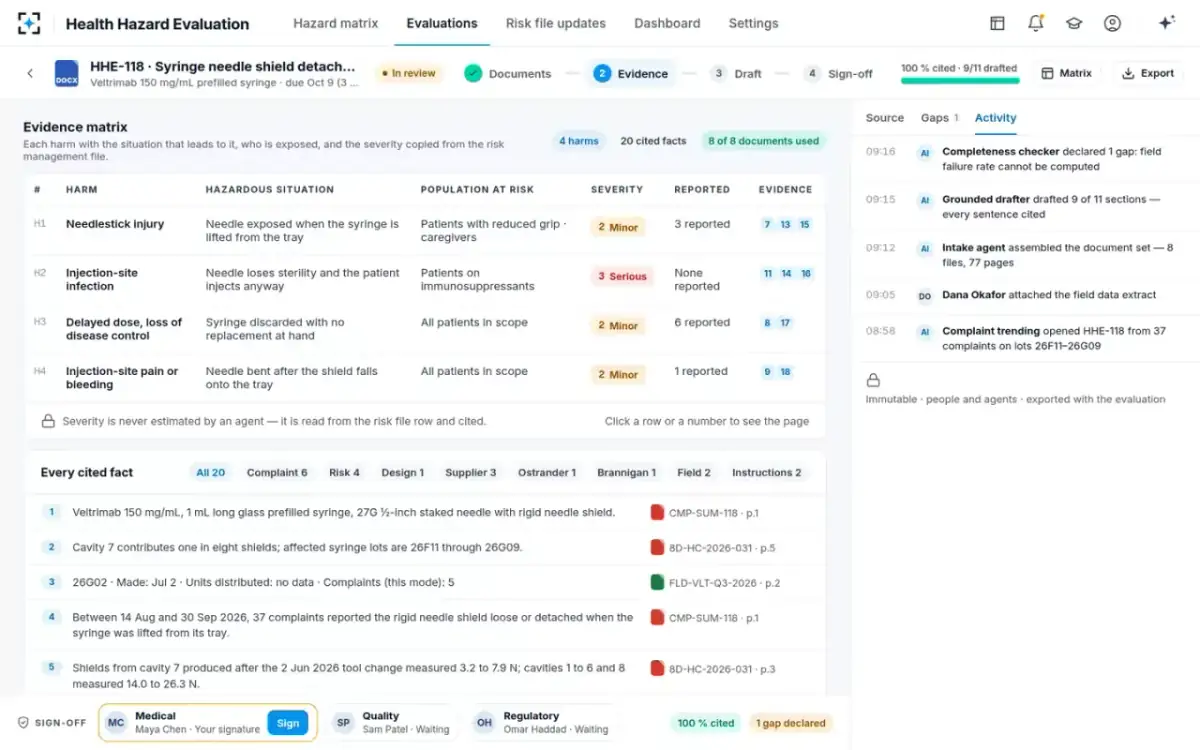
The evidence matrix Health Hazard Evaluation builds when a system can hand its inputs over
What good looks like twelve months in
A year after a good selection, four things are true and none of them is a dashboard. The time from a trend firing to a complete draft is measured and falling. The declared gaps are grouped by kind, so the same missing figure appearing on evaluation after evaluation is visibly a supply-chain problem rather than a writing problem. Risk management receives field-versus-file differences as a routine flow rather than as a surprise. And the people who sign spend their hours on judgement instead of on assembly.
In the solution's demonstration cases, that last shift is the one the figures show: an evaluation that took about 26 hours by hand has a design target of about 12, and the share of those hours spent on review and judgement goes up rather than down. The target is a design goal, not a customer result — but the direction is the thing to specify in your own requirements, because a system that makes the assembly faster and the thinking shorter has optimised the wrong half.
Before you start a selection, it is worth reading what FDA asks you to have before the call: several of the twelve questions above turn out to be readiness questions wearing procurement clothes. To see the evidence, the gaps and the signatures on a worked case, start from Health Hazard Evaluation.
Questions people ask
What should post-market surveillance software do?
Beyond collecting complaints and producing regulatory reports, it should be able to hand a hazard evaluation six things in citable form: the complaint set harm by harm, the risk management file row behind each severity, supplier and laboratory investigations, distribution by lot, literature on the population at risk, and the labelling in force when the affected product shipped. Judge it on that handover, not on its dashboards.
What is the difference between post-market surveillance and vigilance software?
Vigilance is the reporting obligation — telling regulators about serious incidents and field safety corrective actions within set deadlines. Post-market surveillance is the wider, continuous activity of gathering and analysing experience with a device, which the 2025 EU guidance insists must be proactive rather than a wait for complaints to arrive. Vigilance is a subset, and a system can be excellent at it while being unable to support a hazard evaluation.
Does post-market surveillance software replace a complaint system?
It does not have to, and usually should not. Most firms already have a working complaint process; the gap is assembling complaints, risk file rows, supplier investigations, distribution figures, literature and labelling into one citable case quickly. The smallest effective change is a layer that reads the systems you have rather than a replacement for one of them.
Where do distribution figures by lot come from?
Usually from an enterprise or supply-chain system rather than from surveillance, and often by request to a person rather than by query. In the solution's sample cases, field failure rates are the evidence most often missing from a likelihood section. Specify it explicitly in a selection: either the system holds units by lot by period, or it records who was asked, what they said and when.
How do you set a trend threshold that triggers a case?
Base it on a rate rather than a count, so growth in volume does not fire it, and define what firing creates. European guidance frames the obligation as analysing for a statistically significant increase in frequency or severity that could significantly affect the benefit-risk profile. A threshold that raises an alert in a queue starts no clock; one that opens a case with an owner and a due date does.
What questions should you ask a post-market surveillance vendor?
Twelve are set out above, but three cannot be answered convincingly in a slide: query a lot for units distributed, live; delete a required figure and show what the system then writes; and click one sentence through to the page it came from. A system that handles those three well will handle most of the rest.