The medical device complaint handling process runs from intake to a field action decision through five desks: the complaint handler who takes it, the quality investigator who works it, the supplier quality engineer who chases the supplier, the laboratory analyst who characterises the defect, and risk management, who owns the file that says how bad the harm was supposed to be. Published flow charts draw that as a relay — intake, investigation, reportability, trend, hazard evaluation, decision — and every one of them stops at a box marked "escalate". What a real case looks like is different: a queue of people waiting on three documents, two of which belong to desks that do not report to quality at all. Botminds’ Health Hazard Evaluation is built for the point in that path where the harm is assessed.
This guide follows the path the way it actually runs, names the three files that hold it up, and shows what changes when the waiting is visible instead of implied. The screens and the hours come from Health Hazard Evaluation on its sample cases — the people, products and lots in them are invented characters and invented data — and the regulatory material and wage figures come from the sources linked where they appear.
The medical device complaint handling process, desk by desk
The path has six stages and five desks, and the handoffs matter more than the stages. A complaint arrives and is recorded. A quality investigator decides whether it is a genuine product problem, what the failure mode is, and what evidence exists. Reportability is assessed, which starts a regulatory clock. The complaint joins a trend, or starts one. If the trend or the severity crosses a line, a hazard evaluation opens. And at the end, three functions sign a recommendation about a field action.
Complaint to decision: six stages, and the place the chain usually stops
A person decides
IntakeThe complaint handler records the event, the device, the lot and what the complainant actually said, and asks for the returned unit.
A person decides
InvestigationA quality investigator establishes the failure mode, requests the laboratory examination and opens a supplier request if the part is bought in.
A person decides
ReportabilityA decision on whether this event must be reported, and to which regulator — the decision in the path with statutory deadlines attached.
Agent
TrendingThe complaint is counted against its failure mode and its lots, and a rate is computed against units distributed over the same period.
Never: counts a complaint against a denominator from a different period
Agent
Evidence and draftingThe case is assembled as one document set, each harm placed on the grid from cited evidence, and the form drafted section by section with a citation on every sentence.
Never: fills a section whose source has not arrived — it declares a gap and names the owner
A person decides
The decisionMedical, Quality and Regulatory sign in order; Regulatory writes the recommended class and the reporting decisions that follow.
The stop is almost never at a signature. It is between the investigation and the arithmetic, where someone is waiting for a file.
Who owns the complaint file in a medical device company?
Formally, quality. Practically, the complaint file is a folder whose contents are written by five functions and owned by one, which is why the owner is usually the person least able to produce the missing piece. The quality investigator owns the record and the conclusion. The supplier's 8D belongs to a company you do not employ. The laboratory report belongs to a queue in another building. The distribution extract belongs to a system supply chain runs. The risk management file belongs to a function that may not know the case exists.
That spread is visible in how the roles are described outside any one company. The US Department of Labor's occupational description for quality control systems managers includes "Stop production if serious product defects are present", "Monitor performance of quality control systems to ensure effectiveness and efficiency" and "Review quality documentation necessary for regulatory submissions and inspections" — the authority to halt, and the duty to hold the documentation, in the same job. Regulatory affairs specialists are described as reviewing adverse drug reactions and filing the related reports, and preparing "additional information or responses as requested by regulatory agencies" (O*NET 11-3051.01; O*NET 13-1041.07). Nobody's description includes producing another function's data on request, which is precisely the work the path depends on.
Five desks on one complaint in Health Hazard Evaluation, and what each one keeps
Today
Records the event and chases the returned unit, then loses sight of the case for a fortnight until someone asks what the complainant actually said.
With agents
The words of the complaint are a cited fact in the evaluation, quoted with its page, so the detail they captured is used rather than paraphrased.
Still theirs: the first and most perishable account of what happened
Today
Rebuilds the case from eight kinds of document every time, and writes the sections that nobody else will write.
With agents
Reads a drafted set of sections with a citation on every sentence, and spends the time on the two that are genuinely contested.
Still theirs: the failure mode and the problem definition
Today
Chases the supplier by email with no deadline anyone outside quality can see. "The stopper supplier owes us the coring investigation."
With agents
Receives one named request for the file the evaluation is waiting on, visible to everyone as the thing holding the case open.
Still theirs: the relationship with the supplier, and the judgement on their answer
Today
Gets asked what the particles are, answers, and is asked three weeks later how big they were and how many per vial.
With agents
Gets one request that names the measurement the evaluation needs and the section it unblocks.
Still theirs: the examination and what it can honestly conclude
Today
Finds out last that the field rates a harm higher than the file does. "If the field says Occasional and the file says Remote, I need to know."
With agents
Receives every harm the field rates above the file, with the basis beside it, and decides whether the file changes.
Still theirs: the risk management file — no agent edits it
The reportability decision, and the clock it starts
Reportability is the decision on the path with the tightest statutory deadlines, and the deadline runs from awareness, not from the end of the investigation. In the United States a device manufacturer must report an event that reasonably suggests its device may have caused or contributed to a death or serious injury, or a malfunction that would be likely to do so if it recurred, "no later than 30 calendar days after the day that you receive or otherwise become aware of information, from any source" (21 CFR 803.50(a)), and within 5 work days where a reportable event "necessitates remedial action to prevent an unreasonable risk of substantial harm to the public health" — an awareness the rule says can come from "any trend analysis" (21 CFR 803.53). The UK's rules set shorter intervals by severity: a serious public health threat must be reported no later than 2 calendar days after the manufacturer becomes aware; a death or an unanticipated serious deterioration in state of health, no later than 10 calendar days; all other serious incidents, no later than 15 calendar days. Separately, a manufacturer must provide any information the regulator requests about an ongoing investigation "within 3 UK working days unless otherwise stated in correspondence" (MHRA vigilance reporting requirements, updated 5 September 2025).
Clocks that run while the complaint file is still being assembled
| The clock | What starts it | How long | What it means for the evaluation |
|---|---|---|---|
| US medical device report | The manufacturer becomes aware of a reportable death, serious injury or malfunction | No later than 30 calendar days; 5 work days where remedial action is needed | The report is due long before most supplier investigations close. It goes on what is known. |
| Serious public health threat (UK) | The manufacturer becomes aware | No later than 2 calendar days | There is no version of this in which the investigation finishes first. The report goes on what is known, and says what is not. |
| Death or unanticipated serious deterioration (UK) | The manufacturer becomes aware | No later than 10 calendar days | Roughly the time it takes a supplier to acknowledge a request. The hazard assessment will be provisional and must say so. |
| All other serious incidents (UK) | The manufacturer became aware | No later than 15 calendar days | The common case. Two weeks to establish whether this is one event or the twelfth of a pattern. |
| Information requested about an ongoing investigation | The regulator asks | Within 3 UK working days | The answer has to come from whatever is in the file on the day. A file nobody can see the state of cannot be answered from in three days. |
| Device correction or removal report to FDA | The firm initiates the correction or removal | 10 working days | The report may carry a statement of what is not yet available and when it will be, which is the compliant way to be incomplete. |
The practical effect is that a reportability clock and an evidence clock run against each other. The report is due on a date; the evidence arrives when it arrives. A process that treats the evaluation as something written after the evidence is complete will always be late, and a process that treats a missing figure as something to reason around will be on time and wrong.
When does a complaint trigger a health hazard evaluation?
Commonly, on one of three triggers: a complaint whose harm is serious on its face, a trend that crosses a rate or a count threshold, or a corrective action that proposes a field action. None of the three is a regulatory definition, which means each firm sets its own line and each firm can get it wrong in the same direction.
The way it goes wrong is documented. In an October 2026 warning letter, FDA's inspectors recorded that a manufacturer "received over 1900 complaints between September 2021 and September 2024, including 1583 that were MDR reportable", that a corrective action opened in October 2023 saw no action taken "as the Health Hazard Evaluation was canceled on January 31, 2024, because it was deemed not necessary based on complaint incident rates and without considering the potential harm to patients", and that the recall came in November 2024, "over a year later" (FDA warning letter, 7 October 2026).
Read the middle clause twice, because it is the general lesson rather than one firm's failure: the evaluation was cancelled on a rate, without considering the harm. A rate is one axis. A hazard evaluation is the thing that puts a rate next to a severity and refuses to conclude from either alone — which is the whole subject of the severity and probability grid. A trigger built only on incident rates can only ever find the high-rate problems, and some of the most dangerous failures are rare.
The three files that hold everything up
On a real case, the evaluation is rarely waiting for a decision. It is waiting for one of three documents, and none of them is written by a person who signs.
Three files, three desks, and the section each one blocks
The supplier’s investigation
Who holds itSupplier quality — chasing a supplier who is not your employee and whose clock is their own
What it blocksProblem definition: the defect can be described, but the cause and the affected batch range cannot
Whose signature waitsQuality, which signs the problem definition
How long it usually takesWeeks. An 8D report that names the batch and the mechanism is the single most valuable document in the file, and the one you control least.
The laboratory’s characterisation of the defect
Who holds itThe quality control laboratory — often a different site, usually a queue
What it blocksSeriousness and mitigating factors: without a size, a count or a composition, the mitigation you are relying on is an argument
Whose signature waitsMedical, which signs the harms and severities
How long it usually takesDays to weeks, and longer again if the first request asked only "what is it" and not "how big, how many, in how many units".
Distribution figures by lot
Who holds itSupply chain — a system quality has read access to and nobody owns the extract from
What it blocksLikelihood: a rate on three lots out of five is not a rate, and a denominator that stops at last quarter is not a denominator
Whose signature waitsQuality, which signs likelihood of occurrence
How long it usually takesHours, once someone asks the right person. It is the shortest of the three waits and the most often left until last.
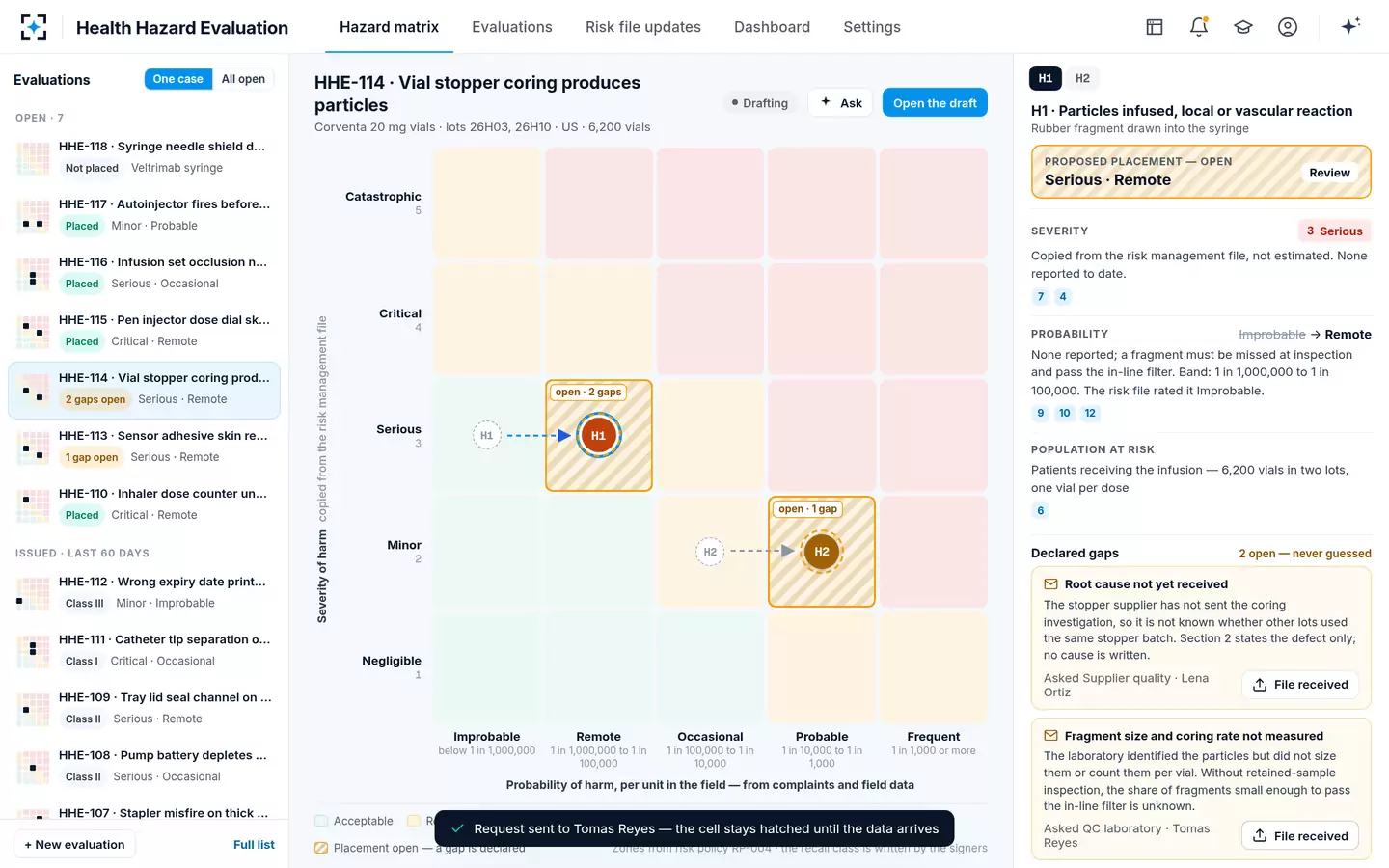
Two patterns recur. The first is that the request is vague: "what are the particles" comes back as "stopper rubber", which is true and does not unblock anything, because the section needed a size and a count. The second is that the request has no visible owner, so the case sits in a state nobody can name — not refused, not answered, not escalated. The fix for both is the same, and it is not a faster approver. It is naming the owner and the exact figure at the hour the gap appears.
A request with a name on it, and a cell that stays open until it is answered
Why the signature queue is not the bottleneck
Count the approvals on a complaint-to-decision path and you get three or four. Count the elapsed days and the approvals account for a small share of them. The reason is structural: the signers are senior people reading a finished document, and reading a finished document takes an afternoon. What takes a fortnight is the interval before the document can be finished, and that interval belongs to people who are not in the approval chain at all.
This is why initiatives aimed at the approval queue disappoint. Moving three signatures from paper to electronic signature removes days from a process that is losing weeks somewhere else. The measurable change comes from compressing the assembly — the gathering and the extraction — while deliberately leaving the judgement alone or giving it more room.
Where the hours of one evaluation go, before and after
By hand — about 26 hours
- Gathering documents · 23%
- Extracting evidence · 27%
- Drafting the sections · 35%
- Review and judgement · 15%
With agents — about 12 hours
- Gathering documents · 4%
- Extracting evidence · 8%
- Drafting the sections · 29%
- Review and judgement · 59%
The bar that goes up is the point. An evaluation where people spend four hours on judgement and twenty-two on assembly is not a careful document; it is a scarce document. Shifting the ratio is what makes a second opinion affordable.
How long should a complaint investigation take?
No regulator publishes a number, and any firm quoting one is quoting its own procedure. What the regulators do publish is the reporting deadline, which is a ceiling on how long you can take before saying something, and the standard of adequacy applied afterwards. The October 2026 warning letter's finding was not that an investigation was slow in the abstract; it was a failure "to conduct a timely and adequate analysis of complaint data related to potential causes of nonconforming product" over a period in which more than 1,900 complaints arrived.
A more useful internal target is the one the three waits imply. If the supplier investigation is the long pole, the question is how early it was requested and how precisely — not how fast the investigator wrote. In the sample case in the software, the case opened on 1 October, the two gaps were requested from named owners, and the files arrived on 6 October; the agents then read only what was new, and the placement was confirmed on cited evidence. The elapsed time was set by the request, not by the drafting.
Risk management: the desk that finds out last
The risk management file assigns every identified harm a severity and an expected probability, and it is written before the product ships. The field then produces evidence. When the two disagree — when the field supports a higher band than the file carries — somebody has to tell the function that owns the file, and without a route for it that can wait until the next periodic review.
In the sample data the disagreement is common. Harm after harm on the open cases is rated above the risk file: a missed full dose the file calls Occasional and five lost doses over 18,600 units make Probable; particles the file calls Improbable and retained-sample evidence moves to Remote. The direction makes sense: a risk file written before launch is an estimate, and the field is a measurement.
What matters is who decides. The evidence belongs to the evaluation; the file belongs to risk management. In the software every harm rated higher in the field than in the file appears on its own screen with its basis, and is sent to risk management for review — the agents never edit the file. Keeping that boundary is what stops an evaluation quietly rewriting the document it is supposed to be checked against, and it is also why the template carries a section for the comparison rather than leaving it implicit.
From a single complaint to a trend, and back again
The agency's guidance for its own hazard committees sets out what the likelihood question is really asking, and it is a question about a population rather than an event: "How frequently have deaths, diseases, injuries, or other adverse reactions already occurred? How does the frequency of occurrence relate to the total extent of product exposure (e.g., number of devices implanted, number of prescriptions, etc.)? How has this frequency been documented?" (FDA RPM chapter 7, Attachment D1). Three questions, and the second one is where most complaint systems stop being able to help.
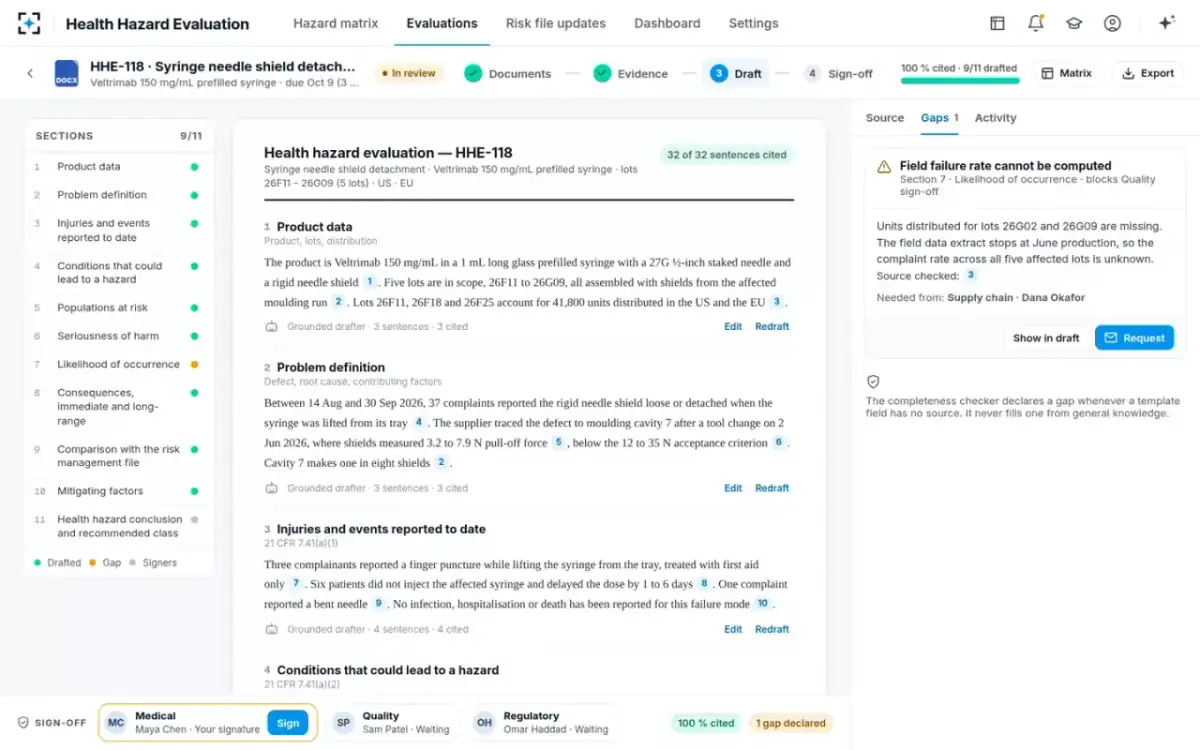
A complaint system counts complaints. Relating them to the total extent of exposure means joining them to distribution, by lot, over the same period — a join that lives between two systems and belongs to neither. One of the worked examples in FDA's benefit-risk guidance shows the consequence from the agency's side of the table: where a manufacturer could not provide complete information on the number of complaints involving adverse events, "Without additional information, FDA could not determine the likelihood of risk for the device" (FDA benefit-risk factors guidance, 2016). The uncertainty did not disappear. It became the firm's problem.
A likelihood section left blank, with the figure it needs and the person who has it
What changes when the waiting is visible
Three things, and none of them is speed for its own sake.
First, the request gets specific. A gap that has to name the data needed cannot be "please send the investigation"; it has to be the batch range, or the fragment size distribution, or units distributed for two named lots. Specific requests are answered faster because the person answering knows when they are done.
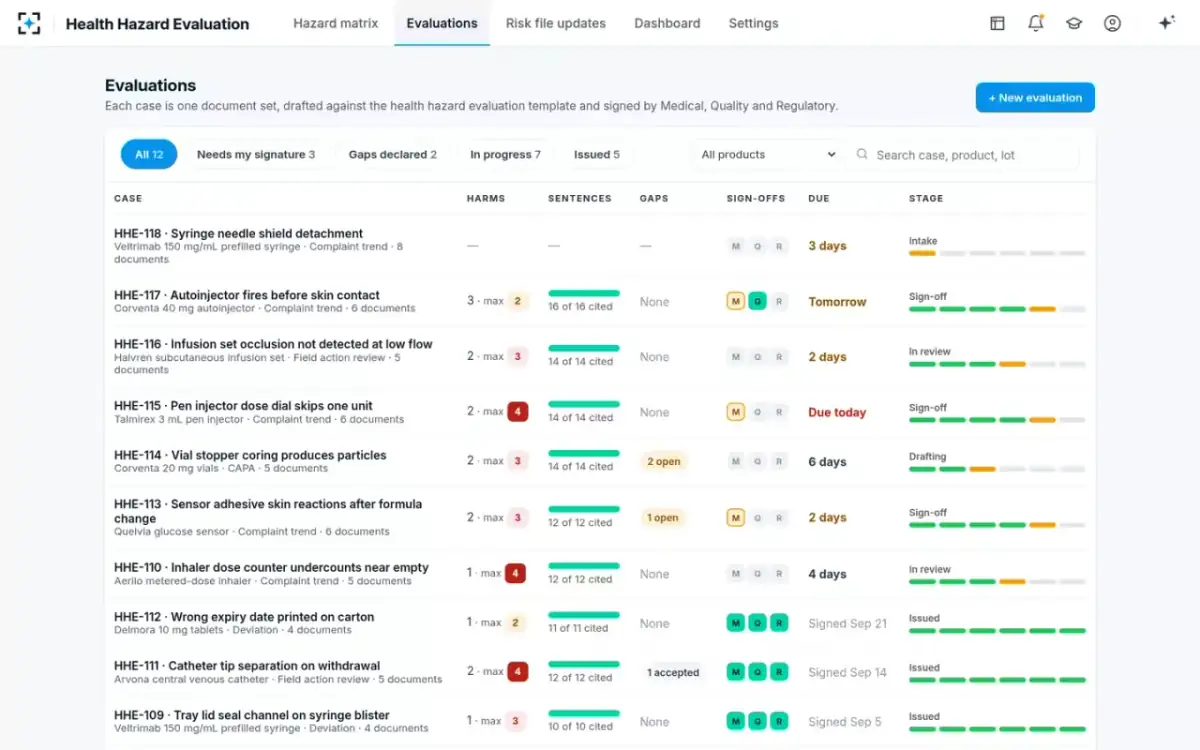
Second, the queue becomes a shared fact. When a case sits open with two hatched cells and two named owners, the question at the Monday meeting changes from "where is the evaluation" to "has Tomas sent the sizing". That is a question someone can act on, and it is asked of the person who can act.
Third, the evaluation stops absorbing the uncertainty. The old failure mode is quiet: the missing figure gets reasoned around, the reasoning is plausible, and the sentence that results looks exactly like the sentences around it. A declared gap looks different from a cited sentence, which means a reviewer can see the difference at a glance and a signer can refuse to sign over it. Where that leaves the recommendation, and what the agency does with it next, is how the class is decided.
Twelve cases in Health Hazard Evaluation, and the two columns a manager actually reads
Questions people ask
Who decides whether to open a recall case?
Quality normally opens it, on one of three triggers — a complaint whose harm is serious on its face, a trend crossing a threshold, or a corrective action proposing a field action — and three functions decide what happens next. In a three-signature scheme the medical officer confirms the harms and severities, the head of quality confirms the product data, the problem definition and the likelihood, and regulatory affairs signs last with the recommended class. FDA assigns the actual recall class.
What does a supplier quality engineer contribute to a complaint investigation?
The one document the evaluation most often waits for: the supplier's own investigation, which names the mechanism and the affected batch range. Until it arrives, the problem definition can describe the defect but not its cause, and nobody knows whether other lots used the same batch of the affected part. It is also the file the firm controls least, which is why the request should go out on the day the defect is characterised, not after the trend meeting.
Who tells risk management when the field disagrees with the risk file?
Often nobody, until the next periodic review. That is the gap worth closing: the evaluation is the first place the disagreement becomes visible, and the person who owns the risk management file is rarely on its distribution. The workable arrangement is that every harm the field rates above the file goes to risk management with its basis attached, and risk management decides whether the file changes — the evaluation reports the difference, it does not resolve it.
How many people are involved in a recall decision?
Three signatures and at least five desks. The three signers are medical, quality and regulatory. Behind them are the complaint handler who took the account, the quality investigator who established the failure mode, the supplier quality engineer chasing the supplier, the laboratory analyst characterising the defect, the supply chain contact who holds distribution by lot, and risk management. The signers are rarely the delay; two of the desks they depend on do not report to quality at all.
When does a complaint become a reportable event?
When it meets the reporting criteria of the regulator in question, counted from the date the manufacturer became aware. In the US, 21 CFR 803.50 requires a medical device report no later than 30 calendar days after the manufacturer becomes aware of information reasonably suggesting a device may have caused or contributed to a death or serious injury, or malfunctioned in a way likely to do so if it recurred; 803.53 shortens that to 5 work days where remedial action is needed. The UK sets 2 calendar days for a serious public health threat, 10 for a death or unanticipated serious deterioration, 15 for all other serious incidents, plus 3 UK working days to answer a regulator's question about an ongoing investigation.
What is the medical device complaint handling process, in one sentence?
It is the path a complaint takes from intake through investigation, reportability and trending to a hazard evaluation and a field action decision — five desks, several statutory clocks and, on many real cases, three documents that have to arrive from people who do not sign the result.