Ask for the FDA recall timeline and you will be given a diagram with one arrow on it. The reality is six clocks running on the same product issue, starting on different days, measured in three different kinds of day, and only one of them with a length you set yourself. Knowing how much harm a product issue could cause — the health hazard evaluation that sits between a complaint trend and a recall decision — is the step that most often holds everything else up, because it waits on documents other people own. Botminds' Health Hazard Evaluation puts a clock on that step: a due date in working days from the day a case opens to the last of the three signatures, with the days still to run on every case in the list.
Two kinds of number appear below. Deadlines and measured intervals come from the regulations, from FDA's own procedures manual and from an audit of five years of agency data; each is linked where it appears. Figures about cases, due dates and hours per evaluation are sample data from the solution's demonstration cases, and are labelled as such.
Four numbers that govern a product issue
10working days
to report a correction or removal to FDA, counted from initiating it
21 CFR 806.10(b)
2calendar days
to notify the UK regulator of a serious public health threat, counted from awareness
MHRA, updated 5 September 2025
32business days
average from initiation to classification for the highest-risk device recalls in 2024
GAO analysis of FDA data
74%
of recalls exceeded FDA’s policy of terminating within three months of the request
GAO, fiscal years 2020–2024
Six clocks on one product issue
The confusion about recall timing comes from treating one issue as one process. It is not. A complaint arrives; from that moment an adverse event reporting clock runs in Europe, the United Kingdom and, for a reportable device event, the United States. Separately, when you decide to correct or remove product, a United States reporting clock starts. Separately again, your own procedure gives the hazard evaluation a due date. Then three clocks you cannot touch: the agency's hazard evaluation committee, the recall unit that assigns the class, and the queue that eventually terminates the recall.
Six clocks, what starts each one, and who owns it
| The clock | What starts it | How long it runs | Whose it is |
|---|---|---|---|
| Adverse event report: EU, UK and US | The day the manufacturer is first made aware of a serious incident or reportable event, not the day its investigation ends. | EU and UK: 2, 10 or 15 calendar days, by what happened. US: 30 calendar days, or 5 work days where remedial action is needed. | Yours. Article 87 MDR; UK regulation 44ZH; 21 CFR 803.50 and 803.53. |
| Correction or removal report, United States | Initiating a correction or removal to reduce a risk to health. | 10 working days. | Yours. 21 CFR 806.10(b). |
| The hazard evaluation itself | The day the case opens — a complaint trend, a corrective action, a deviation. | Whatever your own procedure sets. There is no external deadline. | Yours, and the only clock you can shorten by changing how you work. |
| FDA hazard evaluation committee | Receiving a recall recommendation. | Two working days to complete and forward the worksheet, unless more information is needed. | FDA. Regulatory Procedures Manual chapter 7. |
| Classification | The recall unit receiving the hazard evaluation. | Normally two days on paper. From initiation, an average of 32 business days for class I in 2024. | FDA. |
| Termination | The firm asking for termination once the recall is complete. | A three-month policy; an average of 263 business days for class I recalls. | FDA. |
Reading down that table, one row is unlike the others. Every clock except the third has its length set for you. The third is the one that decides whether you meet the others, and it is the one nobody publishes a target for.
When does the clock start? The awareness date, and what it is not
For European vigilance the start is defined precisely and it is earlier than most quality units assume. The Medical Device Coordination Group states that "the awareness date (day=0) refers to the date when the manufacturer is first made aware or receives information of the occurrence of the (potentially) serious incident, and not after it has conducted its investigation". The reporting period then begins on the following day.
Two consequences follow, and both are easy to get wrong. First, a report from a distributor, a hospital complaint line or a field engineer starts the clock on the day it reaches you, not on the day it reaches the right desk. Second, not knowing yet is not an extension. The same guidance is explicit that a delay caused by incomplete information from a hospital, a user or anyone else is not justified, and that "any report must not be unduly delayed because of incomplete information". The UK regulator says the same thing in plainer words: if it is unclear whether the event even meets the reporting criteria, report within the timeframe anyway and follow up.
The United States adverse event report also runs from awareness: no later than 30 calendar days "after the day that you receive or otherwise become aware of information, from any source" that reasonably suggests a reportable event (21 CFR 803.50(a)). The United States correction and removal report has a different starting pistol. Its ten-working-day clock runs from the day you initiate the correction or removal, not from awareness — which means the long interval between knowing and deciding does not show up on that clock at all. It is invisible to the deadline and entirely visible to an inspector reading your complaint history afterwards.
Ten working days: the United States correction and removal report
21 CFR 806.10 requires a device manufacturer or importer to report a correction or removal initiated to reduce a risk to health, and to do so "within 10-working days of initiating such correction or removal". The content list that follows runs to thirteen items, and the last of them is the one that makes the deadline achievable: if any required information is not immediately available, the report carries a statement of why it is not available and when it will be submitted.
Put those two clauses together and the rule is not "report when you are ready". It is "report on day ten with the holes named". This is the same drafting discipline a hazard evaluation needs, which is why a programme that declares its gaps as it goes has a much easier tenth day than one that hides them — the report's unknowns are already written, with owners and dates against them. How to write one is the subject of the likelihood section and its missing denominators.
Two, ten and fifteen days: the EU and UK vigilance deadlines
European and United Kingdom vigilance reporting runs on three tiers, counted in calendar days from awareness. They are among the few deadlines in this field that are genuinely identical on both sides of the Channel, and the two-day tier is shorter than any United States device reporting deadline.
The three vigilance tiers, counted in calendar days from the awareness date
| What happened | Deadline | Where it comes from |
|---|---|---|
| A serious public health threat | Immediately, and no later than 2 calendar days after the manufacturer becomes aware of the threat. | Article 87(4) MDR; UK regulation 44ZH. Identical in both. |
| A death, or an unanticipated serious deterioration in a person’s state of health | Immediately after a causal relationship is established or suspected, and no later than 10 calendar days. | Article 87(5) MDR; UK regulation 44ZH. |
| Any other serious incident | Immediately, and no later than 15 calendar days after the awareness date. | Article 87(3) MDR; UK regulation 44ZH — reduced from 30 days when the UK post-market surveillance regulations came in. |
| The regulator asks you something during its own investigation | Within 3 UK working days, unless the correspondence says otherwise. | UK regulation 44ZI(3)(b). |
A detail worth putting in your procedure: the European rules count calendar days, so weekends and public holidays are inside the window, and a two-day period must still contain at least two working days. The working-day rule only stops a period expiring before anyone could act; the guidance still recommends reporting immediately, so a serious public health threat identified on a Friday afternoon is a Friday problem.
Classification: two days on paper, thirty-two in the data
Once a recall reaches the agency, two internal clocks apply, and both are short. FDA's Regulatory Procedures Manual states that the hazard evaluation committee "will complete, endorse, and forward the health hazard evaluation form to the center recall unit within two (2) working days after receiving a recall recommendation unless additional information is required", and that for ongoing recalls the recall unit "will normally classify recalls within two days after receiving the health hazard evaluation".
About four days, end to end, for the part everyone imagines is the slow part. The measured average from initiation to classification is roughly ten times longer, because it includes everything either side of those four days; FDA officials told the GAO that one reason is that manufacturers "might not provide all the required information in the early phases".
Average business days from initiation to classification, for device recalls
The direction is good news and the spread is the point. A firm planning a field action in 2026 on the assumption of a four-day classification is planning on the agency's internal target rather than on its throughput. Plan on weeks, and make the recall strategy work without the class having been assigned yet — which is what the way a class is actually decided implies in practice.
The agency's own internal targets, and how the measured data compares
It is worth being fair to the agency here, because the gap between its targets and the measured intervals is not simple slippage. The two-working-day committee target applies to the committee's own handling of a recall recommendation once it has what it needs; the manual adds the qualifier "unless additional information is required", and additional information is required often, for exactly the reasons a manufacturer recognises — a denominator, a laboratory result, a population estimate.
The manual also sets an obligation that has no analogue in most company procedures: where new injury, illness, medical or scientific findings arrive, the committee must promptly re-evaluate, and where data is arriving continuously it is to meet and re-evaluate "at least biweekly". A hazard evaluation is not a document you finish; it is a position you hold and revise. Few corporate procedures say when a signed evaluation must be reopened, and that omission is worth a paragraph in yours.
Drawing the two side by side makes the shape plain. On the upper lane the agency's own handling targets are so short they barely register; the policy for closing a recall is three months. On the lower lane, the intervals five years of data actually recorded.
Classification and closure: what the targets allow, and what the data measured
- Classification target
- Termination within policy3 months
- Initiation to classification32 days
- Completion to termination263 days
Termination: a three-month policy and a 263-day average
Termination is the clock that decides how long a company is publicly "in recall", and it is the one with the widest gap between policy and practice. The GAO audit found that FDA officials described termination as being, in their words, on the "back burner" because of limited resources, and that "74 percent of recalls across fiscal years 2020-2024 exceeded FDA's policy of terminating a recall within 3 months of receiving the manufacturer's request to terminate".
The averages behind that figure are long and their spread is enormous: class I recalls averaged 263 business days from completion to termination, with a range from 11 to 882 days; class II and class III averaged 269 and 248 days. For a quality leader this is a planning fact rather than a compliance one. The recall is finished when your effectiveness checks are finished; the file closes when the agency gets to it. Budget the difference, and tell the board the difference exists before it asks.
Do you have to finish the investigation first?
No, and this may be the most useful single sentence in FDA's final guidance on voluntary recalls (March 2022). Describing what a firm's procedures should cover when a problem is found, the guidance calls for a prompt evaluation by a qualified person against established criteria, and then says plainly: "The recalling firm need not delay initiation of a voluntary recall pending completion of the investigation."
It repeats the point a few pages later for the agency's own review: a firm need not wait for FDA to review its recall strategy or communications either. Between them, those two sentences remove the two most common reasons given for a slow start. Root cause can be unknown. The supplier's report can be outstanding. If what you already know supports a decision to act, acting is the compliant choice, and the hazard evaluation continues in parallel on the evidence as it arrives.
The price of one more day of distribution
None of the six clocks measures the interval that costs the most: the time between the day somebody could have known and the day somebody decided. It has no regulatory name, no deadline and no field on any form, and every day inside it is another day of product shipping.
It is also the only interval in this guide that is entirely within a company's control. A vigilance deadline cannot be shortened by working harder. A classification queue cannot be jumped. The days between a complaint trend crossing a threshold and three people signing a hazard evaluation can be shortened by removing the waiting from the middle of it, and that is the whole argument for treating the evaluation as a tracked piece of work with a due date rather than as a document someone is writing.
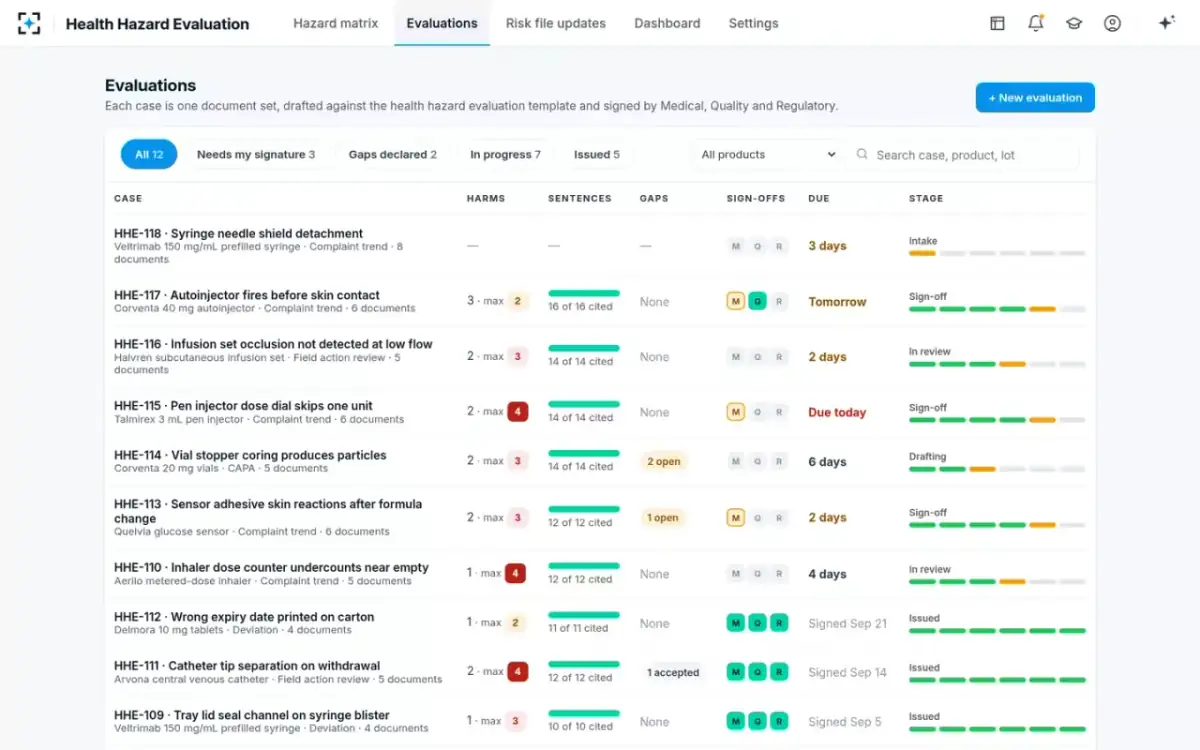
Health Hazard Evaluation: every open case with its due date and the days still to run
The clock you set yourself: a due date on the evaluation
In the solution the evaluation's clock is a setting, not a convention: working days from the day a case opens to the last signature. In its demonstration cases the particulate evaluation opens on 1 October with a due date of 12 October, and on the morning the medical officer reviews her list it is at the drafting stage with six days to go. The useful part is not the number of days; it is that the number exists, is visible on every row, and is the same number for the person who has to supply the missing supplier report as for the person who has to sign.
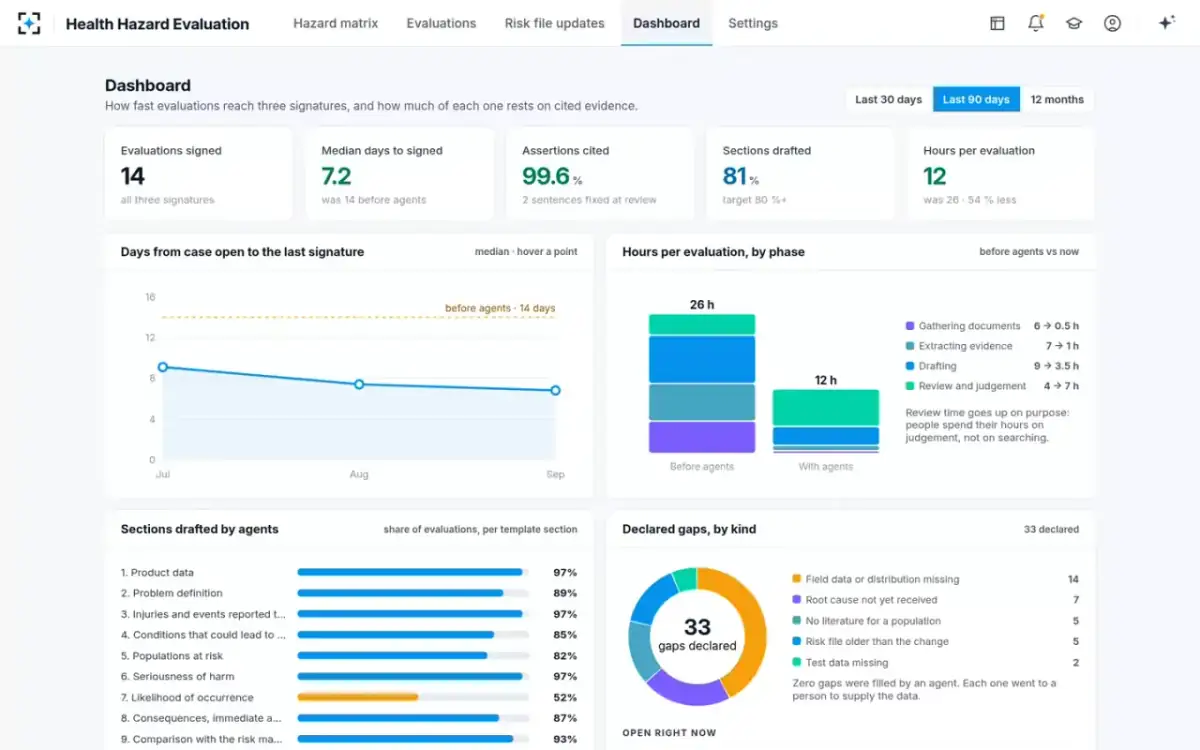
What changes underneath it is where the hours go. Across the sample cases, an evaluation written by hand takes about 26 hours, of which rather more than half is gathering documents and extracting evidence. With the agents reading the document set and drafting from cited evidence, the design target is about 12 hours — and review time deliberately goes up, not down, because the hours that survive are the judgement ones.
Where an evaluation’s hours go, by hand and with agents
By hand — about 26 hours
- Gathering documents · 23%
- Extracting evidence · 27%
- Drafting the sections · 35%
- Review and judgement · 15%
With agents — about 12 hours
- Gathering documents · 4%
- Extracting evidence · 8%
- Drafting the sections · 29%
- Review and judgement · 59%
The reason to show it as shares rather than hours is the last segment. The time spent on judgement roughly doubles in absolute terms while everything around it shrinks, which is the only version of a time saving worth having on a document three people put their names to.
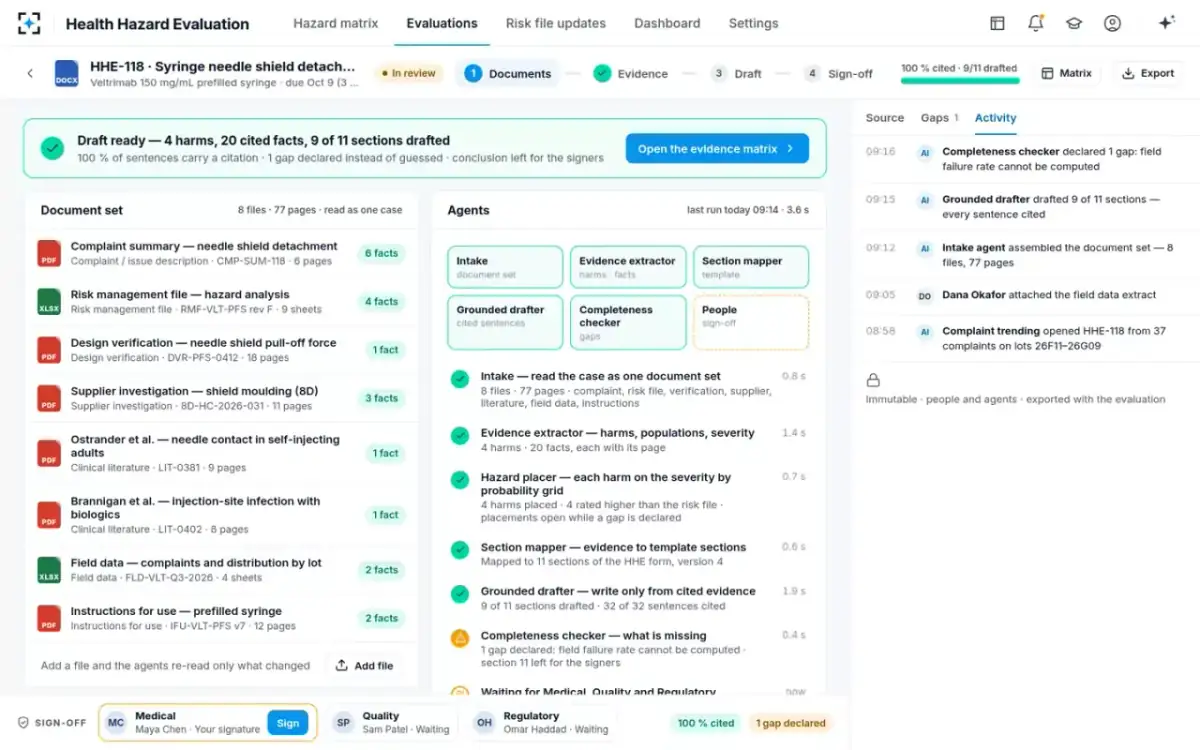
Reading a whole case at once, so the clock starts on the judgement
How long should a health hazard evaluation take to write?
There is no published answer, because no regulator sets one for a manufacturer's own evaluation. What the published data does tell you is the shape of the budget around it. You have at most fifteen calendar days from awareness to a European vigilance report, ten working days from initiating a correction or removal to the United States report, and an agency that will take weeks rather than days to classify what you send. An evaluation that takes a fortnight to write is consuming the whole of one deadline and a meaningful part of the agency's queue position.
In the solution's sample cases the median from case open to the last signature before the agents was 14 days. That is the number worth measuring in your own programme, and worth splitting into waiting and working — because in an evaluation that runs long, much of the elapsed time can be spent waiting on a file somebody else owns rather than on anyone writing. The desks a complaint crosses before anyone says recall is where that waiting actually lives.
Days to the last signature in Health Hazard Evaluation, and the gaps that explain them
To see the clock on a worked case — the due date, the declared gaps and the three signatures — start from Health Hazard Evaluation.
Questions people ask
How long does a recall take from start to finish?
Longer than the classification figures suggest, because closure is the slow end. For device recalls in fiscal years 2020 to 2024, the average from initiation to classification was 32 business days for class I in 2024, and the average from completion to termination was 263 business days for class I, with a range of 11 to 882 days. Seventy-four percent of recalls exceeded FDA's three-month termination policy.
When does the recall clock start?
It depends which clock. European and UK vigilance deadlines run from the awareness date — the day the manufacturer is first made aware of the incident, not the day its investigation concludes — with the period beginning the following day. A United States medical device report is due no later than 30 calendar days after awareness under 21 CFR 803.50. The United States correction and removal report runs from the day you initiate the correction or removal, which can be much later.
How many days do you have to report a correction or removal to FDA?
Ten working days from initiating it, under 21 CFR 806.10(b). The report has a thirteen-item content list, and the last item allows information that is not immediately available to be declared, with a statement of why it is missing and when it will be submitted — so the deadline is met with declared holes rather than missed while they are filled.
Do you have to finish the investigation before starting a recall?
No. FDA's final guidance on initiating voluntary recalls states that the recalling firm need not delay initiation pending completion of the investigation, and separately that it need not wait for FDA's review of its recall strategy or communications. A prompt evaluation by a qualified person against established criteria is what is expected, not a completed root cause.
How long does it take FDA to terminate a recall?
Far longer than its policy. FDA's policy is termination within three months of receiving the manufacturer's request; the GAO found 74% of recalls over five fiscal years exceeded it, with class I averaging 263 business days from completion to termination, class II 269 and class III 248. Agency officials described termination as being on the back burner because of limited resources.
What happens if you miss a vigilance reporting deadline?
The report is late and the lateness is on the file, which is what an inspection reads. The guidance removes the usual defence in advance: a delay caused by incomplete information from a hospital, a user or another party is not deemed justified, and a report must not be unduly delayed because of incomplete information. If you are unsure whether an event is even reportable, report inside the timeframe and supplement afterwards.