A health hazard evaluation template is a form your firm writes, not one a regulator issues. Searching for an official one is a natural first step, and it fails, because 21 CFR 7.41(a) does not describe a document — it names six factors the agency's committee will take into account "but need not be limited to", and then stops. What does exist in public is better than a template anyway: the agency publishes the worksheet its own scientists complete about your product, and the guidance that expands each of the six factors into the questions they ask. Write your template against those and every section you fill in answers a question your reader has already written down.
This guide lays out the eleven sections that result, what each one maps to, and what it has to cite. The screens are from Botminds' Health Hazard Evaluation, which drafts those sections from the case documents with a citation on every sentence and leaves the last one for the people who sign; its cases, products and people are fictional sample data. The regulatory material is quoted from the rule and from FDA's Regulatory Procedures Manual, linked where it appears.
Why there is no official health hazard evaluation template
Three reasons, and each one tells you something about how to build yours.
The first is that the regulation governs the agency's evaluation, not yours. The duty in 7.41(a) runs to an ad hoc committee of FDA scientists. Your obligation comes from elsewhere — 21 CFR 7.46(a)(3) asks a firm removing or correcting a distributed product for an evaluation of the risk associated with the deficiency, and 21 CFR 806.10 requires a device firm to report a correction or removal within 10 working days — and none of those places prescribes a form. Which document you were asked for is worth settling before you design one.
The second is that the six factors are deliberately open. "Need not be limited to" is not throat-clearing; a committee facing a device whose failure mode has no analogue in the list is expected to go beyond it. A template that treats the six as an exhaustive checklist will be complete and still miss the point of a novel case.
The third is that the hard parts of an evaluation are not structural. Nobody struggles to write down the product name. They struggle with the population at risk, with a likelihood figure whose denominator is held by another function, and with the honest handling of what is not yet known. A good template is one that forces those three into the open early.
The six factors in 21 CFR 7.41, and what each is really asking
Read in isolation the six look like headings. Read against the guidance the agency gives its own committees, each turns into a specific interrogation.
Factor one, whether disease or injuries have already occurred, is really four questions once the product is named: what adverse reactions have occurred in association with the product; what documentation supports the association; whether the product was used in conformance with its labelled directions; and, if it was, whether the harm was due to malfunction, formulation, quality, design, inadequate directions, or something else. A section that says "three complaints received" has answered one quarter of one factor.
Factor two, existing conditions that could contribute to a clinical situation, asks you to name the specific clinical conditions that might make a person more susceptible, say how they would change the risk, ask whether they could mask it, and consider what other products being used to treat those conditions might make it better or worse. It also carries the evidential rule for the whole document: any conclusion "shall be supported as completely as possible by scientific documentation and/or statements that the conclusion is the opinion of the individual(s) making the health hazard determination".
Factor three, the hazard to segments of the population, is the longest in the guidance — eight questions covering the universe of users by segment, which segment is at greatest risk, whether infants, children, the elderly, pregnant women or surgical patients are likely to be exposed, the setting of use, the frequency and duration of use, and how much of the population at greatest risk is already under close medical supervision. Factors four and five are the two scales, dealt with below. Factor six asks for the immediate consequences, the long-range consequences, and — a question that is easy to omit — whether alternate forms of therapy are available if the product goes away.
The worksheet the agency fills in about you, question by question
Attachment D of chapter 7 of the Regulatory Procedures Manual is the form itself, published with a note that it "has been developed by the agency" and that this worksheet, or an equivalent form, is to be used by all centre hazard committee personnel to record their evaluations. It runs to nine numbered questions.
One and two identify the product and the firm. Three asks for the nature of the problem. Four asks, in three parts, whether adverse reaction reports or other indications of injury have been reported for this problem, whether they have been reported for similar situations, and whether the problem is easily identified by the user. Five asks what the risk is to the general population. Six asks which segments are most at risk and why, and whether any known or accepted off-label use would change the population at risk. Seven asks whether particular conditions or diseases make individuals more or less at risk. Eight is the hazard. Nine is the probability. Three signature lines follow, and then a separate market assessment, completed by the centre's medical staff only when asked, on whether removing the product would disrupt treatment — an assessment the form says "should not impact on the health hazard".
Question four(c) is the one firms underrate. Whether the defect is obvious to the user changes the hazard materially: a crack a nurse will see before use is a different exposure from a seal failure nothing reveals. If your own template has no place for it, the answer never gets written down and the committee has to ask.
A hazard scale whose last line is 'cannot be assessed'
Question eight asks what the hazard is, instructs the writer to "explain and cite literature references when applicable", and offers seven lines: life-threatening, where death has or could occur; results in permanent impairment of a body function or permanent damage to a body structure; necessitates medical or surgical intervention to preclude or reverse permanent damage or impairment; temporary or reversible without medical intervention; limited, meaning transient minor impairment or complaints; no adverse health consequences; and, last, "Hazard cannot be assessed with the data currently available".
That seventh line may be the most useful sentence in the whole chapter for a firm writing its own form. The agency's own scientists are given a way to say they cannot tell yet. If your template offers five severity levels and no seventh line, every case where the laboratory has not characterised the defect gets forced into one of the five, and the forcing is invisible afterwards. Give your form the same escape, with a named owner and a date attached to it, and the gap stays a gap instead of becoming a number.
Three severity scales, all in use on the same product issue
| The scale | What it is for | Who maintains it | The mistake |
|---|---|---|---|
| Committee guidance, five levels: life threatening, severe, moderate, limited, none | Expressing the degree of seriousness of the hazard if it occurred, for a named segment of the population — the answer to 21 CFR 7.41(a)(4). | FDA, in Attachment D1 of the Regulatory Procedures Manual chapter 7. | Treating "severe" here as the same word your risk file uses. The agency’s severe means permanent significant disability, nothing else. |
| Worksheet hazard question, seven lines ending in "cannot be assessed" | Recording the hazard on the agency’s own form, with literature references where applicable. | FDA, in Attachment D of the same chapter. | Dropping the seventh line. A form with no way to say the hazard cannot yet be assessed forces an answer that was never evidenced. |
| Benefit-risk guidance, three levels: deaths or serious injuries; non-serious adverse events; events without reported harm | Weighing benefit against risk in availability, compliance and enforcement decisions, with a duration component in each level. | FDA, in the 2016 benefit-risk factors guidance. | Reading the three levels as a coarse version of the five. They are a different instrument, built for a different decision. |
| Your risk management file’s scale | Rating each identified harm for your own product, so the rating is set once and read many times. In the sample case it runs over five named levels set by the firm’s risk policy. | Your risk management function, under your own procedure. | Re-arguing a severity during an evaluation instead of reading it. If the field evidence disagrees with the file, that is a change to the file, decided by the people who own it. |
A probability scale whose last band is 'Unknown'
Question nine asks for the probability of an adverse event occurring and offers five: every time, reasonable probability, remote, unlikely, and unknown. There are no percentages beside them. The committee assigns a band from the evidence and explains it in the space provided.
Two things follow for your template. First, "reasonable probability" is a band near the top of a five-band scale, not a synonym for "it could happen" — and it is the exact phrase that defines a Class I recall, which is why how the class is decided turns on it. Second, because the agency's scale is qualitative and your risk management file's scale is almost certainly quantitative, the two do not line up. Keep them in separate columns and state the rate that produced your band. A reviewer who can see "11 events over 48,200 units distributed in the same period" can check your band; a reviewer who sees only the band cannot.
The eleven sections a health hazard evaluation usually has
Here is the template that results. The numbering is a firm's own — the rule has six factors, not eleven sections — and the extra sections exist because a firm has to write down things the agency's committee gets from elsewhere: the product and lot data, the defect's root cause, and the comparison between what the field is showing and what the risk management file says.
Eleven sections, the factor each answers, the worksheet question behind it, and what it must cite
1 · Product data
Factor—
The question behind itWorksheet 1 and 2: product, identification number and usage; firm name, address and identification numbers
What it must citeThe specification or device master file, the lot list, and the distribution extract that gives units by lot
2 · Problem definition
Factor—
The question behind itWorksheet 3: the nature of the problem
What it must citeThe complaint summary, the deviation or corrective action file, and the supplier or laboratory investigation that found the cause
3 · Injuries and events reported to date
Factor7.41(a)(1)
The question behind itWorksheet 4(a) and 4(b): adverse reactions reported for this problem, and for similar situations
What it must citeThe complaint file by event type, with the documentation that associates each event with the product
4 · Conditions that could lead to a hazard
Factor7.41(a)(2)
The question behind itWorksheet 7: conditions or diseases that make an individual more or less at risk
What it must citeClinical literature, the instructions for use, and the reasoning stated as the named reviewer’s opinion where no document covers it
5 · Populations at risk
Factor7.41(a)(3)
The question behind itWorksheet 5 and 6: the risk to the general population, and which segment is most at risk and why
What it must citeDistribution by setting and indication, the labelled population, and any known off-label use
6 · Seriousness of harm
Factor7.41(a)(4)
The question behind itWorksheet 8: the hazard associated with use of the product, on a seven-line scale, citing literature where applicable
What it must citeThe risk management file row for each harm, plus the clinical source for any harm the file does not carry
7 · Likelihood of occurrence
Factor7.41(a)(5)
The question behind itWorksheet 9: the probability of an adverse event occurring, on a five-band scale
What it must citeA cited numerator (events in a defined period) and a cited denominator (units exposed over the same period)
8 · Consequences, immediate and long-range
Factor7.41(a)(6)
The question behind itCommittee guidance: immediate consequences, long-range consequences, and whether alternate therapy exists
What it must citeClinical literature on the natural history of the harm, and the shortage assessment if the product is withdrawn
9 · Comparison with the risk management file
Factor—
The question behind itNo worksheet question — this section exists so the difference is written down rather than discovered
What it must citeThe file’s own rating for each harm, beside the rating the field evidence supports
10 · Mitigating factors
Factor7.41(a)(3), question 8
The question behind itCommittee guidance: what actions or medical interventions could reasonably decrease the likelihood of the hazard
What it must citeThe monitoring, inspection or in-use control relied on, with evidence that it actually operates
11 · Conclusion and recommended class
Factor7.41(b)
The question behind itCentre recall unit assessment: the degree of seriousness of the hazard to the population at risk
What it must citeNothing new. It is the signers’ judgement on the evidence in sections 1 to 10
Sections 9 and 10 are the ones a template built only from the six factors leaves out. Section 9 exists because the field and the risk management file can disagree, and writing the difference down is cheaper than being asked about it. Section 10 exists because mitigations change the answer and must therefore be evidenced rather than asserted.
What does each section have to cite?
The rule's own standard is the one to adopt: a conclusion supported by scientific documentation, or a statement that it is the opinion of the named person making the determination. Those are the two acceptable kinds of sentence, and the second is a legitimate choice rather than a failure — a medical officer's reasoned judgement, signed, is evidence. What is not acceptable is the third kind: an assertion with no document and no name.
What a section of a health hazard evaluation is not finished without
- A cited passage, with its document and page
Not "per the risk file" but the row, the revision and the sheet. A reviewer who cannot reach the source in one step will re-derive the fact, and will sometimes get a different answer.
- A named population, not a patient
Which segment, in which setting, using the product how often and for how long, and how much of it is already under medical supervision.
- A scale value chosen from a written scale
With the scale named and its version given. Severity from the risk management file row; probability from a rate you can show.
- A date on every figure
Complaints to a stated date over units distributed to the same date. A numerator and a denominator from different periods is not a rate.
- A gap statement where the evidence is absent
What is missing, why it is missing, who owns it and when it will arrive — the shape 21 CFR 806.10(c)(13) asks for.
- A name against every judgement
The regulation accepts the opinion of the individuals making the determination. It does not accept an unattributed one.
Holding to that list by hand is the expensive part of the work, which is why the drafting rules in the software are written as prohibitions rather than reminders: a sentence without a page citation is not written, a section with no source produces a declared gap instead of a paragraph, and in the default settings signing stays blocked while coverage is below one hundred per cent.
One fact, from the source document to a signed section
Agent
Found in a source documentA passage in the complaint summary, the supplier investigation, the laboratory report, the literature or the field data extract, captured with its document and page.
Agent
Mapped to the sections it servesOne fact may serve several sections — a distribution figure feeds product data and likelihood — and a section may have no facts at all, which is reported rather than hidden.
Never: invents a section’s content when no fact maps to it
Agent
Drafted into a sentenceWritten in plain, precise language from the mapped evidence only, with the citation attached to the sentence rather than to the section.
Never: adds a fact from general knowledge
Agent
Checked for coverageEvery template field is confirmed to have a cited source; where one has none, a gap is declared with the data needed and the person who owns it.
Never: infers a value to close a gap
A person decides
Judged and signedMedical confirms the harms, severities, populations and consequences; Quality confirms product data, problem definition and likelihood; Regulatory signs last and writes the conclusion and recommended class.
A drafted section in Health Hazard Evaluation, with its citation open on the source page
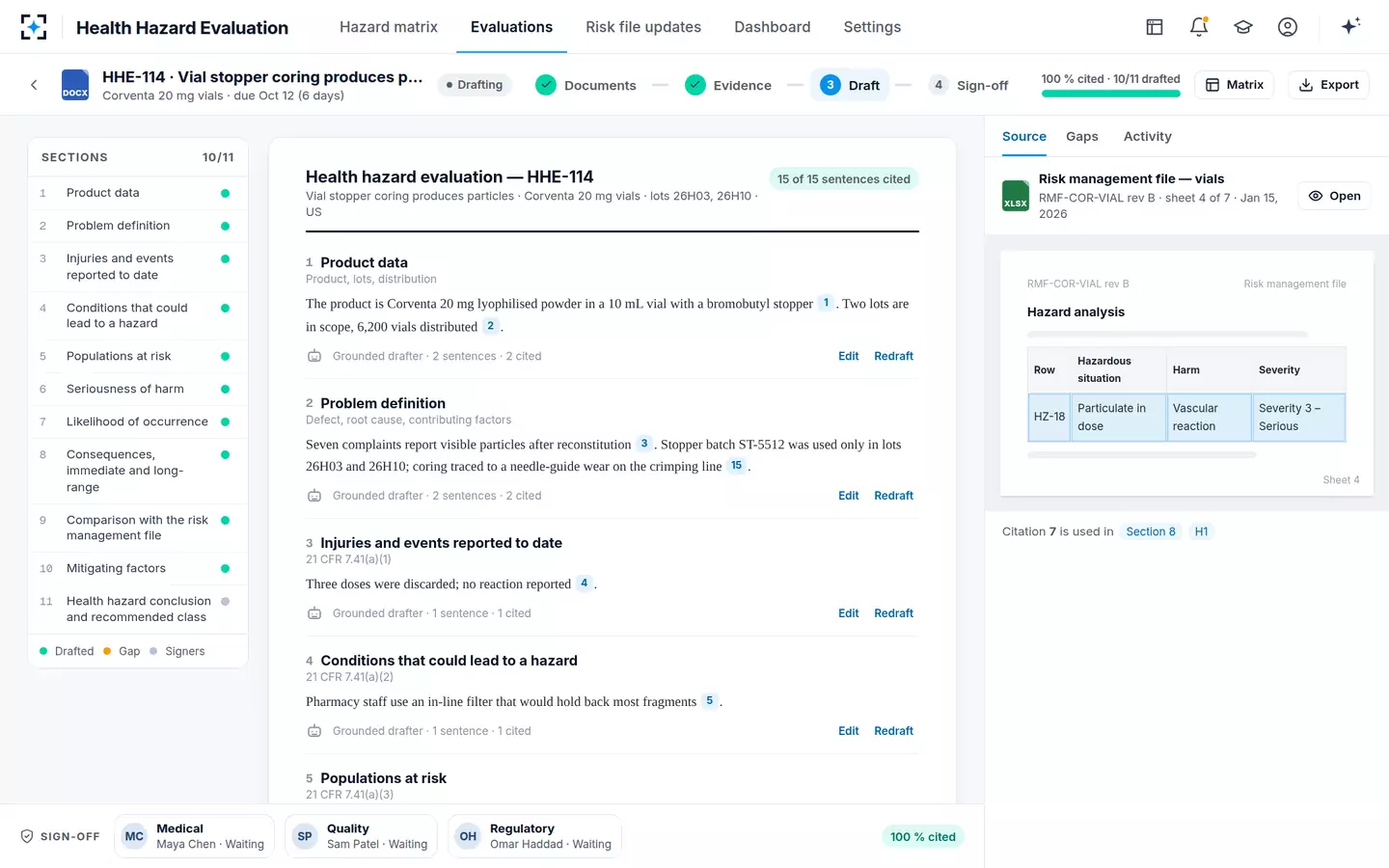
Populations at risk: the section most often written from memory
This is the section where a template earns its keep, because the honest answer is almost never in one document. The agency's committee guidance asks for the universe of users by segment and the relative frequency of use of each; which segment is at greatest risk; whether infants, children, the elderly, pregnant women, surgical patients or others are likely to be exposed; the anticipated frequency of exposure for each high-risk group; the setting of use; how frequently and for how long the product is used; and what percentage of the population at greatest risk is now under close medical supervision, with the follow-up question of whether everyone in that population could easily be brought under observation.
Answer those with a labelled indication and nothing else and you have described the population the product was approved for, not the population that has it. The figures that make the section real live in distribution by customer type, in the lot-level shipment data, and sometimes in the instructions for use where a second population — the person administering the product rather than receiving it — appears for the only time. A needle shield that detaches can endanger the caregiver as well as the patient, and often only the instructions for use say who lifts the syringe out of the tray.
Mitigating factors, and the line between a mitigation and an excuse
FDA's benefit-risk guidance defines the term usefully: "Mitigations are actions taken by the manufacturer, by FDA, or by other stakeholders to recover benefit or to limit harm," and it adds the sequencing rule that matters — "Risk acceptability is assessed after any appropriate mitigation." A mitigation is therefore not a reason the hazard is smaller than it looks. It is a thing somebody does, after which the hazard is genuinely smaller.
The test is whether the mitigation is evidenced as operating. The committee guidance asks what actions or medical interventions could reasonably be expected to decrease the likelihood of the hazard, and gives the example of patient monitoring detecting a defect before it causes harm. Applied to a real case, that means: if you are relying on an in-line filter, you need the filter's pore size and the measured size of the particles; if you are relying on inspection, you need the inspection's measured detection rate. In the sample particulate case in the software, the mitigation is a 0.2 micron in-line filter and the evidence is a retained-sample inspection that found fragments of 180 to 600 micrometres — comfortably held back. Without that measurement the filter was an argument. With it, it is a mitigation.
The conclusion and recommended class: whose words these are
Section 11 is the only section in the template that no agent writes and no evidence dictates. The agency's own form reserves the equivalent space for the centre recall unit's assessment, with four boxes: the three class definitions, and market withdrawal for a minor violation or none. Your firm's version of that box is a recommendation, and it belongs to the people signing.
Keeping it reserved is a design decision, not a courtesy. If the conclusion can be generated from the sections above it, then the sections above it have been written to produce a conclusion, and the evaluation has quietly become an argument for a decision already made. Leaving it blank until a person writes it keeps sections 1 to 10 honest, and the software enforces that with a rule that cannot be switched off: agents never write a medical conclusion or a recall class, and the assistant, asked for one, offers the evidence instead.
The evidence matrix every section is drafted from
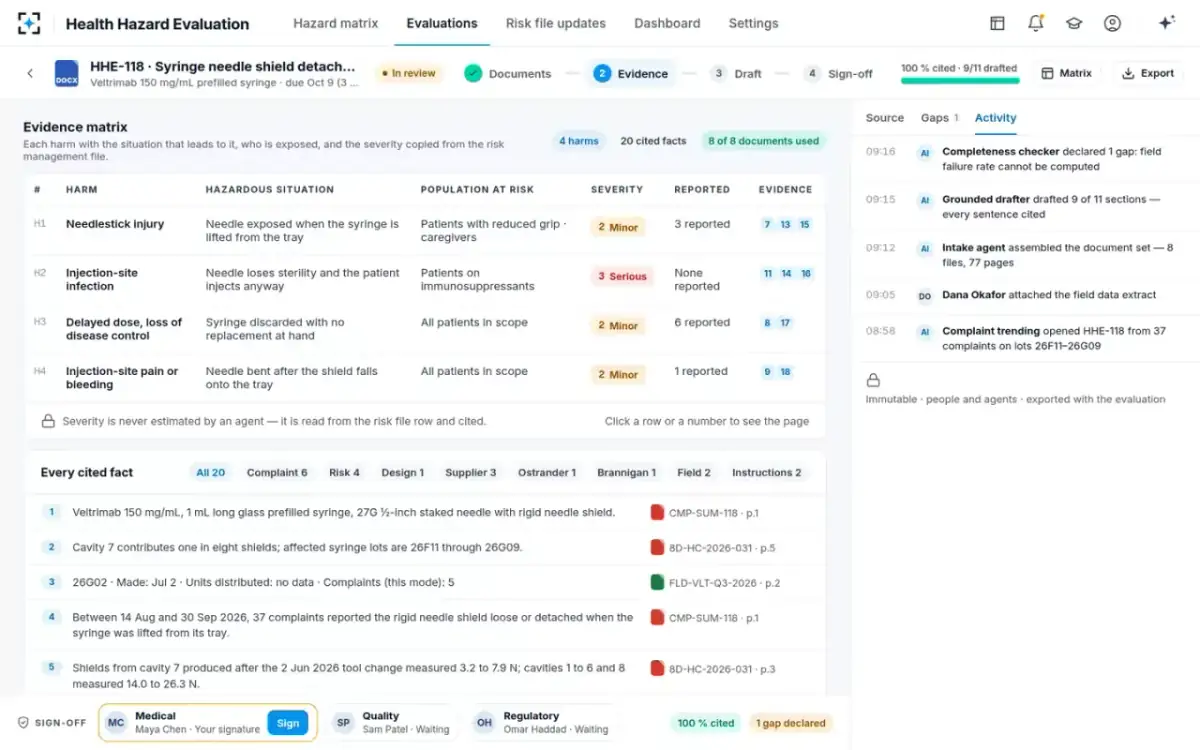
Where do you write down what you do not know?
In the template, in the section it belongs to, with an owner and a date. The rule that makes this a compliant answer rather than an admission is short.
If any required information is not immediately available, a statement as to why it is not available and when it will be submitted.
21 CFR 806.10(c)(13), Reports of corrections and removals
That is the shape to copy: why it is not available, and when it will be. Add the owner's name — the supplier quality engineer chasing the 8D, the laboratory analyst who has not yet sized the particles, the supply chain manager who has the units distributed for two lots — and a gap becomes a tracked request rather than a hole in a document. The agency's own worksheet does the same thing twice, with "hazard cannot be assessed with the data currently available" and the probability band "unknown".
The alternative is what the agency sees when it goes looking. In one of the worked examples in FDA's benefit-risk guidance, a firm's complaint system could not provide complete information on adverse events, and the guidance concludes that the deficiencies "created uncertainty about the risks for this device" — uncertainty the firm then has to answer for. A stated gap costs you a line. An unstated one costs you the benefit of the doubt. Which figures are hardest to get, and who holds them, is the subject of the five desks a complaint crosses.
The drafting rules behind the template, in Health Hazard Evaluation
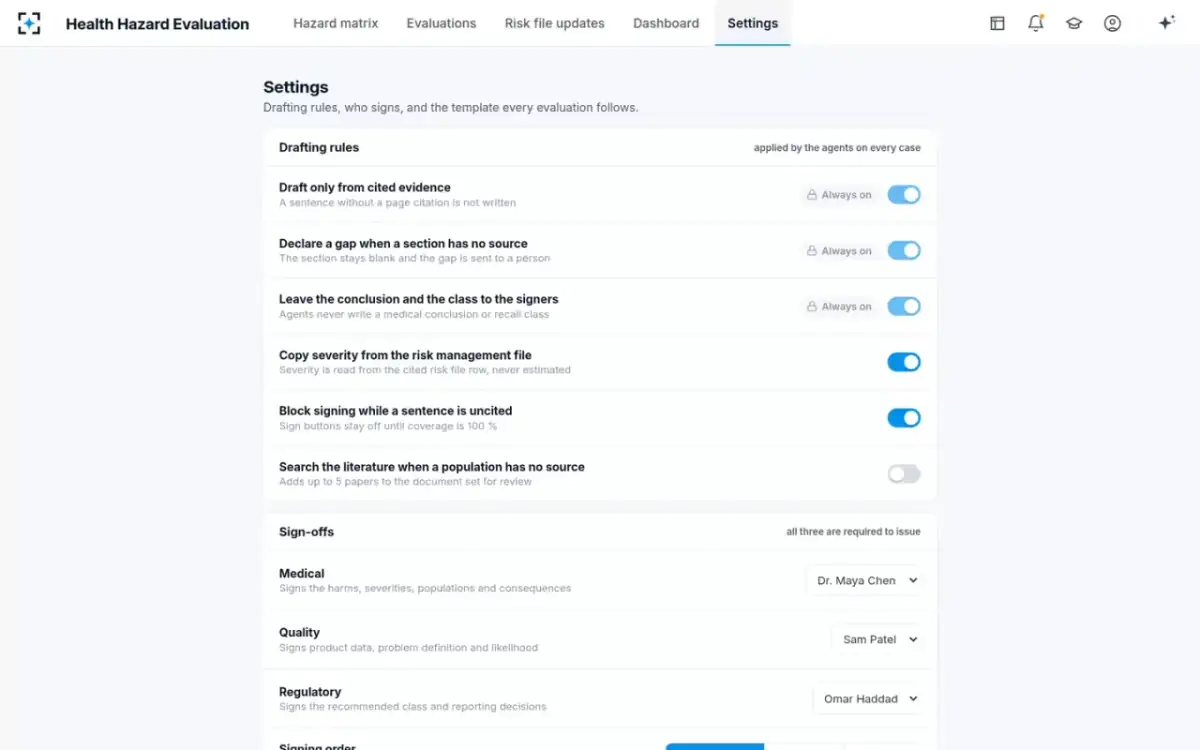
A template is a promise about what each section will contain. Enforce it and your evaluation reads the same on the day it is written and on the day someone asks about it two years later. Leave it as a document outline and the citation column soon becomes optional. The axis where that erosion shows first is the grid, which is why the severity and probability matrix deserves its own argument.
Questions people ask
Is there an official health hazard evaluation template?
No. 21 CFR 7.41(a) lists six factors and does not prescribe a document, and no FDA guidance issues a template for a manufacturer. The closest public artefact is the Health Hazard Evaluation Worksheet at Attachment D of chapter 7 of the Regulatory Procedures Manual — the form the agency's own hazard committees complete — together with the committee guidance at Attachment D1. Most firms build their template from those two.
What severity scale should a health hazard evaluation use?
The one in your risk management file, cited row by row, with the agency's scale alongside rather than merged into it. The committee guidance expresses seriousness in five levels — life threatening, severe, moderate, limited and none — and the worksheet's hazard question uses a seven-line scale of its own. FDA's benefit-risk guidance groups severity into three levels. They are different instruments for different jobs, and silently mapping one onto another is how a severity gets changed without anyone deciding to change it.
Does every statement in a health hazard evaluation need a reference?
Every statement needs either a reference or an attributed opinion. 21 CFR 7.41(a)(2) says any conclusion "shall be supported as completely as possible by scientific documentation and/or statements that the conclusion is the opinion of the individual(s) making the health hazard determination". A signed medical judgement is acceptable; an unattributed assertion is not.
What are mitigating factors in a health hazard evaluation?
Actions that genuinely limit harm or recover benefit — a filter that holds back a fragment, monitoring that detects a defect before it causes injury, an inspection step that removes affected units. FDA's benefit-risk guidance defines mitigations as actions taken by the manufacturer, by FDA or by other stakeholders, and states that risk acceptability is assessed after any appropriate mitigation. A mitigation you cannot evidence as operating is a hope, and should be written as one or left out.
Who writes the conclusion and recommended class?
The signers. In a three-signature scheme the medical signer confirms the harms, severities, populations at risk and consequences; the quality signer confirms the product data, the problem definition and the likelihood, and that every declared gap is closed or accepted; and the regulatory signer goes last, confirming the recommended class and the reporting decisions that follow. FDA assigns the actual class; your document recommends one.
How do you describe the population at risk?
By segment, setting and exposure. Name the universe of users and the relative frequency of use of each; say which segment is at greatest risk and why; state whether any high-risk group — infants, children, the elderly, pregnant women, surgical patients — is likely to be exposed; give the setting, the frequency and the duration of use; and say how much of the population at greatest risk is already under close medical supervision. Those are the committee's own questions, and answering them from distribution data rather than from the labelled indication is what makes the section real.