AI model risk management has no agreed answer yet for a tool that reads a farm loan file and builds the spread, because the one letter a US bank would reach for excludes it. The Federal Reserve's revised guidance, SR 26-2, leaves generative and agentic AI outside its scope while telling the bank to work out its own governance and controls anyway. That leaves an ag lender with a duty and no checklist. The practical answer is to borrow the discipline that supervisors have spent twenty years describing — outcomes analysis, effective challenge, documentation — and apply it to four things a farm spread can actually be tested on: whether every figure cites a page, whether the missing liabilities are found, whether the price flags are right, and whether the tool refuses when it should. Farm Financial Spreading is built so all four can be measured by a reviewer rather than asserted by a vendor.
Every number shown below as a scorecard is a design target on a fictional sample book, not a measured customer result; the distinction is stated again where the figures appear. The regulatory material is quoted and linked where it is used.
Farm Financial Spreading, as four claims a reviewer can test
100%
source-citation rate: every figure on the spread opens the page and line it came from
0
liabilities removed: a debt the borrower listed is never dropped, only questioned
4
exceptions raised on the sample file, each with the document that produced it
9
checks reported as passed, so a silent success is still evidence
Why there is no official validation checklist for an agentic farm spread yet
Supervisors have been careful rather than silent. The Federal Reserve replaced its long-standing model risk guidance in April 2026 and used the opportunity to put agentic AI outside its scope. The sentence immediately after that exclusion is the one that matters to a lender, because it hands the problem back: for anything the letter does not cover, the banking organisation's own risk management and governance practices decide what governance and controls are appropriate (SR 26-2).
The Farm Credit Administration takes the same position from the other side of the ag lending market. Its artificial intelligence page lists "Model Risk Management" among the examination material that applies, describing it as guidance that "provides guidance on evaluating the overall model risk framework, including any models that use AI" (FCA, Artificial Intelligence). Neither agency has written a validation procedure for an agent that reads Schedule F. Both expect the lender to have one.
Nor will an examination fill the gap. The OCC’s agricultural lending booklet is explicit that "examiners generally do not perform verification procedures as part of a typical examination", reserving them for cases where "substantive safety and soundness concerns are identified that are not mitigated by the bank’s risk management systems and internal controls" (OCC, Comptroller’s Handbook: Agricultural Lending). An examiner arriving to find no evidence that the tool was tested is not going to produce that evidence; they are going to ask why the controls did not.
That is less unusual than it sounds, and it is not an excuse to wait. Lenders have always had to validate things nobody wrote a checklist for — a new scorecard, a vendor cash flow model, an appraisal review process. The method survives even when the subject is new: state what the tool is supposed to produce, measure whether it produces it on cases where you already know the answer, have someone independent try to break it, and write down what you found.
Is a farm spreading AI tool a model under bank guidance
In practice, treat it as one. The definition most model risk policies use — a quantitative method that applies statistical, economic or financial assumptions to input data to produce an output used in decision-making — covers a tool that converts a cash-basis tax return into accrual income and a term debt coverage ratio that a committee votes on. Calling it something else does not change what it does to a credit decision.
Two practical consequences follow from that decision, and both are easier to accept early than to retrofit. First, the tool goes on the model inventory, with an owner, a use, a tier and a validation date, which means someone has to be named as responsible for it before it is used. Second, it inherits the expectation of effective challenge. SR 26-2 describes it as critical analysis by people with the expertise to challenge the work objectively, enough independence to stay objective, and the standing and influence to have their findings acted on (SR 26-2). A review of the ag spreading tool signed off by the head of ag lending is not effective challenge.
What a classic validation asks, and what it can ask of an agentic farm spread
The question in a model validation: Are the design, assumptions and data choices documented and defensible?
What it becomes for a farm spread: Is the accrual method the recognised one — inventories, receivables and prepaid expenses less payables and accrued interest — and is each agent’s limit written down and testable?
The question in a model validation: Is the data accurate, complete and appropriate for the use?
What it becomes for a farm spread: The inputs are the borrower’s own documents. The testable question is whether the tool reads them correctly and whether it says so when a page is missing.
The question in a model validation: Do outputs match real-world results over time?
What it becomes for a farm spread: Re-spread files you have already signed and compare the figures, the exceptions and the ratios with what the analyst produced by hand.
The question in a model validation: Is performance tracked after deployment, with thresholds and escalation?
What it becomes for a farm spread: Track the four measures by month and by analyst, and watch the override rate: a tool whose flags are always overridden has stopped being used.
The question in a model validation: Can the organisation validate a product whose internals it cannot see?
What it becomes for a farm spread: It can test behaviour exhaustively if every output carries its evidence. The citation is what makes a closed tool auditable from the outside.
Does SR 26-2 cover agentic AI, and does it apply to your ag lender
No on the first, and probably not directly on the second. SR 26-2 excludes agentic AI from its scope, and it also states its own audience: "This letter is expected to be most relevant to banking organizations with over $30 billion in total assets regulated by the Federal Reserve." Most ag lenders are far below that line, and many are not Federal Reserve-regulated at all.
Quote it carefully, then. It is the best available description of what a disciplined validation looks like, and it is not a rule this or any agentic tool is certified against. A vendor who says their product is "compliant with SR 26-2" is describing something that cannot be true of an agentic system the letter excludes. The honest framing is the one a lender should use in its own file: we borrowed the method, here is what we measured, here is who challenged it.
What outcomes analysis means, borrowed from model risk guidance
Outcomes analysis is the part of validation that does not depend on seeing inside the tool, which is why it is the right place for an ag lender to start. SR 26-2 describes it as comparing what a model produces with what actually happened, to judge how well it performs against its objectives and the use the business makes of it (SR 26-2).
On a farm spread the real-world outcome is not whether the loan eventually performed — that is a credit question, and the tool does not make credit decisions. It is whether the spread was right: whether the accrual-adjusted income matches what a careful analyst reaches from the same documents, whether the liabilities on it are the liabilities that existed, whether the inventory was priced at the policy price. Those are checkable against files the lender has already signed and, for the awkward cases, against the exceptions that turned up afterwards.
The NIST framework adds the discipline that makes outcomes analysis a habit rather than an event: "MANAGE 4.1: Post-deployment AI system monitoring plans are implemented, including mechanisms for capturing and evaluating input from users and other relevant AI actors, appeal and override, decommissioning, incident response, recovery, and change management" (NIST AI RMF 1.0). The words that matter on a lending desk are appeal and override. An analyst must be able to disagree, the disagreement has to be recorded, and someone has to read the record.
Four measures a farm spread can actually be tested on
A measure is only useful if it can fail. Each of the four below has a denominator, an owner and a way to compute it from a sample of files, which is what separates them from a vendor's accuracy percentage with nothing behind it.
Four measures, with the agent each one tests and how to compute it
Source-citation rate
cells that open a page and line ÷ cells on the spread
The foundation of every other measure. A cell with no source cannot be re-tested by anyone, so the target is every cell, and any shortfall should be a named, understood list rather than a percentage.
Tax return reader · balance sheet reader
Missed-liability catch rate
liabilities found ÷ liabilities that existed but were not listed
Measured on files where the truth is known afterwards: a lien search, a later statement, the next renewal. The denominator is the hard part and the reason to run this on past files rather than live ones.
Debt and liability finder
Price-flag precision
flags the analyst confirmed ÷ flags raised
A flag that is almost always overridden is noise, and noise gets clicked through. Watch it alongside recall: a tool that flags nothing scores perfectly here and is useless.
Inventory and price checker
Refusal rate
cells left empty for want of a source ÷ cells that could not be sourced
The measure most tools do not report. A high number here is good news if the gaps are real, because the failure it prevents — a plausible estimate indistinguishable from a fact — is the expensive one.
Accrual adjuster · all six
Two of the four are in tension on purpose. Price-flag precision rewards a tool that keeps quiet; refusal rate rewards one that says it does not know. Read together they describe the behaviour a lender actually wants: silent when the figures agree with policy, loud and specific when they do not, honest when a page is missing. A single composite accuracy score hides exactly that trade-off, which is why there is no fifth number averaging the four.
Where the measures land: three years of farm ratios, banded against policy
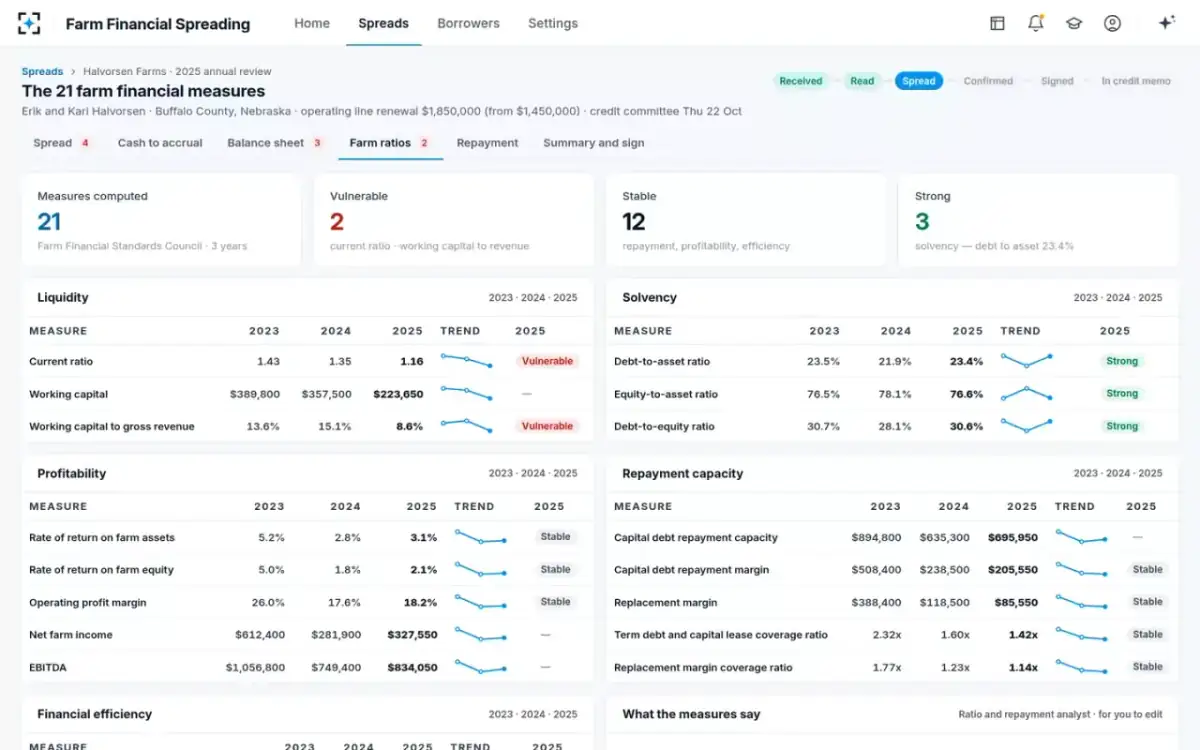
How to back-test a farm spreading tool on files you have already signed
The best test set an ag lender has is its own closed file room. Twenty to fifty renewals from the last two seasons, already spread by hand, already signed, already argued over at committee — and in many cases already settled by what happened next. Re-spread them and compare.
A back-test on past farm files, step by step
| Step | What to do | What a result looks like |
|---|---|---|
| 1. Choose the sample | Twenty to fifty signed renewals across crops, livestock and multi-entity borrowers, including the files that went wrong afterwards. | A sample that is not all easy files. If every file in it was straightforward, the test will pass and tell you nothing. |
| 2. Freeze the rules | Set the price sheet, coverage minimum, family living floor and bands to what was in force when each file was signed. | Differences that are real differences, not an artefact of a policy that changed in between. |
| 3. Re-spread blind | Run the package without the signed spread available, so the comparison is not anchored. | An independent second reading of the same documents. |
| 4. Compare the figures | Accrual-adjusted income, the balance sheet totals, the ratios. Line up every difference over a materiality floor you set in advance. | A short list of differences, each traceable to a document on one side or the other. |
| 5. Adjudicate each difference | An analyst who did not spread the original decides which reading is right from the documents alone. | Three piles: the tool was right, the analyst was right, the documents are ambiguous. The third pile is the most informative. |
| 6. Write it down | Counts, the four measures, the adjudications, and what you will monitor after go-live. | The validation file. It is the artefact an examiner or a board will ask for, and it is worth more than the headline count. |
Expect the third pile to be larger than anyone predicts. A hand-built farm spread contains judgements that were never written down — which year-end a prepaid input belongs to, whether a landlord's share is revenue or an expense, whether a parent's off-farm income counts. The back-test surfaces them as differences, and the right response is usually to settle them as policy rather than to score one side as wrong.
What a seeded-error test for a farm spread looks like
A back-test measures agreement on files where you hope nothing was wrong. A seeded-error test measures detection on files where you know exactly what is wrong, and it is the cheaper and sharper of the two. Take a handful of clean packages and plant a defect in each, then see whether the tool reports it, misses it, or reports something else.
Eight defects worth planting in a farm package
- A liability removed from the balance sheet
Delete an equipment note that the depreciation schedule still shows. The debt and liability finder should propose it back with both pages.
- A CCC loan reported as income only
Leave the Schedule F line 5a entry in place with no matching current liability. Watch for both the liability and the collateral consequence on the pledged bushels.
- An inventory priced above the sheet
Value corn at a hoped-for price. The flag should name the sheet price, the difference and the effect on income.
- A balance sheet that does not tie to last year
Change an opening figure so it no longer matches the prior ending. This should be a check that fails loudly, not a silent reconciliation.
- Family living stated below the floor
State $48,000 for a household of four against a $72,000 floor. The tool should flag it against the policy and leave the stated figure as stated.
- A page removed from the middle of a return
Drop Form 4562. The right behaviour is an empty cell and a named missing document, not an estimate.
- Two balance sheets at the same date
Supply duplicates instead of two year-ends. The accrual bridge cannot be built, and the tool should say that rather than produce zero adjustments.
- A figure that contradicts itself across documents
Make the grain count and the balance sheet inventory disagree. Both should appear, with the exception, rather than one quietly winning.
Run the same set again after any change to the tool. The point of a seeded-error set is that it is cheap to repeat, and a measure you only took once is a claim about the past.
When should an AI agent refuse instead of guess
Whenever the alternative is a figure that looks like a fact. The rule is easy to state and expensive to keep, because a refusal is visible and an estimate is not. An empty cell with a named missing document sends an analyst to the borrower; a plausible number sends a credit memo to committee.
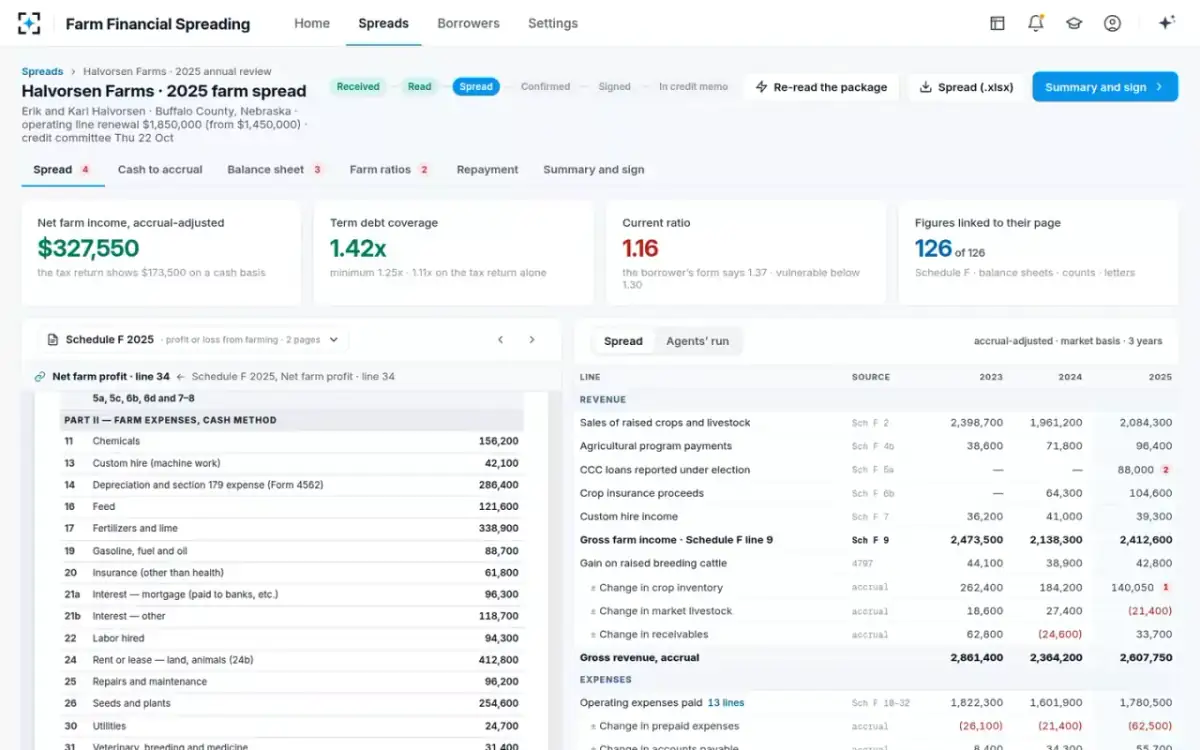
The sharpest case on a farm file is the accrual bridge. If only one balance sheet is present, the change in inventories, receivables, prepaid expenses, payables and accrued interest cannot be computed at all. A tool that reports no adjustments in that situation is reporting something false — it is not that the adjustments were zero, it is that they are unknown, and on this file the difference between the two is term debt coverage of 1.11x against 1.42x. The OCC booklet's underlying expectation is the same one: matched statements and returns are what make an accrual adjustment possible in the first place (OCC, Comptroller's Handbook: Agricultural Lending).
What a Farm Financial Spreading citation looks like when a reviewer clicks it
What a model-risk committee should ask to see before go-live
Six artefacts, and none of them is a demonstration. A demonstration shows a tool working on a file chosen by the person demonstrating it, which is the one piece of evidence a committee should discount.
The evidence file a model-risk committee should ask for
| Ask for | Why it matters | What a weak answer sounds like |
|---|---|---|
| The limits, written per agent | A boundary that is stated per agent can be tested per agent; a general promise of human oversight cannot. | "There is always a human in the loop." |
| The back-test on your own files | Vendor benchmarks are run on documents you have never seen. Your borrowers write their balance sheets in pencil. | "Accuracy is above 99% in our testing." |
| The seeded-error results | Detection is the thing the tool is for, and it is the thing a happy-path demonstration cannot show. | "The model has not missed a liability in production." |
| The refusal behaviour | What happens when a document is missing decides whether an unknown becomes a number. | "It fills the gap with a reasonable estimate." |
| The override record | Analysts overriding the same flag every week is a finding about the tool, and it is invisible unless it is recorded. | "Analysts can always override." |
| The rule versions | A spread signed in March has to be readable against March’s price sheet and floors, or no later review can be fair to it. | "The settings are configurable." |
One more question belongs on the list and rarely gets asked: who is allowed to change the rules, and does changing them leave a trace. The price sheet, the coverage minimum and the family living floor move the output of every spread in the book, and they move it silently. Where those live, who owns them and what a lender brings to set them up is covered in the go-live plan; the limits each agent carries, and why they are written per agent, are in how six agents read a farm loan file. To see the citations and the exceptions on a real screen, start from Farm Financial Spreading.
Questions people ask
How do you validate an AI model for lending?
The same way as any other model, minus the parts that need the internals. Document what it is meant to produce and on what assumptions; test it against outcomes you already know, which for a farm spread means files you have already signed; have someone independent of the lending line challenge the results and act on what they find; monitor it after deployment with thresholds that trigger a review. The method predates AI and survives it; what changes is that behaviour has to be tested exhaustively from the outside rather than inspected from the inside.
How do you measure AI accuracy in credit analysis?
Not with one number. On a farm spread, measure the source-citation rate, the missed-liability catch rate, the precision of the price flags and the refusal rate separately, because they trade off against each other: a tool tuned to flag less scores better on precision and worse on detection. A single accuracy figure quoted without a denominator and a sample description tells a reviewer nothing they can re-test.
What happens when an AI agent isn't sure about a number?
In this design it leaves the cell empty, names the document it needed, and raises the gap rather than filling it. That is deliberately the less impressive behaviour. An estimate inside a spread is indistinguishable from a sourced figure a month later, and the one place a farm spread can be quietly wrong is an accrual adjustment that was inferred rather than read from two dated balance sheets.
Who should sign off on an agentic tool before it touches a credit file?
Someone with the standing to say no. The Federal Reserve's description of effective challenge asks for expertise, enough independence to stay objective, and enough organisational influence for findings to be acted on. On a small ag lending desk that usually means credit risk or internal audit rather than the lending line, and it means the sign-off is a dated document with findings in it rather than a verbal approval at a committee.
Can a lender validate a tool whose internals it cannot see?
Yes, if every output carries its evidence. A closed tool that produces a figure and a page reference can be tested cell by cell by anyone with the documents; a transparent tool that produces a figure with nothing behind it cannot. The citation requirement is doing the work that white-box access would otherwise have to do, which is why it is the first of the four measures rather than a nicety.
How often should the measures be re-run after go-live?
Monthly for the four measures while volumes are low, quarterly once they settle, and immediately after any change to the tool or to the rules it works to. Watch the override rate alongside them: a steady rise in overrides of the same flag is the earliest sign that something has drifted, and it shows up long before an accuracy figure does.