How long it takes to implement farm lending software depends almost entirely on how quickly a lender can produce four things it already owns: its own balance sheet form, its year-end price sheet, the credit policy numbers every spread is tested against, and a sample of past farm files with their signed spreads. None of those is a software problem. Farm Financial Spreading is built and deployed from those requirements, and goes live once every acceptance check has passed — which means the schedule is set by how long the credit side takes to agree its own floors, not by how long anything takes to build. A desk that has those four ready can be reading its own past files in weeks; a desk still arguing about the family living floor cannot.
The worked example throughout is a fictional sample lender from the working product — Wexmoor Ag Bank and its borrower Halvorsen Farms. Where a regulator is quoted it is linked, and where a figure is a design target rather than a measurement it says so.
What a Farm Financial Spreading go-live is actually made of
4
things the lender brings: the form, the price sheet, the policy numbers, past files
8
policy settings that have to be agreed before the first spread is built
15min
from a complete package to a signed spread — the design target, measured in the live solution
0
custom code the lender writes or maintains to get its own form on screen
How long it takes to implement farm lending software, week by week
The useful way to read a rollout schedule is as two tracks that have to meet. One is the build — your form, your settings, your documents — and it is predictable. The other is the credit-side agreement on the numbers, and it is not: a desk where the lending manager can set the family living floor in an afternoon moves at a different speed from one where it needs a policy committee.
The two tracks of a farm spreading rollout, and where they meet
- Requirementsweeks 1–2
- Build on your formweeks 3–4
- Acceptance checksweeks 5–6
- First live spreadsweeks 7–8
- Price sheetquick
- Coverage minimuma policy question
- Family living floorthe slow one
- Who signsquick
Two practical consequences follow. Start the credit-side conversation before the build begins, not after the demonstration — the questions are the lender's own, and a vendor cannot answer them. And set the target to the first signed spread on a live file rather than to deployment, because a deployed tool that nobody has signed a file with has proved nothing.
What we need from you to go live with farm spreading software
Four inputs, and a fifth that is optional but changes the quality of the first month. Each one is something the desk already has, usually in a drawer or in one person's head.
The inputs an ag lender brings, and what each one becomes
- Your balance sheet form
The blank form your borrowers fill in, plus two or three completed ones in the handwriting you actually receive. This becomes the layout of the spread, so the analyst reads the figures where they expect them.
- Your year-end price sheet
Prices by commodity, livestock class and land, with the source you take them from — a local co-op cash bid, an auction report. This becomes the price every inventory is valued at, and the thing a stated price is flagged against.
- Your credit policy numbers
The coverage minimum, the family living floor, the capital replacement allowance, the income basis, the earned net worth tolerance, the required documents and the ratio bands. Eight settings, each one a decision somebody on the credit side has to own.
- A sample of your own signed farm files
Twenty to fifty past renewals with the spreads your analysts produced. These are what the acceptance checks run on, and they are how you find out what the tool does with a pencil balance sheet from your own market.
- Your exported credit memo format, if you want the summary in it
Optional. Without it the signed summary is still produced; with it, the officer stops retyping the figures into the memo.
The fourth item is the one most often supplied last and matters most. A sample of a lender's own signed files is simultaneously the acceptance evidence, the first half of a model validation, and the only honest way to find out whether the tool reads the handwriting your borrowers actually use. Twenty files is enough to learn something; fifty is enough to count.
How your own balance sheet form becomes the spread's layout
A farm spread is read by people who have read the same form for years, and moving the lines is more disruptive than it sounds. The spread in the sample lender's deployment is laid out as that lender's own form FB-2: Schedule F on a cash basis, the balance sheets at two dates, family living and repayment, then the corrected balance sheet. An analyst opening it finds crop inventory where crop inventory has always been.
The constraint is worth stating plainly: the layout follows your form, and the method does not. Accrual adjustment follows the recognised approach — the change in inventories, receivables and prepaid expenses, less the change in payables and accrued interest — whatever your form calls those lines. A lender whose form omits prepaid expenses does not get a spread without them; it gets the line added, in the place its form would have put it.
One rollout decision belongs here and is easy to miss. Decide whether the balance sheet is held at cost, at market or both before the form is mapped, because the ratio bands mean different things on each basis. On the sample file, debt to asset is 23.4% at market and the corrected net worth is $12,136,450; the same farm at cost basis is a different conversation with the committee, and a desk that mixes the two across files has lost comparability without noticing.
Setting the price sheet, the coverage minimum and the family living floor
These are the three settings that move every spread in the book, and they are the three that most often stall a rollout. None of them is a technical choice.
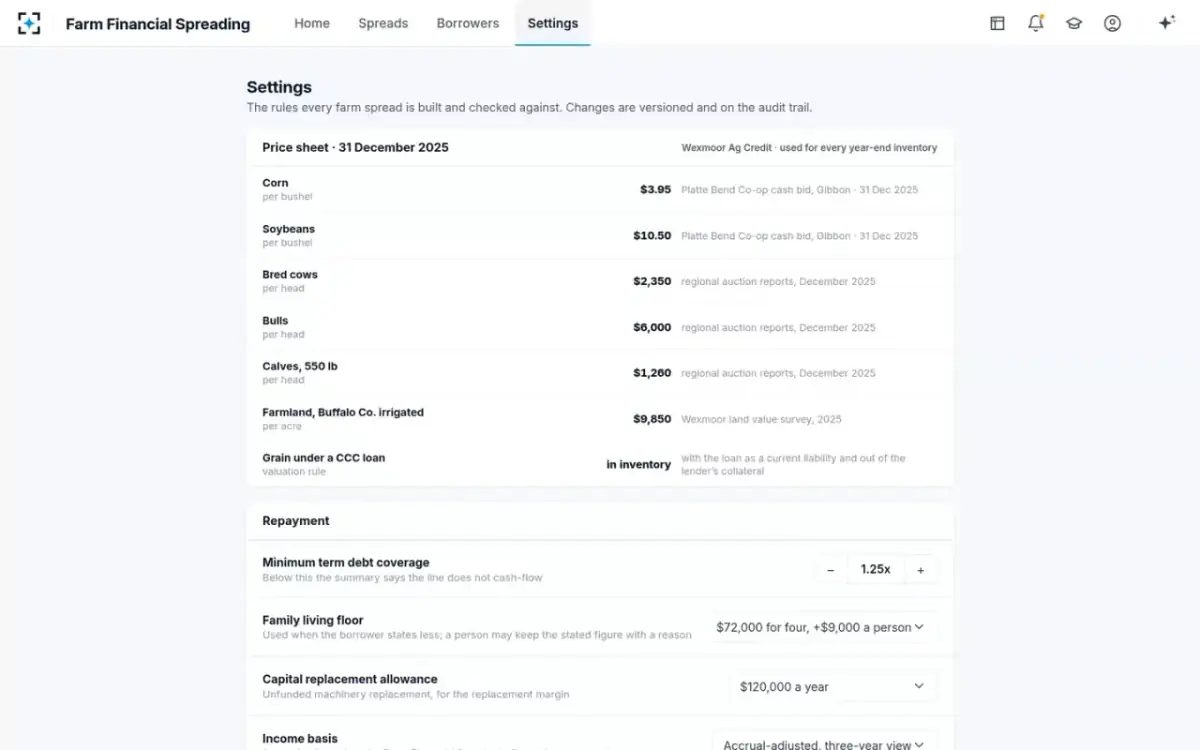
The eight settings, what the sample lender chose, and the decision behind each
| Setting | What the sample lender set | The decision behind it |
|---|---|---|
| Year-end price sheet | Corn $3.95, soybeans $10.50 a bushel | Which source, and as of which date. A local cash bid and a futures-based figure can differ by enough to move a coverage ratio across the minimum. |
| Minimum term debt coverage | 1.25x | The line below which the summary says the line does not cash-flow. Moving it is a credit policy change, not a setting change, and should be minuted as one. |
| Family living floor | $72,000 for four, +$9,000 a person | What the bank will assume a farm household consumes when the borrower states less. The commonest override on any farm desk, and the one most worth recording a reason for. |
| Capital replacement allowance | $120,000 a year | Whether replacement is a policy figure or equal to depreciation. The second is easier to defend and less honest on an ageing machinery line. |
| Income basis | Accrual-adjusted, three-year view | One year or three, and whether weighted. A three-year view damps a good year and a bad one, which is usually right for a farm and occasionally wrong for a young operation. |
| Earned net worth tolerance | $10,000 or 0.1% of assets | How close the reconciliation has to be before the file is treated as tying out. Too tight and every file has an exception; too loose and the check stops meaning anything. |
| Required documents | 3 years of returns, 2 balance sheets, inventory count | What makes a package complete enough to work. This is the setting that decides how much of the calendar is spent waiting. |
| Ratio bands | Current ratio below 1.30 vulnerable, above 2.00 strong | Where vulnerable, stable and strong sit for each measure. Published benchmark bands are a starting point; your own book is the better one. |
The eight settings in Farm Financial Spreading, each with its alternatives and its history
Why the first live spread should run on your own past files first
Because a file you have already signed has an answer. Everything else in a rollout is a judgement about whether the output looks right, and looking right is exactly what a confidently wrong figure does.
Running your own past files produces three things at once. It is the acceptance evidence, because the differences are countable. It is the first half of the model validation a risk function will ask for, so the work is not done twice. And it is the only way to see what the tool does with the documents your market actually produces — a co-op invoice from your county, a grain count in the handwriting of a borrower who has banked with you for thirty years, the balance sheet form your predecessor designed.
Expect differences, and expect most of them to be policy rather than error. A hand-built farm spread contains decisions nobody wrote down: which year a December prepay belongs to, whether a landlord's share is revenue or an expense, whether a spouse's off-farm income counts toward family living. The rollout is the right moment to settle those as settings rather than as habits, and how to run that comparison as a measured exercise is set out in measuring whether an AI-built farm spread can be trusted.
What the acceptance checks test before a spread is allowed through
A spread does not reach an analyst until the file it was built from holds together. The checks are arithmetic and tie-outs rather than opinions, which is why they can be run on every file rather than on a sample.
What is checked on every file, and what a failure produces
| Check | What it tests | What happens when it fails |
|---|---|---|
| Schedule F ties to the 1040 | That net farm profit on the schedule is the figure carried to the return. | An exception naming both pages. Usually an amended return the file does not have. |
| Depreciation ties to Form 4562 | That the Schedule F deduction matches the schedule behind it. | An exception, and a prompt to look for the note financing a newly placed asset. |
| Opening balance sheet ties to last year’s ending | That the two statements are the same operation, consecutively. | The accrual bridge is not built. The file is held, naming the statement and the date it needs. |
| Every cell has a source | That no figure on the spread arrived without a page and line behind it. | The cell stays empty rather than being filled, and is shown as a gap. |
| Earned net worth reconciles | That the change in net worth is explained by earnings, withdrawals and valuation changes within tolerance. | An exception with the unexplained amount, which is often where an unlisted liability is hiding. |
| Inventory priced at the sheet | That every quantity is valued at the lender’s own price, not a stated one. | A flag with the difference and its effect on income, for the analyst to accept or query. |
| Required documents present | That the package meets the completeness rule before it is worked. | The file waits, and the reminder names the missing document rather than asking for paperwork. |
The design principle behind the list is worth stating because it shapes the rollout: a check that cannot fail is not a check. Each row above has a failure state that stops or marks the file, and part of acceptance is proving each one fails when it should — by planting the defect deliberately and watching what the file does.
How to test farm spreading software before going live on real files
Three tests, in order, and none of them is a demonstration. Together they take about two weeks of part-time work from one analyst and one reviewer.
Three tests before the first live spread, and what each one proves
What you do: Twenty to fifty past renewals, run with the rules set to what was in force when each was signed, without the original spread visible.
What it proves, and what it cannot: Proves agreement on ordinary files and surfaces undocumented policy. Cannot prove detection, because you do not know what those files were hiding.
What you do: Remove a liability that the depreciation schedule still shows; price corn above the sheet; supply two balance sheets at the same date; drop a page from a return.
What it proves, and what it cannot: Proves the checks fail when they should. Cannot prove the tool is right on a file you have not thought of.
What you do: One analyst spreads a new package by hand while the same package runs through the tool; compare before either is signed.
What it proves, and what it cannot: Proves the handoff works for a real analyst on a real deadline. Cannot be done at volume, which is why it comes last and on two or three files.
The NIST framework asks for the oversight arrangement to be written down rather than assumed: "MAP 3.5: Processes for human oversight are defined, assessed, and documented in accordance with organizational policies from the GOVERN function" (NIST AI RMF 1.0). On an ag desk that is three sentences, not a document: who confirms adjustments, who may keep a stated figure over the policy figure and with what reason, and who sees the list of files where that happened. Agree them before go-live and the first override is a recorded decision rather than an argument.
What changes for a Farm Credit System institution versus a bank
The regulator changes, and so does who you talk to about the tool. The Farm Credit Administration supervises Farm Credit System institutions; a bank's ag lending desk answers to the OCC, the Federal Reserve or the FDIC depending on its charter. An ag lender that quotes the wrong agency's material at its own examiner has made a longer meeting for itself.
For System institutions, FCA has published its position on artificial intelligence and it is even-handed: "AI can also create risk, including safety and soundness risks for lending institutions" (FCA, Artificial Intelligence). It does not prohibit, and it does not bless; it points at the examination material that already exists. For banks, the nearest relevant supervisory thinking is model risk and third-party risk, and the Federal Reserve's 2026 letter names the difficulty directly: "The widespread use of customized vendor and other third-party products—including data, parameter values, or complete models—can present unique challenges for validation and other model risk management activities" (SR 26-2).
The practical answer to that challenge is the same for both tracks, and it is a property of the file rather than of the contract. If every figure on the spread opens the page it came from, a reviewer can test the tool's behaviour exhaustively without seeing inside it. Citation is what makes a third-party tool auditable from the outside, which is why it is the first thing to check at acceptance rather than a feature to admire at the demonstration.
What to ask your examiner before go-live
Ask early, ask narrowly, and ask about evidence rather than permission. An examiner is not going to approve a vendor, and a lender that frames the conversation as a request for approval will get a non-answer. The useful questions are about what the file should contain when they next look at it.
Five questions worth putting to your examiner before the first live spread
- What would you expect to see in the credit file itself?
Whether the page references and the signed summary belong in the file as exported, or whether the system of record is enough on its own.
- Where does this sit in our model inventory?
Tier, owner and validation expectations. Getting this agreed early avoids a finding that is purely about classification.
- What evidence of testing would you want to see?
The back-test counts, the planted-defect results, and who performed them. Agreeing the form of the evidence beforehand is cheaper than producing it twice.
- How should overrides be reported?
Who reviews the list of spreads where a stated figure was kept over the policy figure, and how often. This is the control an examiner is most likely to test.
- Does anything change for collateral inspection?
Nothing in a spreading tool replaces physical inspection. The OCC booklet still expects a bank to set "crop and livestock inspection requirements, including appropriate frequency and timing of inspections and valuations".
The last question is the one that catches people out. A tool that reads a grain count and prices it at the lender's sheet has not inspected a bin, and no amount of citation changes that. Spreading and inspection are separate controls, and a rollout that quietly leans on one to justify thinning the other is the kind of change an examiner notices.
The end state: a package in, a signed spread out
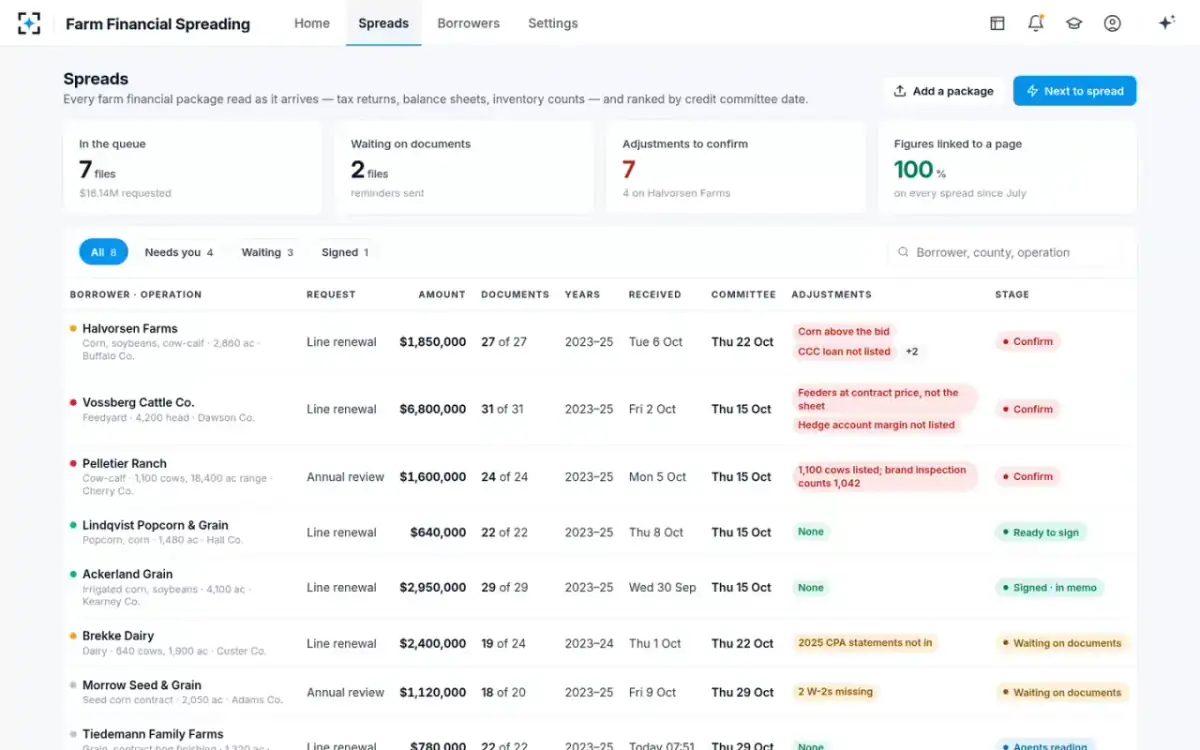
One last piece of sequencing. Decide who signs before the first live file rather than after, because moving a signature later is a credit policy change in the middle of a season. The seats and what each one owns are walked through in who spreads a farm loan renewal, and the business case to put beside this plan is in the real cost of a farm spread. To see the whole thing working on one package, start from Farm Financial Spreading.
Questions people ask
Do we need three years of tax returns to start?
Only if your own policy says so — it is a setting, not a constraint. The sample lender requires three years of returns, two balance sheets and an inventory count, because its income basis is a three-year view; a lender reading the latest year alone can require less. The one input with no alternative is the second balance sheet: without two dated statements the cash-to-accrual bridge cannot be built at all, and reporting no adjustments in that case would be reporting something false.
Can we use our own balance sheet form?
Yes, and you should, because analysts read a familiar layout faster and argue with it more usefully. The spread follows your form — your sections, your line order, your labels — while the method underneath it stays the recognised one. If your form is missing a line the method needs, such as prepaid expenses, the line is added where your form would have put it rather than the method being bent to fit.
What happens in the first week of a farm spreading rollout?
Requirements, and most of them are credit documents rather than technical ones: the blank balance sheet form with two or three completed examples in the handwriting you actually receive, the year-end price sheet with its source, the eight policy numbers, and the list of documents that make a package complete. The slowest item is usually the family living floor, so raise it in week one even though it will not be needed until week three.
How do we know it is ready to go live?
When the acceptance checks have passed on your own past files, the planted defects were all caught, and two or three live packages have run in parallel with an analyst spreading them by hand. The target to hold the rollout to is the first signed spread on a live file, not the deployment date — a deployed tool nobody has signed a file with has proved nothing about the handoff.
Does our examiner have to approve the tool before we use it?
No, and asking for approval is the wrong framing — examiners supervise, they do not certify vendors. What they will look at is your evidence: where the tool sits in your model inventory, what testing you did and who did it, how overrides are reported and reviewed, and whether a figure in a credit file can be traced to the document behind it. Asking what they would expect to see is a question that gets answered; asking whether you may proceed usually is not.
Who owns the settings after go-live?
The ag lending manager, on most desks, because every one of the eight is a credit policy decision. What matters more than the name is that changes are versioned and on the audit trail: the price sheet, the floors and the bands move the output of every spread in the book silently, so a file signed in March has to remain readable against March's rules rather than today's.