AI reads a farm tax return the way a careful analyst does: line by line, tying Schedule F to the 1040 and depreciation to Form 4562, citing the page behind every figure, and refusing to tidy up a number the borrower reported. The work is divided the way a credit team already divides it, and kept away from the one thing a team never delegates. In Farm Financial Spreading, six specialist agents read a farm renewal package — a tax return reader, a balance sheet reader, an inventory and price checker, an accrual adjuster, a debt and liability finder, and a ratio and repayment analyst. Each does one job, cites a page for everything it produces, and stops at a boundary written into it. None of them rates the credit, approves the line or signs anything. The ag credit analyst confirms every adjustment against the document behind it, and the analyst's signature is the only decision in the file.
The file used throughout is a fictional sample from the working product: Halvorsen Farms, a 2,860-acre corn and soybean operation with 220 cows, renewing an operating line with Wexmoor Ag Bank. Regulators and standards bodies are quoted and linked where they appear.
One package read by Farm Financial Spreading, in numbers
61
lines mapped from the 2025 return to the spread, each with its page
31
balance sheet lines tied from one year-end to the next opening
2
liabilities found in the return that the balance sheet did not list
0
figures rewritten: a reported number is never changed, only questioned
What each of the six agents actually does, in order
The order is not cosmetic. Each agent depends on what the one before it established, and the dependency is what makes the result checkable: a price cannot be applied before the count is read, and an accrual adjustment cannot be booked before both balance sheets are tied.
The six agents of Farm Financial Spreading, and the one seat that decides
Agent
Tax return readerReads the 1040, Schedule F, Forms 4797 and 4562, Schedule SE and W-2s, maps every line to the spread with its page, and ties Schedule F line 34 to the 1040 and line 14 to Form 4562.
Never: alters a reported figure — it reports the difference instead
Agent
Balance sheet readerReads the lender’s own balance sheet form or the accountant’s statements, including handwritten entries, at cost and at market, and ties this year’s opening to last year’s ending.
Never: revalues an asset without a price source
Agent
Inventory and price checkerReads handwritten grain and livestock counts by bin and by class, prices them at the lender’s year-end sheet, and notes grain pledged under a CCC loan.
Never: uses a price the lender has not set; a contract price needs the contract
Agent
Accrual adjusterConverts cash-basis Schedule F to accrual-adjusted income: the change in inventories, receivables and prepaid expenses, less the change in payables and accrued interest.
Never: books a change it cannot source to a page
Agent
Debt and liability finderCross-checks listed liabilities against interest paid, new depreciation, recurring bank statement payments and CCC loans, and reports each missing one with its evidence.
Never: removes a liability the borrower listed; adds one only with evidence
Agent
Ratio and repayment analystComputes the farm measures for three years, repayment capacity, term debt coverage, the trend and a price stress, and drafts the summary for the credit memo.
Never: rates the credit or decides the loan
A person decides
Ag credit analystConfirms each adjustment against the page that proves it, or sends it back to the borrower as a question, then signs the spread with the meaning of the signature.
Never: hands the signature to anything else
How AI reads a farm tax return, line by line
A farm tax return is not a document to be summarised; it is a set of interlocking claims that have to be checked against each other. The tax return reader works through the 2025 Halvorsen return the way an analyst would, and leaves a page reference on every value it lifts: 61 lines mapped out of a 1040 with Schedule F, Form 4797, Form 4562, Schedule SE and two W-2s.
Three of those checks are worth naming because they are the ones a hurried reading skips. Schedule F line 34 — the net farm profit — has to tie to the figure carried onto the 1040, or something has been amended. Schedule F line 14, depreciation, has to tie to Form 4562, which is also the place a new machine first appears, often a year before it reaches the borrower's balance sheet. And the Form 4797 gain on raised breeding stock is farm income in substance even though the return reports it elsewhere, so a spread that starts and ends at Schedule F understates the operation. On this file that gain is $42,800 on top of $130,700 of net farm profit.
What the agent will not do is tidy up. If the return says one thing and the balance sheet says another, the figure the borrower reported stays on the page as reported and the difference is raised as an exception with both sources attached. That rule is the reason the spread can be audited at all: a file where the software silently reconciled the two is a file where nobody can tell what the borrower actually claimed.
What none of the six agents may ever do in a farm loan file
Each agent carries a short list of actions it may not take, and those lists are the design. They are not an afterthought bolted on for comfort; they are the reason an analyst can confirm the output in minutes instead of rebuilding it.
The limits matrix: six agents, and the action each one may never take
| Agent | May never | Why the limit is there |
|---|---|---|
| Tax return reader | Alter a figure the borrower reported | The reported figure is the claim being tested. Correcting it quietly destroys the comparison and the audit trail. |
| Balance sheet reader | Revalue an asset without a price source | An unsourced revaluation is an opinion wearing a number. Net worth moves, and nobody can say on whose authority. |
| Inventory and price checker | Use a price the lender has not set | Inventory value is a credit policy decision. A contract price needs the contract attached; a hoped-for price is not a price. |
| Accrual adjuster | Book a change it cannot source to a page | Accrual adjustments are where a spread is most easily inflated. Every one has to point at two balance sheet dates. |
| Debt and liability finder | Remove a liability the borrower listed | Finding debt is useful; losing debt is dangerous. It may only add, and only with evidence. |
| Ratio and repayment analyst | Rate the credit or decide the loan | The rating and the decision belong to people with lending authority. The measures inform them; they do not replace them. |
There is a seventh limit that belongs to no single agent: nothing in the file is signed by anything other than a person. A signature carries a meaning — on this desk, that the figures and adjustments were reviewed and confirmed — and a meaning can only be asserted by someone who can be asked about it afterwards.
Is AI allowed in agricultural lending, and who says so
Yes, with the plain condition that the lender stays responsible for the result. The Farm Credit Administration, which supervises Farm Credit System institutions, states it in one sentence on its own artificial intelligence page: "Using AI does not absolve any institution from the responsibility of complying with legal requirements" (FCA, Artificial Intelligence). It also says, on the same page, that AI brings risk to a lending institution as well as benefit — a point FCA develops into examination expectations rather than into a prohibition.
That is the whole of the permission and the whole of the constraint. Nothing in it says a farm spread must be typed by hand; everything in it says the lender owns the output as if it had been. The practical consequence for a design is that the human decision has to be real rather than ceremonial — an analyst who clicks confirm on four adjustments they can see the evidence for is exercising judgement, and an analyst who clicks confirm on forty they cannot is operating a rubber stamp.
The NIST AI Risk Management Framework asks for the same thing in the language of governance: "GOVERN 3.2: Policies and procedures are in place to define and differentiate roles and responsibilities for human-AI configurations and oversight of AI systems" (NIST AI RMF 1.0). Differentiating the roles is exactly what the limits matrix above is for — it is the document that answers the question for each agent separately rather than for "the AI" as a whole.
Bank supervisors have been more cautious about saying anything specific. The Federal Reserve's revised model risk guidance, issued in April 2026, describes generative and agentic AI as novel and rapidly evolving and leaves them outside its scope (SR 26-2), while telling the organisation to settle the governance and controls for such tools itself. An ag lender reading that correctly concludes there is no checklist to tick and a duty to build one; how to do that is the subject of measuring whether an AI-built farm spread can be trusted.
How the debt and liability finder stops short of removing a borrower's figure
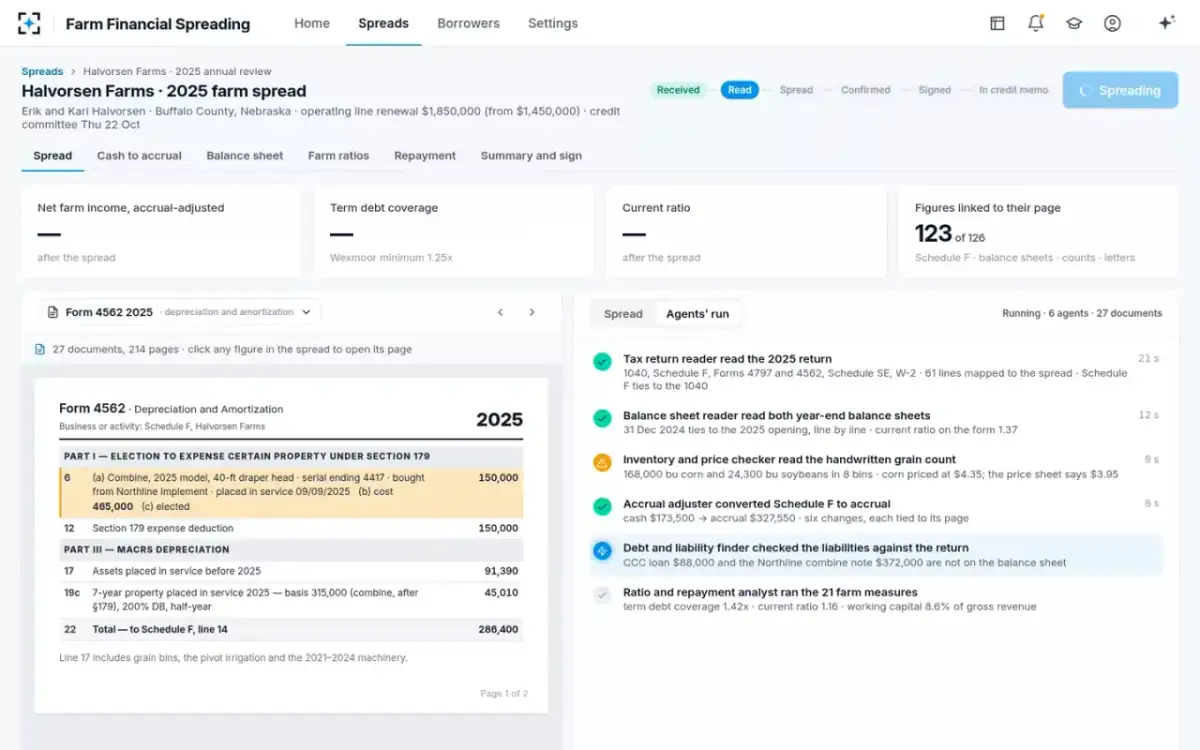
The most valuable agent on a farm file is the one that finds debt, and it is also the one with the most dangerous failure mode. On the Halvorsen renewal it finds two liabilities that the borrower's own balance sheet does not list, and it finds them in the tax return rather than on the form.
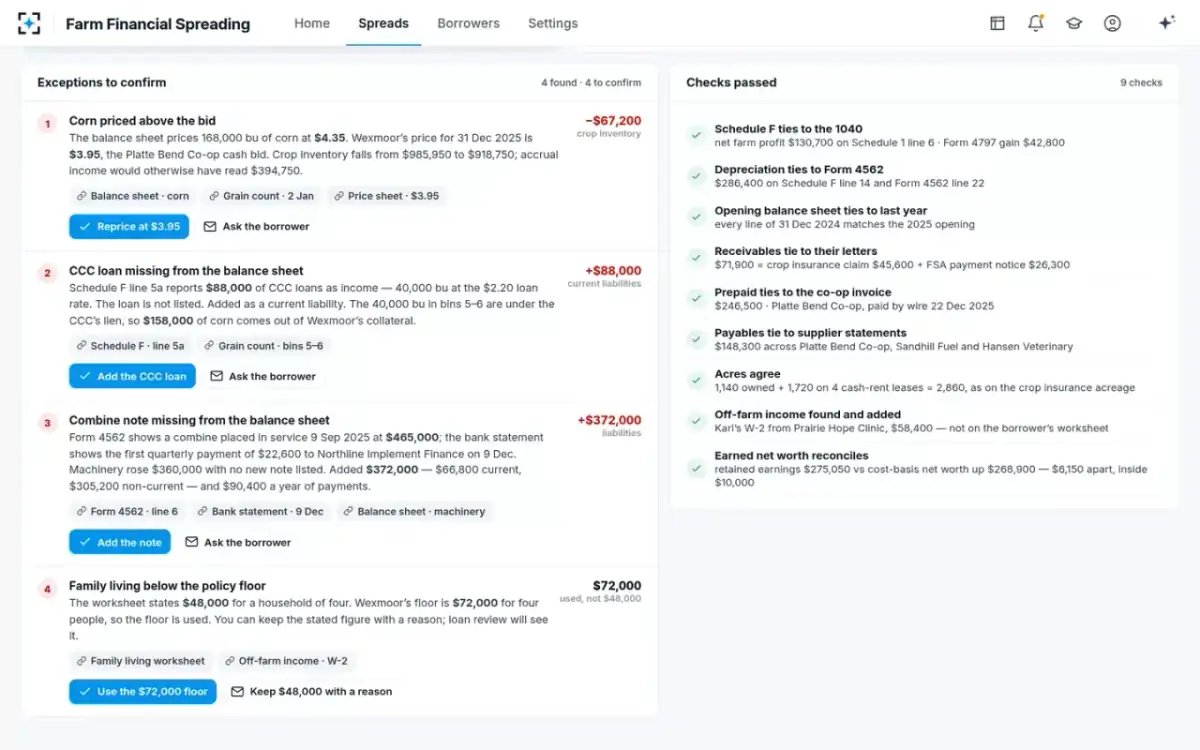
The first is a CCC marketing loan of $88,000 against 40,000 bushels, reported on Schedule F line 5a as income but never carried across to the balance sheet — a common omission, because to the farm it feels like a sale rather than a borrowing. It has a second consequence beyond the ratio: the pledged bushels sit under the Commodity Credit Corporation's lien, so they come out of the bank's collateral even though they stay in inventory. The second is a $372,000 combine note with a finance company, inferred from a new machine on Form 4562 and confirmed by a recurring payment on the December bank statement.
The limit is what makes those findings usable. The agent may add a liability when it has evidence, and it may never remove one the borrower listed. The asymmetry is deliberate: a borrower who lists a debt the bank cannot find has told the truth in an inconvenient way, and software that quietly dropped it would be correcting the file toward a better-looking credit. With both liabilities added and the corn repriced to the bank's sheet, the current ratio on this file falls from the 1.37 the form claimed to 1.16, and net worth falls by $527,200 from what the form showed. The arithmetic behind those corrections is walked through in what a farm spread really costs, and what a missed liability costs with it.
Four exceptions, each with the pages that prove it
Why the accrual adjuster cites a page for every change it books
Cash-basis Schedule F is a tax document, and farms manage the timing of sales and purchases around it. A farm that held its crop into the new year looks weaker on the return than it was; a farm that sold two crops in one calendar year looks stronger. The OCC's agricultural lending booklet explains why a lender has to undo that: matched financial statements are needed "to make accurate accrual adjustments to the Ag borrower's cash-based tax return, providing a more reliable estimate of the farmer's repayment capacity" (OCC, Comptroller's Handbook: Agricultural Lending).
Each adjustment is the difference between two balance sheet dates, which is why each one has to carry two page references rather than one. On the Halvorsen file the crop inventory rose from $778,700 to $918,750 between 31 December 2024 and 31 December 2025, and that single change of $140,050 moves term debt coverage from 1.11x to 1.39x. Market livestock, receivables, prepaid expenses, accounts payable and accrued interest follow, each pinned the same way, landing accrual-adjusted net farm income at $327,550 and coverage at 1.42x.
The reason the citation is not optional is visible in that one number. An adjustment of $140,050 is the difference between a file that does not cash-flow and one that does. An analyst confirming it needs to see both year-end figures on the pages they came from, in a second, or the confirmation means nothing — and a reviewer reading the file in eighteen months needs the same thing. One unsourced accrual adjustment is enough to make a whole spread unreliable, because there is no way to tell which one it was.
What happens when an agent finds something it cannot source
It stops and says so. That is a less impressive answer than producing a figure, and it is the behaviour that makes the rest of the file worth reading. There are three shapes this takes on a farm package, and each resolves differently.
Three ways a farm file goes unsourced, and what each one produces
- The document is missing
No second balance sheet, so the accrual bridge cannot be built. The file is held as incomplete and the borrower is asked for the specific statement, by date, rather than for paperwork in general.
- The document is there but the figure is not
A grain count with no bin totals, or a balance sheet line with no basis stated. The agent reports what it can read and leaves the cell empty rather than estimating into it.
- The figure is there but contradicts another document
A corn price above the lender’s sheet, a machine on the depreciation schedule with no matching note. This becomes an exception with both documents attached, for the analyst to confirm or query.
Refusal has a cost, and it is worth being honest about it. A tool that stops on every ambiguity produces a queue of questions and no spreads. The design answer is to be strict about what counts as a fact and generous about what can be done without one: the spread is built with the cells it can source, the gaps are visible as gaps, and the analyst sees immediately whether what is missing matters to the ratio they care about. A missing family living worksheet matters; a missing page of a crop insurance schedule usually does not.
How the six agents hand off to the ag credit analyst
The handoff is the product. Everything upstream exists to make the first ten minutes of the analyst's work consist of decisions rather than data entry, and the measure of whether it worked is how much of the file the analyst has to reconstruct before they can disagree with it.
One exception: what the agent proposes, and what the analyst decides
What the agent produced: 168,000 bu of corn valued by the borrower at $4.35; the lender’s year-end sheet is $3.95. The agent flags the difference, shows both, and computes the effect: −$67,200.
What the analyst decides: Accept the sheet price, or keep the stated price with a reason on the file. Loan review sees every spread where the stated figure was kept.
What the agent produced: $88,000 reported on Schedule F line 5a, no matching liability on the form; 40,000 bu under the lien. The agent adds the liability with both pages attached.
What the analyst decides: Confirm the liability and the collateral consequence, or ask the borrower whether the loan was repaid before year end.
What the agent produced: Stated at $48,000 against a $72,000 floor for a family of four. The agent flags it against the policy figure and does not overwrite the statement.
What the analyst decides: Apply the floor, or keep the stated figure with a documented reason — a second household income, a parent’s support — on the record.
What the agent produced: New machine on Form 4562 line 6, a recurring payment on the 9 December bank statement, no liability listed. Proposed at $372,000 with both documents.
What the analyst decides: Confirm and add it, and attach a lien search to the committee conditions so the bank’s position is known before the line is drawn.
The agents at work: what each step read, and what it found
What FCA expects a Farm Credit System institution to show about its AI tools
A Farm Credit System institution and a commercial bank are supervised by different agencies, and an ag lender should be clear which track it is on before it quotes anyone's guidance at an examiner. FCA supervises System institutions; a bank's ag lending desk answers to the OCC, the Federal Reserve or the FDIC depending on its charter.
For System institutions, FCA's own artificial intelligence page does not issue a separate AI rulebook. It points back at the examination material that already exists — model risk management, third-party risk management, information technology — and names that material as where an institution's AI tools will be looked at. The expectation, in other words, is continuity: an AI tool in a credit file is inspected through the frameworks already in place for models, vendors and internal controls, and what a reviewer asks of it is the same conversation an ag lender would have about any other tool in the file.
Three things make that inspection go quickly, and all three are properties of the file rather than of the vendor. First, every figure traces to a document, so a sample can be tested without an interview. Second, every human decision is attributable, with the meaning of the signature recorded alongside it. Third, the rules the file was built against — the price sheet, the coverage minimum, the family living floor — are versioned, so a spread signed in March can be read against March's policy. What a lender should ask for before go-live, and what it provides in return, is set out in the ag lender's go-live plan, and who in the lending team owns each of those decisions is walked through in the farm spreading desk, seat by seat.
Questions people ask
Can an AI agent sign a loan document?
Not in this design, and a lender should be wary of any design where it can. A signature on a farm spread asserts that the figures and adjustments were reviewed and confirmed, and that assertion has to belong to someone who can be asked about it later. The agents produce evidence and arithmetic; the ag credit analyst confirms each adjustment and signs, and the signature, its meaning, the time and the figures as they stood go to the audit trail.
How does AI check its own work on a farm file?
It does not check itself so much as get checked by the agent on either side of it. The tax return reader's depreciation figure has to tie to Form 4562; the balance sheet reader's opening has to tie to last year's ending; the accrual adjuster's changes have to come from two dated statements. On the sample file nine such checks run alongside the four exceptions, including Schedule F tying to the 1040 and earned net worth reconciling within $6,150. A check that passes is reported too, because silence is not evidence.
Does an AI farm spread count as a model under bank guidance?
Most lenders will treat it as one, and should, even though the Federal Reserve's April 2026 model risk guidance places generative and agentic AI outside its scope. The same letter leaves the governance and controls for anything it does not cover to the banking organisation's own risk management, which lands the question back with the lender's own model risk policy.
Can AI read a handwritten grain count?
Yes, and on a farm file it has to — bin counts, scale tickets and livestock tallies often arrive in pen. What matters more than reading it is what happens next: the count is priced at the lender's own year-end sheet rather than at whatever price appears beside it, grain pledged under a CCC loan is marked so it stays in inventory and out of the bank's collateral, and a price the borrower stated above the sheet is raised as an exception rather than silently replaced.
How many agents does it take to spread a farm file?
Six here, but the number is a consequence rather than a target. The work splits naturally into reading returns, reading balance sheets, reading and pricing counts, converting cash to accrual, hunting missing debt, and computing the measures — and splitting it that way means each piece has one job, one limit and one kind of evidence. A single general-purpose reader would produce the same spread with no way to tell which part of it to disbelieve.
What stops an agent inventing a number?
The rule that every value carries a page reference, and the refusal behaviour that follows from it. If the accrual adjuster cannot point at two balance sheet dates, it does not book the change; if the inventory checker cannot find a bin total, the cell stays empty. A gap is visible as a gap on the spread, which is the one state an estimate can never be mistaken for.