The questions to ask an ag lending software vendor are the ones that have to be answered early, because the two things that decide whether a farm spreading tool works for a bank — whether it runs on your credit policy and whether it can show an examiner where each figure came from — are both easy to answer vaguely in a demonstration and expensive to discover afterwards. The usual anchor, model risk guidance, does not fully reach these tools yet, so the burden of proof shifts onto the buyer's own question list. This guide is that list, organised by the four risks a bank actually carries, with honest notes on where Botminds' Farm Financial Spreading answers well and where it does not.
Where an example is needed, it comes from the solution's own fictional sample file: a Nebraska grain and cattle farm renewing an operating line. The supervisory material is quoted from the regulators' current pages, linked where it appears.
Does ag lending software need to follow model risk guidance?
A bank buying analytical software normally reaches for its model risk framework, and that framework rests on a definition that was written for a different kind of thing. "Models are simplified representations of real-world relationships among observed characteristics, values, and events," the Federal Reserve's revised guidance states; they rest on assumptions "which also can have limitations and create model risk" (Board of Governors, SR 26-2).
The same guidance draws its own boundary: its principles are written for traditional statistical and quantitative models and for AI models that are neither generative nor agentic. A tool that reads a handwritten grain count, decides which document answers a question and raises an exception is not a non-generative, non-agentic model. That does not put it outside risk management — it puts it outside the framework a bank already has, which is a harder place to be.
The practical consequence for a buyer is that two familiar questions stop doing the work. "Is it validated?" has no agreed answer for this class of tool. "Is it approved?" has no approver. What replaces them is narrower and more useful: what does it decide, what can it never decide, and what can it show you about how it got there. The Farm Credit Administration's own page on AI makes the same point about where responsibility sits, noting that System institutions "should remain vigilant against model bias — to ensure that AI-based systems do not impair their ability to comply with nondiscrimination and data privacy laws" (Farm Credit Administration).
"Trustworthy AI depends upon accountability. Accountability presupposes transparency."
NIST, AI Risk Management Framework 1.0
That sentence is the best single test to carry into a vendor meeting. Every question below is a way of asking whether there is anything to be accountable with: a figure you can trace, a rule you can read, a decision with a name beside it.
The due-diligence questions a bank is expected to ask of any third party
Before the AI-specific questions, the ordinary ones still apply, and supervisors are explicit about why they come first: "conducting due diligence on third parties before selecting and entering into third-party relationships is an important part of sound risk management. It provides management with the information needed about potential third parties to determine if a relationship would help achieve a banking organization's strategic and financial goals" (Interagency Guidance on Third-Party Relationships).
For a spreading tool, three of the standard areas carry more weight than usual. The first is data: farm packages contain tax returns, W-2s and personal financial statements for named individuals, so where the documents are processed and how long they are kept are credit-file questions, not IT questions. The second is exit: a spread that cannot be exported with its source references is a spread that stops being evidence the day the contract ends. The third is concentration — if the same tool spreads every farm file in the book, a systematic error in how it reads one form is a portfolio event rather than a file event.
Third-party and data questions, before the demonstration
- Where are our borrowers’ documents processed and stored, and for how long?
A farm package carries the names, social security numbers and personal financial statements of real people. Ask for the answer in writing, with the jurisdictions named.
- What leaves with us if we leave?
Every spread, with its page references, in a form that opens without the vendor. If the evidence lives only in the vendor’s system, your file is incomplete the day you terminate.
- Are our files used to improve the product?
A yes is not automatically wrong, but it needs a contract clause, not a reassurance.
- What happens on the day the service is down in the third week of October?
The renewal calendar has no slack in it. Ask what the fallback is and who declares it.
- Who else in our footprint uses this on farm files?
A reference from a lender with your loan sizes and your forms is worth more than a reference from a larger one.
- What changes when the tool changes?
How you are told that the reading or the rules have changed, and whether a spread signed last season can still be reproduced as it stood.
Questions about what the tool may never do to a borrower's figures
This is the question set most buyers skip, and it is the one that separates tools that can sit in a credit file from tools that cannot. A farm spread is a record of what a borrower stated and what the lender concluded. Any system that blurs those two is producing a document that cannot be defended.
So ask for the prohibitions, not the capabilities. Can it change a figure the borrower reported? Can it remove a liability the borrower listed? Can it apply a price the lender has not set? Can it decide that a stated family living figure is wrong? The answers you want are all no, and they should be stated as hard limits rather than as defaults that an administrator can relax.
For comparison, the limits in this solution are: the agents never alter a reported figure, never revalue an asset without a price source, never use a price the lender has not set, never book an accrual change they cannot tie to a page, never remove a liability the borrower listed — liabilities are added only with evidence — and never rate the credit or decide the loan. Corrections sit beside the submitted figure with the document that raised them, and the analyst confirms each one or sends it to the borrower as a question before the spread can be signed.
The same four questions, answered evasively and answered well
The answer that should worry you: "Over 99% accurate." No document type, no field list, no definition of a field, no test set.
The answer you are looking for: "Here is accuracy by field on your document types, measured against a truth set your analysts built from your own past files, with the errors listed."
The answer that should worry you: "It cleans the data automatically." Cleaning is editing, and editing a borrower’s statement is the thing that must not happen.
The answer you are looking for: "It never changes a stated figure. It proposes a correction beside it, with the page, and a person confirms or asks the borrower."
The answer that should worry you: "They’re industry standard." Published bands differ by source, and your policy is not an industry.
The answer you are looking for: "They’re yours. Here is the settings page, here is where the change is recorded, and here is which version each signed spread used."
The answer that should worry you: "It estimates." On a credit file, an unsourced estimate is an unsupported figure.
The answer you are looking for: "It raises it as a question with the borrower rather than filling the gap, and the file shows the question and the answer."
Questions about your own credit policy versus the vendor's defaults
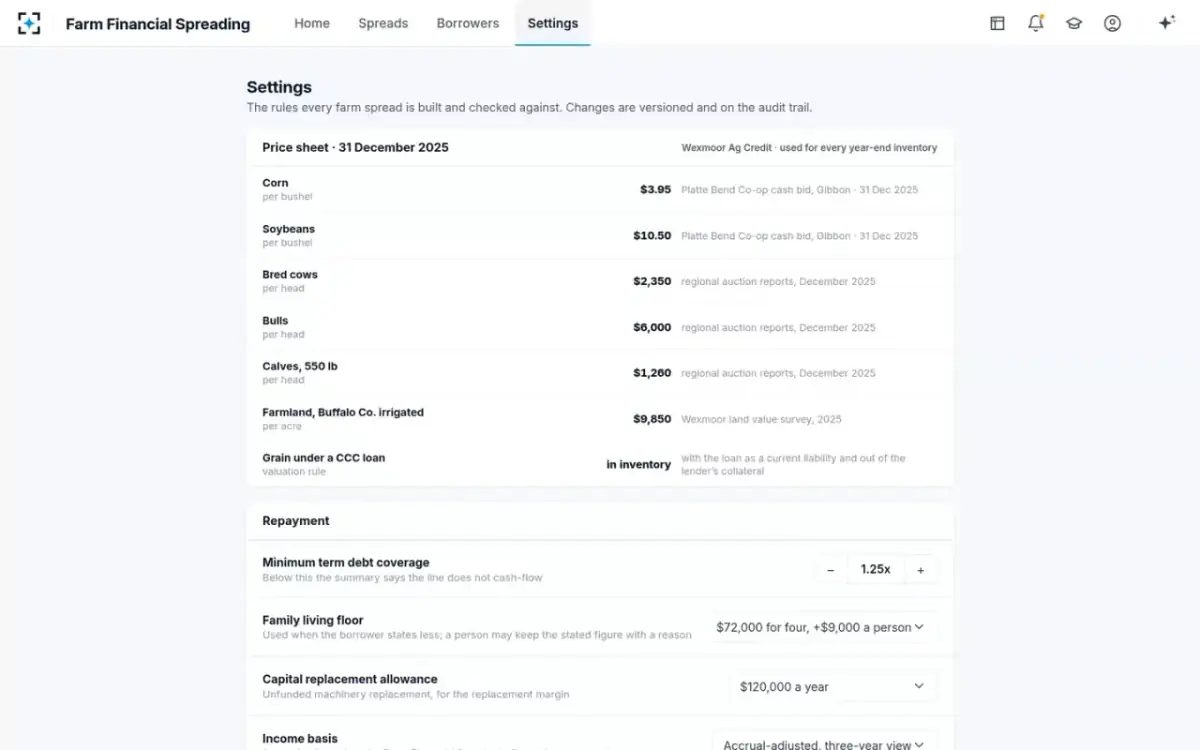
A farm spread is only as useful as its agreement with the policy the credit committee actually applies. Ask to see, as settings rather than as a roadmap: the year-end price sheet by commodity and class, the minimum term debt coverage, the family living floor, the capital replacement allowance, the income basis, the ratio bands, the required document list, and who may sign.
Then ask the second question, which is the one that catches most tools: are those settings versioned, and does a signed spread record which version it used? A policy that can be changed without a trace turns every historic spread into an unreproducible number. In this solution the price sheet, floors and bands are the lender's own, versioned and on the audit trail, and a change after sign-off requires a new version of the spread rather than an edit to the old one.
The settings to ask to see, and why each one decides files
| Setting | What a sample policy holds | What goes wrong if it is the vendor’s |
|---|---|---|
| Year-end price sheet | Corn $3.95, soybeans $10.50 a bushel, by commodity, livestock class and land | Grain is valued at a price your credit committee never approved, and every inventory-driven ratio moves with it |
| Minimum term debt coverage | 1.25x | Files pass or fail against a threshold that is not in your credit policy |
| Family living floor | $72,000 for four, plus $9,000 a person | Repayment capacity is overstated on every farm that states a low living figure |
| Capital replacement allowance | $120,000 a year | Depreciation is added back as spendable cash and machinery replacement is never charged |
| Income basis | Accrual-adjusted, three-year view | A one-year or cash-basis view changes the answer on any farm that carries inventory |
| Earned net worth tolerance | $10,000 or 0.1% of assets | The reconciliation that catches unexplained changes either never fires or fires on everything |
| Required documents | 3 years of returns, 2 balance sheets, an inventory count | Spreads get built on thinner files than your policy allows |
A lender's own credit policy, as configuration
Questions about testing on your own past files before go-live
The only honest accuracy figure is one measured on your documents. Ask to run a set of your own completed, signed farm files through the tool and compare its spread against the one your analyst produced. Twenty to thirty files across your real mix — a grain farm, a feedyard, a dairy, a ranch with a brand inspection, at least one package with handwritten inventory counts and one with a CPA's statements instead of your form — will tell you more than any reference call.
Define what counts as an error before you start, because the argument afterwards is always about definitions. A figure in the wrong field is an error. A figure that is right but unsourced is a different kind of error and worth counting separately. A difference where the tool is right and the original spread was wrong is a third category, and on a real test set it will not be empty.
How to run the test so the result means something
- Use files you have already signed, not a prepared sample
A vendor’s demonstration file has been through the tool before. Yours has not.
- Include the awkward packages on purpose
Handwritten grain counts, pencil balance sheets mixing cost and market, a second entity, a spouse’s W-2, a partnership return.
- Score by field, not by document
"Ninety-nine per cent accurate" over a 214-page package can still mean every term debt figure is wrong.
- Count unsourced figures as findings
A number nobody can trace is not usable in a credit file, whatever its value.
- Have the analysts who built the originals do the scoring
They are the only people who know which of the two answers was right.
- Agree in advance what result would make you walk away
A threshold written before the test is a decision. One written after is a negotiation.
Ask too what proficiency the tool assumes of the person using it. The NIST AI Risk Management Framework asks organisations to ensure that "processes for operator and practitioner proficiency with AI system performance and trustworthiness — and relevant technical standards and certifications — are defined, assessed, and documented." An analyst who confirms every exception without understanding what raised it is not a control, and the tool that makes confirming easiest is not automatically the best one.
Questions about what's recorded when a stated figure is kept over policy
Every farm desk overrides policy sometimes, and it should. The questions are whether the system makes it possible to do so without a reason, and whether anyone downstream can find out that it happened.
Ask: when a stated figure is kept over the floor, is a reason required? Is the person who made that decision named? Can loan review pull a list of every spread where it happened, without asking the vendor to run a query? Can it be done after sign-off, and if so, what does the file show?
The equivalent in this solution is narrow and worth stating plainly: keeping a stated figure over policy requires a reason, the signature carries its meaning and is written to the audit trail with the time and the figures, loan review sees every spread where a stated figure was kept over the policy, and a later change needs a new version of the spread rather than an edit. What a file needs to hold to survive loan review sets out the rest of that test.
What are the red flags when a vendor explains how it is validated?
Five answers should slow a purchase down. The first is a single accuracy percentage with no field list and no test set behind it; ask what a field is and the number usually dissolves. The second is "the model is validated" with no statement of what was tested, on which documents, and when — especially from a vendor whose tool is agentic, where the framework the word borrows from does not cleanly apply.
The third is a demonstration that will not take one of your own files. The fourth is an answer to "whose ratio bands are these?" that appeals to industry standard. The fifth, and the most quietly dangerous, is enthusiasm about how much the tool decides. On a farm spread, a vendor who leads with what their system decides has misunderstood the product: the value is in the reading, and the decisions belong to the analyst, the loan officer and the committee.
A sixth is worth adding for ag specifically. If a vendor cannot talk fluently about the cash-to-accrual adjustment, about why Schedule F understates a farm that holds grain, or about what a CCC loan does to a balance sheet, then their tool was built for commercial spreading and pointed at farm files. The accrual adjustment is the part of a farm spread that most often gets simplified into uselessness.
What does a good answer to “can we see the source page?” sound like?
Ask for any figure on a finished spread — not one the vendor chooses — and ask to see where it came from. A good answer opens the borrower's own document beside the spread with the relevant line lit: Schedule F line 34, the grain count total for a named bin, the co-op invoice, box 1 of a W-2. A weaker answer shows a document name. The weakest shows a confidence score, which tells you how sure the software is and nothing at all about whether it is right.
The page beside the spread, with the line lit
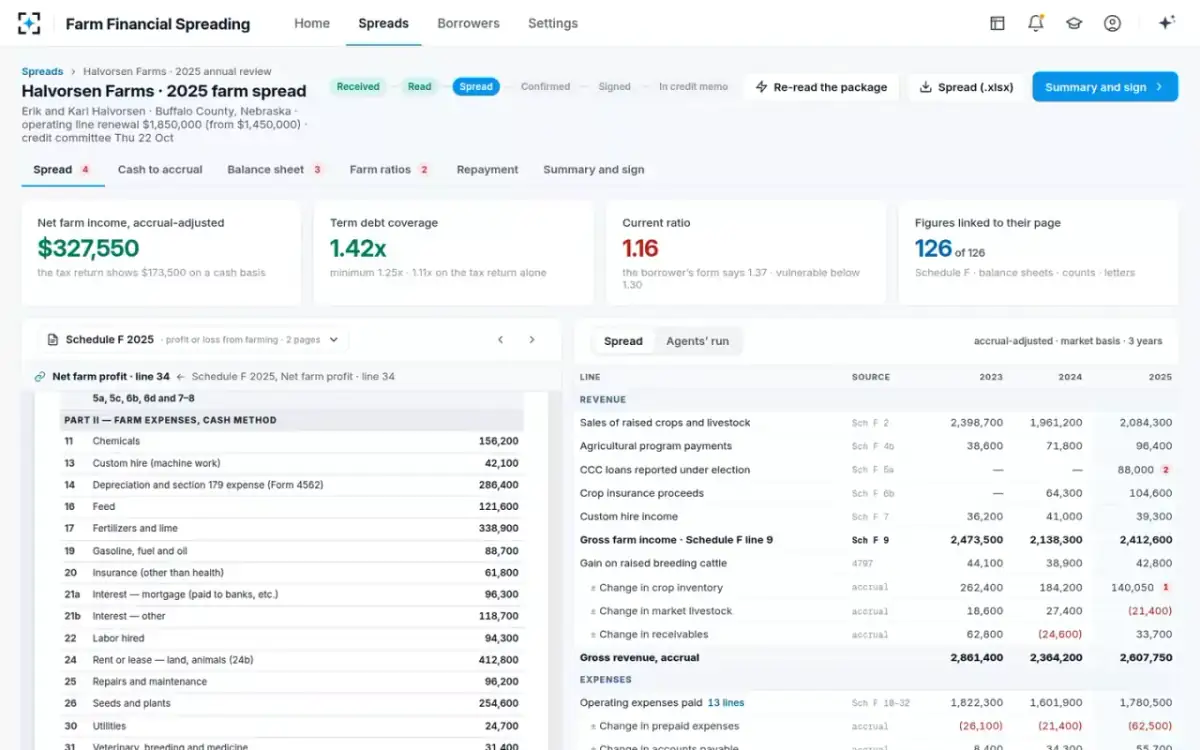
Then ask the same question about the export. A spread that shows its sources on screen but exports as plain figures has moved the evidence problem rather than solved it, because the credit memo and the examiner's copy are the versions that outlive the subscription.
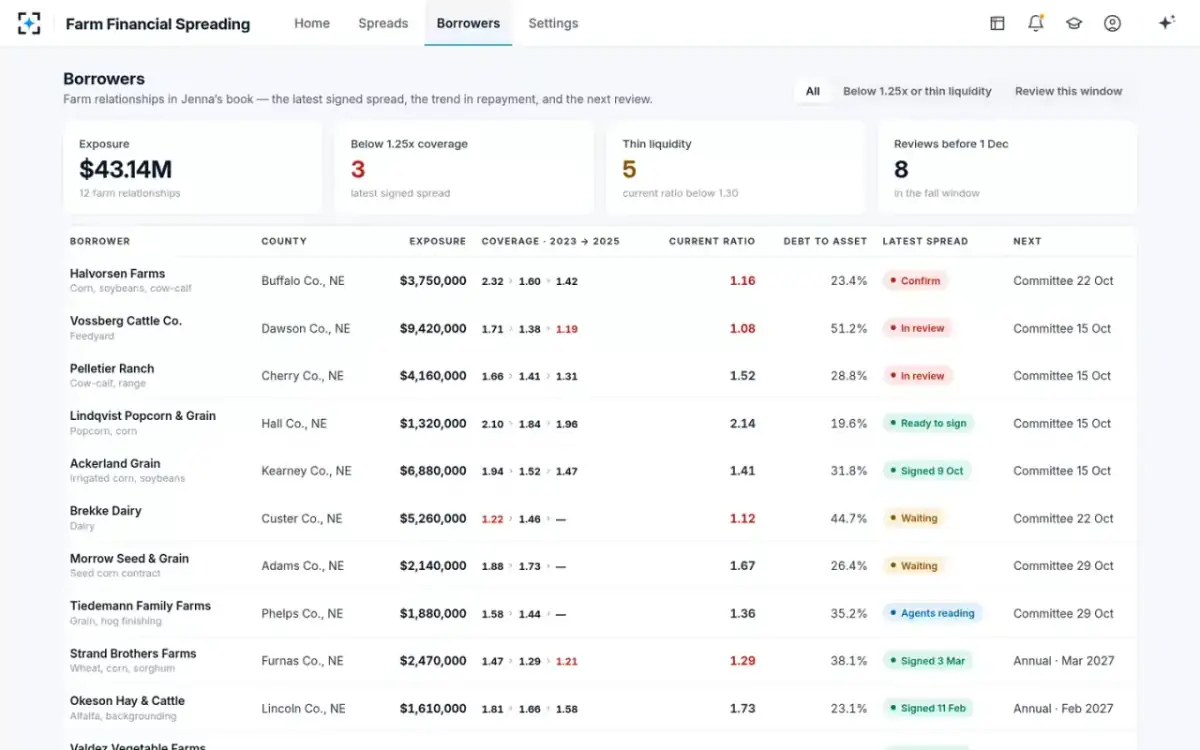
Where this solution fits is worth saying as narrowly as the questions above demand. It reads farm packages and builds the spread, with every figure linked to its page; it runs the farm measures, repayment capacity and a price stress; it finds liabilities the file evidences and raises them as exceptions. It does not rate the credit, decide the loan, price it, value land, or replace the farm visit and the collateral inspection — and it needs the lender's own form, policy and price sheet configured before any of it is worth reading. On a book like the sample one, twelve relationships with eight reviews due in the same seven weeks, that division of labour is the whole proposition.
What the desk is actually buying: a book it can see
To work through the questions on real screens, start from Farm Financial Spreading, or read why the 2026 season is the one making this a buying decision.
Questions people ask
What questions should I ask an ag lending software vendor?
Four groups. What the tool may never do to a borrower's figures; whose credit policy, price sheet and ratio bands it runs on, and whether those are versioned; what it can show an examiner about where a figure came from; and ordinary third-party diligence on data, exit and concentration. Ask for each answer on a screen rather than in a slide.
What should ag lending software never be allowed to do to a borrower's figures?
Change a figure the borrower reported, remove a liability the borrower listed, value inventory at a price the lender has not set, or overwrite a stated family living figure with its own. Each of those turns a record of what the borrower said into something nobody said. The acceptable pattern is a proposed correction shown beside the stated figure with the page that raised it, confirmed by a named analyst — and the limits should be hard rules, not defaults an administrator can relax.
Can ag lending software use our own balance sheet form?
Ask to see your form, not a similar one, during the evaluation. The same question applies to your price sheet, your coverage minimum, your family living floor and your ratio bands. If any of those is the vendor's rather than yours, your spreads are being judged against someone else's credit policy.
What should an AI vendor show about accuracy before you buy?
Accuracy by field, on your document types, measured against a truth set built from your own signed files, with the errors listed rather than summarised. A single percentage over a whole package is close to meaningless: a 214-page farm file can be read 99% correctly and still have every repayment figure wrong.
What third-party risks come with AI lending software?
Data handling, because farm packages carry personal financial information for named individuals; exit, because a spread without its source references stops being evidence when the contract ends; and concentration, because one systematic misreading applied across the whole book is a portfolio problem rather than a file problem. Supervisory guidance treats due diligence on all three as part of sound risk management.
How do you test ag lending software before relying on it?
Run twenty to thirty of your own completed, signed farm files through it and compare field by field with the spreads your analysts built. Include the awkward packages on purpose, count unsourced figures as findings, have the original analysts do the scoring, and write down before you start what result would make you walk away.