On a farm loan renewal, the spreading workflow starts with the ag credit analyst, who builds the farm spread: they read the borrower's 1040 with Schedule F, two balance sheets and a handwritten grain count, re-key them into the lender's own form, rebuild accrual income from the change between the two balance sheets, price the inventory at the bank's sheet, hunt for liabilities the form left out, compute the farm ratios and sign the spread that every later decision rests on. The ag loan officer, who owns the relationship and writes the credit memo, works from that spread rather than building it. Two more seats sit either side of them: the ag lending manager, who sets the price sheet, the coverage minimum and the ratio bands everyone works to, and the loan review officer, who samples signed files afterwards and asks where each number came from. Farm Financial Spreading, the Botminds agentic solution for farm financial spreading, reads the whole package and builds the spread with every figure linked to its page, so the analyst confirms rather than types and the other three seats get a file they can argue with.
The farm file on this page is a fictional sample used throughout the working product: Halvorsen Farms, 2,860 acres of corn and soybeans and 220 cows in Buffalo County, Nebraska, renewing an operating line at $1,850,000 with Wexmoor Ag Bank. The people are sample characters. Everything attributed to a regulator or a statistical agency is linked where it appears.
One farm renewal in Farm Financial Spreading: four seats, one signature
4
seats touch the file: analyst, officer, lending manager, loan review
27
documents, 214 pages, in one complete renewal package
6agents
read the package before the analyst opens it
1
signature decides: the analyst confirms every adjustment
Who touches a farm loan renewal, from the first document to the signed memo
A farm renewal is not one person's work and never has been. It passes through four pairs of hands, and each pair has a different question. The analyst asks what the numbers are. The officer asks what the numbers mean for the request on the table. The lending manager asks whether the file was built to the bank's own policy. Loan review, months later, asks whether any of it can be traced.
The sequence matters because the file is only as good as the first pass. If the analyst keys a grain count wrong, the officer's memo is wrong, the committee votes on a wrong coverage ratio, and loan review finds it a year later when the line is already out. The OCC's agricultural lending booklet puts the first pass plainly: lenders "should strive to obtain and analyze annual financial statements that correspond with the date of the borrower's income tax returns" (OCC, Comptroller's Handbook: Agricultural Lending). Matching the statement to the return is not clerical tidiness; it is the only way the cash-to-accrual bridge can be built at all.
The renewal package, seat by seat, and what each hands on
Agent
The package arrivesTax returns, two balance sheets, a grain count, co-op invoices, supplier statements, a W-2 and a family living worksheet reach the file from the farm and its accountant.
Never: nothing is judged yet — a complete package is 27 documents and 214 pages
A person decides
Ag credit analystBuilds the spread on the lender’s own form, makes the accrual adjustments, ties the balance sheets together, computes the farm measures and writes the summary.
Never: does not approve the loan or set the price
A person decides
Ag loan officerTakes the spread into the credit memo: the request, the structure, the collateral, the recommendation and the conditions the committee should attach.
Never: does not rebuild the analyst’s numbers
A person decides
Credit committeeApproves, declines or approves with conditions, on the figures in front of it.
Never: does not see the documents behind the spread
A person decides
Loan review officerSamples signed files afterwards, traces figures back to their pages and reports what the sample says about the portfolio.
Never: does not change a signed file
What does an ag credit analyst do, hour by hour?
The ag credit analyst is the seat that turns documents into a spread. In a season that means reading a cash-basis Schedule F line by line, pulling the Form 4797 gain on raised breeding stock, reading a balance sheet that is often in pencil and mixes cost and market values, pricing a handwritten grain count by bin, and then rebuilding accrual income by hand from the change between two balance sheet dates. On the Halvorsen file that is 27 documents and 214 pages before a single ratio exists.
It is skilled work wrapped in typing. The judgement — is this grain price defensible, is family living understated, does the equipment on Form 4562 have a note behind it — takes a fraction of the time that getting the numbers into the form takes. On a hand-built farm spread the split runs roughly four hours of work with under half an hour of it spent deciding anything.
The analyst’s half-day on one farm review, by kind of work
By hand
- Keying returns, balance sheets and counts · 56%
- Adjusting and tying out · 31%
- Judging: ratios, summary, sign-off · 13%
With the package already read
- Keying returns, balance sheets and counts · 24%
- Adjusting and tying out · 28%
- Judging: ratios, summary, sign-off · 48%
Read the second bar as a change of subject, not a saving. Nearly half of what is left is the part of the job the analyst was hired for. The first bar's keying does not become judgement; it disappears, and what survives is confirming four adjustments against the pages behind them. On the Halvorsen file those four are a corn price above the bank's sheet, a CCC loan reported on the return but missing from the balance sheet, a combine note found from the depreciation schedule, and a family living figure below the bank's floor.
The analyst’s queue: every farm renewal ranked by committee date
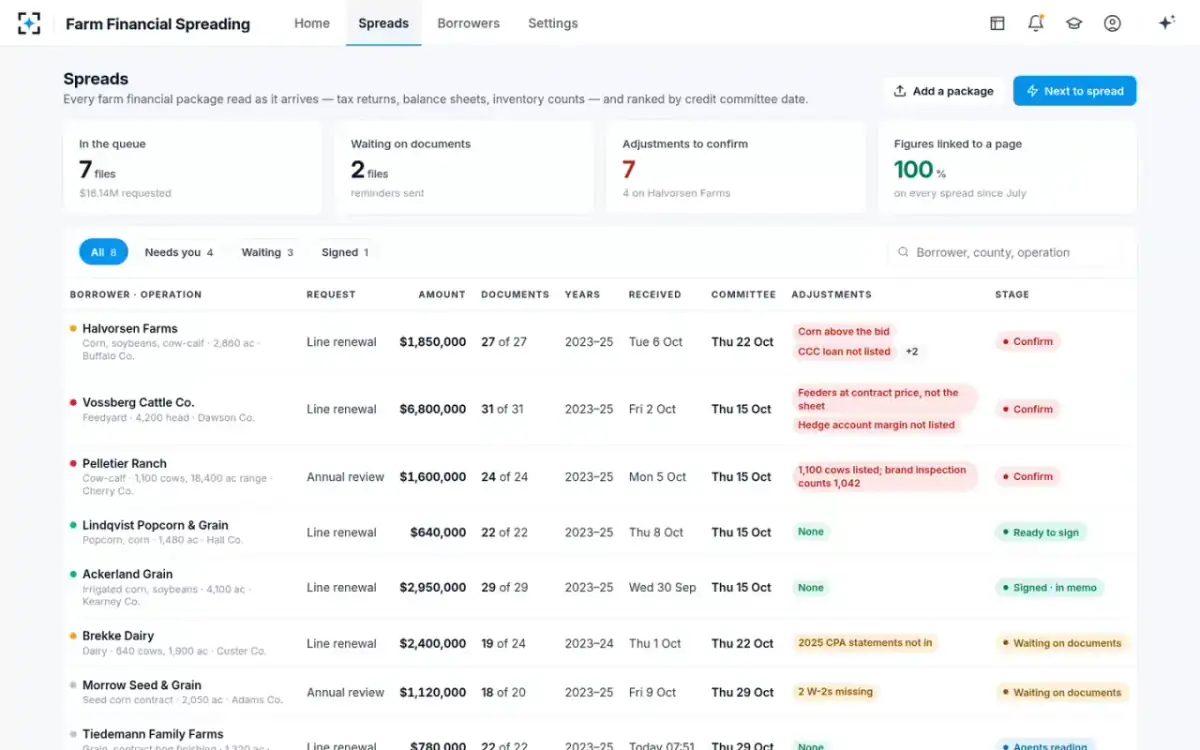
What the ag loan officer does with the analyst's spread
An ag loan officer carries the relationship and writes the recommendation. They visit the farm, know which quarter section was bought from whom, hear about the new combine before the depreciation schedule shows it, and take the renewal request in the first place. When the spread comes back, their job is to turn it into a credit memo: does the line still cash-flow, at what price, against what collateral, with what conditions.
The officer is not supposed to rebuild the analyst's arithmetic, and in a well-run desk they do not. What they need from the spread is three things a number alone does not give. First, the direction: Halvorsen's term debt coverage runs 2.32x, 1.60x, 1.42x across three years, and a 1.42x that arrived by falling is a different credit from a 1.42x that arrived by rising. Second, the sensitivity: at $3.55 corn rather than the bank's $3.95 sheet price, coverage lands at 1.28x, still above the 1.25x minimum, with the break-even near $3.46. Third, the conditions worth attaching — a marketing plan for the unpledged corn, a lien search on the combine note, a mid-year balance sheet.
The OCC booklet describes the same instinct as a supervisory expectation: the bank should carry out "a sensitivity analysis that determines a farm or ranch operation's ability to withstand risk and uncertainty as part of cash flow projection analysis". An officer who can only report the one coverage figure the spread produced has nothing to say when the committee asks what happens if the basis moves.
That is also why the officer cares about global cash flow more than the analyst does. The same booklet notes that "a global assessment of Ag borrower cash flow and repayment ability is often appropriate and necessary", and that such analyses "can be complex and often involves integrating cash flows from multiple partnership and corporate tax returns, business financial statements, K-1 tax schedules, and personal tax returns". A farm that files three returns across two entities and a trust is one borrower to the officer and three spreads to the analyst.
The ag lending manager's seat: setting the rules everyone else works to
The ag lending manager rarely appears in a process diagram and decides more than anyone in it. Their seat sets the inputs every spread is built and tested against: the year-end price sheet by commodity, the minimum term debt coverage, the family living floor, the capital replacement allowance, whether income is read on the latest year or a three-year view, the earned-net-worth tolerance, the documents a package must contain before it is worked, and the bands that call a ratio vulnerable, stable or strong.
Every one of those is a credit policy decision wearing a settings label. Move the corn price on the sheet by a dime and the farm's unsold inventory moves by $16,800 on 168,000 bushels, which moves accrual income, which moves coverage, which moves whether the memo says the line cash-flows. A desk where each analyst carries their own price in their own spreadsheet is a desk where two identical farms get two answers.
The lending manager’s seat in Farm Financial Spreading: price sheet, floors and bands
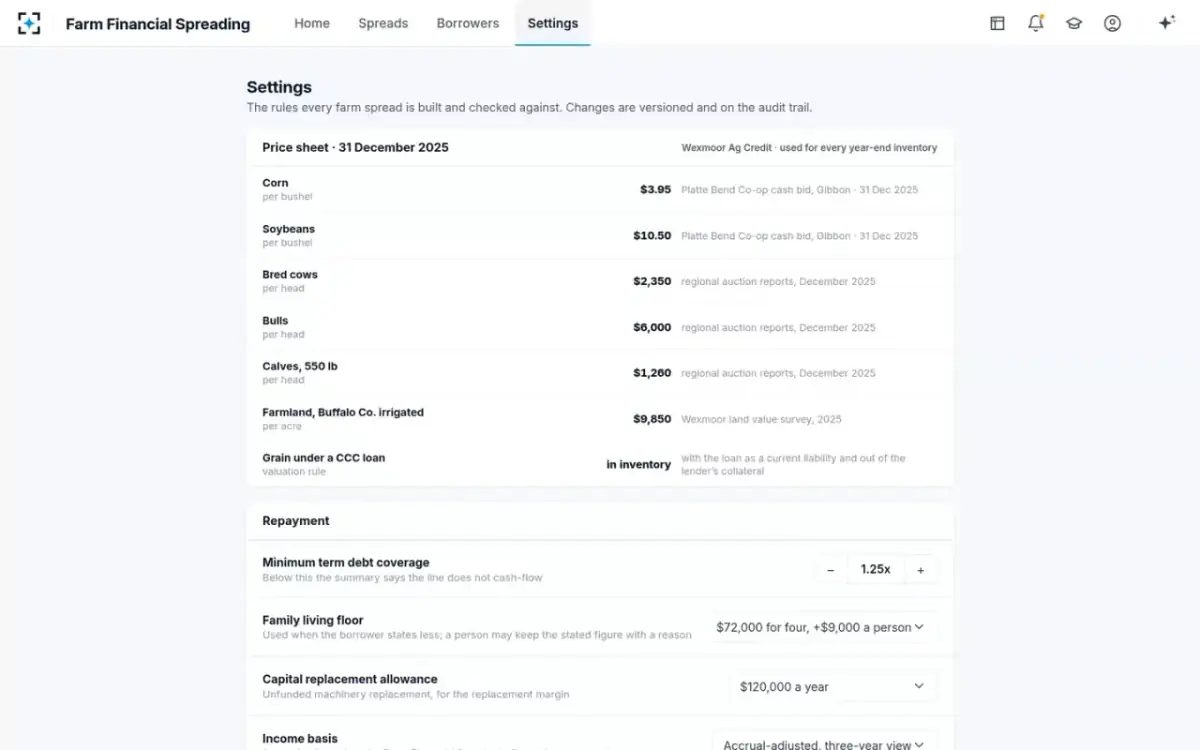
The reason to version them is that a spread outlives its rules. A file signed under a $4.15 corn sheet and re-read two years later under a $3.95 sheet looks like a mistake unless the sheet in force on the signing date is still readable. When the lending manager changes the family living floor from $66,000 to $72,000 for a family of four, every file signed before that change was correct under the rule it was signed under, and every file after it is held to the new one.
What does a loan review officer look for in a signed spread
A loan review officer looks for three things, in order: whether the file supports the rating, whether the numbers in it can be traced to a document, and whether the exceptions that were waived were waived by someone allowed to waive them. They are not re-underwriting the credit. They are testing whether the process that produced the credit can be relied on.
The independence of that seat is a supervisory expectation, not a courtesy. The OCC booklet asks the board to keep loan review independent of ag loan production, approval and credit administration, to keep loan volume out of reviewers' pay, and calls loan review a critical control function (OCC, Comptroller's Handbook: Agricultural Lending). An ag lending desk where the loan review officer reports to the head of ag lending is a desk with three seats and a title.
What makes the seat slow is tracing. Given a signed spread with an accrual-adjusted net farm income of $327,550, the reviewer wants to know which line of which document each piece came from: the $130,700 net farm profit from Schedule F line 34, the $42,800 gain from Form 4797, the $140,050 crop inventory change from two balance sheet dates, the prepaid expenses from a December co-op invoice. On a hand-built spread that is an email to the analyst and a wait. Where every cell is pinned to its page, it is a click, and the question the reviewer actually wants to ask — why was a stated figure kept over the policy figure — is the one they get to spend the hour on.
The same renewal, seen from each of the four seats
Today
Spends the morning typing a Schedule F and ten minutes thinking about it, then rebuilds accrual income by hand from two balance sheets.
With agents
Opens a spread already read and pinned, confirms four adjustments against the pages that prove them, and spends the time on the credit.
Still theirs: Every adjustment is theirs to confirm or send back to the borrower, and the signature on the spread is theirs alone.
Today
Waits for the spread, then asks whether the line still cash-flows and why, often by phone while writing the memo.
With agents
Gets a signed summary into the credit memo: coverage, the three-year trend, the stress at $3.55 corn and what to consider attaching.
Still theirs: The relationship, the recommendation, the structure and the price on the deal.
Today
Knows that a liability missing from a spread makes the coverage ratio fiction, and can only find out by reading files.
With agents
Sets the price sheet, the coverage minimum, the family living floor and the ratio bands once; every spread is checked against them.
Still theirs: Credit policy, the limits, and who is allowed to override what.
Today
Asks where every number came from and waits for an analyst with the file open to answer.
With agents
Clicks any figure to see its page and line, and sees every spread where a stated figure was kept over the policy figure.
Still theirs: The sample, the findings and the report to the board — unchanged by anything the agents do.
Where the four seats hand off — and where a farm file waits
Measure a farm renewal end to end and most of the elapsed time is not work. It is waiting. The package is incomplete and a reminder goes out. The analyst is spreading a different file. The officer is at a farm. The committee meets on Thursdays. The gaps between the seats are where a renewal that needed half a day of spreading takes weeks.
Each handoff, what is passed, and what makes it wait
| Handoff | What crosses | What makes it wait |
|---|---|---|
| Borrower → file | The package: returns, balance sheets, counts, invoices, the W-2, the living worksheet | An incomplete package. A missing second balance sheet makes the accrual bridge impossible, not merely harder. |
| File → analyst | A package judged complete against the required-documents rule | Queue order. A file due at committee in nine days behind one due in four weeks. |
| Analyst → officer | The spread, the exceptions, the farm measures and a drafted summary | Unconfirmed adjustments. An exception sent back to the borrower stops the file until an answer returns. |
| Officer → committee | The credit memo, with the spread and the recommended conditions | The calendar. One missed Thursday is a week, and a renewal dated to the operating season cannot absorb many. |
| Committee → file | Approval, decline, or approval with conditions | Conditions that need a document — a lien search, a marketing plan, a mid-year statement. |
| Signed file → loan review | The sample, months later | Traceability. A figure nobody can source turns a ten-minute test into a week of correspondence. |
Two of those waits are worth attacking before anything else, because they are the ones a desk controls. The first is the incomplete package: a required-documents rule applied at intake, with reminders that name the missing document, turns an open-ended wait into one the desk can see and chase. The second is the unconfirmed adjustment, where the fix is to make each exception arrive with the evidence attached, so the analyst can decide it rather than research it. Both are covered in what an ag lender has to bring before the first live spread.
How many farm files does one analyst carry in a season
The answer is that it depends on the calendar, not the headcount. Farm renewals cluster: operating lines are dated to the production year, so the same desk that handles a trickle in June handles a wall in the fall window after the tax returns are filed. An analyst who can spread four or five files a week in a quiet month at about half a day each faces a queue in which every file wants the same three weeks.
Two published trends are tightening that window from both ends. The Kansas City Fed's survey of terms of lending to farmers reported in April 2026 that "the share of new operating loans greater than $500,000 increased to a record high following steady increases in recent years" (Kansas City Fed, April 2026). Bigger loans are not quicker to spread; they are usually multi-entity, which means more returns per borrower.
At the same time the files are getting harder to call. The same bank's Ag Credit Survey for the second quarter of 2026 found credit conditions still tightening, with smaller farms weaker on average, and found that "the pace of decline in farm loan repayment rates was similar to recent quarters but less rapid than a year ago" (Kansas City Fed Ag Credit Survey, Q2 2026). A desk with the same four seats is spreading more files, each larger, each closer to the line — against a sector whose assets the USDA expects to "increase 3.0 percent to reach $4.47 trillion in 2026" (USDA ERS), which is to say against collateral values that still look comfortable while cash flow does not. The arithmetic of the season is set out in what one farm spread actually costs.
What changes in each seat's week when the package arrives already spread
Nothing about the four seats goes away. What changes is the first hour of each of them. The analyst opens a spread that is already built on the bank's own form with every cell pinned to its line, and starts at the four exceptions rather than at the 1040. The officer gets a summary drafted into the memo rather than a phone call. The lending manager's policy is applied to every file the same way rather than remembered differently by each analyst. The reviewer clicks instead of writing.
The limits are as important as the changes, and they are deliberate. The agents never change a figure the borrower reported, never use a price the lender has not set, and never remove a liability the borrower listed. The ratio and repayment analyst drafts the summary and computes the measures, and it does not rate the credit or decide the loan. What that means in practice, agent by agent, is set out in how six agents read a farm loan file and what none of them may decide, and how a lender tests whether the result can be trusted is in measuring whether an AI-built farm spread can be trusted.
The end of the file: four adjustments confirmed, one signature
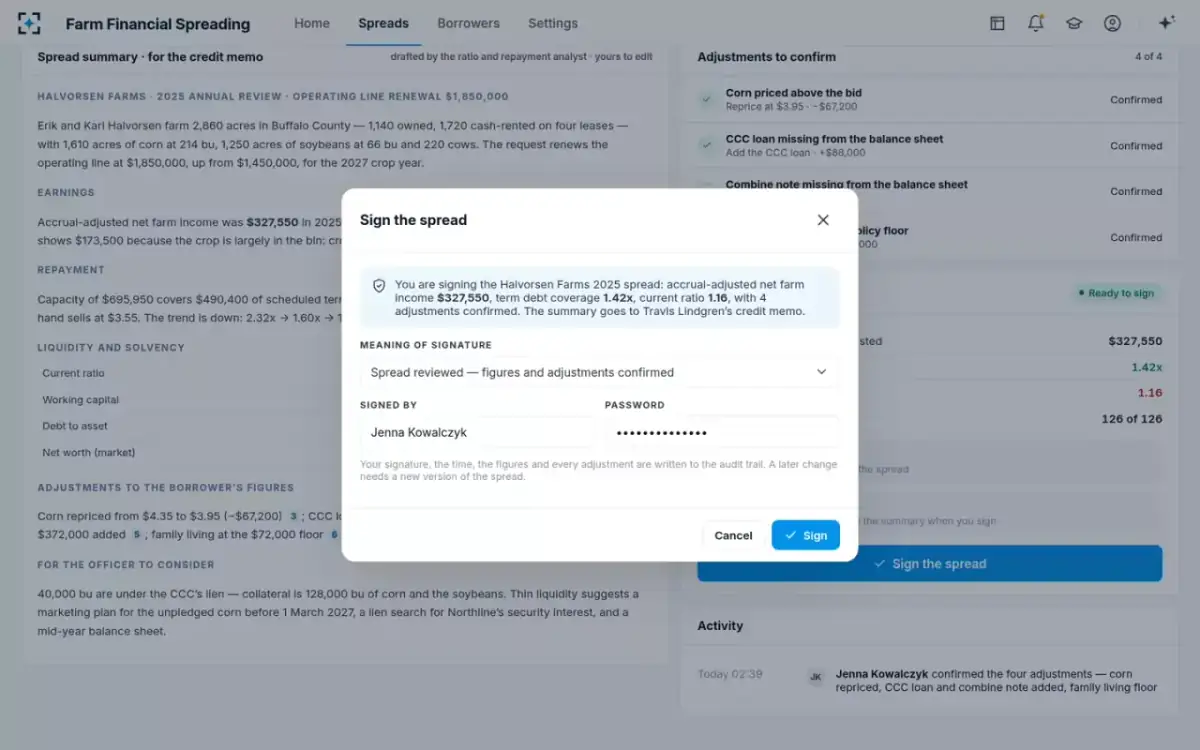
One last thing a desk should settle before it changes anything: who signs. The seat that signs the spread is the seat that owns its figures, and moving the signature is a credit policy decision, not a configuration one. On this desk it stays with the analyst, because the analyst is the person who confirmed each adjustment against the page behind it. To see the four seats working one file end to end, start from Farm Financial Spreading.
Questions people ask
What does an agricultural credit analyst do?
An agricultural credit analyst turns a farm borrower's documents into a spread the bank can judge: the tax returns with Schedule F, Forms 4797 and 4562, two balance sheets, the inventory count and the family living worksheet. The analyst adjusts cash income to accrual, prices inventory at the lender's sheet, finds liabilities the form left out, computes the farm measures and repayment capacity, drafts the summary for the credit memo and signs the spread. On a single-entity farm with a complete package that is about half a day by hand, most of it keying.
Is an ag credit analyst the same as an ag loan officer?
No, and conflating them is how small desks lose their second pair of eyes. The analyst builds and signs the spread — the numbers, the accrual adjustments, the farm measures. The officer takes those numbers into a recommendation and carries the relationship. Smaller lenders often put both in one person, which is workable as long as everyone knows the file has had one reading rather than two, and loan review samples it accordingly.
What does an ag lending manager decide that an analyst cannot?
The rules: the year-end price sheet by commodity, the minimum term debt coverage the memo is tested against, the family living floor, the capital replacement allowance, whether income is read on one year or three, which documents a package must contain, and the bands that label a ratio vulnerable, stable or strong. An analyst applies those; changing one is a credit policy decision and sits with the manager.
Does loan review rebuild the spread?
Normally no. Loan review tests whether the file supports its rating and whether its figures can be traced, and re-does arithmetic only where a sample raises a concern. Its value is in the sample and the report, not in a second spread — which is why the seat is held to the independence the OCC’s agricultural lending booklet requires of it, and why the time it saves on tracing is time it spends on the findings that matter. Whether a particular figure can be traced at all is usually settled in the first minute of the test.
How long does one farm renewal take to spread by hand?
Roughly half a day of analyst time for a single-entity farm with a complete package — our estimate is about four hours, of which over half is keying. Multi-entity borrowers multiply that, because each return is its own spread before the global picture can be assembled. The elapsed time from request to committee is far longer, and is dominated by waiting for documents and for the committee calendar rather than by the spreading itself.
Who signs a farm spread, and what does the signature mean?
On most desks the ag credit analyst signs, because they are the person who confirmed each adjustment against the document behind it. The useful signature says what it means — that the figures and adjustments were reviewed and confirmed — and is written to the file's audit trail with the time and the figures as they stood. A change afterwards should produce a new version of the spread rather than quietly alter the signed one.