A CCC loan is reported as income only when the farmer elects it. "In most cases, you don't report CCC loan proceeds as income," the IRS instructions for Schedule F say, but "if you pledge part or all of your production to secure a CCC loan, you can elect to report the loan proceeds as income in the year you receive them." That election is why the same borrowing can sit on line 5a of a tax return as revenue and nowhere at all on the farm's own balance sheet as a liability — and why a credit file that reads the two documents separately will quietly overstate the farm. Botminds' Farm Financial Spreading cross-checks every liability against the return, the depreciation schedule and the bank statements, reports what it finds with the page behind it, and leaves the decision to the analyst.
The file worked through here is a fictional sample used in the solution: Halvorsen Farms, Buffalo County, Nebraska, renewing a $1,850,000 operating line. Two liabilities were missing from the balance sheet the borrower filled in, and both were sitting in documents the lender already held.
What two missing liabilities did to one farm's file
$527,200
by which the borrower’s own balance sheet overstated net worth
2liabilities
found in the tax return and the bank statements, not on the form
9checks
passed beside them, from Schedule F tying to the 1040 to earned net worth
Why a CCC marketing loan disappears between the tax return and the balance sheet
The Commodity Credit Corporation is, in the OCC's own glossary, "a lending arm of the USDA participating as a lender in the FSA's farm loan programs when farmers 'seal' their grain and obtain CCC loans at below market interest" (Comptroller's Handbook, Agricultural Lending). A farmer seals grain, receives cash against it, and keeps the bushels in the bin. Nothing has been sold. A loan has been made, secured by the crop.
Then the tax election intervenes. A farm that elects under the Schedule F instructions reports the proceeds on line 5a — the instructions direct the filer to "report loan proceeds you received in 2025 on line 5a" and to "attach a statement to your return showing the details of the loan(s)" (IRS, Instructions for Schedule F). The money is now income for tax purposes. It is still a loan for every other purpose, and the grain securing it is still in the bin and still on the balance sheet as inventory.
So the farm's own form, filled in honestly, shows the bushels as an asset and shows no debt against them. The tax return shows the cash as income. Read either document alone and the farm looks better than it is: once as inventory with no offsetting liability, once as revenue that was never a sale. On this file the amount was $88,000 against 40,000 bushels, and there was a second consequence nobody had noticed — those 40,000 bushels are under the CCC's lien, so they are not available as the bank's collateral either.
The nine ties a defensible farm spread closes
Finding a missing liability is not detective work. It is closing the loops between documents a lender already has, in a fixed order, every time. The nine below are the checks the solution reports as passed on this file, each named here as the tie it closes.
Nine checks, from the tax return to earned net worth
- Schedule F ties to the 1040
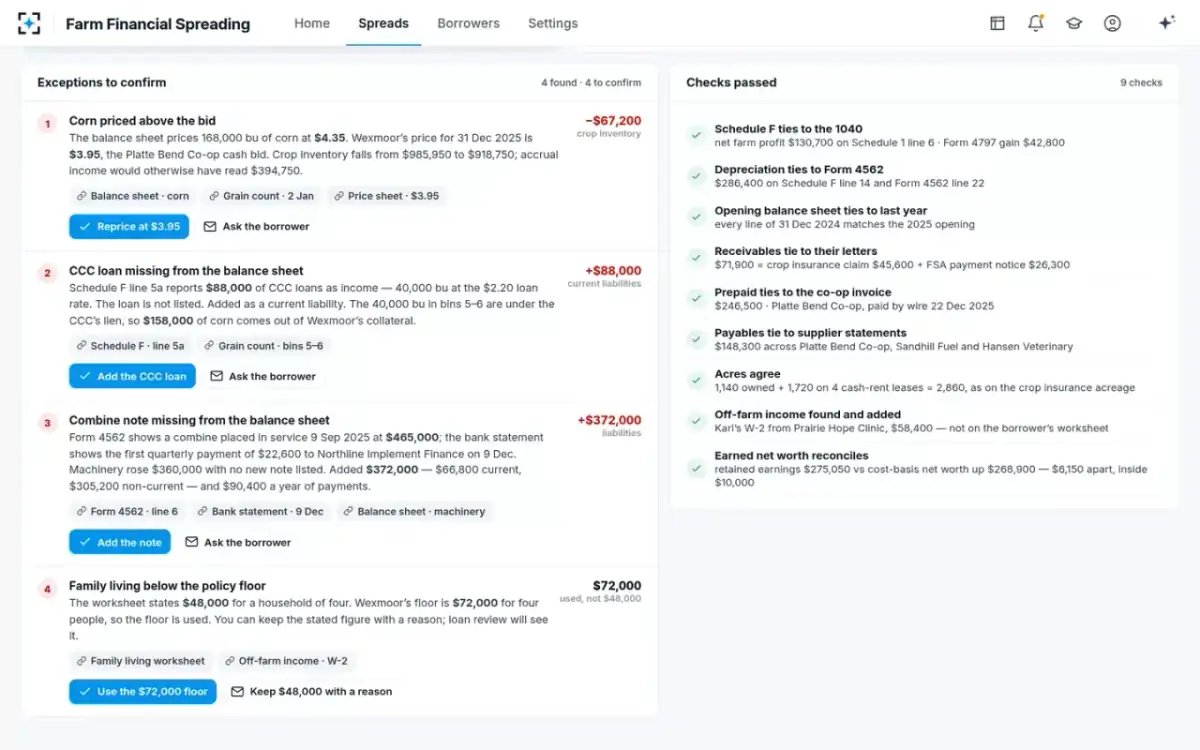
Net farm profit of $130,700 appears on Schedule 1 line 6, with the $42,800 Form 4797 gain alongside it. A mismatch means a page is missing or a second entity exists.
- Depreciation ties to Form 4562
$286,400 on Schedule F line 14 and on Form 4562 line 22 — which puts every depreciable asset on the table, and with it every asset that had to be paid for somehow.
- The opening balance sheet ties to last year
Every line of 31 December 2024 matches the 2025 opening. An asset that appears or vanishes between two statements is the first place a liability hides.
- Receivables tie to their letters
$71,900 is a $45,600 crop insurance claim plus a $26,300 FSA payment notice. A receivable with no letter behind it is a hope.
- Prepaid ties to the co-op invoice
$246,500 with Platte Bend Co-op, paid by wire on 22 December 2025. The date is what makes it next year’s input and this year’s deduction.
- Payables tie to supplier statements
$148,300 across three suppliers. Payables are the line a borrower is most likely to round down on a form filled in at the kitchen table.
- Acres agree
1,140 owned plus 1,720 on four cash-rent leases is 2,860, as on the crop insurance acreage. Acres that do not agree mean an unreported lease, a sale or a partner.
- Off-farm income is found and added
A spouse’s W-2 for $58,400 was not on the borrower’s worksheet. Off-farm income is as often understated as overstated, and it belongs in repayment capacity either way.
- Earned net worth reconciles
Retained earnings of $275,050 against a cost-basis net worth up $268,900 — $6,150 apart, inside the lender’s $10,000 tolerance. This is the check that catches what the other eight miss.
The last one is the check that catches what the other eight miss. Earned net worth is an identity: what the farm started with, plus what it earned, minus what it took out, should be what it ended with. When the three statements disagree by more than a tolerance, something is unexplained — an unrecorded gift, a debt that is not on the balance sheet, a valuation change dressed up as income. The sample lender sets the tolerance at $10,000 or 0.1% of assets, whichever is larger, and the two sides of this file land $6,150 apart.
Notice what the list is not. None of the nine is a judgement about the credit, and none of them needs a view on grain prices or on the borrower's character. Each is a tie between two documents that either closes or does not, which is why this is the part of a farm spread that can be run the same way on every file, every time — and why it is the part most often skipped when seven renewals land in the same fortnight.
What examiners' own verification procedures actually test
Bank supervisors have a name for this work, and it is deliberately narrow. "Verification procedures are used to verify the existence of assets and liabilities, or test the reliability of financial records," the OCC booklet states. The word doing the work is existence. A verification does not ask whether a figure is reasonable; it asks whether the thing is there, and whether the records saying so can be relied on.
That framing is useful for a credit desk, because it separates two jobs that get run together. Judging whether $327,550 of accrual income is plausible for 2,860 acres and 220 cows is credit analysis. Establishing that the combine exists, that the note exists, and that the balance sheet omits it, is verification — and it is the job that scales, because it is mechanical and the evidence either exists or does not.
"Loan review is a critical control function. Periodic objective reviews of the Ag portfolio provide an assessment of credit risk and risk management processes."
OCC, Comptroller's Handbook: Agricultural Lending
The booklet also sets out who may do it: the board "should establish audit and loan review functions that are independent of Ag loan production, approval, and credit administration functions," and their pay must not carry incentives tied to loan volume. Independence is what makes the second read worth anything. It is also why a spread that cannot be re-opened and re-traced by someone who was not there is a weaker file than one that can, whatever its figures say.
How a $527,200 net-worth overstatement happens without anyone lying
Three ordinary things stack up. The borrower fills in the lender's balance sheet form from memory in October, listing the debts they think of as debts. A sealed-grain loan does not feel like a debt; it feels like a government programme, and the bushels are still in the bin. A machinery note taken out in December of the previous year has made one payment, so it is not yet part of the annual rhythm. And the corn in the bin gets valued at the price the farm is holding out for — $4.35 a bushel — rather than the price the bank would mark it at.
Where the $527,200 went
| What the form showed | What the documents showed | Effect on net worth |
|---|---|---|
| No CCC loan listed | $88,000 reported on Schedule F line 5a, secured on 40,000 bushels | −$88,000, and 40,000 bu out of the bank’s collateral |
| No machinery note listed | $372,000 Northline note, from the Form 4562 asset and the 9 December payment | −$372,000 |
| Corn at $4.35 a bushel | The lender’s year-end price sheet at $3.95, on 168,000 bushels | −$67,200 |
| Net worth as submitted | Net worth as corrected: $12,136,450 | −$527,200 in total |
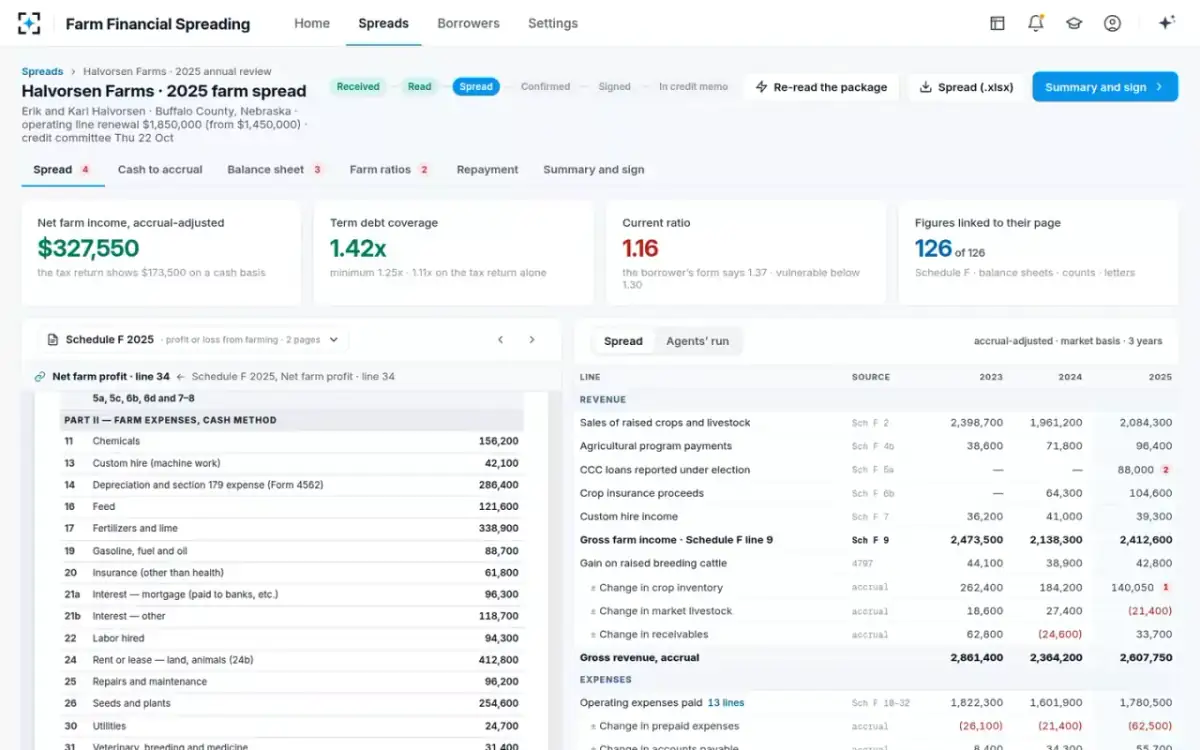
None of those three is a lie. Together they move the current ratio from 1.37, which reads as stable, to 1.16, which sits in the vulnerable band; and the combine note alone, left off, would have shown term debt coverage of 1.74x instead of the 1.42x the corrected file supports. That is the whole case for cross-checking: the failure mode is not fraud, it is an honest form read without its sources.
Four exceptions, each with the pages that prove it
What the file needs to show when a stated figure is kept over policy
Sometimes the borrower's number should stand. A family living figure below the lender's floor may be right for a household with a second income already counted elsewhere, or for a farm whose owners live in a house the operation does not pay for. The question is never whether an exception may be made; it is whether the file shows that one was.
The rule worth writing into a procedure is this: a stated figure may be kept over policy, with a reason, by a named person, and loan review sees every file where it happened. That is three things, and the third is the one usually missing. An override that is recorded but never reported is an override nobody reviews; a pattern of the same analyst keeping the same kind of figure on the same kind of file is invisible until someone can list them.
On this file the family living figure was stated at $48,000 against a $72,000 floor, and the honest resolution is not to argue the farm's grocery bill. It is to use the floor, show the stated figure beside it, and let the credit memo say which was used and why.
Why liabilities are only ever added with evidence, never removed
The asymmetry is deliberate and it is worth stating as a rule rather than leaving as an instinct. A liability the borrower listed stays on the spread even when the analyst cannot find it in any other document, because a borrower who tells you about a debt is giving you information and nothing is gained by discarding it. A liability the borrower did not list is added only with a document behind it — the Form 4562 line and the bank payment, the Schedule F line and the attached statement.
Applied to a tool rather than a person, the same asymmetry becomes a hard limit on what the tool may do. The agents in this solution never change a reported figure, never use a price the lender has not set, and never remove a liability the borrower listed; corrections sit beside the submitted figure with their evidence, and the analyst confirms each one before the spread can be signed.
That limit matters more as more of the reading is automated. The Federal Reserve's model risk guidance reminds banks that every model simplifies the world on assumptions, and that the same assumptions which make it useful are where its limitations and its risk come from (Board of Governors, SR 26-2). A system that could delete a borrower's stated debt on an inference would be exactly the kind of simplification that produces a loss nobody can trace.
What loan review tests when it samples the file
A reviewer sampling signed files a quarter later is not re-doing the credit. They are asking whether the figures can be followed back, whether the exceptions were resolved rather than closed, and whether the person who signed knew what they were signing.
A file that survives review, and one that merely passed
What review actually finds: A cell in the spread that nobody can trace to a document. The reviewer cannot test it, so it counts as unsupported.
What the file should have held: Every cell opens its source page with the line lit, including in the exported copy.
What review actually finds: A flag closed with no answer recorded. Was the fix accepted, or was the question asked and dropped?
What the file should have held: Each exception shows which of the two answers was given, by whom, and when.
What review actually finds: A stated figure kept over the floor, with no reason and no report.
What the file should have held: The reason, the named person, and the file listed in the override report review can pull.
What review actually finds: A number that is not the number the signer saw, with no history.
What the file should have held: A new version of the spread. The signature belongs to the figures as they stood.
What review actually finds: Bushels under a CCC lien carried as free collateral in the borrowing base.
What the file should have held: The loan on the liability side and the pledged bushels marked out of the collateral.
Any figure, open to the page it came from
What facially complete doesn't mean for a farm balance sheet
Every box filled is not the same as every figure supported. A borrower's balance sheet form with no blanks, signed and dated, is facially complete and can still be wrong by half a million dollars — this one was. Completeness is a property of the form; support is a property of the file.
The distinction has become sharper now that part of the reading is done by software, because a tool that produces a tidy, complete-looking spread from a thin file is producing a better-looking error. Supervisory expectations for third-party arrangements go to this directly: "appropriate due diligence includes an evaluation of the effectiveness of a third party's overall risk management, including policies, processes, and internal controls, and alignment with applicable policies and expectations of the banking organization surrounding the activity" (Interagency Guidance on Third-Party Relationships). Alignment with the bank's own policy is the phrase that matters for a spreading tool: a system running its own price sheet and its own floors is not aligned with anything.
The NIST AI Risk Management Framework adds the half that falls on the lender rather than the vendor: under MAP 3.4, an organisation defines, assesses and documents how its operators and practitioners become proficient in what the AI system does and how far it can be trusted (NIST AI RMF 1.0, MAP 3.4). An analyst who confirms four adjustments without understanding what raised them is not a control, however well the screen is laid out. The questions to put to a vendor before any of this is bought are mostly versions of that one.
The balance sheet as submitted, and as corrected
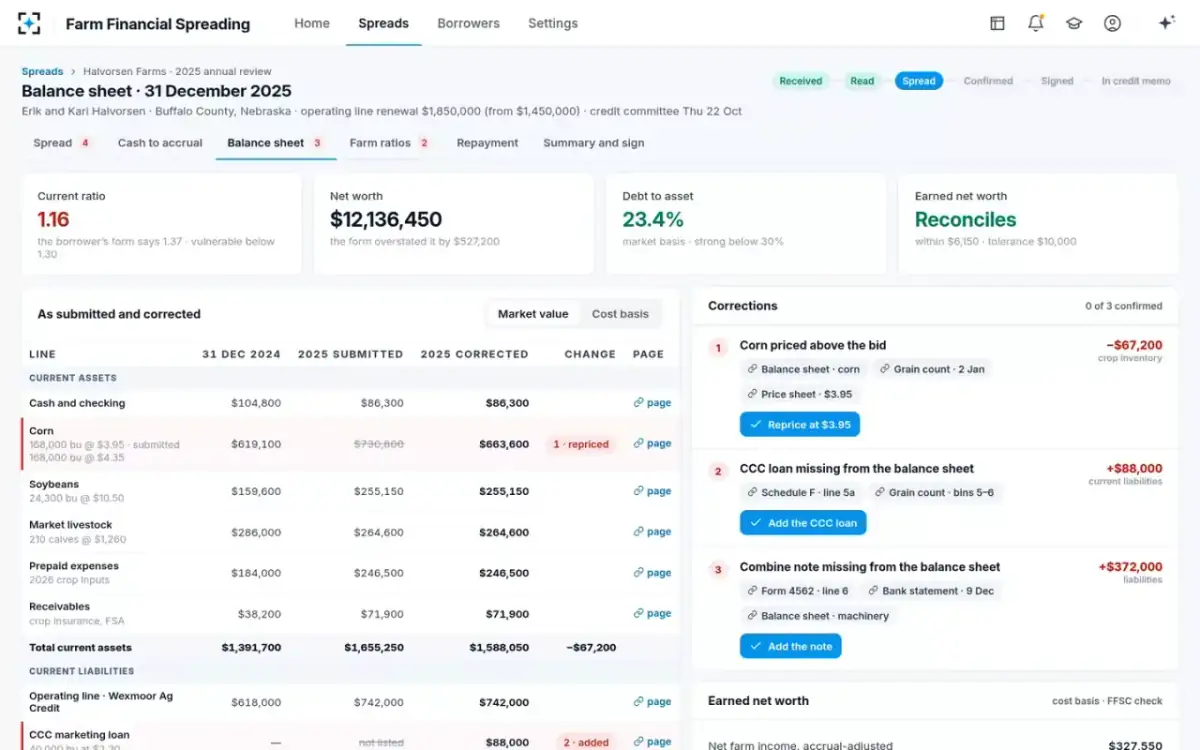
To see the cross-checks run on a real farm package, with the evidence beside each correction, start from Farm Financial Spreading.
Questions people ask
Is a CCC loan reported as income or a liability?
Both can be true at once. For tax, a farmer who pledges production to secure a CCC loan may elect to report the proceeds as income in the year received, on Schedule F line 5a, with a statement attached. For credit, the loan is still a liability secured by the sealed grain, and the grain is still inventory. A spread that takes the tax treatment as the whole answer will overstate the farm.
Why isn't a CCC loan on the farm balance sheet?
Usually because the borrower does not think of it as a debt: the bushels are still in the bin, the counterparty is a government programme, and the cash arrived without a bank visit. The lender's own documents give it away — the amount on line 5a of Schedule F and, if the election statement is attached, the details of the loan.
What liabilities does a lender check for on a farm loan?
The ones that leave traces elsewhere: financing behind any asset newly placed in service on Form 4562, debts behind recurring payments on the bank statements, CCC loans on Schedule F, carryover operating debt, leases, and loans from family or an input supplier. The test is a loop, not a list: every outflow should have a liability and every new asset a source of funds.
What does a farm loan file need to survive an exam?
Figures that open to their source pages, exceptions resolved with an answer recorded, policy overrides with a reason and a named person, financial statement dates consistent with the tax returns, and a signature that belongs to the figures as they stood. A later change should produce a new version rather than editing the signed one.
What happens when a borrower's balance sheet overstates net worth?
Every ratio built on it is wrong in the same direction, and the error is largest where it is least visible. On the file here the overstatement was $527,200, which moved the current ratio from 1.37 to 1.16; the missing combine note alone would have shown 1.74x coverage rather than 1.42x. The borrower was not being dishonest; the form was read without its sources.
What is a defensible loan file?
One where someone who was not there can retrace the decision: each figure to its page, each correction to its evidence, each exception to the answer given, each override to the person who made it. It is a lower bar than being right about the credit and a different one — a file can be defensible and still be a loan that goes bad.