The penalties for fair lending violations in mortgage pricing come in three layers, and the civil penalty is usually the smallest. Under the Equal Credit Opportunity Act a creditor is liable for actual damages plus punitive damages of up to $10,000 per applicant, capped in a class action at "the lesser of $500,000 or 1 per centum of the net worth of the creditor" (15 U.S.C. § 1691e); the Fair Housing Act adds civil penalties in Justice Department cases. The larger cost is remediation, the unexplained part of the price returned to every affected borrower for every period the practice ran, and then the consent order: a revised pricing policy, documented exceptions, monitoring and reporting, for years. Discretionary pricing is where most of that exposure is created, one rate concession or fee waiver at a time. Botminds' Fair Lending Exception Monitoring measures each concession, waiver and override against similar loans in basis points, so a fair lending officer knows the size of any unexplained gap in dollars within a quarter rather than after an examination.
The worked figures come from a fictional sample bank, Halden Ridge, as its third quarter of 2026 runs through the solution. Research and enforcement sources are linked where they appear.
What a pricing case can cost, and what one quarter's monitoring found
$80M
damages to more than 235,000 minority auto borrowers, plus an $18M penalty (Ally, 2013)
$1.3M
settlement fund and a $50,000 civil penalty for six years of discretionary mortgage pricing (Evolve, 2022)
$13,060
the credit to 11 borrowers for one quarter's gap at one branch of the sample bank
What are the penalties for fair lending violations?
Damages and penalties under two statutes, remediation to the borrowers harmed, and supervisory or court-ordered obligations that last for years. ECOA makes a creditor liable for actual damages and punitive damages "in an amount not greater than $10,000" per individual, with the class-action cap above, and in setting punitive damages a court considers "the frequency and persistence of failures of compliance" among other factors. Banking agencies that have reason to believe a creditor engaged in a pattern or practice of discouraging or denying applications in violation of ECOA must refer the matter to the Attorney General.
In a Justice Department case the Fair Housing Act supplies the civil penalty. Evolve Bank & Trust paid "$50,000 to the United States Treasury as a civil penalty under 42 U.S.C. § 3614(d)(1)(C)", beside a $1,300,000 settlement fund "to compensate for direct damages that the United States alleges aggrieved borrowers may have suffered" (Evolve consent order). The ratio is the point: the penalty was less than 4% of the fund, and both were small beside the cost of the obligations that followed.
The layers of cost in a fair lending pricing finding
| Layer | What it is | How it is sized |
|---|---|---|
| Remediation | The unexplained part of the price returned to each affected borrower | The gap in basis points times each loan amount, for every borrower and every period affected |
| ECOA damages | Actual damages, plus punitive damages up to $10,000 per applicant | In a class action, punitive damages capped at the lesser of $500,000 or 1% of net worth |
| Fair Housing Act civil penalty | Payable to the Treasury in a Justice Department pattern-or-practice case | Set by the settlement or the court; $50,000 at Evolve |
| Consent-order obligations | Revised pricing policy, documented exceptions, monitoring, training, reporting | Staff time, systems and independent review for the order's term |
| Supervisory consequences | Findings, referrals and constraints a regulator places on the business | Not a published figure; often the largest cost to a growing lender |
Why remediation is the largest number
Because it is computed per borrower and accumulates for as long as the practice runs. Regulation B's self-testing provision describes the corrective action a creditor must take when a self-test shows "it is more likely than not that a violation occurred": it "may include both prospective and remedial relief", and remedial relief goes to each applicant "identified by the self-test as one whose rights were more likely than not violated" (12 CFR § 1002.15). The exposure is the gap times each affected loan, summed over borrowers and periods, before any penalty.
The per-borrower amounts in pricing cases are modest. The Evolve complaint alleged that in 2017 the bank charged Black borrowers "an average of 18.6 basis points more" than white borrowers, "approximately $360 per person more in discretionary pricing", and that from 2014 to 2019 it originated about 21,670 mortgage loans at an average of $215,305 (Evolve complaint). Ally's $80 million in damages across more than 235,000 borrowers is about $340 each by our arithmetic. Modest amounts per borrower are exactly why the practice goes unchallenged in the market and why the totals grow large: the same discretion, applied to thousands of loans, for years.
A lender's exposure on an unexplained pricing gap
Gap per loan
gap in bps ÷ 10,000 × loan amount
A 38 bps gap on a $328,000 loan is $1,246. The Evolve complaint uses the same unit: a basis point is "one hundredth of one percent of the total principal amount of the loan".
Measured against similar loans on the same rate sheet
Borrowers affected
loans in the group with the gap, per period
Eleven loans at one branch in one quarter at the sample bank; thousands across six years in the cases above.
The monitoring scope
Periods
quarters the practice ran before it was found
The multiplier a lender controls: the same gap found after one quarter or after twenty-four.
How often exceptions are tested
Penalties and obligations
damages + civil penalty + consent-order cost
Added on top when the finding is made by someone else rather than corrected by the lender.
Regulator, court or settlement
How big are pricing gaps in the mortgage market?
Single-digit basis points of rate on average, after credit controls, and hundreds to about two thousand dollars a loan over its life. An FDIC study of 2020 HMDA data found that on conventional purchase loans "Black borrowers paid 6.1 basis points more in interest rate than White borrowers and Hispanic borrowers paid 6.4 basis points more" after credit score, LTV, income, lender and loan controls, and that across all four pricing components Black borrowers paid "$1,583 more than White borrowers for a conventional purchase loan" (Popick, FDIC CFR Working Paper 2022-05). Without controls the conventional purchase rate gap was 13.1 basis points.
The market-wide estimate most often cited is from Bartlett, Morse, Stanton and Wallace: "lenders charge Latinx/African-American borrowers 7.9 and 3.6 basis points more for purchase and refinance mortgages respectively, costing them $765M in aggregate per year in extra interest", and "FinTech algorithms also discriminate, but 40% less than face-to-face lenders" (NBER Working Paper 25943). For a lender, the second finding is the operational one: where a person sets part of the price, more of the gap appears. Neither study shows that any particular lender discriminated; a lender answers that with its own loans and its own documented reasons.
The life-of-loan price gap by loan type, 2020: the market average a lender is measured against
Is intent needed for a pricing violation?
No. The FDIC's consumer compliance examination manual, drawing on the interagency fair lending procedures, says disparate treatment "does not require any showing that the treatment was motivated by prejudice or a conscious intention to discriminate", and that when a lender "has apparently treated similar applicants differently on the basis of a prohibited factor, it must provide an explanation for the difference in treatment" (FDIC Consumer Compliance Examination Manual, IV-1, updated August 2025). An exception with no documented reason is therefore not neutral; it is a difference the lender cannot explain.
That is why the cases turn on discretion and documentation. The Evolve complaint alleged that the pricing policy "allowed loan officers broad discretion to select inflated initial interest rates to present to borrowers and then to determine what 'concessions' or discounts from the loan price to offer borrowers, if any", and that until at least July 2018 the bank "did not require its loan officers to have a reason or to provide any documentation or justification for offering concessions or discounts to borrowers". Where enforcement emphasis has shifted since 2025 toward disparate treatment, pricing exceptions sit squarely within it, as disparate treatment and disparate impact in lending sets out.
What does a consent order cost after the settlement?
Years of the monitoring the lender did not run before. The Evolve order required a revised pricing policy that "mandates documentation of pricing exceptions, including loan officer and loan production office decision-making and managerial approval in a standardized manner"; a monitoring programme that assesses "disparities in concession incidences and value of concessions in basis points"; a Fair Lending Officer and committee "throughout the term of this Order"; equal credit opportunity training for everyone involved in pricing within 120 days; and, where disparities appear, a duty to "promptly take corrective action" for any not necessary to a legitimate business need (Evolve consent order).
Read as a specification, that is exception monitoring, imposed with a court's deadline and reported to the Justice Department. A lender that builds the same programme voluntarily pays for it once and on its own schedule; one that builds it under an order pays for it under scrutiny, after paying the remediation it would have avoided.
What the Evolve consent order required, as a pricing-monitoring checklist
- A written pricing policy with margin requirements
And documentation of every pricing exception, including who decided and who approved, in a standard form.
- Monitoring of concession incidence and value in basis points
By race, sex and national origin, covering below-par rate and point combinations and waived or reduced lender charges.
- A named Fair Lending Officer and committee
Responsible for monitoring and coordinating adherence for the term of the order.
- Training for everyone who prices loans
Management, loan officers and anyone with significant involvement in mortgage lending, within 120 days.
- Prompt corrective action
For disparities attributable to a policy or practice that no legitimate business need explains.
Does a self-test protect the lender?
It can, if the lender acts on it. Regulation B makes the report or results of a voluntary self-test privileged, but "the privilege in this section applies only if the creditor has taken or is taking appropriate corrective action", which means identifying the policies or practices that are the likely cause, "assessing the extent and scope of any violation", and providing relief to the borrowers identified (12 CFR § 1002.15). A self-test that finds a gap and stops there buys nothing.
Time limits the self-test too. Regulation B requires a creditor to keep application information for 25 months after notifying the applicant of action taken (12 CFR § 1002.12), so a gap found years after the loans closed may have to be rebuilt from whatever files survive. Testing every exception each quarter keeps the evidence, the reasons and the remediation inside the window where all three still exist.
Sizing one quarter's exposure at the sample bank
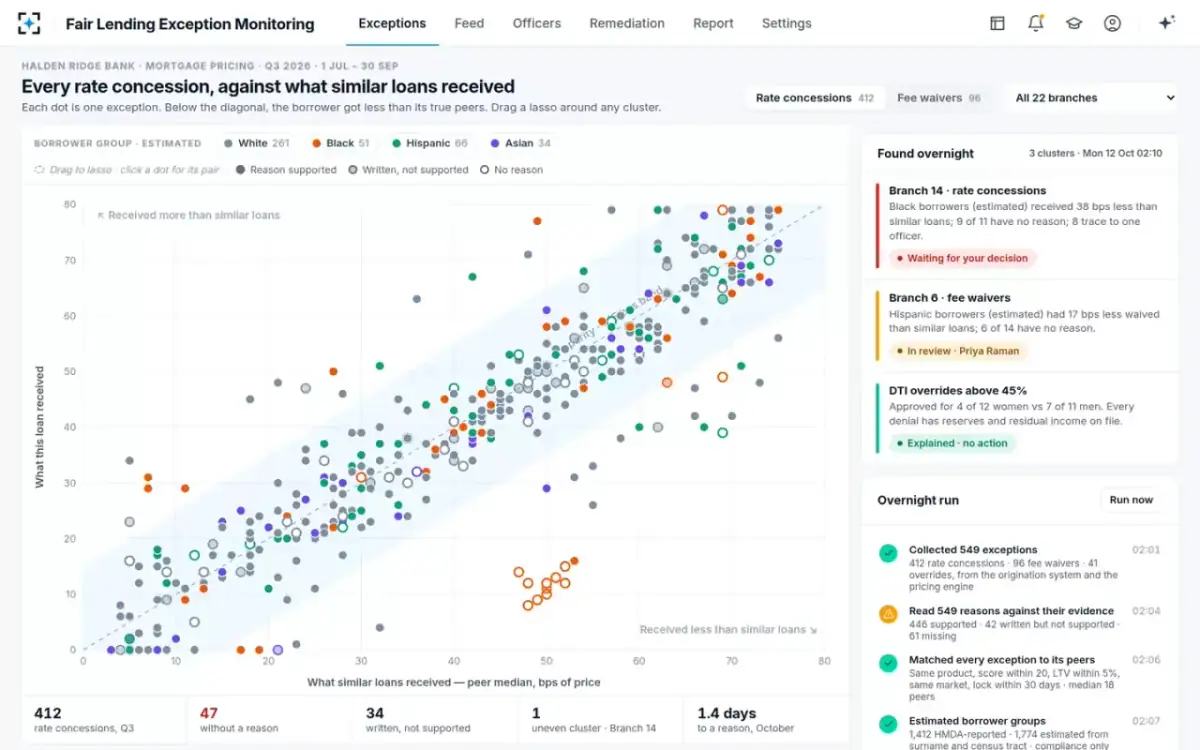
Fair Lending Exception Monitoring's overnight run at the sample bank collected 549 exceptions from the quarter's 3,186 loans, 412 rate concessions, 96 fee waivers and 41 overrides, matched each loan to a median of 18 peers and tested 22 branches, 25 officers and 5 products. One cluster was clear: eleven rate concessions to Black borrowers (estimated) at Branch 14 averaged 12 basis points against 50 for similar loans, a 38 basis point gap significant at p = 0.002 after score, LTV, amount and product, with "No reason entered" on nine and eight granted by one loan officer.
The agents drafted the remedy as the gap applied to each loan amount, paid by principal reduction: $13,060 across the eleven borrowers, between about $1,040 and $1,380 each. Two forward-looking actions came with it: for 90 days that officer's concessions above 10 basis points need the pricing desk manager before lock, and no competitor-match exception may be granted without the competing Loan Estimate on file. The Fair Lending Officer signed and the Chief Compliance Officer co-signed before any credit was scheduled.
The remedy in dollars, borrower by borrower, in Fair Lending Exception Monitoring
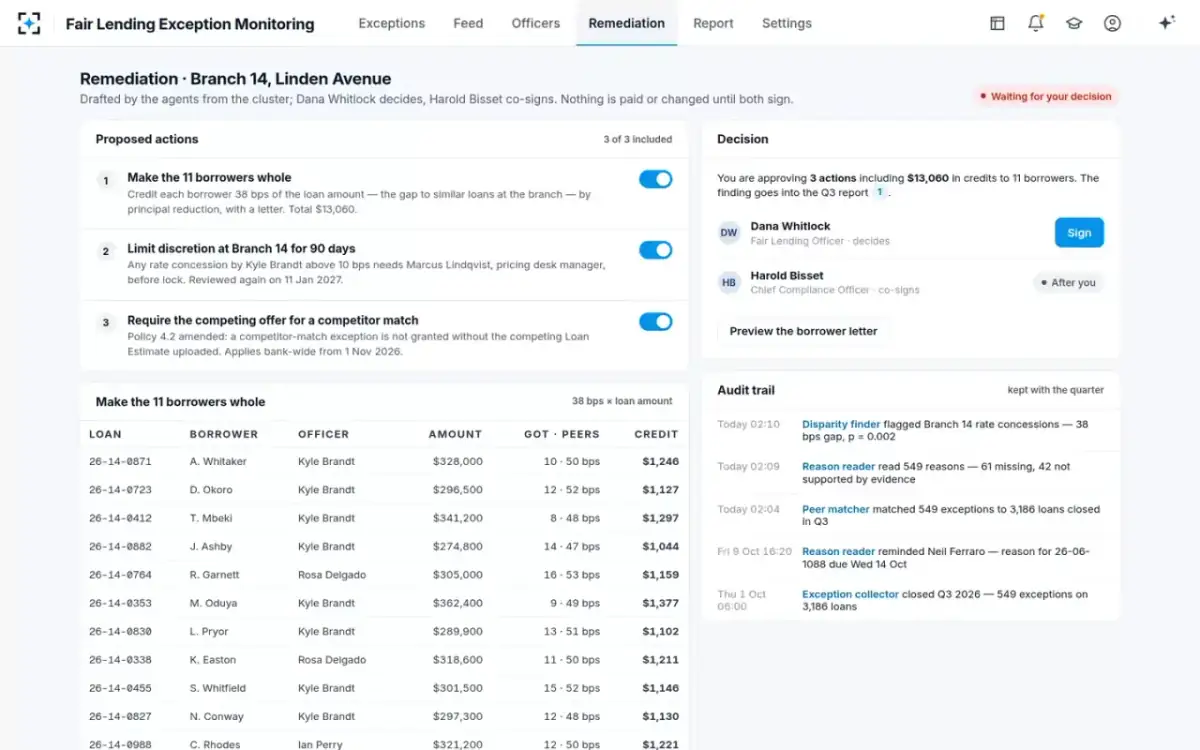
A second cluster shows exposure before a decision. Fourteen fee waivers to Hispanic borrowers (estimated) at Branch 6 averaged 6 basis points of loan amount against 23 for similar loans, a 17 basis point gap, with no reason on six. The fourteen loans total $6,042,800, so the unexplained amount is about $10,270 by our arithmetic. Whether any of it is owed depends on the review; the number tells the Fair Lending Officer how deep that review should go. How the quarter unfolded, from the overnight run to the board report, is in the fair lending exception review case study.
Each rate concession of the quarter against what similar loans received
What should a board see about pricing exposure?
A number in dollars, the clusters behind it, and how quickly reasons arrive. A board that is told "no statistically significant disparities were found in a sample of 40 files" has been told how the test was run, not what the bank is exposed to. One that sees each cluster's unexplained gap in basis points and dollars, the share of exceptions with a documented reason, and the days from grant to reason can judge whether the programme is working.
The ECOA damages provision tells a board why persistence matters: in setting punitive damages a court weighs "the frequency and persistence of failures of compliance" and "the extent to which the creditor's failure of compliance was intentional". A gap that appears, is found in the same quarter and is remediated with a policy change reads very differently from one that ran for years under a policy that did not ask for reasons. The quarterly report at the sample bank is drafted from the same data as the scatter, scope and method, results by exception type, findings, actions and timeliness of reasons, and each number links to its loans, so a director's question can be answered at the level of a single concession.
Where Fair Lending Exception Monitoring fits
The solution's agents collect every concession, waiver and override as it is granted, read the reason against its evidence within a three-business-day clock, match each loan to similar loans on the same rate sheet, and test branches, officers and products for gaps by borrower group using estimated race and ethnicity where the bank does not hold it. When a gap is unexplained they draft the remedy, the credit per borrower and its working, and the forward-looking controls. What counts as a legitimate reason is a decision for people, which is why the agents compare and stop; agents compare, people conclude sets out that line.
The Fair Lending Officer decides each finding and remedy, the Chief Compliance Officer co-signs, and the board receives a quarterly report in which each number links to its loans. What changes is the multiplier in the exposure formula: a gap found in the quarter it opened is eleven loans, not six years. To see the scatter on your own exceptions, start from Fair Lending Exception Monitoring.
Questions people ask
What are the ECOA penalties for a creditor?
Actual damages plus punitive damages of up to $10,000 per individual applicant, with punitive damages in a class action capped at the lesser of $500,000 or 1% of the creditor's net worth. Courts weigh the frequency and persistence of the failures, and successful plaintiffs recover costs and attorney's fees.
Who enforces fair lending pricing violations?
The prudential regulators and the CFPB supervise and examine, and must refer a matter to the Attorney General when they have reason to believe a creditor has engaged in a pattern or practice of discouraging or denying applications in violation of ECOA; they may refer others. The Justice Department brings cases under ECOA and the Fair Housing Act, as it did against Evolve Bank & Trust in 2022.
How is fair lending remediation calculated?
Typically as the unexplained gap in basis points applied to each affected loan amount, for each borrower in the affected group and period. The sample bank credited 38 basis points of each loan amount by principal reduction, $13,060 across eleven borrowers.
Does documenting a reason protect a pricing exception?
A legitimate reason, documented at the time with its evidence, is what explains a difference in treatment; examination procedures require the lender to provide one. A reason written after the fact, or one with no evidence such as a competitor match without the competing offer, explains little.
How long does a fair lending consent order last?
The term is set in each order. Throughout it, the Evolve order required a Fair Lending Officer and committee, documented exceptions, monitoring of concession incidence and value, and corrective action for unexplained disparities.
Can a lender avoid penalties by self-testing?
Regulation B makes a voluntary self-test privileged only if the lender takes appropriate corrective action, including remedial relief to borrowers whose rights were more likely than not violated. Self-testing reduces exposure by shortening the period a gap runs; it does not excuse the gap.