Post-earnings announcement drift is the tendency of a stock's price to keep moving in the direction of an earnings surprise for weeks after the announcement, as if the market under-reacted on the day. The question of whether it is "delayed price response or risk premium" gave Bernard and Thomas's 1989 paper its title (Journal of Accounting Research, 1989), and later research has tied much of it to attention: DellaVigna and Pollet found that Friday announcements have "a 15% lower immediate response and a 70% higher delayed response," and Kimbrough found that conference calls reduced both the drift and the share of the reaction that was delayed. For a buy-side research team the practical reading is that part of each quarter's information is priced in the days after the call, and more of it when attention is thin, which makes the hours between the end of a call and a signed note a measurable cost. Botminds' Earnings Call Analysis reads every covered call while it runs and drafts a cited thesis-impact note for the analyst to decide and sign, so the note can reach portfolio managers the same evening.
Research figures are linked where they appear. Figures about Quillfield Capital, its analysts and Hoshida Robotics are fictional sample data from the solution; the minute-by-minute split of an analyst's evening is Botminds' estimate, labelled where it is used.
Four findings a research director should know
−15%
immediate price response to earnings announced on a Friday
+70%
delayed response to Friday announcements
48h
after a furnished release within which the call keeps its Form 8-K exemption
64min
average length of the results calls in a 2024 study, 41 of them questions
What is post-earnings announcement drift?
It is the part of the price reaction to an earnings surprise that arrives after the announcement day: a positive surprise followed by weeks of further rise, a negative one by further fall. The drift is an anomaly because a fully informed market would price the surprise at once. The two classic explanations are in Bernard and Thomas's title: either the market responds late, or the drift is compensation for a risk the standard models miss.
The attention studies make the first explanation concrete. If investors and analysts have limited time, then announcements that compete for attention, on busy days or at the end of the week, should be read more slowly, and the share of the reaction that is delayed should rise. That is what the evidence below found, and it is why the drift matters to a firm whose analysts are among the readers.
What the research found: attention, crowding and the conference call
Three findings carry most of the weight. DellaVigna and Pollet found that "Friday announcements have a 15% lower immediate response and a 70% higher delayed response" (Journal of Finance, 2009). Hirshleifer, Lim and Teoh found that "the immediate price and volume reaction to a firm's earnings surprise is much weaker, and post-announcement drift much stronger, when a greater number of same-day earnings announcements are made by other firms" (Journal of Finance, 2009). And Kimbrough found that when firms began holding conference calls, both the drift and the delayed share of the market reaction fell, with the effect concentrated in the smallest, least-traded firms (The Accounting Review, 2005).
Friday earnings: a smaller reaction on the day, a larger one later
The call itself carries information the release does not. Matsumoto, Pronk and Roelofsen found that both the presentation and the discussion "have incremental information content over the accompanying press release," with the discussion the more informative part (The Accounting Review, 2011). Bowen, Davis and Matsumoto found that conference calls increase analysts' ability to forecast earnings accurately, most of all for analysts with weaker records (The Accounting Review, 2002). Who asks questions in an earnings call covers who gets that information first.
Is the drift a delayed price response or a risk premium?
The attention evidence supports a delayed response for a large part of it, without settling the question. A risk premium should not depend on the weekday or on how many other firms report the same day; inattention should, and the Friday and crowding results say it does. Kimbrough's finding points the same way: an event that improves information, the conference call, reduced the drift.
For a research team the distinction is practical rather than academic. Whatever part of the drift is delayed attention is a window in which a correct reading of the quarter is worth most, and the team's own speed decides whether its portfolio managers act inside it. The SEC made a related point in its 2026 semiannual reporting proposal, citing studies that find "markets generally react to the information when it is first disclosed, but less so when it is subsequently repeated" (Federal Register, 7 May 2026).
Peak weeks: why the calls bunch together
US domestic companies report quarterly, and the call is tied to the release by a 48-hour window. A domestic company files a Form 10-Q for each of its first three fiscal quarters (17 CFR 240.13a-13), and a results call keeps its exemption from a separate Form 8-K only if it starts "within 48 hours after" a release already furnished and is "broadly accessible to the public by dial-in conference call, by webcast, by broadcast or by similar means" (Form 8-K, Item 2.02(b)). With most companies sharing calendar quarter-ends, the calls crowd into a few weeks. The SEC proposed in May 2026 a semiannual Form 10-S option; it remains a proposal.
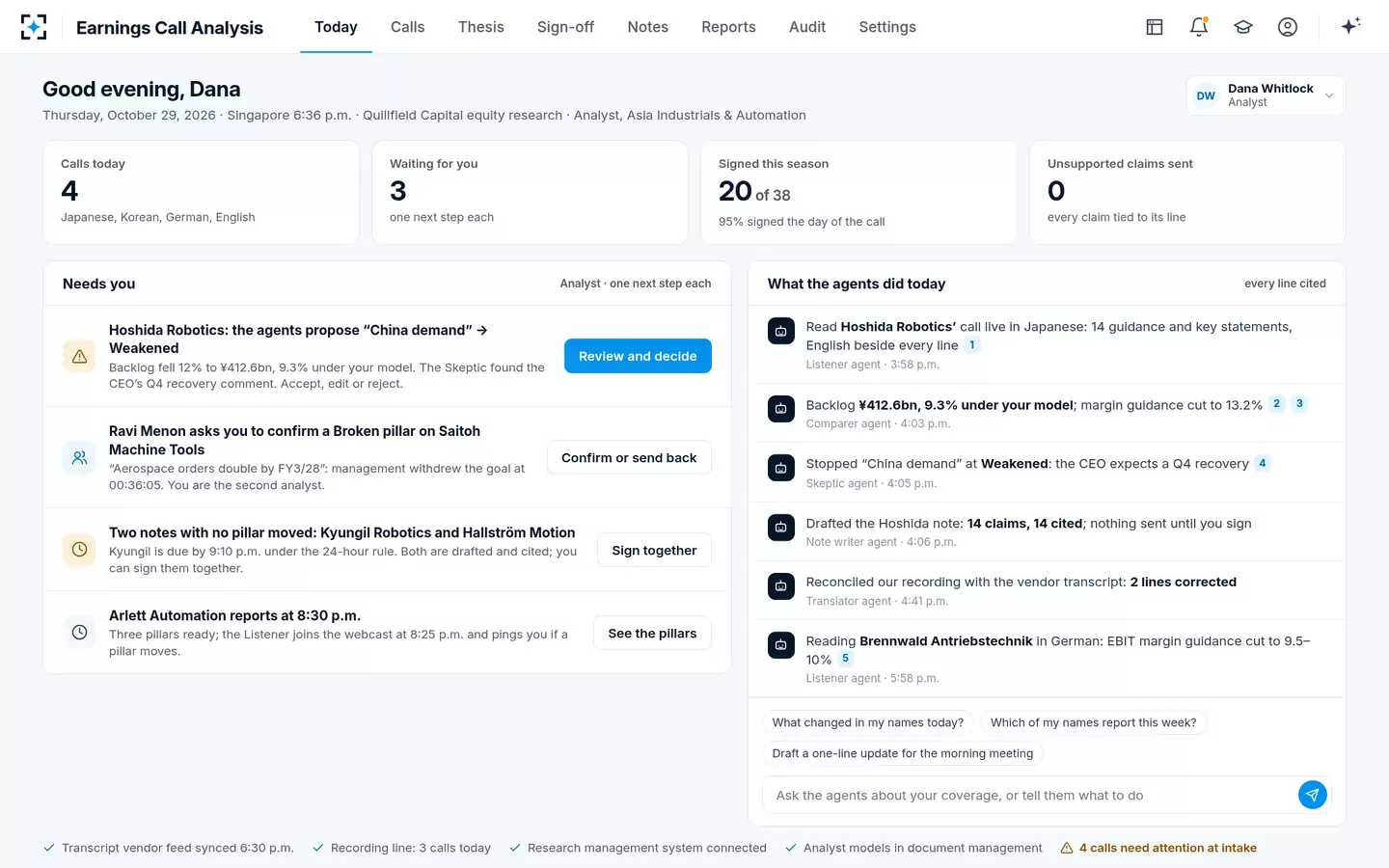
The crowding the market struggles with is the crowding the analyst faces. In the sample, an analyst covering 38 Asian industrial names had four calls on one Thursday afternoon, in Japanese, Korean, German and English, and a note from the previous day's call due by 9:10 p.m. The days on which the market reads earnings most slowly are the days on which the research team is most stretched.
Four calls, four languages, and what is waiting for the analyst
Where the hours after the call go
By hand, the steps after a call wait on each other: the model waits for the transcript, the note waits for the model, the review waits for the note. Botminds estimates about three hours and 45 minutes of analyst time per covered company on results day by hand, including 45 minutes of preparation and the hour of the call. No regulator or peer-reviewed source we found measures the analyst's side of the evening.
One name's results evening, by hand and with Earnings Call Analysis (estimate)
- Prepare45 min
- Listen and take notes60 min
- Re-read or wait for English30 min
- Update the model45 min
- Write the note30 min
- Review and send15 min
- Prepare6
- Listen18
- Check lines6
- Approve model6
- Note9
- Sign6
The sample call shows the waits disappearing. The Hoshida Robotics call ended at 3:58 p.m.; the comparer had checked it against the analyst's model by 4:03, the skeptic agent had searched it for counter-evidence by 4:05, and a draft note with 14 cited claims existed at 4:06. The vendor's English transcript of the Japanese call arrived at 4:41. By hand, the evening would have started there.
How soon should a buy-side note be signed? Setting the rule
No regulation sets a deadline for a buy-side note; it is the research team's policy, and the useful version is one that is measured per note. In Earnings Call Analysis the default is a signed note within 24 hours of the call, after which it escalates to the Director of Research, and a thesis pillar marked Broken must be confirmed by a second analyst within four hours. Both are settings the Director approves, from 2 to 48 hours.
Turnaround measures a research director can hold a team to
| Measure | What it shows | In the sample season |
|---|---|---|
| Share of notes signed the same day as the call | Whether the team reads inside the window the drift research points to | 91% |
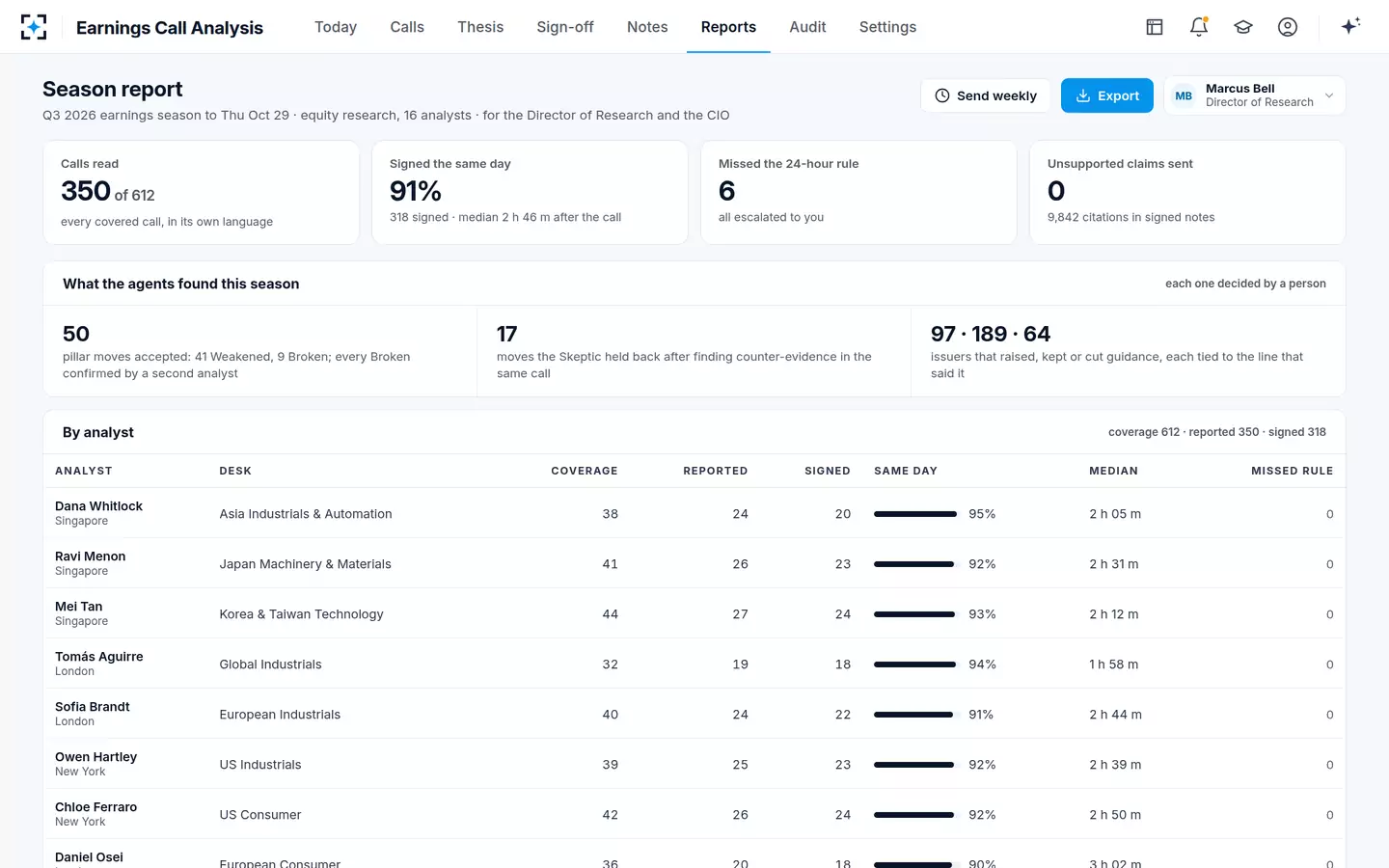
| Median time from end of call to signature | The team’s typical delay, by analyst | 2 h 46 min |
| Notes past the 24-hour rule | Where the policy failed, each escalated | 6 |
| Covered companies reported so far | How far into the season the team is | 350 of 612 |
| Friday and crowded-day notes, separately | Whether the team slows on the days the market does | Tracked per note |
A season report: calls read, notes signed the same day, the 24-hour rule
What a director can change, and what stays fixed
The call's length and the reporting calendar are fixed; three things are in reach. The wait for the English transcript can go if the firm reads its own recording of the call in the language spoken and reconciles the vendor's transcript when it lands. The model update can be proposed cell by cell during the call, for the analyst to approve rather than type. And the review can become a step with a clock instead of an email that waits overnight.
Where the hours after the call go, by hand and in Earnings Call Analysis
By hand: Wait for the vendor; for a call in Japanese, Korean or German, wait longer for the English.
With Earnings Call Analysis: Read live from the firm’s recording line in the language spoken; the vendor transcript is reconciled when it lands and each correction logged.
By hand: Re-key guidance and actuals after the call.
With Earnings Call Analysis: The comparer proposes changes cell by cell, each with its line; nothing is written until the analyst approves.
By hand: Written from notes and memory; sources added if there is time.
With Earnings Call Analysis: Drafted from the decided pillars with every claim cited; an unsourced sentence blocks signing.
By hand: An email to a colleague, answered when they see it.
With Earnings Call Analysis: A Broken pillar goes to a second analyst with a 4-hour clock; the note escalates after 24 hours.
Speed without a check is the wrong trade. A note signed in an hour that misreads a guidance line moves a portfolio on a mistake. The solution keeps the decision and the check with people: a skeptic agent searches each call for the strongest case against any proposed move, and why the reader is never the checker sets out the review step.
Which names in a coverage list deserve the fastest note?
The research points to the names where attention is thinnest, not the largest ones. Kimbrough found the reduction in drift from conference calls concentrated in the smallest, least-traded firms, where drift had been most severe; DellaVigna and Pollet and Hirshleifer, Lim and Teoh found the delayed share largest on Fridays and on days crowded with other announcements. A research director ordering the evening's notes can use those three conditions directly: small or thinly covered names, Friday reporters, and names reporting on the season's busiest days go first.
That order is the reverse of the one an analyst naturally follows, which starts with the largest position or the most-watched name, where the market's own reading is fastest. In the sample, the Thursday queue held four calls; the order in which their notes were signed was a choice the director could make in advance, by setting which names escalate first when the 24-hour rule is at risk.
What the solution does on results day
The solution reads every covered call as it runs: it joins the firm's recording line, tags guidance and key statements with metric, value, direction, period, speaker and timestamp, compares each with last quarter's guidance and the analyst's model, searches for counter-evidence and drafts the note with every claim cited. Lines under 80% confidence are marked unclear until a person checks them.
It does not decide or publish. The analyst accepts, changes or rejects each proposed move with a reason code, a Broken pillar needs a second analyst who is not its author, and nothing reaches a portfolio manager until the covering analyst signs. The earnings call summary template covers what the signed note should contain.
Questions people ask
Is post-earnings announcement drift still observed?
The studies cited here measure it in their sample periods; none of them is a live measurement of today's market. What they establish is the mechanism: the delayed share of the reaction is larger when attention is thin, on Fridays and crowded days, and smaller when firms hold conference calls.
Why do Friday earnings get less attention?
DellaVigna and Pollet attribute it to investor inattention: Friday announcements had a 15% lower immediate response and a 70% higher delayed response than other weekdays in their sample, consistent with less attention going into the weekend.
Do earnings calls reduce post-earnings announcement drift?
Kimbrough found that when firms began holding conference calls, both the drift and the share of the market reaction that was delayed fell, with the effect concentrated in the smallest, least-traded firms, where drift had been most severe.
What is the Bernard and Thomas paper?
"Post-Earnings-Announcement Drift: Delayed Price Response or Risk Premium?", published in the Journal of Accounting Research in 1989. Its title states the two explanations the later literature has tested, including the attention studies above.
How long after an earnings call should an analyst publish?
No rule sets it; it is the research team's policy. A measurable version sets a deadline per note, such as 24 hours with escalation, and tracks the median time from call to signature by analyst. In the solution's fictional sample season, 91% of notes were signed the same day.
Why do earnings calls cluster in a few weeks?
Most US companies share calendar quarter-ends and file 10-Qs on similar clocks, and a results call keeps its Form 8-K exemption only if it starts within 48 hours of a furnished release. The calls follow the releases into the same weeks.