An earnings call summary template for a buy-side research team is a fixed structure for the note an analyst writes after a covered company's results call: the thesis pillars the call bears on, each guidance line against last quarter's, the statements that moved a pillar with their speaker and timestamp, the strongest evidence against each move, the analyst's decision, and the model changes that follow. The template matters because a summary written from the transcript reproduces the company's ordering, and the company's ordering puts the script first; the research says the questions carry more new information. A template built on the thesis forces the summary to say what changed for the position. Botminds' Earnings Call Analysis drafts the summary in this shape while the call runs, with every claim cited to its line, and the analyst decides each move and signs.
Research and rules are linked where they appear. The worked call is fictional sample data from the solution: Hoshida Robotics, a Tokyo-listed company, covered by an analyst at Quillfield Capital.
What an hour-long call contains
64min
average results call in the 2024 study, from 35 to 95 minutes
41min
of that went to questions, against 23 for the presentation
45%
of analysts’ questions were on topics the presentation never raised
19.3
questions per call on average, from 10 to 33
What should an earnings call summary contain?
What changed for the position, and the evidence for it, in a form another analyst can check. That means the pillars the call touched and whether each was confirmed, weakened or broken; each guidance line set against the release and the last call; the lines that drove each change with speaker and timestamp; the strongest counter-evidence from the same call; the model cells the analyst approved changing; and the questions that went unanswered. A summary that only lists what management said is a transcript abstract, and the portfolio manager has to do the analysis again.
The fixed structure is also what makes summaries comparable across a coverage list. A director of research reading 30 notes on a peak evening needs every note to put the decision in the same place, so that the one pillar marked Broken stands out.
The template, section by section
| Section | What goes in it | Evidence required |
|---|---|---|
| 1. Bottom line | The decision for each affected thesis pillar: confirmed, weakened or broken, and any rating or position implication | The pillar’s break rule, quoted |
| 2. Guidance, line by line | Each guided metric: last quarter, the release, the call; maintained, narrowed, raised, cut or deferred | Release section and call timestamp |
| 3. What moved, and who said it | The statements that drove each change | Speaker, timestamp, original language if not English |
| 4. The case against | The strongest evidence on the call against each move | Speaker and timestamp, usually in the Q&A |
| 5. Model changes | Cells changed, old and new values, and why | The line behind each change; approved by the analyst |
| 6. Non-GAAP figures | Each non-GAAP measure used and where its reconciliation sits | The release page or website the speaker named |
| 7. Unanswered and scripted | Questions not answered, and answers read from the script | Questioner and timestamp |
| 8. Follow-ups | Questions for investor relations, data to check, next catalysts | Owner and date |
Start from the thesis, not from the transcript
The summary is only as useful as the thesis it is written against. A pillar with a numeric break rule, such as "China orders below −20% for two quarters, or backlog under ¥400 billion," lets the analyst mark a line as it is spoken; a pillar that reads "China weakens" cannot be tested. How to write an investment thesis you can test every quarter covers the break rules themselves.
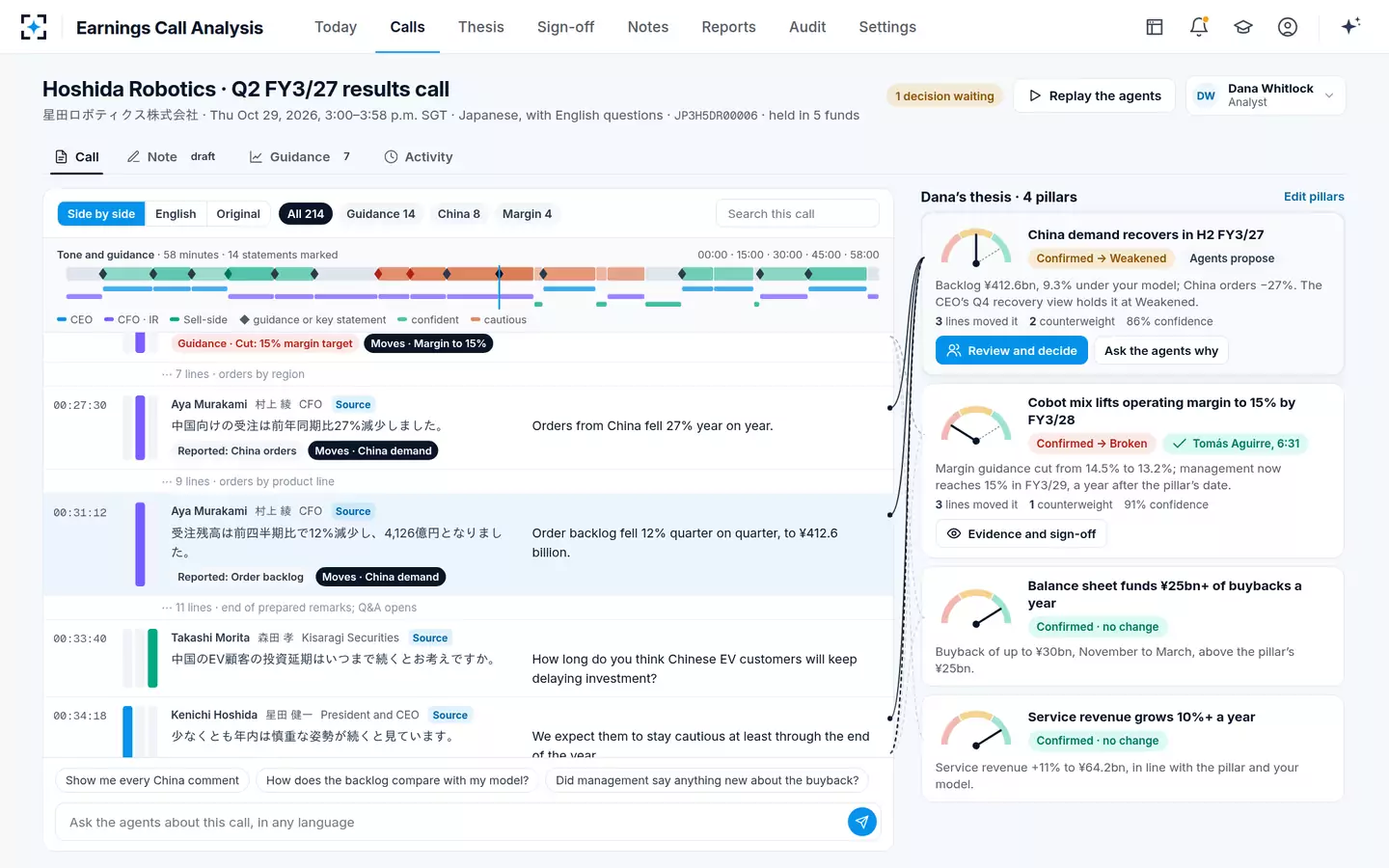
In the sample, the analyst held a four-pillar thesis on Hoshida Robotics, and two pillars moved during its 58-minute call. The template's bottom line therefore had two entries, each with the rule it was tested against, and the remaining two pillars were listed as untouched rather than left out, so the reader knows they were checked.
Guidance lines: maintained, narrowed, cut or deferred
Guidance wording carries information, so the template records each line's direction in a fixed vocabulary. "Maintained" and "reaffirmed" are statements; a range that narrows toward one end is a move; and a target kept in size but pushed a year later is a cut, whatever the speaker calls it. Each line is set against the release and the last call, because the call's wording can differ from the release's.
The sample call shows two kinds. In the prepared remarks the chief financial officer cut full-year operating margin guidance from 14.5% to 13.2% at 22:40, and moved the 15% margin target from the year to March 2028 to the year to March 2029 at 24:55. The first is a plain cut. The second reads as maintained in a careless summary and is, in the template, a deferral: the margin pillar went to Broken, confirmed by a second analyst, and cobot sales up 18% did not offset it.
Where the lines that mattered fell in the sample call
- Script, to the guidance cut at 22:400–23
- Guidance cut, target deferred, China orders, backlog23–33
- Q&A with the counter-evidence33–58
Why does the Q&A section carry the most weight?
Because that is where the new information is. In the 2024 study, 45% of analysts' questions concerned topics the presentation never covered, and 32% topics neither the presentation nor the annual report covered (MAB, 2024). A study of more than 10,000 US call transcripts found both parts "have incremental information content over the accompanying press release," with the discussion the more informative (Matsumoto, Pronk and Roelofsen, The Accounting Review, 2011).
The sample shows the cost of a summary that stops at the script. Everything that argued against the obvious reading came in the questions: the chief executive's expectation that China orders recover in the fourth quarter as large electric-vehicle projects restart, with two projects in final specification, at 44:05 and 46:20. A reader of the script alone would have marked the China pillar Broken. The analyst marked it Weakened at 6:38 p.m., because the break rule had not been met and the company gave a dated, specific reason to expect recovery. Section 4 of the template exists for exactly this line.
The call in speaker lanes, with the thesis beside it
Unanswered questions and scripted answers
Two things a summary should record are what management did not say and what it said from the script. Hollander, Pronk and Roelofsen found that managers "regularly leave participants on the conference call in the dark by not answering their questions," and that "investors seem to interpret no news as bad news" (Journal of Accounting Research, 2010). Lee found that adherence to predetermined language in answers was negatively associated with the market's reaction, that analysts downgraded forecasts afterwards, and that such firms were less likely to guide (The Accounting Review, 2016).
What the template records from each half of the call
Prepared remarks: Changed wording on guidance and targets; a metric that disappeared since last quarter.
Q&A: Answers that move a pillar; the case against any move.
Prepared remarks: A long script followed by a short Q&A.
Q&A: Non-answers, with questioner and time; answers that repeat the script.
Prepared remarks: Timestamp and release section for each guidance line.
Q&A: Speaker and timestamp for every line used.
Prepared remarks: A target moved in time but not in size.
Q&A: The chief executive handing a pointed question to the chief financial officer.
Non-GAAP figures and where the reconciliation sits
Any non-GAAP measure in the summary should carry where its reconciliation is published. When a company first gives a non-GAAP measure orally, Regulation G is satisfied if the comparable GAAP figure and reconciliation are on the company's website and "the location of the web site is made public in the same presentation" (17 CFR 244.100). The template's section 6 records the measure, the speaker's reference to the reconciliation and the page itself, so that a reader can check the bridge without searching.
A model updated on an adjusted margin that excludes a recurring cost is a model of a different company, and the reconciliation is where that exclusion shows. A summary that quotes an adjusted figure without its location leaves the next reader to repeat the search.
Citing every line: timestamps and the vendor transcript
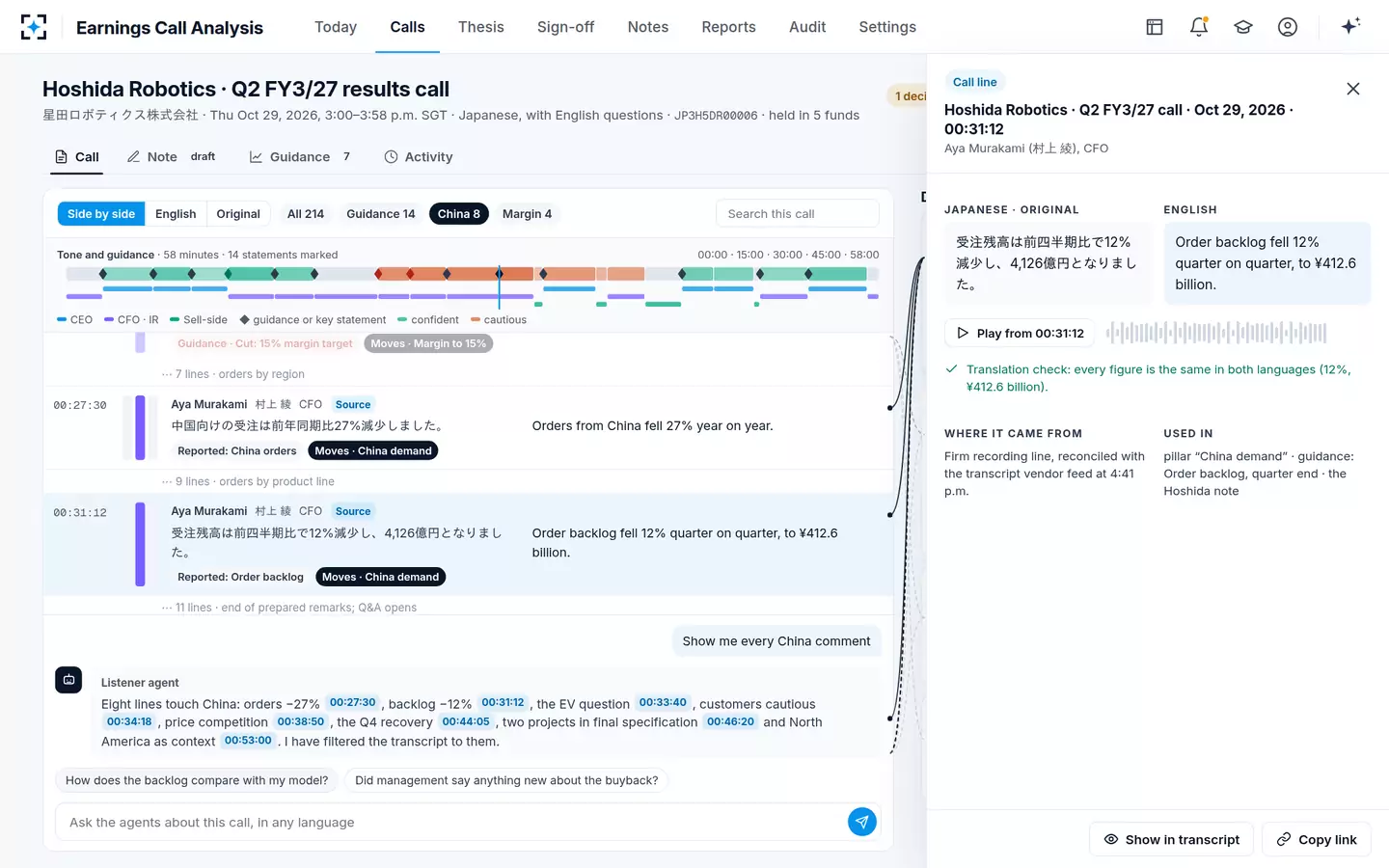
Every claim in the summary should point at a line a reader can play. A transcript is an edited record, and for calls in other languages the English version arrives later and is a translation. In the sample, the vendor's English transcript of the Japanese call arrived at 4:41 p.m., 43 minutes after the call ended, and the solution logged two lines where the vendor transcript and the firm's own recording differed. The habit to keep, with or without software, is to note the minute and second of each line that might be quoted and play it back before it goes into the note.
One line in the original and in English, with its figures checked
Regulation FD and what a summary should flag
A summary is also where a research team notices disclosure that should not have happened. Regulation FD bars an issuer from selectively disclosing material nonpublic information to analysts and investors, and the SEC's adopting release describes the open call that avoids it: a release, notice of the call with "the time and date of the conference call, and instructions on how to access the call," and a call held "in an open manner" (SEC Release 33-7881, 2000). SEC staff guidance says a regular quarterly call's notice of "several days would be reasonable" (Regulation FD interpretations, 102.01).
If an analyst hears something material in a follow-up call with investor relations that was not on the public call, the template's follow-up section is where it is flagged for compliance, not where it is used. Regulation FD for analysts covers what an analyst may hear, and when.
Who checks the summary before it reaches a portfolio manager?
Someone other than its author, at least for any pillar marked Broken. An analyst reading alone tends to read the call to confirm the thesis, and the template's case-against section only works if someone tests it. In Earnings Call Analysis, a skeptic agent searches each call for the strongest case against any proposed move before the analyst decides, a Broken pillar goes to a second analyst with a four-hour clock, and an unsourced sentence blocks signing. Why the reader is never the checker covers the review design.
Eight checks before an earnings call summary is signed
- Every affected pillar has a decision
Confirmed, weakened or broken, tested against its written break rule.
- Every guidance line has a direction
Maintained, narrowed, raised, cut or deferred, against the release and last call.
- Every claim has a speaker and timestamp
Played back before quoting; original language noted.
- Each move has its case against
The strongest counter-evidence from the same call, usually the Q&A.
- Model changes match the summary
Each changed cell with old and new value and the line behind it.
- Non-GAAP figures point to their reconciliation
The page the speaker named, checked.
- Non-answers are recorded
Questioner, question and what was said instead.
- A Broken pillar has a second reader
Someone who did not write the note.
How Earnings Call Analysis fills the template during the call
The solution fills the template while the call runs. Its listener tags guidance and key statements with metric, value, direction, period, speaker and timestamp, marking lines under 80% confidence as unclear until a person checks them; the comparer holds each statement against last quarter's guidance and the analyst's model and proposes cell changes; the skeptic writes the case against; and the drafter writes the summary with every claim cited. On the sample call, a draft with 14 cited claims existed at 4:06 p.m., eight minutes after the call ended.
The analyst keeps the decisions: each pillar move is accepted, changed or rejected with a reason code, model cells change only on approval, and nothing reaches a portfolio manager until the covering analyst signs. Post-earnings announcement drift explains why the time from call to signed summary matters.
Questions people ask
How long should an earnings call summary be?
Long enough to state each pillar decision and its evidence, and no longer. The template's bottom line fits in a few lines; the guidance table and cited statements carry the detail, so a portfolio manager can stop after the first section and an analyst can check every claim.
Should the summary follow the order of the call?
No. The call's order puts the script first, and research finds the Q&A more informative: in a 2024 study, 45% of analysts' questions were on topics the presentation never raised. A thesis-first order puts what changed for the position at the top.
What is the difference between an earnings call summary and a transcript abstract?
An abstract condenses what was said; a summary for the buy side says what it means for the position, with the decision, the evidence for it and the evidence against it, each line cited to its speaker and timestamp.
How should non-GAAP figures appear in a call summary?
With the location of their reconciliation. Under Regulation G, a non-GAAP measure first given orally is accompanied by the comparable GAAP figure and reconciliation on the company's website, with the site's location given in the same presentation; the summary should record it.
Why record unanswered questions?
Because investors read them. Hollander, Pronk and Roelofsen found managers regularly leave call participants "in the dark" by not answering, and that investors seem to interpret no news as bad news. A summary that drops non-answers loses that signal.
Can AI write the earnings call summary?
It can draft one, with every claim cited, as Earnings Call Analysis does while the call runs. The decision on each pillar, the model changes and the signature stay with the analyst, and a Broken pillar needs a second analyst who did not write the note.