A remediation check stop payment is the block a bank places on one of its own refund checks so that the item cannot be paid, usually because the check came back undelivered, was reported lost or stolen, is being reissued to a new address, or has passed the void date printed on it. Stopping or voiding the paper does not cancel what the bank owes. A remediation check is often an official check drawn on the bank itself, so the obligation stays on the bank's books until the customer is paid, a replacement is cashed, or the amount is reported to a state as unclaimed property after the period state law sets, three years for official checks in New York, California and Texas. Getting those steps right decides how many customers a remediation actually pays. Botminds' Customer Remediation follows every check from mailing to a final state, and a program cannot close while any dollar is unaccounted.
A remediation check's life: the void date is early, the debt runs for years
- Cashable6 mo
- Search and reissue6 mo
- Held as owed24 mo
- Notice, report4
- Cashable3 mo
- Research, reissues, third mailing23 mo
- Wind-down11 mo
- Escheat1
What is a remediation check stop payment?
It is the bank instructing itself not to pay an item it issued, and it works differently from the stop payment a customer places on a personal check. For a personal check the Uniform Commercial Code gives the account holder the right, and sets its life: six months, renewable in writing, and only 14 calendar days for an oral order that is never confirmed (UCC § 4-403). A cashier's check is different, because the bank is both drawer and drawee and “is obliged to pay the instrument (i) according to its terms at the time it was issued” (UCC § 3-412). A bank that refuses to pay its own official check without a good reason can owe the holder expenses, interest and, in some cases, consequential damages (UCC § 3-411).
So for a remediation check, a stop is a control, not a cancellation. It belongs in three situations: the check was returned and will be reissued, the customer reports it lost or stolen, or the void date has passed and the amount is being moved to a replacement or a hold. In each case the stop must be in place before the replacement is issued, or the bank risks paying twice.
How long are remediation checks valid?
As long as the bank decides, and the date printed on the check is a fraud control rather than a legal limit. The Independent Foreclosure Review chose 90 days: “Because checks were issued with a 90-day expiration date to prevent fraud, checks issued in the early waves of distribution that have not been cashed or deposited have begun to expire” (OCC, August 2013). The fictional sample bank in these guides uses 180 days, and its letter states the date in plain words.
The law's own default for ordinary checks is six months, and it does not void anything: a bank need not pay an uncertified check presented more than six months after its date, but it may pay one in good faith (UCC § 4-404). A short void date lowers the window for theft and alteration; it also lowers the cash rate, so it should come with a reissue process that starts the day the date passes.
Stale, void and stopped: three different things
The three words describe different states, and a program that treats them as one loses track of money. A stale check is old; a void check is past the payer's own deadline; a stopped check is blocked by an instruction. None of them ends the debt to the customer.
Stale, void, stopped and escheated: what each means for a remediation check
| State | What it means | Set by | Is the customer still owed? |
|---|---|---|---|
| Stale | Presented more than six months after its date; a bank may refuse an ordinary check, or pay it in good faith | UCC § 4-404 | Yes |
| Void after a date | The payer will not honour the paper after the printed date | The bank’s program design | Yes: reissue or hold |
| Stopped | The bank has blocked payment of this item, usually before a reissue or after a reported loss | The bank’s own instruction | Yes: the replacement carries the debt |
| Lost cashier’s check claim | A declaration of loss becomes enforceable 90 days after the check’s date | UCC § 3-312 | Yes: paid to the claimant |
| Reported to a state | Held by the state for the owner after the dormancy period | State unclaimed property law | Yes: claimable from the state |
Can a remediation check be reissued?
Yes, and a well-run program reissues routinely: after a return with a new address, after the void date, and after a reported loss. The FTC describes its own loop plainly: “When a check is returned as undeliverable or remains uncashed after its void date, the agency conducts an address search to determine if there is a more recent address for the consumer, and then reissues a new check to the updated address” (FTC, 2024 Annual Report on Refunds to Consumers). The foreclosure review did the same at scale. By February 2015, “Nearly 600,000 checks mailed to borrowers of these 13 servicers remain outstanding, and have now expired”, and the regulators mailed replacements on a strict clock: “Borrowers must cash or deposit the replacement checks within 90 days of the issue date or the check will be void” (Federal Reserve and OCC, February 2015).
A lost official check needs one more step. Under the Code, a claim on a lost cashier's or teller's check “becomes enforceable at the later of (i) the time the claim is asserted, or (ii) the 90th day following the date of the check”, and “Until the claim becomes enforceable, it has no legal effect and the obligated bank may pay the check” (UCC § 3-312). A bank that reissues at once to a customer who says the check never arrived takes the risk that the original turns up in someone else's hands; the program's policy should say when it accepts that risk, for instance for small amounts, and when it waits.
Before a remediation check is reissued
- Stop the original first
The block on the old item is in place and confirmed before the new one prints.
- Check it was not already paid
Clearing records and positive pay show the original was never presented.
- Confirm the new address
A low-confidence match goes to a person, not to the printer.
- Apply the lost-check rule
For a reported loss, a declaration of loss and the 90-day rule for official checks, or the program’s documented exception.
- Keep the amount and the history
Same refund, same customer, a link from the new check to the old one, and the void date the policy sets.
- A different person approves
The reissue batch has a maker and a checker; nobody approves a reissue they prepared.
What happens to uncashed remediation checks?
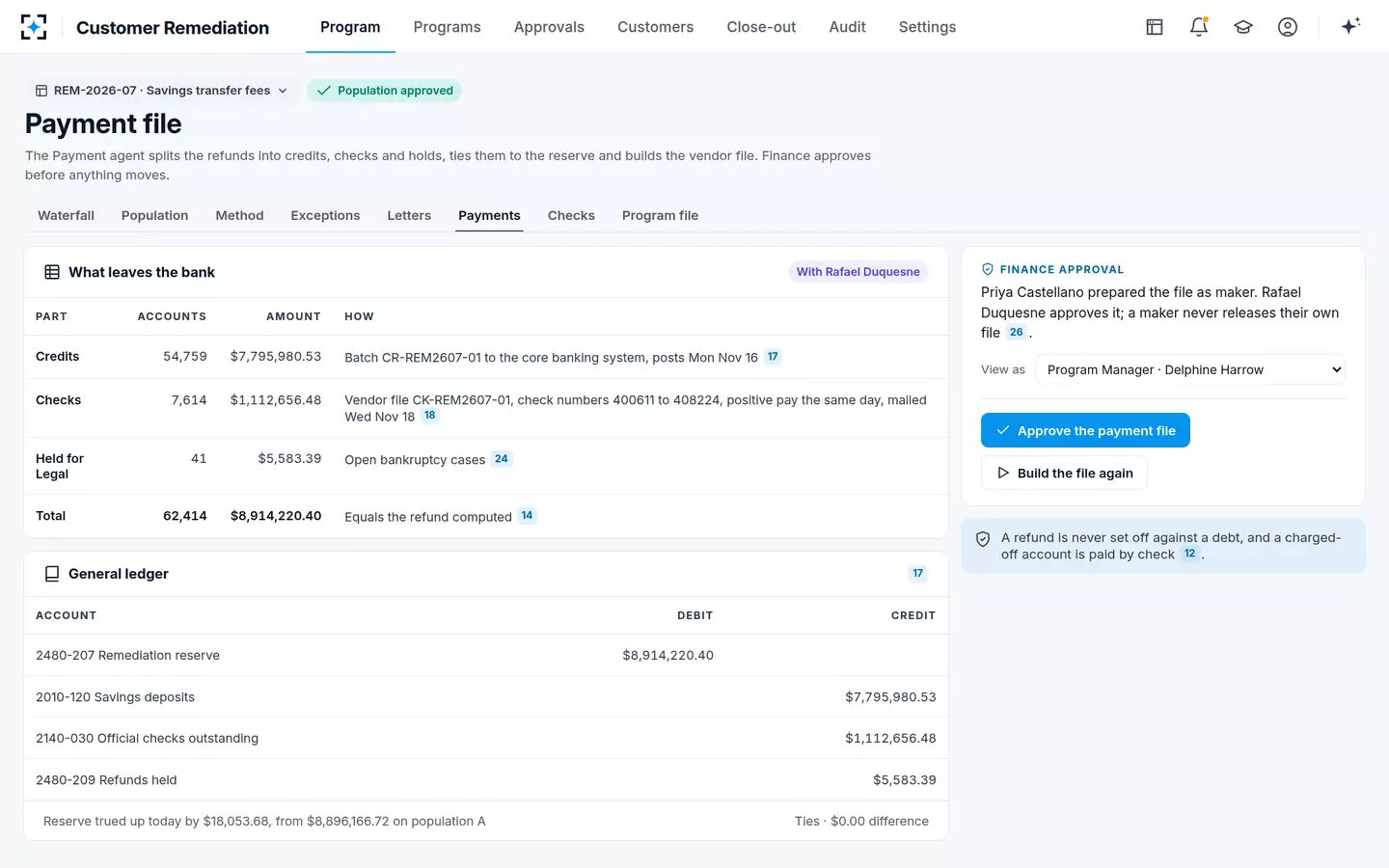
They stay on the bank's books as money owed. In accounting terms the official check sits in an outstanding-checks liability until it clears; when it is voided, the liability moves to a refund held for the customer, not back to income. The remediation reserve should not be released for amounts that are merely uncashed.
What the bank does next is a choice the program should make in writing: keep reissuing to new addresses, offer a claim process with proof of identity, or hold until state law requires a report. The Navy Federal order, for instance, required a 180-day hold during which a customer could claim the refund. Each choice has a cost; the only unacceptable one is losing track. The KPIs that price a program show how to measure the uncashed share in money.
Where uncashed checks sit until they are paid: official checks outstanding
Do uncashed refunds go to the state?
Yes, eventually: an uncashed remediation check is unclaimed property, reported to the state of the customer's last known address once the state's dormancy period has run. For official checks the period is three years in New York, California and Texas. New York treats as abandoned an instrument on which a banking organization “is directly liable, which instrument shall have been outstanding for more than three years from the date it was payable or from the date of its issuance, if payable on demand” (N.Y. Abandoned Property Law § 300). California's code names “cashier’s check, teller’s check, or certified check” outstanding “for more than three years from the date it was payable” (Cal. Code Civ. Proc. § 1513), and Texas presumes a check abandoned on “the third anniversary of the date the check was payable” among other dates (Tex. Prop. Code ch. 73).
Before reporting, the bank must try once more. The Uniform Law Commission's model act requires a notice by first-class mail “not more than 180 days nor less than 60 days before filing the report”, where the address is usable and “the value of the property is $[50] or more”, and sets reports “before November 1 of each year” covering the 12 months to July 1 (Revised Uniform Unclaimed Property Act, 2016). States adopt their own versions, so the remediation team needs its unclaimed property group's calendar. A void date 180 days after mailing and a report three years later fit together; the void date is not a reporting date.
What the states hold, and return
$5.40B
returned to owners by state unclaimed property programs in fiscal 2023, a record
NAUPA, $5,404,074,038
3 years
outstanding before an official check is presumed abandoned in New York, California and Texas
State codes
$50
value at which the model act requires a mailed notice before the report
Revised Uniform Unclaimed Property Act
What happens to unpaid redress under a consent order?
It depends on the order, and orders have gone three ways: to the regulator, to the states, or back to the customers who were reached. The CFPB's 2022 Regions order required the bank to pay any shortfall against its redress plan to the Bureau, which could use it for more redress, and otherwise “the Bureau will deposit any remaining funds in the U.S. Treasury as disgorgement” (CFPB Consent Order 2022-CFPB-0008; the CFPB terminated the order on July 21, 2025, ending that paragraph among others). The OCC's 2018 TCF order went the other way, requiring “procedures to be followed for escheating any uncashed restitution payments to the state of the last known domestic address” (OCC AA-EC-2018-38; terminated 2019).
The foreclosure review did both, one regulator each. The OCC escheated about $273 million of uncashed payments for about 450,000 borrowers to 54 state and territory offices, noting that “There is no time limit for OCC borrowers to claim the escheated funds from the state of the borrower's last known address” (OCC). The Federal Reserve instead redistributed its leftover funds: “every eligible loan received a payment of $124.30”, and those checks were cashed at “a cash rate of nearly 73 percent” (Federal Reserve, 2016 annual report). Escheat keeps the money claimable by the person it was owed to; redistribution pays people who were already reached. The order, or the bank's own policy if there is no order, should decide before the first check is mailed.
Leftover remediation money: two regulators, two answers
How do you raise the cash rate on remediation checks?
Mostly by not sending a check at all, and otherwise by sending a better one. Every open account should be credited, which leaves checks for former customers only. Before mailing, run addresses against the change-of-address database: the FTC checks “every distribution list against the National Change of Address system” before it mails. Write the letter so it is obviously real and obviously the customer's money, with the void date in plain words.
Then follow up. A peer-reviewed field experiment with the IRS sent new mailings to 35,050 people who had failed to claim $26 million after a first notice, and found that “the mere receipt of the mailing, simplification, and the heightened salience of benefits led to substantial additional claiming” (Bhargava and Manoli, American Economic Review, 2015). A reminder before the void date, a reissue the week after, and an electronic option for customers who respond are the ordinary tools. What a remediation check is shows the letter from the customer's side.
Following every check in Customer Remediation
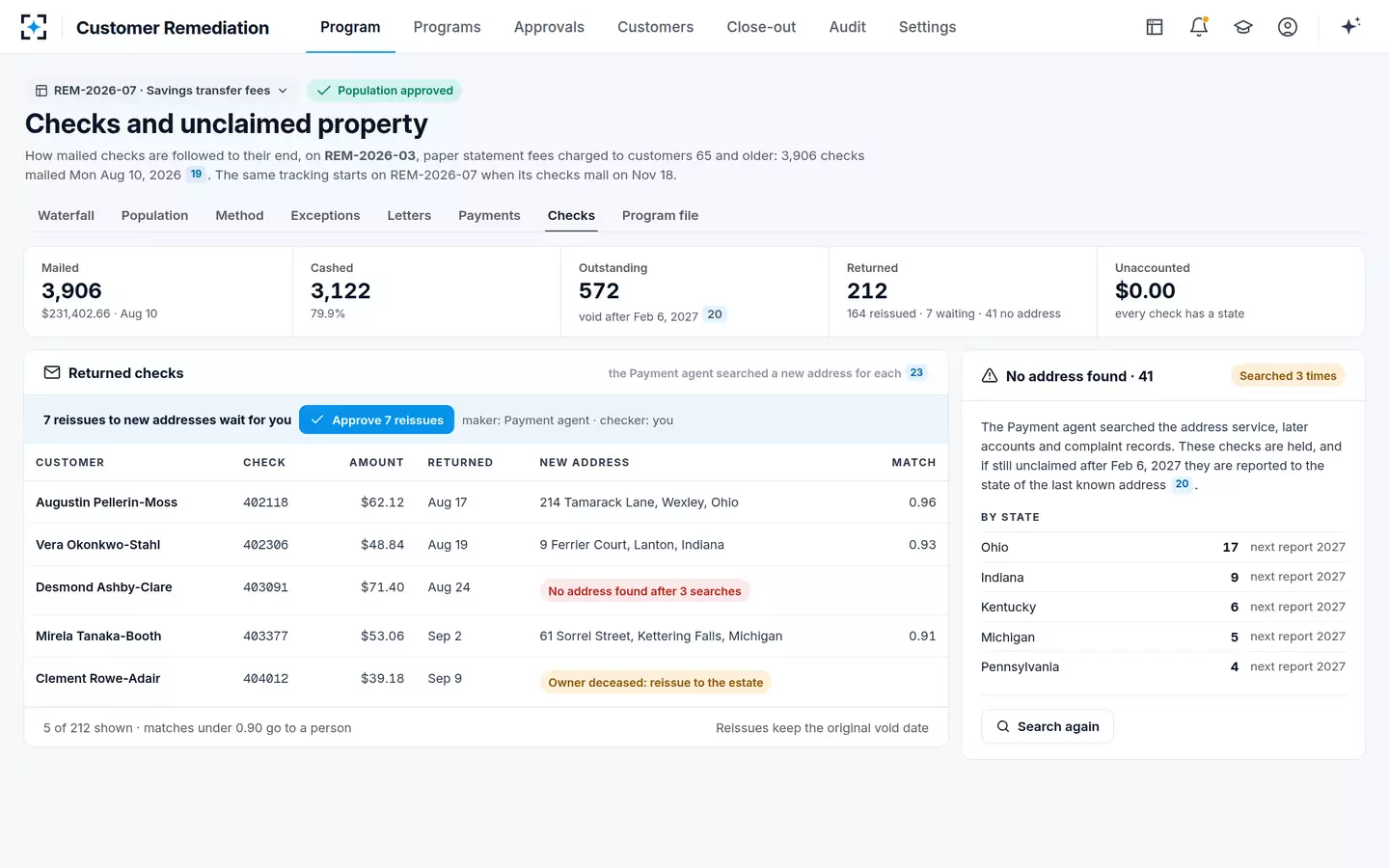
In Botminds' Customer Remediation, the Payment agent watches the returned-mail file daily, searches for a new address for each return and proposes reissues; a match under the program's threshold goes to a person, and the program manager approves reissues as a batch. On a fictional sample program of 3,906 refund checks for paper statement fees, 3,122 had been cashed (79.9%), 572 were outstanding and 212 had come back: 164 reissued, 7 waiting for approval and 41 with no address found after three searches.
Every check followed to its end in Customer Remediation: cashed, outstanding, returned or held
The program closes only when every dollar has a final state: credited, cashed, reissued and cashed, or reported to a state with its general ledger entry. On a closed sample program, internal audit tied 4,269 cashed checks and 519 checks reported as unclaimed property back to the 4,788 issued, with $0.00 unaccounted, and re-performed a sample of each from the clearing record or the state report line. How audit tests delivery describes that sample. Banks running escheat across all accounts, not just remediation checks, will find the wider process under dormant account and escheatment management.
Questions people ask
Can a bank stop payment on its own cashier's check?
Only in narrow cases. The bank is obliged to pay its cashier's check according to its terms, and wrongful refusal can cost it expenses, interest and damages. For a remediation check the bank's block is a control before a reissue or after a reported loss, and it does not remove the obligation to the customer.
How long does a stop payment last?
A customer's stop payment on a personal check lasts six months and can be renewed in writing; an oral order lapses after 14 days unless confirmed. A bank's internal block on its own refund check lasts as long as its procedure says, and should be lifted only when the item is reissued and cashed, or reported.
Can I cash a remediation check after the void date?
Usually not at a bank teller, because the paying bank will reject it. But the money is still owed: call the number on the letter and ask for a reissue. If years have passed, search your state's unclaimed property site; the OCC set no time limit for claiming escheated foreclosure-review payments.
Does reporting a refund to the state end the bank's responsibility?
It ends the bank's custody of the money once the state accepts it, but not its responsibility for the report. The model act keeps the holder “responsible” even when a third party prepares its reports, and the bank must keep its records for ten years after the report.
How do banks report escheated remediation funds?
Through their normal annual unclaimed property reports, state by state, after a due-diligence notice. The remediation file should show each reported check, the state, the report date and the general ledger entry, so that internal audit can tie reported amounts back to checks issued.