Remediation management tools are the software a bank uses to run customer remediation programs: to identify the affected customers, calculate what each is owed, approve and pay it, and prove the result to auditors and regulators. Products sold under the name do very different jobs. Some track issues and tasks; some calculate refunds in a configurable spreadsheet; a few hold every account's population, calculation, letter and payment state in one place. The difference only shows on a real program, which is why the best evaluation is twelve questions asked of one of your own closed programs. Botminds' Customer Remediation uses agents to build the population twice, recompute under versioned methods, draft letters and follow every dollar, with a named person approving each step.
The twelve questions below are ordered the way a program runs. Each one exists because a remediation somewhere failed on it, and the sections after the list explain the hardest of them.
Twelve questions to ask remediation management tools, on one of your closed programs
- Can it read every system that held the history?
Live core, pre-conversion archive, charged-off and retired-product systems, and tell you which it did not read.
- Can it build the population twice, by different methods, and reconcile account by account?
Matching totals is not reconciliation; each difference needs a cause and a source.
- Can it re-run the whole program when the method changes?
And show both versions side by side, account by account, before anyone approves the new one.
- Does it hold interest, day count, rounding and minimums as approved settings?
Versioned, with the rate memo cited, not typed into a cell.
- Can it apply an order’s exact inclusions and exclusions?
Already refunded, charged off and never collected, displaced by a daily cap: each a rule, each counted.
- How does it handle closed, deceased, joint, bankrupt and charged-off accounts?
As groups with a proposed payment route that a person decides.
- Can it draft letters with every fact cited, in each customer’s language?
From templates compliance approved, with no internal findings and nothing for the customer to do.
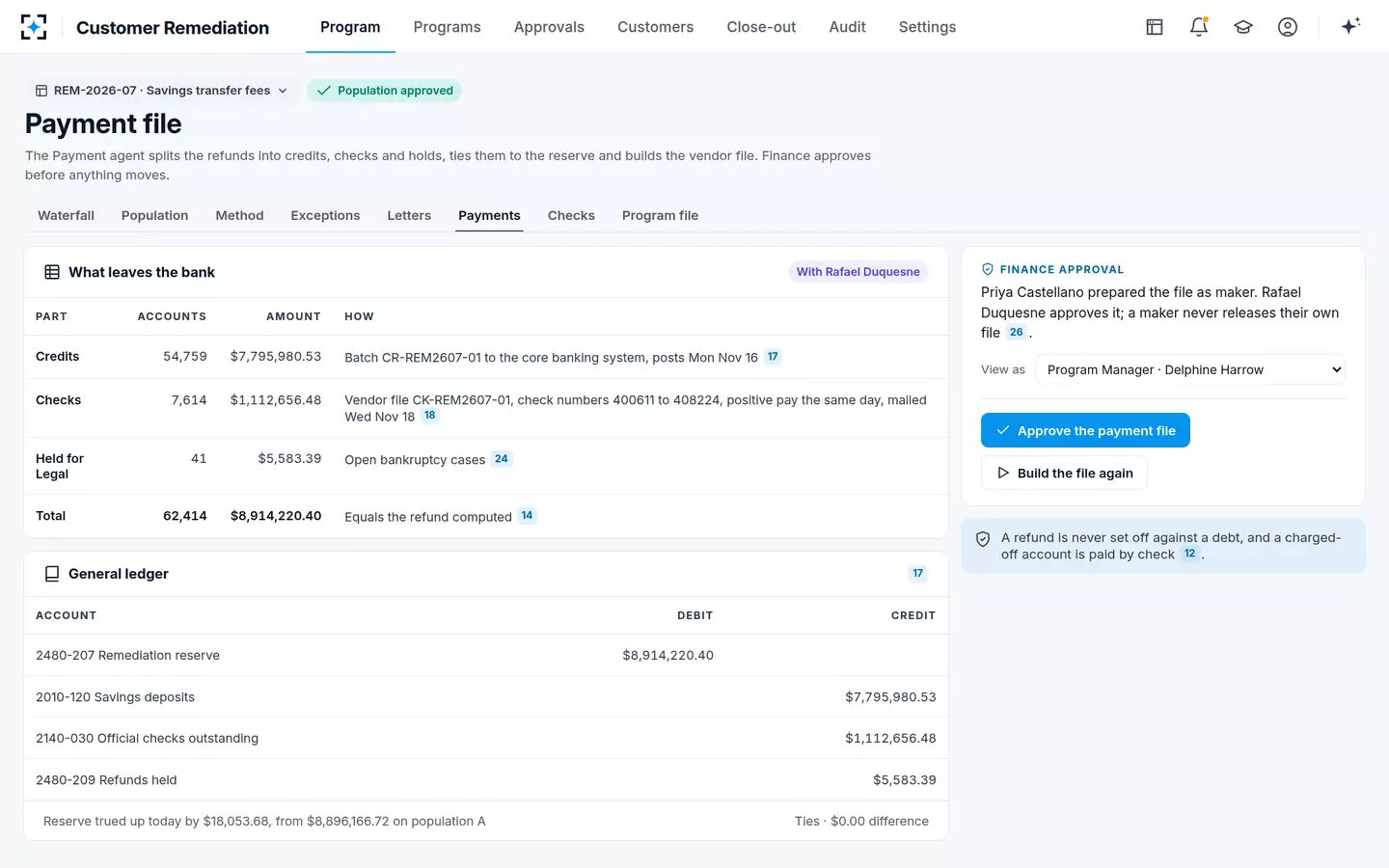
- Does it build payment files tied to the general ledger?
Credits, checks and holds tied to the reserve, and a maker who cannot release their own file.
- Does it follow every check to a final state?
Returns, address searches, reissues, void dates, and the report to each state when its law says.
- Can internal audit re-perform from it independently?
Read-only access, a blind sample from source and its own rebuild of the population.
- Will its audit trail satisfy an examiner?
Who, what, when, why and the evidence, for people and software alike, exportable with account numbers masked.
- What does it connect to, and what does it replace?
Core and archive, issue register, general ledger, check vendor, correspondence, address service and unclaimed property system.
What should remediation software do?
It should do the parts of a remediation that are mechanical, completely and repeatably, and leave the decisions to named people. The mechanical parts are large: extracting years of postings, rebuilding the population, computing each refund with interest, filling letters, building payment files, matching returned mail, ageing checks. The decisions are fewer and heavier: scope, lookback, method, exceptions, letters, release of money and close-out.
It should also make the bank's conduct easy to judge. The CFPB's responsible-conduct bulletin asks whether a bank took “measures, such as a root-cause analysis, to ensure that the issues were addressed and resolved in a manner likely to prevent and minimize future violations” (CFPB Bulletin 2020-01, still in force). A tool that cannot show why the population came out the way it did leaves the bank unable to answer.
What changes when the program lives in one system
Spreadsheet, query and vendor: One query against the live core, saved as a file.
A remediation management tool: Two independent builds across every system, reconciled account by account.
Spreadsheet, query and vendor: A memo, and a workbook with the rate typed in.
A remediation management tool: A versioned method that re-runs on the whole program.
Spreadsheet, query and vendor: Filtered by hand, decided in email.
A remediation management tool: Groups with a proposed route, decided with a reason code.
Spreadsheet, query and vendor: Mail merge from the workbook, checked by eye.
A remediation management tool: Drafted from approved templates, every fact cited to the account.
Spreadsheet, query and vendor: Returned mail worked by hand; uncashed checks age on the general ledger.
A remediation management tool: Every check followed to cashed, reissued or reported.
Spreadsheet, query and vendor: Folders, emails and versions of the workbook.
A remediation management tool: One trail of who did what, when, why and on what evidence.
How do you evaluate remediation management tools?
On one of your own closed programs, with the answer held back. Give each vendor the issue, the scope and access to the history, and ask it to reproduce the population, the refunds and the payment states you already know. Count what it finds that you found, what it finds that you missed, and what it misses. A demonstration on the vendor's data proves only that the vendor's data works.
Pick the test program for difficulty: one that crossed a core conversion, included closed and deceased customers, and had checks returned. Those are the places where a tool either reads the archive or does not, and either routes an estate correctly or prints a check to a dead customer.
Can a tool recompute refunds when the method changes?
It must, because methods change after review, and every change has to be applied to every account. A tool should hold the method as a version, re-run the whole program under a proposed new version, and show the difference account by account and in total before anyone approves it. The OCC's Wells Fargo order anticipated exactly this kind of change, requiring a validation of “The rationale for any changes or adjustments to the underlying facts or assumptions relied upon in determining the population of affected customers, the amount of remediation, and the type of remediation” (OCC Consent Order AA-EC-2018-15; terminated 2025).
Methods must also cope with missing data. ASIC's guide says that where assumptions fill gaps, “licensees should give consumers the benefit of the doubt, and minimise the risk of consumers falling out of scope or being under-compensated” (ASIC RG 277). A tool should let the bank state such an assumption once, apply it consistently and show which accounts it touched.
Interest and minimums: which rules should a tool hold?
Whatever the bank or its order decides, held as a setting rather than a formula in a cell, because there is no single standard. Some US orders require interest: the CFPB's 2022 U.S. Bank order required “interest to account for the time-value of money if this interest is more than one dollar” (CFPB Consent Order 2022-CFPB-0006; terminated 2025). The Truth in Lending restitution policy sets the floor the other way: “If the amount of adjustment on an account is less than $1.00, no restitution will be ordered” (FFIEC, 63 FR 47495). Benchmarks abroad have moved recently, as the table shows.
Interest on remediation refunds: no single rate, and recent changes
| Source | Rate or rule | Status |
|---|---|---|
| CFPB, U.S. Bank order, 2022 | Interest for the time value of money where it exceeds $1 | Terminated August 2025 |
| FFIEC Truth in Lending restitution policy | No restitution ordered on adjustments under $1 | Still the cited policy |
| UK Financial Ombudsman Service | Bank of England base rate plus 1 point, simple; 8% only for late payment and complaints referred before 2026 | In force from January 1, 2026 |
| FCA motor finance redress scheme | Base rate plus 1%, with a 3% annual floor | Final rules March 2026; partially suspended since July 2026 |
| ASIC Regulatory Guide 277 | RBA cash rate plus 6% acceptable where actual foregone returns cannot be calculated | Current (amended April 2026) |
| Fictional sample bank | 4.10% simple a year per its rate memo, or the rate an order sets | A design setting |
The UK changes show why the rule must be a setting. The ombudsman historically applied 8% simple, then concluded it “may no longer reflect prevailing market conditions and could potentially lead to overcompensation in some instances” (FOS policy statement, 2025). The FCA's motor finance scheme set “a floor so the minimum interest rate consumers will receive for any year is 3%”, and then a legal challenge paused it: “The scheme is currently partially suspended” (FCA, updated October 26, 2026). Minimum payments deserve the same care. The FCA lists as poor practice a firm that “decided to not pay out redress where the amount was less than £250” without analysis (FCA FG26/2).
How do tools handle closed accounts and order exclusions?
A good tool treats them as rules and groups, not as filters someone applies by hand. Inclusions and exclusions from an order should be encoded, counted and shown: fees already refunded, fees in charged-off balances that were never collected, fees that only displaced another fee under a daily cap. Closed, deceased, joint, bankrupt and unreachable accounts should be grouped with a proposed payment route, and a person should decide each group.
The tool should also handle the case where the plan falls short. The CFPB's 2023 Bank of America order required the redress plan, “In the event that redress to Affected Consumers is less than the amount identified in Paragraph 27, [to] specify a method for providing alternative consumer redress” (CFPB Consent Order 2023-CFPB-0006; post order). That only works if the system knows, at every moment, how much has been delivered. How banks pay customers who already left covers each group.
Can remediation tools send letters?
They should draft them, and compliance should approve them; the sending is usually done by the bank's correspondence system or print vendor. The test is whether every fact in each letter comes from the account and the approved method, whether the letter asks nothing of the customer, and whether it is in the customer's language. ASIC is blunt about the last point of principle: in-scope consumers “should not be asked whether they want to participate (otherwise known as an ‘opt-in arrangement’)”, and “An in-scope consumer should not be excluded from a remediation or disadvantaged merely because they fail to respond to correspondence, or cannot provide evidence of their loss.”
The FCA reached the same view in 2026: “The opt-in approach creates friction in the process and some eligible individuals may not opt in due to lack of awareness, inertia or vulnerable characteristics.” A tool built around claim forms is built for a different job.
If the customer has to do something to be paid, some will not. A remediation tool should make doing nothing the way to get paid.
Does remediation software handle unclaimed property?
It should track it, and hand it to the system that files. Uncashed checks pass their void date, are reissued or held, and years later are reported to the state of the customer's last known address. The remediation tool should age every outstanding check against each state's dormancy date, build the list for the unclaimed property system and record the report against the check. The bank's unclaimed property system, which already runs the annual reports and due-diligence letters, should do the filing. Void dates, stop payments and unclaimed property explains the timing.
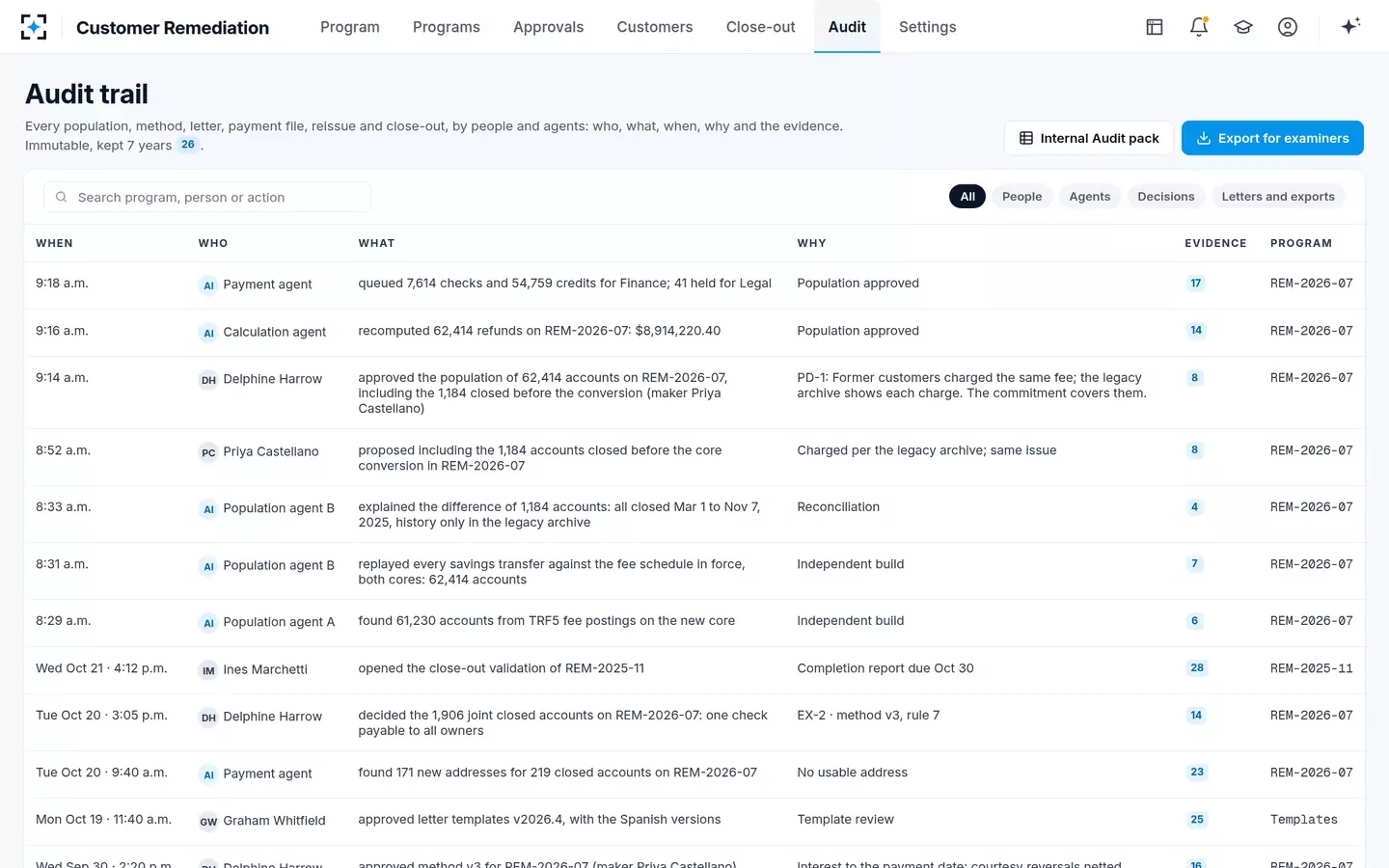
What audit trail should remediation software keep?
Every action, by every person and every piece of software, with who, what, when, why and the evidence, kept for at least as long as the bank keeps the remediation records. Three things are often missing: which source a number came from, which version of a method or agent produced it, and proof that no one approved their own work. Credit-report corrections need their own trail; the OCC asked for “Procedures to validate that requested amendments to affected customers’ credit reports have been accepted and applied by the credit reporting agencies”.
One trail for people and agents in Customer Remediation, exportable for examiners
What integrations does remediation need?
Read access to every system with history, and file exchange with every system that moves money or mail. In practice that is the core banking system and its archives, the issue register and complaint system, the general ledger, the check printing vendor, the correspondence system, the returned-mail file, an address service and the unclaimed property system. A tool that needs a data warehouse built first will spend its first year on that.
The payment file the tool builds and Finance releases
Where Customer Remediation fits, and where it does not
Botminds' Customer Remediation fits programs where the bank holds the transaction history and the harm can be computed from it: deposit and overdraft fees, NSF charges, and interest or fee misapplication. Its agents build the population twice, compute under versioned methods, draft letters and follow each payment; its people approve every step, and its read-only Validation agent works for internal audit. A new version of any agent or method runs on a closed program before it is used on a live one.
It is not an issue tracker, and it does not print checks or file unclaimed property reports: it builds the files and tracks the outcomes. A program that pays for individual consequential losses, like the OCC's 2022 Bank of America order with its “individualized review process administered by an independent third-party payment administrator” (OCC AA-ENF-2022-21; terminated June 2026), needs a claims process for that part. And no tool earns the bank full credit by itself: the OCC weighs whether the bank “has made adequate attempts to locate affected customers, or has made reasonable efforts to ensure that all affected customers receive restitution, but restitution is not 100 percent complete” (OCC PPM 5000-7), which is a judgment about the bank's effort that the evidence in the tool supports. Going live on your next program sets out the first eight weeks.
Questions people ask
What is the difference between remediation management and remediation tracking?
Tracking reports where a program stands; management runs it. A tracker can tell you that 7,614 checks were mailed; a management tool built them, knows each one's amount and customer, and follows each to cashed, reissued or reported. Many banks buy a tracker and discover they needed the second.
Should a bank build its own remediation tool?
Some large banks have, usually as a data platform plus workflow. The cost is less in the build than in keeping it current: every program brings a new product, a new system and a new method. Ask whether your team will maintain the population logic for each program, because that is where in-house tools fall behind.
How long does a remediation tool take to evaluate?
A back-test on one closed program takes a few weeks if data access is ready, most of it spent getting history out of the archive. That time is not wasted: the same access is what the next live program needs.
Can one tool handle remediations for deposits, cards and loans?
If it reads each product's history and holds each product's method, yes; the program structure is the same. Lending remediations add credit-report corrections and payoff adjustments, so ask to see those on a loan program before assuming they work.
Do remediation tools use AI, and is that allowed?
Some do. The banking agencies' revised model risk guidance of April 2026 states that it sets no enforceable standards or prescriptive requirements, and it generally does not apply to banks of $30 billion or less without significant model risk (FDIC FIL-15-2026). What examiners look for in a remediation is that people own the decisions and the bank can show how each number was produced, which is why agents should propose and cite, and never approve.