Banking remediation jobs are the roles that run customer remediation programs, the work a bank does after it finds it charged customers wrongly: remediation analysts who build the affected population and calculate refunds, remediation program or project managers who own the scope and the decisions, consumer compliance officers who approve what customers are told, finance controllers who release the money, and internal auditors who validate the result. Titles vary from bank to bank and the government's job statistics have no remediation category, so most of these jobs are counted as compliance officers, accountants and auditors. The work is hard because most of the week goes on extracts, reconciliations and spreadsheets rather than the judgment calls the job titles promise. Botminds' Customer Remediation gives that mechanical work to agents and leaves each person the decision their seat exists to make.
The occupations remediation jobs are counted under
417,070
compliance officers employed in the US, all industries; median pay $80,730
BLS OEWS, May 2025
$83,680
median pay of 1,449,500 accountants and auditors, the occupation that includes internal auditors
BLS OEWS, May 2025
7%+
projected growth for financial examiners, well above the average occupation; mean pay $106,240
O*NET and BLS, 2025–26
What banking remediation jobs exist?
Five seats appear in almost every program, whatever they are called: the analyst who builds, the program manager who decides, the compliance officer who governs the words, the finance controller who moves the money and the auditor who validates. Larger banks add data engineers who extract history from old systems, lawyers for bankruptcy and estate cases, and contact-center staff who answer customers' calls. Smaller banks fold the first two seats into one compliance officer, and use an outside firm for the validation.
The five seats in a customer remediation, and what each signs
| Seat | Usually sits in | What they own | What they sign |
|---|---|---|---|
| Remediation analyst | Consumer compliance or the business line | Population builds, calculations, exception proposals, payment file preparation | Nothing alone: every proposal as maker |
| Remediation program or project manager | Consumer compliance | Scope, lookback, method, timeline and the regulator’s commitments | Population, method and reissue approvals |
| Consumer compliance officer | Compliance | The rules that apply and every word customers read | Letters and templates |
| Remediation finance controller | Finance | Reserve, credits, official checks, unclaimed property reports | Release of the payment file |
| Internal audit validation lead | Internal audit | Independent re-performance and the close-out opinion | Validation before completion is reported |
What does a remediation analyst do in a bank?
Most of a remediation analyst's week goes on four tasks: finding the affected accounts in the bank's systems, calculating each refund, sorting the accounts that need special handling, and building the files that pay them. The occupational database the Labor Department maintains describes the compliance officer's work in terms that fit: “Identify compliance issues that require follow-up or investigation” and “Provide assistance to internal or external auditors in compliance reviews” (O*NET 13-1041).
The skill that separates a good analyst is knowing where history lives. A query against today's core finds today's customers; an analyst who knows the core was converted in November 2025, and that closed accounts stayed in an archive, finds the former customers too. In a fictional sample program, that knowledge was worth 1,184 customers and $18,053.68 in refunds that a single query would have missed.
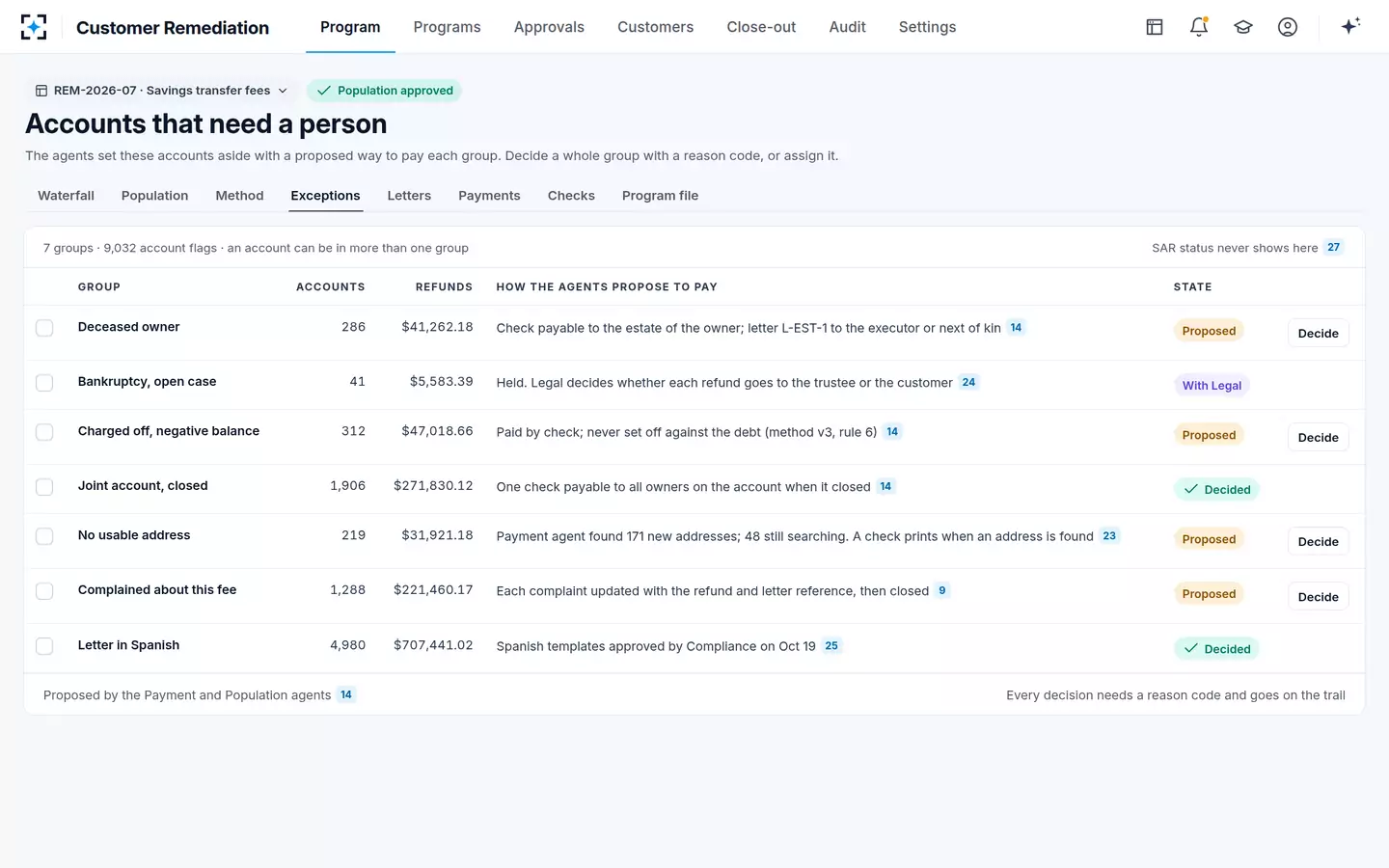
The other half of the job is the accounts that do not fit. In the same sample program the analyst faced seven groups that needed a decision: 286 accounts whose owner had died, 41 in an open bankruptcy, 312 charged off with a negative balance, 1,906 closed joint accounts, 219 with no usable address, 1,288 customers who had complained about the fee and 4,980 who needed a letter in Spanish. Each group needs a payment route someone can defend: a check to the estate, a hold for Legal, a check rather than a setoff, one check payable to all owners. That is analyst work no query does, and it is where experience shows.
What does a remediation project manager do?
The project or program manager owns the remediation from scope to close-out: the lookback dates, the method, the timetable promised to the regulator, the decisions on each population and the reporting to senior management. In a bank with several programs open at once, the job is mostly sequencing decisions so that none waits on another, and making sure nothing is paid before the population is settled.
The UK regulator's March 2026 guidance on redress exercises shows what good governance above that seat looks like: “A firm had an overall compliance board, chaired by their Chief Risk Officer, which” brought together complaints, product, compliance and legal teams and oversaw redress exercises (FCA FG26/2). The program manager is the person who brings each decision to that table with the evidence attached.
Who approves a remediation method, and who owns customer remediation?
A senior person named for the program approves the method, and the board holds management to account for it. ASIC describes the arrangement directly: “For incorporated businesses, this may include reporting to the board or appointing a director or senior executive as the person responsible for the remediation”, with independent oversight where appropriate, and “The person(s) providing oversight should not oversee their own work” (ASIC RG 277). Australia's accountability regime now goes further: “Under the FAR regime, accountable entities will need to nominate an accountable person responsible for oversight of remediation programs” (ASIC, 2023).
US supervisors put it in compliance-management terms. The OCC's handbook says the board “should be apprised of material issues and resolution strategies, and hold management accountable for correcting issues and validating corrective actions” (Comptroller's Handbook, Compliance Management Systems), and the FDIC expects the compliance officer to have the authority to “effect corrective action” (FDIC Consumer Compliance Examination Manual II-3). In the UK a firm “must appoint an individual at the firm, or in the same group as the firm, to have responsibility for oversight of the firm's compliance with DISP 1” (FCA Handbook, DISP 1.3.7R), which covers proactive redress for customers who never complained.
Every regulator that has written about remediation names a person. None of them names a spreadsheet.
How big is a remediation team?
Smaller than the work makes it look, when the mechanical steps are done for it, and much larger when they are not. The fictional sample bank in these guides runs eight open programs, six to nine a year, with five people signing and a second analyst sharing the exceptions. The opposite extreme is the Independent Foreclosure Review, where file reviews were done by hand by outside consultants: “As of August 2012, the collective costs for the consultants had reached $1.7 billion, according to OCC’s decision memorandum”, and the regulators ended the reviews partly because the remaining fees would have been at least $2 billion more (GAO-14-376).
Headcount is the main cost in either model. A Federal Reserve study of community banks found that personnel was by far the largest category of compliance expense, more than three-fifths of the total in every size group (Federal Reserve Bank of St. Louis, 2016). Tooling that removes extract and spreadsheet work changes the size of the team more than anything else a bank can buy.
How do remediation teams work with finance?
Through the reserve, the payment file and the general ledger. Finance books the remediation reserve when the issue is estimated, trues it up when the population is approved, releases credits and official checks against it, and keeps the outstanding checks on its books until each is cashed, reissued or reported to a state. In the sample program, approving 1,184 more former customers trued the reserve up by $18,053.68 the same day. Finance also owns the measure that matters most at the end, how much of the money reached customers; the KPIs that price a program sets them out.
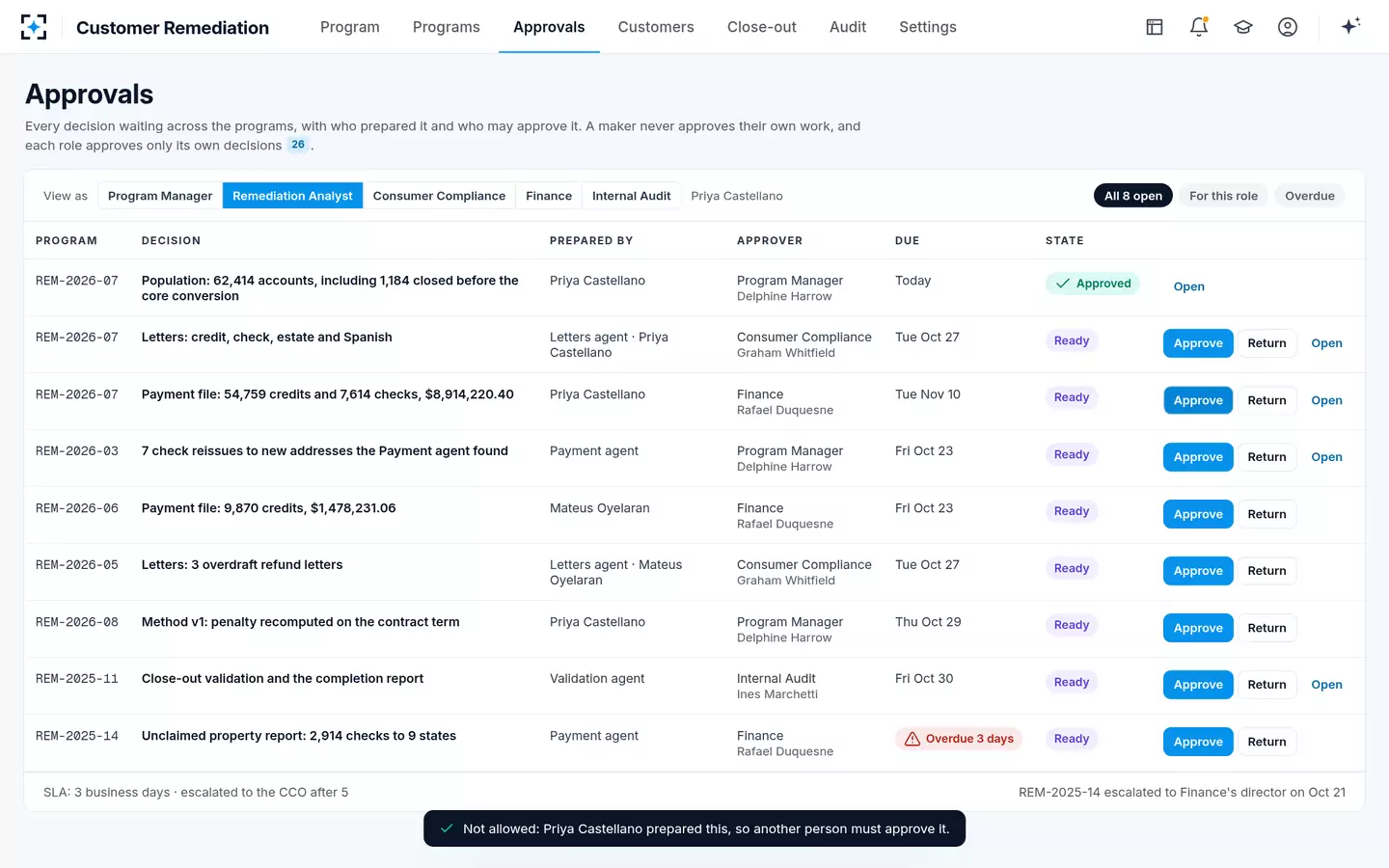
The working rule is that the person who prepares a payment file never releases it. In the sample bank, the analyst who built the file was stopped by the system when she tried to approve it herself, and the finance controller released it after the credits, checks and holds tied to the reserve to the cent. That separation is the first thing an auditor tests.
What skills do remediation jobs need?
Data, regulation, arithmetic and writing, in that order of scarcity. An analyst needs enough SQL or data skill to know what a query misses, a working knowledge of the rules behind the fee (Regulation DD, Regulation E, UDAAP), and the patience to compute interest correctly to the cent. A program manager needs judgment about scope and the discipline to document every decision. Everyone needs to write for customers in plain words; the sample bank's letters are measured at a sixth-grade reading level.
No certification is specific to remediation. Compliance, audit and project credentials all apply, and experience in the product that caused the harm counts for more than any of them: an overdraft remediation is run best by someone who understands how the core posts overdrafts.
Will AI replace remediation analysts?
It replaces the part of the job that is extraction and arithmetic, not the part that is judgment, and regulators expect a named person to own each decision. Our estimate for one program at a large regional bank is that the team's working weeks from population to payment fall from about ten to about four with agents doing the builds, the calculations and the drafts. What remains is concentrated in the hard cases.
Where a remediation team's weeks go, by hand and with agents
By hand, ~10 weeks
- Population · 30%
- Refunds · 20%
- Letters · 20%
- Exceptions · 15%
- Payment file · 15%
With agents, ~4 weeks
- Population · 25%
- Refunds · 12.5%
- Letters · 25%
- Exceptions · 25%
- File · 12.5%
The analyst's seat changes most. Instead of writing the query, the analyst reviews two builds that never saw each other, proposes how to resolve each difference with a reason code, and decides exception groups in bulk. The population, the method and the payment are still approved by different people, and the agents approve nothing. Why two population builds must agree shows the review the analyst now does.
The remediation team in Customer Remediation
In Botminds' Customer Remediation each of the five seats has its own decisions and nobody can approve their own work. The People figure below describes the fictional team at the sample bank, before and after the agents took the mechanical part of each week.
Five remediation seats in Customer Remediation, before and with agents: what each keeps
Today
Writes the query against the core, computes refunds and interest in a spreadsheet, keeps the method in a memo and builds the payment file by hand.
With agents
Reviews two cited population builds, proposes how to resolve each difference and decides exception groups with a reason code.
Still theirs: Every proposal as maker, and the judgment on hard cases: estates, bankruptcy, joint owners.
Today
Signs a population built from one extract, and learns about the customers it missed from the next finding.
With agents
Approves the population only when two blind builds agree, and sees every program’s next decision on one screen.
Still theirs: Approval of populations, methods and reissues across all open programs.
Today
Reads letter templates by hand before a vendor prints them.
With agents
Approves or returns plain-language letters in each language, every fact cited to the account record.
Still theirs: The governing rules and every customer-facing word.
Today
Books the reserve, posts credits, issues official checks and watches uncashed checks age.
With agents
Releases the payment file only when credits, checks and holds tie to the reserve, and sees each check to its end.
Still theirs: Release of money, the general ledger and the unclaimed property reports.
Today
Samples accounts and re-performs refunds from workbooks with hand-edited rates.
With agents
Signs the close-out after a blind re-performance from source, a rebuilt population and a general ledger tie-out.
Still theirs: The independent opinion, and the signature before completion is reported.
Every decision waiting across the programs, with maker and approver
The analyst's real work: accounts that need a person
Questions people ask
What is a remediation analyst's salary?
Government statistics do not track the title. The nearest occupation, compliance officers, had a median annual wage of $80,730 in May 2025 across all industries, and financial examiners a mean of $106,240. Pay for analysts inside banks varies with location, seniority and whether the role sits in compliance, operations or audit.
Is remediation a good career in banking?
It is steady work: banks run remediations every year, and regulators have kept asking for refunds even as penalties have fallen. It also teaches how a bank's products, systems, controls and regulators fit together, which is why remediation experience leads naturally into compliance testing, audit and product risk roles.
Do remediation jobs require a specific qualification?
No. Employers look for data skills, knowledge of consumer banking rules and audit or compliance experience. Product knowledge matters most: the best overdraft remediation analyst is the one who knows how the core posts overdrafts.
What is the difference between a remediation analyst and a KYC remediation analyst?
A customer remediation analyst works out who is owed money and how much. A KYC remediation analyst brings customer due-diligence files up to standard, with no refund involved. The titles look alike in job listings; the skills overlap only in data handling.
Who does a remediation team report to?
Usually the chief compliance officer, with a dotted line to the business that caused the harm and regular reporting to a risk or compliance committee. Internal audit, which validates the work, reports separately to the audit committee, which is what keeps its opinion independent.