Remediation tracking software is the system a bank uses to follow a customer remediation from the issue to the last dollar: who is affected, what each is owed, what has been paid and how, and what remains unpaid. Most tools sold under the name track tasks and due dates, which is useful for a project and blind to the question a regulator asks, whether customers actually received their money. The test of a tracker is whether it reports a program in dollars at each stage, from refunds computed to credits posted, checks cashed, checks reissued, amounts reported to the states and the amount nobody can account for. Botminds' Customer Remediation is built that way: each program reads as one waterfall of counts and dollars, each tied to its source, and it cannot close while any dollar lacks a final state.
Measuring in money changes what "done" means. A program that has printed every check is complete in the project plan; at the cash rates mass refund programs achieve, it can be a long way from complete in customers' pockets.
What “paid” really looks like in mass refund programs
55%
weighted cashing rate of checks sent automatically, without a claim, in 149 class actions
FTC staff report, 2019
81%
of Independent Foreclosure Review checks cashed nine months after the first mailing
GAO-14-376, January 2014
29%
of reported customer loss paid by Australian licensees at 30 June 2023, for breaches reported that year
ASIC REP 775
What is remediation tracking software?
It is software that holds a remediation's population, calculations, payments and their outcomes, and reports the program's status from that data rather than from people's updates. Three kinds of product are sold under the label. Issue and project trackers, often part of a governance, risk and compliance suite, record the issue, owners, tasks and dates. Spreadsheets with a payment vendor behind them hold the money but not the history. A remediation system holds both, account by account. Only the third can tell a board how many customers have been paid.
The OCC's 2018 order against Wells Fargo shows what regulators expect a tracker to produce. It required “Monthly reporting of the status of any anticipated or ongoing Remediation Plans developed by the Bank (“Remediation Report”)” and standards for “The issuance and tracking of remediation payments disbursed to affected customers” (OCC Consent Order AA-EC-2018-15; terminated February 13, 2025). A monthly report on payments disbursed and tracked is a money report, not a task list.
How do you track a remediation program?
As a waterfall: each stage a count of accounts and a sum of dollars, each stage reconciling with the one before. The stages are accounts screened, accounts affected, refunds computed, paid by credit, paid by check, checks cashed, checks returned and reissued, amounts reported to states, and unaccounted. If a stage does not tie to the one before it, the tracker should say so, and nothing downstream should move until a person decides why.
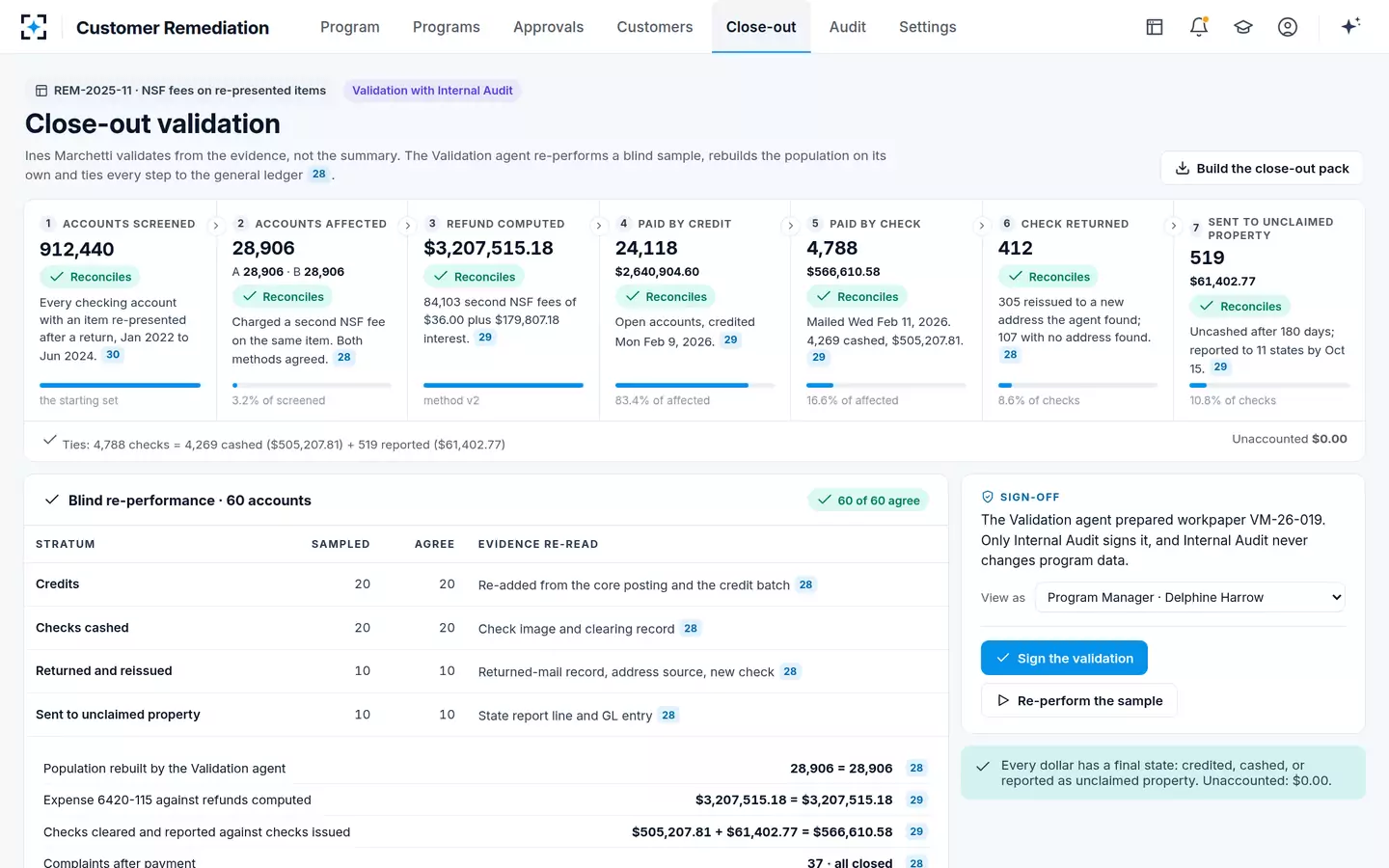
Take a closed program at a fictional sample bank, run through Botminds' Customer Remediation: NSF fees charged again on re-presented items. 28,906 accounts were affected and owed $3,207,515.18 with interest. The waterfall below follows those dollars to their ends.
One closed program in money: computed, credited, cashed, reported, unaccounted
Counted at print or counted in money: one program, two reports
The same program reads very differently depending on what the tracker counts. Take another fictional sample program, paper-statement fees refunded to customers aged 65 and over: 3,906 checks worth $231,402.66 mailed on August 10, 2026. A task tracker marks the payment step complete that day. Ten weeks later, the money view shows 3,122 checks cashed, 79.9% of them, 572 still outstanding with a void date in February 2027, and 212 returned by the post office, of which 164 had been reissued, 7 were waiting for approval and 41 had no address after three searches.
The same remediation, reported two ways ten weeks after mailing
Counted at print: Complete: 3,906 checks mailed.
Counted in money: 3,122 cashed (79.9%); 572 outstanding; 212 returned.
Counted at print: Reported as all of them.
Counted in money: Four in five, with the rest named and assigned.
Counted at print: None: the program waits for close-out.
Counted in money: 7 reissues to approve; 41 addresses to search again; a reminder before the void date.
Counted at print: On schedule.
Counted in money: On schedule, with a fifth of the refunds not yet in customers’ hands.
Which KPIs measure remediation?
Five money measures and five control measures cover almost everything a program manager, a CFO and an examiner ask. The money measures say how much of what is owed has reached customers. The control measures say whether the numbers can be trusted and whether the program is moving.
Ten remediation KPIs, and what each tells you
| KPI | How it is computed | What it tells you |
|---|---|---|
| Paid rate, by value | Credits posted plus checks cashed, divided by refunds computed | How much money has actually reached customers |
| Credit share | Refunds paid by account credit, divided by refunds computed | How much of the program needs no customer action at all |
| Check cash rate | Checks cashed, by count and by value, divided by checks issued | Whether letters and addresses are working |
| Return rate | Checks returned undeliverable, divided by checks mailed | The quality of the address search before mailing |
| Unaccounted | Refunds computed minus every final state | Must be $0.00 before close; anything else is a control failure |
| Population drift | Accounts added or removed after the population was approved | Whether the first population was complete |
| Recompute variance | Independent recalculation minus program amounts, to the cent | Whether the method was applied correctly |
| Age of outstanding checks | Checks outstanding by months since issue, and by state dormancy date | What will reach the states, and when |
| Decision latency | Days each approval waits against its service level | Where the program is stuck |
| Time to pay | Days from issue identified to first payment, and to close | What the regulator will judge as timely |
What is the cash rate of a remediation, and what is normal?
The cash rate is the share of mailed checks, by count or value, that customers have cashed. For checks sent without a claim, which is what a bank remediation sends, a weighted rate around 55% is common, falling to 39% for amounts under $10, according to the FTC's study of 149 class action settlements (FTC staff report, 2019). The FTC's own programs do better: for payments sent from defendants' customer lists in 2024, “To date, 59% of eligible consumers have cashed their payment”, and “the average participation rate for these cases is 81%” across the 17 programs whose first distribution was complete (FTC, 2024 Annual Report on Refunds to Consumers).
A determined program does better again. The foreclosure review reached about 81% of checks cashed by January 2014, 87% of funds by January 2015, and finished at “a cash rate of nearly 91 percent of the total value of the funds made available to borrowers” after, in most cases, at least two follow-up attempts per borrower (Federal Reserve, 2019). A bank should set its own target from the amounts involved, because size drives the rate more than anything.
Check cash rates rise with the amount: checks sent without a claim
When is a remediation complete?
When every dollar computed has a final state, internal audit has validated the program, and only then the completion report goes to the regulator. Final states are few: credited, cashed, reissued and cashed, held for a legal reason, or reported to a state under its unclaimed property law. "Mailed" is not a final state, and neither is "void".
Regulators judge completeness in customers, not effort. Australia's corporate regulator found that, at June 30, 2023, licensees “had paid out approximately 29% of the total customer financial loss reported and had compensated 19% of financially impacted customers for the reporting period” (ASIC REP 775). A tracker that reported tasks would have shown those programs on schedule.
How do you measure unpaid redress?
As dollars and accounts without a final state, aged. Outstanding checks are not unpaid redress until their void date passes; after that they are owed money awaiting a reissue, a claim or, years later, a state report. A useful report shows four buckets: checks within their void date, returned and being searched, past void and held, and reported to a state. Each bucket has a different action and a different owner.
The money in the last bucket is still the customer's, but the bank's exposure on it is different. Whether money that cannot be delivered goes to the states, back to other customers or to the regulator depends on the order or the bank's policy; void dates, stop payments and unclaimed property sets out the choices.
How much does a remediation program cost?
The refunds are what is owed, not the cost; the cost is everything a bank spends to pay them, plus what it spends when it gets them wrong. There is no published US benchmark for a bank's own programs. The public extreme is the foreclosure review, where consultants had cost $1.7 billion by August 2012, and the regulators replaced the file reviews with direct cash payments of about $3.9 billion to 4.4 million borrowers.
The cost of a remediation program, term by term
Team time
working weeks × loaded weekly cost
Population, calculation, letters, exceptions and payment files. Our estimate for one large-bank program: about 10 weeks by hand, about 4 with agents.
Program manager
Payment costs
checks × (print + postage + positive pay) + address searches
Falls as the credit share rises; every open account credited is a check not mailed.
Finance
Validation
audit hours + any outside firm
Smaller when the population was built twice and every refund can be re-performed from source.
Internal audit
Rework
missed customers × (refund + second letter + second payment run)
The term that turns one program into two. A complete first population sets it to zero.
Program manager
How do you report remediation to the board?
In money and age, with exceptions named. A board or audit committee report should show, for each open program, the dollars computed and the paid rate, the oldest decision outstanding, and any program where the population changed after approval. The Federal Reserve's audit guidance asks for the equivalent on audit issues: “Audit issue information, including aging, past-due status, root-cause analysis, and thematic trends” and for higher-risk issues their “potential impact, root cause, and remediation status” (SR 13-1).
The board will also want to know how a regulator would score the program. The OCC's civil money penalty matrix weighs restitution as a mitigating factor, considering “the extent to which the bank timely provides complete restitution (as determined by the OCC) to all affected customers” and “the bank’s timeliness, proactiveness, and good faith” (OCC PPM 5000-7). Paid rate and time to pay are those two words in numbers.
What to look for in remediation tracking software, and where Customer Remediation fits
Look for a system that knows the money account by account and proves every number to its source. Ask each vendor to load one of your closed programs and reproduce its final figures; the questions below decide what that test shows. Twelve questions before you buy goes deeper on calculation, letters and integrations.
What remediation tracking software should do
- Report in dollars at every stage
Computed, credited, issued, cashed, reissued, reported, unaccounted, with the counts beside them.
- Hold each account’s state
Not a total from a spreadsheet: every account’s refund and where its money is now.
- Refuse to treat printed as paid
A check is not a final state until it clears, comes back or is reported.
- Tie to the general ledger
Reserve, credits, official checks outstanding and state reports reconcile to the cent.
- Show population drift
Accounts added after approval are a measure of the first build’s quality.
- Age outstanding checks by state
With each state’s dormancy date, so the unclaimed property calendar is known in advance.
- Keep maker and checker on every decision
And the latency of each approval against its service level.
- Export for the board and the examiner
From the same data, with account numbers masked.
Botminds' Customer Remediation fits fee and charge remediations where the bank holds the transaction history: deposit fees, overdraft and NSF charges, interest or fee misapplication. It reads the core and its archives, computes, writes the letters and follows each payment, and it connects to the systems a bank already uses rather than replacing them. It does not print checks or file state reports itself: the check vendor and the unclaimed property system do, from files it builds. And a program built on individual claims and consequential losses needs a claims process for that part, with the tracker counting its outcomes.
Every program's money in Customer Remediation, waterfall by waterfall
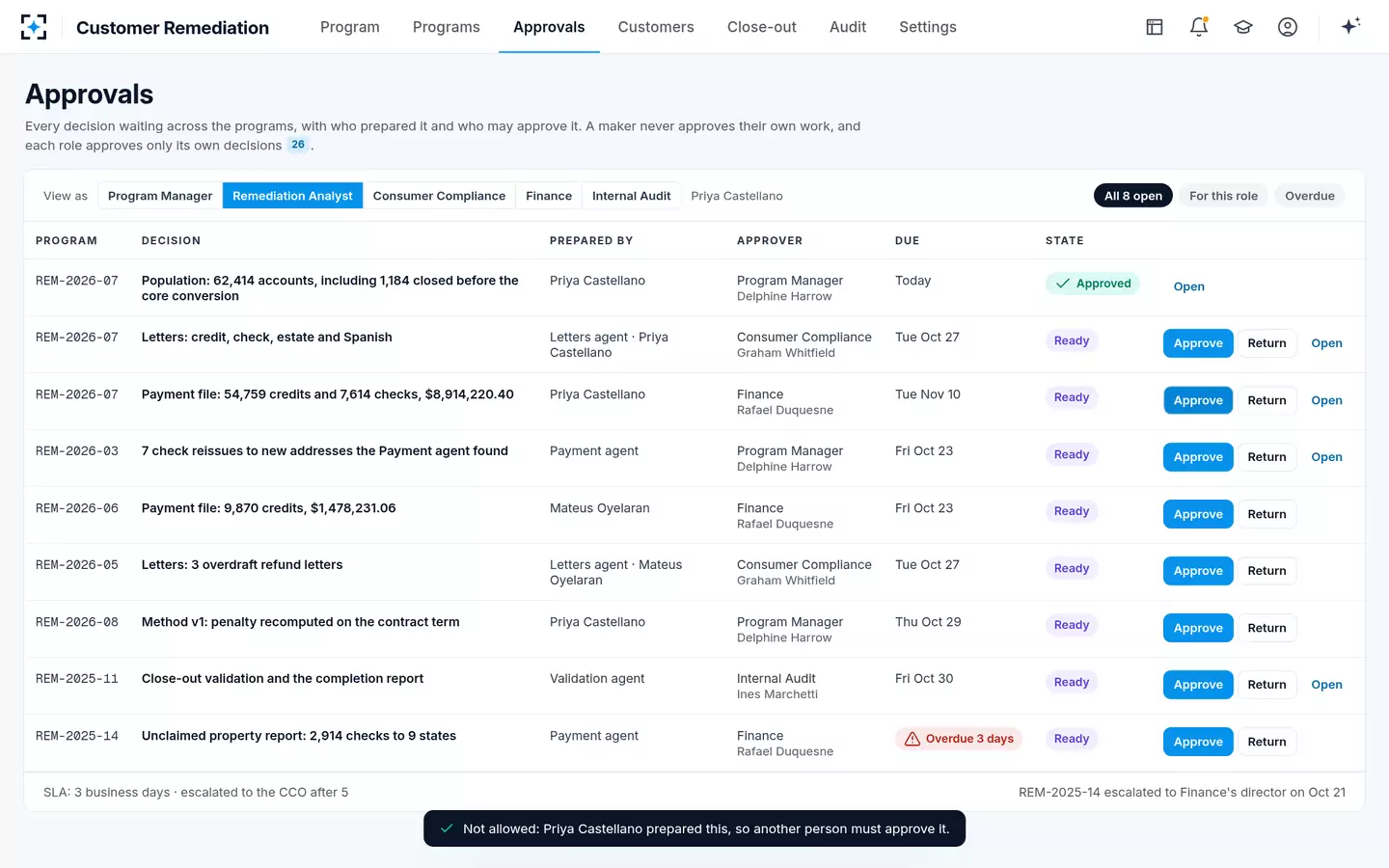
Decisions waiting, with their age and service level
Questions people ask
Can a GRC issue tracker be used for remediation tracking?
For the issue, owners and deadlines, yes. For the money it cannot, because it does not hold each account's refund and payment state. Many banks use both: the GRC tool for the issue's lifecycle and a remediation system for the program behind it, with the completion status flowing from the second to the first.
What is a good cash rate for remediation checks?
It depends on the amounts. For checks sent without a claim, the FTC found 39% under $10 and more than 80% between $50 and $200. Credit every open account first, and set a target per amount band rather than one figure for the program.
Should remediation be reported by count of customers or by dollars?
Both, because they diverge. Small refunds are cashed least, so the paid rate by customers is usually lower than by value; a program can be 95% paid in dollars and leave thousands of small-balance customers unpaid. Board reports should show both.
How often should a remediation be reported?
Monthly to senior management while it is open, the cadence the OCC required in its Wells Fargo order, and to the board or its committee each quarter. The report's figures should come straight from the system, not from a slide someone updates.
What happens to the KPI when checks go to the state?
Amounts reported under unclaimed property law are a final state, so the program can close, but they are not paid to the customer. Report them separately from cashed checks: on the closed sample program, 1.9% of the money went to the states.