A refund to a closed account cannot be credited: the receiving bank rejects the deposit and the money goes back to whoever sent it, who then owes the payment by another route. Nothing is lost, but nothing arrives until the payer acts. That is true of a merchant refund, a tax refund and a bank's own refund of a fee it should not have charged. The last case is the one this guide is about. When a bank runs a customer remediation, its former customers are owed exactly what current customers are owed, yet they are the hardest to find and the easiest to leave out. Botminds' Customer Remediation builds the affected population from every system that holds history, including archives of accounts closed before a core conversion, and routes each former customer to a check, an estate or a person's decision.
Former customers are where remediation populations break
1,184
former customers one population method missed in a fictional sample program, all closed before a core conversion
Found by a second, independent build
7,614
refund checks in that program, one for every affected account already closed, against 54,759 credits
Fictional sample data
$5
the only small-amount exception ASIC allows: former customers owed that or less, with no payment details on file, may be paid through a charity
ASIC RG 277
What happens to a refund sent to a closed account?
It is returned to the sender, and the sender has to pay again by another method. An account that has been closed cannot accept a credit, so the deposit is rejected by the bank that held it. What happens next depends on the payer's own rules: a merchant may issue a check or ask for new account details; a government agency follows its program's procedure; a bank refunding its own former customer mails a check.
The practical advice for anyone waiting for a refund that went to a closed account is the same in every case. Do not try to reopen the old account; contact the payer, confirm they received the returned money, and give them a current address or account. Allow for a delay of weeks: returned payments are worked in batches, and a check is slower than the deposit that failed.
If it was your tax refund: the 2026 IRS rule
Federal tax refunds now work differently, because the IRS is phasing out paper checks. The National Taxpayer Advocate explains that from 2026 “The IRS will freeze most direct deposits that are rejected by the bank and will not automatically reissue them as paper checks” (Taxpayer Advocate Service, January 2026). The IRS sends a CP53E notice asking for new bank details through the taxpayer's online account, usually with 30 days to respond; “If you don’t take any action, the IRS will issue a paper check after six weeks.” The notice is sent once, so a second rejected deposit does not get a second chance.
A bank's refund of its own fees follows no such national rule. Its procedure is set by its own policy and, if there is one, by the order that requires the refund. The rest of this guide is about that procedure.
Can a bank refund a closed account?
It cannot credit one, so it pays the former customer another way, almost always by check. CFPB orders write this into the redress plan. The 2023 order against Atlantic Union Bank, which covered “current and former customers”, gave the bank the choice of a check or an account credit for current customers but required it to “mail a Redress Notification and mail a bank check to each Affected Consumer who no longer maintains a checking account with Respondent”, by first-class mail with the Postal Service's address-correction service (CFPB Consent Order 2023-CFPB-0017; status: post order, CFPB). The 2022 Regions order put it as a rule of preference: direct deposit whenever feasible, a paper check when it is not (CFPB Consent Order 2022-CFPB-0008; terminated July 21, 2025).
A former customer who still holds another account at the bank, such as a savings account after closing checking, can often be credited there; the plan should say whether that is allowed and how the customer is told. A transfer to an account at another bank needs verified details the bank rarely has for someone who left years ago, which is why the check remains the default.
How one remediation pays: credits for open accounts, checks for everyone who left
Accounts
- Open, credited: 54,759 · 87.7%
- Closed, check: 7,614 · 12.3%
Dollars
- Credits: $7.80M · 87.5%
- Checks: $1.11M · 12.5%
Why former customers fall out of remediation populations
Because the systems a bank queries first are the ones that hold today's customers. A core conversion migrates open accounts and leaves closed ones in an archive; a charged-off account moves to a recovery system; a product retired years ago keeps its history somewhere nobody has queried since. A population built from the live core finds the living accounts and stops.
Some programs leave former customers out on purpose, which regulators treat as worse. The UK regulator's March 2026 guidance on redress exercises describes a firm that knew an issue had affected previous customers, yet “decided to only include current customers in the exercise, without first trying to contact ex- customers, meaning many customers did not receive adequate redress” (FCA FG26/2). ASIC allows only one narrow exception, “for former customers owed $5 or less (after interest) with no current payment information on file”, whose amounts may go to a residual payment to a charity instead (RG 277). US orders make no such exception: the OCC's 2018 TCF order, like the CFPB orders above, defined the affected as “current and former TCF customers” (OCC AA-EC-2018-38).
Closing an account ends the relationship. It does not end what the bank owes for the time the relationship lasted.
How do banks find former customers for refunds?
With an address search before the first mailing and a second, different search after any return. The CFPB's 2024 order against Navy Federal Credit Union is the most detailed public standard. Before mailing, the credit union had to seek a current address “by using, at a minimum, the National Change of Address System (NCAS), any databases maintained by Respondent that are reasonably accessible by Respondent, and skip-tracing”. After a return, it had to use “a commercially available database other than the NCAS by attempting to contact the Affected Consumer at their last known email address or phone number” and mail again (CFPB Consent Order 2024-CFPB-0014).
The same order kept the money available after a final return: the credit union had to “retain the redress amount of such Affected Consumer for a period of one hundred and eighty (180) days from the date the check was mailed or re-mailed, whichever is later, during which period such amount may be claimed by such Affected Consumer upon appropriate proof of identity”. The CFPB terminated that order on July 1, 2025 and waived any alleged non-compliance; its termination notice does not say whether redress was paid (CFPB). The address standard is still the best published description of reasonable effort.
Finding a former customer: two searches and a person for the doubtful matches
Agent
Before the first mailingLast address on file checked against the change-of-address database, the bank’s other systems and a locator search.
A person decides
Low-confidence matchesWhere the match score falls below the program’s threshold, a person confirms the address before a check is printed.
Never: A check printed to an address nobody has confirmed.
Agent
After a returnA different commercial source, plus the last known email and phone, then a reissue to the new address.
A person decides
Still no addressThe refund is held as an outstanding obligation, claimable by the customer, and reported to the state when the law says.
Do charged-off accounts get remediation, and can refunds be set off against debts?
It depends on whether the wrong fee was ever collected, and the answer differs by order. The 2022 Regions order excluded fees “included in account balances that were charged off when the customer’s account was closed, provided that Respondent does not or did not sell or attempt to collect any debt related to the Authorized-Positive Overdraft Fees”. The Navy Federal order drew the same line. The 2023 Bank of America order counted only fees “assessed and collected”, noting that the bank had “charged off tens of millions of dollars more” that it never collected (CFPB Consent Order 2023-CFPB-0006; status: post order).
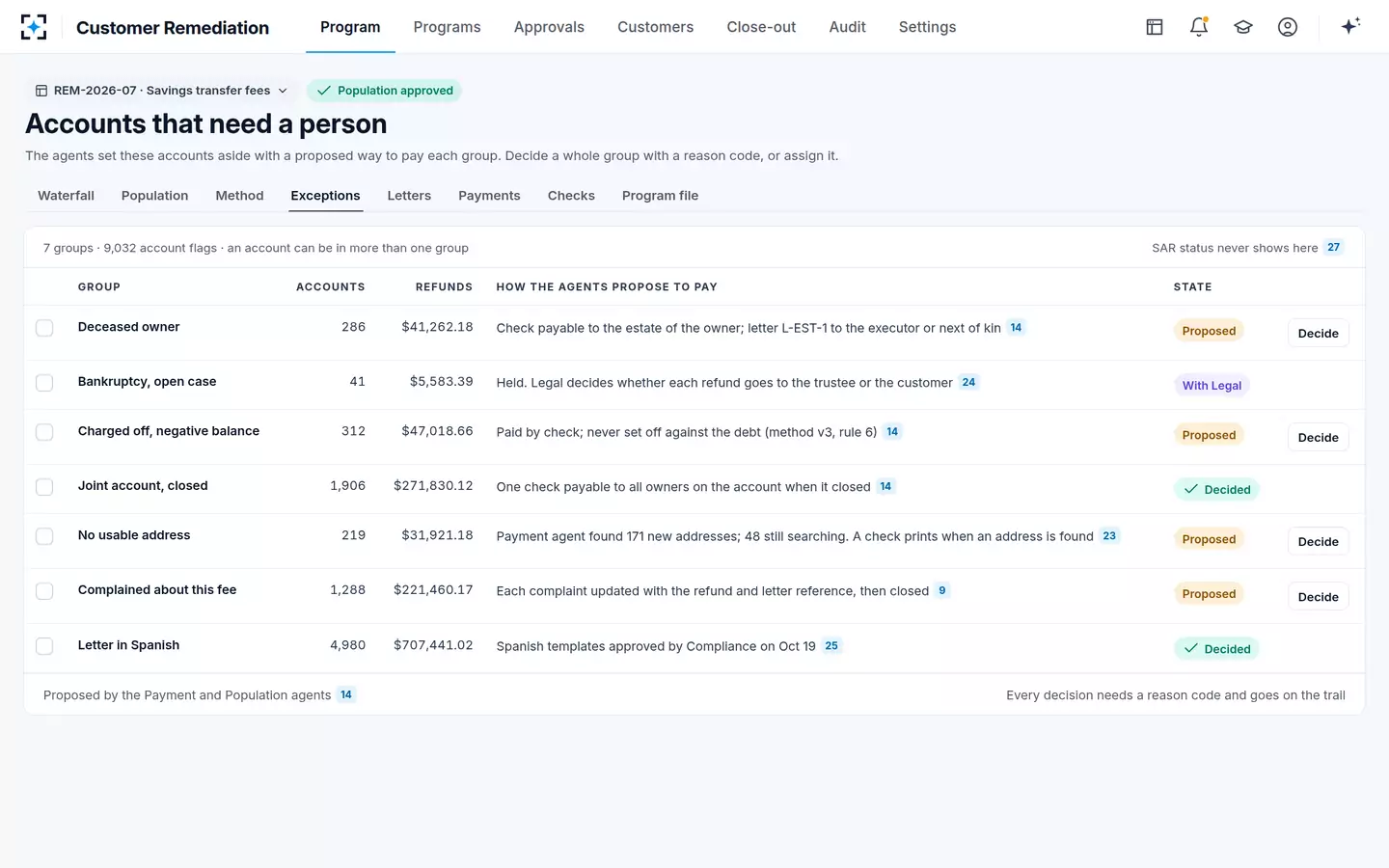
The logic is that a fee nobody paid needs no refund, only removal from the debt. That logic fails when the debt was sold, sent to a collector or reported to a credit bureau, which is why both orders made the exclusion conditional. Setoff, applying a refund to a balance the customer still owes, is a separate choice. The interagency Truth in Lending restitution guidance allows that, if the loan “has been charged off, the creditor may apply all or part of the reimbursement to the amount past due, if permissible under law” (FFIEC Questions and Answers, TILA reimbursement). A bank may decide it never will. The fictional sample bank's method says “never set off against any debt” and pays its 312 charged-off accounts by check.
Charged-off balances and setoff: four published positions and one bank policy
| Source | Fee charged off, never collected | Refund applied to a debt |
|---|---|---|
| CFPB, Regions Bank, 2022 (terminated 2025) | Excluded, if the debt was never sold or collected | Not addressed for paid fees |
| CFPB, Navy Federal, 2024 (terminated 2025) | Excluded, if the credit union has not and will not collect it | Not addressed for paid fees |
| CFPB, Bank of America, 2023 (post order) | Outside redress: only collected fees count | Not addressed |
| FFIEC Truth in Lending reimbursement Q&A | Not the issue: TILA reimburses overcharges | Allowed on delinquent or charged-off loans, if permissible under law |
| Fictional sample bank, method v3 | Paid by check like any former customer | Never |
How are deceased customers refunded?
To the estate, under state law, not to whoever is still receiving mail at the old address. The interagency Truth in Lending guidance is the only federal text that addresses it directly: “If the primary obligor(s) is deceased, the payment should be made pursuant to the estate and unclaimed property laws of the state.” In practice that means a check payable to the estate of the customer, sent with a letter to the executor or next of kin the bank has on file, and a hold where nobody can be identified.
Deceased customers are also where delivery testing finds most problems: a check payable to the customer and endorsed by a relative has cleared, but the customer's estate has not been paid. The sample program sets 286 deceased owners aside as their own group, each with a check to the estate and an estate letter.
How do joint accounts get remediation?
The refund goes to the owners of the account when the fee was charged, which for a closed joint account usually means one check payable to all of them. Splitting the refund requires a basis the bank rarely has; paying one owner alone risks a complaint from the other. A check payable to two people who have since divorced or moved apart is hard to cash, so the letter should say what to do and the program should expect a higher return rate in this group.
The fictional sample program has 1,906 joint accounts that were closed when it ran, refunds of $271,830.12 in all, decided as one group: one check payable to all owners on the account when it closed.
Paying former customers in Customer Remediation
In Botminds' Customer Remediation, the Payment agent splits each program into credits, checks and holds, and sets aside the accounts that need a person, each group with a proposed way to pay. The analyst decides a whole group in one step with a reason code, or assigns it. The exceptions in the sample program show what a former-customer population usually contains.
Former customers in Customer Remediation, each group paid the right way
Finance then releases one payment file that ties credits, checks and holds to the remediation reserve, and the analyst who prepared it cannot approve it. Former customers' checks carry their own numbers and go to positive pay the day they are issued, so a check presented with a changed amount or a number the bank never issued is stopped at the bank's own door.
The payment file: credits for open accounts, checks for former customers, holds for Legal
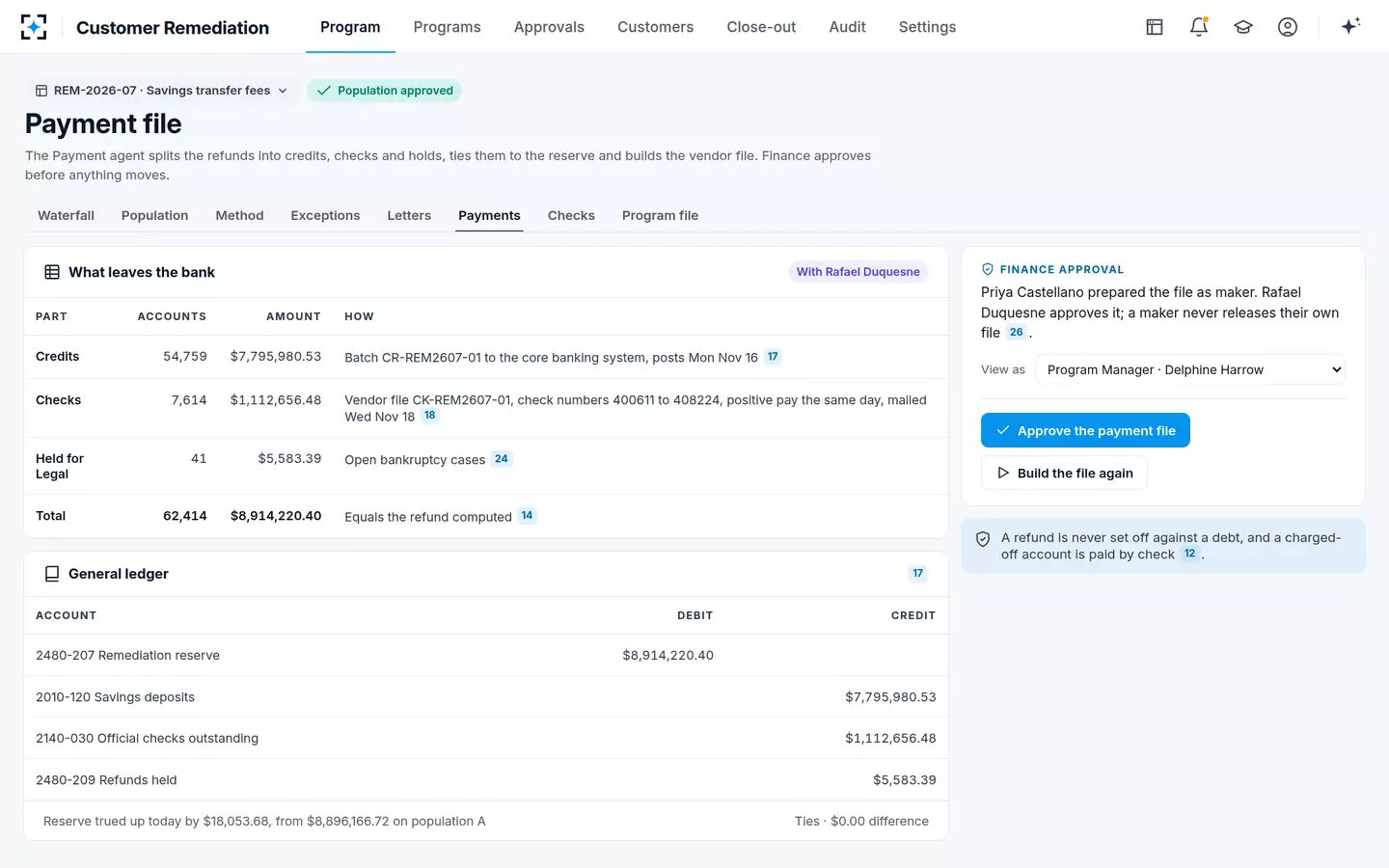
Many of those checks will come back or never be cashed. Stop payments, void dates and unclaimed property follows them to the end, and what a remediation check is explains the same check from the customer's side.
Questions people ask
Will my old bank tell me if I am owed a refund on an account I closed?
If it runs a remediation that covers you, it should write to your last known address after an address search; CFPB orders have required exactly that. If you moved without leaving a forwarding address and the search fails, the refund is held for you and, years later, reported to your state's unclaimed property office, where you can still claim it.
Can I ask for the refund to be sent to my new bank instead of by check?
You can ask, and some programs allow it, but most banks pay former customers by check because they have no verified details for an outside account. Regulators running their own refund programs now offer electronic options too: the FTC pays by check, prepaid card, PayPal and Zelle (FTC refund FAQ).
Does a bank have to refund fees on an account it closed itself?
Yes, if the fees were charged wrongly. Who closed the account does not change what was owed while it was open. Where the account was closed with a negative balance, the bank may instead remove an unpaid fee from the debt, as several orders allowed, as long as it never collected or sold that debt.
Do former customers get interest on a remediation refund?
Under the same method as everyone else, yes. Interest usually runs from each fee's date to the payment date, so a former customer charged years ago is owed more interest than a recent one; in the sample program a former customer with fourteen $5.00 fees received $4.17 of interest on top of $70.00.
How long does a bank keep trying to reach a former customer?
Until the program's search steps are exhausted, then it holds the money as an outstanding obligation. The Independent Foreclosure Review sent checks to borrowers' mailing addresses rather than the property under review (GAO-14-376) and made a third mailing attempt in February 2015, nearly two years after the first (Federal Reserve and OCC). After that, state unclaimed property law takes over.