A remediation check is a refund from a bank or other company of money it took from you by mistake or in breach of the rules, most often a fee it should not have charged, usually with interest added for the time it held the money. Banks send checks when they cannot simply credit your account, typically because the account has closed. A real remediation check comes with a letter that says what went wrong, how the amount was calculated and when to cash it, and it asks you for nothing: no fee, no account details, no signature giving up your rights. Banks prepare these programs carefully because their regulators check them; Botminds' Customer Remediation is a system banks use to find every affected customer, calculate each refund, write the letter in plain words and follow each check until it is cashed.
Many people get these checks without ever having complained. The bank found the problem itself, or an examiner did, and the bank is now paying everyone affected, including customers who left years ago. The letter below is an example from a fictional sample bank, annotated with what to look for.
What a real remediation check letter tells you
Corvane National Bank · Reference REM-2026-07
Dear Loretta Vance-Albright,
1 When you had a savings account with us, ending 4417, we charged you a fee we should not have charged: $5.00, fourteen times, from March 4 to September 2, 2025. We had stopped this fee on March 1, 2025, but our systems kept charging it.
2 A check for $74.17 is enclosed: $70.00 in fees and $4.17 in interest. 3 Please cash or deposit it by May 17, 2027. 4 You do not need to do anything else.
5 Questions? Call us and mention reference REM-2026-07.
We are sorry.
- 1What went wrong, in one sentenceThe fee, how many times and over what dates. A real letter is specific about your account.
- 2How the amount was worked outFees plus interest, shown separately. Orders have required the letter to explain the calculation.
- 3The date to cash it byAfter that date the paper is void, but the money is still yours: ask for a reissue.
- 4Nothing asked of youNo fee, no account number, no form to sign. A request for any of them is the warning sign.
- 5A way to check itA reference number. Call the bank on the number from its website or your card, not only the one in the letter.
What is a remediation check?
It is the payment end of a bank's remediation program: the process a bank runs after it finds it harmed customers, to find each one, work out what each is owed and pay them back. Customers who still have the account usually receive a credit; everyone else receives a check. The check is often drawn by the bank on itself, as an official check, which is why it carries the bank's name rather than a third party's.
The amount is the money taken, plus interest in many programs. In the example above, fourteen $5.00 fees add up to $70.00 and interest at 4.10% a year from each fee's date adds $4.17. Remediation is not a lawsuit settlement you joined, and there is normally no claim form: the bank decided you were owed and paid you. What customer remediation in banking is explains the program from the bank's side.
Why did my bank send me a check?
Because it charged you something it should not have, and you no longer have an account it can credit. Recent public examples are mostly about fees. US regulators have ordered refunds of overdraft fees charged on debit card transactions that were approved when the account had enough money; of repeat fees charged each time a returned payment was presented again, which the CFPB's 2023 order against Bank of America covered with about $80.4 million in redress (CFPB; status: post order); and of fees on accounts opened without the customer's consent.
Many remediations are never public. A bank that finds an error in its own testing, fixes it and pays customers may never be the subject of an order. The FDIC counted 47,902 consumers paid voluntary restitution in 2025 by the banks it supervises, outside its formal orders. If the letter names your account and the fee, that is the reason.
Is a remediation check a scam?
A real one is not, but scammers copy them, and the test is simple: a real refund never asks you for money or for your financial details. The FTC states its own rule this way: “The FTC never requires you to pay upfront fees or asks you for sensitive information, like your Social Security number or bank account information. If someone claims to be from the FTC and asks for money, it’s a scam” (FTC refund programs FAQ). The CFPB said the same of the checks it sends: “We will never require you to pay money to receive money” (CFPB blog, 2017, now archived). A bank's refund follows the same logic.
People who have lost money before are targeted most. The FTC warns that “Scammers buy lists of people who’ve paid scammers. They call it a “sucker list,”” and then contact those people offering to recover their money for a fee (FTC consumer advice). A letter promising a refund if you first pay a processing charge, or asking you to confirm your account number, is not a remediation.
Real or fake: what separates a bank's refund from an imitation
A real remediation check: Nothing. Cash or deposit the check.
A scam made to look like one: A fee, a tax, your account or Social Security number, or a call to a number only the letter gives.
A real remediation check: Your account’s last four digits, the fee, the dates and the amount.
A scam made to look like one: Your name and address, and vague talk of a settlement.
A real remediation check: A check drawn by the bank on itself, or a credit to your account.
A scam made to look like one: A check for more than you are owed, with a request to send some back, or a gift card.
A real remediation check: A cash-by date months away, and a reissue if you miss it.
A scam made to look like one: Act today or lose it.
A real remediation check: Call the bank on the number on its website or your card and quote the reference.
A scam made to look like one: The letter discourages you from calling the bank.
What should the letter tell you?
Why you are being paid, how much and how it was worked out, and what to do. US orders set this out for the letters they require. The CFPB's 2023 order against Atlantic Union Bank required redress notices with “language explaining how the amount of redress was calculated and a statement that redress is being provided in accordance with the terms of the Consent Order”, and barred the bank from putting anything else in the envelope: “Respondent must not include in any envelope containing a Redress Notification any materials other than the approved Redress Notification and” the payment itself (CFPB Consent Order 2023-CFPB-0017; status: post order). That second rule exists to stop a refund letter being used to sell you something.
A letter that says only “please find enclosed a refund” is not wrong, but you are entitled to ask the bank how the amount was calculated. Banks that keep the working fee by fee can answer on the phone in a minute.
Why is my remediation check so small?
Because it repays exactly what you were charged, plus interest at a modest rate, and many wrongful fees are small. Fourteen $5.00 fees and up to 20 months of interest come to $74.17; a single fee might return a few dollars. Many programs pay every affected customer whatever the amount, and regulators look hard at floors, because leaving out small amounts means keeping money that belongs to customers.
Small checks are the ones people do not cash, so the money is never received. The FTC's study of 149 class action settlements found that where checks were sent to people automatically, without a claim, the weighted check-cashing rate was 55% overall and 39% where the payment was under $10 (FTC staff report, 2019). A small remediation check is still your money; cashing it costs nothing.
Small checks go uncashed most often
55%
weighted cashing rate of checks sent automatically to class members, all amounts
FTC study of 149 settlements
39%
cashing rate where the payment was under $10
Same study
$74.17
a typical small refund: fourteen $5.00 fees and $4.17 of interest
Fictional sample letter
Is a remediation check taxable?
The refunded fees usually just return your own money; the interest part may be taxable income. The IRS's guidance on settlements says that “Interest on any settlement is generally taxable as “Interest Income” and should be reported on line 2b of Form 1040” (IRS Publication 4345), and that whether other proceeds count as income depends on the facts. Whether the payer sends you a Form 1099-INT depends on how it classifies the interest: the general reporting threshold is $10, but the IRS sets $600 for certain interest paid in the course of a trade or business, including “interest received with damages” (IRS instructions for Form 1099-INT).
So: keep the letter, which shows the fee and interest separately; if a 1099 arrives, report what it shows; and ask a tax adviser if the amounts are large. A refund of fees on a business account can be different, because the fees may have been deducted.
What happens if I don't cash a remediation check?
After the date on the check it can no longer be cashed, but the bank still owes you the money. It will usually try again with a new check to an updated address; after a period set by state law, often three years for an official check, it reports the amount to your state's unclaimed property office, where you can claim it. Under some regulator orders, money that could not be delivered goes to the regulator instead. Void dates, stop payments and unclaimed property sets out the whole sequence.
A void date ends the paper, not the debt. The refund is still yours after the check expires.
How do I get a remediation check reissued?
Call the bank, quote the reference on the letter and confirm your identity and address. If the check expired, it should send a new one. Government refund programs work the same way while money remains; the FTC tells recipients of expired checks: “If there is still money available in the settlement fund, we may be able to reissue your payment.”
If the check was lost or stolen, expect a short wait. For a lost cashier's or teller's check the Uniform Commercial Code lets the bank pay the original until 90 days after its date, so some banks wait that long, or ask for a declaration of loss, before reissuing. If the check was sent to someone who has died, the estate's executor should call; the bank will reissue to the estate.
Do I have to sign anything, or give the money back?
No. A remediation payment is not a deal. CFPB orders state that the bank “may not condition the payment of any redress to any Affected Consumer under this Consent Order on that Affected Consumer waiving any right” (CFPB Consent Order 2022-CFPB-0008), and in the foreclosure-review payments the servicers “were not permitted to ask borrowers to release any claims they may have had against their servicer in order to receive a cash payment” (Federal Reserve, 2019).
Nobody from the bank should ask for the check back either. The FDIC's examination manual records that “There have been instances where institution personnel have inappropriately asked consumers to return restitution checks to the institution. This is not permissible” (FDIC Consumer Compliance Examination Manual V-2). If that happens, call the bank's complaints line or its regulator.
Before you deposit a remediation check
- Does the letter name your account and the charge?
Last four digits, the fee, the dates. Vague letters deserve a phone call.
- Does it ask for anything?
Money, account numbers or a signature: if yes, stop and call the bank on a number you already trust.
- Is the payee right?
Your name, all joint owners, or the estate. A check payable to someone else must not be endorsed by you.
- Note the cash-by date
Deposit before it; if you miss it, ask for a reissue.
- Keep the letter
It shows fees and interest separately, which is what a tax question will turn on.
How banks prepare these checks with Customer Remediation
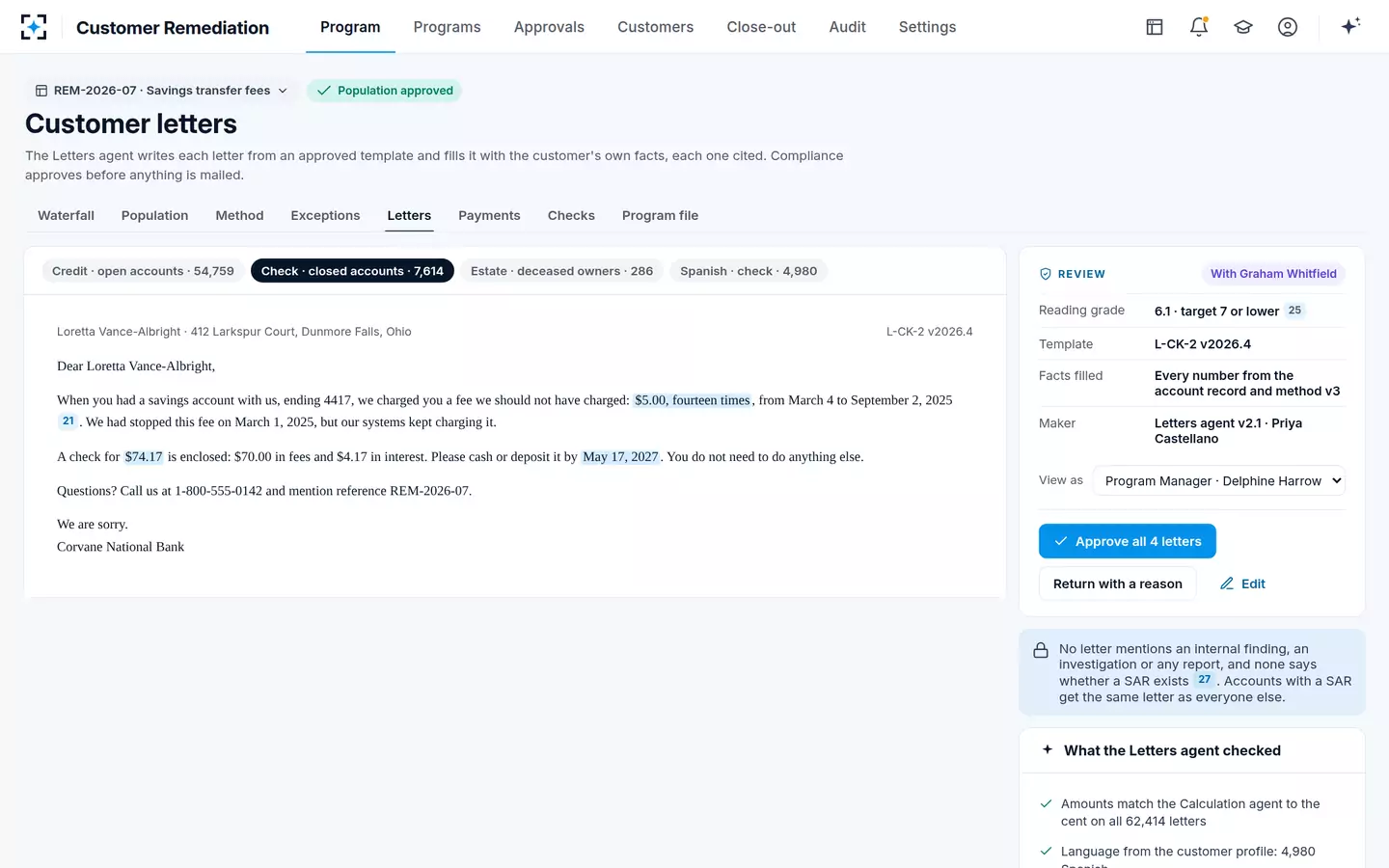
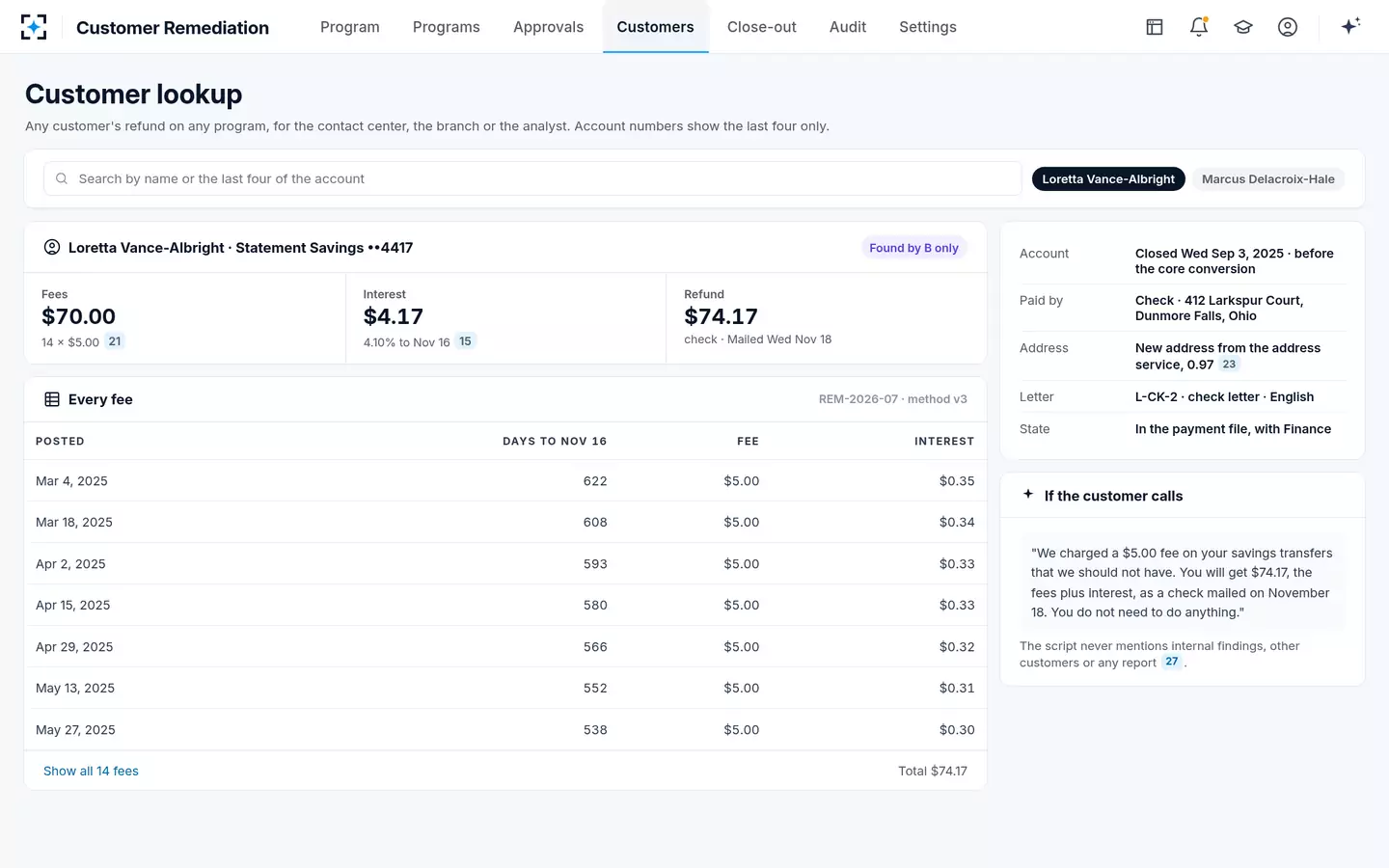
The letter at the top of this page was written by the Letters agent in Botminds' Customer Remediation from a template the bank's compliance officer approved, with every number taken from the customer's own account and the calculation behind it. It reads at a sixth-grade level, mentions no internal finding or investigation, and goes out only after compliance approves it. The same customer's refund can be opened by a branch or call-center colleague with a script for what to say if she calls.
The check letter in Customer Remediation, as compliance sees it before approving
What the bank sees when the customer calls
Questions people ask
Can my bank send a remediation check when I still have the account?
It can, but most programs credit open accounts and send checks only to people who have left. If you received a check while your account is open, the account may not be the one that was charged, or the bank's plan may pay everyone by check; the letter should say which.
Is a remediation check the same as a class action settlement check?
No. A settlement check comes from a court case, usually through a claims administrator and often after you filed a claim. A remediation check comes from the bank itself, because it or its regulator found the problem, and it needs no claim. Both are real money, and both should never ask you to pay to receive it.
The check is made out to someone who has died. What should I do?
Do not deposit it into your own account. Contact the bank with the death certificate and the executor's details; it will reissue the refund payable to the estate, which is how remediation programs are meant to pay deceased customers.
Does cashing the check stop me from complaining or suing?
Not for a regulator-supervised remediation. The CFPB says that cashing a check it sends “does not mean you give up your rights to pursue further action against the defendant”, and its orders bar banks from requiring a waiver. If you think the amount is wrong, cash the check and ask the bank how it was calculated.
Why did I get two remediation checks from the same bank?
Usually because there were two programs, or because the bank paid a top-up after finding its first calculation was short. In the foreclosure review the paying agent sent about 96,000 supplementary checks for that reason. Each letter should say which charge it covers.