Schema drift detection is the practice of comparing an incoming file with the shape you last accepted from the same sender, and deciding, before anything is read out of it, whether the differences change what the values mean. In a laboratory file it has a sharper answer than it does in a general data pipeline, because a column header here often carries a unit, and a unit is not a label — it is part of the measurement. CRO Data Integration treats that as the dividing line: a CRO's renamed or reordered column is matched and recorded, and a column whose unit or qualifier vocabulary has changed stops the file until a named person decides what to do with it.
The worked example below is sample data on fictional people and companies — a discovery sponsor, Northwind Bio, and the six invented CROs it places work with. The published sources are linked where they appear.
One plasma concentration workbook, compared with the layout last accepted from the same CRO
4
differences between this file and the CRO's last accepted layout
3
matched automatically: two renamed columns and one pair that had swapped places
1
change that stopped the file: a concentration column whose unit had moved
1,000×
the size of the error a fixed import would have written, on every sample at once
What is schema drift, and what does it look like in a CRO file?
Schema drift is any change in the structure of a file or feed between one delivery and the next: a column added, removed, renamed or moved; a sheet renamed; a type widened; a unit or a code vocabulary redefined. The term comes from data engineering, where the usual worry is that a job breaks. In a laboratory setting the worry is the opposite one. The job usually does not break. It keeps running and writes the wrong number.
Drift in CRO deliverables rarely arrives as an announcement. A contract research organisation upgrades the software on an LC-MS/MS instrument and its export template changes with it. An analyst rebuilds a reporting workbook and renames two columns to something clearer. A new study director prefers concentrations in a different unit. None of these is misconduct, and none of them is usually communicated — from the laboratory's point of view nothing about the science has changed, and the file is still correct in its own terms.
The sponsor's position is different. The sponsor is mapping that file into a schema that was agreed against the previous version, and the mapping is the thing that silently stops being true. That is why drift detection belongs at receipt, in front of the mapping, rather than in a validation step that runs on the loaded values: by the time a value is in the warehouse, a thousandfold unit error looks exactly like a surprising result.
A file stopped at the moment its layout stopped matching
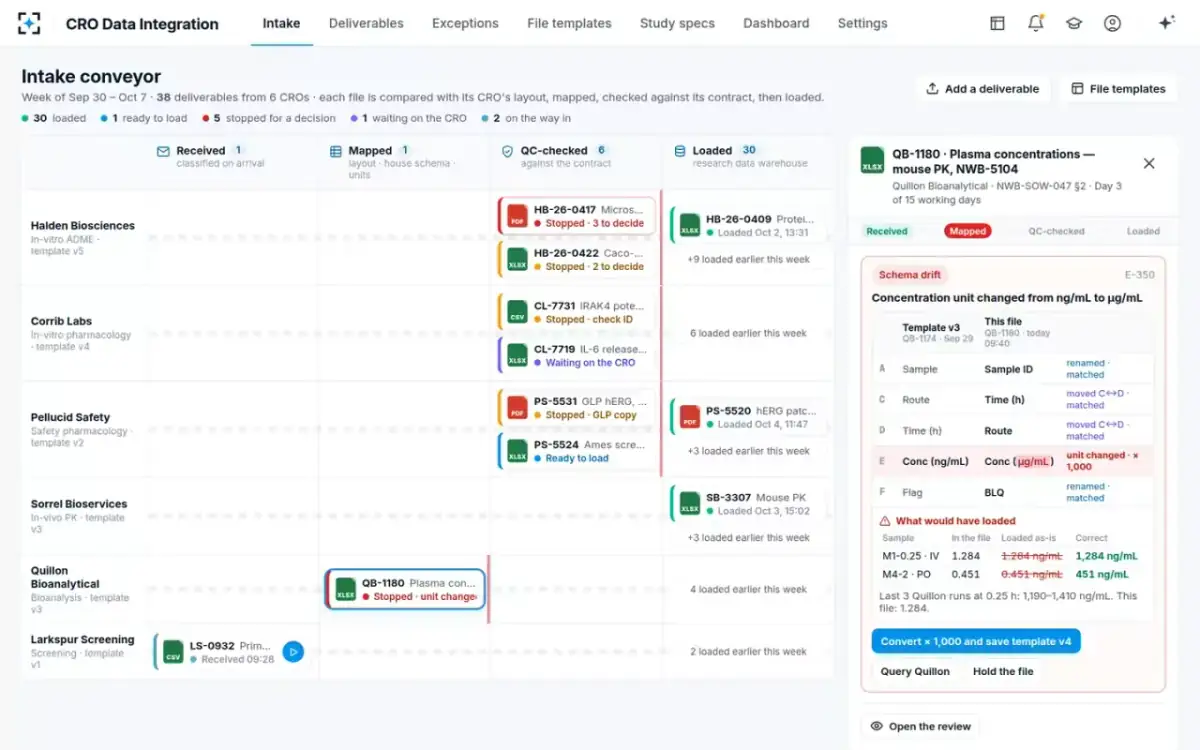
Three kinds of drift: renamed, moved, redefined
Sorting drift into three kinds is what makes it tractable, because the three carry completely different risk and deserve completely different handling.
A renamed column holds the same measurement under a new label. Sample becomes Sample ID; Flag becomes BLQ. Nothing about the values changes, and the only damage a rename can do is to break a mapping that matches on the literal string.
A moved column holds the same measurement in a new position. Two columns swap, or a column is inserted in the middle and everything after it shifts one place right. Again nothing about the values changes — but anything that reads by position rather than by name now reads the wrong column into the right field, which is worse than a break because it produces a complete, plausible-looking table.
A redefined column keeps its name and its place and changes what its numbers are a measurement of. A unit moves from nanograms per millilitre to micrograms per millilitre. A time column changes from minutes to hours. A qualifier column changes its vocabulary, so that what used to be written BLQ is now written as a blank. This is the dangerous kind, and the one every automatic matcher is tempted to wave through, because by every structural test it is not a change at all.
A change of label against a change of meaning: why only one of them may be matched automatically
A change of label (renamed, moved): The name a value sits under, its position in the row, or the sheet it is on.
A change of meaning (redefined): What the number in the column is a measurement of: its unit, its qualifier vocabulary, or its basis.
A change of label (renamed, moved): Unchanged. The same numbers, in the same range as the last few runs from the same laboratory.
A change of meaning (redefined): Often unchanged as well. 1.284 is a plausible concentration in either unit, which is the whole difficulty.
A change of label (renamed, moved): Sample became Sample ID. Flag became BLQ. Route and Time swapped places.
A change of meaning (redefined): Column E went from a concentration in ng/mL to a concentration in µg/mL, under the same column letter.
A change of label (renamed, moved): Match on meaning and on name above a stated confidence, record the match on the file, and carry on.
A change of meaning (redefined): Never on its own, at any confidence. A person accepts the conversion, queries the laboratory, or holds the file.
A change of label (renamed, moved): A file stopped unnecessarily, and ten minutes of somebody's morning.
A change of meaning (redefined): Every value in that column, silently, together with every ranking and decision built on them.
How do you detect schema drift before any value loads?
By keeping a versioned template per sender and comparing every arriving file against it on eight points, before the mapping runs. The template is not a schema definition written in advance; it is the shape of the last file from that laboratory that a person accepted, which is why it stays accurate as a relationship evolves and why every change to it has an author.
The eight things a drift check compares on every incoming file
- Sheet names, and the order they appear in
A renamed sheet is the most common harmless change and the easiest to match by content.
- Header names, exactly as written
Including the punctuation and the parentheses, because a unit usually lives inside them.
- Column order
So that anything reading by position is protected from a column inserted in the middle.
- The unit written into each header
Parsed as a unit, not as part of the label. This is the one comparison that separates a laboratory file from a generic feed.
- The vocabulary of each flag or qualifier column
A column that used to say BLQ and now says nothing has changed meaning, even though it is still a column of text.
- The type and precision of each column
A numeric column that arrives as text usually means a spreadsheet has reformatted something on the way.
- Each numeric column's range against the last three runs
The only check that can catch a redefinition the header did not announce.
- The row and compound count against what the contract commissioned
A file that is structurally perfect can still be missing a third of the study.
Order matters here as much as coverage. Running the comparison after extraction means a redefined column has already been read into the house schema, and the only evidence that something moved is a set of values that look odd — which is a judgement, made later, by someone who may not have seen the previous run. The four checks a deliverable has to pass put layout first for exactly this reason.
Matching a renamed or moved column by meaning — and when not to
An automatic match should rest on more than string similarity. Sample and Sample ID are close as strings; Flag and BLQ are not close at all, and yet they are the same column, because both hold the qualifier for the concentration beside them. The signals that actually identify a column are its position relative to its neighbours, the shape of its contents, whether its values match the previous run row for row, and what the template says the column it most resembles was for.
Two rules keep that useful rather than clever. The first is a stated threshold: in CRO Data Integration a renamed or moved column is matched above 95% confidence, and anything below that is an unmatched column, which stops the file rather than being guessed. The second is that the match is recorded. A matched rename is written onto the deliverable and into the layout history, so that a reader six months later can see that the column called BLQ in October was the column called Flag in September, and that nobody renamed anything in the sponsor's own schema.
There is one class of rename that should never be matched automatically, however confident the match: a rename that changes a unit or a vocabulary at the same time. A column that moves from Conc (ng/mL) to Concentration has lost the unit from its header, and a matcher that scores it as a 97% rename has just accepted a column whose unit is now unknown. The right behaviour is to stop and ask, because the missing information cannot be recovered from the file.
The check a header cannot do: value ranges against the last three runs
Header comparison has a blind spot by construction: it cannot see a change that leaves the header alone. A laboratory that reports in a new unit but keeps a generic header, or an instrument that starts exporting peak areas where it used to export concentrations, produces a file that passes every structural test and every value of which is wrong.
The defence is statistical and simple. Keep the range each numeric column has occupied over the last few runs from the same sender, and compare the arriving column against it. A tenfold or thousandfold shift in a column that the header says is unchanged is not a result; it is a redefinition that nobody wrote down. In the sample data the setting is explicit — value ranges are compared with the last three runs, and a column that jumps tenfold or more stops the file even when the header did not move.
The check has an honest limit. It needs history, so the first two or three deliverables from a new CRO have nothing to be compared against, and it will not notice a redefinition whose effect is inside the range the assay normally produces. It is a second line, not a first: it catches what the header check cannot, and misses what the header check would have caught.
Why a changed unit has to stop the file every time
Because a unit change is the one drift whose damage is complete, silent and proportional. Every value in the column is wrong by the same factor, the file still parses, the table still looks like a table, and nothing downstream has any way to tell. The sample file is the ordinary version of this: column E moved from a concentration in nanograms per millilitre to the same concentration in micrograms per millilitre, and a cell still reading 1.284 means something a thousand times larger than it did in the previous run.
One cell, two readings: what an unexamined unit change writes into a warehouse
What the cell holds
1.284
Column E, the first sample after an intravenous dose. The number itself did not change.
The CRO's workbook
What the header now says
Conc (µg/mL)
The same column was headed Conc (ng/mL) in the layout last accepted from this laboratory.
The export, this run
What the value is in house units
1.284 µg/mL × 1,000 = 1,284 ng/mL
What loads once a person has accepted the conversion and the rule has been applied and versioned.
The study monitor
What a fixed import would have written
1.284 ng/mL
A thousandfold understatement, on all nine samples at once, in a table that looks complete and well formed.
The most expensive demonstration of this problem was not in a laboratory. NASA's investigation board into the loss of the Mars Climate Orbiter found that "the root cause for the loss of the MCO spacecraft was the failure to use metric units in the coding of a ground software file" — a file called Small Forces, used in trajectory models. Nothing failed, nothing threw an error, and the numbers were correct in the unit they were produced in.
The data in the AMD file was required to be in metric units per existing software interface documentation, and the trajectory modelers assumed the data was provided in metric units per the requirements.
NASA, Mars Climate Orbiter Mishap Investigation Board Phase I Report (10 November 1999)
That sentence is the whole argument for stopping a file. The interface documentation said what the unit had to be, the people downstream assumed the documentation was being followed, and the assumption was never tested against the file itself. A drift check that compares the arriving header with the accepted one is precisely that test, run on every delivery rather than at the start of the relationship.
Spreadsheets add a second, quieter form of redefinition. In a study of gene name errors in published supplementary files, the authors noted that "there is no way to permanently deactivate automatic conversion to dates in MS Excel and other spreadsheet software". The same autocorrection reaches laboratory identifiers and sample codes: a compound label that survives an instrument export intact can be turned into a date by the act of opening the workbook to look at it. A drift check that compares types and formats, not just names, catches a column that arrived numeric and is now text.
What a 1,000× error does downstream, and how far it travels
A concentration is almost never a final answer. It is an input to exposure, to clearance, to a half-life, to a bioavailability estimate, and finally to the comparison between one compound and the next. A thousandfold error does not stay in the column it entered.
Where one unexamined concentration column ends up, step by step
| Where the value has got to | What it has become | Why the error is harder to recognise here |
|---|---|---|
| 1. The loaded concentrations | Nine plasma concentrations, each a thousandfold low. | Every one of them is a plausible number on its own. Nothing about a single value says it is in the wrong unit. |
| 2. Exposure | Area under the curve, computed from those concentrations and wrong by the same factor. | The arithmetic is correct, so the figure carries no sign of its input being wrong. |
| 3. Clearance and volume of distribution | Parameters derived from dose and exposure, now a thousandfold high. | The error now presents as an implausibly high clearance, which reads like a property of the compound rather than a unit problem. |
| 4. The structure-activity view | A compound ranked against its series on the derived parameters. | The ranking is relative, so one misplaced compound looks like a finding about that compound. |
| 5. The programme decision | A choice of what to make next. | Weeks later, several steps from the file, with nothing on the record pointing back at a column header. |
The practical test of any drift detection is therefore not how much it catches but where it catches it. Catching a redefined column at receipt costs a stopped file and one decision. Catching it at the structure-activity view costs the re-examination of everything loaded since the change, and the credibility of the warehouse with the scientists who use it. The same argument applies to a qualifier dropped on the way in: the information is cheap to keep and expensive to reconstruct.
Who accepts the change, and what a new template version has to record
A stopped file is a decision waiting for an owner, and the owner has to be named in advance. In the sample data the study monitor decides layout and unit changes, and the data steward owns the templates and the unit rules; an exception that nobody is named for is an exception that sits on the conveyor. The three choices in front of the person who decides are narrow on purpose: accept the conversion and save a new template version, query the laboratory, or hold the file.
Kept that way, the log becomes a quarterly picture rather than a pile of incidents. On the sample data the quarter holds seven layout changes across six laboratories, of which two were unit changes, and none loaded wrong: a column added to a PK parameters workbook and accepted as a new version, a column moved in an hERG report and matched by name, a unit label changed in a results workbook with a conversion rule added, and the plasma concentration export that is the worked example here. Each entry carries how it was resolved and who resolved it: a rename or a move matched on its own and was recorded, while an added column and each of the two unit changes waited for a named person.
Whichever is chosen, the record has to carry six things if the decision is to be defensible later: what changed, with the before-and-after headers; what would have loaded if nobody had looked; the evidence that the new reading is right, which in the sample file was the agreement between the converted values and the last three runs; the rule applied and its factor; the new template version and who approved it; and the deliverables the decision affects. The regulatory expectation behind all of that is unremarkable — the OECD's guidance on computerised systems under good laboratory practice states that "any changes to a computerised system should be made in a controlled manner and in accordance with written change control procedures" — but a template is a system component that many organisations never put under change control at all, because it lives in a script.
The four differences in one workbook, and what the drift check did with each
| Column in the layout last accepted | The same column in this file | The kind of change | What the check did |
|---|---|---|---|
| Sample | Sample ID | Renamed. Same contents, same position, same neighbours. | Matched by meaning above the confidence threshold, recorded on the file and in the layout history. |
| Flag | BLQ | Renamed. The qualifier column for the concentration beside it. | Matched by meaning. The vocabulary inside the column was compared as well, and was unchanged. |
| Route, then Time (h) | Time (h), then Route | Moved. The two columns swapped position. | Matched by name, so nothing reading by position could pick up the wrong column. |
| Conc (ng/mL) | Conc (µg/mL) | Redefined. Same name, same place, different unit. | Stopped the file. No value from the workbook was mapped until a person chose between converting, querying and holding. |
Each sender's accepted layout, by version, with every change this quarter
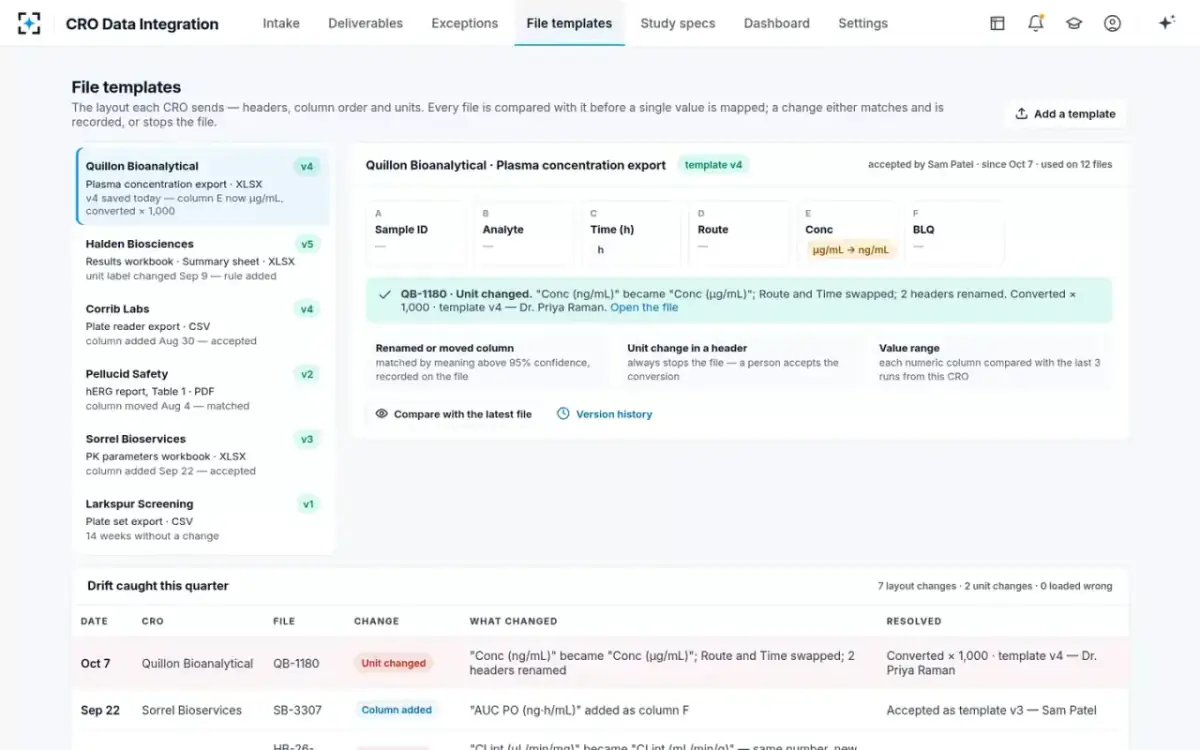
What schema drift detection will not catch
Four things, and they are worth stating because a detector that is trusted beyond its reach is more dangerous than no detector at all.
It will not catch a wrong value in a correctly shaped column. If a laboratory reports a concentration that is simply mistaken, every structural check passes and the range check passes too, because the value is inside the range the assay produces. That is what the contract's acceptance criteria, the controls and the replicates are for.
It will not catch a redefinition that lands inside the normal range. A change from one closely related measure to another — a time reported from the start of an incubation rather than from the first sample, say — moves values by a factor the history check cannot distinguish from biology.
It will not catch anything on the first delivery from a new sender, because there is no accepted layout and no history to compare with. The first few deliverables from a new laboratory have to be read by a person, which is an argument for onboarding a CRO deliberately rather than letting the first file arrive into an automatic process.
And it will not, on its own, keep a mapping honest through a migration. The UK regulator expects transfer and migration procedures to carry a written rationale and to be designed and validated so that integrity holds across the data's life — which is a different exercise from per-file drift detection, and one the detector cannot stand in for. If you are weighing tools, how to test one on your own deliverables sets out a trial that exercises exactly these limits. To see the comparison, the diff and the three choices on a real screen, start from CRO Data Integration.
Questions people ask
How should you handle schema drift once you have detected it?
Split the handling by kind rather than by severity. Renames and reorderings should be matched, recorded and carried on from, because stopping for them trains people to click through stops. Redefinitions — units, qualifier vocabularies, anything that changes what a number measures — should stop the file for a named person, who accepts a conversion, queries the sender or holds the delivery. Every accepted change should produce a new version of the template with an author and a date.
What happens when a column is renamed in a source file?
Nothing should break, and nothing should be guessed. A renamed column is identified by its position relative to its neighbours, the shape of its contents and its agreement with the previous run, and matched above a stated confidence — 95% in the sample data. Below that it is an unmatched column, which stops the file. The match is written onto the deliverable, so the rename is visible afterwards rather than absorbed invisibly.
How do you detect a unit change in a CSV?
Two ways, and you want both. Parse the unit out of the header as a unit rather than treating the header as a label, and compare it with the unit in the accepted layout — this catches the change the moment it is written down. Then compare the column's values with the range the same column held in the last few deliveries, which catches a unit change the header did not announce. A column that has shifted by a factor of ten or more without a header change is a redefinition until somebody proves otherwise.
Can schema drift detection be automated?
The detection can be, completely. The decision cannot, and should not be: accepting a unit conversion is a scientific judgement about what the laboratory meant, and in a regulated setting it is also a change to a controlled system component. The useful division is that software notices every difference on every file, which people do not do reliably, and a named person decides the ones that change meaning, which software should not do at all.
What should happen when a header changes?
The file should stop before the mapping runs, and the person who has to decide should see three things on one screen: the before-and-after header, what an import would have written value by value, and whatever evidence exists about which reading is right — typically the agreement or disagreement between the converted values and the previous runs. The choices should be narrow: convert and version the template, query the sender, or hold.
Is schema drift the same as data drift?
No, and the pair is worth keeping separate. Schema drift is a change in the structure or the meaning of the fields: a column renamed, moved or redefined. Data drift is a change in the distribution of the values within a stable structure — an assay running differently, a new compound series with a different profile. Schema drift is a file problem with a right answer; data drift is a scientific signal, and automatically correcting it would destroy the thing you are measuring.