The ALCOA+ principles are nine words that describe data a regulator can rely on: attributable, legible, contemporaneous, original and accurate, plus complete, consistent, enduring and available. Every guide to them is written for the laboratory that generates the data. A discovery sponsor is in a different position: the measurement was made somewhere else, by a contract research organisation, and what the sponsor holds is a copy that arrived as a PDF or a workbook and became a row in a research warehouse. The nine words still apply — the responsibility does not transfer with the file — but each one turns into a different, concrete requirement on an incoming file. Botminds' CRO Data Integration is built around those requirements: every value carries the file, page and table or sheet and cell it was read from, every conversion names the rule that made it and shows the value as reported beside the value in house units, and a named person decides every exception, with the decision kept beside the value it changed.
The worked example is sample data on fictional people and companies: a sponsor, Northwind Bio, and a plasma concentration workbook, QB-1180, sent by one of its contract laboratories. The regulatory wording is quoted from the published guidance and linked where it appears.
What are the ALCOA+ principles?
They are the attributes that make data trustworthy. The UK's medicines regulator gives the shortest version: the five letters of ALCOA stand for attributable, legible, contemporaneous, original and accurate, and the plus adds complete, consistent, enduring and available (MHRA, GXP Data Integrity Guidance and Definitions, 2018). The OECD's advisory document for Good Laboratory Practice uses the same nine and gives each of the four additions a one-line definition: complete means "the data must be whole, a complete set"; consistent means "the data must be self-consistent and free from self-contradiction"; enduring means "permanent, lasting throughout the data life cycle"; available means "readily available" (OECD, Advisory Document on GLP Data Integrity, No. 22, 2021).
What the nine words do not say is who has to satisfy them when two organisations are involved, and that is the whole question for a sponsor. The table below is the translation this guide is for: each word, its regulatory meaning, and what it demands of a file you did not generate.
The nine ALCOA+ words, and what each one demands of a file that arrived from a contract laboratory
| The word | What it means | What it demands of an incoming file |
|---|---|---|
| Attributable | The data can be traced to the person who generated, modified or reviewed it. | Not only the laboratory's analyst, but the name against every decision you took about the file: the conversion you accepted, the exception you waived, the identity you resolved. |
| Legible | The data can be read and understood, now and later. | A number is not legible without its unit, its qualifier and the compound it belongs to. A column header that read ng/mL last month and µg/mL this month makes the whole file illegible in the sense that matters. |
| Contemporaneous | The data was recorded at the time of the activity. | This one stays with the laboratory. What belongs to you is recording your own handling at the time: when the file arrived, when it was read, when each decision was made. |
| Original | The first capture of the data, or a verified copy of it. | The hardest word for a sponsor. Your warehouse row is not the original; the laboratory's record is. Either treat your copy as a verified copy, with a documented process behind that claim, or label it as a working copy and keep the pointer back. |
| Accurate | The data correctly represents what happened. | Accuracy of transcription is yours to prove, not the laboratory's. A 1,000-fold unit error is an accuracy failure on your side of the boundary even though every value in the laboratory's file was right. |
| Complete | "The data must be whole, a complete set." | Every compound and time point the contract asked for, and a recorded reason for each one missing. A value never generated because the compound precipitated is part of the complete set; a silent gap is not. |
| Consistent | "The data must be self-consistent and free from self-contradiction." | One compound identity, one unit per parameter, one version of the file layout, across every laboratory you use. Two deliverables that disagree about what NWB-4439 is are not consistent data. |
| Enduring | "Permanent, lasting throughout the data life cycle." | The citation has to outlive the file. A warehouse row pointing at a mailbox attachment nobody can find in three years is not enduring, however well the number itself is stored. |
| Available | "Readily available." | Available to the scientist reading a clearance value in a structure–activity table, not only to the data steward. If seeing the source cell takes a request, the value is stored, not available. |
ALCOA, ALCOA+ and why the plus was added
ALCOA came first, as the five attributes of data fit for regulatory purposes. The plus arrived later to make four further expectations explicit. The OECD is clear that this was emphasis rather than escalation: ALCOA+ "has been referred to in more recent times to emphasise the additional attributes Complete, Consistent, Enduring and Available. There is no difference between the expectations related to data integrity for both these terms since data governance measures should ensure that data are complete, consistent, enduring and available throughout the data life cycle" (OECD No. 22).
For a sponsor the four additions are the ones that bite, because they are about the life of the data rather than the moment of its capture. A contract laboratory can satisfy all five original words inside its own walls and still hand you a deliverable that fails completeness, because two compounds are missing without explanation; fails consistency, because this quarter's workbook uses a different unit from last quarter's; or fails endurance, because the only link back to the measurement is an email thread. Those are not laboratory failures. They are boundary failures, and the boundary is yours.
Attributable: who decided that this value could be converted?
Attribution at the laboratory is well covered: an analyst's name sits against the run. Attribution at the sponsor is usually not covered at all, because the sponsor's handling is treated as plumbing rather than as data work. It is not plumbing. Every judgement made on the way in changes what the warehouse says.
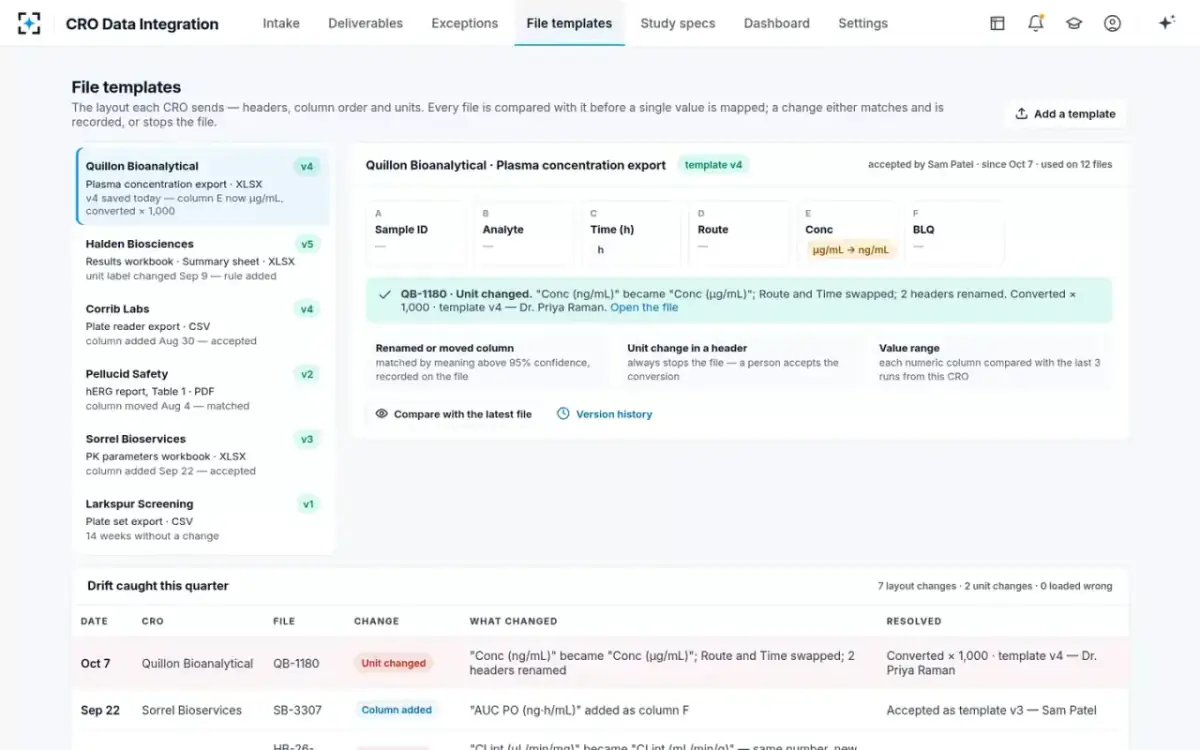
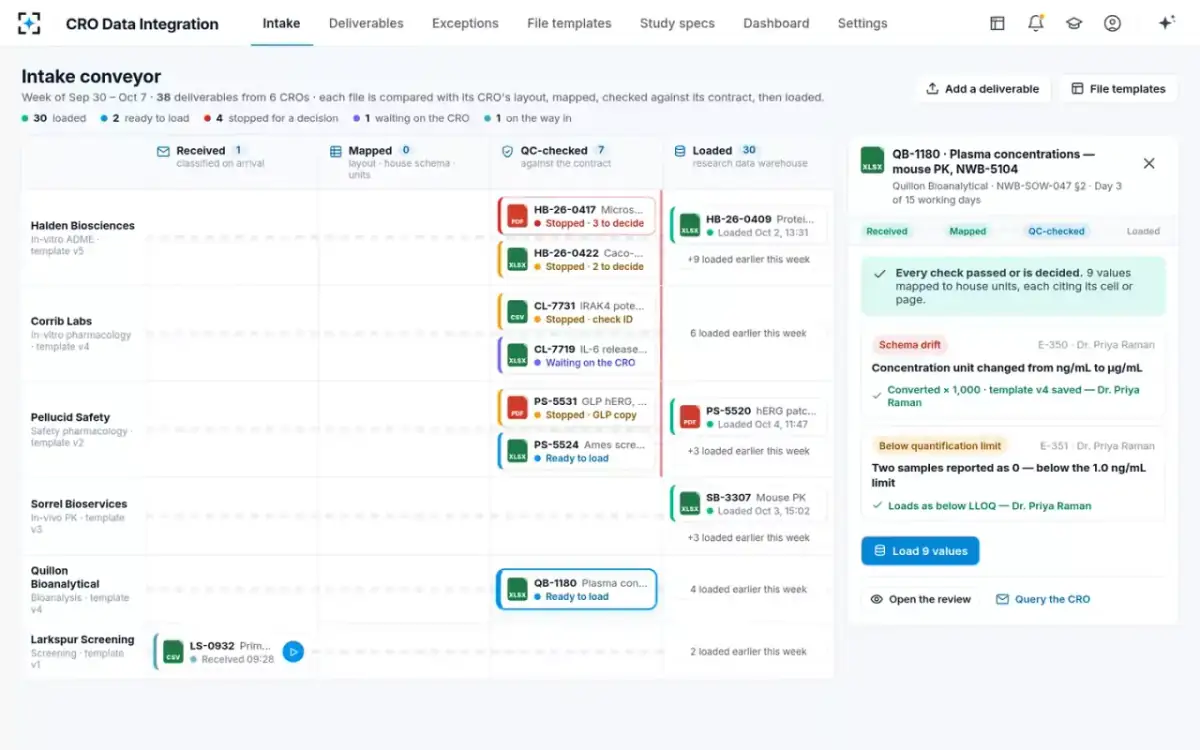
Take the sample file. A header on the plasma concentration workbook changed from ng/mL to µg/mL between one study and the next. Three things then happened that a reader a year later will need to know about: someone judged that the values agreed with the new header rather than the old one, someone accepted a conversion of ×1,000, and someone saved that acceptance as a new version of the laboratory's expected layout. If those three judgements are anonymous, the warehouse contains numbers that are a thousand times larger than the file they came from with nothing to say why. In the solution each is a decision with a name, and the template owner is told when the layout version changes.
What attribution looks like on one sample file
2
decisions on this file, each carrying the name of the person who made it
9 of 9
values citing the sheet and cell they were read from
v4
layout version saved when the conversion was accepted, recording who approved it and when
The same applies to compound identity. When a deliverable names a compound that is not on the manifest shipped with the study — a tube labelled NB-4493 where the registry expects NWB-4439 — somebody decides whether those are the same compound. That decision is more consequential than most extractions, and it should carry the name of the data steward who made it. Identity resolved silently by a lookup table is the fastest way to put one compound's results on another compound's page.
Original, and the true-copy problem with a warehouse
This is the word sponsors most often fail, and the failure is structural rather than careless. The laboratory holds the original; you hold a copy; and within a week of loading, your copy is what every decision is made on. Nobody opens the PDF again.
Regulatory guidance gives a way out, but it is a demanding one. The World Health Organization defines a certified true copy as "a copy (irrespective of the type of media used) of the original record that has been verified (i.e. by a dated signature or by generation through a validated process) to have the same information, including data that describe the context, content, and structure, as the original" (WHO, Guideline on data integrity, TRS 1033 Annex 4, 2021). The OECD adds the same requirement in operational terms: the verification "must be attributable to the individual who performs the verification", and the date of the copy's generation "should be retained with the relevant copy".
Read that against what a warehouse load actually is. Values are extracted from a workbook, converted into different units, given house compound identifiers and written into a table with a different structure from the file they came from. That is not a copy of the original; it is a derived dataset. Pretending otherwise is the real integrity risk, because it invites people to treat the warehouse row as the record. The honest options are two: build the extraction as a validated process and keep the verification attributable and dated, or label the loaded data as a working copy and make the pointer back to the original cheap enough that people use it. The sample solution does the second for data from Good Laboratory Practice studies, where the signed report stays the record and the loaded values are labelled a convenience copy — the arrangement that work needs is set out in what GLP asks of the sponsor when a CRO runs the study.
The laboratory's record and your copy: what each one is, and which is the original
The contract laboratory's record: The raw data and the report the laboratory signed, in its own archive.
Your warehouse copy: Values extracted, converted and written into your schema. A derived dataset, not a reproduction.
The contract laboratory's record: Original.
Your warehouse copy: Original only if it is a verified copy — "verified … by a dated signature or by generation through a validated process", in the WHO wording.
The contract laboratory's record: The laboratory, under its own change control, with the previous entry not obscured.
Your warehouse copy: You. Which is exactly why your change history has to be as good as theirs.
The contract laboratory's record: It is the record. It needs nothing from you.
Your warehouse copy: A citation per value to page or cell, the as-reported value beside the converted one, and the rule that converted it.
The contract laboratory's record: The laboratory's record governs.
Your warehouse copy: Your copy is wrong, and the useful question is which step introduced it — extraction, conversion or identity.
Accurate: the check the CRO's own procedure does not do for you
Accuracy inside the laboratory is a solved problem with a long history: calibration, controls, a second person on the numbers. Accuracy across the boundary is almost always unmanaged, because the step that moves data from their file to your table is seen as administration rather than as part of the measurement. The guidance disagrees, in the plainest sentence in any of these documents.
Transcriptions should be avoided as they increase the risks of errors and inconsistencies. Where transcriptions cannot be avoided, they should be verified by a second person or operated by a validated system.
OECD Working Party on Good Laboratory Practice, 'Advisory Document on GLP Data Integrity', No. 22, section 6.7
Re-keying a 96-value report into a house schema is a transcription, performed at volume, by people who are not being checked. The OECD's two permitted mitigations are a second person or a validated system; a scientist copying values on a Thursday afternoon is neither. The measured error rates for data entry are published and are not comfortable — they are set out in what the research shows about an acceptable data entry error rate — and the biggest errors are not the mistyped digits but the whole-column ones: a unit that changed, a column that moved, a compound identifier that matched the wrong row.
The same section adds the requirement most transcription processes drop: "the original records should be regarded as raw data and should be retained". Keeping the file you were sent, exactly as it arrived, is not archiving sentiment. It is the only way an accuracy question asked next year can be answered at all.
Who is responsible when the contract laboratory generated the data?
You are. The World Health Organization's guideline leaves no room on this: the party that places the work carries final responsibility for the integrity of the data the contracted party sends back (WHO, TRS 1033 Annex 4, paragraph 2.3). Outsourcing the measurement does not outsource the accountability for the data that comes back, and no amount of contractual language moves it.
That has a practical shape rather than a moral one. It means the sponsor needs its own evidence about an incoming deliverable, not merely the laboratory's assurance that the deliverable is good. It means a laboratory's "Pass" against its own procedure is information, not a verdict, when the contract sets a tighter criterion — the case worked through in what to check before trusting a microsomal stability result. And it means the checks have to happen before the values are usable, because a value that has reached a structure–activity table has already been acted on.
The life of one value, and the word each step serves
Agent
Read the deliverableIdentify the laboratory, the study and the contract schedule the package belongs to, and keep the file exactly as it arrived.
Never: guess a study — an unmatched package goes to a person
Agent
Compare the layout with the last accepted oneHeaders, column order, units written into headers, sheet names and each numeric column's range against recent runs. Serves consistent and legible.
Never: accept a changed unit on its own
Agent
Extract with a citationTurn each reported value into a record carrying its file, page and table or sheet and cell, with the qualifier as written. Serves legible and enduring.
Never: turn a qualified value such as “> 60 min” into a plain number
A person decides
Accept the conversionA named person judges the unit change, the conversion is applied by an approved rule, and the new layout version records who approved it.
Never: happen silently — attribution is the point
Agent
Test against the contractControls, replicate variability, recovery, time points and compounds delivered against the manifest. Serves complete and accurate.
Never: mark a failed control as passed because the laboratory did
A person decides
Decide each exceptionHold, flag, record or query, with the evidence beside the proposal and the decision stored against the values it affects.
Never: be inferred from an absence of objection
Agent
Load with the citation intactHouse units, qualifiers, flags and the pointer back to the cell, with the as-reported value kept beside the converted one. Serves original and available.
Never: load while an exception on the deliverable is undecided
What an audit trail has to record about a loaded value
An audit trail is not a log of everything. The WHO's definition sets the bar precisely: it "provides for a secure recording of life cycle details such as creation, additions, deletions or alterations of information in a record, either paper or electronic, without obscuring or overwriting the original record" (WHO, TRS 1033 Annex 4). Three things matter in that sentence — it is secure, it covers the life cycle rather than a moment, and the previous state survives.
For an incoming value, that means four entries at minimum. The arrival: which file, from which laboratory, at what time, and its unchanged form kept. The reading: which value came from which page or cell, under which layout version. The decisions: each one with who, when, what evidence was in front of them and what they chose, including the choices not taken. And the load: what was written, in which units, by which rule, and which values were held back.
The last of those is the one most systems omit. A list of what loaded, without a list of what was held and why, cannot answer the question an auditor actually asks, which is whether anything was quietly dropped. The OECD's own expectation for reviewing these trails is proportionate rather than exhaustive — "it is not necessary for audit trail review to include every system activity", with the review conducted "according to a documented risk-based process" (OECD No. 22, section 7.2) — but a review can only be risk-based if the entries that matter are there to find.
A value opened to the cell it came from, as reported and in house units
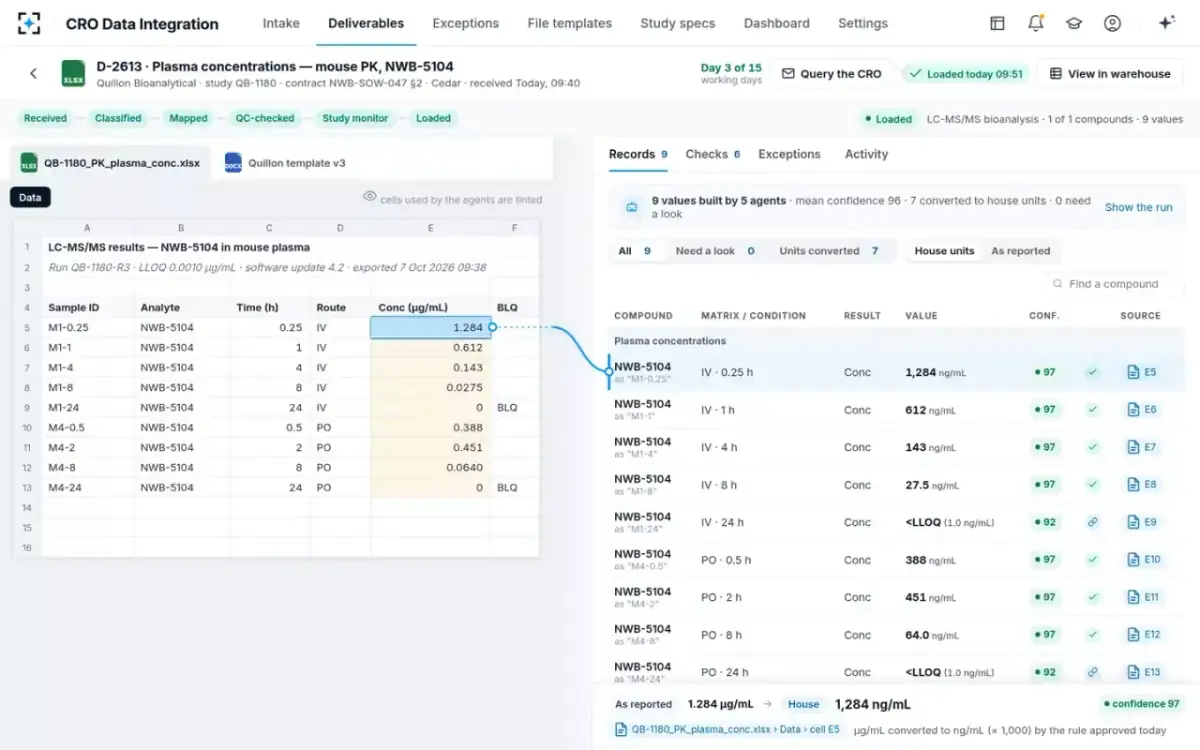
The nine words applied to one incoming file, line by line
Abstractions are easy to agree with. Here is the sample file against all nine, in the order a reader meets them. A plasma concentration workbook arrives on a Tuesday morning with nine samples from an intravenous and an oral dose, under a contract schedule that specifies the unit.
What a loaded value has to carry to survive a data-integrity question
- The file as it arrived, unaltered
The workbook kept in its original form, so an accuracy question has something to be answered against. The OECD asks that original records be regarded as raw data and retained.
- A citation to the page or cell
File, page and table, or sheet and cell. Without it the value is an assertion; with it, a reader can check it in seconds rather than requesting it.
- The value as reported, beside the value in house units
Both, always. A converted value alone hides the step most likely to be wrong, and makes a reversal impossible.
- The rule that converted it, named
Not “units normalised”, but the specific approved rule and the layout version it belongs to.
- The qualifier, as the laboratory wrote it
“> 60 min”, “< LLOQ”, “not tested — solubility”. A bound flattened into a number is a new, wrong measurement.
- The compound identity, and who resolved it if it was not exact
A name that did not match the shipped manifest is a judgement, and judgements carry names.
- The contract criterion it was judged against
Which clause set the acceptance range, so that a pass means something specific and a failure can be reproduced.
- Every decision taken about it, with who and when
Including the decision to hold it, and the decision to release it later. Absence of an objection is not a decision.
Run the nine words down that list and most of them are already satisfied. Attributable: the decisions carry names. Legible: unit and qualifier travel with the number. Contemporaneous: the handling is recorded as it happens. Original: the file is kept and the copy points back to it. Accurate: the conversion is by rule rather than by hand. Complete: the manifest is checked and gaps have reasons. Consistent: one layout version, one compound registry. Enduring: the citation survives the mailbox. Available: the cell is one click from the value.
What ALCOA+ does not require
Three things, and saying them plainly saves a lot of unnecessary work.
It does not require that your copy be the original. It requires that you know which is which, and that the one you treat as authoritative is either verified or labelled. A working copy, honestly labelled, with a live pointer back, is a defensible arrangement. A warehouse row that everybody quietly treats as the record is not.
It does not promise correctness. The OECD is explicit that its guidance "addresses data integrity and not data quality since the controls required for integrity do not guarantee the quality of the data" — integrity "provides control over the data (i.e. whether it can be trusted)" (OECD No. 22, section 2). A perfectly attributable, fully cited, impeccably audited value can still be wrong because the plate's controls failed. Integrity tells you the number is the number the laboratory reported; whether it should have been reported is the contract's question.
And it does not require every click to be logged and every log to be read. The expectation is a documented, risk-based review of the entries that bear on the data, not an exhaustive one. A team that tries to record everything usually ends up reviewing nothing.
A layout change recorded as a version, with who approved it and when
None of this is heavy once it is part of the way data arrives rather than a review bolted on afterwards. The nine words describe a value that carries its own context, and a value that carries its own context is also the one a scientist can use without asking anyone. If you want the full path a deliverable takes from a drop folder to a loaded value, it is in how CRO data management turns a deliverable into a loaded value; to see the citations and decisions on your own files, start from CRO Data Integration.
Every check passed or decided, with the name against each decision
Questions people ask
What does the acronym ALCOA stand for?
Attributable, Legible, Contemporaneous, Original and Accurate. The MHRA's data integrity guidance gives the five and names the four that the plus adds — Complete, Consistent, Enduring and Available. The nine together describe data a regulator can rely on, and they apply to paper and electronic records alike.
Is ALCOA+ stricter than ALCOA?
No — the difference is emphasis rather than substance. ALCOA is the original five attributes; the plus makes four further expectations explicit. The OECD states that there is no difference between the expectations for the two terms, because data governance measures should ensure data are complete, consistent, enduring and available throughout the data life cycle in any case. For a sponsor, the four additions are the ones most likely to fail, because they concern the data's whole life rather than the moment it was captured.
Who is responsible for data integrity when a contract laboratory generates the data?
The sponsor. The WHO guideline states that contract givers are ultimately responsible for the integrity of data provided to them by contract acceptors. In practice that means the sponsor needs its own evidence about an incoming deliverable — its own layout comparison, its own test against the contract's acceptance criteria, its own record of what was decided — rather than relying on the laboratory's assurance that the deliverable is sound.
Is a warehouse copy of CRO data a true copy?
Not as usually loaded. A true copy is one verified to carry the same information as the original, including the data that describe its context, content and structure — verified either by a dated signature or by generation through a validated process, in the WHO's definition. The verification must be attributable to whoever performed it, and the date of generation kept with the copy. A warehouse row extracted and converted from a workbook is a derived dataset rather than a copy, so it is either produced by a validated process or labelled as a working copy.
Do ALCOA+ principles apply to research data?
They apply as written to data generated under Good Laboratory Practice. For discovery work outside a regulated study, no inspector will test your warehouse against the nine words — but the same failures cost you anyway: a unit error nobody can trace, a compound identity nobody can explain, a value nobody can check. Most discovery teams adopt the principles not because they must, but because data that satisfies them is the only data that can be reused.
What is an audit trail review?
A review of the recorded life cycle of the data — creations, additions, deletions and alterations — to check that what happened to a value is what should have happened. It is not an inspection of every system action: the OECD states that it is not necessary for audit trail review to include every system activity, and asks instead for a documented, risk-based process that identifies which data and which transactions are critical. For incoming contract laboratory data, the entries that matter most are the conversions accepted, the exceptions decided and the values held back.