LIMS integration usually means building an interface so that results arrive in your laboratory information management system without anyone retyping them. When the results are generated inside your own building, that is largely an engineering problem: the format is yours, it changes when you change it, and a broken field is noticed the same afternoon. When the results come from a contract research organisation, every one of those assumptions fails. The format belongs to someone else, it changes when their instrument software is upgraded, and a wrong value can sit in the warehouse for a quarter before anyone questions it. This guide compares the four ways teams actually solve it, what each costs to build and to run, and which of them survives contact with a file that has quietly changed shape. Botminds' CRO Data Integration is the fourth of those approaches: an acceptance step that compares each file with the layout last accepted from that laboratory, extracts every value with a citation, tests the deliverable against the contract and loads it only once a named person has decided each exception.
The worked example is sample data on fictional people and companies: a sponsor, Northwind Bio, and the six contract laboratories whose files it receives over SFTP, a portal and a mailbox. The regulatory wording is quoted from published guidance and linked where it appears.
What does LIMS integration mean for data you did not generate?
Regulators have a precise name for the thing being built. The UK's medicines regulator defines it as data transfer: "the process of transferring data between different data storage types, formats, or computerised systems" (MHRA, GXP Data Integrity Guidance and Definitions, 2018). That definition is broader than an interface and narrower than a project, and it is the right unit to think in, because every one of the four approaches below is a data transfer whether or not any code is written. A scientist retyping ninety-six values is performing a data transfer between formats. So is a Python script. So is an instrument feed.
What distinguishes external data is that the sending side is outside your change control. Internally, a column rename is a ticket; externally it is an event you find out about from its consequences. Everything that follows comes from that one asymmetry.
The four approaches, and what each one costs
Teams converge on the same four. They are usually presented as a maturity ladder, as though each were a better version of the one before, but they are not: they differ most in what they do when something unexpected arrives, and that is not a dimension that improves monotonically with effort.
Four ways into a LIMS or a warehouse, judged on the day the file changes
| Approach | What it costs to build and run | How fast a deliverable moves | What happens when a column or unit changes |
|---|---|---|---|
| Manual entry | Nothing to build. Runs on scientist and data steward hours, every week, for as long as the programme lasts. | Days. A 96-value report is most of a working day, and it queues behind the science. | A careful person may notice. A tired person will not, and nobody will know which happened. |
| Scripted import | Days to weeks per laboratory per file type, plus ownership of each script when the person who wrote it moves on. | Minutes, when it works. Hours or days when it does not, because someone has to find out why. | The worst case. A script that reads by column position or header name keeps running and loads the new numbers as if nothing happened. |
| Instrument or system-to-system feed | Weeks to months, and usually a commercial arrangement with the laboratory as well as engineering on both sides. | Near real time, for the laboratories that have one. Few sponsors get one with all six. | Better, because a schema is usually enforced — but a unit written into a field value rather than the schema still passes. |
| An acceptance step in front of the load | Configuration rather than code per laboratory: the layouts, the unit rules, the contract criteria and who decides what. | Minutes, with the decisions a person genuinely has to make taken explicitly rather than skipped. | The file stops before anything is mapped. The change is shown against the last accepted layout, with what would have loaded, and a person decides. |
The cost column is the one that gets argued over in a business case, and it is the least interesting. The difference between a week of scripting and a fortnight of configuration disappears into the noise of a discovery programme. The last column is where the money actually is, because the cost of loading a thousand-fold unit error is not an engineering cost at all — it is the cost of the decisions taken on the wrong number before anyone noticed.
Why a fixed interface is the riskiest option for CRO files
Because its failure mode is silence. Manual entry fails visibly and slowly: a person falls behind, a backlog appears, somebody escalates. A fixed import script fails invisibly and fast. It reads the file it was given, finds the columns where it expects them, writes the numbers it finds, and reports success — which is exactly correct behaviour for a file that is still what it used to be.
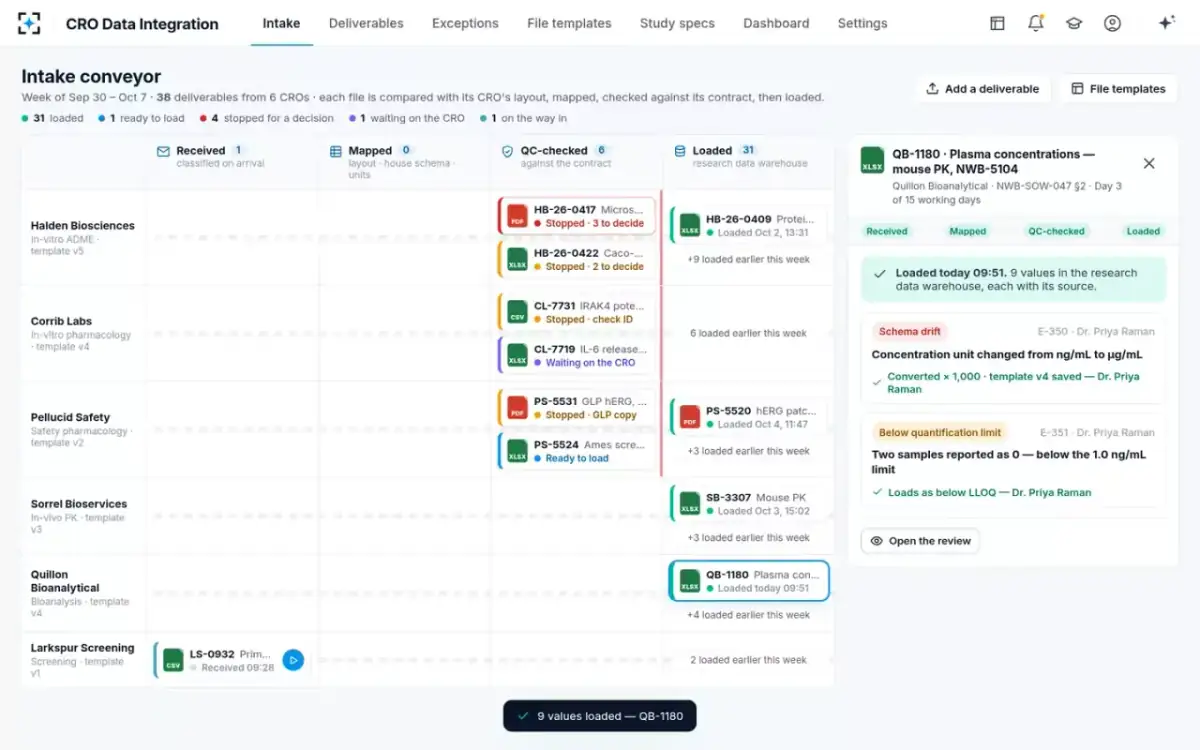
Three changes break a script without breaking its run. A header renamed, which stops a column being matched or matches it to the wrong field. A column moved, which a position-based reader will read straight past. And a unit changed in a header, which is the dangerous one, because nothing about the values looks wrong: a concentration column that switches from nanograms to micrograms per millilitre contains numbers a thousand times smaller than before, and they are all still plausible numbers. The sample data has exactly this case: a plasma concentration export where column E moved from "Conc (ng/mL)" to "Conc (µg/mL)", with the previous three runs at that time point reading 1,190 to 1,410 ng/mL and the new file reading 1.284. The script would have loaded nine values a thousand times too low; how that comparison is made before anything is mapped is set out in catching a changed column or unit before any value loads.
The regulatory guidance anticipates this precisely where an interface exists. The OECD's document on computerised systems asks that "special focus and monitoring is expected with regard to the control of data flow where interfaces to other systems are established" (OECD, Application of GLP Principles to Computerised Systems, No. 17, 2016). Monitoring of the data flow — not of the job's exit status. A nightly import that has succeeded every night for a year is monitored in the sense that matters only if somebody is watching what it carried, not whether it ran.
What a validated data transfer actually requires
Validation here is not a ceremony; it is a set of documents that make the transfer reviewable. The MHRA's requirement is one sentence and sets the whole bar: data transfer and migration procedures "should include a rationale, and be robustly designed and validated to ensure that data integrity is maintained during the data lifecycle" (MHRA, section 6.8). The US electronic records rule adds the test the validation has to pass: systems are to be validated for accuracy, for reliability, for consistent intended performance, and for their ability to tell invalid or altered records apart (21 CFR 11.10(a)).
Data migration is the process of moving stored data from one durable storage location to another. This may include changing the format of data, but not the content or meaning.
UK Medicines and Healthcare products Regulatory Agency, 'MHRA GXP Data Integrity Guidance and Definitions', section 6.8
Read the four tests in the US rule in order and the third and fourth are the ones import projects are most tempted to skip. Accuracy and reliability are usually tested: does it load the right numbers, and does it keep doing so. Consistent intended performance means the same input produces the same output after a change to either system — which is a regression test, not a one-off acceptance. And the ability to tell invalid or altered records apart is a requirement that the transfer itself be able to separate good input from bad. A script that cannot recognise an unexpected file does not meet that, however carefully it was tested on the expected one.
What a validated data transfer has to document, and what a thin version of each looks like
| What to document | What it has to establish | The thin version that fails a review |
|---|---|---|
| A rationale | Why this transfer exists, what it carries and which decisions depend on it. | “To load CRO results.” No statement of what is in scope or what is not. |
| The design | Source, destination, field-by-field mapping, units, qualifiers, identity resolution and what is deliberately dropped. | The code, offered as its own documentation. |
| Test evidence | That the right values arrive, and that wrong or unexpected input is detected rather than loaded. | One happy-path file, loaded once, by the person who wrote the mapping. |
| Change control | That a change to either system is assessed before it is made, and the transfer re-tested after it. | A changelog in a commit history nobody reviews. |
| An audit trail | What was transferred, when, from which file, with what outcome — and what was not. | A log of successful runs with no record of what was skipped or held. |
| Ongoing monitoring | That the data flow is watched, not only the job status. | An alert when the job fails, which is the one case that was never the problem. |
Mapping to the house schema: units, qualifiers, identity, citation
Mapping is where integration projects spend their time and where they make their lasting mistakes, because a mapping decision made once is applied to every value afterwards. Four of them are worth settling explicitly before any code is written.
Units first. Decide the house unit per parameter, and require every conversion to be by a named, approved rule rather than by arithmetic buried in a transform. This matters less for correctness than for reversibility: when a conversion turns out to be wrong, you need to know which values it touched. Keeping the value as reported alongside the converted value costs one column and makes the whole question answerable.
Qualifiers second, and this is the one most schemas get wrong. A result of "> 60 min", "< LLOQ" or "not tested — solubility" is not a number with a note attached; it is a different kind of statement. A schema with a numeric result column and nowhere to put the qualifier forces every import to choose between discarding information and inventing a number, and both choices are made silently a thousand times. Give the qualifier its own column and keep it as the laboratory wrote it; why a zero in particular is so damaging is worked through in what to load instead of zero for a value below the limit of quantification.
Identity third. A compound as a laboratory names it is not a compound as your registry names it, and the gap is where the worst errors live, because a value attributed to the wrong compound is wrong in a way that no range check will catch. Match through the manifest shipped with the study, and send anything that does not match exactly to a person rather than to a fuzzy lookup. Citation fourth: every value carries the file and page and table, or the sheet and cell, it came from. It is the cheapest column in the schema and the one that makes every later question answerable in seconds.
What the interface should do when the file changes
Not all changes deserve the same response, and treating them alike is what makes people switch the checking off. A layout comparison that stops the file for a renamed sheet is likely to be disabled before long; one that waves through a changed unit is worse than nothing.
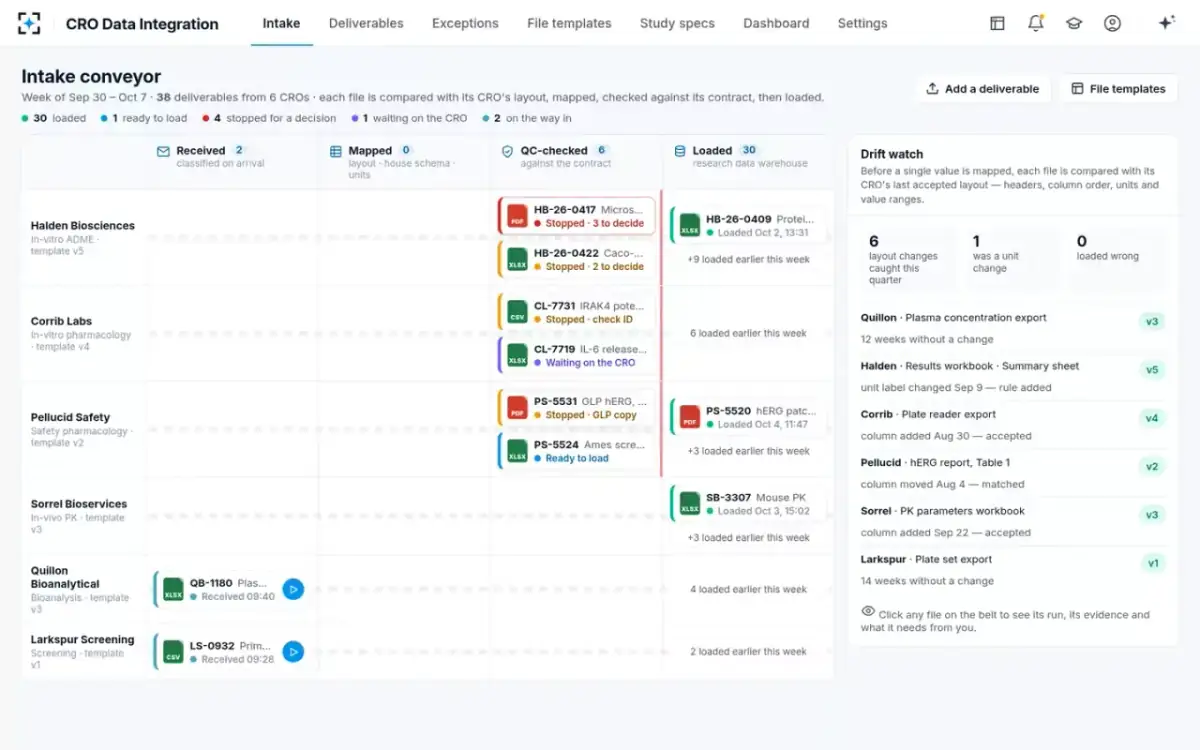
The workable rule separates changes that preserve meaning from changes that alter it. A column renamed or moved, where the content still matches by meaning or by name above a high confidence threshold, is matched automatically and recorded — the drift log keeps the history, and nobody is interrupted. A unit written into a header, an unmatched column, or a numeric column whose range has jumped by an order of magnitude against the last three runs, stops the file before anything is mapped. The person who decides sees the before-and-after comparison, the values that would have loaded, and three choices: accept the conversion, query the laboratory, or hold the file. Accepting saves a new version of that laboratory's layout, with who approved it and when, and informs the layout's owner.
The OECD's change-control requirement applies to your side of this too: changes to a computerised system are to be controlled and made under written procedures (OECD No. 17). Accepting a new layout is a change to how data is interpreted, and it belongs under the same discipline as a change to the code — which is precisely what versioning the layout and recording the approver achieves.
A lane for each laboratory and four stations, with the layout watch beside them
Should CRO data go into the LIMS or the warehouse?
Usually the warehouse, and the reason is about what each system is for rather than what it can technically hold. A laboratory information management system is built around work you perform: samples you received, batches you prepared, instruments you ran, states that move as the work moves. A contract laboratory's results have none of that life cycle on your side — the work is finished when the file arrives. Forcing them into a sample-centric schema usually means inventing sample records that correspond to nothing you ever held.
The warehouse is built for the opposite job: comparable values across programmes, queried by compound and assay rather than by sample. That is what a structure–activity view needs, and it is what a contract deliverable supplies. The cases for loading into the LIMS instead are narrow and real: when your own laboratory runs the same assay and the two sets must sit together; when the contract laboratory is doing a step in a workflow you are managing, such as analysis of samples you shipped; or when the LIMS is genuinely your system of record and the warehouse is a reporting copy.
In practice the answer is often "both", and that is fine provided one of them is the authoritative copy and the other is derived from it, rather than two independent loads of the same file that drift apart. What should never be in doubt is which is which. How the system categories divide up this work in general is set out in what a LIMS, an ELN, an SDMS and a warehouse are each for.
How long an integration takes, and what makes it slip
Ask three organisations and you will get three answers, because the engineering is a small share of the elapsed time. The shape below is our framework rather than a measured average — treat it as a planning checklist rather than a schedule — and the two phases drawn in warning colour are the ones that depend on other people, which makes them the likeliest to overrun.
The shape of an integration project, and the two phases that usually overrun
- Get real files and the contract1 wk
- Agree the house mapping1 wk
- Build2 wk
- Test and sign off1 wk
- Go live1 wk
- Get real files and the contract3 wk
- Agree the house mapping4 wk
- Build2 wk
- Test and sign off2 wk
- Go live1 wk
The first slippage is getting real files. A project that starts with two sample files from the laboratory's sales team will discover the variety later, in production: the report with a second sheet, the export where the time column is text, the study where the manifest named four compounds and the file has three. Ask for everything that laboratory sent you in the last year, not a representative sample chosen by someone who wants the project to go smoothly.
The second is agreeing the mapping, which is a vocabulary argument rather than a technical one: whether two assays are the same parameter, what a qualifier means, which compound identifier is canonical. It takes as long as it takes to get the right four people in a room, and no amount of engineering shortens it. The useful move is to start it in week one, in parallel with collecting files, rather than treating it as an input to the build.
The third, which the chart does not show because it has no end, is the second laboratory. An interface built for one laboratory's files is often most of a rebuild for the next, which is why the per-laboratory cost of the scripted approach does not fall the way teams expect. An approach where a new laboratory is a layout and a set of rules rather than a new piece of code is the one that scales to six.
How to monitor it after go-live
Monitoring a data transfer is not the same as monitoring a job, and the distinction decides whether you find problems or they find you. A job monitor answers "did it run". What you need answered is "did it carry the right things, and what did it refuse".
What to watch after go-live, and what should raise an alert
- Deliverables received against deliverables expected
A study with a contracted turnaround that has not arrived is the failure a job monitor can never see, because nothing ran. Alert on the absence, by laboratory and by study.
- Files that stopped, and how long they have been stopped
A stop is only useful if someone acts on it. Age the queue, and alert when a deliverable has been waiting on a decision longer than its turnaround allows.
- Layout changes, by laboratory
A laboratory that changes its file three times in a quarter is telling you something about its own change control. Alert on the third one, and raise it in the review.
- Value ranges against recent runs
A numeric column that jumps by an order of magnitude against the last three runs should stop the file even when the header did not change. This is the backstop for a unit change the header did not advertise.
- Exceptions by type and by laboratory
Control failures, replicate variability, missing compounds, recovery below the minimum. The mix tells you where to spend a conversation; a rising rate at one laboratory is a contract discussion, not a data problem.
- Values held and values released
Both numbers, together. A long list of held values nobody has released is a backlog wearing a quality uniform.
- Queries sent and answered
Time to answer, by laboratory. It is the single best measure of whether the relationship is working.
- Restorability of what you stored
The OECD asks that stored data be verified for restorability, accessibility, readability and accuracy, with access ensured throughout the retention period. Test a restore; do not assume one.
What the running intake looks like on the sample data
10min
between checks of each laboratory's drop folder; a portal sync or a mailbox can replace it
3
ways a deliverable arrives — SFTP, a laboratory portal, or email — with one route configured per laboratory
0
values that load while any exception on the deliverable is still undecided
Where the acceptance step belongs
In front of the load, and after the file has been received intact. That position is what lets it do the one thing none of the other three approaches can: refuse. A manual process cannot refuse reliably because refusing is a judgement nobody has time to make a hundred times a week. A script cannot refuse because it does not know what it is looking at. A feed can enforce a schema but not a contract — it has no opinion about whether a control met the range you negotiated.
An acceptance step is positioned to hold all three kinds of evidence at once: what the laboratory sent, what it sent last time, and what the contract says it should have sent. From there, the four outcomes are simple. Load, when everything passes. Load with a flag, when a value is real but qualified. Hold, when something must be resolved first. Query, when only the laboratory can answer. And in every case the decision carries the name of whoever made it, which is what turns an intake process into something that can be reviewed a year later.
None of this removes the need for the systems you already have. The warehouse still holds the corpus, the registry still owns compound identity, the contracts still define acceptance. What changes is that the moment between "a file arrived" and "the warehouse changed" stops being a gap between systems and becomes a place where decisions are made and recorded. The requirements list and the trial design for comparing products on this job are in what to look for in CRO data management software, and how to test it; to see the acceptance step run on your own past deliverables, start from CRO Data Integration.
Values written to the warehouse, each carrying its source
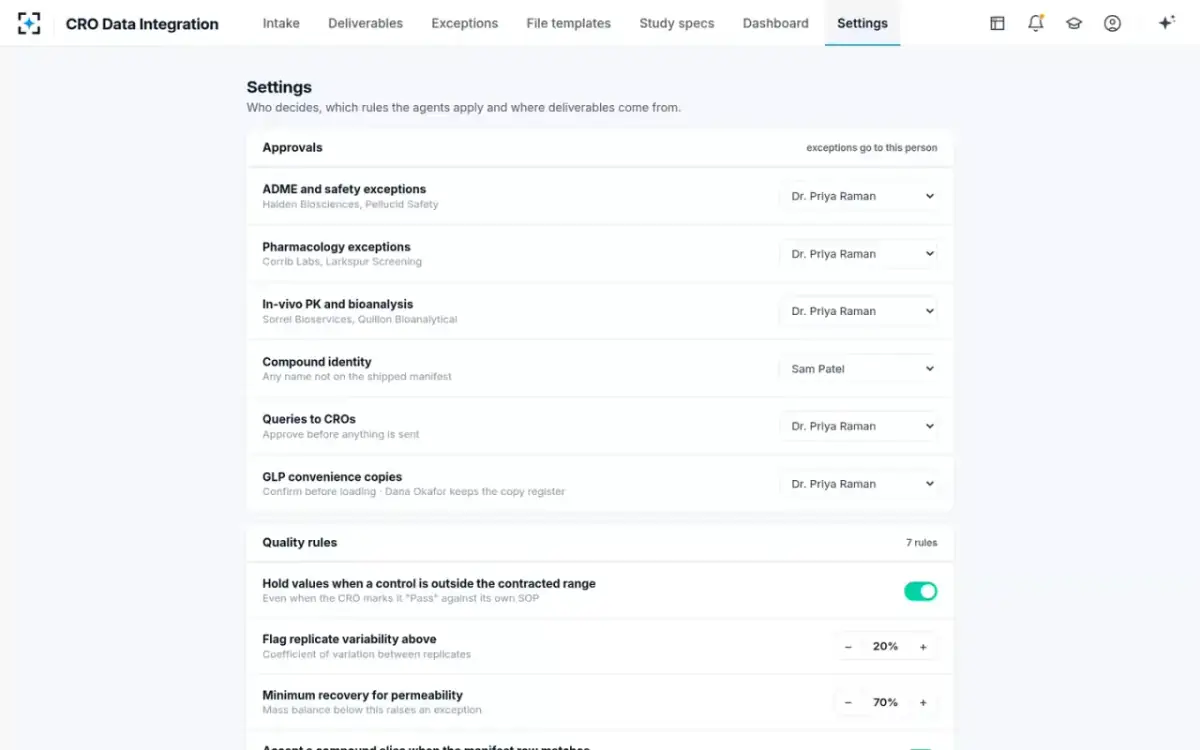
Who decides what, and which rules the checks apply — as settings
Questions people ask
What is the difference between an interface and an integration?
An interface moves data between two systems. An integration is the whole arrangement around it: the mapping into your vocabulary, the rules about what is acceptable, the people who decide exceptions, the change control when either side alters, and the monitoring that tells you what moved. Regulators frame the first as a data transfer — moving data between storage types, formats or computerised systems — and expect the second to be documented, validated and monitored around it.
How do you handle a CRO file that changes format?
Separate changes that preserve meaning from changes that alter it. A renamed or moved column whose content still matches confidently can be matched automatically and recorded in a change log. A unit written into a header, an unmatched column, or a numeric column whose range has jumped against recent runs should stop the file before anything is mapped, and a person should see the before-and-after comparison and the values that would have loaded. Accepting the change should save a new version of that laboratory's expected layout, recording who approved it.
How do you validate a data interface?
Document a rationale for the transfer, the field-by-field design including units and qualifiers, and test evidence that covers invalid input as well as valid — the US electronic records rule asks for validation that establishes accuracy, reliability, consistent intended performance and the ability to discern invalid or altered records. Then keep it under change control, so that a change on either side is assessed before it is made and the transfer re-tested after it, and monitor the data flow rather than the job's exit status.
What breaks a LIMS integration?
Four things, in rough order of frequency: a header or unit changed at the sending laboratory; a schema with nowhere to put a qualifier, so bounds become numbers or disappear; compound identity resolved by a fuzzy match instead of by a person; and a mapping that was agreed by one team and never written down, so nobody can say what a field means when the person who built it leaves. None of them is an engineering failure, which is why engineering alone does not prevent them.
What does a LIMS integration project involve?
Collecting a representative year of real files rather than a sample chosen for you, agreeing what each parameter and qualifier means in your own vocabulary, building the mapping, testing it against both valid and deliberately broken files, and then running it with monitoring that watches what arrived rather than whether the job ran. The build is rarely the long part: the two phases that overrun are getting real files and agreeing the mapping, because both depend on other people.
Should CRO data go into the LIMS or the warehouse?
Usually the warehouse, because a contract laboratory's results have no life cycle on your side — the work is finished when the file arrives — and a warehouse is built for comparable values across programmes rather than for samples you handled. Load into the LIMS when your own laboratory runs the same assay and the two sets must sit together, or when the contract laboratory is performing a step in a workflow you are managing. If both hold the data, make one authoritative and derive the other from it.