CRO data management is the work of accepting, checking and loading the results a contract research organisation sends back — final reports, results workbooks, instrument exports — so that the sponsor's own research data warehouse holds values it can defend. It is hard because every CRO writes its own layout and its own units, because a package arrives with no obligation to match the schema it is going into, and because the one change that matters most, a redefined column, looks exactly like the changes that do not. CRO Data Integration is Botminds' software for that acceptance: seven agents classify each package, compare it with that CRO's last accepted layout, extract and convert every value with the cell or page it came from, test it against the statement of work, and load it only when a named person has decided every exception.
The worked example on this page is sample data on fictional people and companies: Northwind Bio, a discovery sponsor placing work with six invented CROs. The research figures come from regulators, intergovernmental bodies and peer-reviewed studies, linked where they appear.
Eight weeks of CRO deliverables on the sample data
271
deliverables accepted, checked and loaded over eight weeks
31,482values
loaded, each one citing the page or cell it was read from
2.1h
median from receipt to readable records, as a design target
3–5days
the same journey when values are re-keyed by hand, estimated
What is CRO data management?
CRO data management is the sponsor-side discipline of turning what a CRO delivers into records the sponsor's scientists can use and its quality unit can defend. It covers five things: knowing what was commissioned and under which contract schedule; receiving the package and identifying it; reading every reported value out of the format it arrived in; normalising units, qualifiers and compound identity into the house schema; and testing the result against the acceptance criteria the contract set, before anything is loaded.
What it is not is a transfer problem. Moving a file from a CRO's portal to a sponsor's storage is solved and has been for years. The difficulty sits in the gap between the file and the schema: the CRO's workbook was designed for the CRO's instrument and its own reporting conventions, and the warehouse was designed for the sponsor's structure-activity view. Somebody has to carry each value across that gap and be able to say, afterwards, exactly where it came from and what was done to it.
That somebody is usually a scientist or a data steward with a second window open, reading a number out of one and typing it into the other. The job is slow, and the errors it makes are not random noise: they are whole-column errors, whole-plate errors and identity errors that travel into every downstream ranking built on the value. A pooled analysis of 93 published studies in clinical research put the error rate for single-keyed data at 0.29% of fields (Garza and colleagues, 2023) — small per value, and not small at all across a 96-value deliverable arriving every week. What the measured error rates actually are, by method, is worked through separately.
One plasma concentration file, from the drop at 09:40 to nine loaded values at 09:51
- Classified, layout comparedstopped: the unit had changed
- Converted, checkedboth stops decided by 09:49
- Loaded, cited09:51
Eleven minutes is not the point of that example. The point is that the file stopped twice and a person decided twice, and that both decisions are attached to the nine values for as long as they exist. A process that cannot stop has no decisions in it, and a process whose decisions are not written down cannot be explained to an auditor a year later.
The five things a CRO package contains, and what each costs to read
A deliverable is rarely one file. A typical in-vitro ADME package carries a report, a workbook, an export and a covering note, and it answers a contract schedule that is not in the package at all. Each part costs something different to read, and each hides a different class of error.
What arrives in a CRO package, and what reading it by hand costs
| What arrives | What it holds | What reading it by hand costs |
|---|---|---|
| The final report, as a PDF | Methods, conditions, result tables, the controls and their verdicts, and the study director's signature page. | The slowest part. Values live in tables laid out for the page, not for a parser, and the control verdicts are prose. |
| The results workbook, as Excel | The numbers themselves, sheet by sheet, usually with a flag or qualifier column beside each value. | Fast to copy and the easiest place to lose a row, a unit or a qualifier. Spreadsheets also silently retype what looks like a date. |
| The instrument export, as CSV or XLSX | What the LC-MS/MS or plate reader wrote, closest to the raw data and furthest from the house schema. | The file most likely to change shape, because it changes when the laboratory upgrades its instrument software — not when anyone decides to tell you. |
| The covering email or portal note | What the CRO believes it is sending, and often the only mention of a repeat, a re-run or a sample lost in transit. | Usually unread, and the one place a material fact about the package appears in free text. |
| The contract schedule it answers | The acceptance criteria: control ranges, replicate variability, recovery, time points, the compound manifest and the turnaround. | Not in the package. Somebody has to fetch it, and if nobody does, the only criteria applied are the CRO's own. |
The last row is the one that decides whether this work is data entry or acceptance. A package read on its own can only be checked against itself, and against itself it almost always passes: the CRO applied its own standard operating procedure and wrote Pass. Checked against the contract, the same package can fail — because the contract bought a narrower control range, more replicates or a shorter turnaround than the CRO's routine method guarantees.
Where a deliverable's working days actually go
Ask a discovery organisation how long CRO data takes to reach the warehouse and the answer is usually a number of days with no breakdown behind it. The breakdown matters, because the days are not spread evenly and the largest block is the least skilled. On a typical in-vitro ADME deliverable, re-keying alone is more than a third of the elapsed effort, and the contract checks — the part that needs a scientist — are under a fifth.
Where about four and a quarter working days go on one ADME deliverable, by hand
Read the chart as a case for where the automation should go, not as a promise. Two of those six rows are judgement: deciding an exception and reading a control against a contract clause. The other four are transcription, lookup and conversion, and they are the rows that both consume the week and generate the errors. An intake step that removes them does not make a scientist faster at the judgement; it gives the judgement back the day it was taking.
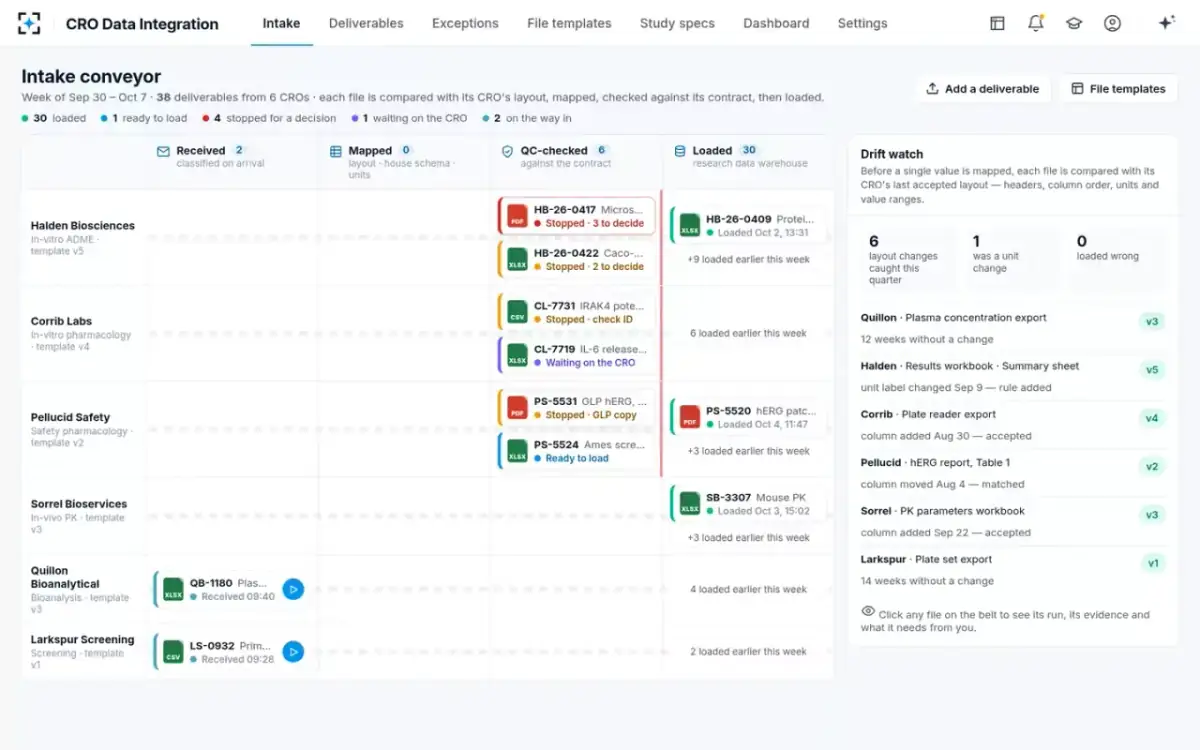
Every CRO on one intake conveyor, with the week's deliverables on it
Who is responsible for data a CRO generated?
The sponsor is. This is the part of CRO data management that is not a matter of operating preference, and three separate bodies say it in almost the same words. The World Health Organization's data integrity guideline is the shortest: "Contract givers are ultimately responsible for the integrity of data provided to them by contract acceptors." Placing the work moves the bench; it does not move the answerability.
Sponsors cannot rely solely on the assurances of test facilities they may have contracted to arrange or perform such studies.
OECD Panel on Good Laboratory Practice, The Role and Responsibilities of the Sponsor in the Application of the Principles of GLP, No. 11 (1998)
The OECD panel's sentence is the operational one, because it rules out the only cheap answer. If a sponsor could accept a CRO's assurance and stop there, CRO data management really would be file transfer. The panel says it cannot, which means the sponsor needs its own evidence that what arrived meets what was commissioned — and that evidence has to be produced on receipt, not reconstructed when somebody asks.
In the United States the duty is written into the good laboratory practice regulation itself. Where a sponsor uses a consulting laboratory or contractor for part of a nonclinical study, 21 CFR 58.10 requires the sponsor to tell the contractor that the work belongs to a nonclinical laboratory study and has to be conducted in compliance with the regulation. The obligation runs outward from the sponsor to the contractor, not the other way around. What that means when you are choosing software is a buying question with a different shape, and it is worked through separately.
It is worth being precise about what "the data" means here, because sponsors and CROs often use the word for different things. The UK regulator's definition is the usable one: "Data integrity is the degree to which data are complete, consistent, accurate, trustworthy, reliable and that these characteristics of the data are maintained throughout the data life cycle." The life cycle includes the step this page is about. A value that was accurate in the CRO's instrument export and wrong in the sponsor's warehouse has failed on integrity, and the failure belongs to whoever ran the load.
The four checks that have to pass before a value loads
Acceptance is testable, and it comes down to four questions asked in order. Each one has a different failure, a different piece of evidence and a different person who should decide it. Running them out of order wastes work: there is no point extracting a workbook whose columns no longer mean what the template says they mean.
The four checks CRO Data Integration runs before a value reaches the warehouse
| The check | What it compares | What it stops | Who decides when it fails |
|---|---|---|---|
| 1. Layout | The file against that CRO's last accepted template: header names, column order, sheet names, units written into headers, and each numeric column's range against the last three runs. | A changed unit, an unmatched column, a column whose values have jumped tenfold without the header moving. | The study monitor, who accepts the conversion and saves a new template version — or queries the CRO. |
| 2. Extraction | Every reported value against the page and table, or sheet and cell, it was read from. | A value with no source, a table read into the wrong row, a qualifier dropped on the way out of a report. | Nobody has to: the citation either exists or the value does not load. |
| 3. Units and identity | Each value against the approved unit rule for its parameter; each compound name as reported against the manifest shipped with the study. | A conversion with no approved rule behind it, and a compound name that is not on the manifest. | The data steward decides identity; an ambiguous name is never guessed. |
| 4. Contract criteria | Controls, replicate variability, recovery, integrity markers, time points, compounds delivered and turnaround against the statement of work. | A control inside the CRO's own range but outside the contracted one; replicate variability above the contracted limit; a compound missing from the delivery. | The study monitor, with the report page and the contract clause side by side. |
Check 2 is the one that is easiest to skip and hardest to add later. A value that arrives with its citation can be re-examined by anyone, at any time, without reopening the original package; a value that arrives as a number in a schema can only be re-examined by finding the file again and trusting that it has not been replaced. The regulatory expectation here is not subtle — the point of an audit trail is that the original entry is never obscured — and in practice a citation per value is what makes a warehouse row answerable at all.
How does a changed column or a changed unit get caught?
By comparing the file with the last file from the same CRO before anything is read out of it, and by comparing the numbers with the numbers that CRO last sent. A header comparison alone is not enough, because the dangerous change is the one that keeps the column in place and alters what it means; a value comparison alone is not enough either, because a renamed column with identical values is harmless and should not stop anything.
In the sample file, the comparison found four differences at once. Two were renames — a column called Sample became Sample ID, a column called Flag became BLQ — and both matched by meaning. One was a reordering: Route and Time swapped places, and both matched by name. The fourth changed column E from a concentration in ng/mL to a concentration in µg/mL, and that one stopped the file, because accepting it silently would have divided every concentration in the study by a thousand. How drift detection separates the three kinds of change is the subject of its own guide.
The asymmetry is the rule worth writing down: a change that can only make a value harder to find may be matched automatically; a change that can alter what a value means may not. Renames and moves are the first kind. Units, qualifier vocabularies and anything that redefines a column are the second, and no confidence score is high enough to let one through on its own.
What a house schema has to hold: unit, qualifier, identity, citation
Most of the damage done to CRO data happens at the moment it is written into the sponsor's own structure, because that is where information is dropped rather than altered. A schema with a numeric column and nothing else forces every qualified result — below the quantification limit, greater than sixty minutes, not tested — into a number that lies about what was observed. The schema has to be able to hold the truth before the intake process can be asked to preserve it.
What one loaded value has to carry, if the warehouse is to answer for it
- The value as reported, and the value in house units
A conversion that overwrites the original leaves a reader nothing to check it against.
- The unit, written as a unit
A unit implied by a column header is a unit that can change without the schema noticing.
- The qualifier, exactly as the CRO reported it
Below the limit, greater-than, not tested: a qualifier is data. Turning it into a plain number invents a measurement that was never made.
- The limit or threshold the qualifier refers to
"Below the limit" means nothing a year later unless the limit in force that day travels with it.
- The compound, as reported and as registered
The CRO wrote what was on the vial; the registry holds what the programme calls it. Both are needed to defend the match.
- Replicates and the variability behind the number
A mean with no spread cannot be judged against a contracted limit on replicate variability.
- The citation: file, page and table, or sheet and cell
The difference between a value you can re-examine and a value you can only re-trust.
- The rule that converted it, and who approved that rule
A conversion nobody approved is an edit, and an edit with no author is the thing every data integrity guideline is written against.
- The decision, and the name of the person who made it
Every stop that was overridden, accepted or held should be readable from the value it affected.
There is a standards answer to part of this for safety studies. CDISC's Standard for Exchange of Nonclinical Data sets out one consistent format for collecting and presenting nonclinical data, and CDISC lists it among the standards the US regulator requires for data submission. Where a study is in SEND scope, the shape of the destination is decided for you. Most discovery and DMPK work is not, which is exactly why each sponsor ends up with a house schema of its own and has to be deliberate about what that schema is able to record.
Re-keying, a fixed import script, or an intake step: what each one gets wrong
Three ways of doing this work are common, and they fail differently. Re-keying by hand is honest about its cost and dishonest about its accuracy: a careful scientist still transposes digits, and nothing about the method makes the error visible afterwards. A fixed import script is the opposite — it is accurate on the file it was written for and silently wrong on the day that file changes, which is the day it matters. The third option is an intake step that is allowed to stop.
On the day a CRO changes a column: a fixed import script against an intake step that can stop
A fixed import script: Only if the change breaks it. A renamed column throws an error; a redefined unit in the same column does not.
An intake step that can stop the file: Yes, by comparing headers, order, units and each column's value range with the CRO's last accepted layout before any value is read.
A fixed import script: Everything, converted by last month's assumption. A thousandfold unit change loads as a thousandfold error.
An intake step that can stop the file: Nothing, until a person has seen the before-and-after and chosen. Held values stay out of the warehouse.
A fixed import script: A scientist, weeks later, when a compound ranks oddly — if anyone looks.
An intake step that can stop the file: The study monitor, at the moment the file arrives, with the diff and what would have loaded.
A fixed import script: A new script, and a second thing to maintain. Scripts accumulate one per CRO per export.
An intake step that can stop the file: A template for that CRO's layout, learned from its first accepted deliverables and versioned from there.
A fixed import script: A loaded table. The reasoning, if there was any, is in the code.
An intake step that can stop the file: The decision, the rule applied, the new template version and the name of whoever approved it.
None of this removes the person. An intake step that stops a file is useless unless somebody is named to decide it, and the decision is a scientific one: convert, query the CRO, or hold. What the step removes is the requirement that the person notice. That is the part humans are reliably bad at and software is reliably good at — comparing this file with the last one, every time, including the week everybody is busy.
What to measure: turnaround, first-pass clean rate, exception mix
CRO data management is usually managed on anecdote: the last bad deliverable, the CRO somebody had trouble with. Four measures turn it into something a head of external research can act on, and all four can be taken from the intake process itself rather than from a survey.
One week of deliverables on the sample data, by where they stopped
38 deliverables
- Loaded · 30 · 78.9%
- Stopped for a decision or a query to the CRO · 5 · 13.2%
- Still moving · 3 · 7.9%
Four measures of CRO data management, and how to count each one
| What to measure | How to count it | Why it is the number that moves |
|---|---|---|
| Receipt-to-warehouse time, as a median | From the moment the package lands to the moment its values are readable in the warehouse. Take the median, not the mean: one held deliverable distorts an average and tells you nothing about the typical file. | It is the measure a scientist feels. CRO Data Integration's design target is 2.1 hours against an estimated 3–5 days of hand work. |
| First-pass clean rate | The share of deliverables that pass all four checks with no exception raised. Count by deliverable, not by value, or one large study will swamp the figure. | It separates a CRO relationship that is working from one that is being carried by the sponsor's own staff. |
| Exception mix | Exceptions grouped by kind — layout, units, identity, controls, replicate variability, missing compounds, turnaround — over a quarter. | The mix tells you what to fix. A quarter dominated by layout exceptions is a template conversation; one dominated by control failures is a contract conversation. |
| Drift caught before load | Layout changes detected and resolved before any value was written, counted per quarter and per CRO, with how each was resolved. | It is the only one of the four that measures an error that did not happen, which is why it is the one most organisations have never counted. |
Every deliverable, with its stage and its turnaround against the contract
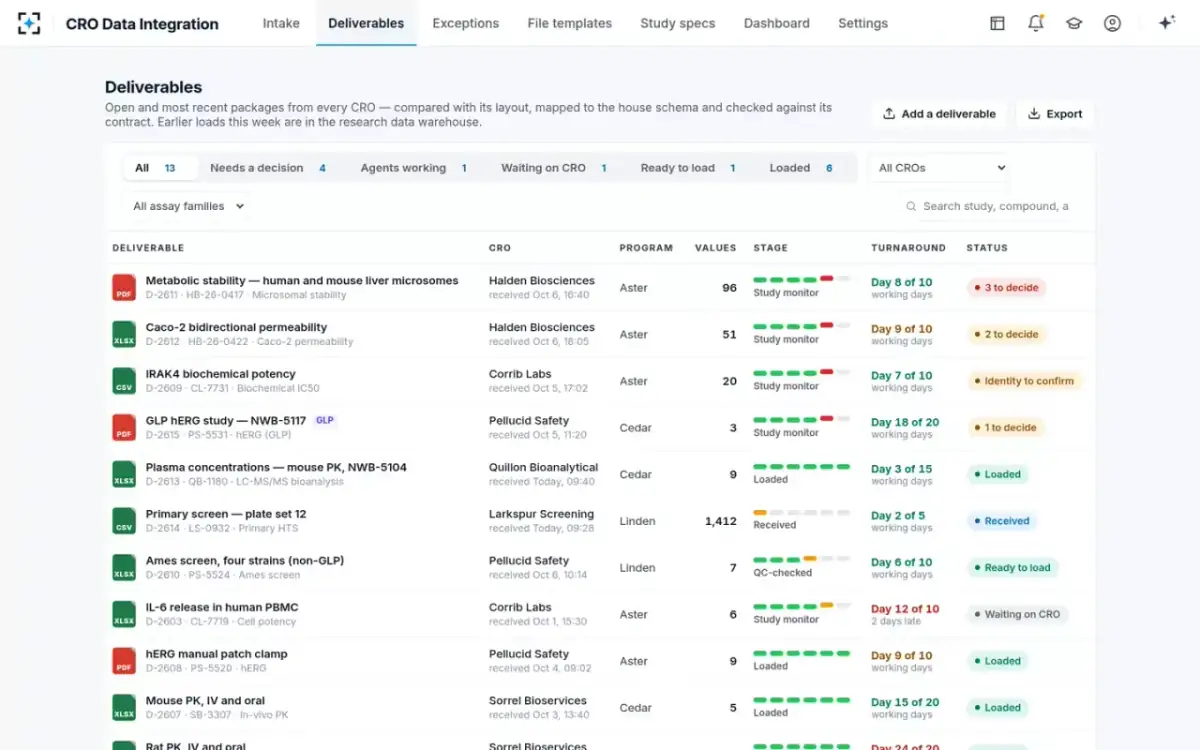
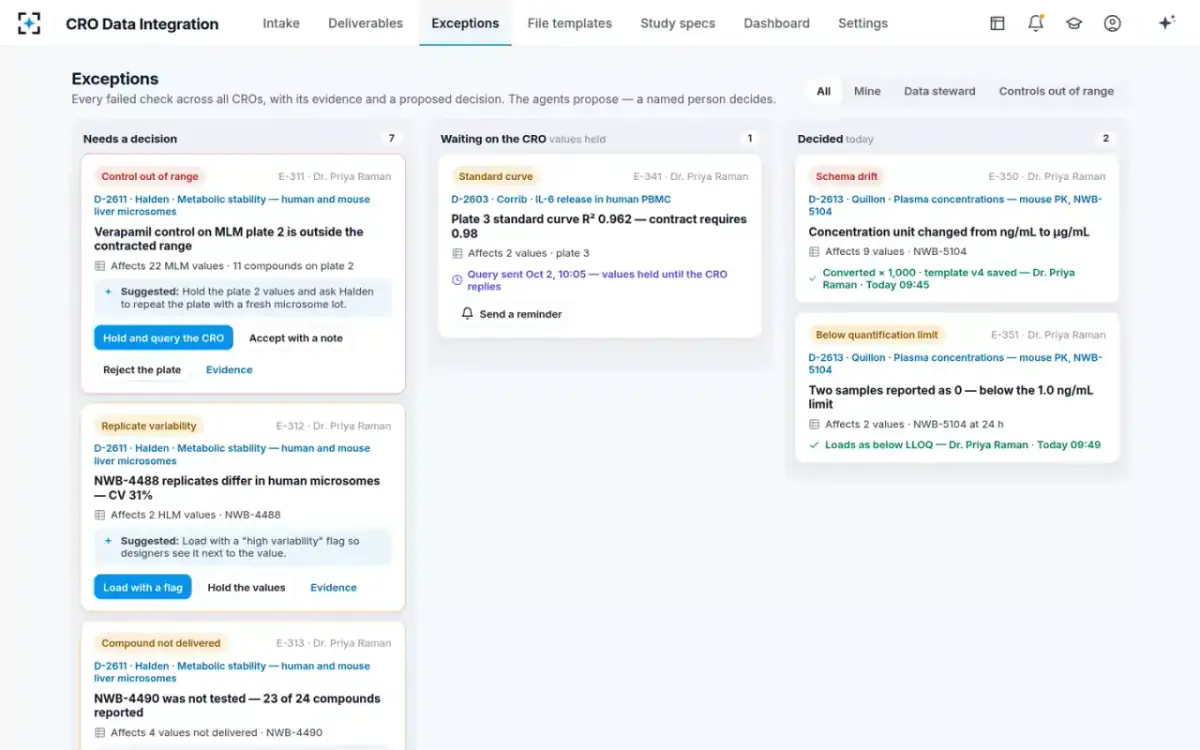
The exception mix is the measure that changes behaviour fastest, because it converts a vague sense that one CRO is harder work into a count of a particular kind of failure. What to load when a result sits below the quantification limit and what to do when a file changes shape are the two exception kinds that recur most often in discovery work, and both are decisions a sponsor should make once, write down, and apply the same way every time. To see the conveyor, the checks and the decisions together, start from CRO Data Integration.
The exceptions waiting on a decision, each with its evidence
Questions people ask
What does a CRO data management plan cover?
At minimum: which contract schedule each study runs under and where its acceptance criteria live; how deliverables arrive and who is told when one does; the house schema and the unit rules that map into it; what happens to qualified results such as values below the quantification limit; who decides each class of exception; and how a layout change is accepted and versioned. The plan is worth writing because every one of those is otherwise decided ad hoc, differently, by whoever opens the file.
How long should it take to get CRO results into a warehouse?
There is no published benchmark for discovery work, so judge it against your own baseline rather than against a figure. Measure the median today, by deliverable type, before changing anything. On its sample data CRO Data Integration carries a nine-value plasma file from receipt to loaded in eleven minutes including two human decisions, and its design target across all deliverables is a 2.1-hour median, against an estimated 3–5 days when values are re-keyed by hand.
What are the biggest CRO data management challenges?
Three, in order of damage done. A redefined column or unit that loads silently and rewrites every value from that column. A qualified result flattened into a number — most often a result below the quantification limit written as zero. And compound identity: a name on a vial that does not match the registry, guessed rather than resolved, which attaches real measurements to the wrong molecule.
How do you check a CRO deliverable before loading it?
In four passes, in order: compare the file's layout with the last accepted one from that CRO; extract every value with the page or cell it came from; normalise units and resolve compound identity by approved rules only; then test controls, replicates, recovery, time points, delivery and turnaround against the statement of work rather than the CRO's own procedure. Anything that fails stops at the pass that caught it, with the evidence attached.
Who is accountable if a CRO sends bad data and it reaches our warehouse?
The sponsor. The World Health Organization's data integrity guideline states that contract givers are ultimately responsible for the integrity of data provided by contract acceptors, and the OECD's panel on good laboratory practice adds that sponsors cannot rely solely on the assurances of the facilities they contract. A CRO can be in breach of its contract at the same time; that is a commercial matter and does not transfer the answerability.
How do you measure CRO data quality?
By exception, not by opinion. Count the share of deliverables that pass every check first time, group the failures by kind, and track both by CRO over a quarter. Add turnaround against the contracted date, and count the layout changes caught before any value loaded. Four numbers, taken from the intake process itself, support a supplier conversation that a list of remembered incidents does not.