CRO data management software is the layer between what a contract research organisation sends and what a sponsor's research data warehouse holds: it takes the package, identifies it, reads every value out of the report, workbook or instrument export, converts it into the house schema, tests it against the contract, and loads it with a citation. Choosing one is harder than it looks because the thing that matters is not extraction accuracy. Most serious candidates read a clean file well. What separates them is behaviour on the day a laboratory changes a column, writes a censored result as zero, or marks a control Pass against its own procedure — which is why the only useful evaluation is a trial on your own past deliverables, including the ones that went wrong. CRO Data Integration is Botminds' answer to this problem, and this guide is written so that it can be judged against the same test as anything else.
The figures from the solution below are sample data on fictional people and companies, and are marked where they are design targets or estimates rather than observations. The regulatory sources are linked where they appear.
Eight weeks of deliverables, as a candidate's trial should be able to report them
79%
of deliverables clean on first pass — every check passed, no exception raised
2.1h
median from receipt to readable records, as a design target, against 3–5 days by hand
60
exceptions over eight weeks, across seven kinds, each with a named decision
472h
of re-keying avoided over the same eight weeks, estimated
What does CRO data management software actually have to do?
Four jobs, and a product can be strong at some of them and weak at others. It has to take delivery — from whichever of SFTP, portal and mailbox each laboratory uses, without someone forwarding files. It has to read — PDF report tables, workbook cells and instrument exports, with the page or cell recorded for every number. It has to normalise — units, qualifiers and compound identity into the sponsor's schema, by rules that are written down and versioned. And it has to accept or refuse — test the delivery against the acceptance criteria in the contract and stop when it fails, rather than loading it and raising a report afterwards.
The fourth job is the one that distinguishes this category from document extraction, and the one buyers most often leave out of a requirements list. Extraction asks "what does this file say?" Acceptance asks "does what this file says meet what we bought, and should any of it reach the warehouse?" A product that answers only the first question moves the problem from typing to checking, which is the more expensive half.
Eleven requirements, in the order a deliverable meets them
Written in the order a package actually encounters them, so that a demonstration can be walked through end to end rather than cherry-picked.
Eleven requirements, in the order one deliverable meets them
- Takes delivery where the file already lands
A drop folder, a portal sync or a mailbox per laboratory. Anything that needs a person to forward a file will be skipped in a busy week.
- Identifies the package without being told
Which laboratory, which study, which assay, which contract schedule — matched against the open studies, with anything unmatched going to a person rather than being guessed.
- Compares the layout before it maps anything
Against the last accepted layout from that laboratory: header names, column order, sheet names, units in headers, and each numeric column's range against recent runs.
- Stops on a change of meaning, and only on a change of meaning
A renamed or moved column should be matched and recorded. A changed unit or qualifier vocabulary should stop the file. A product that stops on both is likely to be switched off by its users.
- Reads PDF tables, workbook cells and instrument exports equally well
Most discovery deliverables are a mixture, and a product strong only on workbooks leaves the report — where the controls and the conditions live — to a person.
- Cites the page or cell for every single value
Not a link to the file: the page and table, or the sheet and cell. This is what makes a loaded value re-examinable instead of merely re-trustable.
- Converts units only by an approved, versioned rule
And shows the value as reported beside the value in house units, with the rule that made the conversion and who approved it.
- Keeps qualifiers exactly as reported
Below the limit, greater-than, not tested. Never a plain number in place of a bound, and never a zero for a censored result.
- Resolves compound identity against the study's manifest
Proposing the likeliest match where a name does not fit, and sending anything ambiguous to a named person instead of choosing.
- Tests acceptance criteria against the contract, not the laboratory's procedure
Controls, replicate variability, recovery, integrity markers, time points, compounds delivered, turnaround — and the contract range winning wherever the laboratory's own is wider.
- Loads only when every exception is decided, and records who decided
Held values stay out until released, and each decision stays attached to the values it affected.
The questions to ask about units, qualifiers and compound identity
These three are where the demonstrations are weakest, because none of them shows well on a clean file. Ask them as questions about behaviour, and ask for the screen rather than the answer.
Nine questions to put to any candidate, and what a weak answer sounds like
| Ask | What a strong answer looks like | What a weak answer sounds like |
|---|---|---|
| Where does the unit for a value come from? | Parsed from the header as a unit, compared with the accepted layout, and converted by a named rule. | "It is configured in the mapping." A configured unit is an assumption that does not change when the file does. |
| What happens when a header's unit changes? | The file stops before mapping, with a before-and-after diff and what would have loaded. | "We would flag it for review." Ask whether the values load in the meantime. |
| What do you store for a result below the quantification limit? | A qualifier, the limit in force for that run, the unit, and the citation. No number. | "We put zero" or "we use half the limit." Both destroy the censoring. |
| Can I change the convention for censored results later? | Yes, because the record keeps the bound rather than a substituted number. | "You would need to reload." That is the answer that tells you the information is gone. |
| How is a compound name matched to our registry? | Against the manifest shipped with the study, with a confidence, and ambiguity escalated to a named person. | "Fuzzy matching." Ask what it does when two registry entries score within a point of each other. |
| What happens to a compound that is not on the manifest? | An exception for the data steward, with the proposed match and the evidence. | "It creates a new entry." That is how a registry acquires duplicates of real compounds. |
| Show me a value traced back to its source. | A click from the loaded record to the page and table, or the sheet and cell. | A link to the file. Finding the number again is then the reader's problem. |
| Who can change a rule, and where is that recorded? | Named roles, a version per change, and an audit trail entry with who and when. | "Our team configures it for you." A rule you cannot change is a rule you cannot defend. |
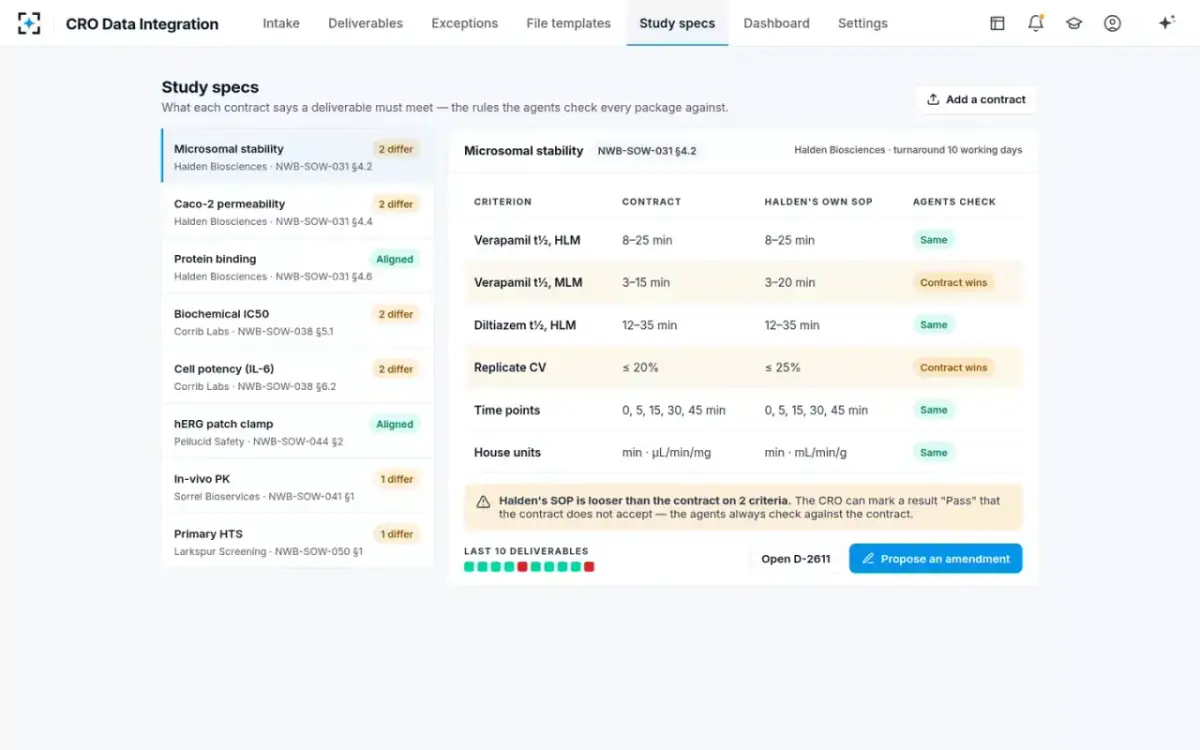
| What does it do with a control the laboratory marked Pass? | Re-tests it against the contract and raises an exception where the contract is tighter. | "We read the result column." Then the laboratory's procedure is your acceptance standard. |
One contract's acceptance criteria beside the laboratory's own procedure
Does it have to meet 21 CFR Part 11 or GLP computerised-system expectations?
It depends on what the data is for, and the answer is usually narrower than a procurement questionnaire assumes. Most discovery and DMPK work is not conducted under good laboratory practice and is not submitted, so the formal expectations do not bite. Two situations change that: where the system holds or processes electronic records that are themselves regulated submissions, and where it touches data from a study that was run under good laboratory practice.
Where Part 11 does apply, the two requirements that bear most directly on this category are validation and the audit trail. The regulation asks for systems validated for accuracy, reliability and consistent performance, able to recognise records that are invalid or have been altered, and for an audit trail that the computer itself generates, secures and time-stamps, logging independently when an operator created, changed or deleted an electronic record. The second requirement is worth reading as a product requirement rather than a compliance one: an audit trail that records which person accepted which unit conversion is the thing that makes a warehouse value explicable a year later, regulated or not.
For good laboratory practice work, the OECD's guidance on computerised systems is the practical reference, and it is explicitly proportionate.
Risk management should be applied throughout the life cycle of a computerised system taking into account the need to ensure data integrity and the quality of the study results.
OECD Working Party on Good Laboratory Practice, Application of GLP Principles to Computerised Systems, No. 17 (2016)
The same document sets the expectation for scale: "minimal activities may be required for simple processes like weighing on a stand-alone balance; more extensive activities might be required for complex systems like interfaced laboratory information management systems." An intake step that writes into a research warehouse sits toward the second end of that range, which is an argument for asking a vendor what validation evidence it supplies rather than whether it is "compliant".
One honest caveat belongs in any evaluation, and the UK regulator states it plainly: automation, or a validated system, "may lower but not eliminate data integrity risk". Software moves the risk from transcription to configuration. That is a good trade — configuration is visible, versioned and testable where transcription is none of those — but it is a trade, not an elimination, and a trial should be designed to find the configuration failures rather than to confirm the extraction successes.
How do you test it before you buy? A fifty-deliverable trial
Run every candidate over the same fifty of your own past deliverables, chosen before anyone sees how a product performs, and score on what it stops rather than on what it reads. Fifty is enough to cover your laboratories and assay families without becoming a project, and the set should be deliberately unrepresentative: the point is to exercise the behaviours that matter, which are rare in any random sample.
What to put in a fifty-deliverable trial set, and what each part is there to prove
| What to include | How many | What it is there to prove |
|---|---|---|
| Recent, ordinary deliverables from your busiest laboratory | 18 | Baseline accuracy, turnaround and how many values arrive with a usable citation. This is the only part a demonstration already covers. |
| Deliverables from at least three other laboratories | 12 | That layouts are learned from your files rather than coded by the vendor. Ask how long each new one took to reach the same accuracy. |
| The three that went wrong | 3 | The most valuable three files you own. The candidate should stop exactly where your people eventually had to intervene — and if it does not, you have your answer. |
| A file with a unit changed in a header, prepared by editing one | 2 | That the file stops, that the diff is legible, and that nothing loads while the question is open. |
| A file with a renamed column and a moved column | 3 | That it does not stop. A product that cannot tell a rename from a redefinition will be switched off by its users. |
| Studies with censored results written as 0, as a blank, as <value and as a flag | 4 | That all four arrive in the warehouse as the same thing, with the limit, and that none of them becomes a number. |
| A study with a compound name not on the shipped manifest | 2 | That it escalates with a proposed match rather than creating a registry entry or guessing. |
| Studies whose controls pass the laboratory's procedure and fail the contract | 3 | That the contract wins, and that the exception names the clause and the report page. |
| PDF-only reports with a table running across a page break | 2 | Extraction fidelity on the format that is hardest and most common in final reports. |
| A deliverable missing part of what was commissioned | 1 | That completeness is checked against the manifest and the schedule, not just against the file. |
Two rules make the trial comparable. Fix the set before the first demonstration, so that no candidate's strengths shape it. And have the same two people score every candidate on the same sheet, because most of the differences are judgements — whether a diff was legible, whether an exception named the right clause — and a scorer who has seen three products judges the fourth differently.
What to measure in the trial: first-pass clean rate, drift caught, false stops
Six measures, and the third is the one buyers forget. A product that stops everything scores perfectly on safety and risks being abandoned by the people who have to use it.
The first-pass clean rate is the share of the thirty ordinary deliverables that passed every check with no exception raised. On the sample data this runs at 79% — a figure from fictional data, not a benchmark. A much higher figure in a trial is worth questioning: it can mean checks are not running rather than that files are clean. Drift caught before load is the companion: of the two files whose header unit you altered, did both stop, and did any value from either reach the warehouse first? Two out of two, with nothing loaded, or the candidate is out.
False stops is the measure buyers forget, and it decides whether anyone will still be using the product in six months. Of the three files carrying only a renamed column and a moved column, how many stopped unnecessarily, and what did each unnecessary stop cost in someone's morning? A product that stops on everything is safe on paper and abandoned in practice. Median receipt-to-readable time is the fourth, measured end to end and including the human decisions rather than only the machine time.
Citation coverage is the proportion of loaded values that can be opened to a page and table or a sheet and cell. The answer should be all of them; anything less means some part of the warehouse is unexaminable and you will not know which part. Exception quality is the last and the most judgemental: for each prepared file that should have stopped, did the exception name the right evidence — the report page, the workbook cell, the contract clause — and propose a sensible decision, or did it only report that something was wrong? The difference between those two is most of the daily cost of running this work.
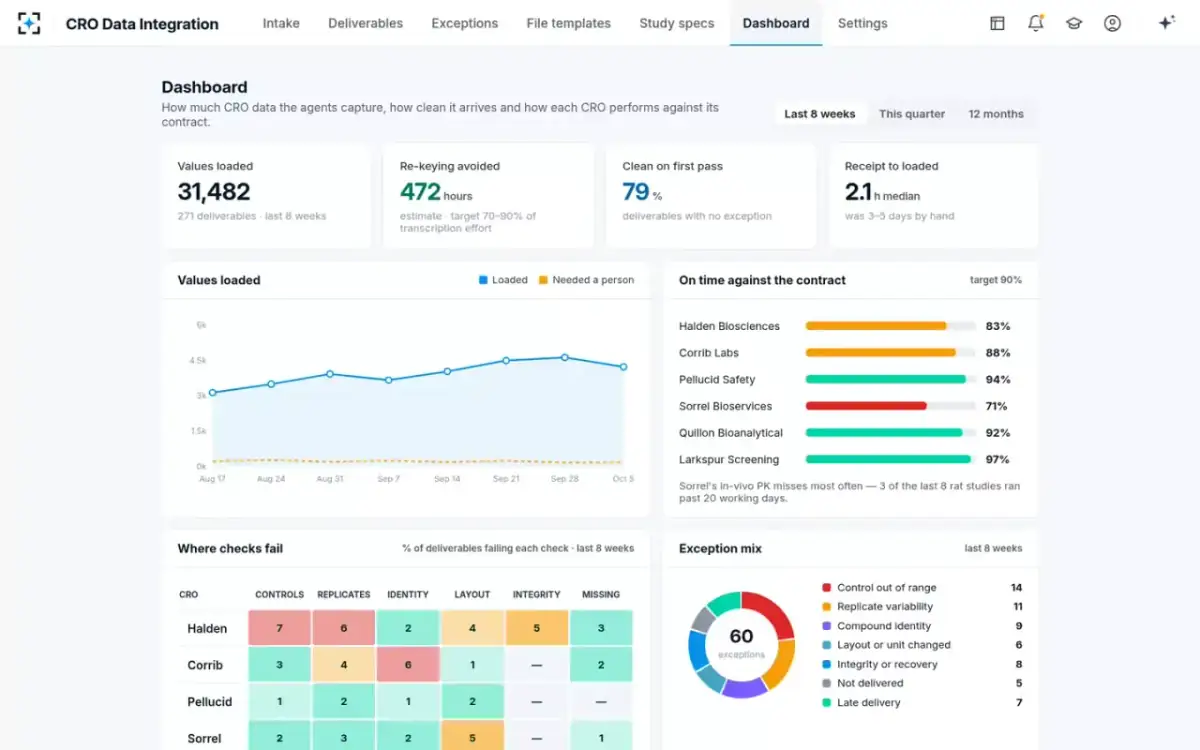
Measure the mix as well as the totals. Over eight weeks the sample data produced sixty exceptions in seven kinds — controls out of range, replicate variability, compound identity, layout or unit changes, integrity and recovery, items not delivered and late delivery — and the mix is what tells a head of external research whether the next conversation is with a template owner, a laboratory or a contract manager.
Where checks fail, by laboratory, over eight weeks on the sample data
A scorecard like that is also the second thing a trial buys you, after the software. Most organisations placing work with six laboratories cannot say which of them costs the most to accept, because the evidence is spread across individual scientists' memories. One quarter of structured exceptions answers it.
How each laboratory performs against its contract, over eight weeks
Build, script or buy — and what a script cannot do
Almost every organisation has already built something. A script per laboratory per export, maintained by one informatics engineer, is the normal starting position and it is not a foolish one: it is cheap, it fits exactly, and for a stable relationship with one laboratory it may be the right answer for years. The question is what happens around it.
A script your team maintains against software bought for the acceptance step
A script your team writes and maintains: An exact fit to today's files, owned entirely by you, with no licence and no vendor.
Software bought for the acceptance step: A comparison against the last accepted layout, a decision record, and somebody else's problem when a format changes.
A script your team writes and maintains: Whoever wrote it. The rules are in the code, and reading the code is the only way to know what they are.
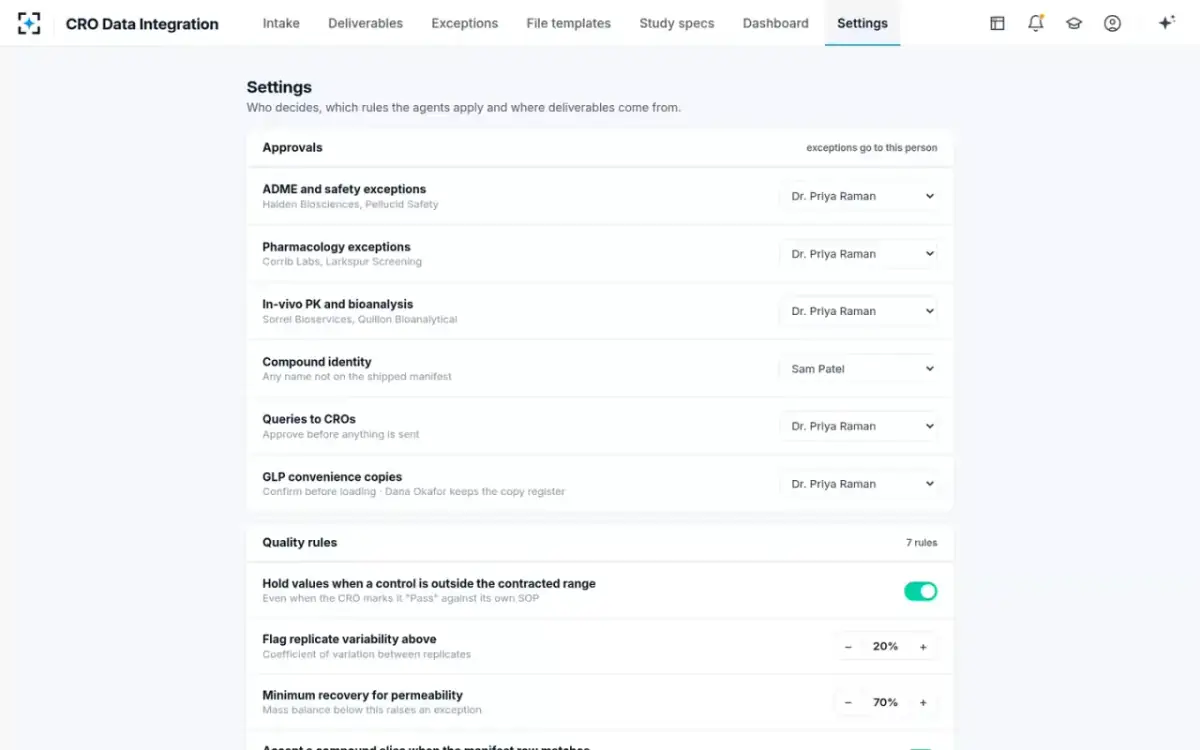
Software bought for the acceptance step: Named roles in settings: who decides each exception kind, which thresholds apply, which laboratories go to whom.
A script your team writes and maintains: Whatever your team produced, usually a test file and a memory. Rarely enough for a study run under good laboratory practice.
Software bought for the acceptance step: A vendor's validation package plus your own trial results — evidence an auditor can actually review.
A script your team writes and maintains: A change request to an engineer, and a release. In practice, rules stop being changed.
Software bought for the acceptance step: A setting, changed by the team that owns the science, versioned and on the audit trail.
A script your team writes and maintains: The behaviour becomes archaeology, and a common reason for replacing the script.
Software bought for the acceptance step: Unchanged, because the behaviour is configuration rather than code.
A script your team writes and maintains: One or two laboratories, stable formats, low volume, and an engineer who is staying.
Software bought for the acceptance step: Several laboratories, changing formats, work that has to be defensible, or a team that cannot afford to be the integration layer.
There is one place where building is clearly the wrong instinct, and it is standards work. Where a safety study falls inside the scope of CDISC's Standard for Exchange of Nonclinical Data, the destination format is already specified and maintained by somebody else, and it is a required standard for submission to the US regulator. Writing your own interpretation of a published standard is work with no upside; ask a candidate what it produces for a study in that scope, and treat "we can map to it" as a different answer from "we implement it".
Where this class of software does not help
Four limits, stated plainly, because a buyer who discovers them after signing concludes the category does not work.
It cannot tell you a result is scientifically right. It can tell you that a control was outside the contracted range, that replicates disagree by more than you bought, that a recovery is below the minimum and that a compound was not delivered. It cannot tell you that an assay was poorly run within its own acceptance criteria, and it does not re-run anything. The scientific review of a study remains the scientist's.
It cannot recover information the laboratory never sent. If an export writes a censored result with no limit anywhere in the package, the software can raise the question but not answer it. Several of the strongest improvements available in this work are not software at all — they are two sentences in a statement of work about how results below the limit, qualifiers and units must be reported.
It cannot make a contract specific. Acceptance testing against a statement of work that says "results will be of appropriate quality" produces nothing. Where contracts carry no numeric criteria, the first quarter's exception mix is usually the material for rewriting them.
And it is poor value at very low volume. An organisation receiving three deliverables a month from one laboratory with a stable format will not recover the cost of configuring templates and contracts. The arithmetic turns somewhere around several laboratories and a weekly rhythm, which is also the point at which the published transcription error rates start to produce wrong values faster than anyone finds them.
What CRO Data Integration does, and what it leaves to your team
Seven agents do the mechanical work, each with limits written into it rather than left to judgement. A deliverable classifier identifies the package and never guesses a study. A template drift checker compares every file with the last accepted layout and never accepts a unit change on its own. A result extractor turns tables, cells and exports into records with a page or cell for every value, keeps qualifiers as reported, and never writes zero for a value below the quantification limit. A unit and identity normaliser converts only by an approved rule and sends ambiguous identities to the data steward. A study-spec checker tests every acceptance criterion in the contract, never marks a failed control as passed, and proposes rather than decides. A query writer drafts the message to the laboratory and sends nothing until a person approves it. A warehouse loader loads only when every exception on the deliverable is decided, and labels data from studies run under good laboratory practice as a convenience copy, the signed report remaining the record.
What the four people keep, once the mechanical part is done
Today
Finds out after the fact that a control was out of contract or a unit had changed — once the numbers are already in the warehouse.
With agents
Sees every file stop at the check it failed, with the evidence beside it, and decides each stop.
Still theirs: Every exception decision, and approval of every query that goes to a laboratory
Today
Hears about a renamed header or a new unit after the warehouse does, and traces it back by hand.
With agents
Owns each laboratory's layout versions and the unit rules, and is told of every change as it is accepted.
Still theirs: Compound identity whenever a name is not on the shipped manifest
Today
Trusts that a value in the warehouse is right, with no way to see the cell or page it came from.
With agents
Opens any value to its source cell, as reported and in house units, with the rule that converted it.
Still theirs: The scientific reading of the study
Today
Judges laboratories on impressions and the last bad deliverable.
With agents
Has a quarter of structured exceptions by laboratory and by kind, and timeliness against each contract.
Still theirs: The supplier relationship, and what to do about it
What stays with your team is everything that is a judgement or a policy. Who decides each kind of exception, and for which laboratories. Whether a control outside the contracted range holds the affected values even when the laboratory marked it Pass. The replicate variability above which a result is flagged, and the minimum recovery for a permeability assay. The confidence above which a renamed column is matched automatically, and how many previous runs a column's values are compared against. Each of those is a setting, changed by the people who own the science, with every change on the audit trail.
Who decides each kind of exception, as a setting rather than a convention
If you are building a requirements list from this page, the three guides behind it are the detail: what the acceptance work contains, how a changed layout is caught, and what a censored result should look like in a warehouse. To run the fifty-deliverable trial on your own files, start from CRO Data Integration.
Questions people ask
Should we build or buy CRO data integration?
Build where you have one or two laboratories, stable export formats, modest volume and an engineer who will still be there in three years. Buy where formats change, where several laboratories are involved, or where the data has to be defensible to someone outside the team. The decisive question is not cost but ownership: a script encodes its rules in code that only its author can read, and it tends to become a replacement project when that author moves on.
How long does a CRO data integration project take?
The work divides into two parts. Configuring the destination — the house schema, the unit rules, the contract criteria — is the slower half and depends on how well those are already written down; it is often the first time an organisation discovers its contracts have no numeric acceptance criteria. Teaching a layout per laboratory is fast, because the templates are learned from accepted deliverables rather than specified in advance. Run the trial before committing to a timeline: the fifty deliverables will tell you which half is your bottleneck.
How do you test a CRO data tool before buying it?
On fifty of your own past deliverables, fixed before the first demonstration, of which about twenty are chosen to fail — a unit changed in a header, a renamed column that should not stop anything, censored results written four ways, a compound missing from the manifest, controls that pass the laboratory's procedure and fail the contract. Score on what it stops, what it wrongly stops, and whether each exception names the right evidence. Extraction accuracy on clean files is the least informative thing you can measure.
Does CRO data management software have to meet 21 CFR Part 11?
Only where it holds or processes regulated electronic records. Most discovery and DMPK work is outside that scope, and a procurement questionnaire that demands full Part 11 compliance for a research warehouse is usually asking the wrong question. Where it does apply, the clauses that matter most here are validation of the system and a secure, computer-generated, time-stamped audit trail of the actions that create or modify records.
What does CRO data management software cost to run?
Ask for the ongoing cost in three parts, because the licence is rarely the largest. What does it cost to add a laboratory, in configuration and in supervised deliverables? What does it cost when an existing laboratory changes an export — a setting, or a vendor change request? And how much of your own team's time does the exception queue consume in a normal week? The third is the one that decides whether the thing is actually cheaper than what you do now.
What should CRO data management software not be expected to do?
Judge the science. It can test a deliverable against the contract — controls, replicates, recovery, time points, compounds delivered, turnaround — and refuse to load what fails. It cannot tell you a well-run assay produced a misleading result, it does not re-run anything, and it cannot supply information the laboratory never sent. Nor will it rescue a contract with no numeric acceptance criteria; that is a document problem, and the first quarter of exceptions is the best material for fixing it.