The GLP compliance requirements most people look up are the test facility's: a study director, a quality assurance unit independent of the study, written procedures, calibrated equipment, a signed final report, an archive. If your study is running at a contract research organisation, almost none of those are yours to satisfy — and the handful that are yours are the ones nobody writes about. Good Laboratory Practice leaves the raw data and the signed report in the test facility's archive, leaves the responsibility for the study's scientific validity with the study director, and leaves the sponsor a short, specific list it cannot pass on. This guide works through that division, and through what it means for the copy of the values you load into your own systems. Botminds' CRO Data Integration handles that copy the way the rules imply: a study under GLP is labelled on arrival, its values load only as a labelled convenience copy once a person has confirmed it, every value cites the page of the signed report it was read from, and the signed report stays the record.
The worked example is sample data on fictional people and companies: a sponsor, Northwind Bio, and the six contract laboratories that run its work, some studies under GLP and most not. The regulatory text is quoted from the OECD Principles, the OECD advisory documents and the US Food and Drug Administration's regulations, linked where it appears.
What are the GLP compliance requirements?
Good Laboratory Practice is a quality system for non-clinical health and environmental safety studies — the safety studies whose results go to a regulator. It governs how a study is organised, conducted, monitored, recorded, reported and archived, and it does so almost entirely through requirements on the facility that performs the work. In the OECD's scheme those requirements fall into ten sections: test facility organisation and personnel, a quality assurance programme, facilities, apparatus, test systems, test and reference items, standard operating procedures, performance of the study, reporting, and storage and retention of records.
Two definitions in the OECD text decide everything that follows for a sponsor. A "Sponsor means an entity which commissions, supports and/or submits a non-clinical health and environmental safety study", and a "Study Director means the individual responsible for the overall conduct of the nonclinical health and environmental safety study" (OECD Principles of GLP, as revised in 1997). The study director is an individual at the test facility, not at the sponsor. The sponsor commissions and submits. Those are different jobs, and the rules follow the job rather than the money.
Who holds what: study director, test facility, sponsor
The question that matters in practice is not who is responsible in the abstract, but where each physical thing ends up. The study plan, the raw data, the specimens, the final report and the archive all have an owner under GLP, and in almost every case it is not you.
Where each part of a GLP study lives, and what the sponsor actually gets
| What | Who holds it | What the sponsor has |
|---|---|---|
| The study plan | The test facility. Approved by the study director, and by test facility management and the sponsor "if required by national regulation or legislation in the country where the study is being performed". | A copy, and in some countries a signature on it. The plan names the sponsor and its address. |
| The raw data | The test facility, in its archive. In the OECD definition, raw data are the facility's original records of what was observed and done in the study, or verified copies of them. | Not the raw data. What you receive is the final report and whatever tabulations accompany it. |
| Specimens and samples of the test item | The test facility, retained for the periods the authorities specify, and only as long as their quality permits evaluation. | Nothing, unless the contract says otherwise. Specimens stay where they can be re-examined. |
| The final report | Signed and dated by the study director, who by signing takes responsibility for whether the data are valid, and says how far the study met the GLP Principles. | The signed report. This, and not your copy of its numbers, is the record of the study. |
| The archive | The test facility, or a commercial archive it contracts with. Under the US rule, raw data and specimens may sit in other places as long as the archive points to where they are. | A right to know where things are: under the US rule the final report has to say where the specimens, the raw data and the report itself will be stored. |
| Your copy of the values | You. Nobody else has it, and nobody else is accountable for it. | A working copy, which has to be labelled as one, kept pointing back to the report page each value came from. |
The last row is the one worth sitting with. Every other line has an owner named in a regulation, an archive with a location, and a person who signed for it. Your warehouse copy has none of that by default. It is the only part of a GLP study whose quality depends entirely on arrangements you make yourself.
What counts as raw data under GLP
Wider than most people assume, and specifically not limited to the first piece of paper. The OECD defines raw data as the test facility's original records and documentation of the study's observations and activities — or verified copies of them — and it goes on: raw data "also may include, for example, photographs, microfilm or microfiche copies, computer readable media, dictated observations, recorded data from automated instruments, or any other data storage medium that has been recognised as capable of providing secure storage of information" (OECD Principles, section 2.3).
Three consequences follow for a sponsor. First, an instrument's electronic output is raw data, so a contract laboratory's chromatography system is inside the GLP system and has to be validated as part of it. Second, a verified copy counts as raw data, which is why the verification process matters so much — the same point that governs every copy of a value you take, worked through in what the ALCOA+ principles demand of data a CRO sends you. Third, and least comfortable: a tabulation the laboratory prepares for you from its raw data is not raw data. It is a derived summary, and if it disagrees with the raw data, the raw data is right.
That third point is the reason a sponsor's checks are worth doing even on a GLP deliverable. The transformations between the measurement and the table you receive are performed somewhere, and the US rule requires the final report to describe every transformation, calculation and operation applied to the data (21 CFR 58.185(a)(11)). Read that description. It tells you what was done to the numbers before they reached you, which is exactly what you need in order to know whether your own conversion on top of it is valid.
Why the archive sits at the test facility, and the one case it moves
The archive sits with the test facility because the study director's final duty is to put it there: to "ensure that after completion (including termination) of the study, the study plan, the final report, raw data and supporting material are archived" (OECD Principles, section 1.2). The US regulation says the same in facility terms: a facility must keep archives in which all raw data, documentation, protocols, specimens and interim and final reports are stored in order and can be retrieved quickly (21 CFR 58.190(b)), with an individual identified as responsible for them and only authorised personnel admitted.
There is one case where the archive becomes the sponsor's problem, and it is worth knowing before it happens. The OECD Principles provide that "if a test facility or an archive contracting facility goes out of business and has no legal successor, the archive should be transferred to the archives of the sponsor(s) of the study(ies)", and the OECD's advisory document for sponsors adds that the sponsor is then expected to arrange proper storage and retrieval for study plans, raw data, specimens, samples and final reports. The US rule is blunter: if a facility conducting non-clinical testing goes out of business, "all raw data, documentation, and other material specified in this section shall be transferred to the archives of the sponsor of the study", and the FDA "shall be notified in writing of such a transfer" (21 CFR 58.195(h)).
So the archive is the laboratory's until the laboratory ceases to exist, at which point it is yours, at short notice, in whatever form it is in. A sponsor with a decade of safety work spread across contract laboratories should know, for each one, what it holds, in what formats, and what a transfer would involve. For electronic archives the OECD adds the requirement that makes a transfer meaningful: "as content and meaning of any electronic data should be preserved during the archiving period, the complete information package should be identified and archived (e.g. raw data, metadata necessary to understand correctly the meaning of a record or to reconstruct its source, electronic signatures, audit trails, etc.)" (OECD, Application of GLP Principles to Computerised Systems, No. 17, 2016).
How long GLP records have to be kept
Under the OECD Principles, for "the period specified by the appropriate authorities" — the Principles list what must be retained and leave the clock to national law. The US regulation sets three clocks and takes the shortest of them, which surprises people who expect the longest.
Three retention clocks under the US rule, and the shortest one wins
- Study
- After approval of the application≥ 2 years
- Study
- After submission≥ 5 years
- Study
- After completion, termination or discontinuation≥ 2 years
Two details in the same section matter for anyone planning a transfer or a copy. Records "may be retained either as original records or as true copies such as photocopies, microfilm, microfiche, or other accurate reproductions of the original records" — so an electronic archive is permitted, if the copies are accurate reproductions. And the OECD's computerised-systems document adds that nothing stored electronically "should be destroyed without test facility management and, where applicable, the sponsor's authorisation and relevant documentation". Your authorisation is required for destruction; it is not required for anything else.
What the sponsor cannot delegate
A short list, and each item is a real obligation rather than a best practice. The first is notification. Under the US rule, a sponsor using a contract laboratory for part of a study "shall notify the consulting laboratory, contractor, or grantee that the service is part of a nonclinical laboratory study that must be conducted in compliance with the provisions of this part" (21 CFR 58.10). A laboratory that was not told your bioanalysis was part of a GLP study will not have run it under GLP, and the omission is yours.
The second is due diligence on the facility. The OECD's advisory document for sponsors frames the whole relationship at the outset: a sponsor may not simply take a contracted test facility's word for it (OECD, The Role and Responsibilities of the Sponsor, No. 11, 1998). It suggests monitoring contracted laboratories before and during the study according to its nature, length and complexity, and contacting the national monitoring authority to establish a facility's current compliance status.
The third is the integrity of what you submit. Where several studies are presented to a regulator together, "the responsibility for the integrity of the assembled package of unaltered final reports lies with the sponsor". The fourth is information the laboratory cannot get elsewhere: known risks of the test item to people or the environment, and the characterisation of the test item — and if you characterised it yourself, or withheld the characterisation data, that fact has to be stated in the final report.
What is not on the list is as useful as what is. Scientific validity is not the sponsor's to claim or to disclaim.
The ultimate responsibility for the scientific validity of a study lies with the Study Director, and not with the sponsor, whose responsibility is to make the decision, based on the outcome of the studies, whether or not to submit a chemical for registration to a regulatory authority.
OECD Panel on Good Laboratory Practice, 'The Role and Responsibilities of the Sponsor in the Application of the Principles of GLP', No. 11, paragraph 10
That division is cleaner than most commercial relationships manage. The study director owns whether the science is sound. The sponsor owns whether to rely on it — and, as the same document notes, if the sponsor contracts parts of the work to subcontractors, "the responsibility for the whole study remains with the Study Director, including the validity of the raw data and the report". The sponsor's judgement is a judgement about evidence, which is why it needs evidence to be made on.
What a sponsor should confirm before and after a GLP study
- The facility can run it under GLP, and knows it must
Confirm compliance status before the work starts, and give the notification the US rule requires. A national monitoring authority can be asked about a facility in its programme.
- The study plan says what you think it says
It names the sponsor, and in some countries needs the sponsor's signature. Approval is the study director's, but the content is where your acceptance criteria live.
- The test item is characterised, and the report says by whom
If the sponsor characterised it, the final report must say so; if characterisation data were withheld from the facility, that must be stated too.
- The facility was told the risks
Known hazards of the test item to people or the environment, and any protective measures, are the sponsor's to provide.
- Communication lines exist, and are used
Adequate links between the sponsor's representatives and the study director, quality assurance and facility management — monitoring during the study, not only at the end.
- The final report is signed, and names its locations
Signed and dated by the study director, with the statement from quality assurance, and the locations where specimens, raw data and the report are stored.
- You know what would happen if the facility closed
The archive transfers to you, at short notice. Know what it contains, in what formats, and what metadata would come with it.
- Your own copy is labelled for what it is
Values you load are a working copy of a signed report, not the record — and the pointer back to the report page is what makes them usable at all.
Mutual acceptance of data: why units and format still matter
Mutual acceptance of data is the OECD Council Decision that makes a GLP study portable. In its own words, it "decides that data generated in the testing of chemicals in an OECD member country in accordance with OECD Test Guidelines and OECD Principles of Good Laboratory Practice shall be accepted in other member countries for purposes of assessment and other uses relating to the protection of man and the environment" (OECD Council Decision C(81)30(Final), reproduced in the GLP compilation). One study, run once, accepted across the member countries — it is one of the most effective pieces of regulatory cooperation there is, and it is why a safety study is worth what it costs.
It is also narrower than it sounds, in a way that matters for data work. What travels is the study and its final report, accepted for regulatory assessment. Nothing in the decision makes two laboratories' files interchangeable, standardises a unit, or obliges anyone to write a header the same way twice. A deliverable from a facility in one country and a deliverable from a facility in another are equally acceptable to a regulator and equally capable of disagreeing about whether a concentration column is in nanograms or micrograms per millilitre. Mutual acceptance solves the regulatory problem and leaves the integration problem exactly where it was — which is why a layout comparison on the way in earns its place even on studies whose reports are above reproach, as catching a changed column or unit before any value loads sets out.
Can GLP study data go into a research warehouse?
Yes, with one condition that is easy to state and easy to lose: the warehouse copy must not become the record. Nothing in GLP prevents a sponsor from reading its own study's results, tabulating them, or putting them next to discovery data. What GLP does is fix where the record lives — the signed final report and the test facility's archived raw data — and nothing you do downstream changes that.
The failure mode is social rather than technical. Values get loaded, a structure–activity table starts using them, a slide quotes one, and within a quarter the organisation's working belief about a compound's safety margin rests on a row in a database rather than on a signed report nobody has reopened. If a number in that row is wrong, the error will not be caught by the test facility's quality assurance unit, because the error happened after their work ended.
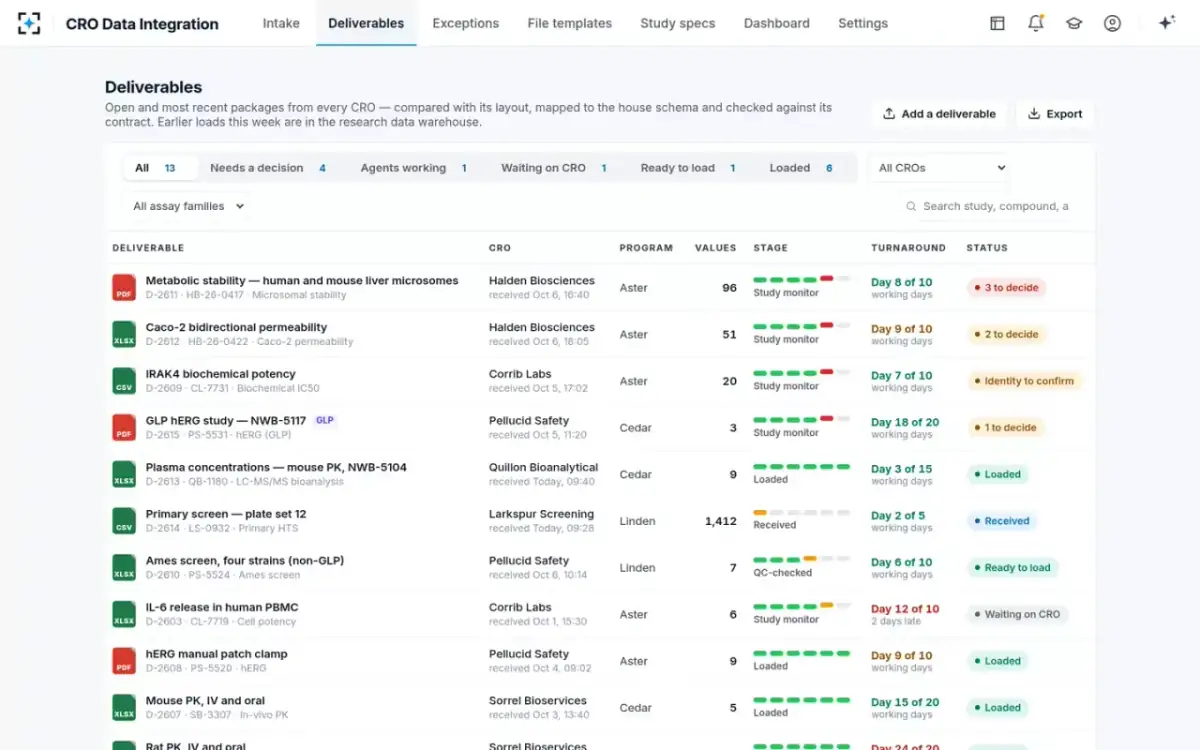
So the conditions are practical ones. Label GLP values as a convenience copy on arrival, so that nobody is confused about what they are looking at. Require a person to confirm the load rather than letting a GLP study flow in with the screening data. Cite the signed report page on every value, so reopening the record costs seconds. Keep the loaded values out of anything that produces a regulatory statement. And keep your own handling on an audit trail, because a question about a number in your warehouse is a question only your records can answer. Those are the rules the sample solution applies: GLP studies are labelled by the classifier the moment a package is identified, and the values load only after a person confirms them.
How a GLP deliverable is handled differently on the way in
Labelled
GLP studies marked as such when the package is identified, before anything is read
Confirmed
a person confirms the load; a GLP study never flows in with the screening work
Cited
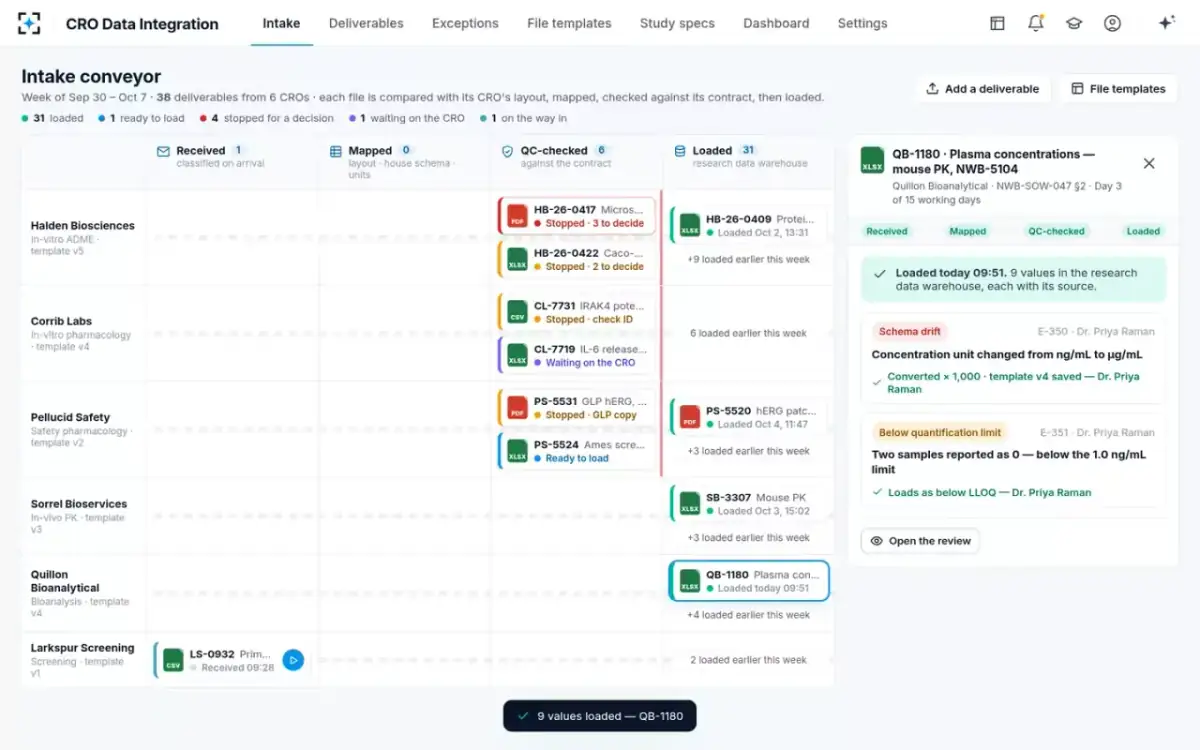
every value carries the page of the signed report it was read from, so the record is one click away
Every package with its laboratory, stage and turnaround — and whether it is a GLP study
Computerised systems: validation, change control and the audit trail
The OECD's guidance on computerised systems is where GLP meets the realities of a modern laboratory, and its scope statement is broad: "all computerised systems used for the generation, measurement, calculation, assessment, transfer, processing, storage or archiving of data intended for regulatory submission or to support regulatory decisions should be validated, and operated and maintained in ways that are compliant with the GLP Principles" (OECD No. 17, paragraph 4). Transfer and processing are on that list, which is why an interface between a laboratory system and anything else is in scope rather than beside the point.
Three of its requirements are worth a sponsor's attention. The first is that the study director has to verify the validation status of the systems a study will use before the study starts, and that "the study director's responsibility for electronic data is the same as that for data recorded on paper". The second is change control: every change to a computerised system is to be made in a controlled way, under written procedures — which is precisely what a laboratory is doing when it upgrades the software that writes your export file, and precisely why the header in that file changes without anyone meaning harm.
The third is the sentence most likely to describe your own organisation rather than the laboratory's: "the use of invalidated data entry systems should be excluded (e.g. uncontrolled use of spreadsheets)". A scientist re-keying ninety-six values from a signed GLP report into a workbook is an uncontrolled use of a spreadsheet, performed on the data the regulator will eventually see, by a process nobody has qualified. The guidance also expects particular attention to how data flows wherever one system is interfaced to another — the choices that opens up are compared in four ways to get CRO data into a LIMS.
GLP, non-GLP, and the deliverables in between
Most of what a discovery organisation receives is not GLP work, and treating everything as though it were is the fastest way to make the controls unaffordable. The useful distinction is not strictness but consequence: a GLP deliverable's record lives somewhere else and must stay reachable, while a screening deliverable's record is, in practice, whatever you loaded.
A GLP deliverable and a screening deliverable, handled side by side
A study run under GLP: The signed final report and the test facility's archived raw data.
A discovery screening deliverable: In practice, your warehouse — which is why your own checks are the only ones there are.
A study run under GLP: The study plan and the protocol, under a quality assurance programme independent of the study.
A discovery screening deliverable: Your statement of work, and nothing else. There is no inspector and no required range.
A study run under GLP: The study director, accepting responsibility for the validity of the data and stating the extent of GLP compliance.
A discovery screening deliverable: Usually nobody. A results workbook arrives by SFTP with no signature on it.
A study run under GLP: A labelled convenience copy for research use, loaded after a person confirms it, citing the signed report page.
A discovery screening deliverable: The working dataset, loaded once every exception on the deliverable has been decided.
A study run under GLP: Years, set by the retention rules — and potentially transferred to you if the facility closes.
A discovery screening deliverable: As long as the programme does, which is often longer than anyone plans for.
A study run under GLP: That the working copy quietly becomes the record.
A discovery screening deliverable: That a layout or unit change loads silently and nobody can reconstruct what the file said.
The practical consequence is that one intake process can serve both, provided it knows which is which from the first moment. The classifier identifies the laboratory, the study and the contract schedule, and labels a GLP study then — before extraction, before conversion, before anything can be loaded by accident. Everything after that is the same machinery with a different rule attached, which is a great deal cheaper than two processes.
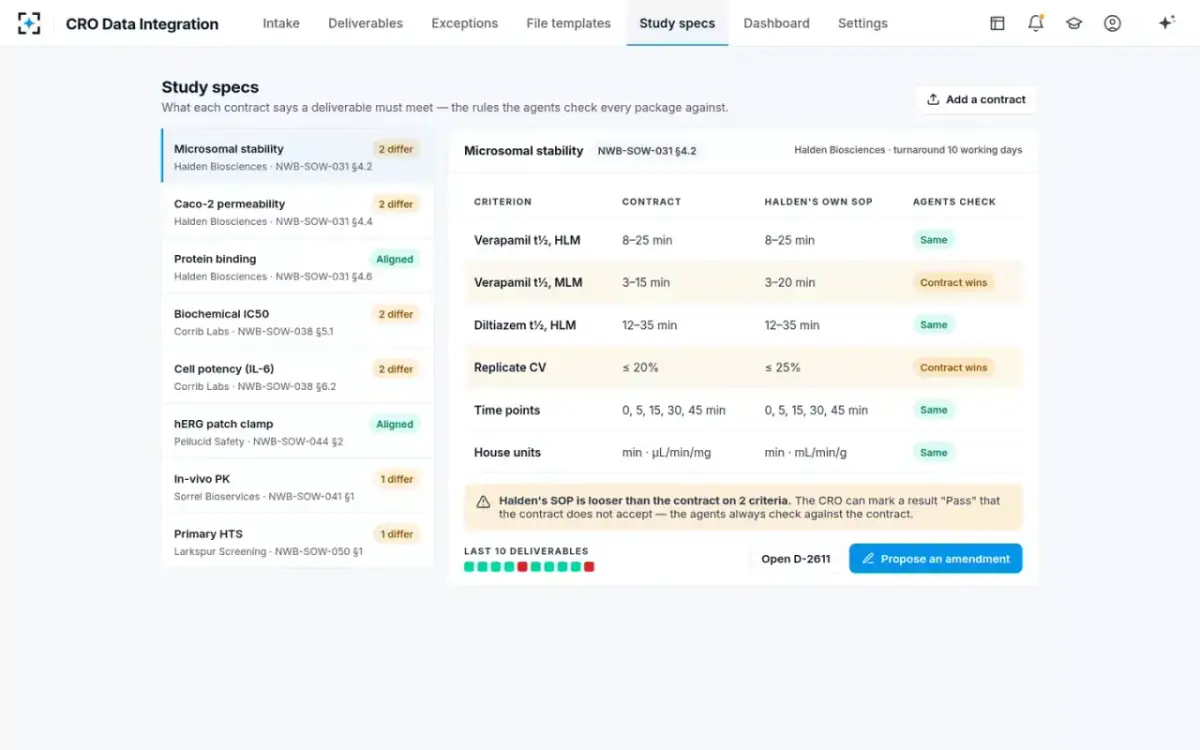
Each contract's acceptance criteria, beside the laboratory's own procedure
None of this makes a sponsor GLP-compliant, and no software can: compliance belongs to the facility that runs the study. What it does is keep the sponsor's side honest — the study labelled, the copy labelled, the citation live, the decisions recorded — so that the part of the work the regulations leave to you is the part you can actually show. For the whole journey a deliverable takes from arrival to a loaded value, see how CRO data management turns a deliverable into a loaded value; to see GLP labelling on your own studies, start from CRO Data Integration.
Values in the warehouse, each with the source it was read from
Questions people ask
What is a GLP study director responsible for?
The overall conduct of the study, and the validity of its data. The OECD defines the study director as the individual responsible for the overall conduct of the non-clinical health and environmental safety study; the role signs and dates the final report to accept responsibility for the validity of the data and to state the extent of GLP compliance, and ensures the study plan, final report, raw data and supporting material are archived afterwards. The role sits at the test facility, and its responsibility cannot be delegated to a principal investigator.
What does the sponsor have to do under GLP?
Notify the laboratory that the work is part of a GLP study, satisfy itself that the facility can run it under GLP rather than relying on assurances alone, supply what only it can supply — known risks of the test item, and its characterisation, with any sponsor-performed or withheld characterisation stated in the report — keep real communication with the study director and quality assurance, and take responsibility for the integrity of an assembled package of unaltered final reports submitted to a regulator. If the facility closes with no successor, the archive transfers to the sponsor.
What counts as raw data under GLP?
All original test facility records and documentation, or verified copies of them, that result from the original observations and activities of the study. The OECD expressly includes photographs, microfilm or microfiche copies, computer-readable media, dictated observations and recorded data from automated instruments. A summary table prepared from the raw data is not raw data — and where a summary and the raw data disagree, the raw data governs.
How long do GLP records have to be kept?
The OECD leaves the period to national authorities. The US regulation sets three periods and requires the shortest: at least 2 years after the FDA approves an application the study supported, at least 5 years after results are submitted in support of an application, or at least 2 years after a study that was never submitted is completed, terminated or discontinued. Fragile wet specimens are kept only as long as their quality permits evaluation, and records may be kept as originals or as accurate true copies.
Can GLP study data be loaded into a research warehouse?
Yes, provided the copy is never mistaken for the record. The signed final report and the test facility's archived raw data remain the record whatever you do downstream. A workable arrangement labels GLP values as a convenience copy on arrival, requires a person to confirm the load rather than letting the study flow in with screening work, cites the signed report page on every value, and keeps the loaded data out of anything that produces a regulatory statement.
What is mutual acceptance of data?
An OECD Council Decision under which data generated in one member country in accordance with the OECD Test Guidelines and the Principles of GLP is accepted in the other member countries for assessment relating to the protection of people and the environment. It means a safety study need only be run once. It does not standardise file formats, units or headers, so two equally acceptable studies can still arrive in layouts that disagree.