Preclinical data management is the work of getting discovery and safety results into a form your organisation can find, trust and reuse — and in most organisations it now means managing data that someone else generated. A mid-size discovery company may place work with six or more contract research organisations and run comparatively little in its own laboratories, so the systems bought for internal science end up carrying external files they were never designed for. This guide sets out what each category of system is actually for, where data from a contract laboratory falls between them, what the FAIR principles demand of a value that arrived from outside, and six questions worth putting to anything you are asked to buy. Botminds' CRO Data Integration sits in the one place none of those systems covers: it is the acceptance step in front of your warehouse, reading each deliverable, checking it against the contract you signed and loading cited records once a named person has decided every exception.
The worked example is sample data on fictional people and companies: a sponsor, Northwind Bio, and the six contract laboratories that run its discovery and safety work. The research is published and linked where it appears.
What is preclinical data management?
It is everything between a measurement and a decision: capturing results, giving them identity and units a second reader will understand, recording who did what, storing them somewhere durable, and making them findable by someone who was not in the room. In a wholly internal laboratory that work is mostly about capture, because the people generating the data and the people using it share a corridor and a vocabulary. When the measurement happens at a contract laboratory, capture is already done — by someone else, in their format — and the work shifts almost entirely to the harder half: identity, units, acceptance and reuse.
That shift is why teams find their systems unhelpful rather than broken. A system that excels at capturing an experiment as it happens has little to offer a workbook that arrives finished. The question is not which system is best; it is which job you are actually doing.
Two things change when most of the work moves outside. The first is variety: six laboratories send six dialects, and each dialect changes on its own schedule, so the number of distinct file shapes a team has to understand grows faster than the number of laboratories. The second is tempo. An internal result can be questioned while the bench is still set up; an external one arrives finished, often weeks after the measurement, from people whose incentive is to close the study rather than to reopen it. Both push the same way — towards deciding about a deliverable at the moment it arrives, when the context is still available and a question can still be asked.
LIMS, ELN, SDMS and the warehouse: what each one is for
Four categories of system show up in every one of these conversations, and they are easier to tell apart by the job they do than by their feature lists. The distinctions blur at the edges — the ELN literature notes that "high-end systems include all the features of an eLN, but also function as laboratory information management systems (LIMS), facilitating inventory management or direct link to laboratory equipment" (Dirnagl & Przesdzing, F1000Research, 2016) — but the core jobs stay distinct.
Four system categories, and the four jobs data from outside the building needs done
| System | The job it is built for | What it does well with external data | What it does not do |
|---|---|---|---|
| LIMS — laboratory information management system | Running the work you do in-house: samples, batches, instruments, workflow states, who has what. | Holds results once they are in its schema, and ties them to a sample identity you control. | Deciding whether an arriving file may be loaded at all. A LIMS import expects a shape and trusts it. |
| ELN — electronic laboratory notebook | Recording what a scientist did and thought, as they did it, in a form that can be witnessed. | Keeps an attributable narrative — including the judgement to accept or reject a batch of outside results. | Structure. A PDF attached to a notebook entry is filed, not integrated. |
| SDMS — scientific data management system | Filing the raw output of instruments and studies, durably and searchably, in whatever format it came in. | Exactly the job of keeping the file you were sent, unaltered, for as long as anyone may ask about it. | Reading it. An SDMS makes a report retrievable; it does not turn page 6 into comparable values. |
| The research data warehouse | Holding comparable values across programmes so scientists can ask questions of the whole corpus. | Everything, once the values are in it with house units, qualifiers and identity resolved. | Judging what gets in. A warehouse loads what it is given; its quality is set entirely upstream. |
| An acceptance step in front of the warehouse | Deciding whether an incoming deliverable may become records, and on what terms. | Compares the file with the layout last accepted, extracts with a citation, tests it against the contract, and routes exceptions to a person. | Being any of the four above. It does not run your laboratory, replace a notebook, or store the corpus. |
Read down the last column. Each of the four established categories declines the same job for a good reason: none of them was built to adjudicate a file from a party it does not control. That is not a defect in any of them. It is a gap, and gaps between systems are where data goes to die.
Where data from a CRO falls between them
Follow one deliverable. A contract laboratory sends a report PDF, a results workbook and an instrument export, by SFTP or a portal or a mailbox. The SDMS can file all three. The ELN can hold a scientist's note saying they arrived. The LIMS can take the values once they are in its shape. The warehouse can hold them once they are comparable. And between "arrived" and "comparable" sit six decisions nobody owns: is this the study we think it is; has the laboratory changed its file since last time; what unit is column E in; is NB-4493 the same compound as NWB-4439; did the controls meet our contract or only theirs; and does the value written as 0 mean zero or below the quantification limit.
In most organisations those six are made by a scientist with a spreadsheet open, under time pressure, with no record of the reasoning. That is not a process failure by the person; it is the predictable result of a job that no system claims. The literature on laboratory informatics is blunt about why nothing in the stack closes it.
As of now there are no standards for data annotation and integration, therefore migration between different platforms may be difficult or even impossible.
Dirnagl U, Przesdzing I, 'A pocket guide to electronic laboratory notebooks in the academic life sciences', F1000Research, 2016
Ten years on, the sentence still describes the ground truth for discovery work. There is a mature standard for non-clinical data at the regulatory end: CDISC's SEND gives nonclinical data one consistent format for collection and presentation, and CDISC counts it among the standards the FDA requires for data submission (CDISC, SEND). But SEND governs the toxicology studies that go into a submission, not the in vitro ADME, screening and pharmacology work that fills a discovery warehouse, and no equivalent exists there. Every laboratory's export is its own dialect, and it changes when their instrument software does.
One week of deliverables, and where they actually were on Friday
38 deliverables from six contract laboratories
- Loaded · 79%
- Stopped for a decision · 10%
- On the way in · 5%
- Ready to load · 3%
- Waiting on the laboratory · 3%
The interesting share is the ten per cent stopped for a decision. In a stack without an acceptance step those four deliverables do not stop; they load, and the decisions get made implicitly by whatever the import script assumed. The work does not disappear when nobody does it — it reappears later as a value that does not make sense, and someone spends a day finding out why.
What the FAIR principles ask of a value, and which part external data fails
FAIR — findable, accessible, interoperable, reusable — is the most widely adopted statement of what makes scientific data worth keeping. The original paper's framing is worth repeating because it is routinely misread as being about open data: the point is machine-actionability, which "applies in two contexts—first, when referring to the contextual metadata surrounding a digital object ('what is it?'), and second, when referring to the content of the digital object itself ('how do I process it/integrate it?')" (Wilkinson and 52 co-authors, Scientific Data, 2016). Both questions are about a reader who was not there, which is exactly the position of anyone opening a warehouse row two years after a contract study ended.
Applied to internal data, most organisations do reasonably well on findable and accessible and poorly on interoperable. Applied to data from a contract laboratory, it is interoperability and reusability that collapse — and they collapse at the moment of loading, not in the laboratory. The sub-principles are specific enough to turn into questions about one file.
The FAIR principles as nine questions about one incoming deliverable
- Does every value have an identifier that will still mean something in five years?
F1 asks for a globally unique and persistent identifier. A row keyed on a file name and a row number fails this the moment the file is renamed.
- Is the value described richly enough to be understood without the file?
F2 and F3 ask for rich metadata that explicitly includes the identifier of the data it describes. Compound, assay, matrix, condition, parameter, unit, qualifier, replicates — all of it, on the value.
- Can someone retrieve it by its identifier, without asking a person?
A1 asks for retrieval by identifier using a standardised protocol. If seeing the source cell means emailing the data steward, the value is accessible to one person.
- Does the description survive even if the data does not?
A2 asks that metadata stay accessible when the data is no longer available. A contract ends, a portal closes, a mailbox is purged — what is left should still say what the measurement was.
- Is it written in a shared vocabulary rather than this laboratory’s?
I1 and I2 ask for a formal, shared language and vocabularies that are themselves FAIR. “MLM”, “HLM” and “Conc (µg/mL)” are one laboratory’s shorthand; your house schema is the shared vocabulary they have to be mapped into.
- Does it point at the things it relates to?
I3 asks for qualified references to other data. A clearance value should reference its compound in the registry, its study, its contract schedule and the plate it shares with its control.
- Are the attributes rich, accurate and relevant?
R1 asks for a plurality of accurate and relevant attributes. In practice this is the as-reported value, the unit, the qualifier and the conversion rule — not just the number you kept.
- Is it clear where the value came from and what was done to it?
R1.2 asks that data be “associated with detailed provenance”. For external data that means the file, the page or cell, the layout version, the conversion rule and every decision taken on the way in.
- Does it meet the standards your field would expect?
R1.3 asks for domain-relevant community standards. For regulated non-clinical work that is SEND; for discovery ADME there is none, which makes your own house schema the standard you are accountable for.
Run that list against a typical warehouse row and the failures cluster in one place: the eighth question. Almost every organisation can tell you a value's compound and assay. Very few can tell you which cell of which file it came from, under which layout version, converted by which rule, decided by whom. That is the question an auditor asks, and it is also the question a scientist asks when two values disagree.
What has to travel with a CRO value to make it reusable
Six things, and the list is short enough to write into a statement of work. Each one is cheap to carry at the moment of loading and expensive or impossible to reconstruct later.
What has to travel with one value from a contract laboratory
| What travels | Why it cannot wait | Where it comes from |
|---|---|---|
| The value as reported, with its original unit | Because the conversion is the step most likely to be wrong, and without the original there is nothing to check it against. | The cell or table in the deliverable, read as written. |
| The qualifier, unflattened | Because “> 60 min”, “< LLOQ” and “not tested” are different statements from any number, and all three become nonsense as a number. | The laboratory’s own flag column, kept rather than interpreted. |
| Compound identity, and how it was resolved | Because a name that did not match the manifest was a judgement, and judgements can be wrong in a way that puts one compound’s data on another’s page. | The registry, the shipped manifest, and the data steward who decided. |
| The contract criterion it was judged against | Because “passed” is meaningless without the clause that set the range, and the laboratory’s own procedure may be looser. | The statement of work and its acceptance criteria. |
| A citation to the page or cell | Because every later question about the value is answered there, and a link that costs nothing to follow is the difference between a value that is checked and one that is assumed. | The extraction, recorded as the value is read. |
| The decisions taken on the way in, with names | Because the warehouse row is the output of judgements as well as measurements, and an anonymous judgement cannot be reviewed. | The people who accepted the conversion, resolved the identity and decided each exception. |
What does a preclinical data manager actually decide?
Not where data is stored, which is usually settled by whatever was bought three years ago. The decisions that carry weight are about acceptance and vocabulary, and there are four of them.
The first is what the house schema means: which parameters exist, in which units, with which qualifiers, and what counts as the same compound. This is the vocabulary everything else is translated into, and changing it later is a migration. The second is what the acceptance criteria are: which controls, which replicate limits, which recovery minimum, which turnaround — and crucially, that these live in the contract rather than in the laboratory's procedures, so that a deliverable can fail.
The third is who decides each kind of exception, and the fourth is what happens to a value that fails. Hold, flag, record, query — these are policy choices with real consequences, and leaving them implicit means they are made differently every week by whoever is on duty. In the sample solution all four are settings owned by named people: exceptions route to the study monitor, compound identity routes to the data steward, the replicate limit is a number, and a control outside the contracted range holds its values even when the laboratory marked it as a pass.
A fifth decision sits behind those four and is usually made by default: what is kept unaltered, and for how long. The file as the laboratory sent it, the manifest shipped with the study, the statement of work and its amendments, and the layout version each deliverable was read under — if any of those is only in a mailbox, every question asked about a value in two years will end in a shrug. Deciding this deliberately costs a conversation; discovering it after a contract has ended costs the data.
Every package, with its laboratory, programme, stage and turnaround against the contract
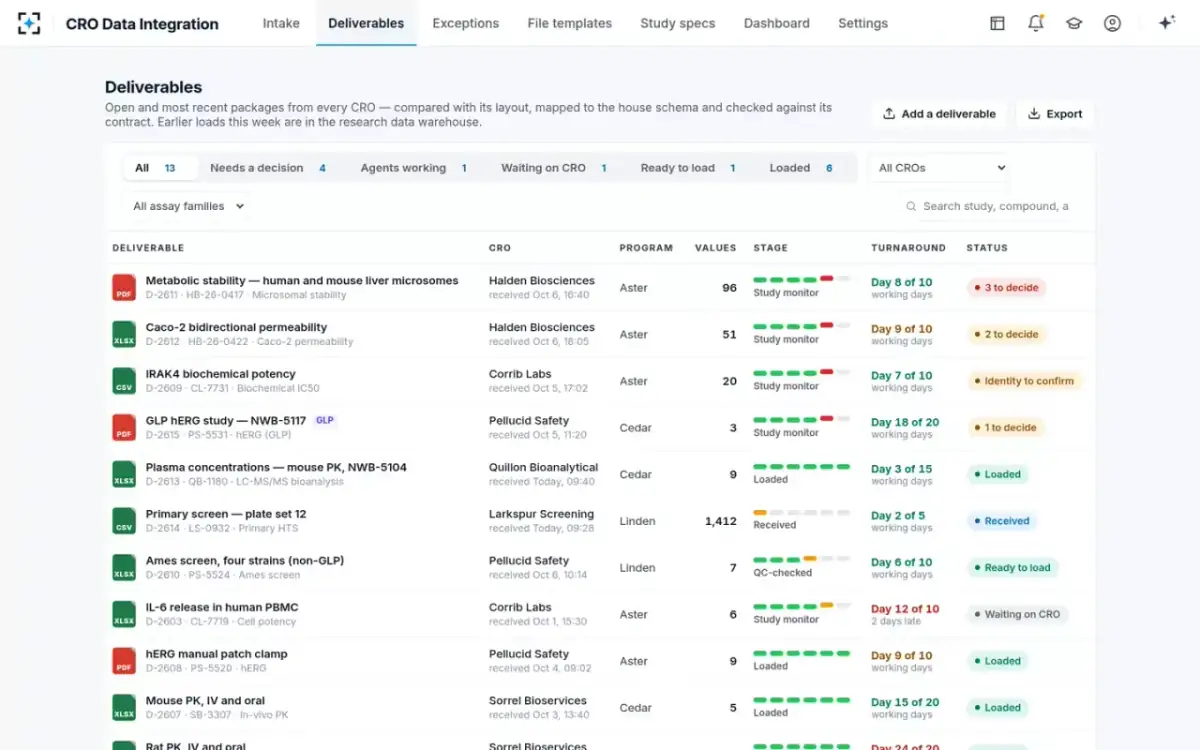
Do you need another system, or an acceptance step in front of your warehouse?
The honest answer for most discovery organisations is that they do not need a fifth system in the sense of a new place where data lives. They need a decision point before the warehouse that nothing they own provides. The distinction matters commercially: a new system of record is a migration, a vocabulary change and a two-year project, while an acceptance step is a stage added in front of what you already have.
Buying a system of record, or adding an acceptance step in front of the one you have
Another system of record: Where the data lives, and which system scientists open. Everything downstream is re-pointed.
An acceptance step in front of the warehouse: What is allowed to reach the place data already lives. Downstream systems see better rows and are otherwise untouched.
Another system of record: A migration, and a second corpus that disagrees with the first until the old one is retired.
An acceptance step in front of the warehouse: A stage you turn off. The warehouse is where it was.
Another system of record: Nothing on its own — a system of record stores what it is given.
An acceptance step in front of the warehouse: Stops the file, shows the difference against the last accepted layout, and asks a person.
Another system of record: Nothing. Acceptance criteria live in a document, not in a schema.
An acceptance step in front of the warehouse: Tests every criterion in the statement of work and raises an exception with the evidence for each failure.
Another system of record: A vocabulary decision, a migration plan and the political will for both.
An acceptance step in front of the warehouse: Your statements of work, each laboratory’s file layouts, your unit rules and a sample of past deliverables.
Another system of record: Acceptance. The gap is still there, one layer down.
An acceptance step in front of the warehouse: Storage, laboratory workflow, or the notebook. It is not a LIMS, an ELN or a warehouse and does not try to be.
Each laboratory's accepted layout, by version, with every change caught this quarter
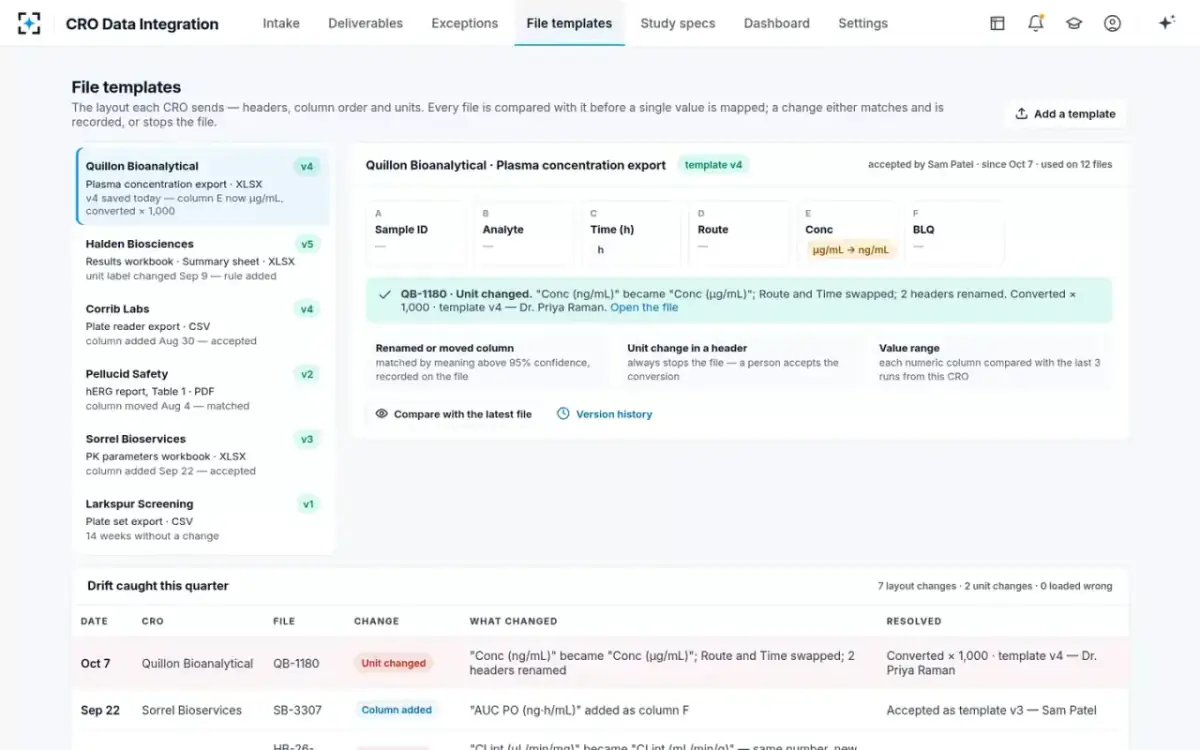
Six questions to put to any candidate system
Buying for this job is unusually easy to test, because every claim can be checked on files you already have. Ask for the demonstration on your own past deliverables rather than on a prepared sample, and break something on purpose.
Six questions, what a good answer sounds like, and how to test it on your own files
| Question | What a good answer sounds like | How to test it |
|---|---|---|
| What happens when a laboratory changes a column header or a unit? | The file stops before anything is mapped, with a before-and-after comparison and what would have loaded; a person accepts the conversion and it becomes a new layout version. | Take a real past file, change “ng/mL” to “µg/mL” in the header, and send it. Loading silently is a failure; a warning nobody has to act on is also a failure. |
| Where does a loaded value point back to? | A file, a page and table, or a sheet and cell — openable in one click, with the as-reported value beside the converted one. | Pick ten loaded values at random and ask to see the source. Time it. |
| Which document decides whether a result passed? | The statement of work. The laboratory’s own procedure is shown beside it, and the contract wins where they differ. | Supply a report in which the laboratory marked a control “Pass” against a range wider than your contract allows. |
| What happens to a value below the limit of quantification? | It loads as a bound with its qualifier, never as zero and never as half the limit without an explicit, recorded decision. | Send a file with zeros in a flagged column and see what reaches the warehouse. |
| Who made each decision, and where is that recorded? | A named person per exception, stored against the values it affected, with what was in front of them and what they chose. | Ask to see every decision on one deliverable from six weeks ago, and who made each. |
| What does it need from our existing systems, and what does it replace? | It needs the warehouse, the registry and the contracts; it replaces none of them. A candidate that answers “it replaces your warehouse” is answering a different question. | Ask for the integration diagram before the pricing. |
What CRO Data Integration adds, and what it still needs from your systems
It is the acceptance step and nothing else. Seven agents read each package: a classifier identifies the laboratory, study and contract schedule; a layout checker compares the file with that laboratory's last accepted version before anything is mapped; an extractor turns report tables, workbook cells and instrument exports into records with a page or cell for every value; a unit and identity normaliser converts by approved rules and matches compounds through the manifest shipped with the study; a specification checker tests every acceptance criterion in the contract; a query writer drafts the question to the laboratory; and a loader writes to the warehouse once every exception is decided. The study monitor decides each exception, the data steward owns the layouts and compound identity, and a query goes out only when a person approves it.
What it needs from you is the rest of the stack. A warehouse or a database to load into, with a house schema. A compound registry, and the manifest shipped with each study. Your statements of work and their acceptance criteria. Your unit rules. And somewhere to receive files — a drop folder checked every ten minutes, a daily portal sync, or a mailbox. It does not replace a LIMS, an electronic notebook or the warehouse, and a vendor who tells you otherwise is selling you a migration.
The cost of preclinical results that cannot be reproduced
53.3%
point estimate of the cumulative irreproducibility rate in preclinical research
$28B/yr
US spend on preclinical research that is not reproducible, in the authors’ estimate
1 of 4
broad categories of cumulative error is data analysis and reporting
That last caveat is deliberate. No published figure measures what sloppy handling of contract laboratory data costs specifically, and anyone quoting one at you should be asked where it came from. What the reproducibility literature does establish is that the problem is large and that data analysis and reporting is one of its four named sources — and the FAIR authors open their paper by calling the improvement of infrastructure for reusing scholarly data an urgent need. The part of that infrastructure a sponsor can fix without anyone's cooperation is the step where other people's data becomes theirs.
A value opened to the cell it came from, in both units
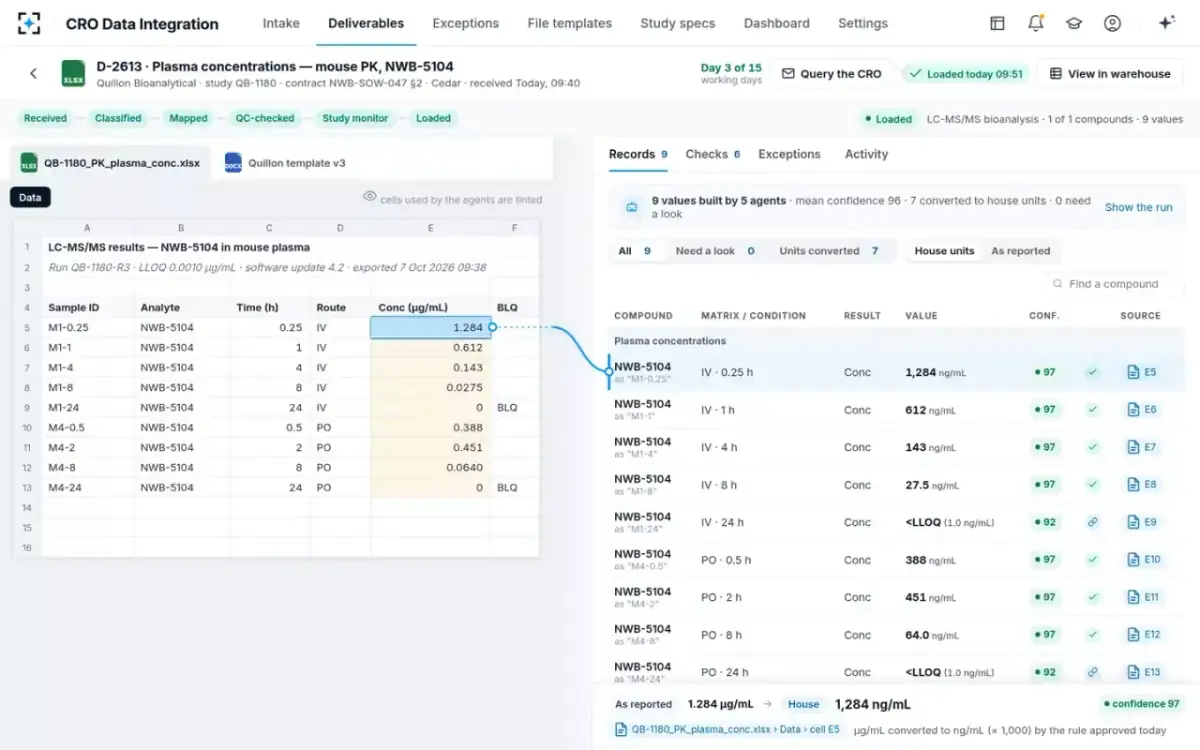
If you are comparing products rather than approaches, the trial design and the requirements list are in what to look for in CRO data management software, and how to test it; the interface decision that usually comes with it is in four ways to get CRO data into a LIMS, compared. To see the acceptance step on your own past deliverables, start from CRO Data Integration.
Questions people ask
What is the difference between a LIMS, an ELN and an SDMS?
A laboratory information management system runs the work: samples, batches, instruments, workflow states. An electronic laboratory notebook records what a scientist did and thought, in a form that can be witnessed. A scientific data management system files raw output durably and searchably in whatever format it arrived in. The categories overlap at the top end — high-end notebooks also function as laboratory information management systems — but the jobs differ, and none of the three decides whether an arriving file may be loaded.
Where should preclinical data from a CRO be stored?
In two places, doing two jobs. The file exactly as it arrived should be kept unaltered and retrievable, which is a scientific data management system's job or any durable store that preserves it. The values should be in the research warehouse with house units, qualifiers, resolved compound identity and a citation back to the page or cell. The mistake is keeping only one of the two: the file alone cannot be queried, and the values alone cannot be checked.
What do the FAIR principles ask of research data?
Findable, accessible, interoperable and reusable — fifteen sub-principles published by Wilkinson and 52 co-authors in 2016, asking for persistent identifiers, rich metadata, standardised retrieval, shared vocabularies, qualified references between datasets, and reusable data with accurate attributes, a clear licence, detailed origins and community standards. The emphasis is machine-actionability rather than openness: the test is whether a system that was not there can work out what the data is and how to integrate it.
What has to be stored with a CRO value to make it reusable?
The value as reported with its original unit, the qualifier unflattened, the compound identity and how it was resolved, the contract criterion it was judged against, a citation to the page or cell, and every decision taken on the way in with the name of whoever made it. All six are cheap to capture at the moment of loading and expensive or impossible to reconstruct afterwards.
How do you choose a system for preclinical data?
Start by naming the job that is failing. If files cannot be found, you have a filing problem; if scientists cannot query across programmes, a warehouse problem; if values arrive wrong or late, an acceptance problem — and acceptance is the one no established category covers. Then test the candidate on fifty of your own past deliverables, some of them deliberately broken, rather than on a prepared demonstration.
Who is responsible for preclinical data quality?
The sponsor, whoever generated the measurement. A contract laboratory is accountable for running the study to its protocol and reporting it accurately; the sponsor is accountable for everything that happens to those results afterwards, including the units they were converted into and the decisions made about exceptions. The practical consequence is that the sponsor needs its own evidence about each deliverable rather than the laboratory's assurance that it is sound.