Top-line results, in clinical trials, means the sponsor's own first summary of whether a trial met its primary endpoint — usually a few paragraphs, often issued within weeks of the data being unblinded and long before any peer-reviewed paper exists. The meaning of the phrase is deliberately narrow: it is the line at the top of the analysis, not the analysis. A top-line release normally says whether the primary endpoint was met and whether the safety profile was consistent with expectations, and leaves out the full effect sizes, the secondary endpoints, the subgroups and the adverse-event tables. Botminds' Competitive Pipeline Tracking treats one as what it is — evidence of a statement, not of a result — by keeping the exact sentence the sponsor used, placing the move on a race board with that sentence attached, and letting the registry and the paper correct it months later.
The worked example is sample data: the fictional asset QLN-2319, its trial QUILL-PSO-1 and the fictional sponsor Quillon Therapeutics. The research below is real, and each figure links to the study it comes from.
What a pre-emptive release looks like, measured
17%
of medication trials in three major journals had a press release 90+ days before the paper
246days
median gap from that release to peer-reviewed publication
85%
of those trials had a positive primary outcome; 81% of the releases had a positive headline
What does "top-line results" mean in a clinical trial?
It means the headline answer, released before the full analysis is public. In practice a top-line statement answers one question — did the trial hit its primary endpoint — and gestures at a second, whether anything alarming happened on safety. Sponsors issue one because they have obligations and audiences that will not wait for a journal: investors, partners, regulators and the investigators who ran the trial.
What it is not is a result you can weigh. A statement that a trial "met its primary endpoint with statistical significance" is compatible with an effect large enough to change practice and with one too small to matter. Without the effect size, the confidence interval, the event counts and the comparator's performance, nobody outside the sponsor can tell which. The discipline, for an intelligence team, is to record exactly that: the claim made, by whom, on what date, and the list of things the claim does not establish.
How long after top-line results does the paper come?
About eight months, where the release comes first, on one large published measurement. Purohit and colleagues reviewed 988 randomised trials of medications published in three major journals and found that 172 (17%) had a press release published at least 90 days before the date of peer-reviewed publication
, and that those releases were published a median of 246 days (interquartile range [IQR] 169-366 days) before publication in a peer-reviewed journal
. The strongest predictor of a release arriving first was industry funding: trials funded by a pharmaceutical company had about thirteen times the odds of a pre-emptive release (Journal of General Internal Medicine, 2023).
Two things follow for anyone tracking a rival. First, the window in which the only public account of a trial is the sponsor's own account is long — a median of eight months, and a quarter of the time more than a year. Decisions get made in that window. Second, the trials most likely to be in that window are exactly the ones a competitive team cares most about, because industry sponsorship is the single strongest predictor of the pattern.
The gap between a release and the paper, and where the registry entry lands
- A quarter of releases were followed by the paper withinday 169
- Half of them byday 246
- Three quarters of them byday 366
- Median delay across trials due to report under the final rule424 days
What a top-line release usually contains, and what it leaves out
The useful way to read one is as a form with most of the fields blank, and to note which fields the sponsor chose to fill. A release that gives the hazard ratio and the confidence interval is saying something quite different from one that gives only the word "significant", and the difference is information in itself.
What a top-line release says, and what the registry record says
The sponsor's top-line release: At the sponsor’s choosing, usually within weeks of unblinding, with no deadline on it at all.
The registry record: Registration within 21 days of the first participant; results within one year of the actual primary completion date.
The sponsor's top-line release: The sponsor, for investors, partners and the press, reviewed by its own legal and medical teams.
The registry record: The responsible party, in a prescribed structure, under a rule that makes false or misleading submission a prohibited act.
The sponsor's top-line release: Whether the primary endpoint was met, often without the effect size, and a general statement on safety.
The registry record: Participant flow, baseline characteristics, outcome measure results with statistical analyses, and adverse events by arm.
The sponsor's top-line release: Only its own words, unless you kept them — a release can be amended or withdrawn from a newsroom.
The registry record: Every prior version, because updates are required never to remove information from an earlier submission.
The sponsor's top-line release: Knowing that something happened, when, and how the sponsor chose to characterise it.
The registry record: Knowing what was actually measured, in enough detail to compare with your own trial.
Are top-line results reliable? How often the headline overstates
Reliable as evidence that a statement was made; weaker as evidence of what the trial showed. The best-measured version of the problem is "spin" — reporting that emphasises benefit beyond what the data support. Yavchitz and colleagues took all press releases for two-arm parallel-group randomised trials indexed in a research release database over four months, 70 in total, matched each to its paper, and found that spin was identified in 28 (40%) scientific article abstract conclusions and in 33 (47%) press releases
. More pointedly, the findings of the trial as described by the release were overestimated in 19 of 70 cases — 27% (PLoS Medicine, 2012).
Read that study for what it is. Its corpus is academic research releases, not industry top-line statements, so it is the nearest good evidence rather than a direct measure of pharmaceutical sponsors. What it establishes is a base rate for the behaviour: when an organisation summarises its own trial for an outside audience, the summary leans positive about half the time, and the single strongest predictor of a release leaning was the paper's own abstract conclusion leaning first.
Where spin was found, across 70 trials and their releases
Guidance on a results call is a date, not a result
The other kind of top-line statement is the one made on an earnings call, and it is usually about timing rather than outcome. It is easy to undervalue, because it carries no data at all. It is also the only public source for a rival's own view of when its answer will exist, and it moves more often than a registry date does.
Enrolment finished early, so we now expect topline data from QUILL-PSO-1 in December.
Sample data — Quillon Therapeutics, third-quarter results call, 1 October 2026, as the news watcher keeps it
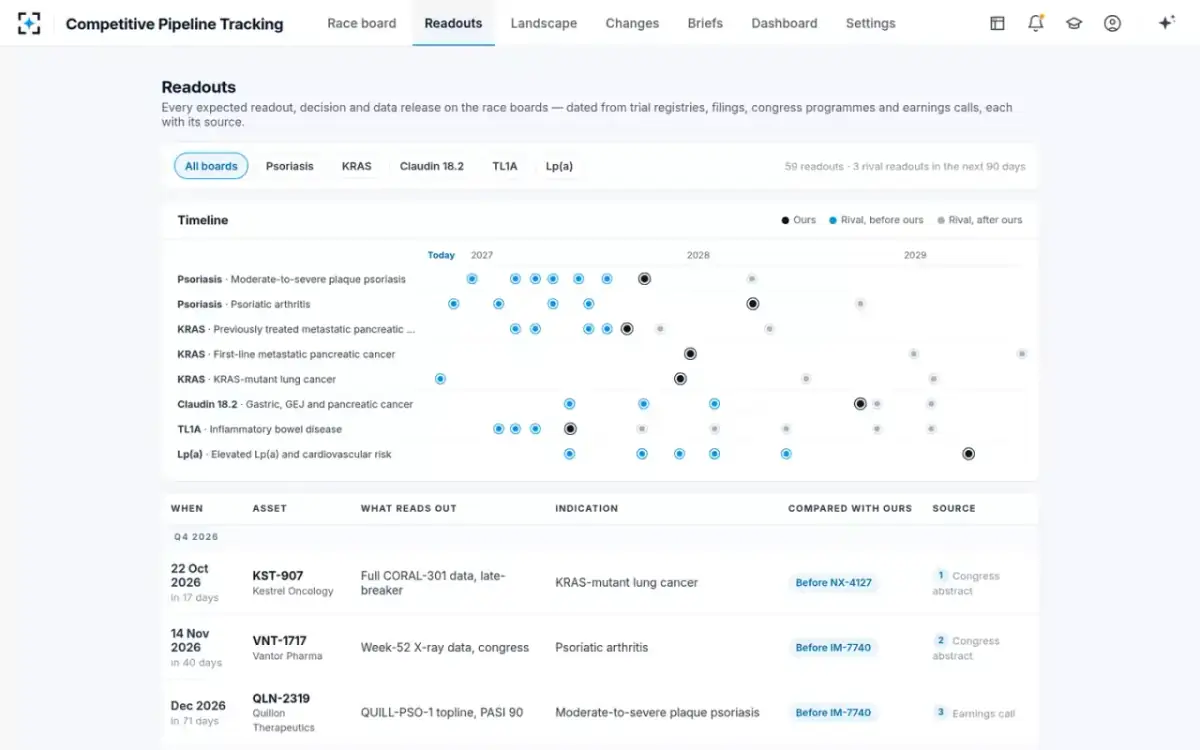
In the sample week that sentence moves QLN-2319's readout from prior guidance of January 2027 into December, which changes where the asset sits against our own planned topline. The sentence is kept because the sentence is the evidence: "management guided to December" is a paraphrase that cannot be audited, while the quotation can be put in front of a programme lead who wants to judge the wording for themselves. How that date relates to the trial's registry dates — and why they usually disagree — is worked through in primary completion date versus study completion date.
Telling an interim look from a final analysis
A top-line statement about an interim analysis and one about a final analysis read almost identically and mean very different things. An interim look tests a pre-specified boundary at a planned fraction of the events; a trial that crosses an efficacy boundary early stops with a smaller dataset and wider intervals, and one that fails a futility boundary stops for a different reason again. A release that says a trial "met its primary endpoint at a pre-specified interim analysis" is reporting a decision by a data monitoring committee, not a final effect estimate.
The practical rule is to carry the distinction as a field on every captured result, not as a note in the prose, because it determines whether the number is comparable with anything else on the board. In the solution, the agent that reads congress abstracts copies numbers rather than computing them and flags interim versus final data on every row, for exactly this reason.
What the registry will say a year later
Eventually the registry entry arrives and settles several of the open questions — participant flow, the outcome measure results with their analyses, adverse events by arm. The catch is that "eventually" is doing real work. Of 4,209 applicable trials due to report under the final rule, 63.8% had submitted results at any point by the study's cut-off, leaving more than a third with nothing posted (The Lancet, 2020).
So the sequence a competitive team should expect is: a sponsor release that frames the result, then a congress abstract with numbers, then possibly a paper around eight months after the release, then possibly a registry entry — and the last two are not guaranteed. A claim written to survive that sequence names its source and its date; a claim written as though the release were the final word has to be rewritten three times, usually in front of the people who relied on it. The registry update rules set out which of those later corrections are actually required.
One topline, three sources, one claim: a worked example
In the sample week, QLN-2319 appears in three places. The results call gives the new timing in one sentence. The sponsor's pipeline page continues to show the asset in Phase 3 in moderate-to-severe plaque psoriasis, unchanged. The registry record for QUILL-PSO-1 still carries its earlier estimated primary completion date, because moving an estimate carries no short deadline.
Those three are not in conflict; they are three different kinds of statement, and the claim has to say which it rests on. The version that reaches the programme team reads as a dated, attributed sentence about guidance, with the registry date shown beside it and marked estimated — so the reader can see that the company has moved ahead of its own public record, which is itself the interesting part.
Where one moved readout lands on the calendar
Writing a top-line claim that can still be checked next quarter
The test of a claim is whether a colleague can reconstruct it in six months without asking you. That means a quotation rather than a paraphrase, a named source with a date, an explicit statement of what the release did not say, and a label for the kind of analysis it describes.
Six tests to run on a top-line release before it reaches a brief
- Keep the sentence, not the summary
A quotation can be re-read. A paraphrase cannot be checked, and tends to firm up as it is repeated.
- Say what the release does not state
Effect size, confidence interval, event counts, secondary endpoints, subgroups, discontinuations. Absence is information about the result.
- Mark interim or final
A result at a pre-specified interim analysis is a monitoring committee’s decision on a partial dataset, not a final estimate.
- Separate the date from the result
Guidance on a call is a statement about timing. It belongs in the readout calendar, not in the evidence table.
- Note who funded and who issued it
Industry funding was the strongest predictor of a release preceding the paper in the published study; that is context a reader is entitled to.
- Set a date to come back
Where a release comes first, the paper has followed a median of eight months later, and over a third of trials due to post registry results had not done so by one study’s cut-off. Put the re-check on the calendar, not in your memory.
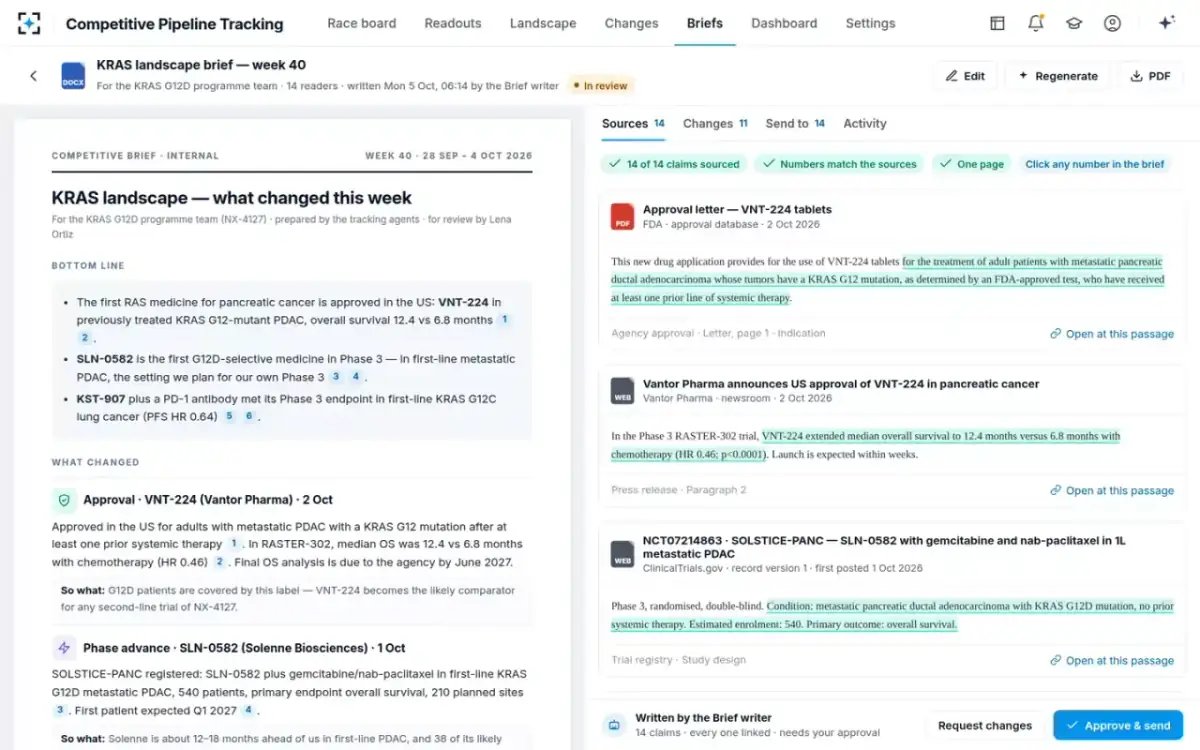
The solution applies the same rule in a narrower form: every claim in a weekly brief needs the passage it came from, numbers are copied rather than computed, and no forecast is stated as a fact. The sample brief carries 14 claims and 14 sources, and the checks beside it are shown to the analyst before they approve it.
A brief where every claim opens the sentence behind it
A top-line release is a real event and worth acting on. It is just worth acting on as what it is: a sponsor's first, shortest and most favourable account, eight months ahead of the version anyone can check. To see how one lands on a race board with its sentence attached, start from Competitive Pipeline Tracking.
Questions people ask
What is the difference between topline and full results?
Top-line results state whether the trial met its primary endpoint and usually make a general statement about safety. Full results give the effect sizes with their confidence intervals, the secondary endpoints, participant flow, baseline characteristics, discontinuations and adverse events by arm. The first is a few paragraphs written for an outside audience; the second is a structured dataset in the registry or a complete paper, and it typically appears many months later.
What does readout mean in pharma?
A readout is the moment a trial's results become known — in practice, when the database is locked, the trial is unblinded and the analysis is run. It is distinct from the primary completion date, which is when the last primary-outcome data were collected, and from the disclosure, which is when the sponsor chooses to say something. A readout calendar that does not distinguish the three will put a rival's news on the wrong quarter.
Positive topline results: what does that actually mean?
That the sponsor says the trial met its primary endpoint. It does not say by how much, in which population, against what comparator, or at what cost in adverse events. Among trials whose releases preceded publication by at least 90 days, 85% had a positive primary outcome and 81% of the corresponding releases carried a positive headline — so a positive top-line release is the overwhelmingly common case and carries little information by itself.
Are top-line results reliable?
They are reliable evidence that a statement was made, and weaker evidence of what the trial showed. In one well-measured study of research press releases, spin was identified in 47% of press releases and the trial's findings were overestimated in 27% of them when read from the release alone. That study covered academic research releases rather than sponsor toplines, so treat it as a base rate for the behaviour rather than a measurement of any one company.
Do companies have to publish their trial results?
For trials covered by 42 CFR Part 11, results information must be submitted to the registry within one year of the actual primary completion date, and failing to do so is a prohibited act carrying civil monetary penalties. There is no equivalent obligation to issue a press release, to publish a paper, or to say anything at all about a trial that is outside the rule — phase 1 trials, observational studies and trials run wholly outside the United States without a US investigational new drug number.
How long after topline results is the paper published?
A median of 246 days — about eight months — among trials in three major journals whose release preceded publication by at least 90 days, with an interquartile range of 169 to 366 days. A quarter of those papers therefore arrived more than a year after the release. In the meantime the sponsor's own words are the only public account, which is why keeping the exact sentence matters more than summarising it well.