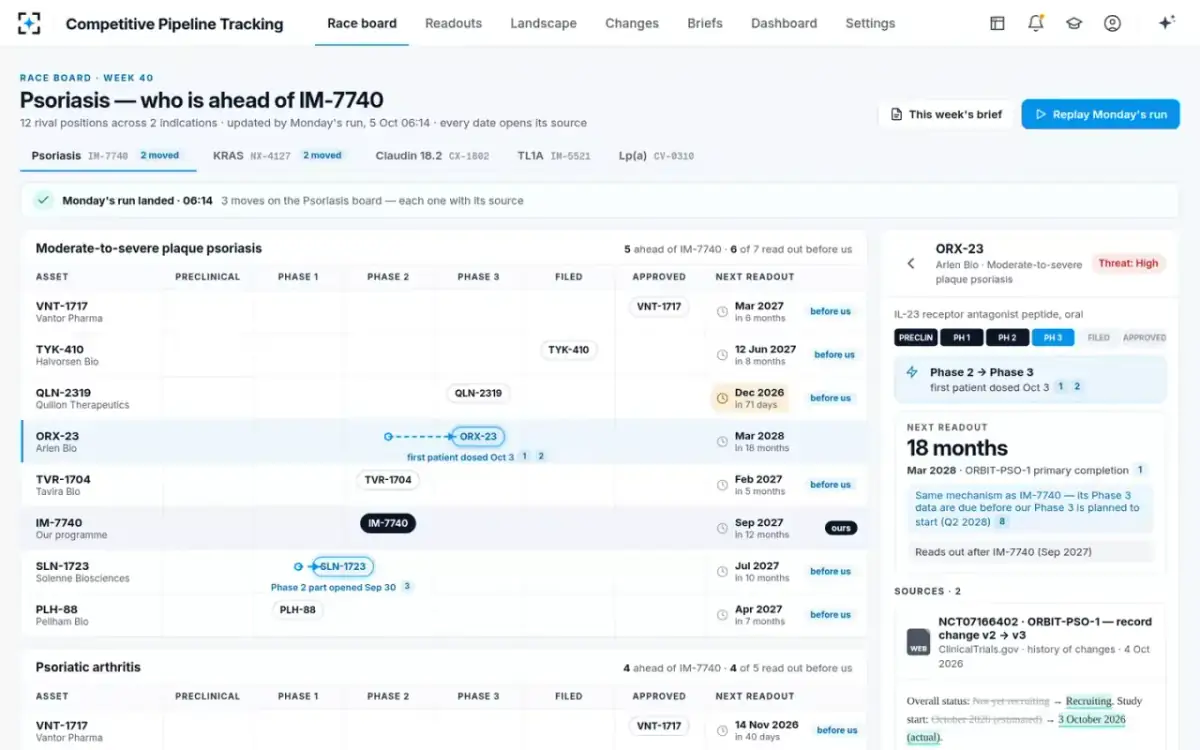
The ClinicalTrials.gov update requirements are set by 42 CFR Part 11, the final rule under the Food and Drug Administration Amendments Act, and they come in three sizes. A covered trial must be registered within 21 calendar days of its first participant being enrolled. A short list of fields — overall recruitment status, study start date, individual site status, the actual primary completion date, the actual study completion date and a few others — must be updated within 30 calendar days of the event that changes them. Everything else must be refreshed at least once every twelve months, and results are due one year after the primary completion date. Those clocks are why a registry is worth watching weekly rather than quarterly, and they are the rule Botminds' Competitive Pipeline Tracking anchors its registry watcher to: it compares each watched record against the last version it captured and records every changed field, before and after, without inferring a status the record does not state.
This page quotes the regulation as it currently reads on the eCFR. The worked example is sample data — the fictional trial ORBIT-PSO-1, NCT07166402, sponsored by the fictional Arlen Bio — used to show what a change looks like, not to describe a real sponsor.
The three clocks in 42 CFR Part 11
21days
to register a covered trial after the first participant is enrolled
30days
for recruitment status, study start, site status and the actual completion dates
1year
after the primary completion date for results information
What are the ClinicalTrials.gov update requirements?
They are the deadlines in § 11.64 for keeping a registered record true, and they are field by field rather than record by record. The baseline is weak and the exceptions are strong: In general, changes to clinical trial registration information specified in § 11.28 must be updated not less than once every 12 months
— but a named list of data elements must be updated not later than 30 calendar days
after the thing that changed them, and a different clock, in § 11.24, governs the registration itself.
Read as an intelligence problem rather than a compliance one, that structure tells you where to look. The fields on the 30-day list are the fields that mark a real-world event: a trial that began dosing, a site that opened, a trial that stopped, a trial that finished collecting its primary data. The fields left to the twelve-month catch-all are the ones that can drift for most of a year — including, awkwardly, an estimated completion date.
Which trials the rule covers, and which it quietly does not
The rule applies to an applicable clinical trial
, and the definition excludes more than most readers expect. For a drug or biological product, § 11.22 requires four conditions together: (i) Study Type is interventional; (ii) Study Phase is other than phase 1; (iii) The clinical trial Studies a U.S. FDA-regulated Drug Product; and (iv)
at least one site in the United States or its territories, or a product manufactured in and exported from the United States for study elsewhere, or a US investigational new drug number (42 CFR § 11.22).
Four exclusions follow, and each is a blind spot on a landscape. Phase 1 trials are outside the rule, so a rival's first-in-human programme may be invisible until it reaches Phase 2. Observational studies are outside it. A trial run entirely outside the United States, with no US investigational new drug number, is outside it. And a record on the site does not by itself tell you the rule required it: sponsors may also submit other trials voluntarily under § 11.60. A watch list built only from US registry records is therefore a watch list with holes in it, which is the argument for reading the other four source families alongside; what a drug pipeline database adds to the public registries works through the same gap from the buyer's side.
When must a clinical trial be registered? The 21-day clock
Within 21 days of the first participant. Section 11.24 sets the deadline as not later than December 26, 2007, or 21 calendar days after the first human subject is enrolled, whichever date is later
, with a parallel 2008 date for trials of conditions that are not serious or life-threatening. Since every trial now starting falls past both historical dates, the operative rule is simply the 21 days.
That clock is the single most useful fact on this page for anyone tracking rivals, because it is the earliest reliable public signal that a programme has moved. A sponsor can delay a press release indefinitely. It cannot delay the registration of a dosed trial by more than three weeks without breaking the rule. A new registry record for a watched asset is, in practice, the announcement.
The 30-day clocks: recruitment status, study start, site status, completion
For trials initiated on or after 18 January 2017, § 11.64(a)(1)(ii) lists the fields with a 30-day deadline. Four of them carry almost all the competitive signal, and one of them carries a second obligation that is easy to miss: when overall recruitment status changes to suspended, terminated or withdrawn, the sponsor must also submit the Why Study Stopped data element. A rival trial does not merely vanish from a landscape; the rule obliges a reason to appear beside it.
The fields with a 30-day deadline, and what a change in each usually means
| Data element | The deadline in § 11.64 | What a change in it usually means |
|---|---|---|
| Overall Recruitment Status | 30 days after any change in overall recruitment status; a change to suspended, terminated or withdrawn also requires the Why Study Stopped element | The strongest single signal on a landscape. Not yet recruiting to Recruiting means dosing has begun; the three stop states mean a programme is in trouble, with a stated reason. |
| Study Start Date | 30 days after the first participant is enrolled, where none was enrolled at registration | First patient dosed. Combined with the planned duration, this is where a readout estimate starts. |
| Individual Site Status | 30 days after a change in status for any individual site | Where the trial is actually opening. If those sites are on your own feasibility shortlist, you are competing for the same investigators. |
| Primary Completion Date | 30 days after the trial reaches its actual primary completion date; the date is then marked actual and the actual enrolment must be submitted | The readout clock has started. The one-year results deadline runs from this date, not from the estimate it replaced. |
| Study Completion Date | 30 days after the trial reaches its actual study completion date | The trial is over, including follow-up. It usually lands well after the primary data have been reported. |
| Intervention Name(s) | 30 days after a non-proprietary name is established for an intervention | A code name becoming a generic name is a quiet sign that the asset is heading toward a filing. |
| Protocol amendments communicated to participants | 30 days after the amendment is approved by a human subjects protection review board | The design changed in a way participants were told about — a comparator, a dose, an endpoint. |
| Record Verification Date | Whenever the responsible party reviews the record, and not less than every 12 months | Not an event, but a freshness stamp: an old verification date means the rest of the record may be older than it looks. |
Note the asymmetry in the primary completion date row, because it is the most common mistake in this area. The 30-day deadline on the primary completion date applies when the trial reaches that date — it converts an estimate into an actual. It is not a 30-day deadline on changing the estimate. A sponsor that pushes an expected readout from March 2028 to September 2028 is editing a field that only the twelve-month rule governs. The difference between the two dates, and why it decides a countdown, is the subject of primary completion date versus study completion date.
One registry change, with the text before and after
When are clinical trial results due? One year after primary completion
Section 11.44 is short: In general, for applicable clinical trials subject to § 11.42, clinical trial results information ... must be submitted no later than 1 year after the primary completion date of the applicable clinical trial.
Certifications can delay it — most commonly where the sponsor is seeking approval of a new use of an already approved product — but the base case is twelve months.
Compliance with that deadline has been measured, and it is poor. Studying every applicable trial due to report under the final rule, DeVito, Bacon and Goldacre found that 4209 trials were due to report results; 1722 (40·9%; 95% CI 39·4-42·2) did so within the 1-year deadline
, with 2,686 — 63.8% — having submitted at any time by the cut-off (The Lancet, 2020). For an intelligence team the practical consequence is blunt: the registry will eventually hold a rival's results, but you cannot plan around its arriving on time, and in six cases out of ten it did not.
Where does the twelve-month catch-all leave a gap?
Exactly where a competitor would most like one. Estimated dates, enrolment targets, outcome measure definitions, eligibility criteria and arm descriptions all sit under the general rule, so each may be edited at any moment and need only be correct once a year. There is no notification when they are, and no marker on the record saying which fields moved.
That is what makes a weekly comparison worth running rather than a weekly reading. The record you can see today is the only version the site shows you by default; the version that contained last quarter's endpoint is not in front of you unless you kept it. A watch that captures each record version by version can tell a programme lead that a rival's primary endpoint definition changed in August. A watch that reads the live page can only tell them what it says in October.
The six fields a weekly registry watch compares against its last capture
- Overall recruitment status, and Why Study Stopped if it is one of the three stop states
The highest-value field on the record, and the only one that comes with a required explanation.
- Study start date, and whether it is marked estimated or actual
An actual start date is first patient dosed. An estimated one is a plan, and plans move.
- Primary completion date, with the same estimated-or-actual flag
A change of estimate is ordinary. A flip to actual starts the one-year results clock.
- Enrolment: the target, and the actual figure that arrives with the completion date
A target cut by half mid-trial says something the sponsor has not announced.
- Individual site list and status
The only public view of where a rival is opening, and the overlap with your own shortlist.
- Outcome measures, arms and eligibility criteria
Under the twelve-month rule, so they drift silently. Compare the text, not the field count.
What happens when a sponsor misses a deadline?
The regulation is explicit about the legal position, and unexciting about the practice.
Failure to submit clinical trial information required under section 402(j) of the Public Health Service Act is a prohibited act under section 301(jj)(2) of the Federal Food, Drug, and Cosmetic Act. ... Any person who violates section 301(jj) of the Federal Food, Drug, and Cosmetic Act is subject to civil monetary penalties
42 CFR § 11.66, Potential legal consequences of not complying
Section 11.66 also allows grant funding actions where a trial is federally funded. Set against the measured compliance figures above, the gap between the rule's force and its practical effect is wide, and an analyst should hold both facts at once: the deadlines are real enough to make a registry watch productive — and loose enough that a missing update is not evidence of anything in particular.
What Europe publishes, and since when
The European route is a separate system with a separate history. The Clinical Trials Information System implements the Clinical Trials Regulation (EU) No 536/2014, and the European Medicines Agency records that CTIS went live with a searchable public website on 31 January 2022
and that Anybody can view information held in CTIS on clinical trials in the EU and EEA, by using the searchable public website
(EMA, Clinical Trials Information System). Trials initiated before 31 January 2023 under the earlier Clinical Trials Directive remain in the older EU Clinical Trials Register, so a complete European history for an asset can span two systems.
What is public in the United States, and what is public in the EU
ClinicalTrials.gov, under 42 CFR Part 11: Interventional trials other than phase 1 of an FDA-regulated drug product with a US site, a US-exported product or an IND number.
CTIS, under Regulation (EU) No 536/2014: Trials authorised to run in EU Member States and EEA countries; a single application can cover up to 30 countries.
ClinicalTrials.gov, under 42 CFR Part 11: 21 calendar days after the first participant is enrolled.
CTIS, under Regulation (EU) No 536/2014: Information appears on the public portal as it becomes available, under the CTIS transparency rules, rather than on a clock counted from first enrolment.
ClinicalTrials.gov, under 42 CFR Part 11: The full registration record, its results when submitted, and every prior version, because updates never remove earlier information.
CTIS, under Regulation (EU) No 536/2014: The EU trial number, therapeutic area, sponsor details, and start and end dates of recruitment and of the trial itself, as soon as each becomes available.
ClinicalTrials.gov, under 42 CFR Part 11: Little: the record is public once posted.
CTIS, under Regulation (EU) No 536/2014: Personal data, commercially confidential information, confidential communication between Member States during evaluation, and supervision material.
ClinicalTrials.gov, under 42 CFR Part 11: One site since 2000; the rule tightened in 2017 for trials initiated from 18 January.
CTIS, under Regulation (EU) No 536/2014: Trials initiated before 31 January 2023 under the Directive sit in the EU Clinical Trials Register, a separate database.
What a weekly registry watch can see, and what it cannot
It can see every field that moved on every watched record since the last capture, with the exact text on both sides, and it can place that change on a race board the same morning. In the sample run it reads 612 records across 49 assets and finds 18 changed. What it cannot do is tell you what the change means, and the honest designs do not pretend otherwise: the registry watcher reads public sources only and never infers a status the record does not state, the change detector sends anything below 85% confidence to review, and a named analyst confirms what counts as significant for the programme.
The one-year results clock, against what was measured
- Submit results information365 days
- Within the deadline365 days
- Median overrun+59 days
A confirmed change, with its sources beside it
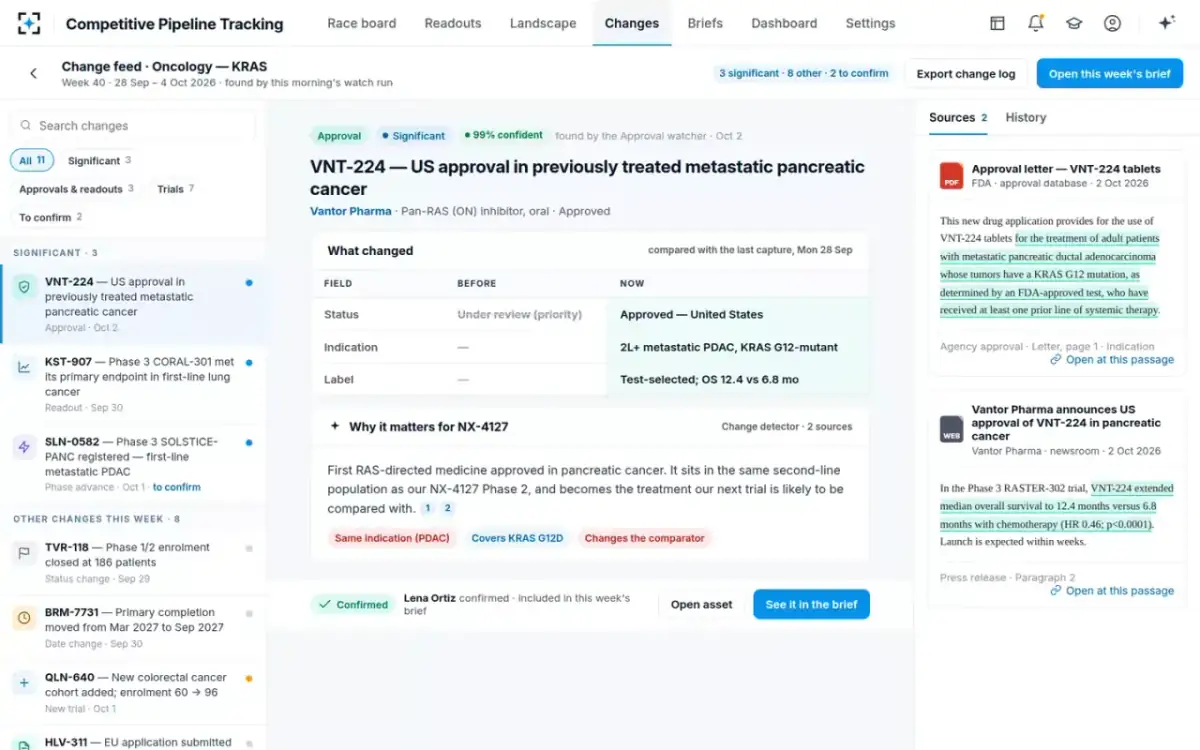
Read together, the clocks are a schedule for somebody else's news. Twenty-one days after a rival doses its first patient you can know. Thirty days after a site opens, or a trial stops, or a readout date becomes real, you can know that too. The rest of the record you have to watch for yourself. To see what a week of that looks like on a race board, start from Competitive Pipeline Tracking, or read the week behind a pharma competitive landscape.
Questions people ask
How often must ClinicalTrials.gov be updated?
At least once every twelve months for the registration record as a whole, and within 30 calendar days for the specific fields § 11.64 names — among them overall recruitment status, study start date, individual site status, the actual primary completion date and the actual study completion date. The full 30-day list applies to trials initiated on or after 18 January 2017; trials initiated before that date carry a shorter one covering recruitment status and the primary completion date.
What does 42 CFR Part 11 require?
It is the final rule implementing section 402(j) of the Public Health Service Act. It defines which trials are applicable clinical trials, requires their registration within 21 days of the first participant being enrolled, sets out the data elements that must be submitted, imposes the 30-day and twelve-month update deadlines, requires results information one year after the primary completion date, and states the legal consequences of not complying. It also requires that updates never remove earlier information, so a record's prior versions stay public.
Which trials must be registered on ClinicalTrials.gov?
For drugs and biological products, an interventional trial of a phase other than phase 1, studying an FDA-regulated product, with at least one site in the United States or its territories, or a product manufactured in and exported from the United States for study abroad, or a US investigational new drug number. Phase 1 trials, observational studies and trials run wholly outside the United States without an IND are not covered, although sponsors may register them voluntarily under § 11.60.
What happens if a sponsor does not report trial results?
Failing to submit required information is a prohibited act under the Federal Food, Drug, and Cosmetic Act, and anyone who commits it is subject to civil monetary penalties; where the trial is federally funded, grant funding actions are also available. In measured practice the deadline is widely missed — 40.9% of trials due under the final rule reported within the year — so a missing results posting tells you less about a sponsor than the deadline's wording suggests.
Does a change to a trial's expected completion date have a deadline?
No, and this is the trap. The 30-day deadline applies when a trial reaches its actual primary completion date, at which point the field is marked actual and the actual enrolment figure must be submitted. Moving an estimate — pushing an expected readout from one quarter to the next — falls under the general rule that registration information be updated at least once every twelve months. A rival's expected readout can therefore sit wrong for months without any rule being broken.
Can you see what a trial record used to say?
Yes. The rule requires that prior registration and results information be retained and made publicly available, so that updates do not remove any information from the original submission or any preceding update. The practical catch is that nothing tells you a change happened: you have to compare versions deliberately, which is why a watch that keeps its own weekly capture catches edits that a reader of the live record never notices.