The competitive intelligence code of ethics is the profession's own standard for how intelligence about a competitor may be gathered: seven short principles published by the Strategic Consortium of Intelligence Professionals, of which the two that do the real work are to comply with all applicable laws and to disclose your identity and your organisation before an interview. It is not a statute and it binds nobody by force. It matters because it tracks, almost line for line, the one law that does: the federal trade-secret statute, which treats information a competitor has published as lawful to take and names misrepresentation, bribery and the inducement of a breach of confidence as improper means. In pharmaceutical competitive intelligence a third constraint sits on top, because a rival's unreported trial result is also price-sensitive information. Botminds' Competitive Pipeline Tracking is built to the narrow half of that line: six agents read public sources, keep the version of each page they read, and never contact anyone.
Where this guide shows the solution, the people, companies, assets and trial numbers in it are fictional sample data — Lena Ortiz, Arlen Bio, NX-4127, SOLSTICE-PANC and the rest are invented for the demonstration. The code, the statute and the enforcement matter quoted below are real and linked where they appear.
Three numbers that frame the question
7
principles in the SCIP Code of Ethics, two of which decide almost every case
10yrs
maximum imprisonment for trade-secret theft under 18 U.S.C. § 1832(a)
$5M
or three times the value of the secret, whichever is greater, for an organisation convicted under § 1832(b)
What is the competitive intelligence code of ethics?
It is a set of guidelines, not a rulebook, and SCIP says so itself: "The Code is not a corporate policy; rather the Code contains guidelines by which companies and practitioners can set their own standards along the ethical spectrum" (SCIP, Ethics). That sentence is the most useful thing about it. The code does not tell a pharmaceutical company what its intelligence team may do; it gives the company a shared vocabulary in which to write that down, and a reason to expect the same behaviour from the agencies and contractors it hires.
The code's own definition of the work is worth keeping, because it is the one a legal reviewer will accept. SCIP: "CI is the process of legally and ethically gathering and analyzing information about competitors and the industries in which they operate in order to help your organization make better decisions and reach its goals." Legality is inside the definition, not a constraint bolted on afterwards. The same passage draws the contrast the searcher usually has in mind: "Corporate spying often implies illegal activities, such as bribing or hiring employees to divulge confidential information."
The seven principles, in plain words
The principles are short enough to read in a minute and vague enough to argue about for an afternoon, so the table below pairs each with the thing it actually rules out in a pharmaceutical intelligence team's week.
The seven principles of the code, and what each one stops you doing
- Elevate the profession
SCIP: "To continually strive to increase the recognition and respect of the profession." In practice: do not do the thing that, reported in a newspaper, would make the function look like surveillance.
- Always in compliance
SCIP: "To comply with all applicable laws, domestic and international." The widest principle and the only one with a prison sentence attached. It incorporates the trade-secret statute, securities law, data protection and the local law wherever the interview happens.
- Transparent
SCIP: "To accurately disclose all relevant information, including one's identity and organization, before all interviews." This is the principle that kills pretexting, the fake graduate student and the job advertisement posted to harvest rivals.
- Conflict-free
SCIP: "To avoid conflicts of interest in fulfilling one's duties." For pharma this reaches the consultant who advises you and your rival, and the key-opinion-leader who sits on both steering committees.
- Honest
SCIP: "To provide honest and realistic recommendations and conclusions in the execution of one's duties." The internal half of the code: do not sharpen an uncertain finding to make a weekly report land harder.
- Act as an ambassador
SCIP: "To promote this Code of Ethics within one's company, with third-party contractors and within the entire profession." The agency you hire is you. Much of the risk in competitive intelligence can sit with a vendor nobody briefed.
- Strategically aligned
SCIP: "To faithfully adhere to and abide by one's company policies, objectives and guidelines." Where your own policy is stricter than the code, your policy wins.
Two of the seven decide most real cases. "Always in compliance" imports the law wholesale, so the code can never be more permissive than the statute. "Transparent" is the one practitioners break by accident, because the easiest way to learn something is to ask someone who knows, and the easiest way to get an answer is not to say who is asking.
Where the code stops and the statute starts
The code is advisory. The Economic Espionage Act, as amended by the Defend Trade Secrets Act in May 2016, is not. Under 18 U.S.C. § 1832(a), whoever, "with intent to convert a trade secret, that is related to a product or service used in or intended for use in interstate or foreign commerce, to the economic benefit of anyone other than the owner thereof", steals, copies or receives it "shall, except as provided in subsection (b), be fined under this title or imprisoned not more than 10 years, or both" (18 U.S.C. § 1832). Subsection (b) prices the corporate version: an organisation is fined "not more than the greater of $5,000,000 or 3 times the value of the stolen trade secret to the organization, including expenses for research and design and other costs of reproducing the trade secret that the organization has thereby avoided."
That last clause is the one a pharmaceutical executive should read twice. The measure of the fine is not what the thief gained in revenue; it is what the development programme avoided spending. A rival's Phase 2 dataset is worth, on that measure, the cost of the Phase 2 you did not have to run.
What counts as improper means?
The statute answers directly, and the answer is short enough to put on a slide for a sales-force training. Section 1839(6) defines the term by listing what is in and what is out.
the term "improper means" — (A) includes theft, bribery, misrepresentation, breach or inducement of a breach of a duty to maintain secrecy, or espionage through electronic or other means; and (B) does not include reverse engineering, independent derivation, or any other lawful means of acquisition
18 U.S.C. § 1839(6), definitions under the Economic Espionage Act, as amended 11 May 2016
Read the second half first. Reverse engineering, independent derivation and "any other lawful means of acquisition" are expressly carved out, which is the legal foundation of the whole discipline: working out what a rival is doing from what it has published is not a wrong, however unwelcome. Read with § 1839(3), which protects only information whose owner "has taken reasonable measures to keep such information secret" and which "derives independent economic value … from not being generally known", the two definitions meet in a single test. Was it secret, and did you take it by one of the listed means?
Lawful acquisition against improper means, drawn from the statute's own two lists
Lawful means — § 1839(6)(B) and the secrecy test in § 1839(3): A trial registration, a pipeline page, an approval letter, a congress abstract, an earnings-call transcript. Published by the owner; no reasonable measures were taken to keep it secret.
Improper means — § 1839(6)(A): Opening an unpublished trial file obtained from inside the sponsor. Secret, and taken by theft.
Lawful means — § 1839(6)(B) and the secrecy test in § 1839(3): An interview in which you give your name and your employer first, and the person answers from what they are free to say.
Improper means — § 1839(6)(A): Pretexting: an interview obtained by misrepresenting who you are or who you work for.
Lawful means — § 1839(6)(B) and the secrecy test in § 1839(3): Recruiting a rival's scientist for their general skill and experience, with a conversation about what they may not tell you.
Improper means — § 1839(6)(A): Recruiting, or paying, to obtain a specific confidential dataset — inducement of a breach of a duty to maintain secrecy, or bribery.
Lawful means — § 1839(6)(B) and the secrecy test in § 1839(3): Independent derivation: inferring a rival's dose from its published protocol and the pharmacology, and saying it is an inference.
Improper means — § 1839(6)(A): Espionage "through electronic or other means": intercepting the message that would have told you.
Lawful means — § 1839(6)(B) and the secrecy test in § 1839(3): A subscription to a service that aggregates published sources, where you can see the passage behind each fact.
Improper means — § 1839(6)(A): Paying for information the seller cannot show you a lawful origin for.
Is competitive intelligence legal, then?
Yes, and the statute is the reason rather than the obstacle. A law that defines misappropriation as the taking of a secret by improper means is, read the other way round, a law that leaves everything else alone. Nothing in it restrains a company from reading what its rival has chosen to publish, counting it, dating it and drawing a conclusion the rival would rather it did not draw.
What makes the question feel open is that the illegal version and the legal version start from the same motive and often from the same question. "When does our rival's Phase 3 read out?" can be answered from a registry page in four minutes or from a stolen project plan in one. The discipline is not in the question; it is in fixing, before anyone asks, which sources a question may be answered from. That is the whole design of a public-sources-only method, and what an agent may and may not do in pharmaceutical competitive intelligence takes the same rule down to the level of a single automated step.
The pharma trap: confidential trial data is also market-moving information
Outside the life sciences, the worst case for a careless intelligence team is a trade-secret claim. Inside them, there is a second body of law, because an unannounced clinical result moves a share price. The securities regulator brings civil enforcement actions against people it alleges traded on them, and the fact pattern it describes is exactly the fact pattern an intelligence team can walk into.
In a litigation release of 15 January 2026, the Securities and Exchange Commission described a civil complaint against a consultant who, it alleged, "became aware of positive clinical trial results for C4's flagship multiple myeloma and non-Hodgkin lymphoma drug while he was performing biostatistical consulting work for the company and had access to the drug's clinical trial data", then bought shares while aware of it, making "$489,739 in realized and unrealized profits from his position" (SEC Litigation Release 26460). On the regulator's allegations, nobody broke into anything: a person with lawful access to an unpublished result used it. The allegations are the SEC's, not findings of a court.
For a competitive intelligence team the lesson is not about trading; it is about custody. A rival's unpublished topline, however it reaches your desk, is information that someone else's insider policy governs. Three practical consequences follow. Do not accept it. If it arrives unsolicited, do not forward it, and tell legal the same day. And do not put a number in an internal report that cannot be traced to something a rival has published, because a report with an unsourced number in it is, to a regulator reading it later, evidence that nobody knew where the number came from.
Public sources only: what that actually rules out
"Public sources only" sounds like a limitation and is mostly a specification. For a rival pipeline the public record is dense: trial registries in the United States, the European Union, Japan and China, sponsors' newsrooms and pipeline pages, earnings-call transcripts, congress abstracts and the approval databases of the agencies. What it rules out is short and should be written down so that it can be audited: no contacting a rival's staff, its investigators, its contract research organisation or its sites; no attendance at a closed investigator meeting; no unpublished documents, however they arrive; and no sources whose origin cannot be shown.
In Competitive Pipeline Tracking that boundary is not a habit, it is a setting. The watch run reads the four source families named in the settings and nothing else, and the sources row can be narrowed but not widened into private channels.
The sources, the approvers and what counts as significant, all written down
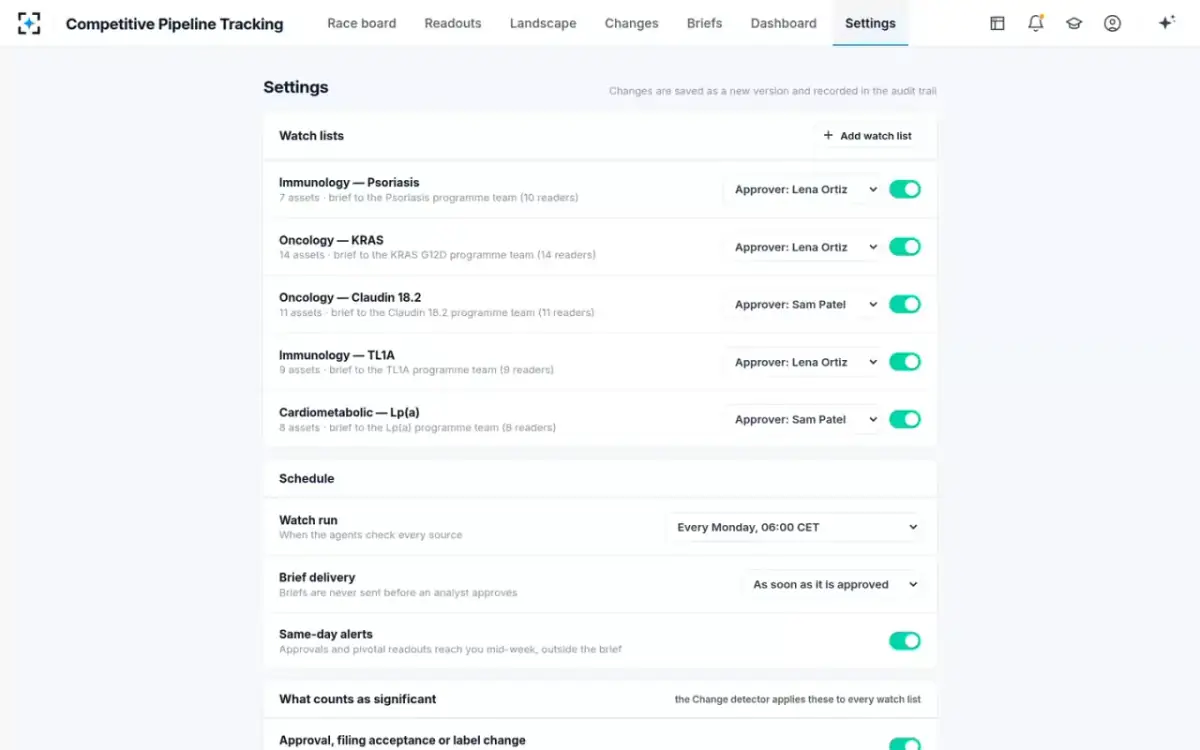
Writing the boundary into the tool rather than the training deck has one more effect that matters at audit. When a compliance reviewer asks how a particular claim in a report from eleven months ago was obtained, the answer is not a recollection. It is the version of the page the watcher read, kept as it stood that day.
The conversation with the competitor's former employee
This is the hardest case in practice, because it is both the most valuable source and the most dangerous, and because it usually arrives as an ordinary onboarding conversation rather than as an intelligence operation. SCIP's guidance is unusually concrete:
employees owe a duty of confidentiality to their former employers. Therefore, before you interview employee(s) who previously worked for a competitor, you should inform them that you do not want them to tell you confidential information about the prior employer. If an employee reveals information that appears to be confidential, do not use it and report the matter to your management or legal counsel.
SCIP, Ethics FAQs — the limitations on information from newly hired employees who used to work at a competitor
Three obligations hide in that paragraph. Warn before, not after. Do not use what comes out anyway — which means a note must be destroyed, not quietly kept. And report it, which protects the company far more than it exposes the employee, because a documented refusal is the best answer to a later claim that the hire was made for the dataset.
The same caution applies to the mirror case, the rival's former employee hired through an agency as an "expert" for an hour's call. The expert network's own terms are not your compliance policy, and the code's ambassador principle puts the contractor's conduct back on you.
Writing a policy your legal team will sign
A policy that works is short, concrete about sources, and clear about who decides. The flow below is one shape that works: a question arrives, the policy routes it to a source family, and anything that cannot be answered from a published source either goes unanswered or goes to a named person to decide.
A question arrives at the intelligence desk: who answers it, and from which source
Agent
Route the questionClassify the question by the source family that can answer it: registry, sponsor publication, congress, agency. A question no family can answer is marked unanswerable from public sources.
Never: Never widen the source list to answer a hard question.
Agent
Read and keep the pageRead the source and keep the version read, with the sentence the answer rests on, so the origin of the answer survives the week.
Never: Never paraphrase a number without keeping the sentence it came from.
Agent
Draft with the passage attachedWrite the finding and attach the passage to the claim, marking an inference as an inference rather than as a fact.
Never: Never state a forecast as a fact.
A person decides
Analyst confirmsA named analyst confirms the significant findings and sends back anything whose source does not support the claim made from it.
A person decides
Legal decides the edge casesUnsolicited confidential material, a former employee's disclosure and any request to contact a rival go to legal, and the decision is kept.
Behind a policy sit the cases people actually argue about. The grid below is six of them, each with the verdict under the code and the verdict under the statute, so a reviewer can see that the two rarely disagree.
Six situations an intelligence team meets, under the code and under the statute
Reading a rival’s trial registration and comparing it with last month’s version of the same page.
Under the codePermitted
Under the statuteLawful acquisition
WhyPublished by the sponsor to a public registry. Nothing is secret, so nothing can be misappropriated.
Standing in the poster hall at a congress, photographing a rival’s late-breaking abstract board.
Under the codePermitted, unless the congress forbids photography
Under the statuteLawful acquisition
WhyThe constraint is the organiser’s rule, not the statute. SCIP says the same of mystery shopping: fine “provided that it does not violate any retailer-specific regulations (such as no photography)”.
Calling a rival’s clinical operations manager and introducing yourself as a graduate student.
Under the codeBreaks the Transparent principle
Under the statuteMisrepresentation — an improper means
WhySCIP: “Depending on the jurisdiction, this type of misrepresentation may be illegal.” The code asks for identity and organisation before every interview.
Posting a vacancy you do not intend to fill, so rival employees apply and describe their programmes.
Under the codeUnethical
Under the statuteArguably misrepresentation
WhySCIP calls this and its mirror image — applying for a job you will not take — activities that “would be considered unethical by most CI practitioners” and that “should be avoided”.
Buying a password to a rival’s customer portal to read its pricing.
Under the codeViolates the code
Under the statuteUnauthorised access; theft
WhySCIP is flat about it: obtaining a password without authorisation, “for any reason, is illegal and therefore violates SCIP’s Code of Ethics”.
A new hire from a rival offers you the unblinded interim results of the trial she ran there.
Under the codeStop the conversation; tell legal
Under the statuteInducement of a breach of a duty to maintain secrecy
WhyThe statute names inducement of a breach among improper means. SCIP says do not use it and report it. In a listed company it may also be inside information.
One thing the grid cannot capture is the test SCIP offers for everything it does not list: "how would the company feel if this behavior was attributed to them in a newspaper?" It is not a legal test and it is better than most legal tests at catching the cases that are technically defensible and still wrong.
The last element of a defensible policy is a record that someone approved what went out. A finding that nobody signed is a finding nobody owns, and the first question in any review of an intelligence function is who decided that this was fit to circulate.
Who approved what went out, and when
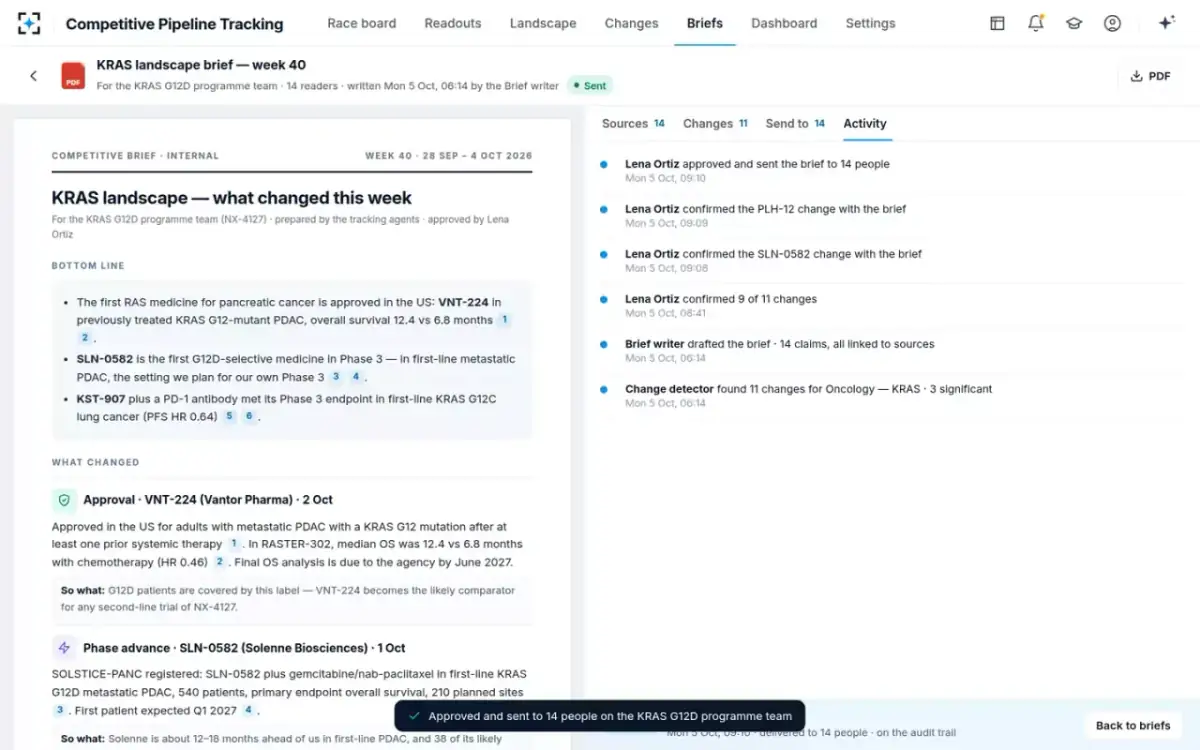
If you are specifying a tool rather than a policy, the sourcing questions are the ones that separate the two, and the twelve questions to ask before you buy puts them in order. If you are weighing a paid aggregator against reading the public sources yourself, what a pipeline database can and cannot give you covers the same ground from the other side. To see the public-sources rule running on a real watch list, start from Competitive Pipeline Tracking.
Questions people ask
Is competitive intelligence legal?
Yes, where the information is acquired lawfully. The federal trade-secret statute expressly excludes "reverse engineering, independent derivation, or any other lawful means of acquisition" from improper means, so reading and analysing what a competitor has published is not misappropriation. What is unlawful is taking a secret by theft, bribery, misrepresentation, inducing a breach of confidence or electronic espionage.
What is unethical competitive intelligence?
Under the code, anything that breaks the transparency principle or the compliance principle: concealing who you are before an interview, posing as a customer or a student, advertising a job you will not fill in order to interview rivals' staff, or obtaining access to a system you are not entitled to use. SCIP treats all four as outside the code, and notes that misrepresentation "may be illegal" depending on the jurisdiction.
Can you call a competitor to ask for information?
You can call, but you must say who you are and who you work for before the conversation starts — that is the Transparent principle, in terms. Many teams go further and do not make the call at all, because a disclosed call tells a rival exactly what you are interested in. A public-sources-only method, like the one in Competitive Pipeline Tracking, removes the question by barring outreach entirely.
How is competitive intelligence different from corporate espionage?
By the means, not the motive. SCIP puts it as the difference between "legally and ethically gathering and analyzing information about competitors" and activities that are illegal, "such as bribing or hiring employees to divulge confidential information". The statute draws the same line with its two lists: lawful acquisition on one side, theft, bribery, misrepresentation, inducement and espionage on the other.
Can pharmaceutical companies track their competitors' clinical trials?
Yes, and the public record is designed to be tracked. Sponsors are required to register applicable trials and to keep key fields current, which is why a rival's phase, recruitment status, sites and completion dates can be followed week by week without contacting anyone. The constraint is at the other end: an unpublished result is confidential to its sponsor and, for a listed company, price-sensitive as well.
What should a competitive intelligence policy contain?
Four things, at minimum: the list of source families the team may read; an explicit prohibition on outreach, pretexting and unpublished documents; a named person who decides the edge cases, including anything a former employee discloses; and a requirement that every circulated claim carries the passage it came from. The fourth is the one that makes the other three auditable a year later.