The PDUFA date is the day by which the United States drug regulator aims to complete its review of an application and act on it, and the meaning of that sentence turns on the word "aims". It is a performance goal the agency committed to under the Prescription Drug User Fee Act, not a statutory deadline; it is measured from the 60-day filing date rather than from the day the application arrived; and nothing in law happens if it passes without a decision. For a competitive intelligence team the practical consequences are sharper still: the agency does not publish a calendar of these dates, which is why a rival decision calendar has to be assembled from four different kinds of date, each with its own source and its own way of moving. Botminds' Competitive Pipeline Tracking keeps that calendar, with the passage behind every date one click away.
Where this guide shows the solution, the companies, people, assets and dates in it are fictional sample data — Vantor Pharma, VNT-224, TYK-410 and the rest are invented for the demonstration. The regulators' own documents are quoted and linked where they appear.
The three goals that set almost every United States action date
10mo
to act on 90% of standard new molecular entity applications, from the 60-day filing date
6mo
the same goal for priority applications
+3mo
the extension a major amendment may add, once per review cycle
What does PDUFA date mean?
It means the agency's own target for finishing a particular review. The commitment letter states the target as a portfolio goal rather than a promise about any one application: "Review and act on 90 percent of standard NME NDA and original BLA submissions within 10 months of the 60-day filing date" (PDUFA VII goals letter). Priority applications get six months on the same clock. In agency documents the resulting day is usually called the action goal date, and PDUFA date is the market's name for it.
Two things follow from that single sentence, and both matter to anyone building a calendar. First, the date is derived, not announced: take the submission, add sixty days, then add ten months or six. Second, "act on" is not "approve". The agency meets the goal by issuing any action — an approval or a complete response letter — so a met date tells you a decision was made, not which decision.
Where the date comes from: filing acceptance and the 60-day clock
A new drug application or biologics licence application does not start a review clock the day it arrives. The agency first decides whether it is complete enough to review, a step the industry calls filing acceptance, and the review clock is anchored to the 60-day point. All the performance goals for new molecular entities are then expressed as a period "of the 60-day filing date", which is why two applications submitted in the same week can have action dates a fortnight apart.
The procedural landmark closest to filing acceptance is the day 74 letter, and the commitment letter is specific about it: "the timeline for this communication will be within 74 calendar days from the date of FDA receipt of the original submission. The planned review timeline included in the Day 74 letter for applications in the Program will include the planned date for the internal mid-cycle review meeting." That one sentence pins the clock's origin to the receipt date, confirms that an internal timeline exists, and shows that it goes to the applicant rather than to the public.
Two more communications punctuate the cycle and occasionally leak into public view through a sponsor's own commentary: the mid-cycle communication, a call the agency makes "generally within 2 weeks following the Agency's internal mid-cycle review meeting", and the late-cycle meeting held "late in the review cycle" to discuss the state of the review. A rival that mentions either on an investor call has told you where in the cycle it is.
The United States review clock, and the European one drawn to the same scale
- Receipt to the 60-day filing date60 days
- Day 74 letter: the planned review timeline goes to the applicant
- Review, mid-cycle and late-cycle meetings, to the action goal date10 months
- First evaluation, to day 120 and the list of questionsday 120
- First clock-stop: the applicant answers≈ 3 months
- Further assessment, to day 180 and the outstanding issuesday 180
- Second clock-stop≈ 1 month
- Consultations and the committee opinion, by day 210day 210
PDUFA date vs approval date: why they are not the same
The goal date is a target for an action; the approval date is the day a particular action turns out to be an approval. They coincide often enough that the two get used interchangeably, and they come apart in three ways that a calendar has to allow for.
An action can be early. Nothing stops the agency acting before its goal, and priority applications in particular are sometimes approved weeks ahead. A rival's approval landing early is one of the most disruptive events a competitive calendar can mis-time, because it changes the comparator for a trial that is still being designed.
An action can be a refusal. A complete response letter meets the goal and starts a new cycle, with its own class 1 or class 2 resubmission clock — two months or six months from receipt under the same commitment letter. On a race board the asset does not advance; it returns to the filed position with a new date.
And an action can slip. The goals are 90% targets, so up to a tenth of applications can be acted on later without the goal being missed. A date that passes in silence is information, not an error in your calendar.
Can a PDUFA date be extended? The three-month rule
Yes, and the mechanism is written down. The commitment letter provides that "A major amendment to an original application, efficacy supplement, or resubmission of any of these applications, submitted at any time during the review cycle, may extend the goal date by three months." The same section lists what counts — a major new clinical safety or efficacy study report, a major re-analysis of previously submitted studies, or the submission or significant amendment of a risk management strategy with elements to assure safe use. A major amendment to a manufacturing supplement extends by two months, and "Only one extension can be given per review cycle."
Review and act on 90 percent of standard NME NDA and original BLA submissions within 10 months of the 60-day filing date.
FDA, PDUFA Reauthorization Performance Goals and Procedures, fiscal years 2023 through 2027
Read that as a competitive analyst rather than as a regulatory affairs manager. The extension is usually triggered by the sponsor's own submission, which means a three-month slip is often the visible shadow of new data the agency asked for. The date moving is the signal; the amendment behind it is the story, and it is rarely disclosed in the same breath.
Why the agency does not publish the date, and who does
There is no official calendar of action goal dates to subscribe to. The date travels to the applicant through the review correspondence — the agency's procedures for new applications describe target dates for communicating on labelling and anticipated postmarketing requirements as "included in the filing communication letter" (CDER MAPP 6010.8 Rev. 2, effective 19 September 2024) — and reaches everyone else only if the sponsor chooses to say it.
Listed sponsors often choose to say it, because an accepted filing and a dated decision are material to their own investors. So the practical sources for a rival's United States decision date, in order of reliability, are the sponsor's acceptance announcement, which often names the date; the sponsor's quarterly commentary, which repeats or revises it; and arithmetic, where an acceptance was announced without a date and the standard or priority goal can be applied to the stated submission.
The same procedures document gives a detail worth knowing for the weeks immediately before a decision: the metrics for notifying applicants of anticipated postmarketing requirements run "6 weeks (for priority applications) or 8 weeks (for standard applications) prior to the PDUFA action goal date". A sponsor that starts talking about postmarketing commitments is, on that schedule, inside the last two months.
How long does the EMA take to approve a medicine?
About a year in practice, on a 210-day procedural clock. The European agency puts it plainly: "Overall, the assessment of a new medicine usually lasts around a year", and separately that "The assessment time may be reduced to 150 days instead of 210 days, if the medicine developer is granted accelerated assessment" (EMA, From evaluation to approval).
The gap between 210 days and a year is the clock-stops, and this is where a calendar built on the European procedure goes wrong if it counts calendar days. "This first evaluation lasts up to 120 days. The evaluation is then paused (first clock-stop) while the applicant prepares the responses to the CHMP's questions and updates the medicine's risk management plan. The developer generally has up to three months to answer the list of questions." A second, shorter stop follows the day 180 list of outstanding issues, for which the developer generally has up to a month. Only active days count against the 210.
The United States clock against the European clock, step by step
United States — new molecular entity, centralised review: Receipt of the application, with the goal measured from the 60-day filing date.
European Union — centralised procedure: Validation of the application; the procedure then counts active days from day 1.
United States — new molecular entity, centralised review: 10 months from the filing date for standard applications, 6 months for priority ones — "90 percent" goals, not deadlines.
European Union — centralised procedure: 210 active days to the committee's opinion, reduced to 150 under accelerated assessment.
United States — new molecular entity, centralised review: None built in. A major amendment may extend the goal date by three months, once per cycle.
European Union — centralised procedure: Two clock-stops by design: up to three months for the applicant to answer the day 120 questions, generally up to one month after day 180.
United States — new molecular entity, centralised review: Roughly twelve months from submission for a standard application, eight for a priority one, if nothing is amended.
European Union — centralised procedure: The agency's own estimate: "the assessment of a new medicine usually lasts around a year."
United States — new molecular entity, centralised review: The applicant, through the review correspondence. There is no published calendar.
European Union — centralised procedure: The procedural milestones are public and dated by day number, so the shape of the timetable is knowable even when the start is not.
United States — new molecular entity, centralised review: An action: approval, or a complete response letter that starts a new cycle.
European Union — centralised procedure: A committee opinion, followed by a European Commission decision that makes the authorisation valid across the Union.
Japan, and the third date on the board
For a watch list with any Asian exposure the Japanese decision belongs on the calendar too, and it behaves differently again. The agency there describes its approach as setting internal targets rather than publishing a per-application date: "PMDA strives to speed up the review process by setting target review times, while clarifying the standards for review by publishing the basic considerations for reviewers on its website" (PMDA, Reviews).
The one structural fact that is public and useful is the priority category: "Priority review products refer to orphan drugs (expected to be used by less than 50,000 patients) and products designated for priority review by the Ministry of Health, Labour and Welfare in consideration of their clinical usefulness and the seriousness of the diseases for which they are indicated." A rival's Japanese orphan designation therefore tells you something about its review speed before any date exists.
Four kinds of date, one countdown
A rival decision calendar that treats every entry as equally firm will mislead the people who read it. The four kinds below come from different places, move for different reasons and deserve different confidence, and a calendar is more useful when it says which is which.
The four kinds of date on a rival readout calendar
| The date | Where it comes from | How firm it is | How it moves |
|---|---|---|---|
| Registry completion date | The sponsor's own trial registration: an estimated primary completion date, which becomes an actual one after the event. | Soft while estimated. Sponsors revise it, sometimes repeatedly. | Quietly, as a new version of the registration. The change is visible only by comparing versions. |
| Guidance from the sponsor | An earnings call, a results release or an investor presentation: "topline in the first half of next year". | As firm as the quarter it names, and no firmer. | At the next quarterly call, in either direction. A move earlier is as informative as a move later. |
| Congress programme | A congress's own abstract titles and late-breaker schedule, published weeks ahead. | Firm as to the day, once the session is listed. | Rarely. An embargoed late-breaker is the most precisely dated readout there is. |
| Regulatory action date | The sponsor's announcement of an accepted filing, or arithmetic on the standard or priority goal. | A 90% target, not a deadline. Reliable to within weeks. | By three months on a major amendment, or by silence if the review runs long. |
The difference between the first two rows is where most calendars go wrong. A registry completion date is about the trial finishing; sponsor guidance is about data being announced; and the gap between them is measured in months, not days. Which registry date to count down from is a question in itself, and the difference between the primary completion date and the study completion date sets out why the wrong one can put a rival's readout a year late.
Every expected readout and decision, dated and sourced
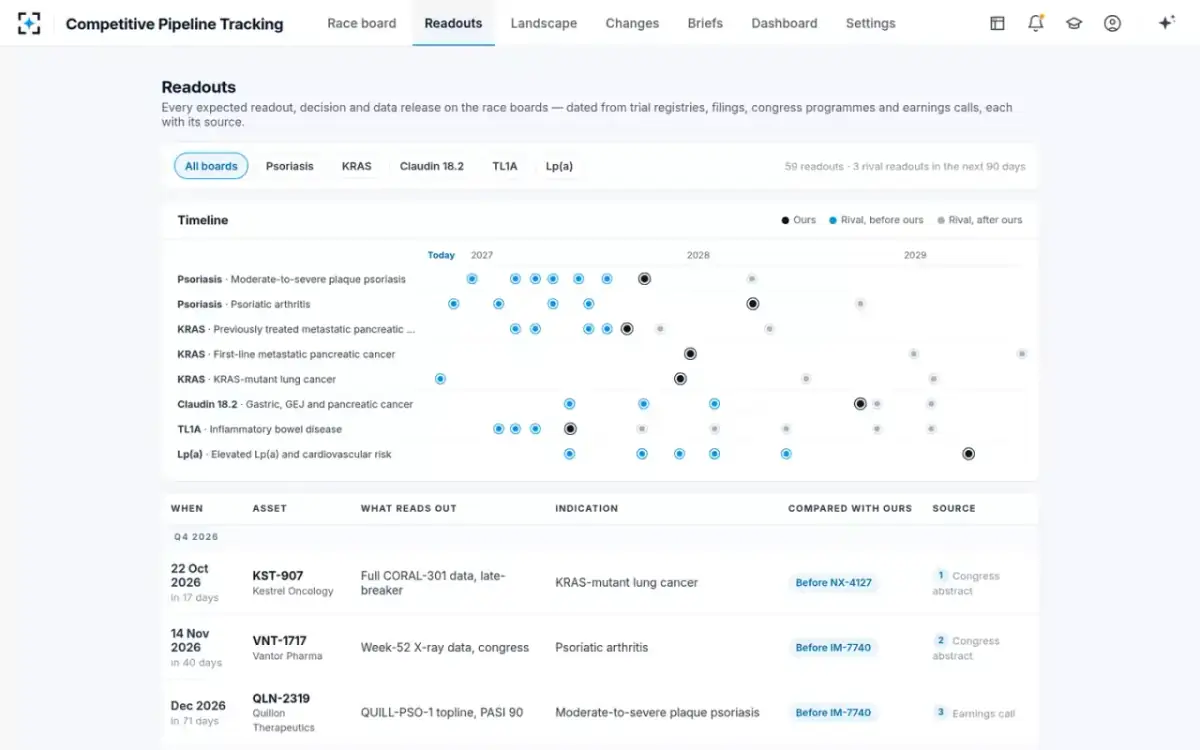
What moves a decision date, and how you find out
Dates move often, and many moves are published somewhere within weeks. The list below is the one worth watching, with the place each move shows up.
Seven things that move a rival's decision date, and where each becomes visible
- A major amendment during the review
Adds three months to the United States goal date, two for a manufacturing supplement, once per cycle. Visible when the sponsor restates the date, usually at its next quarterly commentary.
- A complete response letter
Ends the cycle without an approval and starts a resubmission clock of two or six months from receipt. Listed sponsors often announce it.
- An advisory committee meeting
Scheduled and published by the agency, with a date of its own. The day 74 letter tells the applicant whether one is preliminarily planned — but that letter is not public, so the meeting notice is usually the first public sign.
- A clock-stop running long in Europe
The applicant has up to three months to answer the day 120 questions. A procedure that goes quiet for longer than that has not failed; it is paused.
- An accelerated assessment in Europe
Cuts the assessment from 210 days to 150. Granted for medicines of major interest to public health, and normally announced by the sponsor.
- A primary completion date revised in the registry
Moves the readout that feeds the filing. The record must be updated within 30 days of the trial reaching its actual primary completion date, and the change shows only against the previous version.
- Guidance revised on an earnings call
A common move, and one of the least systematically captured. One sentence in a transcript can pull a rival's readout forward by a quarter.
Dating your own readouts against theirs
A decision calendar is only useful when your own dates are on it. The question a programme lead actually asks is not "when is their decision" but "who is in front of us, and by how long", and that comparison is the whole point of maintaining the calendar at all.
In the sample solution, each rival marker on a race board carries its next expected readout or decision, counted down, and tagged against the programme's own planned date. On the psoriasis board that produces a lane header reading five ahead of our asset, six of seven reading out before us; on the oncology board, a United States approval on 2 October and a rival decision dated 12 June 2027 both sit in front of a Phase 2 topline a year later.
Who is in front, with every date counted down against ours
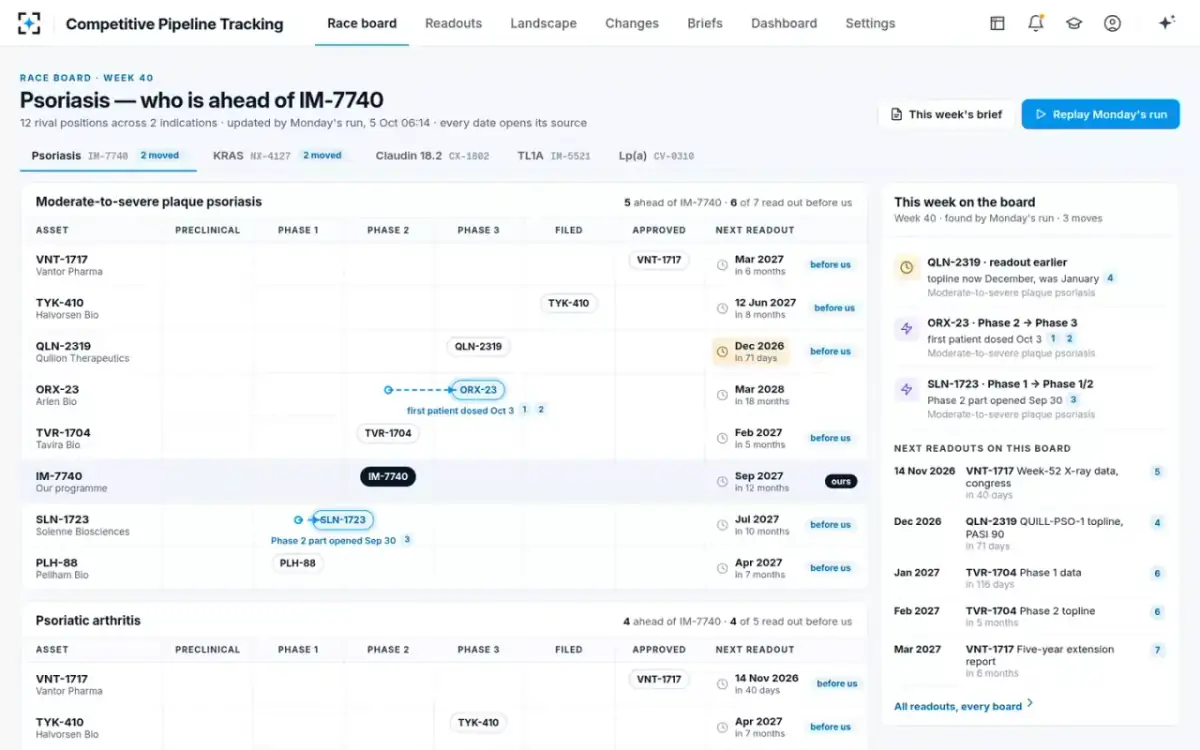
Two cautions about dating your own side of the board. Your planned readout is an internal commitment and should be labelled as one, because a programme plan slips as often as a rival's does. And a comparison is only as good as the date type on each side: counting your own topline announcement against a rival's registry completion date flatters you by several months. Compare like with like, or mark the mismatch.
If you are specifying a tool to keep this calendar, the questions that separate a real one from a dashboard are in the twelve questions to ask before you buy, and what a pipeline database can and cannot give you covers the make-or-buy question behind it. To see the calendar running on a watch list of your own, start from Competitive Pipeline Tracking.
Questions people ask
What does PDUFA stand for?
The Prescription Drug User Fee Act, under which the United States drug regulator collects fees from applicants and, in return, commits to performance goals for how quickly it reviews their applications. The current commitment letter covers fiscal years 2023 to 2027. A "PDUFA date" is the market's shorthand for the action goal date that those commitments produce for a particular application.
Is the PDUFA date a legal deadline?
No. The goals are expressed as portfolio targets — acting on 90% of standard new molecular entity applications within ten months of the 60-day filing date, and 90% of priority ones within six — so the goals themselves allow some applications to be acted on later. Missing the date on one application carries no statutory consequence for that application.
What happens if the agency misses a PDUFA date?
In practice, the review continues and the sponsor usually says so. There is no automatic approval, no penalty and no new date required by the goals themselves. For a competitive calendar the right response is to mark the date as passed rather than to delete it, because the eventual action may follow soon after.
Where can I find PDUFA dates?
From the sponsors, because the agency publishes no calendar of them. An acceptance announcement often names the date; quarterly commentary repeats or revises it; and where only the submission is public, the standard or priority goal applied to the 60-day filing date gives a usable estimate. Record which of the three a date came from, because their reliability differs.
What is a filing acceptance?
The regulator's decision that an application is complete enough to be reviewed on its merits. It matters to a calendar because the performance goals for new molecular entities are measured from the 60-day filing date rather than from receipt, so the clock everyone counts starts two months after the paperwork arrives.
How does the European timetable compare?
The European centralised procedure runs on 210 active days to a committee opinion, or 150 under accelerated assessment, but it pauses twice while the applicant answers questions — up to three months after day 120 and generally up to a month after day 180. The agency's own summary is that assessment of a new medicine "usually lasts around a year", which is roughly where the United States standard review lands too, by a different route.