Competitive intelligence in pharma is the weekly job of reading what rival developers have already made public — trial registry records, press releases and pipeline pages, earnings-call transcripts, congress abstracts and agency approval databases — and telling each of your own programme teams what changed and what it means for their asset. It is not a subscription you buy, and it is not a quarterly deck. It is hard because the facts arrive in five unrelated places on five different clocks, because most of them arrive as a quiet edit to a record nobody announced, and because a claim that has lost the sentence it came from cannot be defended in the meeting where it matters. Botminds' Competitive Pipeline Tracking does the reading half: six agents read those public sources every week, put each rival move on a race board for its indication, and draft a one-page brief in which every claim opens the passage behind it — which a named analyst approves before anyone receives it.
The week on this page is a fictional sample week in the solution: Monday 5 October 2026, five watch lists, 49 watched assets. Every person, company, asset code and trial number named here — Lena Ortiz, Arlen Bio, ORX-23, NCT07166402 — is sample data, not a customer. The research figures come from federal agencies, the Department of Labor's occupation data and peer-reviewed studies, linked where they appear.
One landscape refresh, by hand
4days
of analyst time to refresh a landscape across five watch lists
9days
median from a rival making a move to the programme team hearing about it
6of 7
rivals in plaque psoriasis with a readout or decision before our own
What does competitive intelligence in pharma actually mean?
It means keeping an accurate, sourced answer to four questions about every rival asset that touches one of your programmes: what phase it is in, when it reads out, what it showed last, and what a regulator has done about it. Everything else — the landscape chart, the race board, the weekly note — is a way of presenting those four answers to someone who has to make a decision with them.
Two things make it a profession rather than a search. The first is that the answer changes under you: a registry record edited on a Tuesday carries no announcement, and the version that contained the old date is not the version you will read next week. The second is that the answer has to carry its evidence. A programme lead who is asked to redesign a Phase 3 comparator arm will want to see the sentence that says the comparator changed, and so will the governance meeting after that.
The occupation itself is oddly hard to look up, which is why salary searches return such wide numbers. There is no federal occupation code for a pharma competitive intelligence analyst. The closest is the Department of Labor's Market Research Analysts and Marketing Specialists, 13-1161.00, whose description is to Research conditions in local, regional, national, or online markets
and which May gather information on competitors, prices, sales, and methods of marketing and distribution.
That occupation reported median wages of $37.87 an hour, or $78,760 a year, in 2025, with 952,700 people employed and growth projected to 2035 as Much faster than average (7% or higher)
. Read it as the wide family our work sits inside, not as the pharma job: an analyst tracking oncology assets is doing something much narrower, and much more technical, than that description covers.
The five public sources a landscape is built from
Almost everything a defensible landscape contains comes from five families of public source, and each one behaves differently. Trial registries are the only family with a legal clock on it, so they are the earliest honest signal of a phase change or a date slip. Sponsor press releases and pipeline pages are the fastest but the least complete, and they are published when it suits the sponsor. Earnings-call transcripts carry development guidance that appears nowhere else — when a company expects to read out. Congress abstracts carry the numbers, often a few weeks before anyone presents them. Agency databases carry the facts in the whole set that are closest to final.
The ethical boundary around all five is that they are public, and the professional bodies say to start there and stay there. Asked whether a team may profile a rival's executives, the Strategic Consortium of Intelligence Professionals answers that it is permissible and even advisable
, but that the work should begin with the wealth of information that is available in the public domain (e.g., interviews, speeches, articles, etc.)
(SCIP, Ethics FAQs). Where that line runs, and what the Defend Trade Secrets Act does with the other side of it, is the subject of the competitive intelligence code of ethics and the legal line.
Source to claim to brief in Competitive Pipeline Tracking, with the two steps a person owns
Agent
Four watchers readRegistries, newsrooms and pipeline pages, earnings-call transcripts, congress abstracts and agency databases, once a week per watch list.
Never: No non-public source and no outreach
Agent
Change detector mergesOne change per real-world event even when three sources carry it, scored against the watch list’s own significance rules, with the two-sentence reason it matters to our asset.
Never: Below 85% confidence it goes to review
A person decides
Analyst confirmsReads the old and new text side by side and confirms what counts as significant for this programme.
Never: Significance is never settled by the agent alone
Agent
Brief writer draftsOne page per programme team: bottom line, what changed, what it means with an owner for each action, also this week, watch next — every claim linked to its passage.
Never: No forecast stated as fact
A person decides
Analyst approves and sendsApproves the page as written, which also confirms the changes it carries, and sends it to the named readers.
Never: Nothing reaches a programme team unapproved
Monday: the registry sweep, record by record
The registry sweep is a comparison, not a search. For each watched asset the current record is read and set against the last version you captured — overall status, phase, study start, enrolment, primary completion date, arms, sites — and every field that moved is written down with the text before and the text after. Done by hand on a few hundred records, it is the single largest block of the week.
It has to be a comparison because registries publish edits without publishing notice of them. Reviewing registry entries against protocols and publications, Holst and colleagues put the problem plainly: Clinical trial registries allow assessment of deviations of published trials from their protocol, which may indicate a considerable risk of bias. However, since entries in many registries can be updated at any time, deviations may go unnoticed
(PLoS Medicine, 2023). An analyst who reads only the current record sees a tidy trial. An analyst who keeps last week's copy sees what the sponsor changed.
In the sample week the sweep reads 612 trial records across 49 assets and finds 18 changed. One of them matters more than the rest. On NCT07166402, the trial ORBIT-PSO-1 moved from Not yet recruiting to Recruiting with a study start date of 3 October 2026 marked actual, and Arlen Bio's pipeline page now lists ORX-23 in Phase 3 — the same mechanism as our own IM-7740, which is in Phase 2b. The marker slides a lane on the race board, and its countdown shows primary completion in March 2028. Which fields carry a deadline, and which drift for up to a year, is set out in the ClinicalTrials.gov update requirements.
The race board: who is ahead, and what moved this week
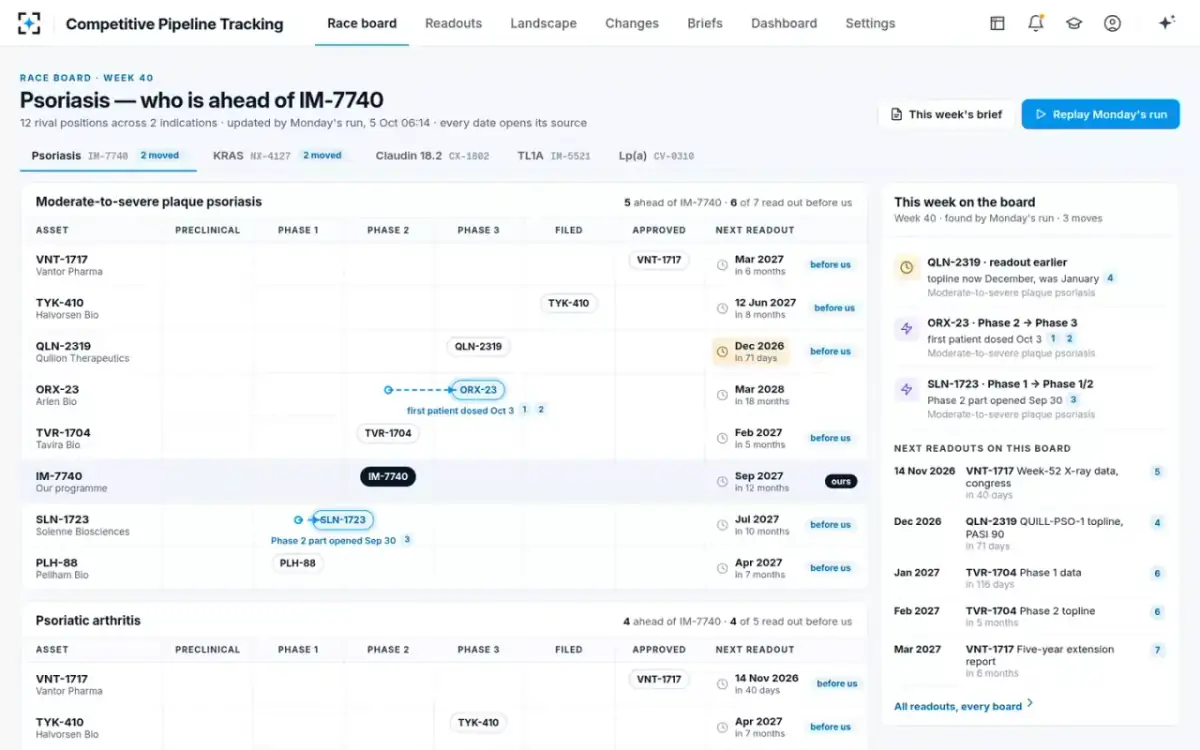
Lane header: 5 ahead of IM-7740 · 6 of 7 read out before us
Mid-week: releases, pipeline pages and the results call
The middle of the week is spent reading what sponsors chose to say. A company's own release can be the first public account of a trial by a long way: of 988 randomised drug trials published in three leading general medical journals between 2015 and 2019, Purohit and colleagues found 172 — 17% — had a press release at least 90 days before the paper, and those releases came a median of 246 days ahead of peer-reviewed publication (Journal of General Internal Medicine, 2023). Eight months is a long time to act on a headline, which is why the discipline of reading a rival's top-line release is worth its own page.
Pipeline pages are the awkward source. They carry phase, indication and sometimes expected timing, they are revised silently, and they have no clock on them at all. The only way to know a pipeline page changed is to have kept the previous version, which is why each page is captured version by version rather than read live.
Earnings calls are where readout timing moves. In the sample week, on Quillon Therapeutics' third-quarter call on 1 October, management said that QUILL-PSO-1 topline is now expected in December, ahead of prior guidance of January 2027, giving early completion of enrolment as the reason. That single sentence moves a rival readout a month closer to our own, and it exists nowhere in any registry. Captured with the sentence attached, it is a claim an analyst can put in front of a programme lead; remembered without it, it is a rumour.
Congress abstracts, and the late-breaker nobody saw coming
Congress abstracts are the only source in the set that reliably carries numbers — design, population, primary and secondary endpoints, hazard ratios and confidence intervals, grade 3 or higher adverse events. They are also the source with the shortest notice, because late-breakers are added to the programme days or weeks before the session. In the sample week the abstract reader matches one, LBA-71, against a watched asset.
Two rules make abstract reading safe. Numbers are copied, never recomputed: an analyst who derives a median from a curve has produced a figure the sponsor never published and cannot defend. And every table marks whether the data are interim or final, because an interim look at a trial that continues is not evidence about the final result, and the two are easy to confuse once they are in the same row.
Approvals and filings in three jurisdictions
Agency databases are the smallest part of the week and the most consequential, because an approval is the move on a landscape least likely to be reversed by the next quarter's data. The work is checking approvals, filing acceptances and label changes in the United States, the European Union and Japan, and copying the approved indication word for word — the indication wording, not the drug name, is what decides whether a rival sits in your population.
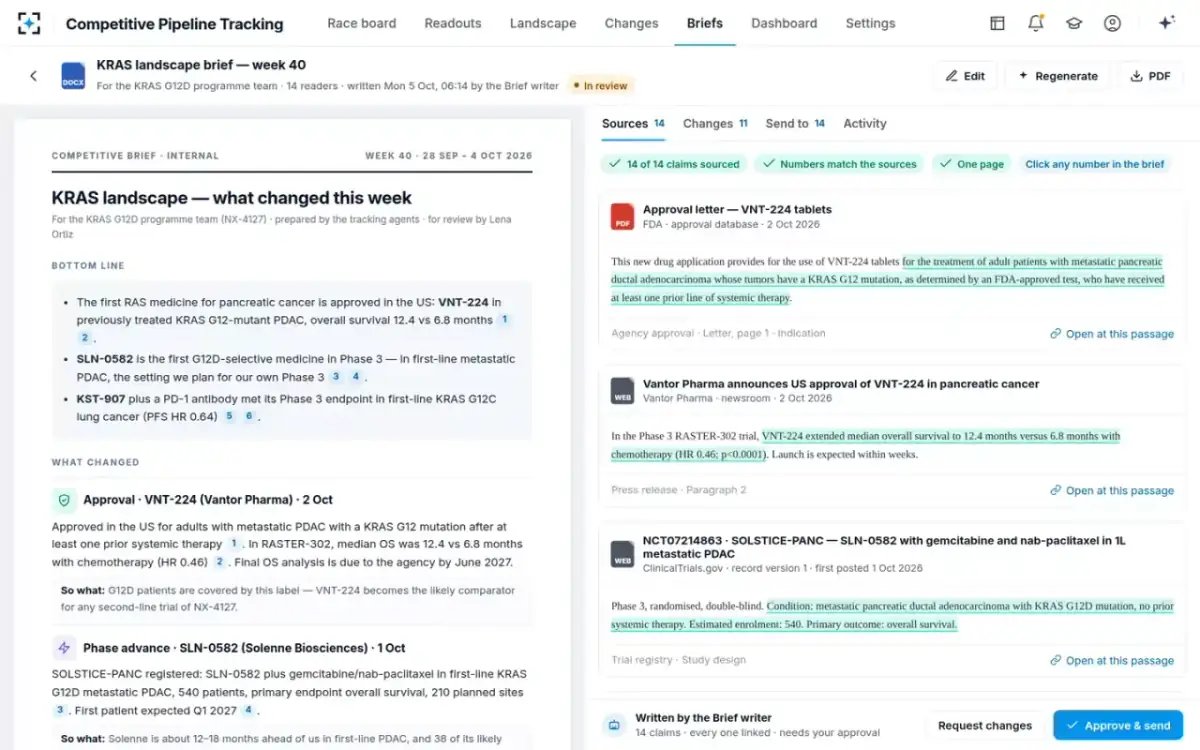
In the sample week, VNT-224 moved from Filed to Approved, approved in the United States on 2 October, in previously treated metastatic pancreatic cancer with a KRAS G12 mutation. On the KRAS board that is not a lane change but a comparator change: a second-line trial designed next year would likely be compared with VNT-224 rather than chemotherapy. When a decision is expected rather than announced, the date comes from a published action calendar, and what a PDUFA date means covers how firm each kind of date is.
Why a landscape is out of date before the deck is finished
Drug development is slow and competitive intelligence is not. The federal review of clinical trial costs and barriers notes that the average length of time from the start of clinical testing to marketing is 90.3 months (7.5 years)
, and that competition is not only for patients: There is more widespread agreement that there is a shortage of investigators who can enroll high-quality patients. There is also competition for qualified sites, especially in popular therapeutic areas
(HHS, Office of the Assistant Secretary for Planning and Evaluation, 2014). A programme runs for seven years; the facts about the rivals around it move every week.
That mismatch is what makes a hand-built landscape stale on arrival. Four days of reading produces a deck that describes the Monday it started on, and the median gap between a rival making a move and the programme team hearing about it is nine days in the sample baseline. Nine days is long enough for a site-selection window to close, which is exactly what nearly happened on the sample week's KRAS board.
Where the hours of one landscape refresh go
By hand · 32 hours
- Registry record changes 10h · 31.25%
- Releases, pipeline pages, calls 7h · 21.875%
- Congress abstracts 5h · 15.625%
- Approvals 3h · 9.375%
- Deck 3h · 9.375%
- Briefs 4h · 12.5%
How much of the week goes to finding out, and how much to deciding?
On this split, seven eighths of it goes to finding out. Five of the six lines above — registry records, releases and calls, abstracts, approvals and updating the deck — are mechanical reading and transcription, and they account for 28 of the 32 hours. The remaining four hours are the only ones that produce judgement: writing each team's brief, sourcing every claim in it and sending it. An analyst hired for interpretation spends one day in eight interpreting.
That ratio is the argument for automating the reading rather than the thinking, and it is also the reason the usual remedies disappoint. Hiring a second analyst buys more reading. Buying a landscape subscription buys somebody else's reading, on their watch list rather than yours, without the sentence behind each claim. Narrowing the watch list buys back hours by deciding in advance which rival you are willing to miss.
The same week, by hand and with the watchers running first
- Registry sweep10 h
- Releases, pipeline pages, calls7 h
- Abstracts5 h
- Approvals3 h
- Deck3 h
- Briefs4 h
- Four watchers and the change detector run before anyone is in14 min
- Analyst confirms, approves and sends22 min
What changes when the reading is done before anyone is in
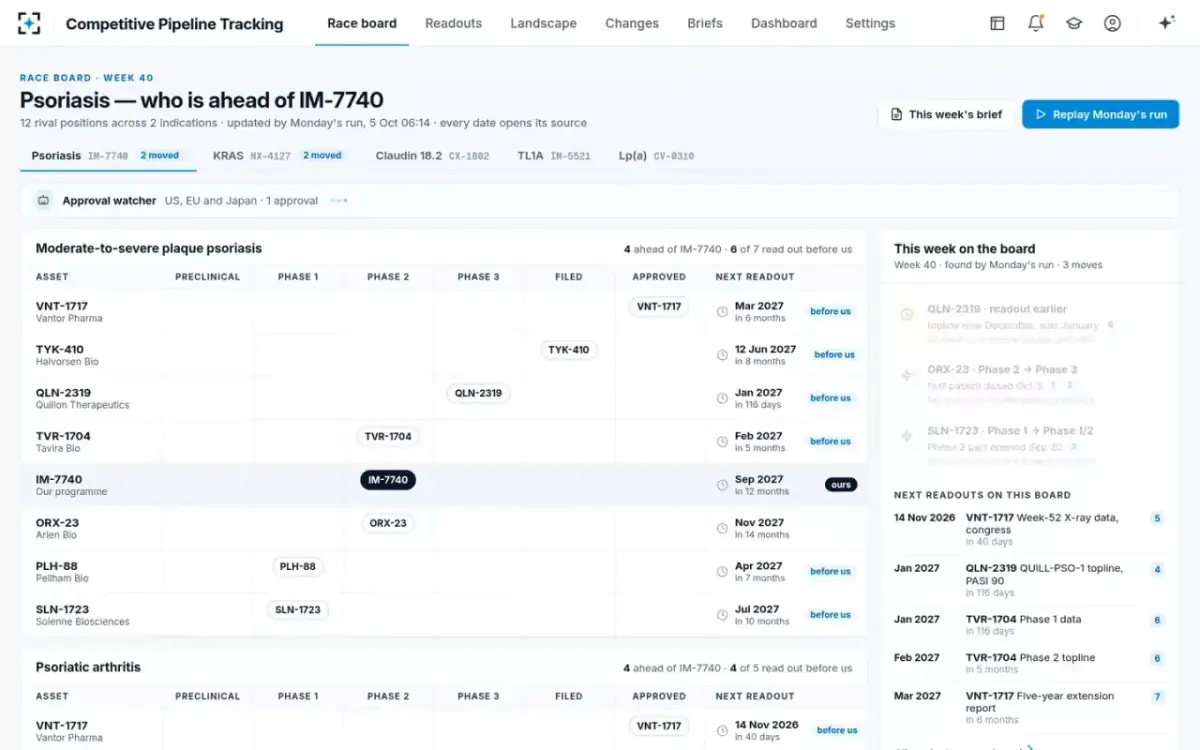
In the sample week the run starts at 06:00 on Monday across five watch lists and finishes at 06:14. It produces 28 changes, 6 of them significant, from 1,284 sources — and the figure that matters more is the other one: in the sample KRAS brief, 14 of 14 claims link to the passage they came from. The analyst arrives to a race board that is already current and spends the morning on the two decisions that cannot be delegated: which changes are significant for this programme, and whether the page is fit to send.
Monday's run, before anyone is in
The same Monday, around a sourced brief
Today
Spends the week finding out what happened across registries, newsrooms, abstracts and agency sites, and pastes it into a deck that is out of date by the time it is built.
With agents
Opens a race board already current, confirms the significant changes and approves each brief on Monday morning.
Still theirs: Decides what is significant, and what is sent
Today
Traces every claim in a hand-built deck back to its source by hand, because a claim without one does not belong in a brief.
With agents
Confirms each change with the old and new text side by side, on pages where every claim already opens its passage.
Still theirs: Confirms the change, and approves two of the five watch lists
Today
Asks who reads out before us, and gets an answer from a spreadsheet that has gone stale.
With agents
Sees every rival readout counted down against our own Phase 2b topline, each date with its source.
Still theirs: Decides what the programme does about it
Today
Learns at the quarterly review that the comparator has changed.
With agents
Reads one page each Monday: what changed, what it means for our asset, who owns each action.
Still theirs: Owns the trial design decision
Today
Asks which shortlisted sites a rival is about to open, and cannot find out before site selection closes.
With agents
Is told the week a rival trial registers that 38 of its likely sites are on our feasibility shortlist.
Still theirs: Chooses the sites
What does not change is who is accountable. The change detector proposes significance and anything it is less than 85% confident about goes to review; a named analyst confirms it. A brief reaches a programme team only after that analyst approves it, with the name and the time recorded and the sent version kept. The brief writer may not state a forecast as a fact. Those are the limits that let a sourced page be used in a governance meeting rather than argued about in one.
One page for one programme team, every claim beside its source
Competitive intelligence in pharma, done well, is unglamorous and almost entirely about discipline: read the public sources on their own clocks, keep the version you read, quote the sentence, and let a person decide what it means. To see a week of it on a race board, start from Competitive Pipeline Tracking.
Questions people ask
What does a competitive intelligence analyst do in pharma?
They keep a sourced, current answer to four questions about every rival asset that touches their company's programmes: its phase, its next readout, its last data and its regulatory status. In practice that means comparing trial registry records against the last version captured, reading sponsor releases, pipeline pages and earnings-call transcripts, pulling numbers out of congress abstracts, checking agency databases, and writing a short note per programme team. There is no federal occupation code for the role; the Department of Labor's nearest is Market Research Analysts and Marketing Specialists, which describes a much wider family of work.
How do pharma companies track competitors?
Almost entirely from five families of public source: trial registries, sponsor press releases and pipeline pages, earnings-call transcripts, congress abstracts and programmes, and agency approval databases. Registries are the only family with legal update deadlines, so they usually move first on a phase change or a date slip; agency databases carry the facts closest to final. Everything else — landscape charts, race boards, readout calendars — is a presentation of what those five sources said, and should name which one each claim came from.
How often should a competitive landscape be refreshed?
Weekly, for any indication where a rival could change a decision you are about to make. The reason is the clocks on the sources rather than a preference: a recruitment status change is due in the registry within 30 calendar days, and a trial's actual primary completion date within 30 days of the trial reaching it, so a monthly cycle can put a two-month-old fact in front of a programme team. Quarterly refreshes are defensible only for indications you are not actively planning in.
How big is a pharma competitive intelligence team?
There is no published figure, and anyone who quotes one should be asked where it came from. What determines the size is arithmetic you can do yourself: the number of watch lists, the number of assets on each, how many sources each asset needs read, and how often. On the sample split here, five watch lists and 49 assets consume about four working days of reading per refresh — one analyst-week per cycle before anybody writes anything.
Is competitive intelligence in pharma legal?
Gathering and analysing public information about competitors is lawful, and the profession's own guidance is to begin in the public domain and stay there. The lines that matter are misrepresentation — the SCIP code expects a practitioner to disclose their identity and organisation before an interview — and trade secrets, which US federal law protects against acquisition by improper means. A programme that reads only published sources, keeps the passage behind each claim and never contacts a rival's staff stays well inside both.
What is a competitive intelligence brief?
A short, dated note to one audience — usually one programme team — that says what changed about the rivals they care about and what it means for their asset. A good one fits on a page, states its bottom line first, gives each action an owner, separates what is known from what is expected, and links every claim to the passage it came from. The sample brief here carries 14 claims and 14 sources, and is sent only after a named analyst approves it.