The primary completion date is the date the last participant was examined or treated for the final collection of data on the trial's primary outcome. The study completion date is the date the trial as a whole finished, including the secondary outcomes, the adverse-event collection and the follow-up visits. They answer different questions, they can sit a year or more apart, and only the first one is the basis of a readout estimate — the one-year results deadline runs from the primary completion date, not the study completion date. Botminds' Competitive Pipeline Tracking counts down each rival asset from the date it can actually defend, records whether that date is estimated or actual, and keeps the version of the record it came from, so a countdown on a race board can be checked rather than believed.
The worked examples here are sample data: the fictional trials ORBIT-PSO-1 and QUILL-PSO-1, the fictional assets ORX-23 and QLN-2319, and the fictional companies Arlen Bio and Quillon Therapeutics. The rule and the research are real, and linked where they appear.
The three numbers behind every readout estimate
30days
to update the primary completion date once the trial reaches it, and flip it to actual
1year
from that actual date until results information is due
424days
median from primary completion to submission, measured across trials due to report
Primary completion date vs study completion date, in one paragraph
Use the primary completion date when you want to know when the answer exists, and the study completion date when you want to know when the trial is finished. A Phase 3 trial that collects its primary endpoint at week 16 and then follows participants for a year of safety has a primary completion date roughly a year before its study completion date. The sponsor can report the primary result, present it at a congress and file on it long before the trial is over. An analyst who counts a rival's readout from the study completion date is, in that example, a year late.
What the rule actually defines
The definitions are in 42 CFR § 11.10, and they are worth reading once in the original because they are narrower than the everyday phrases. Completion date, which the rule then names the primary completion date, means the date that the final subject was examined or received an intervention for the purposes of final collection of data for the primary outcome, whether the clinical trial concluded according to the pre-specified protocol or was terminated.
Where a trial has several primary outcome measures finishing at different times, it is the date on which data collection is completed for all of the primary outcomes.
The study completion date is defined by the same structure and a longer list: the date the final subject was examined or received an intervention for purposes of final collection of data for the primary and secondary outcome measures and adverse events ( e.g., last subject's last visit)
(42 CFR § 11.10). Two features of both definitions matter for intelligence work. A terminated trial still has a completion date — stopping early does not leave the field blank. And neither date is the date anyone publishes anything; they are dates about data collection, not about disclosure.
The two dates, row by row
Primary completion date: Final collection of data for the primary outcome, across all primary outcome measures.
Study completion date: Final collection of data for the primary and secondary outcomes and adverse events — typically the last participant’s last visit.
Primary completion date: Within 30 calendar days of the trial reaching it, at which point it is marked actual and the actual enrolment must be submitted.
Study completion date: Within 30 calendar days of the trial reaching it, when it is marked actual.
Primary completion date: A move in the estimate is a slip or a pull-forward in the readout itself. A flip to actual means the answer now exists inside the company.
Study completion date: Usually administrative: follow-up finished, or the trial closed out. Rarely news on its own.
Primary completion date: The one-year clock for results information under § 11.44.
Study completion date: Nothing with a public deadline attached to the headline result.
Primary completion date: The readout countdown, the comparison against your own planned readout, and the earliest date a rival could present or file.
Study completion date: Knowing when a trial is fully closed, and when late safety or follow-up data might appear.
Estimated or actual: the label that matters more than the date
Every one of these dates carries a flag, and the flag changes what the date is worth. The rule is explicit: Primary Completion Date means the estimated or actual primary completion date. If an estimated primary completion date is used, the responsible party must update the Primary Completion Date data element once the clinical trial has reached the primary completion date to reflect the actual primary completion date.
The same construction governs the study completion date.
So an estimated date is a plan, maintained by the sponsor, under no deadline except the general twelve-month refresh. An actual date is a statement of fact, due within 30 days of the event, and it arrives with the actual enrolment figure beside it. A countdown built on an estimate is a forecast of somebody else's forecast; a countdown that has become an actual date is a countdown to a disclosure, because the results clock has started. A claim that does not say which of the two it used cannot be checked, and the ClinicalTrials.gov update requirements explain why the two live under completely different clocks.
How far does a primary completion date move before it settles?
We could find no independent, published measure of how far estimated primary completion dates drift, and an analyst should be suspicious of anyone who quotes one without naming a study. What is documented is the mechanism that allows drift, and a related measure of how much quietly changes inside registry records.
The mechanism is the clock. Moving an estimate is not on the 30-day list; it falls under the general requirement to refresh registration information at least once every twelve months. A sponsor that re-plans a readout therefore has up to a year before the record has to agree, and no notice is published when it does.
The related measure is that registry records change more than readers assume, and not visibly. Examining trials against their registrations, Holst and colleagues reported that changes to primary outcomes occur in 55% of trials, with 23% trials having major changes
, and that these are rarely transparently reported in the results publication and often not visible in the latest registry entry version
(PLoS Medicine, 2023). If more than half of trials change what they are measuring, the date on which they finish measuring it is not a fixed point either. The defensible position is to treat every estimate as current-as-of a capture date, and to show the reader when it last moved.
From primary completion to results: the gap the data show
Once a primary completion date becomes actual, the law gives a year. The measured behaviour is slower than that. Of the 4,209 applicable trials due to report under the final rule, 1,722 — 40.9% — submitted within the one-year deadline, 2,686 — 63.8% — had submitted at any time by the cut-off, and the median delay from primary completion to submission was 424 days, 59 days past the legal limit (The Lancet, 2020).
Of trials due to report results, how many had
For a competitive calendar this cuts two ways. A rival's registry results are a weak thing to wait for, because in roughly a third of cases they had not arrived at all. But the actual primary completion date itself is strong, because it is on a 30-day clock and it tells you the data exist — which is often months before anybody outside the sponsor sees a number. Most of what happens in that interval is a company release, and how to read a rival's top-line release picks the story up there.
What does the date not tell you about a readout?
It does not tell you when the result will be public. Between the last data point and any announcement sit database lock, unblinding, statistical analysis and a decision about how and when to say something — weeks at the fastest, often a quarter or more, and entirely at the sponsor's discretion. It does not tell you whether the result is good. It does not tell you that the trial is still running as designed: a terminated trial has a primary completion date too, and the rule requires a reason for stopping only on the recruitment status field. And on a trial with several primary outcome measures, it is the latest of them, so a trial can have reported one endpoint internally long before the date arrives.
Treating the date as a disclosure date is a common error in rival readout calendars. The honest phrasing on a board is that the data exist from this date, and that a disclosure usually follows at a sponsor-chosen moment after it.
Reading a rival's date change against your own plan
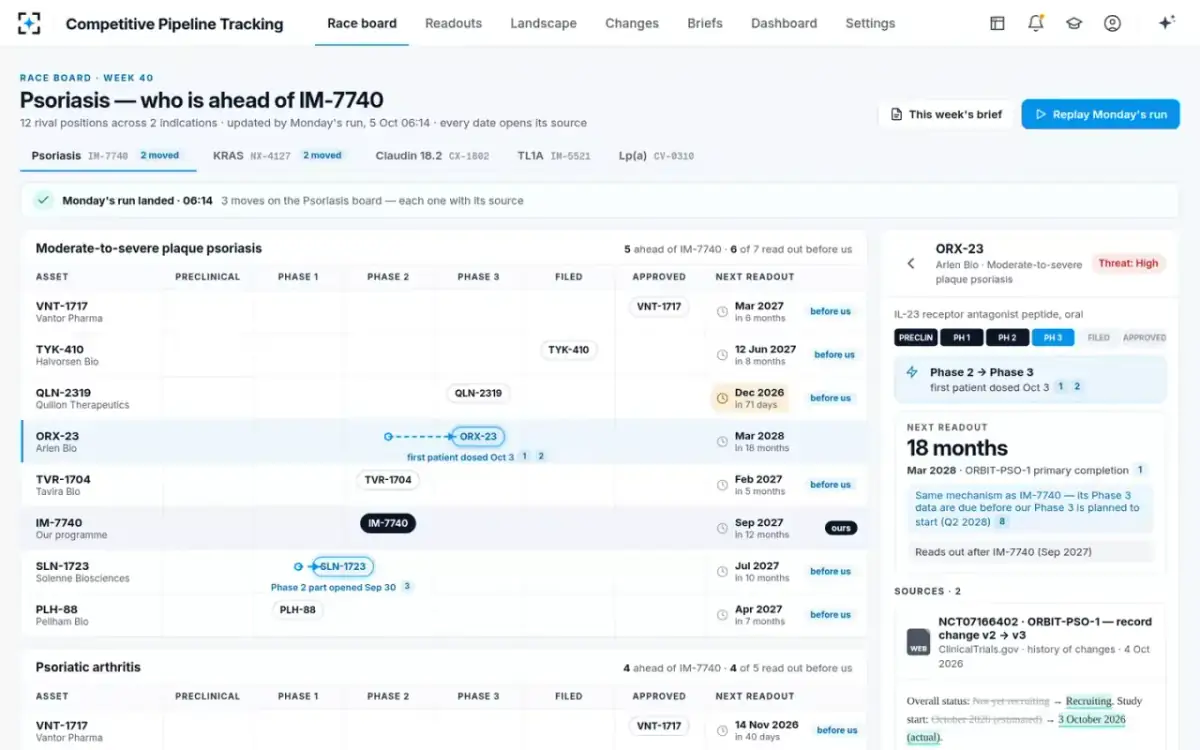
A date only matters relative to yours. In the sample psoriasis watch list, our own asset IM-7740 is an oral IL-23 receptor peptide in Phase 2b with topline planned for September 2027, and our Phase 3 is planned to start in the second quarter of 2028. ORX-23, the same mechanism, dosed the first participant in its Phase 3 on 3 October 2026 and its registry record carries primary completion in March 2028 — before our Phase 3 is planned to begin. That is not a date on a chart; it is a question for a programme lead about whether a Phase 3 design survives a same-mechanism rival reporting first.
One asset, its countdown and the record behind it
One date, four sources: a worked example
A readout date can come from four different places, and they are not equally firm. The registry gives a primary completion date with an estimated-or-actual flag. A sponsor's pipeline page may give a year or a half-year with no definition behind it. An earnings call may give guidance in a sentence. A congress programme may fix a presentation slot, which dates the disclosure rather than the data.
The two sample assets show the contrast. ORX-23's countdown comes from the registry: an estimated primary completion date of March 2028, captured with its record version. QLN-2319's does not exist in any registry at all — it comes from Quillon Therapeutics' third-quarter results call on 1 October, where management said QUILL-PSO-1 topline is now expected in December, ahead of prior guidance of January 2027. Both are legitimate. They need different labels, because one is a registry field under a published rule and the other is a company's statement about its own plans, and only the second can be changed by a press release next month.
One trial's dates, as the record tells them
- Enrolling and on study17 months
- Results information due, from the actual primary completion date12 months
- Enrolling and on study17 months
- Company release, congress abstract or paper, at the sponsor’s timingsponsor’s choice
- Registry results, median 424 days after primary completion424 days
How to record a date so the claim survives review
Three facts travel with every defensible readout date: which date it is, whether it is estimated or actual, and which version of which source it came from. Written out, a claim looks like this — ORX-23: primary completion March 2028 (estimated), ClinicalTrials.gov NCT07166402 as captured 5 October 2026 — and it can be re-checked by anyone, next week or next year. Written as "ORX-23 reads out in early 2028", it cannot.
Which date to count down from, given what the record says
What the source saysThe record shows an actual primary completion date
What to doCount the results clock from it
What the claim must sayPrimary data were collected by this date. Results are due within one year of it, and about four in ten arrive in time.
What the source saysThe record shows an estimated primary completion date
What to doCount down to it, and date the estimate
What the claim must sayExpected, not reached. The sponsor may move it at any time and need only refresh the record once a year.
What the source saysThe sponsor has given readout timing on a results call
What to doUse the guidance, and keep the sentence
What the claim must sayCompany guidance, with the date it was given and the call it was given on. It can move again, and it is in no registry.
What the source saysOnly a study completion date is available
What to doDo not use it as a readout date
What the claim must sayThis is the end of the whole trial, including follow-up. It usually falls well after the primary data exist.
What the source saysThe record shows neither, or the trial is not covered by the rule
What to doSay so, and give the reason
What the claim must sayNo public date. Phase 1 and observational trials, and trials with no US site, US-made product or US IND, carry no US registration duty.
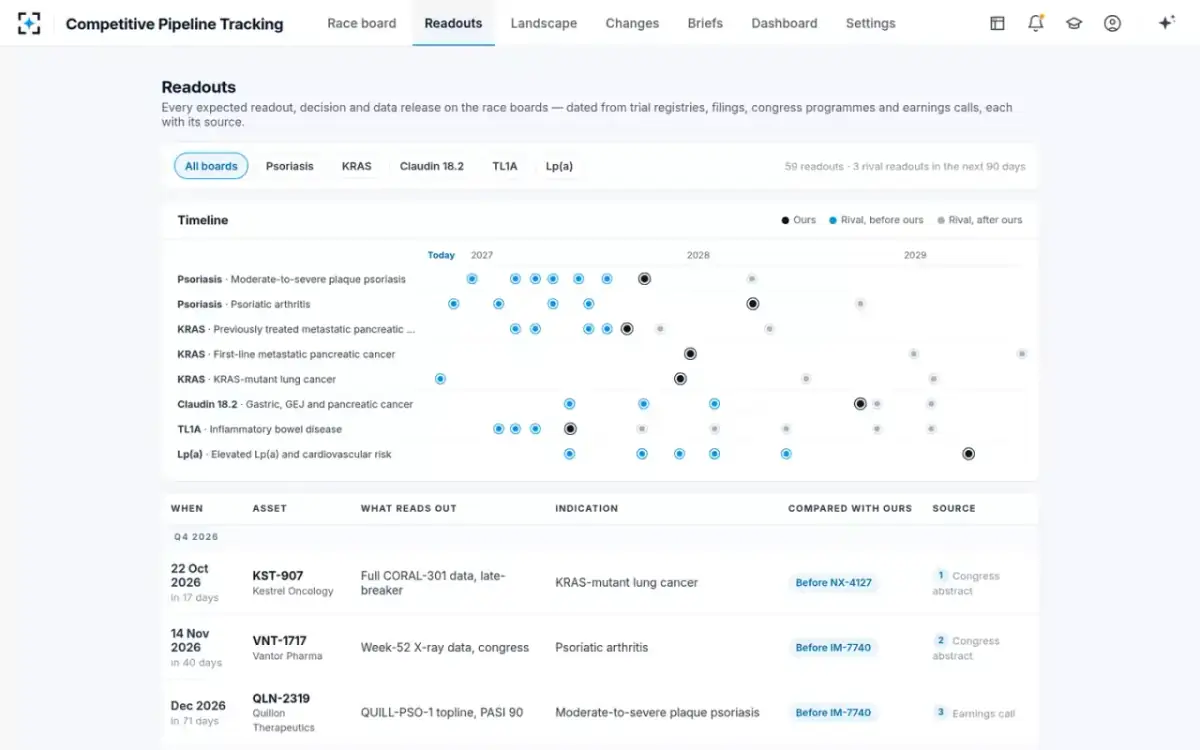
That discipline is what the readouts page in the solution is built on: 59 readouts across every board in the sample data, each with the source it was taken from, and three rival readouts falling inside the next 90 days. A programme lead can ask of any one of them where the date came from, and get an answer rather than an assurance.
Every expected readout, ours and theirs, each with its source
Dating a rival readout is mostly a vocabulary problem solved once: learn which date the rule means, keep the flag, name the source. To see the countdowns on a race board, start from Competitive Pipeline Tracking.
Questions people ask
What is a primary completion date on ClinicalTrials.gov?
It is the date the final participant was examined or received an intervention for the final collection of data on the trial's primary outcome — including when the trial was terminated early rather than completed as planned. Where a trial has more than one primary outcome measure with different finishing points, it is the date collection finishes for all of them. It is also the date from which the one-year deadline for posting results runs.
Does the primary completion date mean the trial is over?
No. The trial continues until its study completion date, which covers the secondary outcomes, adverse-event collection and follow-up — often a year or more later on a trial with long-term safety follow-up. What the primary completion date means is that the answer to the trial's main question now exists in the sponsor's data, whether or not anyone outside has seen it.
Estimated or actual: how do you tell, and does it matter?
The registry record labels each date as estimated or actual, and the difference is the whole value of the field. An estimate is the sponsor's plan and may be revised at any time, with no deadline tighter than the general twelve-month refresh. An actual date must be posted within 30 calendar days of the trial reaching it, arrives with the actual enrolment figure, and starts the results clock. Any readout claim should state which of the two it rests on.
How long after primary completion are results reported?
The deadline is one year. The measured practice is slower: of 4,209 applicable trials due to report under the final rule, 40.9% submitted within the deadline and 63.8% had submitted at any time by the study's cut-off, with a median delay from primary completion to submission of 424 days. Company releases, congress abstracts and journal papers often arrive before the registry entry does.
Why did a trial's completion date change?
Usually because recruitment ran faster or slower than planned, the event count a time-to-event endpoint depends on arrived early or late, the protocol was amended, or the sponsor re-planned the readout. The record will not say which, and no rule requires an explanation for moving an estimate. The one case where a reason is required is a change of recruitment status to suspended, terminated or withdrawn, which must be accompanied by the reason the study stopped.
When will a competitor's trial read out?
The earliest defensible answer is the trial's primary completion date, read from the registry with its estimated-or-actual flag, plus the time the sponsor takes to lock, unblind, analyse and decide to say something — weeks at best, often a quarter or more. Where a sponsor has given guidance on a results call, that is usually the better date, because it already includes their own disclosure plan; keep the sentence it came from, because guidance moves.