Competitive enrollment in clinical trials has two definitions in common use. Inside one trial it means competitive, or first-come, recruitment: sites are not given fixed allocations and each enrols as fast as it can until the target is met. Between trials it means something far more expensive — two studies recruiting the same kind of patient at the same hospital at the same time, so every participant one of them consents is a participant the other cannot. The second meaning is the one that closes trials, and it is largely knowable in advance, because sponsors must register their trials publicly and keep each facility's status current. Botminds' Competitive Pipeline Tracking reads those registrations every week and sets the facilities of a rival's new trial against the sites a clinical operations team is about to choose.
The worked example on this page runs on fictional sample data in the solution — the sponsor, the sites, the people and the asset codes NX-4127 and SLN-0582 are invented. The research figures and the regulation are real, and each is linked where it appears.
Why a shared site is a programme risk, not a scheduling nuisance
52.5%
of phase III trials at one cooperative group closed because they could not recruit enough participants
<35%
of predicted accrual was the rate at which trials in that study were consistently closed early
30days
is the longest a sponsor may take to publish a change in any individual site's status
What does competitive enrollment mean in clinical trials?
In a protocol document, competitive enrolment is a recruitment design. Rather than assigning each site a fixed number of participants, the sponsor opens the study at every site and lets them enrol until the overall target is reached; the fast sites take more, the slow sites take fewer, and nobody is held back waiting for a quota. Sponsors choose it because it reaches the last participant sooner. Sites dislike it, because the start-up cost of opening a study is the same whether a site enrols fifteen participants or one.
In a feasibility conversation the same phrase usually means competing trials: how many other studies at this hospital are recruiting from the patients this study needs. Those patients are a shared pool. The United States government's own review of clinical trial costs puts it plainly among the barriers to conducting research — "There is competition for limited patient pools for certain conditions, such as rare cancers and multiple sclerosis" (HHS Office of the Assistant Secretary for Planning and Evaluation), and it notes in the same passage that sites are often chosen "based on the location of investigators rather than patients".
A third, looser use turns up in investor commentary, where "competitive enrolment" describes a whole therapeutic area in which several sponsors are chasing the same population. That use is real but not actionable. The two that a programme can do something about are the design choice and the site overlap.
Two meanings, and the one that costs money
The design choice is a trade-off a sponsor makes once and can revisit. Site overlap is a fact about the outside world that changes every week, is published, and is rarely re-checked once a site list has been approved. That asymmetry is why the second meaning is the expensive one.
Consider what the overlap actually does to a site's arithmetic. A hospital seeing, say, four eligible patients a month for a given mutation and line of therapy was modelled at four when the feasibility questionnaire was returned. If a rival study opens there and takes half of them, the site's rate halves — and the whole trial's timeline is set by the slowest part of its recruitment curve, not the average. Nothing in the protocol changed. Nothing the site said was untrue when it said it.
Where the money in an oncology development programme's three trial phases sits
Oncology, average per-study cost by phase
- Phase 1 · $4.5M · 12% · 11.9%
- Phase 2 · $11.2M · 30% · 29.6%
- Phase 3 · $22.1M · 58% · 58.5%
The federal cost model is explicit that the burden grows with the programme: "Average per-study costs across all therapeutic areas increase as clinical development proceeds from Phase 1 to Phases 2 and 3." The study you can least afford to slow down is the last one, and it is also the one with the most sites, the broadest geography and therefore the widest exposure to a rival's site list.
Average per-study cost across Phases 1, 2 and 3, by therapeutic area
How to check if a site is running a competing trial
The direct answer: read the rival trial's own registration, which lists its facilities, and compare that list with your shortlist. Everything else is refinement. Four source families, in order of how early they tell you something:
The registry entry at first posting. A new interventional study often appears on a public registry before its first participant is consented — and an applicable trial in the United States must appear within 21 days of the first enrolment — and the record carries the eligibility criteria, the planned enrolment and, in most records, the named facilities with a per-site status. This is the earliest machine-readable warning there is.
Individual site status, afterwards. The facility list is not frozen at registration. Sites are added, and their status changes from "not yet recruiting" to "recruiting", and the sponsor has a deadline for publishing each change.
The sponsor's own announcements. A first-patient-dosed release, an investor presentation or an earnings call often names the regions, and occasionally the centres, before the registry has caught up.
The investigators themselves. A principal investigator who is already running a rival study in the same population will say so at feasibility, if asked a question specific enough to require it. The questions worth asking are at the foot of this guide.
The 30-day site-status clock, and what it lets you watch
The reason a weekly check is worth running at all is that the public record is obliged to keep moving. Under the United States registry rule, "Individual Site Status must be updated not later than 30 calendar days after a change in status for any individual site" (42 CFR § 11.64). The same section gives the trial-level clock: overall recruitment status must be updated within 30 calendar days of any change, and if it becomes "suspended," "terminated," or "withdrawn," the sponsor must also submit the reason the study stopped.
The two clocks interact in a way worth knowing, because it is the difference between a trial that looks open and a site that is actually open. The definitions section of the rule explains that overall recruitment status is "the recruitment status for the clinical trial as a whole, based on the status of the individual sites", and that "If at least one facility in a multi-site clinical trial has an individual site status of 'recruiting,' then the overall recruitment status for the trial must be 'recruiting'" (42 CFR § 11.10). A trial marked recruiting may therefore have one site open and forty not. Reading the trial-level badge alone will tell you a rival has started; reading the facility list tells you where.
Three practical consequences follow for anyone building a weekly check. Compare facility lists, not trial statuses. Treat "not yet recruiting" at a named site as a dated warning rather than an all-clear, because the sponsor has already committed to that centre. And expect a lag of up to a month: the record is a floor on what has happened, never a live feed. The registry's update deadlines, and what each one signals, are set out in the guide to ClinicalTrials.gov update requirements.
A rival trial's registration against our own site-selection deadline
- Registered: 540 participants, 210 planned sites1 Oct
- Facility list public; each site still not yet recruitingOctober
- First patient expected, per the sponsorQ1 2027
- Feasibility questionnaires back from 54 centres1–8 Oct
- Shortlist drafted — the overlap is findable here9–19 Oct
- Site selection closes30 Oct
How many trials close because of poor accrual?
Often enough that it should be treated as a design risk rather than an accident. In a study of phase III trials from United States cooperative groups, Schroen and colleagues found that "Among 40 trials from one CTCG, 21 (52.5%) trials closed due to insufficient accrual" (Clinical Trials, 2010). That figure is from one group's portfolio and academic trials are not industry trials, so it should not be read as an industry rate. What travels is the shape of the problem: the authors open by describing "the frequent low rates of patient enrollment, resulting in high rates of premature closure due to insufficient accrual" as a major challenge for the whole class of study.
The same work produced the most useful operational number in the literature on this subject. Across the broader set of 82 trials from five groups, "Trials accruing at a rate much lower than predicted (<35% actual/predicted accrual rate) were consistently closed due to insufficient accrual." A trial running below about a third of its predicted rate did not recover. That gives a monitoring threshold any sponsor can apply to its own study from the first month, and a reason to care which rival opened next door in month two rather than in month nine.
One more finding is directly about feasibility work: trials that did a pretrial accrual assessment achieved sufficient accrual more often than those that did not, 67% against 47% — a difference that did not reach conventional statistical significance (p = 0.08), but points the same way. The assessment is the thing competitive site intelligence feeds.
What a month of enrolment delay is worth
There is no single published figure for the cost of a month's delay, and the per-day numbers that circulate in conference slides are often a peak-sales estimate divided by 365, which assumes the delay costs a month of patent life at full revenue. A more defensible answer has two parts, and both can be built from published work.
The first part is the trial's own burn. A study that runs a month longer pays a month more of site fees, monitoring, central laboratory and project management. The second, larger part is the cost of time itself. DiMasi, Grabowski and Hansen estimated the average out-of-pocket cost per approved new compound at $1,395 million in 2013 dollars, and reported that "Capitalizing out-of-pocket costs to the point of marketing approval at a real discount rate of 10.5% yields a total pre-approval cost estimate of $2558 million (2013 dollars)" (Journal of Health Economics, 2016). The difference between those two numbers — about $1.16 billion — is what the elapsed time of development cost, on that study's assumptions.
What one month of delay costs, worked from published figures rather than guessed
| The component | How it is derived | For one month |
|---|---|---|
| A month more of an oncology Phase 3 | The federal cost model puts the average oncology Phase 3 study at $22.1 million. A 36-month study therefore runs at roughly $614,000 a month. | ≈ $0.6M of direct trial cost |
| A month later to market, on the development programme | At the 10.5% real discount rate used in the DiMasi study, one month of delay reduces the present value of everything beyond it by about 0.84% (1.105 raised to one-twelfth, less one). | ≈ 0.8% of programme value |
| The same, against that study's own capitalised cost | 0.84% of the $2,558 million capitalised pre-approval cost per approved compound. | ≈ $21M of carrying cost |
| A month of a shared site, instead of an exclusive one | Not a cost but a rate: a site expected to enrol four participants a month that is sharing its eligible pool contributes fewer, and the trial's end date follows the slowest part of the curve. | Measured in the accrual rate, not in dollars |
| The tail risk | A trial running below about 35% of predicted accrual was, in the cooperative-group study, consistently closed. The cost of that outcome is the whole study. | Up to the full study cost |
Two honest caveats belong with that table. The capitalised-cost method attributes the cost of time to the whole programme, so a month of delay in one Phase 3 does not simply cost $21 million; it costs that much only if it moves approval by a month. And development is overwhelmingly a failure business — Wong, Siah and Lo, working from 406,038 clinical trial entries, put the overall probability of success for oncology programmes at 3.4% (Biostatistics, 2019) — so the expected value of a month is lower than the headline arithmetic and the value of not closing a trial early is higher.
Shortlist overlap: a number you can compute every Monday
Once the registry has published a rival's facilities, the overlap with your own shortlist is a set intersection. It needs no modelling and no judgement, only two lists and a weekly habit. In the sample programme below, the week's new registration listed a rival's study at 38 of the centres on a feasibility shortlist due to close on 30 October.
The move that starts the question: a rival's Phase 3 registered, with its size and its sites
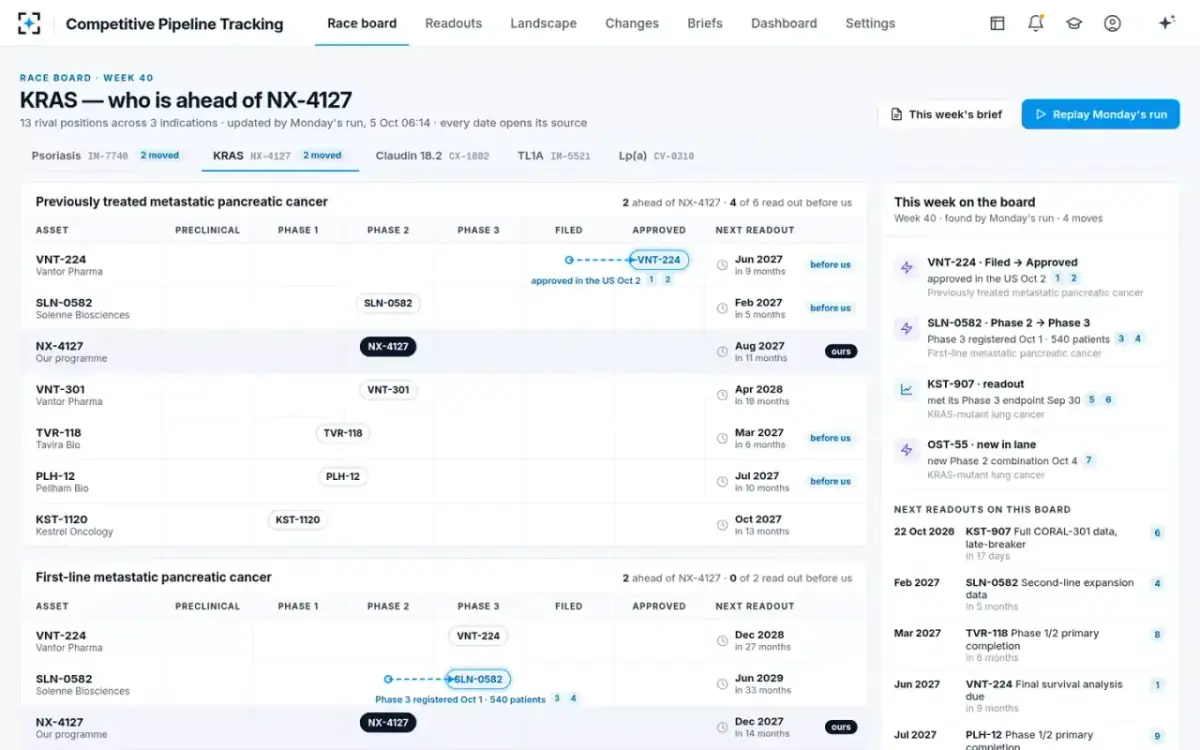
The matrix below is what the comparison looks like once it is drawn. Rows are the centres under consideration; the question for each is not merely "is a rival here" but "is a rival here for the same patients".
Our shortlisted sites against the rival trials recruiting at them
Site 014 · academic cancer centre, Lyon
Our statusShortlisted · tier 1
Rival trial hereSOLSTICE-PANC (SLN-0582) · site listed, not yet recruiting
What it meansSame line of therapy, same mutation. Once it opens: one screening population, two consent conversations.
Site 027 · academic cancer centre, Milan
Our statusShortlisted · tier 1
Rival trial hereSOLSTICE-PANC · site listed, not yet recruiting
What it meansThe registry will show it opening within 30 days of the change. Ask the site when, before the list closes.
Site 041 · hospital network, Barcelona
Our statusShortlisted · tier 2
Rival trial hereVNT-301 Phase 2 · recruiting
What it meansDifferent line of therapy. Competes for staff time, not for patients.
Site 052 · academic cancer centre, Houston
Our statusShortlisted · tier 1
Rival trial hereNone of the watched trials
What it meansClear on the public record today. Re-checked every Monday.
Site 063 · hospital network, Seoul
Our statusReserve
Rival trial hereKST-1120 Phase 1 · recruiting
What it meansEarlier phase, overlapping eligibility at the margin. Worth one question at feasibility.
Site 078 · academic cancer centre, Toronto
Our statusShortlisted · tier 2
Rival trial hereSOLSTICE-PANC · site listed, not yet recruiting
What it meansA third shortlisted site listed by the same trial. The pattern, not the site, is the finding.
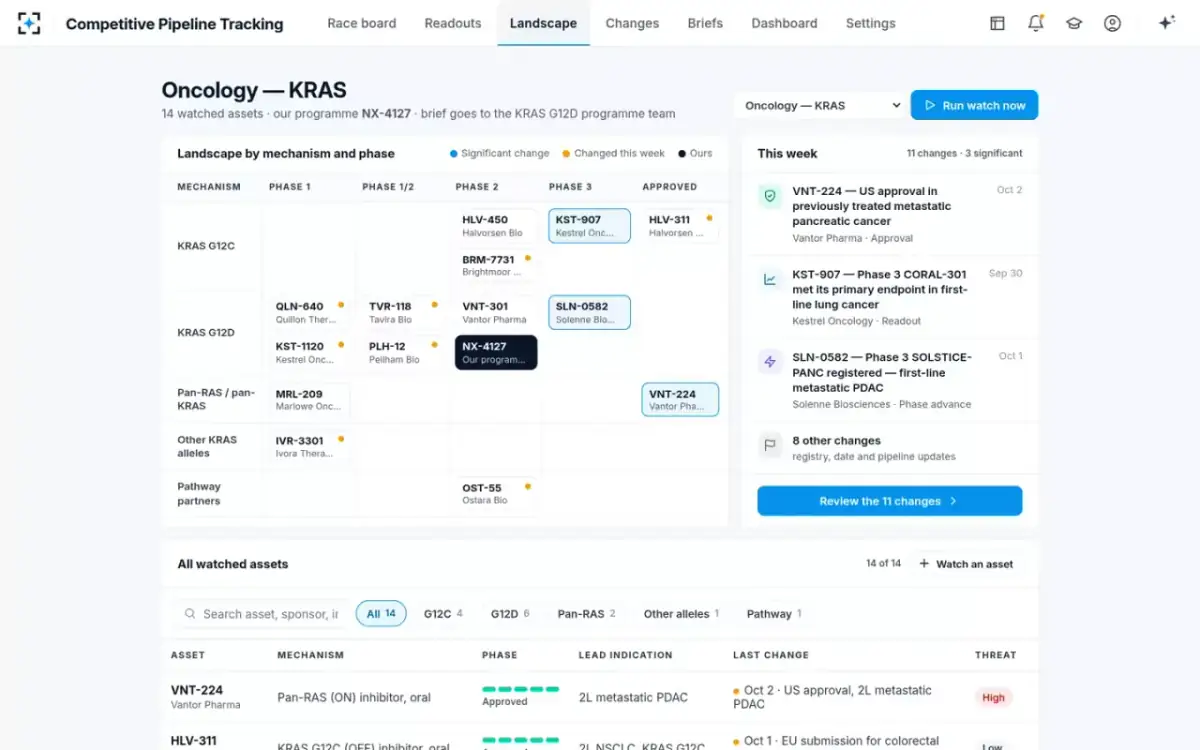
Read down the right-hand column rather than across the rows. One shared centre is a scheduling problem the site can usually manage. Several shortlisted centres listed by the same rival study is a different finding: it says the rival plans to recruit from your population in your geography, and that the shortlist, not the site, needs revisiting.
The same week, seen as a landscape: who is where, and what changed
What to do when the overlap is found late
Sometimes the rival registers after your list is closed, or the finding arrives in month three of recruitment. The response is different from the one before selection, and it is worth having written down in advance.
Re-rank rather than re-open. If reserve centres were ranked at feasibility, activating two of them is faster than re-running the exercise. This is the single best argument for keeping a ranked reserve list rather than an unordered pile of rejected sites.
Ask the shared sites for a split, not a promise. An investigator running two studies will allocate, formally or not. A conversation about how screening will be offered, and in what order, is more useful than a reassurance that both can be accommodated.
Measure against predicted accrual from month one. The under-35% benchmark only helps if the predicted rate per site was written down. Where it was not, the overlap finding is the moment to write it down.
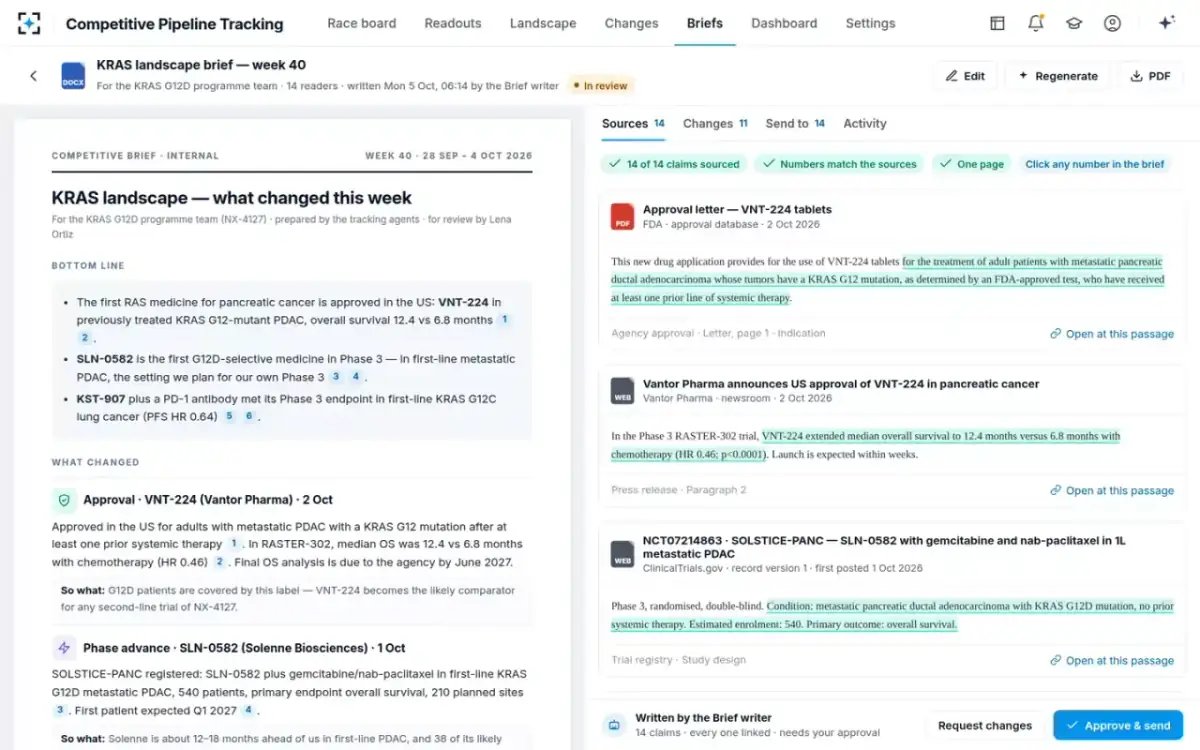
Tell the people who own the consequence. A site overlap matters to clinical operations in days and to the programme lead in months, and the two need different versions of it. In the sample solution the finding reaches both in the same weekly one-page report, with an owner and a date attached to the action rather than left as an observation.
The finding with an owner and a date on it
Feasibility questions worth asking a shared site
The standard feasibility questionnaire asks how many eligible patients a centre sees in a year. That number is usually an estimate made in good faith and rarely adjusted for what else is running. These are the questions that adjust it.
Nine questions to put to a centre you now know is running a competing trial
- Which other studies are open in this indication and line of therapy today?
Name them, and ask for registry numbers. A centre that cannot list them is not tracking its own competition either.
- How many of your eligible patients have been consented into those studies in the last six months?
The historical split is a better predictor of the future split than any assurance about capacity.
- In what order will eligible patients be offered the studies?
There is always an order. Asking makes it explicit and makes a later change visible.
- Who decides that order — the principal investigator, a committee, or the referring clinician?
A committee decision can be influenced by protocol design. A referral pattern cannot be, in the short term.
- Which eligibility criteria differ between the studies?
Overlap is rarely total. A difference in prior lines of therapy or performance status may mean the two studies are not actually competing.
- What is your screen-failure rate in this population?
A centre with a high screen-failure rate needs a larger pool to deliver the same participants, which makes sharing that pool more damaging.
- How many research coordinators are assigned, and to how many open studies?
Competition for staff time delays activation and visits even where the patient pools do not overlap at all.
- What rate per month do you commit to, and from which month?
This is the predicted figure the under-35% benchmark is measured against. Without it there is no early warning.
- Will you tell us if another study in this population opens here?
Asking costs nothing, and the registry is the backstop when the message does not arrive.
One point about where the two lists come from. The rival facility lists are public and can be read by anyone. Your own feasibility shortlist is not: it is your development plan, and in the sample solution it is an input the customer supplies, visible only to the programme team, never a source the agents read from the outside world. The overlap is only computable because one list is public and the other is yours.
The dates on the other side of the comparison — when a rival's study will finish recruiting, and when it reads out — come from the same registration, and which completion date to count down from explains why the two dates in the record mean different things. To see the weekly comparison running on a watch list of your own, start from Competitive Pipeline Tracking.
Questions people ask
What is competitive enrollment in a clinical trial?
Most often it is a recruitment design in which sites have no fixed quota and enrol until the study's overall target is reached, so the faster centres take a larger share. In feasibility discussions the same phrase usually means competing trials: other studies at the same hospital recruiting from the same patients, which reduces the number each study can expect.
How do competing trials affect recruitment?
They divide a shared pool of eligible patients, so a site's realised enrolment rate falls below the rate it forecast in good faith. Because a trial's end date is set by its slowest recruitment rather than its average, a rival at two or three important centres can move a readout by months. The federal review of trial costs lists competition for limited patient pools among the barriers to conducting research in the United States.
How can I find out which trials are recruiting at a particular hospital?
Search the public registries by facility. A registered interventional study lists its locations and gives each one a status, and the sponsor must publish a change in any individual site's status within 30 calendar days. Checking the facility list rather than the trial-level status matters, because a trial counts as recruiting as soon as one of its sites is.
Is competitive enrollment bad for sites?
It is harder for them than a quota design. A site carries the same start-up cost whatever it ends up enrolling, so a centre that activates and then loses the race recovers less of that investment. A sponsor that wants good sites to keep saying yes can pair competitive enrolment with a start-up payment that does not depend on the number recruited.
What accrual rate should trigger a review?
One published benchmark is useful: in the cooperative-group study, trials running below about 35% of their predicted accrual rate were consistently closed for insufficient accrual. That makes a third of plan a reasonable line for a formal review, provided the predicted per-site rate was recorded at activation. The same study found that trials with a pretrial accrual assessment reached sufficient accrual more often, 67% against 47%, though that difference was not statistically significant at the usual threshold (p = 0.08).
How often should a site overlap check be run?
Weekly during site selection and monthly thereafter is a reasonable rule, because the registry's own obligation is a 30-day one and a weekly read is the shortest interval at which new information is likely. The check is worth most in the weeks before a site list closes, which is exactly when the programme is busiest and least likely to do it by hand.