FDCPA third party communication rules, in 15 U.S.C. 1692c(b) and Regulation F's 12 CFR 1006.6(d), prohibit a debt collector from communicating about a debt with anyone other than the consumer, the consumer's attorney, a consumer reporting agency where permitted, the creditor, the creditor's attorney or the collector's own attorney. The main exception is a location communication under 12 CFR 1006.10: a call or letter to a third party solely to confirm or correct where the consumer lives or works, in which the collector gives their own name, must not say the consumer owes a debt, and may contact that person only once. For a lender that places accounts with agencies, the risk is in the conversations nobody hears: a collector who tells a borrower's sister the balance, or a voicemail on a work line that names the loan. A sampled QA program hears a few percent of them. Botminds' Collections Compliance Monitoring checks every call, voicemail, text, email and letter from the lender's own team and each agency against the rules, quotes the moment, and leaves the decision to a compliance analyst.
The calls, agencies and borrowers in the examples are sample data on fictional people and firms.
One night's conversations at a sample lender and its three agencies
41,286
calls, voicemails, texts, emails and letters checked against 41 rules
38
red findings for a person to confirm one by one
826
conversations a 2% sample would have heard
~1
of the 38 red findings that sample would have caught
Who may a debt collector talk to about a debt?
Only the consumer and five others, unless an exception applies. Regulation F says a debt collector "must not communicate, in connection with the collection of any debt, with any person other than" the consumer, the consumer's attorney, a consumer reporting agency "if otherwise permitted by law", the creditor, the creditor's attorney or the debt collector's attorney (12 CFR 1006.6(d)(1)). The exceptions are four: acquiring location information under 1006.10, the consumer's prior consent "given directly to the debt collector", a court's express permission, and what is "reasonably necessary to effectuate a postjudgment judicial remedy".
"Consumer" is wider than the borrower for this purpose. Section 1006.6(a) includes the consumer's spouse, a parent if the consumer is a minor, a legal guardian, the executor or administrator of a deceased consumer's estate, and a confirmed successor in interest. A sister, an adult child, a roommate, an employer and a coworker are third parties.
Who a collector may discuss the debt with, under Regulation F
| Person | May discuss the debt? | Basis |
|---|---|---|
| The borrower | Yes | 1006.6(d)(1)(i) |
| Spouse; parent of a minor; guardian; executor or administrator; confirmed successor in interest | Yes, as the consumer | 1006.6(a) |
| Consumer's attorney, creditor, creditor's attorney, collector's attorney | Yes | 1006.6(d)(1)(ii)–(vi) |
| Anyone, with the consumer's prior consent given directly to the collector | Yes, within the consent | 1006.6(d)(2)(ii) |
| Sister, adult child, roommate, neighbour | No; location only | 1006.6(d)(1); 1006.10 |
| Employer or coworker | No; location only | 1006.6(d)(1); 1006.10 |
The location call: what a collector may say, and how often
A location communication has a fixed form. A collector contacting a third party "for the purpose of acquiring location information" must identify "himself or herself individually by name, state that he or she is confirming or correcting the consumer's location information, and, only if expressly requested, identify his or her employer"; must "not state that the consumer owes any debt"; must not use a postcard or any envelope language showing the communication relates to debt collection; and, once the consumer is known to have an attorney, must contact only that attorney (12 CFR 1006.10(b); 15 U.S.C. 1692b).
Location information itself is narrow: the consumer's "place of abode and telephone number at such place" or "place of employment" (1006.10(a)). A call that asks the sister when the borrower gets paid, or whether he still has the truck, has left the exception. And the frequency rule is strict: no more than one communication with that person "unless requested to do so by such person, or unless the debt collector reasonably believes that the earlier response of such person is erroneous or incomplete and that such person now has correct or complete location information" (1006.10(c)).
A location call within the rule, and the same call outside it
Within 1006.10: "This is Dana. I'm trying to confirm a phone number for Mark."
Outside it: "This is Dana from [agency], calling about Mark's account."
Within 1006.10: Only if the person asks
Outside it: Volunteered, with a name that says collection
Within 1006.10: Never mentioned
Outside it: "He's two payments behind on the truck."
Within 1006.10: Where he lives, his number there, where he works
Outside it: When he gets paid, whether he can borrow money
Within 1006.10: No second call unless asked or the answer was wrong
Outside it: Calls back daily until he answers
When the borrower has died: the estate exception and its script
A deceased borrower's account is where third-party rules are most often misread, because the people who answer are family and the debt is real. Regulation F counts "the executor or administrator of the consumer's estate, if the consumer is deceased" as the consumer, and the CFPB's official interpretation reads that widely: the terms "include the personal representative of the consumer's estate," meaning "any person who is authorized to act on behalf of the deceased consumer's estate." That can include representatives under informal probate and summary administration, universal successors, "persons who sign declarations or affidavits to effectuate the transfer of estate assets," and people who dispose of the deceased person's assets without a court.
Everyone else in the family is still a third party. A collector trying to find the right person may make a location communication, and the commentary to 1006.10(b)(2) allows one change to the script: the collector "does not violate § 1006.10(b)(2) by stating that the debt collector is seeking to identify and locate the person who is authorized to act on behalf of the deceased consumer's estate," or "the person handling the financial affairs of the deceased consumer." The collector still may not say the deceased owed a debt.
The control is evidence of authority, taken before the conversation turns to the balance. An adult son who says he is "dealing with Dad's things" may or may not be authorised; a small-estate affidavit, letters of administration or a statement of how he is disposing of the assets is what moves him from third party to consumer. The lender's deceased-account procedure should name what the agent records, and a monitoring rule can test that the record exists on every estate call where the debt was discussed.
How do third-party disclosures happen on real calls?
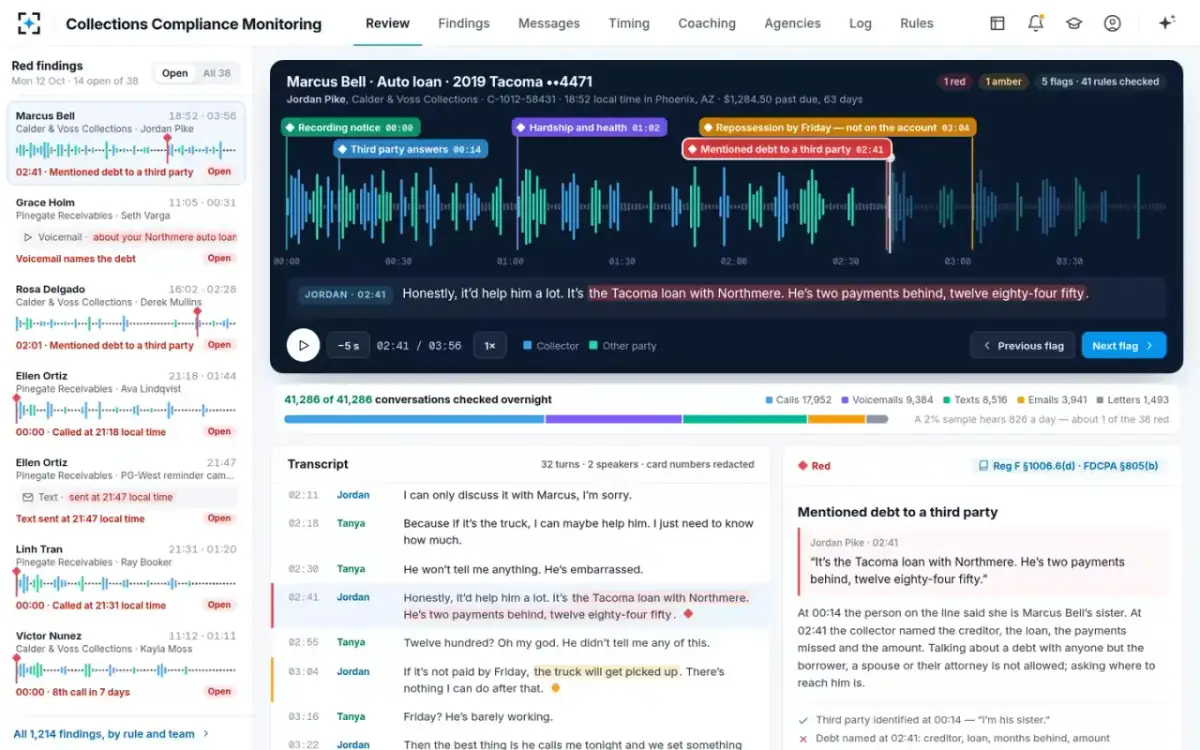
Mostly through failed right-party verification: the collector reaches someone other than the borrower and talks as if they were the borrower. In the sample, an agency collector called about a Tacoma auto loan, $1,284.50 past due at 63 days, at 18:52 local time in Phoenix. At 00:14 the person who answered identified herself as the borrower's sister. At 02:41 the collector said: "It's the Tacoma loan. He's two payments behind, twelve eighty-four fifty."
Twenty-three seconds later he said the truck would be picked up if it was not paid by Friday. The checker looked at the account before calling that false: there was no repossession assignment, and the lender's policy required a right-to-cure letter first at 75 days, with the loan at 63. It went to the analyst as an amber, with the rule cited. A third flag, at 01:02, marked the sister's words about cut hours and a hospital stay, with a button to refer the account to the hardship team.
Collections Compliance Monitoring flags a third-party disclosure at 02:41
Voicemails, texts and emails: third-party disclosure without a conversation
A voicemail can disclose a debt to whoever hears it, which is why Regulation F defines a limited-content message. It must include a business name "that does not indicate that the debt collector is in the debt collection business", a request to reply, one or more names to contact and a phone number, and it may include little else (12 CFR 1006.2(j)). In the sample, an agency's voicemail went to a dispatch office at the borrower's employer, the work line on file, and asked for a call back "about your auto loan balance". Coworkers could hear it.
For email and text, Regulation F gives a collector a procedural defence rather than a safe address. A collector maintains procedures "reasonably adapted … to avoid a bona fide error" in sending a message that would disclose the debt to a third party if it can "reasonably confirm and document" that it used an address or number the rule permits and did not use one it "knows has led to a disclosure" (12 CFR 1006.6(d)(3)). That makes the record of how each address was obtained part of the compliance evidence. The script itself is covered in the limited-content message.
Social media, work email and a friend's phone: channels that disclose by design
Some channels put a message in front of third parties whatever it says, and Regulation F closes them directly. A debt collector must not "communicate or attempt to communicate with a person in connection with the collection of a debt through a social media platform if the communication or attempt to communicate is viewable by the general public or the person's social media contacts" (12 CFR 1006.22(f)(4)). The commentary gives the plain case: no posting a message for someone on a page their contacts can see. A private message is not barred by that paragraph, but a private location message to a borrower's friend must come from a profile that "accurately identifies the debt collector's individual name" and follow the 1006.10 script in full.
Work channels have their own lines. A collector must not email "an email address that the debt collector knows is provided to the consumer by the consumer's employer," except in narrow cases (1006.22(f)(3)), and must not contact the consumer at work at all "if the debt collector knows or has reason to know that the consumer's employer prohibits the consumer from receiving such communication" (1006.6(b)(3)). The sample voicemail to a dispatch office shows how the two combine: the content named the loan, and it was left on a shared work line where coworkers heard it, which turned a content error into a third-party disclosure.
The phone number on file matters as much as the words. The commentary to 1006.2(j) says a voicemail left on a number the collector "knows belongs to the consumer's friend" is not a limited-content message "even if the message includes no more than the content" the definition allows, "because the debt collector knowingly left the message for someone other than the consumer." For monitoring, that means each number needs a source and an owner: a number given by a sister during a location call is safest treated as the sister's until the borrower confirms it, since a collector who knows it is hers cannot leave a limited-content message there. A rule that compares the number dialled with how it was obtained catches these before the complaint does.
Why a lender is accountable for its agencies' third-party contacts
Because outsourcing collection does not outsource the compliance obligation. The federal banking agencies' third-party guidance says "the use of third parties does not diminish or remove banking organizations' responsibilities to ensure that activities are performed in a safe and sound manner and in compliance with applicable laws and regulations, including but not limited to those designed to protect consumers" (Interagency Guidance on Third-Party Relationships, 2023). An agency that discloses a borrower's debt to a family member exposes the lender to the complaint, the reputational cost and the supervisory finding, whatever the contract says.
The FDCPA governs the agencies directly. A lender collecting its own accounts in its own name is generally not a "debt collector" under the statute, but most apply the same third-party standard to their in-house teams as policy, since the conduct that triggers a complaint is the same. The sample lender monitors its own team and its three agencies against the same 41 rules and scores each on the same basis.
Red findings in one night, by team
Monitoring third-party contact across every conversation
The control that finds third-party disclosures is right-party verification, tested on every conversation rather than a sample. A disclosure almost always follows a moment where the other party said who they were, and the collector either missed it or ignored it; a transcript with speakers separated and the verification moment located shows which.
How Collections Compliance Monitoring turns a call into a confirmed finding
Agent
Call and voicemail transcriberTranscribes each call, separates the collector from the other party, time-stamps each word and redacts card numbers.
Never: Never scores or summarises a conversation
Agent
Disclosure checkerChecks right-party verification, the debt-collector disclosure, the recording notice and the limited-content script.
Never: Never treats a third party as the borrower
Agent
Third-party and conduct checkerFinds third-party disclosures, threats and statements not supported by the account, and quotes the moment.
Never: Never decides a breach
Agent
Findings writerWrites one finding per conversation with the moment, the coaching item and the effect on the agency score.
A person decides
Compliance analystConfirms or dismisses each red finding; a dismissal needs a reason and a second person.
A person decides
Agency management leadSends the remediation letter to the agency; nothing goes out without that sign-off.
In the sample, the analyst confirmed the 02:41 finding at 09:12. A coaching item for the collector was created with the moment attached, the agency's 30-day compliance score moved from 91.4 to 91.3, and the decision went into the review log. The same collector had two more items that week: the 03:04 repossession statement and a disclosure to another borrower's roommate at 00:57. The remediation letter asked the agency for a retraining plan within 10 business days.
Controls for third-party communication
Nine controls on third-party contact for a lender and its agencies
- Is right-party verification scripted and tested on every call?
Before any account detail is given.
- Does the location script follow 1006.10(b)?
Own name, confirming location, employer only if asked, no debt.
- Are location calls limited to one per third party?
Unless requested, or the earlier answer was wrong or incomplete.
- Do voicemails to shared or work lines use the limited-content message?
No mention of a debt, a loan or a balance.
- Is consent to talk to a third party recorded as given directly by the consumer?
With the date and scope.
- Is how each email address and phone number was obtained recorded?
The evidence for the 1006.6(d)(3) procedures.
- Are letters and envelopes free of collection language when sent to third parties?
No postcards.
- Does every agency get scored on the same rules as the in-house team?
Per 1,000 conversations, with the moments attached.
- Do confirmed findings produce coaching and remediation with deadlines?
And are repeat collectors tracked?
Frequency rules sit beside these. A collector is presumed to comply with the harassment rule if it calls a particular person about a particular debt no more than seven times in seven days, and not within seven days after a conversation (12 CFR 1006.14(b)(2)); the sample run found six accounts over that line in one night. What a violation costs once a borrower sues is set out in FDCPA statutory damages.
What Collections Compliance Monitoring does, and what it leaves to people
The agents transcribe, check, quote and draft; people confirm, dismiss, coach and send. The checker never decides a breach, the contact-time checker never dials or blocks calls, the vulnerability listener routes accounts rather than labelling people, and the findings writer never closes a red finding or contacts an agency. Rules are versioned: 41 of them from Regulation F, the FDCPA, state law and the lender's own policy, each switchable, with any change approved by the compliance manager.
A lender evaluating any monitoring tool for third-party disclosure should test it on calls where the other party identifies themselves late, on voicemails left on shared lines, and on location calls that drift into questions about money. The answer that matters is whether the tool finds the moment and quotes it, so the analyst can confirm in seconds rather than listen to the whole call. More on how such tools compare is in debt collection quality assurance software.
Questions people ask
Can a debt collector discuss a debt with a borrower's family?
Only with those Regulation F treats as the consumer, such as a spouse, a parent of a minor, a guardian or an executor, or with the consumer's prior consent given directly to the collector. With anyone else, the collector may only seek location information and may not mention the debt.
What may a collector say in a location call?
Their own name, that they are confirming or correcting the consumer's location information, and their employer only if asked. They may not say the consumer owes a debt, under 12 CFR 1006.10(b) and 15 U.S.C. 1692b.
How many times can a collector contact the same third party for location?
Once, unless that person asks for another contact, or the collector reasonably believes the earlier answer was wrong or incomplete and the person now has correct information.
What counts as location information?
The consumer's place of abode and telephone number there, or place of employment. Questions beyond that, about pay, assets or the debt, fall outside the exception.
Is a voicemail on a work line a third-party disclosure?
It can be, if it mentions the debt and others can hear it. Regulation F's limited-content message is designed to avoid that: a business name that does not indicate debt collection, a request to reply, a contact name and a phone number.
Is a bank responsible for its collection agencies' third-party contacts?
The banking agencies' 2023 third-party guidance says using third parties does not diminish a bank's responsibility for compliance with consumer protection laws, so lenders monitor agency conduct as their own.