Every day, collectors working for a lender phone, text, email and write to thousands of people who are behind on a payment. Monitoring is the check made afterwards: someone hears the recordings and reads the messages and letters, and tests each one against the debt collection rules and the lender's own policy. Most teams can hear only a few conversations in every hundred, so most mistakes surface later, as a complaint, a lawsuit or an examiner's finding.
This guide is for anyone who checks collection conversations, coaches the people who have them, oversees collection agencies or answers for the result: collections compliance and quality analysts, collector team leads, agency managers, compliance officers, internal audit, and the leaders deciding whether to automate the checking. No background needed.
Imagine you are a collections compliance analyst at Northmere Bank, a regional bank that lends cars, cards and personal loans, and places its harder past-due accounts with three outside collection agencies. It is a little after 9 a.m. on Tuesday, October 13, 2026. Yesterday the bank's own collectors and the three agencies had 41,286 conversations with borrowers: 17,952 calls, 9,384 voicemails, 8,516 texts, 3,941 emails and 1,493 letters. Your team has time to hear perhaps one in fifty.
One of them is a 3-minute 56-second call placed at 6:52 p.m. Phoenix time by Jordan Pike, a collector at Calder & Voss Collections, about Marcus Tellam's 2019 pickup loan: two payments behind, $1,284.50 past due, 63 days late. Fourteen seconds in, the woman who answers says she is his sister. At 2 minutes 41 seconds Jordan tells her the lender, the loan, the months missed and the amount. Twenty-three seconds later he says the truck "will get picked up" if nobody pays by Friday.
The recording · 6:52 p.m. local
0:14
"No, I'm his sister."
2:41
"…the Tacoma loan with Northmere. He's two payments behind, twelve eighty-four fifty."
3:04
"If it's not paid by Friday, the truck will get picked up."
The account and the rules
Who may hear
The borrower, a spouse, an attorney; never a sister
Repossession
None assigned; policy sends a right-to-cure letter at 75 days
Days late
63
Debt told to a third partyThreat of an action not plannedboth breach the federal collection rules.
Nothing in the call sounds dramatic: the collector was polite and called at a lawful hour, and the borrower never complained. Yet a random 2% sample of yesterday's conversations had a 2 in 100 chance of including it. The same night held 37 other serious breaches across the four teams, and a 2% sample would be expected to hear fewer than one of them.
Monitoring catches the debt told to a sister, the threat the account cannot back, the late call and the wrong figure in a letter, the morning after, before the borrower, a court or an examiner finds them.
Checking collection calls, messages and letters after the fact: the rules, the evidence, the complaints and the sampling math
What a collections monitor checks, which rules apply to whom and since when, what borrowers complain about, what regulators and courts have punished, and why a sample hears so little. Written without selling anything. If you have never worked in collections, start here.
01 · In plain words
The morning-after check: hearing yesterday's collection calls before a borrower, a court or an examiner does
When someone falls behind on a car loan, a credit card or a personal loan, the lender starts collecting. Its own staff call, text, email and write. After a few months many lenders hand the harder accounts to an outside collection agency, which does the same on the lender's behalf. A large lender can have tens of thousands of these conversations in a day, most of them recorded or written down.
Each conversation is governed by rules. Federal law says a collector may not discuss the debt with a neighbor or a sister, may not call before 8 a.m. or after 9 p.m. at the borrower's location, may not call so often that it amounts to harassment, may not threaten what it does not intend to do, and must state the right amount.
State and city laws add their own limits. Phone rules decide when an automated dialer or a recorded voice may be used at all. Military service and a bankruptcy filing change what a collector may do.
Monitoring is the check made after the conversation is over. A quality or compliance analyst opens the recording or the message, compares it with the rules and with the facts on the account, and decides whether something went wrong. A confirmed problem turns into coaching for the collector, a letter to the agency, a fix for the borrower and a line in the record an examiner will ask to see.
The hard part is volume. Listening takes as long as the call, so most teams hear a small random sample, and serious breaches are rare in any one conversation. A sample large enough to describe the average call is still small enough to miss nearly every breach, which is why many lenders now check every conversation with software and have people hear the moments it flags.
One collection conversation, from dial to exam file, in five steps
The account goes past due and is workedNorthmere Bank's own collectors take the early stages; at around 60 days some auto loans go to Calder & Voss Collections, an outside agency.
A collector calls, texts or writesJordan Pike calls Marcus Tellam's number at 6:52 p.m. Phoenix time. His sister answers.
Someone checks the conversation afterwardsThe recording, the account facts and the rules side by side. This is where the debt told to the sister at 2:41 is caught, or left unheard.
A finding becomes coaching, remediation and a fixThe collector hears his own ten seconds; the agency gets a letter with the clip; the borrower's account is put right.
The record goes to the exam fileWho checked what, under which rule version, and who decided. Examiners ask for it, and agencies are scored on it.
Step 3 is the subject of this guide. Live help for collectors during a call is a different job. The people, the bank, the agencies and the figures in this example are fictional.
Four facts about collection conversations that newcomers do not expect
Most debt collection complaints are about the account
The Consumer Financial Protection Bureau (CFPB), the federal regulator for consumer finance, received about 387,400 debt collection complaints in 2025, up from 207,800 in 2024 (every complaint received, including those referred to other regulators), and named credit reporting as a principal reason for the rise.1,2 Of the 283,203 sent to companies and published in its database for 2025, "communication tactics" such as frequent calls account for 9,519.3
Staying under the call count can still be harassment
Examiners found collectors who stayed within seven calls in seven days but placed over 100 calls after the borrower asked them to stop; the count's presumption of compliance was overcome.2
The rules reach the lender's own collectors too
The federal debt collection statute mostly covers outside agencies, but unfair, deceptive or abusive practices are illegal for lenders as well, and states such as Massachusetts write their rules for creditors.4,5
A 2% sample hears 2% of the breaches
Whatever the sample rate, a random sample finds that share of the problems, on average. Industry estimates put hand-scored coverage at "as little as 1% to 3%".6
Four collection terms this guide uses on every page
Third-party disclosure
Telling anyone other than the borrower, a spouse, a guardian or an attorney that a debt exists. One sentence to a sister is enough.
7-in-7
The call count in Regulation F, the CFPB's federal debt collection rule: more than seven calls in seven days about one debt, or a call within seven days of a phone conversation, is presumed to be harassment.
Limited-content message
A voicemail that names a person and a number and asks for a call back, with nothing that reveals a debt.
Full coverage
Checking every call, voicemail, text, email and letter, then having a person hear or read the flagged moment.
Debt collection quality assurance covers five channels and three kinds of evidence
In shortA collections monitor checks calls, voicemails, texts, emails and letters. Some breaches are in what was said, some in when and how often the contact happened, and some only show when the words are set against the account record. A program that only listens to calls sees the first kind and misses most of the other two.
Quality assurance in a collections team has two jobs that share one set of recordings. The first is service quality: did the collector verify who was on the line, explain the options and record the promise to pay. The second is compliance: did anything in the contact break a law or the lender's policy. This guide is about the second, done after the fact, which is how examiners and agency auditors do it too.
The CFPB's examination procedures tell examiners to review a firm's "policies and procedures for monitoring both incoming and outgoing communications, attempts to communicate, and other outgoing messages", and then to "listen to a sample of collection calls".7
Three kinds of evidence behind a finding
In the words
What was said or written
A debt named to a sister, a threat of arrest, a missing "this is a debt collector", a voicemail that mentions the loan, a text with no way to opt out. A careful listener or reader finds these in the conversation itself.
In the timing
When and how often
A call at 9:18 p.m. at the borrower's door, the eighth call on one debt in seven days, a text after a stop request. Found by placing every attempt on the borrower's own clock and counting across days and channels.
Against the account
What the record says
A repossession threatened where none is assigned, a past-due figure that differs from the bank's system, a call after an attorney or a bankruptcy was noted. The words sound fine; the account shows they are wrong.
Each rule can break in only some channels, so a calls-only review leaves gaps
Where a breach of each rule can show up, by channel
RarelyCan occurCommon
CallVoicemailTextEmailLetterDebt told to a third partyCommonCommonCan occurCan occurCan occurOutside 8 a.m. to 9 p.m. localCommonCommonCommonCan occurRarelyToo many calls or contactsCommonCommonCan occurCan occurRarelyMissing debt-collector disclosureCommonCan occurCommonCommonCommonThreat or false statementCommonCan occurCan occurCan occurCommonWrong amount or unauthorized feeCan occurRarelyCan occurCan occurCommonNo electronic opt-outRarelyRarelyCommonCommonRarelyAutodialer or recorded voice without consentCommonCommonCommonRarelyRarely
Our reading of the sources8,9,10 · Our reading of Regulation F, the TCPA and New York City's 2026 rules. Letters cannot be late at night; texts and emails carry the opt-out duty; the TCPA covers autodialed and prerecorded calls and texts.
Show the numbers
Call
Voicemail
Text
Email
Letter
Debt told to a third party
Common
Common
Can occur
Can occur
Can occur
Outside 8 a.m. to 9 p.m. local
Common
Common
Common
Can occur
Rarely
Too many calls or contacts
Common
Common
Can occur
Can occur
Rarely
Missing debt-collector disclosure
Common
Can occur
Common
Common
Common
Threat or false statement
Common
Can occur
Can occur
Can occur
Common
Wrong amount or unauthorized fee
Can occur
Rarely
Can occur
Can occur
Common
No electronic opt-out
Rarely
Rarely
Common
Common
Rarely
Autodialer or recorded voice without consent
Common
Common
Common
Rarely
Rarely
Two practical points follow. A text or an email is a communication like a call, so it can be sent at the wrong time and must carry the debt-collector disclosure; the CFPB's own summary of the time-of-day rule says it covers communicating "including electronically".11 And letters, which feel safe because they come from a template, are where the wrong amount usually appears: 91% of 2024 complaints about false statements were about collecting the wrong amount.2
03 · The rules and their dates
The collection rules a monitor tests against in October 2026: Regulation F, the FDCPA, UDAAP, TCPA consent and state caps
Status as of October 2026
In shortRegulation F's rule text, in force since November 30, 2021, is unchanged as of October 29, 2026. The CFPB withdrew 67 guidance documents in May 2025, including its 2013 bulletin on unfair collection practices, and the Federal Trade Commission (FTC) was the only federal agency to announce a public FDCPA enforcement action in 2024. The phone rules moved: since April 11, 2025 consent can be revoked by any reasonable means, and from November 25, 2026 a caller may name its own opt-out method and treat a "stop" as covering only the kind of informational message it answered. New York City's tighter rules took effect on September 1, 2026.
A few federal laws carry most of the weight. The Fair Debt Collection Practices Act (FDCPA) governs collectors who collect debts owed to someone else.12 Regulation F, 12 CFR 1006, is the CFPB's rule under it and sets the call counts, calling hours and message rules.8
The Telephone Consumer Protection Act (TCPA), with rules written by the Federal Communications Commission (FCC), governs autodialed and prerecorded calls and texts.9 The ban on unfair, deceptive or abusive acts and practices (UDAAP) reaches every lender, including one collecting its own loans.4 The Servicemembers Civil Relief Act (SCRA) and the bankruptcy automatic stay decide when collecting must change or stop.13,14
The federal collection rule held still while phone-consent and city rules moved
Nov 30, 2021Regulation F takes effect
Call counts, time of day, limited-content voicemails, electronic opt-outs, validation notices.
Feb 16, 2024FCC consent order
Revocation by any reasonable means, honored within 10 business days.
Apr 11, 2025Revocation rules apply
The revoke-all piece is waived, later to January 31, 2027.
May 12, 2025CFPB withdraws 67 guidance documents
Including Bulletin 2013-07 on unfair collection practices and three Regulation F advisory opinions.
Jun 20, 2025McLaughlin v. McKesson
Courts are not bound by the FCC's reading of the TCPA.
Sep 1, 2026New York City rules
Three contacts per account in seven days by any medium but mail; recording disclosure.
Sep 30, 2026FCC replaces revoke-all
Callers may name an exclusive opt-out method; a stop can cover one category of informational messages.
Nov 25, 2026New revocation rules apply
Published October 26, 2026; the January 31, 2027 revoke-all date falls away.
Third parties, harassment, false or misleading statements, unfair practices such as unauthorized fees. Individual damages up to $1,000 plus actual damages and fees; class damages up to the lesser of $500,000 or 1% of the collector's net worth.12
In force
Regulation F, 12 CFR 1006
Time and place (1006.6(b)), third parties (1006.6(d)), electronic opt-outs (1006.6(e)), call counts (1006.14(b)), media the person asked to stop (1006.14(h)), threats and disclosures (1006.18), validation notice within five days (1006.34), three-year records (1006.100).8
Unchanged, October 29, 2026
UDAAP, 12 U.S.C. 5531
Unfair, deceptive or abusive acts by any covered person, including a lender collecting its own loans.4
In force; Bulletin 2013-07 withdrawn May 12, 202518
TCPA, 47 U.S.C. 227
Consent for autodialed or artificial and prerecorded voice calls and texts to cell phones; $500 a violation, up to three times that if willful.9 AI-generated voices count as artificial.21
Revocation rules from April 11, 2025; amended rules from November 25, 2026 replace revoke-all20
State and city law
Massachusetts two telephone contacts in seven days; Washington three a week; New York City three per account in seven days; California's Rosenthal Act covers creditors.5,22,10,23
NYC amendments from September 1, 2026
SCRA, 50 U.S.C. 3901 and following
6% interest cap during service; no repossession of property under a pre-service contract without a court order.13,24
In force
Bankruptcy, 11 U.S.C. 362
The automatic stay bars "any act to collect, assess, or recover a claim" that arose before the case.14
In force
Third-party guidance, 88 FR 37920
A bank's use of an agency "does not diminish or remove" its responsibilities; ongoing monitoring scaled to risk.25
June 9, 2023, current
A claim to correct. Some posts say the CFPB "rescinded" debt collection rules in 2025. What it withdrew was guidance: the May 12, 2025 notice withdrew 67 documents, among them Bulletin 2013-07 and three Regulation F advisory opinions (pay-to-pay fees, 2022; time-barred debt, 2023; medical debt, 2024), and says the withdrawal "is not necessarily final".18 Regulation F's rule text reads the same in the eCFR as of October 29, 2026; its last amendment, on April 19, 2023, touched only the official commentary and the appendix on state exemptions.8 Courts and private plaintiffs still enforce the FDCPA, and state attorneys general still enforce their own laws.
04 · Who the rules reach
First-party and third-party collectors answer to different laws for the same sentence
In shortThe FDCPA and Regulation F apply to "debt collectors", which mostly means agencies and debt buyers collecting for someone else. A bank's own collectors answer to the unfair, deceptive or abusive practices law, to state laws written for creditors and, in New York City since September 1, 2026, to the city's contact cap. Many lenders apply Regulation F to their own staff as policy, so one rulebook can score both.
The FDCPA defines a debt collector as a person whose principal business is collecting debts, or who regularly collects debts "owed or due or asserted to be owed or due another".12 A bank calling about its own car loan in its own name is usually outside that definition. The CFPB's examination procedures spell out the consequence: the FDCPA and Regulation F apply only "if the entity is a 'debt collector' under the FDCPA, while the prohibition on unfair, deceptive, or abusive acts and practices applies to all supervised entities".7
Law
Agency collecting for the bank
The bank's own collectors
FDCPA and Regulation F
Yes
Generally no, unless collecting under another name; often adopted as policy
The bank chose the agency, wrote the placement contract and owns the customer relationship. The interagency third-party guidance is direct: "the use of third parties does not diminish or remove banking organizations' responsibilities".25 Agencies also face their own clients' checks. In the CFPB's 2016 study of 58 collection firms, 44 had clients that audit their compliance, by reviewing batches of call recordings remotely or by sending auditors for one to four days.26
A creditor case to remember. In 2016 the CFPB ordered Navy Federal Credit Union, a lender collecting its own loans, to pay about $23 million in redress and a $5.5 million penalty over "false threats about debt collection" to members, including active-duty servicemembers, and over restricting account access when a loan was delinquent.27 No outside agency was involved; the rules that applied were the unfair and deceptive practices provisions.
05 · Counting contacts
Auditing a week of attempts: how a monitor counts 7-in-7 per debt, reads the borrower's clock and applies state call caps
In shortRegulation F presumes harassment above seven calls in seven consecutive days about one debt, or any call within seven days after a phone conversation about it. Time is the borrower's local time, and a collector with two possible locations must be inside the window in both. States are stricter: Massachusetts allows two telephone contacts in seven days, New York City three per account by any medium except mail, Washington three a week.
Massachusetts allows less than a third of the federal call count
Most collection contacts allowed in seven days before a contact is presumed excessive
Regulation F: calls placed, per debtpresumption; plus none for 7 days after a conversation7
Washington: communications with debtor or spousein a single week3
New York City: any medium but mail, per accountfrom Sept 1, 2026; none after the consumer responds3
Massachusetts: calls, texts, recorded messages to home or cellper debt; two per 30 days to other numbers2
Massachusetts: calls, texts, recorded messages to home or cell
2
What the federal count includes
Calls placed count, answered or not. The presumption is about placing a telephone call "more than seven times within seven consecutive days".8
A conversation starts a seven-day pause. No call "within a period of seven consecutive days after having had a telephone conversation" about the debt; the day of the conversation is day one.8
Per debt. A borrower with an auto loan and a credit card in collection has two counts.8
Some calls are left out: calls placed with the person's prior consent within seven days of that consent, calls that never connected, and calls to the borrower's attorney or the creditor.8
Staying within the count only presumes compliance. Over 100 calls after a stop request overcame it in the CFPB's 2024 exam findings.2
A worked week on one auto loan
Day
Calls placed
Running count, 7 days
What a monitor concludes
Tue
1
1
Fine
Wed
1
2
Fine
Thu
2
4
Fine
Fri
1
5
Fine
Sat
0
5
Fine
Sun
1
6
Fine
Mon
2
8
The eighth call is presumed a violation; in Massachusetts the third call of the week already was
An illustrative week; it matches the call pattern of one account in the example in Part B. If two of Monday's calls had been about the borrower's credit card, a second debt, the auto loan count would be six and the federal presumption would not apply.
The clock is the borrower's: when the address and the area code disagree, both windows apply
The time-of-day presumption is "before 8:00 a.m. and after 9:00 p.m. local time at the consumer's location".8 Phone numbers move with people, and when the collector's information points to two places, such as an address in one time zone and an area code in another, the official commentary says the contact must fall inside the window in both.8
A borrower who moved from Sacramento to Richmond, Virginia keeps a 916 number; a dialer that schedules by area code alone calls at 6:18 p.m. Pacific, which is 9:18 p.m. at her door. The CFPB found collectors sending payment reminder emails before 8 a.m. in the consumer's time zone, a reminder that the rule covers messages as well as calls.11 Massachusetts asks for 8 a.m. to 9 p.m. absent known waking hours; Washington's presumption at a residence runs from 9:00 p.m. to 7:30 a.m.5,22
The rule also turns on what the collector knows. A borrower who says "I'm at work" or "I'm driving" has told the collector the time or place is inconvenient. Examiners found collectors who kept talking anyway, in one case to a consumer who said it was a "bad time" because they were "at church without a wallet".11 That shows up only in the words of the call, where a clock or a counter cannot see it.
06 · Messages, letters and phone consent
Voicemails, texts, emails and letters: limited-content messages, opt-outs, validation notices and TCPA consent
Status as of October 2026
In shortA voicemail is safe only when it says nothing about a debt. Every text and email must offer a simple opt-out. A validation notice must follow the first contact within five days. Letters must state the amount the agreement or the law allows. Autodialed and prerecorded calls and texts to cell phones need consent. Since April 11, 2025 a borrower can take it back by any reasonable means; from November 25, 2026 a caller may instead name its own opt-out methods.
Voicemail
What a limited-content message may say
Required: a business name "that does not indicate that the debt collector is in the debt collection business", a request to reply, the name of a person to contact, and a phone number. Optional: a salutation, the date and time, suggested times to call back, and that any representative can help. Nothing else.8 A message knowingly left for someone other than the borrower falls outside the definition entirely.8
Texts and emails
Opt-out, work email and medium requests
Each electronic communication must include "a clear and conspicuous statement describing a reasonable and simple method" to opt out (1006.6(e)). No emails to an address the collector knows the employer provided (1006.22(f)(3)). A request to stop using a medium, "stop texting me", ends that medium (1006.14(h)).8
Disclosures
The debt-collector statement in every contact
The first contact must say the collector is attempting to collect a debt and that information will be used for that purpose, a statement the industry calls the mini-Miranda; every later contact must say it is from a debt collector (1006.18(e)).8 Examiners found it missing from calls and texts made by collectors' service providers, and from electronic payment confirmations.11
Letters
The amount, the validation notice, the true name
No false representation of "the character, amount, or legal status of any debt" (1006.18(b)(2)(i)); no fee not authorized by the agreement or by law (FDCPA 808(1)); a validation notice within five days of the first contact (1006.34); the collector's true company name (1006.18(c)(4)).8,2
TCPA consent for collection calls and texts: revocation since 2025 and the FCC's November 2026 change
The TCPA requires prior express consent for calls to a cell phone made with an autodialer or "an artificial or prerecorded voice".9 The FCC's February 2024 order lets a consumer revoke that consent "by any reasonable means" and requires callers to honor the request "within a reasonable time not to exceed 10 business days"; a reply of "stop", "quit", "end", "revoke", "opt out", "cancel" or "unsubscribe" to a text is a reasonable means per se.15 Those rules have applied since April 11, 2025.
The part that would have made one revocation cover all of a caller's robocalls and robotexts on unrelated matters was waived to April 11, 2026 and then to January 31, 2027.16,17 On September 30, 2026 the FCC replaced it.
From November 25, 2026, a caller may treat a revocation sent in answer to an informational call or text, such as a payment reminder, as covering only that category of messages, and may name an exclusive way to revoke (a key-press opt-out on the call, a standard reply word such as "stop" to a text, or a website or phone number), disclosed clearly on the call or in the text. A caller that names none must still accept any reasonable means, and every revocation must still be honored within 10 business days.20
A monitor checks that the opt-out method the lender chose is disclosed on every call and text, and that a "stop" ends the category of messages it answered.
Two other changes matter to a monitor. In February 2024 the FCC confirmed that AI-generated voices are "artificial or prerecorded" voices, so a voice bot that calls borrowers needs the same consent.21 And in June 2025 the Supreme Court held that district courts are "not bound by the agency's interpretation" in TCPA enforcement cases, so a court may read the statute differently from the FCC.19
Military service and bankruptcy stop the usual script
Servicemembers. A loan taken before active duty is capped at 6% interest during service, and one year after for a mortgage.13 In September 2025 the Justice Department settled with an auto finance company that "took no steps to determine whether the owners of these vehicles were in military service" before repossessing, and in some cases went ahead after being told of active duty.24 A monitor checks that a collector who hears "I'm deployed" or "my orders came" routes the account.
Bankruptcy. Once a case is filed, the automatic stay bars "any act to collect, assess, or recover a claim against the debtor that arose before the commencement of the case".14 A borrower who says "I filed last week" has put the collector on notice; continuing to ask for the October payment is the breach a monitor looks for.
07 · What borrowers complain about
Which CFPB debt collection complaints trace back to a call, text or letter a monitor could have caught
Data queried October 31, 2026
In shortPublished debt collection complaints rose from 68,107 in 2023 to 283,203 in 2025, and the first nine months of 2026 are 20% above the same months of 2025. Most are about debts people do not recognize, many on credit reports. The complaints a call or message monitor can catch are smaller in number and sharper in content: frequent calls, contact after a stop request, third parties told, abusive language and the wrong amount.
Published debt collection complaints quadrupled between 2023 and 2025
Debt collection complaints in the CFPB database, by year received (complaints sent to companies and published)
46,3332019
53,8682020
70,3002021
59,4382022
68,1072023
155,8942024
283,2032025
Source3 · Calendar years, January 1 to December 31 inclusive. January 1 to September 30, 2026: 243,823, against 202,667 for the same months of 2025. The CFPB received more than it publishes: about 207,800 complaints in 2024 and 387,400 in 2025 by its annual reports, which count every complaint received; it sent about 159,700 and 304,700 to companies, and the database holds those published.
Show the numbers
Year received
Complaints
2019
46,333
2020
53,868
2021
70,300
2022
59,438
2023
68,107
2024
155,894
2025
283,203
The CFPB's own reading of 2025 is that "a principal reason for the observed increase in debt collection complaints is credit reporting": people "increasingly complained about collections they did not recognize appearing (or reappearing) on their reports".1 The fault sits in the account data. It still matters to a monitor, because a polite, well-timed call about a debt the borrower does not owe can be a breach that no amount of listening detects without the account record beside it.
Conduct on calls and messages is a small slice of debt collection complaints
Debt collection complaints published for 2025, by the issue the consumer chose
Attempts to collect debt not owed115,682
Written notification about debt64,049
Took or threatened negative or legal action48,578
False statements or representation38,460
Communication tactics9,519
Electronic communications4,312
Threatened to contact someone or share information2,603
More than half of 2025 complainants did not know what the debt was
283,203complaints
Debt type not known154,405
Other debt44,945
Credit card38,637
Rental and telecom22,752
Auto, payday, student and mortgage13,621
Medical8,843
Source3 · Auto loan debt: 8,252 complaints in 2025.
Show the numbers
Part
Value
Debt type not known
154,405
Other debt
44,945
Credit card
38,637
Rental and telecom
22,752
Auto, payday, student and mortgage
13,621
Medical
8,843
The CFPB's 2024 shares tell the same story in percentages. Among communication tactics complaints, 51% were about frequent or repeated calls and 34% about contact after a request to stop; among electronic communication complaints, 58% about frequent messages and 32% about messages after a stop request; among complaints about sharing information, 56% said the collector talked to a third party; and among false statement complaints, 91% were about the wrong amount.2
Companies have 15 calendar days to respond to a complaint the CFPB sends, or 60 if they ask for more time; in 2025 companies gave no timely response to 3% of the debt collection complaints sent to them.1
Complaints are a monitoring input. A complaint names an account, a date and often a collector. Matching each complaint to the conversations around it shows whether monitoring had already flagged the contact, flagged and dismissed it, or never looked. New York City's rules, from September 1, 2026, require agencies to keep monthly logs of complaints, disputes and stop requests with the date and purpose of any later contact.10
08 · Enforcement and lawsuits
Where weak monitoring turned into penalties, settlements and FDCPA and TCPA lawsuits
In shortPublic cases share a pattern: a practice that monitoring should have caught, repeated across thousands of accounts. Agencies broke earlier orders, a credit union made false threats, an auto lender called too often under a state cap, a finance company repossessed servicemembers' cars. Private lawsuits keep coming: WebRecon, a firm that tracks consumer lawsuits, counted 3,246 FDCPA and 2,128 TCPA suits in the first nine months of 2025.
Case
What went wrong
Outcome
What monitoring would have checked
Portfolio Recovery Associates (CFPB, 2023)
Alleged violations of a 2015 order, the FDCPA and dispute rules; illegal dispute practices "impacted at least tens of thousands of consumers".28
At least $12.18 million redress and a $12 million penalty; entered April 13, 202328
That every promise in an earlier order is tested on live accounts
Navy Federal Credit Union (CFPB, 2016)
"False threats about debt collection" by a lender collecting its own loans.27
Threats in calls and letters against what the lender actually does
Toyota Motor Credit (Massachusetts AG, 2023)
Alleged excessive collection calls under 940 CMR 7.04(1)(f), among other collection practices.29,30
$7.6 million including $5.5 million of debt relief, February 202329
Calls per account per week against the state cap, attempts included
New City Funding (DOJ, 2025)
Repossessed servicemembers' vehicles without court orders and without checking military status.24
Over $120,000, including a $60,000 penalty, September 29, 202524
Military status before any repossession step; "I'm on active duty" routed
Consumer Impact Recovery (FTC, 2024)
Threats of arrest, wage garnishment and lawsuits over debts that did not exist; calls to family members.2
The FTC estimated more than $7.6 million paid in bogus debts2
Threat language and third-party contact in every call
In Armata v. Target, Massachusetts' Supreme Judicial Court read the two-in-seven rule to count collection attempts whether or not the borrower was reached, and later settlements follow that reading.31
Consumer lawsuits under the debt collection and phone laws run at hundreds a month
Federal consumer lawsuits filed January to September 2025, by statute
Fair Credit Reporting Act6,053
Fair Debt Collection Practices Act3,246
Telephone Consumer Protection Act2,128
Source32 · WebRecon counts as reported by accountsRecovery.net. 78% of September 2025 TCPA filings were class actions. In May 2026 WebRecon counted 407 FDCPA and 270 TCPA suits, with year-to-date filings up 14.7% and 29.6% on 2025.
Show the numbers
Statute
Lawsuits
Fair Credit Reporting Act
6,053
Fair Debt Collection Practices Act
3,246
Telephone Consumer Protection Act
2,128
A single FDCPA plaintiff can recover actual damages, up to $1,000 more, and attorney's fees; a class can recover up to the lesser of $500,000 or 1% of the collector's net worth.12 The TCPA allows $500 for each call or text, up to three times that when the violation is willful or knowing, which is why most TCPA suits are filed as class actions.9,32,33
09 · The sampling arithmetic
Why a 2% call sample misses 98% of serious collection breaches, worked through
In shortA random sample hears, on average, the same share of breaches as the share of conversations it covers. Breaches are rare per conversation, so even a night with dozens of them can pass a sample unheard, and a small audit of an agency almost never meets its worst conduct. Samples are good at describing the typical call and poor at finding the rare bad one.
A 2% random sample hears 2 serious breaches in every 100
2 in 100
breaches heard, on average, by a 2% random sample; the other 98 stay in the recordings
Illustrative · replace with your own numbers
Show the numbers
Measure
Value
breaches heard, on average, by a 2% random sample; the other 98 stay in the recordings
2 of 100
The arithmetic is short. If a sample takes a share p of conversations at random, each breach has the chance p of being in it, so the sample is expected to hear p of all breaches. On a night with 38 serious breaches among 41,286 conversations, a 2% sample covers about 826 conversations and is expected to hear 0.76 of the breaches. The chance it hears at least one is 1 − 0.9838, about 54%; the chance it hears all 38 is close to zero.
Industry estimates of hand-scored coverage run "as little as 1% to 3%" of interactions.6 New York City lets an agency record a random sample of "at least 5%" of oral communications instead of all of them.10 That rule sets a floor for what is recorded and says nothing about how much is heard.
Bigger samples are likelier to hear at least one breach, yet still miss most of them
Chance a random sample contains at least one serious breach, by sample size, on nights with 1, 5 or 38 breaches
38 breaches a night5 breaches a night1 breach a night
0%25%50%75%100%100%67.2%20%
1%2%3%5%10%20%
Illustrative · replace with your own numbers · 1 − (1 − p)^k. Hearing at least one is different from hearing them all: at every sample size, the expected share of breaches heard equals the sample size.
Show the numbers
Sample size
38 breaches a night
5 breaches a night
1 breach a night
1%
31.7%
4.9%
1%
2%
53.6%
9.6%
2%
3%
68.6%
14.1%
3%
5%
85.8%
22.6%
5%
10%
98.2%
41%
10%
20%
100%
67.2%
20%
Why a 20-call quarterly agency audit ranks a careful agency and a careless one the same
Suppose a lender audits each agency by hearing 20 of its calls a quarter, an illustrative but common shape. An agency with 2.79 serious findings per 1,000 conversations, like the worst agency in this guide's example, gives that audit a 5.4% chance of containing even one. An agency at 0.40 per 1,000 gives it 0.8%. Both audits most likely come back clean, and the scorecard ranks the two agencies the same.
A 20-call quarterly audit sees the worst agency's conduct about one quarter in 18
Chance a random 20-call audit contains at least one serious finding, by the agency's true rate
0.40 per 1,000 conversations0.8%
0.74 per 1,0001.47%
1.29 per 1,0002.55%
2.79 per 1,0005.43%
Illustrative · replace with your own numbers · Rates are the four teams in this guide's fictional example; 20 calls a quarter is an assumption. Formula 1 − (1 − rate)^20.
Show the numbers
Agency's true rate
Chance the audit sees one
0.40 per 1,000 conversations
0.8%
0.74 per 1,000
1.47%
1.29 per 1,000
2.55%
2.79 per 1,000
5.43%
Checking the checker: the random slice of clean conversations
With full coverage, sampling takes on a new job: testing the checks. A review of flagged conversations shows how many flags were right. Only listening to conversations the checks called clean shows how many breaches were missed. A program that checks everything should still draw a random slice of clean conversations each day for a person to hear without looking at the result, and report the misses found.
The AI Risk Management Framework of the National Institute of Standards and Technology (NIST) asks for "formalized reporting and documentation of results" and adds that independent review "can improve the effectiveness of testing".34
10 · Automation and AI
What examiners and the 2026 model guidance expect of debt collection speech analytics, and what still needs a person
Status as of October 2026
In shortSoftware can transcribe every call, read every message, place each attempt on the borrower's clock, count across channels and flag the moment that may break a rule. Regulators leave the choice of tool to the lender and keep the responsibility with it. The limits are the ones a person knows: context, consent given earlier, facts that live in the account, and errors nobody measured.
Collection firms have used speech analytics for a decade. In the CFPB's 2016 survey, 17 of 58 collection firms used it, all of them larger firms, the smallest with 83 employees; the software identified "key words, the timing of the words, and the volume of the conversation" to test script adherence and spot disputes.26 What has changed is the reach: modern transcription and language models can read whole conversations and messages, tie them to account facts and explain a finding in words a reviewer can check.
No single guidance governs a monitoring tool; the lender's own policy covers every part
Does each text speak to this part of a monitoring tool you buy?
NoPartlyYes
Model guidanceThird-party guidanceNIST AI frameworkExam proceduresYour policyTranscribing callsNoYesYesNoYesFlagging possible breachesPartlyYesYesPartlyYesCounting contacts and time of dayNoYesPartlyYesYesScoring agenciesNoYesPartlyYesYesDeciding a findingNoPartlyPartlyYesYesKeeping the recordNoYesPartlyYesYes
Our reading of the sources35,25,34,7 · Our reading for a tool bought from a vendor. SR 26-2 excludes deterministic rule-based software from its model definition and leaves generative AI, and AI that acts on its own, to the bank's own framework; your counsel and model risk team decide.
Show the numbers
Model guidance
Third-party guidance
NIST AI framework
Exam procedures
Your policy
Transcribing calls
No
Yes
Yes
No
Yes
Flagging possible breaches
Partly
Yes
Yes
Partly
Yes
Counting contacts and time of day
No
Yes
Partly
Yes
Yes
Scoring agencies
No
Yes
Partly
Yes
Yes
Deciding a finding
No
Partly
Partly
Yes
Yes
Keeping the record
No
Yes
Partly
Yes
Yes
Model guidance. SR 26-2, issued April 17, 2026 with OCC Bulletin 2026-13 and FDIC FIL-15-2026, replaced SR 11-7. It excludes deterministic rule-based processes from its definition of a model and puts generative AI, and AI that acts on its own, outside its scope, to be governed by the bank's own risk management.35 A contact counter is arithmetic; a language model that judges whether a sentence is a threat is governed by your own framework.
Examiners look at the monitoring. The examination procedures ask for the firm's monitoring policies, "reports to management and the board", "exception/trend reports" and whether recordings are kept three years.7 Regulation F requires records of compliance until three years after the last collection activity, and recordings, when made, for three years after the call.8
What software still cannot do alone
Know consent given earlier. A borrower who asked to be called after 9 p.m. made that hour convenient; the exception is in the rule, and the evidence is in another recording.8
Know who answered. "I'm his wife" and "I'm his sister" decide whether a disclosure is lawful. Transcripts misheard on a noisy line change the answer.
See the account. Whether a repossession is assigned, a bankruptcy filed, an attorney named or an amount right is recorded in the servicing system, which the audio never shows.
Prove its own miss rate. Only people listening to a random slice of clean conversations can say how many breaches the checks missed.34
11 · How teams monitor today
Collections QA by hand: random scorecards, call calibration, agency audits and the listening that fills an analyst's week
In shortQuality analysts pull a small random sample of recordings, score each on a form, meet to calibrate, and pass findings to team leads for coaching. Agency managers audit each agency from recordings the agency sends. Most of the analyst's time goes to listening in real time and gathering account facts. Messages and letters get the least attention.
Five roles share a collections QA program
CA
Collections compliance analyst
Reviews flagged and sampled conversations against the rules, decides findings, keeps the exam record.
Cares about: finding the breach before a complaint does.
QA
Quality analyst
Scores calls on a form, runs calibration sessions so two reviewers reach the same verdict, maintains the scorecard.
Cares about: whether the scoring is consistent.
TL
Collector team lead
Coaches collectors from their own calls, tracks repeat issues, signs off coaching.
Cares about: comparing agencies on the same evidence.
CO
Compliance officer and internal audit
Own the policy, the risk assessment and the reporting to the board and to examiners.
Cares about: a record that shows how the checking was done.
From recording to borrower fix: a sampled call's hand-offs
A sampled call passes through four people before a fix reaches the borrower
1Recorded
Calls recorded; messages and letters archived, often in separate systems.
Dialer and document systemsSame day
2Sampled
A few calls per collector drawn at random; messages rarely.
Quality analystWeekly
3Scored
Heard in real time, scored on a form, account facts looked up.
Quality analyst15 to 30 minutes a call
4Calibrated
Reviewers compare scores on the same calls and settle the reading.
Quality teamMonthly
5Coached and reported
Team lead coaches; agency gets audit results; management report.
Team lead, agency managerWeeks after the call
6Fixed
Borrower remediation, if anyone traced the account.
ComplianceWhen noticed
Illustrative · replace with your own numbers · Times are illustrative; no public source measures minutes per review. Time ten of your own reviews.
Show the numbers
Step
What happens
Who
Time
Recorded
Calls recorded; messages and letters archived, often in separate systems.
Dialer and document systems
Same day
Sampled
A few calls per collector drawn at random; messages rarely.
Quality analyst
Weekly
Scored
Heard in real time, scored on a form, account facts looked up.
Quality analyst
15 to 30 minutes a call
Calibrated
Reviewers compare scores on the same calls and settle the reading.
Quality team
Monthly
Coached and reported
Team lead coaches; agency gets audit results; management report.
Team lead, agency manager
Weeks after the call
Fixed
Borrower remediation, if anyone traced the account.
Compliance
When noticed
Where a quality analyst's review minutes go
Listening and looking things up take most of a hand review
Share of a quality analyst's review time, one sampled call
Listening to the recordingFinding account factsScoring and writing upCalibration and reporting
One hand-reviewed call45%25%20%10%
Illustrative · replace with your own numbers · An estimate for planning; measure your own. A four-minute call takes at least four minutes to hear, more when the reviewer replays a moment.
Show the numbers
Listening to the recording
Finding account facts
Scoring and writing up
Calibration and reporting
One hand-reviewed call
45%
25%
20%
10%
Hand sampling, agency audits or speech and text analytics: three ways teams monitor
By hand
Sample, score, calibrate
Random calls per collector, a scorecard, a monthly calibration session. Cheap to start and easy to explain. Weak on messages and letters, on contact counts across channels, and on rare breaches.
Agency audits
Recordings the agency sends
Remote reviews of call batches or onsite visits of one to four days, as the CFPB's 2016 study described.26 The agency chooses what is sent unless the contract gives the lender direct access to recordings and messages.
Software
Speech and text analytics
Every call transcribed and scored by keywords or models, sometimes messages too. Tools differ most on account facts, on time zones and contact counts across channels, on the evidence behind each flag, and on who decides.
The recordings usually exist. In the CFPB's 2016 study, 48 of 58 firms recorded all calls, two recorded some, and 33 of the 48 kept recordings two years or more.26 The gap is the hours to hear them.
Part B · See it working
One night at a regional bank and its three agencies: 41,286 conversations checked by Botminds Collections Compliance Monitoring
Part A described the work without naming a product. This part shows how Botminds does it, at Northmere Bank, a fictional regional lender whose own collectors and three outside agencies had 41,286 conversations with borrowers on Monday, October 12, 2026. Every person, agency, account and figure on these screens is sample data.
12 · One night, start to finish
The sister at 2:41: one red finding among 41,286 conversations, confirmed, coached and charged to the agency's score by mid-morning
In shortThis is the example from the top of the page, inside the product. Overnight, six agents check every call, voicemail, text, email and letter against 41 rules and pin each finding to the second or the sentence where it happened. Red findings are likely serious breaches that a person confirms one by one; amber findings are lesser ones reviewed in weekly batches. In the morning Dana Whitlock, the bank's collections compliance analyst, hears the flagged moment of the Tellam call, confirms it, and the finding becomes a coaching item for the collector, a change in the agency's score and a line in the review log.
Every conversation was checked; 38 needed a person's decision before breakfast
Northmere Bank, conversations on Monday, October 12, 2026, checked overnight
Conversations checked41,286
With any finding1,214
Red or amber450
Red: a person confirms each38
Fictional example from this guide · The 1,214 include 764 vulnerability signals routed to the hardship team; 40,072 conversations were clean, and a quality analyst hears 1% of those each day.
Show the numbers
Stage
Conversations
Conversations checked
41,286
With any finding
1,214
Red or amber
450
Red: a person confirms each
38
1
The night's 38 red findings, by rule and by team
The findings page opens on the totals: 41,286 conversations checked against 41 rules, 1,214 with a finding, 38 red, 412 amber, 764 vulnerability signals and 40,072 clean. The grid shows where the red findings sit: nine third-party disclosures, seven contacts outside the allowed hours, six accounts over seven calls in seven days, five threats or false statements, four contacts after an attorney, a stop request or a bankruptcy, four vulnerable borrowers pressed, three wrong amounts in letters.
By team, the bank's own collectors had 8, Corvane Recovery 7, Brindlemoor Receivables 9 and Calder & Voss Collections 14.
The night's findings. Totals by severity, and red findings by rule and team. The box's "about one of these 38" is the expected 0.76 breaches a 2% sample would hear.
2
The Tellam call as a waveform, with a flag at each moment that matters
Dana opens the first open red finding. The call is drawn as a waveform, collector and borrower's side in two colors, with flags above it: the recording notice at 0:00, "third party answers" at 0:14, a hardship and health mention at 1:02, the red "mentioned debt to a third party" at 2:41 and the amber "repossession by Friday, not on the account" at 3:04. She clicks the red flag and the playhead jumps to 2:41; the caption shows the words being spoken.
Under the player, the coverage line reads "41,286 of 41,286 conversations checked overnight", split by channel.
The call at its red flag. Flags pinned to their seconds; the playhead at 2:41 with the collector's words; every conversation of the night counted by channel.
3
The transcript and the finding, side by side
The transcript scrolls to the same second. At 2:11 Jordan said, correctly, "I can only discuss it with Marcus, I'm sorry." At 2:41 he named the lender, the loan, the payments missed and the amount to the sister. The finding card quotes the sentence, cites Regulation F 1006.6(d) and FDCPA 805(b), and lists the facts behind it: third party identified at 0:14, debt named at 2:41, no consent on the account to discuss it with family, and the amount matching the bank's record of $1,284.50.
Transcript and finding. The highlighted words at 2:41 and 3:04, the quoted sentence, the rule it breaks and why.
4
Confirmed at 9:12 a.m., with the way it was checked on the record
Dana confirms the red finding. The card records it: "Confirmed by Dana Whitlock · 9:12 am", a coaching item for Jordan with this moment, Calder & Voss's score moving from 91.4 to 91.3, and the entry in the review log. She keeps the 3:04 repossession statement as amber for the agency letter, since the account has no repossession assignment and the bank's policy sends a right-to-cure letter at 75 days, and she refers the hardship mention to the hardship team.
Below the card, "How this call was checked" lists each agent's step and its time; any step can be run again.
Confirmed. Who confirmed and when, what it changed, and the send-to-agency step that a person takes.
5
The agency's score, its red rate and the remediation queue
On the agencies page the four teams are scored on the same checks of every conversation: the bank's own team 97.8, Corvane Recovery 96.9, Brindlemoor Receivables 95.2 and Calder & Voss 91.3, out of 100 over 30 days. Red findings per 1,000 conversations yesterday were 0.40, 0.74, 1.29 and 2.79.
Beth Okafor, the agency management lead, has four remediation items open: Calder & Voss's third-party disclosures and threats (draft ready, clips attached, a retraining plan due in 10 days), a collection fee added to 214 letters in batch 1012-A (two mailed, template stopped at 8:55 a.m.), Brindlemoor's dialer time zones, and a follow-up with Corvane on wage garnishment statements.
Agency compliance. Four teams on the same checks and the same denominator, red findings per 1,000 by rule, and the remediation items each agency must answer.
The solution's design target: every call, voicemail, text, email and letter checked every night. In this worked example all 38 serious breaches were found by the next morning and the agency letter was drafted the same morning; it is an example, to be measured on your own conversations.
13 · Every screen
A voicemail on a work line, a $120 letter fee and a dialer's time zones: the rest of the night on screen
In shortOne call is the story. These screens show the rest of the night: a voicemail that named the debt on a work line, a letter $120 higher than the bank's record, five late contacts traced to one dialer's time zones, coaching items built from confirmed moments, the append-only review log and its exam package, the second signature a dismissal needs, and the versioned rules.
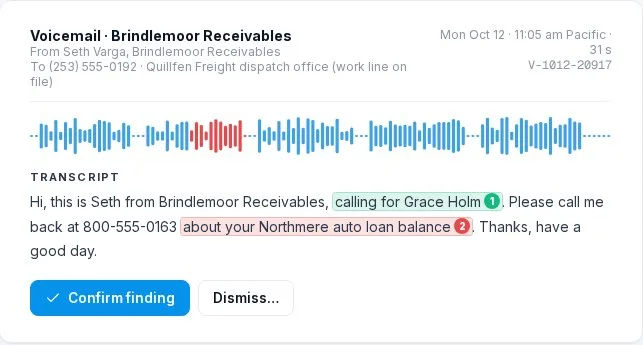
A voicemail that names the debt. Left on Grace Holm's work dispatch line: "about your Northmere auto loan balance". A limited-content message may carry only a business name that does not suggest debt collection, a request to reply, a person's name and a number, plus optional greeting, date, time and call-back hours (12 CFR 1006.2(j)).
A letter $120 too high. $2,316.40 past due "including a $120.00 collection fee"; the bank's system shows $2,196.40 and the retail installment contract allows a late charge only. Both notes cite the false-representation rule (FDCPA 807(2)(A), 12 CFR 1006.18(b)(2)(i)); a fee the contract does not allow also breaks the unauthorized-amount rule (FDCPA 808(1), 12 CFR 1006.22(b)).
The contact clock. 35,852 calls, voicemails and texts by hour on the borrower's own clock. Seven fall outside 8 a.m. to 9 p.m.: five from one agency at 9 p.m., one at 9 p.m. from another, one at 7 a.m.
Why the late contacts happened. Borrowers who moved east kept California numbers, and the dialer scheduled by area code, so 6:18 p.m. Pacific was 9:18 p.m. in Richmond. The screen's note says five borrowers; the list shows four, one of them twice, for five contacts: four calls and a text. Beside it, accounts over seven calls in seven days, counted per debt.
Coaching from the moment. Each confirmed finding becomes a playable clip on the collector's card, sent with the agency's trainer's name.
The review log. Every conversation checked each day, the rule version, the result and who decided, with Dana's 9:13 a.m. decision recorded as its own entry.
The exam package. A period and teams, then everything an examiner or agency auditor asks for in one export.
Dismissing needs two people. A red finding is closed without action only with a reason and the compliance manager's second signature.
The bank's rules. 41 rules with their sources and severity, version 2026.10.2 approved by two people, and the settings the bank owns. The state list shows Massachusetts, the New York City recording notice and Washington; New York City's three-contacts-per-account cap, in force since September 1, 2026, would be added here.
How the call was checked. Each step with what it found and how long it took; the contact checker placed the call at 6:52 p.m. in Phoenix, the fourth call on this debt in seven days.
The agency letter. Drafted from the confirmed findings with their clips; the agency management lead reads and sends it.
Select any screen to open it larger. The bank, agencies, borrowers, collectors and figures are fictional.
14 · Agents, and who decides
An analyst confirms every red finding and a manager co-signs every dismissal: what the six agents may and may never do
In shortEach agent does one job. None of them decides a breach, contacts a borrower, blocks a call or writes to an agency. People confirm, dismiss, coach and send. Rules are versioned, and every check records the version it ran under.
Six checkers, each with one job and a line it never crosses
Call and voicemail transcriber
Transcribes every call and voicemail, separates the speakers and time-stamps every word; redacts card numbers.
Never scores a call or keeps audio beyond the bank's retention schedule.
Disclosure checker
Checks the recording notice, the debt-collector disclosure, right-party verification, the limited-content voicemail and the text and email opt-out.
Never treats a third party as the borrower.
Third-party and conduct checker
Finds third-party disclosures, threats, false or misleading statements, abusive language and actions the account does not support, reading the account record beside the words.
Never decides a breach; it proposes one, with the quote.
Contact time and frequency checker
Places every contact on the borrower's clock from the address on file, counts calls per debt over seven days, and checks attorney, stop, bankruptcy and state limits.
Never dials or blocks a call; it alerts.
Vulnerability listener
Hears hardship, illness, bereavement, disability, a dispute, a complaint, military orders or an attorney named, and routes the account to the right team.
Never labels a person; it routes the account.
Findings writer
Writes one finding per conversation with the quoted moment, the rule, the coaching item and the effect on the agency's score.
Never closes a red finding or sends anything to an agency without a person.
Four people who confirm, co-sign, check the checks and write to agencies
Confirms or dismissesCollections compliance analystHears every red finding at its second, confirms or dismisses it, refers vulnerability signals.
Second signatureCollections compliance managerCo-signs any dismissal of a red finding, with the reason and the recording in front of them.
Checks the checksQuality analystHears 1% of clean conversations each day and calibrates the rules when a flag was wrong or missing.
Sends to agenciesAgency management leadReads and sends each remediation letter with its clips; owns placement reviews.
The review log is append-only: conversation, checks, rule version, finding, decision, who and when. Agents' steps and people's decisions are recorded apart. Audio and transcripts are kept under the bank's retention schedule; Regulation F requires a debt collector that records calls to keep each recording for three years after the call.
Dana, Theo, Beth and Jordan: the fictional team on these screens
Fictional, from the sample data
DW
Dana Whitlock · collections compliance analyst, Northmere Bank
Clears the overnight red findings by mid-morning, then works the review log.
"I used to hear 300 calls a week out of 90,000. Now I hear the 38 that matter."
TM
Theo Marsh · quality analyst
Calibrates the checks and hears 1% of the clean conversations.
"If the flag is wrong, I want to know which sentence fooled it."
BO
Beth Okafor · agency management lead
Owns placements with three agencies and writes their remediation.
"Calder and Voss gets my letter with the call attached, the same morning."
JP
Jordan Pike · collector, Calder & Voss Collections
About 90 dials a shift.
"Nobody told me the sister counted."
15 · What goes in and out
What the monitoring reads from your dialer, letter vendor and servicing system, and the findings, clips and exam log it leaves
In shortThe monitoring reads the conversations the bank and its agencies already keep, with the account facts beside them, and leaves behind one finding per conversation with the quoted moment, coaching items per collector, agency scores on the same checks, remediation drafts and an append-only review log. The dialer, the servicing system and the agencies' platforms stay as they are.
Conversations
Call recordings and voicemails, the bank's and each agency's
Texts and emails as sent
Letters as mailed, from the letter vendor or the agency
Which findings are red, who confirms, who co-signs
Agency score weights and the remediation template
Agents check every conversation overnightAgainst Regulation F, the FDCPA, state rules and your policy, with the account record beside the words
A person confirms every red finding
Every finding pinned to its second or sentence
Outputs
One finding per conversation with the quoted moment and the rule
Coaching items per collector, as playable clips
Agency compliance scores and red findings per 1,000
Remediation drafts with the clips attached
The append-only review log and exam package
What changes for the team
Analysts hear flagged moments instead of whole random calls
Agencies compared on the same evidence
Messages and letters checked as closely as calls
Eight systems the nightly checks draw on
Dialer and call recordingRecordings and attempt logs, the bank's and agencies'
Text and email platformsMessages as sent, opt-outs
Letter vendorLetters and templates as mailed
Collections or servicing systemAmounts, flags, addresses, consent
Agency placement platformWhich agency holds which account
Complaint managementComplaints matched to conversations
Military status and bankruptcy noticesStatus checks and filings
Identity and accessRoles, maker-checker, separation of duties
For each, check whether it has an API, a file feed, or only screens, and who owns it. Agency recordings need a contract term that gives the bank the recordings and messages themselves.
What every finding carries: its moment, the account record and a person's decision
1
Pinned to its moment
The second in a call or the sentence in a message or letter, one click away for the analyst, the collector and the examiner.
2
Read against the account
Repossession, amount, attorney, bankruptcy, consent and address come from the record, so a lawful sentence is not flagged as a threat.
3
Agents propose; people decide
A named analyst confirms each red finding, a second person co-signs any dismissal, and nothing reaches an agency without a person.
Part C · Are you ready to automate?
Deciding whether to check every collection conversation: unheard breaches, review hours, readiness, vendor questions and a pilot
You check collection conversations, manage the people who do, oversee agencies or answer for the result. This part is written for you: what unheard breaches cost today, what checking every conversation could return, whether your team is ready, and what to ask any vendor of monitoring software, including us.
16 · What missed breaches cost
The price of a breach nobody heard: damages per call or text, class actions, and one template error repeated across thousands of letters
In shortStart from your own numbers. The law sets the price of a single breach: up to $1,000 plus fees under the FDCPA, $500 to $1,500 for each call or text under the TCPA. What multiplies it is repetition, because a dialer setting or a letter template repeats the same breach across thousands of accounts before anyone hears one.
$1,000
in additional damages for one FDCPA plaintiff, plus actual damages and attorney's fees; a class can recover up to the lesser of $500,000 or 1% of the collector's net worth.12
15 U.S.C. 1692k
$500–$1,500
for each autodialed or prerecorded call or text without consent, trebled when willful or knowing; 78% of September 2025 TCPA suits were class actions.9,32
47 U.S.C. 227 · WebRecon
3,246
FDCPA lawsuits filed in federal courts in the first nine months of 2025, with 2,128 under the TCPA.32
WebRecon, January to September 2025
The same reading time hears 38 serious breaches instead of fewer than one
One night at the example bank: a person hears or reads about 826 conversations under a 2% random sample, and 851 when every conversation is checked and people hear the flags
2% random sampleEvery conversation checked
Serious breaches among the conversations a person hears0.7638
Fictional example from this guide · With full coverage a person hears the 38 red findings, the 412 amber findings in weekly batches and 1% of the 40,072 clean conversations (about 401). The sample's 0.76 is the expected number of the 38 it contains.
Show the numbers
2% random sample
Every conversation checked
Serious breaches among the conversations a person hears
0.76
38
What nobody publishes. There is no public figure for how many collection conversations carry a breach, how many a typical QA sample finds, minutes per review, or the cost of a breach once defense and remediation are counted. Vendor figures for these come without a dataset. Measure your own.
Measure your coverage, review time and hidden breaches in a week
Cost
Where it hides
How to find your number in a week
Coverage
The share of calls, and of messages and letters, anyone reviews
Divide last month's reviews by last month's conversations, per channel and per agency
Review time
Listening in real time, looking up the account, writing up
Time ten reviews with a stopwatch, by step
Hidden breaches
Rare, serious findings no sample met
Have two reviewers hear 200 random recent calls from your worst agency and count
Complaints
Complaints about conversations nobody reviewed
Match last quarter's collection complaints to the conversations around them; count how many were reviewed first
Lawsuits and demands
FDCPA, TCPA and state claims, settlements and defense fees
Ask legal for the last two years by statute and agency
Agency oversight
Audits of recordings the agency picked; scorecards built on recoveries
List what each agency sends you and how much of its volume that covers
Template and dialer errors
One wrong setting repeated across thousands of accounts
Re-read one week of letters against the account amount, and one week of attempts against the address time zone
Harms that review hours never show
The borrower who was hurtA sister told about a debt, a widow pressed for the full amount, a family called at 9:30 p.m.
The template nobody readA fee the contract does not allow, printed on every letter in a batch.
The agency that looked fineScored on recoveries and a few audited calls until a complaint arrives.
The exam finding on oversightWeak monitoring of collectors and service providers is itself a finding.
The collector nobody coachedThe same sentence repeated for months because no one heard it once.
17 · Your return
Review hours against breaches heard: the arithmetic of a 2% sample and full coverage at your volume
In shortPut in your own numbers. The calculator compares hand-sampling with checking everything and having people hear the flags: the review hours each takes, and how many serious breaches each would hear in a year. Every default is an assumption or the guide's fictional example; replace them.
Six places full coverage pays back, each with its formula
Coverage
Breaches heard
Every conversation is checked, so serious breaches are heard the next morning instead of by chance.
conversations × serious rate × (1 − sample share)
Review time
Moments instead of whole calls
Reviewers jump to the flagged second instead of hearing random calls end to end.
reviews × minutes saved ÷ 60 × hourly cost
Repetition
One setting, fixed once
A dialer time zone or a letter fee is caught after a night, before it repeats for a month.
accounts affected per day × days to detection
Agencies
Comparable scores
Every agency measured on the same checks of all its conversations, with clips for remediation.
placements moved on evidence; remediation days
Coaching
Ten seconds, the next day
Collectors hear their own moment while they remember the call.
repeat findings per collector, before and after
Exams
The record exists
Every check, rule version and decision is already in an exportable log.
hours spent assembling exam and audit evidence
Calculate breaches heard and reviewer hours for your conversation volume
No public source measures breach rates, review minutes or a quality analyst's loaded cost for collections, so every input is an assumption or comes from this guide's fictional example. The 2% default sits inside the "1% to 3%" range an analyst firm estimates for hand-scored coverage.6
Your volumeHand sampling todayChecking everythingYour cost
Illustrative yearly value
Serious breaches in a year0
Heard by today's sample, on average0
More heard by checking everything0
Review hours today0
Review hours checking everything0
Review time saved (or added), valued, less your cost$0
Formulas, per year: Serious breaches = conversations × rate per 1,000 ÷ 1,000 Heard by the sample = serious breaches × share reviewed today More heard = serious breaches × (1 − share reviewed today), assuming the checks catch them; measure the miss rate in a pilot Review hours today = conversations × share reviewed × minutes ÷ 60 Review hours checking everything = conversations × share a person reviews × minutes per flag ÷ 60 Net = (hours today − hours after) × hourly cost − yearly cost; a negative number means coverage costs more reviewer time than sampling did
The example defaults: 0.92 serious breaches per 1,000 is 38 in 41,286 conversations; 2.1% reviewed is 450 red and amber findings plus a 1% clean slice. Not counted: damages and fees avoided, complaints prevented, faster agency remediation, coaching effect and exam evidence.
At 5 million conversations a year, a 2% sample hears 92 of 4,600 serious breaches
Serious breaches heard in a year, by share of conversations reviewed, at 0.92 per 1,000
1% random sample46
2% random sample92
5% random sample230
Every conversation checkedbefore the checks' own miss rate4,600
Illustrative · replace with your own numbers
Show the numbers
Coverage
Breaches heard a year
1% random sample
46
2% random sample
92
5% random sample
230
Every conversation checked
4,600
A lender with 500,000 conversations a year and the same rate has 460 serious breaches; its 2% sample hears about 9. The numbers shrink, the share stays the same.
Start here18 · Readiness check
Eight questions that show whether your collections QA program can move from samples to every conversation
In shortPick the answer closest to your team today. Eight questions score 0 to 2; the last is for reflection. The meter adds up your score as you go, and each question says why it matters and what a strong answer sounds like.
1
Volume
How many collection calls, voicemails, texts, emails and letters do your team and your agencies produce in a month?
Why it mattersRare breaches only add up to a pattern at volume, and sampling falls further behind as volume grows.
A strong answer"About a million a month across all channels, 45% of it at three agencies."
2
Access to conversations
Can you get every recording, text, email and letter, your agencies' included, in a form software can read?
Why it mattersA program is never wider than its recordings. An agency that sends only what it chooses cannot be compared with your own team.
A strong answer"Our dialer exports nightly; two of three agencies send recordings and message logs under the placement contract."
3
Account facts
Can the amount due, address, attorney, stop requests, bankruptcy, military status and consent be read from your servicing system each night?
Why it mattersA threat, an amount or a late call is a breach only against the account. Without the facts, flags turn into guesses.
A strong answer"A nightly file with every flag and the address time zone, owned by collections operations."
4
Rulebook
Are your collection rules written down, with sources, severity, state overlays and a version history, for your own staff and your agencies?
Why it mattersSoftware applies the rulebook you give it. Rules kept as habits produce findings nobody can defend.
A strong answer"One policy, Regulation F adopted for our own collectors, Massachusetts and New York City overlays, approved by two people, versioned."
5
Your baseline
Do you know your coverage by channel, your findings rate per 1,000 conversations, and how many complaints concerned conversations nobody reviewed?
Why it mattersNo public benchmark exists, so your own numbers are the only way to show a change.
A strong answer"1.5% of calls, almost no texts; 3 red per 1,000 in reviewed calls; 80% of last quarter's complaints were about unreviewed contacts."
6
Findings on file
Have examiners, auditors, complaints or lawsuits found collection conduct problems in the last two years?
Why it mattersFindings bring deadlines and budget, and show where to point the first checks.
A strong answer"An audit finding on agency oversight and two TCPA demand letters about texts after a stop request."
7
Who decides
Is it written who confirms a finding, who may dismiss one, who sends to an agency and who marks coaching done?
Why it mattersThose roles become settings. A tool that decides on its own is a tool an examiner will question.
A strong answer"The compliance analyst confirms, the manager co-signs dismissals, the agency lead sends letters, team leads close coaching."
8
Governance
Do you have a path to approve AI that reads borrower conversations: vendor due diligence, privacy and retention, a model risk view under SR 26-2?
Why it mattersThird-party guidance keeps the responsibility with you, and SR 26-2 leaves generative AI to your own framework.25,35
A strong answer"Vendor management, privacy and model risk have a path for AI tools, and recordings stay under our retention schedule."
9
Vision · for reflection
If an examiner asked tomorrow how you know your agencies did not tell anyone's relatives about their debts last month, what would you show?
Why it mattersYour answer lists the gaps: which channels, which agencies, which rules have no evidence behind them.
A strong answerA short, specific list, for example: "every call and voicemail checked, the confirmed findings with their seconds, the dismissals with two names, and the letters sent to each agency."
Explore, pilot or implement: what your QA readiness score means
0–6
Explore
Measure first: your coverage by channel and agency, ten timed reviews, and last quarter's complaints matched to conversations. Fix access to agency recordings in the placement contracts and write the rulebook down.
7–11
Ready to pilot
Run a measured pilot on one agency and one in-house team for eight to twelve weeks, with planted test conversations and a clean slice heard by people, and keep your analysts deciding every finding.
12–16
Ready to implement
Plan every channel and every agency: the account feeds, the rulebook as versioned settings, decision roles, remediation and coaching flows, retention, and the exam package an examiner will ask for.
19 · Questions for any vendor
Fifteen vendor questions that separate collections monitoring that reads the account from keyword spotting
In shortAsk every vendor the same questions, us included. The answers show what is read, how it is judged against the account, what evidence each finding carries, who decides, and how you would measure the tool on your own conversations.
Start where breaches are frequent enough to measure and costly when missed
What one missed instance can cost →
Check every one
Check first
Sample and coach
Automate
Texts after a stopWrong letter amountDebt told to othersLate or early callsOver 7 in 7 daysNo collector disclosureHardship pressed
How often it shows up in complaints and exams →
Our reading of the sources2,3,9,12 · Our reading of complaint counts, exam findings and statutory damages; place your own findings on it. Texts after a stop are autodialed texts sent after a stop request; late or early calls fall outside 8 a.m. to 9 p.m.
Show the numbers
Item
How often it shows up in complaints and exams (0–1)
What one missed instance can cost (0–1)
Texts after a stop
0.35
0.80
Wrong letter amount
0.80
0.68
Debt told to others
0.52
0.58
Late or early calls
0.25
0.37
Over 7 in 7 days
0.66
0.26
No collector disclosure
0.75
0.14
Hardship pressed
0.15
0.56
Ask
A good answer
A warning sign
What it reads
Which channels does it check: calls, voicemails, texts, emails, letters?
All five, with the same rulebook
Calls only, "messages on the roadmap"
Does it check every conversation or a sample?
Every one, with the count shown each night
"Statistically significant samples"
Can it read our agencies' conversations as well as ours?
Yes, by file or API, scored on the same checks
Agencies upload a monthly report
Judged against the account
How does it know whether a repossession threat or an amount is false?
It reads the account record beside the words and shows both
Keyword lists such as "repo" and "garnish"
Which time zone does it use for the 8-to-9 window?
The address on file; the stricter one when address and area code disagree
The phone's area code
How does it count calls: per debt, per person, across channels, with state caps?
Per debt for Regulation F, by each state's own unit, attempts included
One count per phone number
Does it know about consent given earlier, an attorney, a stop request, a bankruptcy or military orders?
From the account record and earlier conversations, cited
Only what is said on this call
Evidence and decisions
What does a finding carry?
The quoted words, the second or sentence, the rule and its version, the account facts
A score and a category
Who confirms and who dismisses?
A named person confirms; a second person co-signs a dismissal
Findings close automatically
Is the record append-only and exportable for an exam?
Yes: every check, rule version and decision, by period and team
Dashboards only
Your data and AI
Which models transcribe and judge, where do they run, and does our data train them?
Named models, a region you choose, no training on your data, in writing
"Proprietary AI"
How are card numbers and sensitive details handled in transcripts?
Redacted before anyone reads them; retention follows your schedule
Kept indefinitely
Proof
Can we test it on our own conversations, with planted breaches, before we sign?
Yes, blind, with a clean set to count false alarms
Demo recordings only
How will we know what it misses?
People hear a random slice of clean conversations daily; misses are reported
"It doesn't miss"
What will you report from the pilot?
Catch rate by rule with counts, false alarms, misses in the clean slice, review minutes
One accuracy percentage
We found no published independent test of any collections monitoring vendor's accuracy, as of October 2026. A test on your own conversations, with planted breaches and a clean slice heard by people, is the fairest comparison, and the same test measures your current sampling.
20 · How to start
Planted breaches and a blind clean slice: piloting full-coverage monitoring on one agency and one in-house team
In shortMeasure your sampling first, then run every conversation from one agency and one team through the tool with planted breaches and a clean slice heard by people, then decide with four numbers. None of these steps commits you to a vendor.
Measure today: coverage by channel and agency, ten timed reviews, and last quarter's complaints matched to conversations.
Write the rulebook the pilot will use: Regulation F, the FDCPA, the TCPA consent rules, your state overlays and your own policy, with severity and a version.
Prepare the data: four weeks of conversations from one agency and one team, the account facts beside them, and 60 planted test conversations across the rules.
Run nightly for six weeks, with your analysts confirming every red finding and a quality analyst hearing 1% of clean conversations blind.
Decide with four numbers: catch rate by rule on the planted set, false alarms, misses found in the clean slice, and review minutes per day.
A twelve-week pilot ends with a decision on four numbers
Your teamVendor
Measure coverage, time reviews, match complaints
Write and version the pilot rulebook
Connect recordings, messages, letters and account facts
Plant 60 test conversations
Nightly checks; analysts confirm every red
Clean slice heard blind by the quality analyst
Score catches, false alarms, misses, minutes
Decide
Week 04812
Illustrative · replace with your own numbers
Show the numbers
Activity
From
To
Measure coverage, time reviews, match complaints
0
2
Write and version the pilot rulebook
1
3
Connect recordings, messages, letters and account facts
1
4
Plant 60 test conversations
2
4
Nightly checks; analysts confirm every red
4
10
Clean slice heard blind by the quality analyst
4
10
Score catches, false alarms, misses, minutes
10
11
Decide
11
12
Five measures that settle the monitoring pilot
Measure
How
Why
Catch rate by rule
Planted breaches caught ÷ planted, per rule, with the count planted
One percentage hides the rules that matter
False alarms
Red findings a person dismissed, per 1,000 conversations
A tool that flags everything wastes the time it saved
Misses in the clean slice
Breaches people found in conversations the checks called clean
The only honest estimate of the miss rate
Review minutes
Stopwatch per confirmed and dismissed finding
The staffing case rests on it
Days to remediation
From conversation to the agency's letter or the borrower's fix
Shows whether repetition stops sooner
A planted set of 60 is enough to see whether each rule works at all. Catching all 20 planted breaches of one rule still allows a miss rate up to about 14% at 95% confidence (1 − 0.05^(1/20)), so the daily clean slice matters as much as the planted test.
The full working-session questions: 21 questions in seven groups
Bring collections operations, compliance, quality, agency management, legal, privacy, vendor management, model risk and IT into one room. Each question says why it matters, what a strong answer looks like, and the warning sign.
A
Conversation counts, products and states in scope
A1
How many conversations a month, by channel, by our team and by each agency?
Why it mattersSets the scale and shows where sampling is thinnest.
Strong answer · warning sign
Counts by channel and team.
"Calls, roughly."
A2
Which products and states are in scope first?
Why it mattersState overlays and product rules differ.
Strong answer · warning sign
A list with the stricter states named.
"All of them."
A3
Do we apply Regulation F to our own collectors as policy?
Why it mattersDecides whether one rulebook can score everyone.
Strong answer · warning sign
Yes, written in the policy.
Nobody knows.
B
Access to conversations
B1
Where are recordings, texts, emails and letters kept, and for how long?
Why it mattersRegulation F expects recordings kept three years after the call.8
Strong answer · warning sign
Named systems and schedules.
Letters only at the vendor.
B2
What do our placement contracts say about agency recordings and messages?
Why it mattersWithout a right to the data, agencies choose what you see.
Strong answer · warning sign
A right to every recording and message.
Monthly summaries.
B3
Is the recording notice on the recording, in every state we call into?
Why it mattersAll-party consent states and New York City require it before collecting.10
Strong answer · warning sign
Checked on every call.
"It's in the script."
C
Account facts
C1
Which fields mark attorney, stop request, bankruptcy, military status and consent?
Why it mattersEach turns a polite call into a breach.
Strong answer · warning sign
Named fields, updated daily.
Free-text notes.
C2
Which time zone does each system use for a borrower?
Why it mattersArea codes travel with people.
Strong answer · warning sign
Address first, the stricter of two.
The dialer decides.
C3
Do letter templates pull amounts from the system of record?
Why it mattersA template fee repeats on every letter.
Strong answer · warning sign
Yes, with fee rules per contract.
Agencies build their own.
D
Findings and complaints
D1
What did exams, audits, complaints and lawsuits find in the last two years?
Why it mattersPoints the first checks.
Strong answer · warning sign
A list by rule and team.
Nobody tracks them.
D2
Are complaints matched to the conversations around them?
Why it mattersShows what monitoring missed.
Strong answer · warning sign
Yes, each one.
Complaints handled apart.
D3
How are vulnerable borrowers identified and routed today?
Why it mattersPressing a borrower after a hardship disclosure can be abusive.4
Strong answer · warning sign
Named signals and a team.
Left to the collector.
E
Decisions and coaching
E1
Who confirms, who dismisses and who co-signs?
Why it mattersMaker-checker becomes a setting.
Strong answer · warning sign
Written roles.
"Whoever is free."
E2
How do agencies receive findings, and in what time?
Why it mattersRemediation speed stops repetition.
Strong answer · warning sign
Letters with clips, a due date.
Quarterly business reviews.
E3
How do team leads coach today?
Why it mattersClips change coaching only if leads use them.
Strong answer · warning sign
Weekly, from moments.
From monthly scores.
F
Model risk, privacy and a sponsor
F1
How does model risk classify a tool that judges conversations under SR 26-2?
Why it mattersGenerative AI is left to your own framework.35
Strong answer · warning sign
A view by component.
Still citing SR 11-7.
F2
What do privacy and vendor management need before borrower recordings leave our systems?
Who sponsors the change, and what budget can move?
Why it mattersA pilot without a sponsor ends as a demo.
Strong answer · warning sign
A named executive.
No sponsor.
G
A next-morning standard
G1
What if every serious breach were heard by the next morning?
Why it mattersTests the appetite for a next-day standard.
Strong answer · warning sign
"We'd fix dialers and templates in a day."
"We'd drown in findings."
G2
What if every agency were scored on all of its conversations?
Why it mattersLinks monitoring to placements.
Strong answer · warning sign
Placements would follow conduct.
Recoveries only.
G3
Which decisions would we never let software make?
Why it mattersTells you where the signatures belong.
Strong answer · warning sign
Confirming, dismissing, writing to agencies and borrowers.
"All of them": then start with the counts and clocks.
21 · Frequently asked questions
The 7-in-7 rule, talking to family, voicemail wording, TCPA revocation and QA sample size: answers for collections compliance teams
In shortThe questions collections and compliance teams search for most, each answered on its own.
What is collections compliance monitoring?
Collections compliance monitoring is reviewing collection calls, voicemails, texts, emails and letters after they happen and testing each against the debt collection rules, state laws and the lender's policy. Confirmed problems become coaching for collectors, remediation for agencies, fixes for borrowers and entries in an exam record. It can be done on a random sample or on every conversation.
What is the 7-in-7 rule in debt collection?
Under Regulation F, 12 CFR 1006.14(b)(2), a debt collector is presumed to harass if it places more than seven telephone calls in seven consecutive days about one debt, or calls within seven days after a phone conversation about it. Staying within the count is presumed compliant, but that presumption can be overcome, for example by many calls after a request to stop. The count is per debt and excludes calls that did not connect and calls made with recent consent.
Can a debt collector talk to my family about my debt?
A debt collector may talk about the debt only with the consumer, the consumer's spouse, a parent of a minor, a guardian, an executor, the consumer's attorney, the creditor and a few others listed in Regulation F 1006.6. It may contact other people only to find the consumer's location, without saying there is a debt. Telling a sister, a roommate or a coworker about the debt is a third-party disclosure.
What times can debt collectors call?
Without knowing otherwise, a collector must assume that before 8 a.m. and after 9 p.m. at the consumer's location is inconvenient, and the rule covers texts and emails too. The time that counts is the borrower's local time, and when the address and the phone's area code point to different time zones, the contact must fall inside the window in both. Some states are stricter, and a consumer who says a time is bad has made it inconvenient whatever the clock says.
What can a debt collector say in a voicemail?
A limited-content message under Regulation F may contain only a business name that does not suggest debt collection, a request to call back, a person's name and a phone number, with an optional greeting, the date and time, and suggested call-back times. Anything that mentions a loan, an account or a balance makes the voicemail a communication, which can be a third-party disclosure if someone else hears it.
Does the FDCPA apply to banks collecting their own loans?
Generally no: the FDCPA covers debt collectors collecting debts owed to someone else. A bank collecting its own loans is still covered by the federal ban on unfair, deceptive or abusive practices, by state laws written for creditors such as Massachusetts' call limits and California's Rosenthal Act, and in New York City by the city's rules. Many banks apply Regulation F to their own collectors as policy.
How did TCPA revocation of consent change in 2025 and 2026?
Since April 11, 2025, consumers can revoke consent to autodialed or prerecorded calls and texts by any reasonable means, such as replying "stop", and callers must honor it within 10 business days. The rule that one revocation would cover all of a caller's robocalls and robotexts never took effect: the FCC replaced it in an order adopted September 30, 2026 and effective November 25, 2026, under which a caller may name an exclusive opt-out method and treat a revocation of an informational message as covering only that category. AI-generated voices count as artificial voices under the TCPA.
What percentage of collection calls should QA review?
No rule sets a review percentage. Hand-scored coverage in contact centers is often estimated at 1% to 3%, and a random sample hears that same share of breaches on average, so rare serious breaches are mostly missed. Programs that check every conversation with software still have people hear the flagged moments and a random slice of conversations the checks called clean.
How do examiners review debt collection calls?
The CFPB's examination procedures tell examiners to review the firm's own monitoring policies, reports to management, complaint logs and exception reports, then to review a sample of records and listen to a sample of collection calls, live and recorded. Regulation F requires collectors that record calls to keep each recording for three years after the call.
How should a lender monitor its collection agencies?
Score every agency on the same checks of all its conversations, with direct access to recordings and messages written into the placement contract, and send remediation with the specific moments attached. Federal third-party guidance says using an agency does not diminish the bank's responsibilities. Audits based on recordings the agency chose rank good and poor agencies the same until a complaint arrives.
What are the most common debt collection complaints?
In 2025 the most common issue in published CFPB debt collection complaints was attempts to collect a debt the consumer says is not owed, 115,682 of 283,203. Among conduct a monitor can test, attempts to collect the wrong amount led with 36,202, followed by frequent or repeated calls with 5,066. The CFPB names credit reporting of unrecognized collections as a principal reason for the rise in 2025.
Can AI monitor debt collection calls for compliance?
AI can transcribe every call, read every message and letter, place contacts on the borrower's clock, count calls per debt and flag moments that may break a rule. To be relied on, each finding should quote the words, give the second or sentence and the rule, and be read against the account record, and a person should confirm it. Measure the misses by having people hear a random slice of conversations the tool called clean.
22 · Printable checklist
A printable checklist for collections compliance monitoring: six checks, the October 2026 rules, readiness bands and 13 terms
Print this page
In shortThe whole guide on one screen: what to check, the rules as of October 2026, the readiness bands and the terms.
What to check, every conversation
Who heard it: third parties, a spouse, an attorney, a coworker on a shared line.
When and how often: the borrower's local clock, 7-in-7 per debt, state caps, stop requests and media.
What was said: disclosures, threats, false statements, abusive language, hardship heard and routed.
What the account says: amount, fees, repossession, attorney, bankruptcy, military status, consent.
Messages and letters: limited-content voicemails, opt-outs, validation notices, true names.
Decide, coach, remediate and record: a named person confirms, a second signs dismissals.
Readiness: score 0–2 on eight questions: 0–6 explore · 7–11 pilot · 12–16 implement.
As of October 2026: Regulation F rule text unchanged since November 30, 2021 · CFPB withdrew 67 guidance documents on May 12, 2025 · TCPA revocation by any reasonable means from April 11, 2025; from November 25, 2026 callers may name an exclusive opt-out method and revocations of informational messages can cover one category · New York City contact cap from September 1, 2026 · SR 26-2 replaced SR 11-7 on April 17, 2026.
13 terms
FDCPA
The federal Fair Debt Collection Practices Act, mainly for third-party collectors.
Regulation F
The CFPB's rule under the FDCPA, 12 CFR 1006, in force since 2021.
UDAAP
Unfair, deceptive or abusive acts or practices; reaches lenders collecting their own loans.
First-party / third-party
The lender's own collectors / an agency collecting for it.
Third-party disclosure
Telling someone other than the borrower, spouse or attorney about the debt.
7-in-7
More than seven calls in seven days per debt, or a call within seven days of a conversation.
Limited-content message
A voicemail with a business name, a person, a number and a request to reply; nothing else.
Mini-Miranda
"This is a debt collector" disclosure required in first and later contacts.
Validation notice
The written notice of the debt and dispute rights, due within five days of first contact.
TCPA revocation
Withdrawing consent to autodialed or prerecorded calls and texts, by any reasonable means or by the opt-out method the caller names.
Automatic stay
The bankruptcy bar on collecting debts that arose before the filing.
Calibration
Reviewers scoring the same conversations to agree on how a rule is read.
Clean slice
A random share of conversations the checks passed, heard by a person to measure misses.
23 · Sources
Sources
Accessed October 2026. Regulatory status statements are as of October 2026.
CFPB, "Consumer Response Annual Report, January 1 – December 31, 2025", March 31, 2026. files.consumerfinance.gov
CFPB, Consumer Complaint Database, product "Debt collection", by date received, inclusive end dates, queried October 31, 2026. consumerfinance.gov
Consumer Financial Protection Act, unfair, deceptive or abusive acts or practices, 12 U.S.C. 5531, Cornell Legal Information Institute. law.cornell.edu
Massachusetts Attorney General's debt collection regulations, 940 CMR 7.04, Cornell Legal Information Institute. law.cornell.edu
ISG Research (formerly Ventana Research), "Contact Center Quality Processes Must Modernize for the Digital Era", July 15, 2022. research.isg-one.com
eCFR, 12 CFR part 1006 (Regulation F, Debt Collection Practices), current as of October 29, 2026, with its official interpretations (Supplement I); rule text unchanged since November 30, 2021, last amended April 19, 2023 (commentary and Appendix A). ecfr.gov
Telephone Consumer Protection Act, 47 U.S.C. 227, Cornell Legal Information Institute. law.cornell.edu
New York City Department of Consumer and Worker Protection, Notice of Adoption of rules relating to debt collectors (6 RCNY 2-193 and 5-77), February 2026, effective September 1, 2026. rules.cityofnewyork.us
Fair Debt Collection Practices Act, 15 U.S.C. 1692k (civil liability) and 1692a (definitions), Cornell Legal Information Institute. law.cornell.edu
Servicemembers Civil Relief Act, 50 U.S.C. 3937, Cornell Legal Information Institute. law.cornell.edu
Bankruptcy Code, automatic stay, 11 U.S.C. 362, Cornell Legal Information Institute. law.cornell.edu
FCC, Report and Order and Further Notice (TCPA Consent Order), FCC 24-24, released February 16, 2024. docs.fcc.gov
FCC Consumer and Governmental Affairs Bureau, Order, DA 25-312, April 7, 2025. docs.fcc.gov
FCC Consumer and Governmental Affairs Bureau, Order, DA 26-12, January 6, 2026. docs.fcc.gov
CFPB, "Interpretive Rules, Policy Statements, and Advisory Opinions; Withdrawal", 90 FR 20084, May 12, 2025. federalregister.gov
Supreme Court of the United States, McLaughlin Chiropractic Associates v. McKesson Corp., No. 23-1226, June 20, 2025. supremecourt.gov
FCC, Report and Order and Further Notice of Proposed Rulemaking, FCC 26-67, adopted September 30, 2026, released October 1, 2026; published as "Enhancing the Ability of Consumers To Control the Robocalls", 91 FR 67214, October 26, 2026, effective November 25, 2026. federalregister.gov · docs.fcc.gov
FCC, Declaratory Ruling on AI-generated voices under the TCPA, FCC 24-17, released February 8, 2024. docs.fcc.gov
Washington Collection Agency Act, RCW 19.16.250, Washington State Legislature. app.leg.wa.gov
California Rosenthal Fair Debt Collection Practices Act, Civil Code 1788.2, FindLaw (current as of January 1, 2026). codes.findlaw.com
U.S. Department of Justice, "New York Auto Finance Company to Compensate Servicemembers for Illegal Repossessions", September 29, 2025. justice.gov
Federal Reserve, FDIC and OCC, "Interagency Guidance on Third-Party Relationships: Risk Management", 88 FR 37920, June 9, 2023. federalregister.gov
CFPB, enforcement action: Navy Federal Credit Union, 2016-CFPB-0024, October 11, 2016. consumerfinance.gov
CFPB, enforcement action: Portfolio Recovery Associates, LLC (2015 order; complaint and stipulated judgment March 23, 2023, entered April 13, 2023). consumerfinance.gov
Carscoops, "Toyota agrees to $7.6 million Massachusetts settlement over illegal loan collection practices", February 6, 2023 (trade press: the Attorney General's release on mass.gov refuses automated reads, so the settlement terms are cited from this report and from Goodwin). carscoops.com
Goodwin, "Massachusetts AG Enters Into $7.6 Million Settlement With Auto Dealer", February 8, 2023. goodwinlaw.com
Hudson Cook, "Recent Settlement with Massachusetts AG Addresses Compliance Emphasis on Collection Calls, Repossession Notices and Service Contract Sales", 2021. hudsoncook.com
accountsRecovery.net, "WebRecon September 2025 Stats", October 28, 2025. accountsrecovery.net
Troutman, Consumer Financial Services Law Monitor, "May 2026 Consumer Litigation Filings" (WebRecon data), July 2026. consumerfinancialserviceslawmonitor.com
NIST, "Artificial Intelligence Risk Management Framework (AI RMF 1.0)", NIST AI 100-1, January 2023. nvlpubs.nist.gov
Federal Reserve, SR 26-2, "Revised Guidance on Model Risk Management", April 17, 2026 (issued with OCC Bulletin 2026-13 and FDIC FIL-15-2026). federalreserve.gov
Next step
See it on a night of your own conversations.
Explore the solution, or bring a day of your own recordings, messages and letters with the account facts behind them, and we will check every one with you, each finding pinned to its second or its sentence.
We use essential cookies to make this site work, and cookieless, anonymised analytics to understand how it's used. "Accept all" also turns on Google Analytics, which sets cookies. Privacy policy