Underrepresented populations in clinical trials are usually discussed as a problem of willingness — of trust, of outreach, of how a study is explained. That conversation matters, and it is also downstream of a quieter decision nobody describes as a decision: which patient list gets pre-screened in the first place. A site that reads its main-campus tumour-board list every morning has applied a sampling rule to its own population before any patient has been asked anything, and the rule has a demographic shape. Botminds' Clinical Trial Patient Matching reads the records of every clinic a site runs, not just the list a person had time for, and reports the result to the sponsor as counts. This guide is about that lever, which is one of the few a site can pull without a new protocol, a new site or new money.
The research on this page comes from peer-reviewed studies, the FDA and the Department of Health and Human Services, linked where it appears. The site, protocol and patients are fictional sample data: Lakemont Cancer Institute, a main campus and three satellite clinics, running VLT-411 against 24 criteria.
Pivotal trials whose enrolment matches the US population
Why are some groups underrepresented in clinical trials?
Because several independent filters act in sequence, and the ones that do most of the work sit before anybody is asked to take part. A trial has to exist for the disease. It has to be open at an institution the patient attends. Somebody at that institution has to consider that patient against it. The patient has to clear the protocol's criteria. Only then does willingness enter — and willingness is the filter most interventions are aimed at.
The order matters because the filters are not independent of geography. The same paper that reports the 6% figure concludes that “Trial location and regulatory designations influence who is included”, and recommends “Earlier planning of trials and more strategic site selection”. Where a trial is open decides, before anything else, which populations can be in it.
Within a site, the same logic applies one level down. Which of the institution's clinics are read is a location decision made every morning by whoever has the list.
Before willingness comes availability: 55.6% were never offered a trial at all
The clearest measurement of the sequence comes from Unger and colleagues, who pooled 13 studies and 8,883 cancer patients. A trial was unavailable for patients at their own institution 55.6% of the time. Of the rest, 21.5% were ineligible for an available trial and 14.8% did not enrol; 8.1% enrolled. Not enrolling once a trial was available and the patient eligible — the stage where the patient's and the physician's choices sit — is the smallest of the three losses, and it comes last.
Three numbers that order the problem
341trials
phase III trials supporting US approvals from 2017 to 2023, analysed for how closely enrolment matched the population
55.6%
of the time no trial was open for the patient at their own institution
5–7%
of adult cancer patients enrol in a trial, despite the growth in trials available
Each of those stages has a different owner. Whether a trial exists belongs to the sponsor. Whether it is open at this institution belongs to the sponsor and the site together. Whether this patient was considered against it belongs to the site alone — and it is the only one a research office can change between now and the end of the quarter.
Site selection, and the sentence that explains most of it
The availability figure is not an accident of epidemiology. A 2014 report prepared for the Department of Health and Human Services on clinical trial costs and barriers puts the mechanism in one line among its findings on recruitment: sites are often chosen for where the investigators are, not for where the patients are. The same section notes that “Patient recruitment requires a substantial investment of time and money” and that failure to recruit causes costly delays or cancellation.
Those two sentences, side by side, describe a system that chooses sites for the convenience of the research enterprise and then spends heavily trying to find patients near them. A site cannot fix that. What a site can do is make sure that, once chosen, it actually considers the patients it already serves — all of them, not the ones on the most convenient list.
Is a diversity action plan required by the FDA?
Not yet, in the sense that matters to a site: the guidance that would make it operative is a draft, published in June 2024 under docket FDA-2021-D-0789, and the FDA's own page still marks it “Not for implementation” — the page was taken down early in 2025 and restored under a court order, still as a draft. The underlying obligation is statutory, not a guidance invention — the FDA issued the draft “as mandated under section 3602 of FDORA, which requires that FDA update or issue guidance relating to the format and content of diversity action plans required by sections 505(z) and 520(g) of the FD&C Act” — and the agency has said which part will bite: insofar as the guidance specifies the form and manner for submission, “it will have binding effect, once this guidance is finalized”.
The practical reading for a site is therefore: a sponsor you work with may already be writing diversity action plans, because the statute exists and sponsors plan ahead; nobody can yet tell you what format FDA will require; and anything a site does now should be the thing that would help under any version of the rule. Check the guidance's status on the FDA's page before you rely on this paragraph.
The thing that helps under any version is a count you can defend: how many patients were considered, from where, and what happened to them. That is a by-product of pre-screening done properly, not a separate reporting exercise.
The pre-screening list as a sampling rule
Here is the argument in its sharpest form. A site has, say, several thousand patients with the relevant disease across its campuses. Nobody can read several thousand charts against 24 criteria, so a list is used. That list is a sample. Every property of the sample — its size, its sites, its referral pattern, who attends which clinic — is inherited by the shortlist, the referrals and ultimately the enrolment. Choosing the list is choosing the sampling frame, and nobody writes it down as a methodological decision because it does not feel like one. It feels like the only list there was time for.
Four lists a site could pre-screen, and what each one is
| The list | Who is on it | What it costs to read by hand | What it misses |
|---|---|---|---|
| The tumour-board list | Patients whose case was discussed this week — usually complex, usually main campus, usually already under a specialist. | An hour or two. It is the list sites actually use. | Anyone whose case was straightforward enough not to be presented, and anyone seen elsewhere. |
| New-patient notes | Everyone newly referred into the service this week. | Half a day a week, and it grows with the service. | Established patients, who are most of the population and whose disease has had time to change. |
| The whole main campus | Every patient of the service at the main site, new and established. | Not feasible by hand against 24 criteria. This is the answer. | Every patient seen at a satellite clinic. |
| Every clinic the site runs | The site’s whole population for the disease, wherever they are seen. | Not feasible by hand at all. | Patients of other institutions — which is the sponsor’s problem, not the site’s. |
The method for reading a list that size is the same as for reading one chart — the criterion map, the three verdicts, the dated question — applied without an afternoon's limit. It is set out in pre-screening patients for clinical trials.
Reading every clinic, not just the main campus
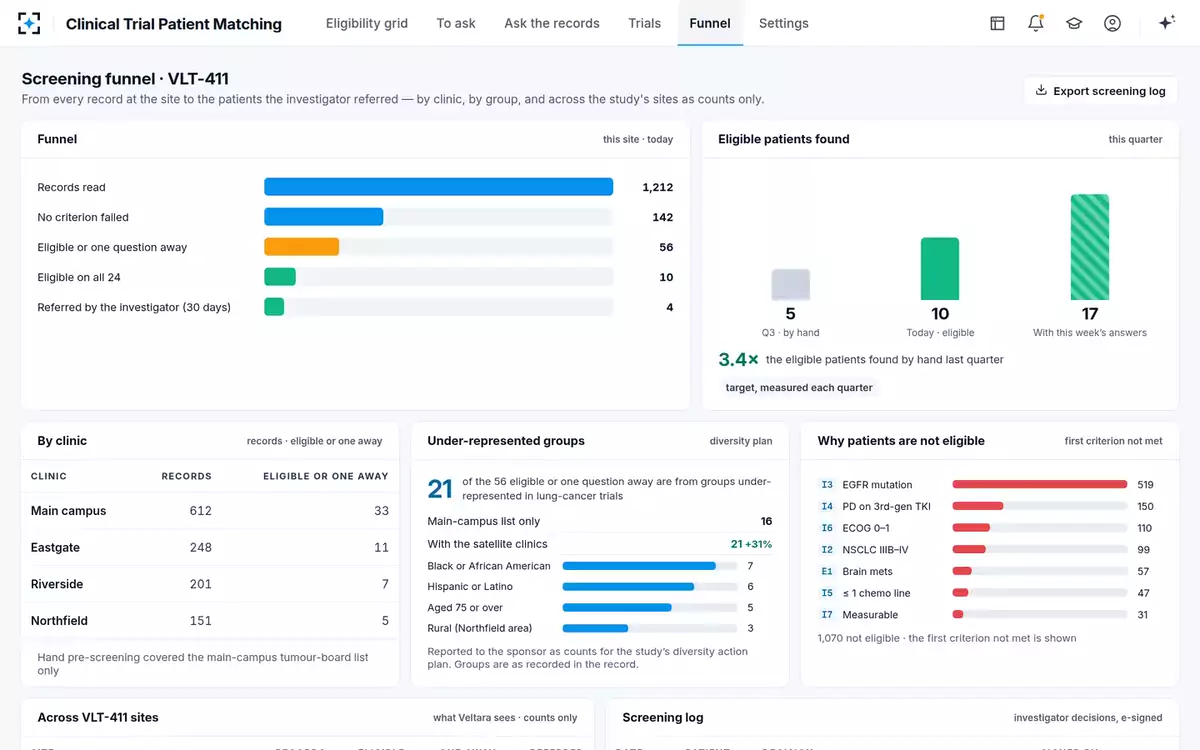
On the sample data the difference between the two lists is visible in one morning. Hand pre-screening of the main-campus tumour-board list found 5 eligible patients last quarter. Reading all 1,212 records against all 24 criteria produces 142 patients with no criterion failed: 9 met on all 24, 47 one question away, 86 two or three away. When the scanned outside pathology report arrives for one of the 47, she moves up and the count of patients met on all 24 becomes 10; with this week's answers the site projects 17 — a target of 3.4 times the 5 found by hand.
The main-campus list alone, against every clinic read
The tumour-board list, by hand: The main-campus tumour-board list and new-patient notes, as far as the afternoon allows.
Every clinic, with Clinical Trial Patient Matching: 1,212 records from the main campus and three satellite clinics, overnight.
The tumour-board list, by hand: As many as time allows; the rest are judged on the clinical picture.
Every clinic, with Clinical Trial Patient Matching: All 24, each with the line in the record that decides it — 29,088 checks.
The tumour-board list, by hand: 5 eligible patients found last quarter.
Every clinic, with Clinical Trial Patient Matching: 56 eligible or one question away; 9 met on all 24, 10 once the outside report is read, 17 projected once this week’s questions are answered.
The tumour-board list, by hand: Not counted. Of the 21 on the right, 16 are main-campus patients.
Every clinic, with Clinical Trial Patient Matching: 21 of the 56, five of them seen only at satellite clinics.
The tumour-board list, by hand: The main campus.
Every clinic, with Clinical Trial Patient Matching: Every clinic, including Eastgate — which hand pre-screening never covered.
The tumour-board list, by hand: A screening number.
Every clinic, with Clinical Trial Patient Matching: Counts by site and week, with each group as it is recorded in the record.
The funnel, from records read to referrals, by clinic
Counting representation honestly, and reporting it as counts
Two rules keep this work defensible. The first is to report each group as it is recorded in the record, rather than inferring it: a pre-screening process has no business deriving ethnicity from a name, an address or a language preference, and a count built that way cannot be defended to anyone. The second is to report counts by site and by week, never patients — which is also what the privacy basis for a records review requires, as pre-screening and screening in clinical trials sets out.
The sample shortlist, two ways
The 56 eligible or one question away, by how close they are
- Met on all 24 criteria (9) · 16%
- One question away (47) · 84%
The same 56, by whether they are from groups under-represented in lung-cancer trials
- From under-represented groups (21) · 38%
- Not (35) · 62%
A site that can produce those two bars every month has something more useful than a diversity statement: it has a measurement of its own sampling frame, which it can compare with the population it serves. If the shortlist's composition differs sharply from the clinic population's, the question is which list is being read — and that question has an answer the site controls.
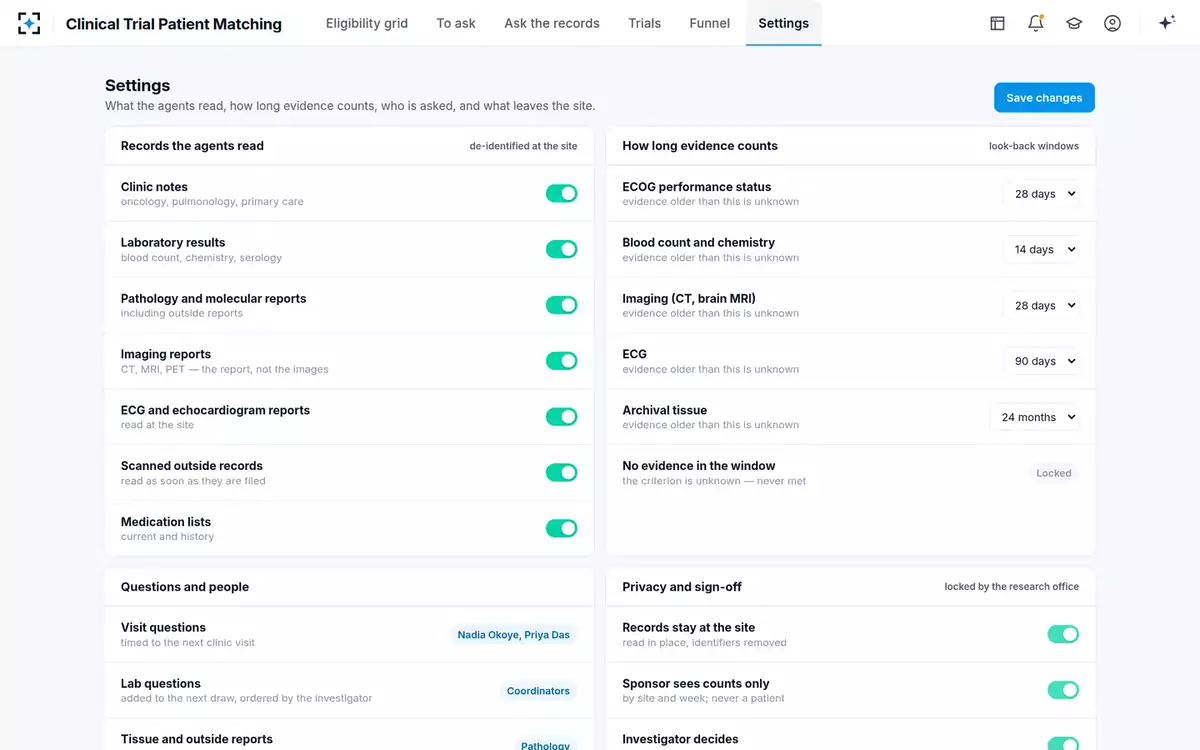
What the agents read, and from where
What a site can change this quarter
Protocols, sites and budgets move on sponsor timescales. The list does not. These are the changes that sit inside a research office's own authority, and none of them needs an amendment.
Who owns each filter, and which one moves this quarter
| The filter | Who owns it | How long it takes to change | What a site can do about it |
|---|---|---|---|
| Does a trial exist for this disease? | The sponsor, and the field | Years | Nothing directly. Report accrual honestly so the next protocol is sized on real numbers. |
| Is it open at this institution? | The sponsor and the site together | Months, at feasibility | Make the case with its own population figures, by clinic, rather than a single catchment claim. |
| Was this patient considered against it? | The site alone | This quarter | Widen the list. This is the row the page is about. |
| Do the protocol’s criteria admit this patient? | The protocol author, at design time | One amendment, if at all | Send criterion-level counts back, so an exclusion that excludes your patients can be re-examined. |
| Does the patient want to take part? | The patient | One conversation | Ask well, at the right visit, with the treating clinician informed. It is the last filter, not the first. |
Five things a site can do before the next protocol lands
- Write down which list you actually pre-screen
Name it in the SOP, with its boundaries. A sampling frame that is written down can be argued about; one that is habit cannot.
- Count your own clinic population by group, once
As recorded, not inferred. Compare it with the composition of last year’s shortlist. The gap is your number, and nobody else can give it to you.
- Add one clinic to the frame and measure what changes
A single satellite clinic is a cheap experiment. On the sample data, reading every clinic rather than the main campus alone takes the under-represented count on the shortlist from 16 to 21.
- Send criterion-level counts back to the sponsor
A protocol author can act on a count of otherwise-eligible patients excluded by one named criterion, and on how close their values were. They cannot act on a complaint about restrictive criteria.
- Ask the sponsor which exclusions have been re-examined
The FDA’s own guidance asks sponsors to “examine each exclusion criterion to determine if it is needed … If it is not needed, consider eliminating or modifying the criterion to expand the study population.”
Whose morning the first of those changes, and what happens to the questions a wider list produces, is set out in clinical research coordinator workload, and where pre-screening hours go. To see every clinic in one funnel, start from Clinical Trial Patient Matching.
Questions people ask
What is a diversity action plan for a clinical trial?
A document in which a sponsor sets enrolment goals for a study's clinically relevant population — by age group, sex, and racial and ethnic characteristics — and describes how it will meet them. The obligation comes from sections 505(z) and 520(g) of the Federal Food, Drug, and Cosmetic Act as amended in 2022; FDA's draft guidance on its form and content was published in June 2024, and the FDA's guidance page still lists it as a draft.
How do you measure representation in trial enrolment?
By comparing enrolment with a defined reference population and saying which one you used. The Communications Medicine analysis compared 341 phase III trials with the US distribution of the four largest racial and ethnic groups and found 6% aligned. A site's own version is narrower and more useful: compare the composition of your shortlist with the composition of the clinic population you serve, counting each group as it is recorded.
Why does site selection affect who enrols?
Because a patient can only join a trial that is open where they are treated, and sites are frequently chosen for where investigators are rather than where patients are — the phrasing is from a 2014 report prepared for the Department of Health and Human Services. Unger's pooled analysis puts the consequence at 55.6%: more than half the time, no trial was available for the patient at their own institution.
How can a site reach patients at satellite clinics?
By putting those clinics inside the pre-screening frame rather than outside it, which is a records question before it is an outreach question. On the sample data, 1,212 records from the main campus and three satellite clinics are read overnight against all 24 criteria; the shortlist includes patients at Eastgate, a clinic hand pre-screening never covered.
What percentage of trials match the US population?
Six per cent of pivotal trials, on the most recent analysis: Zaaijer and Groen examined 341 phase III trials supporting US approvals from 2017 to 2023 and found only 6% with enrolment aligned to the distribution of the four largest racial and ethnic groups. They also found enrolment of Black and Hispanic participants decreasing over the period.
What can a site change about representation without a new protocol?
The list it reads. Protocol criteria, site selection and budgets move on the sponsor's timescale; which of the institution's own patients get considered against an open trial does not. Widening the frame from one main-campus list to every clinic is the change available this quarter, and it is measurable from the site's own counts.