Missing data in electronic health records is usually discussed as a statistical nuisance — something to impute before a model is fitted. At a trial site it is not a nuisance; it is a patient. When a chart is silent on an eligibility criterion and the coordinator has no way to mark that silence, the chart is set aside as a no, and the patient is never asked. Botminds' Clinical Trial Patient Matching refuses that collapse: a criterion with no evidence inside its look-back window is marked unknown, never met and never failed, and each unknown becomes one question with a date. This guide is about the distinction underneath that rule — absent is not negative — and about how to count your own screening log so you can see how much of your “not eligible” is really “nobody wrote it down”.
The research figures on this page come from peer-reviewed studies and the FDA's own workshop record, linked where they appear. The site, protocol and patients are fictional sample data: Lakemont Cancer Institute, running VLT-411 against 24 criteria.
Where cancer patients stop, before anyone says no
55.6%
of the time no trial was available for the patient at their own institution
21.5%
of patients were ineligible for an available trial
14.8%
did not enrol once a trial was available and they were eligible
8.1%
enrolled
What missing data in electronic health records looks like at a trial site
It rarely looks like a gap. It looks like a sentence that nearly answers the question. “EGFR+ per outside records” names no variant and no method. “Performance status stable” gives no number. A medicine list shows a strong CYP3A4 inhibitor with no stop date and no note saying why it was prescribed. An imaging report describes disease without saying whether any lesion is measurable by the protocol's criteria. Each of those is a chart doing its real job — communicating between clinicians who already share the context — and failing a job it was never asked to do.
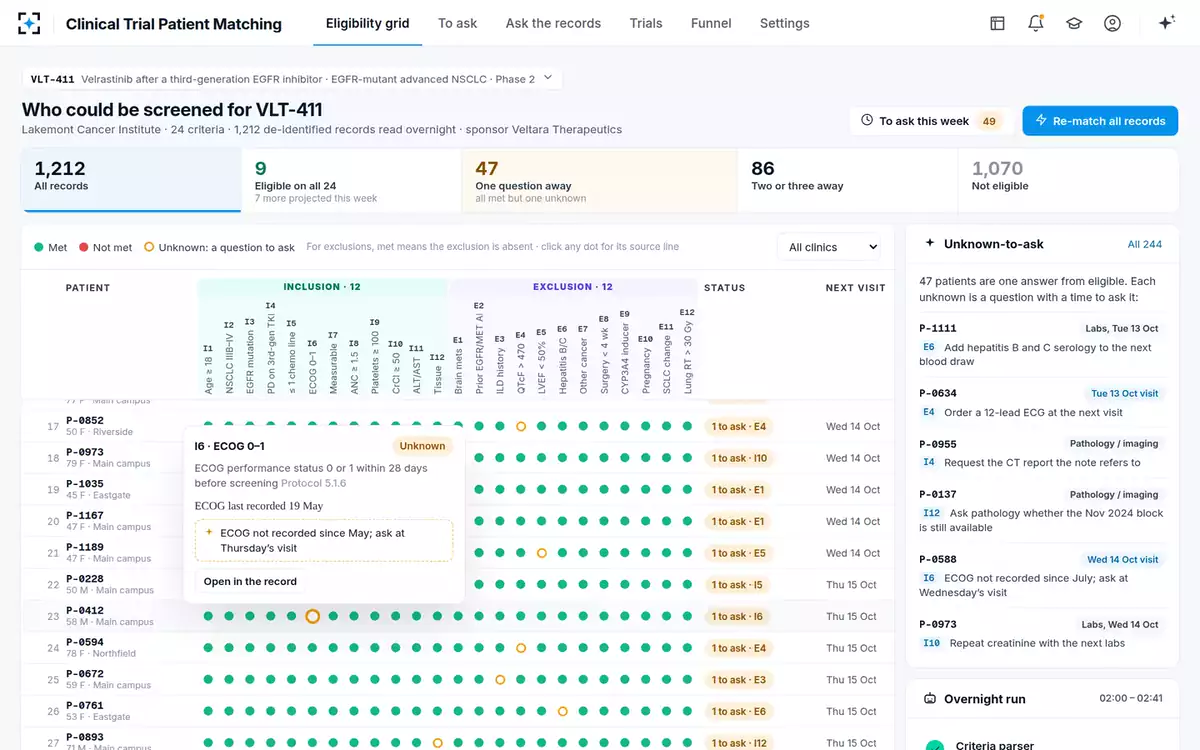
The second shape is the result that exists but is too old. The sample protocol wants a performance status within 28 days, blood counts within 14 and an ECG within 90. A patient with an excellent ECOG of 1 recorded on 19 May has, for eligibility purposes in October, no performance status at all. Nothing is missing from the chart. Something is missing from the window.
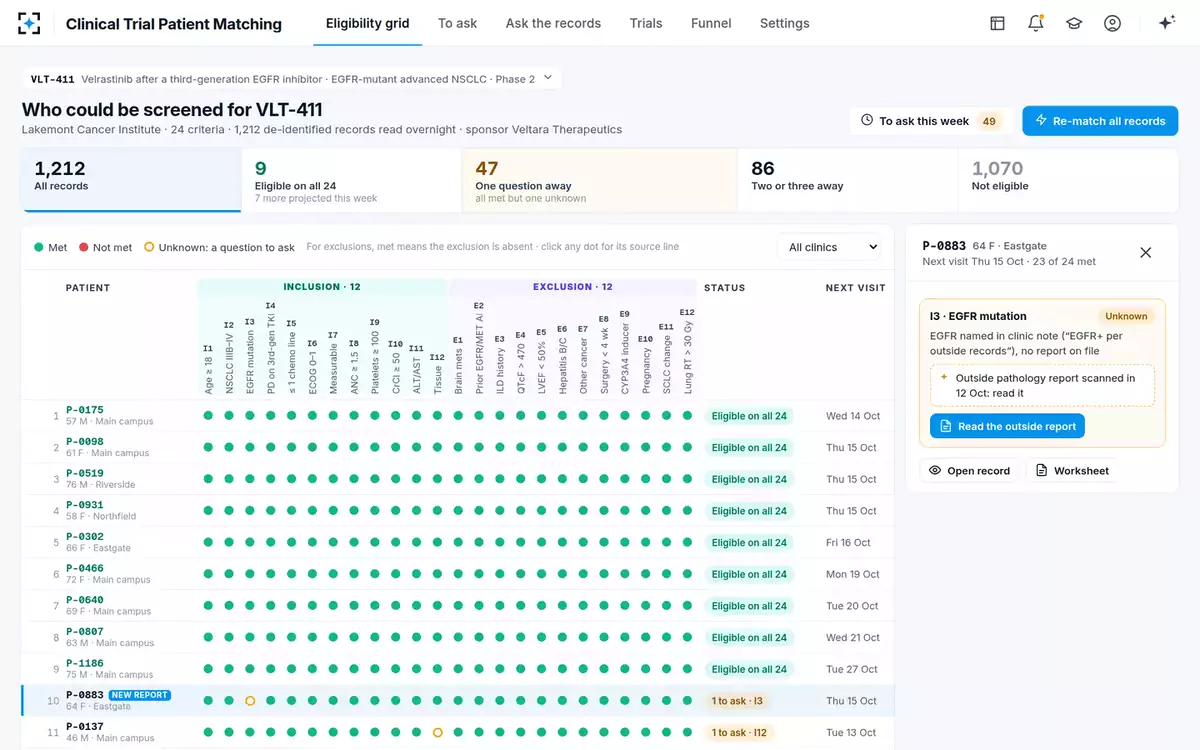
The third shape is the document that exists somewhere else: a molecular report from a community laboratory, a scan read at another hospital, a biopsy from before the referral. It is in the chart as an image, so it is invisible to every query the institution can write, and it is frequently the criterion that decides the case. Where each of the 24 criteria is proved is mapped in pre-screening patients for clinical trials.
What do you do about missing data in electronic health records?
For eligibility work, you do three things, in this order. You give absence a verdict of its own, so that it can be counted. You attach a question to each one — what to ask, of whom, at which visit or draw — so that the absence can be closed rather than merely noted. And you look at which criteria go blank most often, because a criterion that is unknown for a quarter of your patients is telling you something about your institution's documentation, not about your patients.
What you do not do is impute. Imputation is the right tool for a cohort analysis where a plausible value preserves a distribution; it is the wrong tool for a decision about one person, because the output of pre-screening is not an estimate but a referral. A patient referred on an imputed performance status fails at the screening visit, having been given a false expectation, and the site has spent a visit to learn what a question at the clinic door would have told it.
One grid, three verdicts: green, red and hollow amber
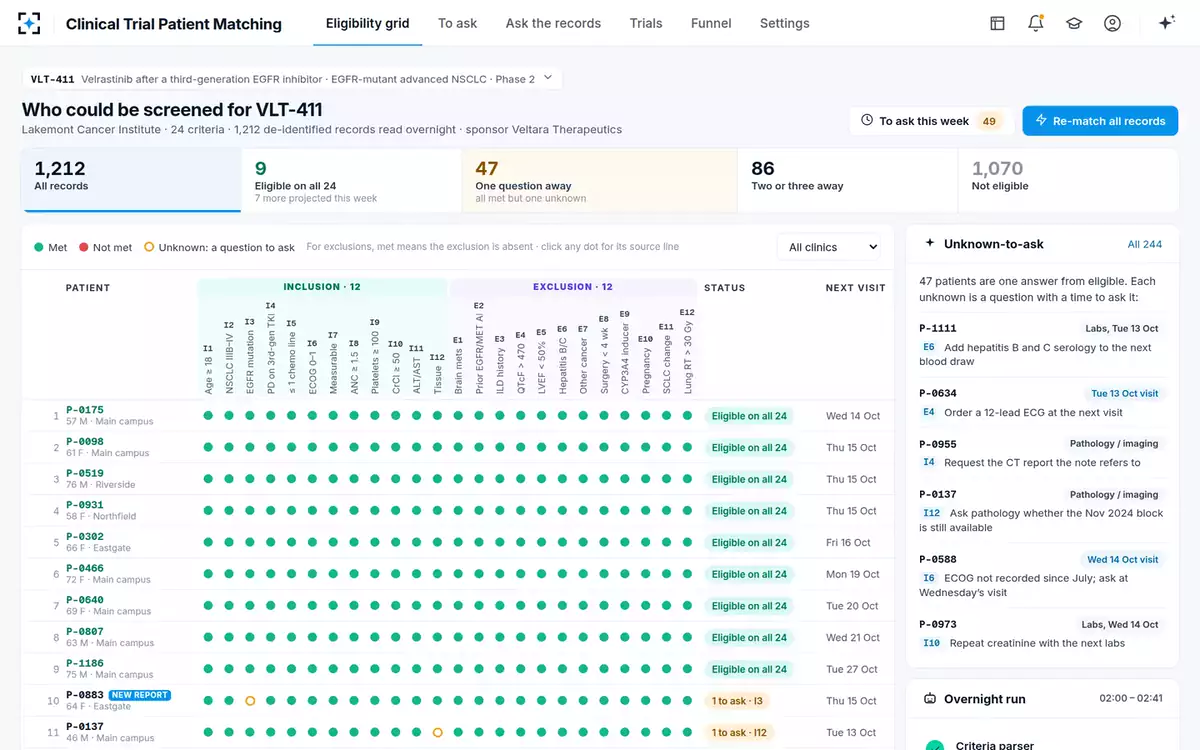
Absent is not negative: the distinction that decides a patient
In a clinical record, the absence of a statement is weak evidence of anything. A note that does not mention brain metastases may mean the patient has none, or that the question did not arise at that visit, or that the finding is in an MRI report nobody has opened. Clinicians read absence in context. A screening process that reads absence as negative is making the same inference without the context — and, worse, making it in only one direction.
That asymmetry is the quiet damage. Treating a blank as negative on an exclusion criterion lets a patient through who should not be — a silent chart on hepatitis serology becomes “no hepatitis”. Treating a blank as negative on an inclusion criterion keeps a patient out who should be in — a silent chart on performance status becomes “not ECOG 0 or 1”. The same lazy rule produces both a safety error and a recruitment error, and only one of them is ever noticed.
The locked rule in the sample solution is the answer in one line: no evidence inside the look-back window is unknown, never met. It is deliberately not a setting, because the moment it becomes negotiable it gets negotiated by whoever is behind on enrolment.
Three kinds of no, and how to tell them apart
A screening log's “not eligible” column holds at least three different events with three different owners. Separating them is the only way a site learns anything from its own numbers.
Three kinds of no in a pre-screening log
| Kind of no | What it means | A worked example from the sample protocol | Who can fix it |
|---|---|---|---|
| Genuinely not eligible | The record proves the patient fails a criterion the protocol needs. | Squamous transformation on the most recent biopsy (E2): the pathology report says so. | Nobody. This is the criterion working. |
| Excluded by a criterion that should not be there | The record proves a failure, but the criterion is not needed for safety or for the question the trial asks. | A creatinine clearance floor set higher than the drug’s handling requires, carried over from an earlier protocol. | The sponsor and the protocol author, at design time. |
| Nobody wrote it down | The record is silent, or the only evidence is outside the window, or it sits in a document nobody opened. | No performance status since 19 May (I6); “EGFR+ per outside records” with no report on file (I3). | The site, this week, with one question. |
Only the third is a records problem. The first is the trial working as intended. The second belongs upstream, and it is well documented: at the FDA's 2018 public workshop on eligibility criteria, “participants also pointed to pervasive copy-and-paste approaches in setting eligibility criteria”, with investigators reusing exclusions from a prior study “without thinking about whether the exclusions are rational for their trial or scientifically justifiable”.
Does a missing lab result mean a patient is ineligible?
No. A missing laboratory result means the criterion is unanswered, which is a different state from failed, and it usually has a cheap remedy: the test is ordered, or added to a draw the patient is already coming in for. On the sample run, hepatitis B and C serology is the second most common blank — 44 patients — and in almost every case the fix is one line added to a blood draw that is already scheduled.
The reason this gets treated as a failure is arithmetic under time pressure. A coordinator with a list of 200 charts and an afternoon cannot hold 200 open questions; the only way to finish is to resolve each chart to a yes or a no. The open questions are not a judgement about the patients. They are the part of the work that did not fit in the afternoon, and they are discarded silently.
Where the sample run's 244 unknowns sit, by criterion
Why performance status is the most common blank
Performance status leads the list on the sample run, and it would lead it at most oncology sites, for two reasons. The first is that it is rarely a coded field outside a trial visit: it lives as a phrase inside a clinic note, so a result exists only if someone wrote the number rather than the description. The second is the window. Performance status changes, which is why protocols ask for a recent one; a patient seen every eight weeks will often have no assessment inside a 28-day look-back.
There is a third reason, and it is the one that should make a site careful about reading too much into a single recorded value. Performance status is a judgement, and patients and their physicians do not always make the same one. In a Mayo Clinic and University of Iowa study of 1,269 patients with leukaemia and lymphoma, “Overall, 65% of patients and physicians rated PS the same”, with age, disease stage and disease subtype predicting disagreement; the authors are plain that performance status is a subjective measure with no gold standard behind it. About a third of the time, two careful observers disagreed.
That does not make performance status useless — the same study found it predicted overall survival whoever did the rating, in every subtype but Hodgkin lymphoma — but it does change what a site should do with a blank. A criterion that two observers disagree on a third of the time is not a criterion to infer from an old note or from a sentence like “doing well”. It is one to assess, at the next visit, and record as a number.
The blank, with its window and its question
What the published funnel counts, and what it cannot see
Unger and colleagues gave the field its clearest decomposition of why cancer patients do not enrol, pooling 13 studies and 8,883 patients: a trial was unavailable at the patient's own institution 55.6% of the time, 21.5% of patients were ineligible for an available trial, 14.8% did not enrol, and 8.1% did. Their summary of the combined effect is the sentence most often quoted from the paper — these barriers “make trial participation unachievable for more than three of four cancer patients”.
Read the second number carefully. “Ineligible for an available trial” is a measured fact about what sites recorded, and it is an honest description of what the studies could see. What no published figure can tell you is how many of those ineligible patients were ineligible on the record rather than in reality — because the studies observed the same screening logs that collapse the three kinds of no into one. The number is a ceiling on genuine ineligibility, not a measurement of it.
Two funnels, two denominators
Published: 8,883 cancer patients, 13 studies (Unger 2019)
- No trial available at the institution · 56%
- Ineligible for an available trial · 21%
- Did not enrol · 15%
- Enrolled · 8%
Sample run: 1,212 records against one protocol’s 24 criteria
- A criterion is genuinely not met · 88%
- Two or three questions open · 7%
- One question away · 4%
- Met on all 24 · 1%
Criteria that should never have been there: the copy-and-paste problem
The middle kind of no deserves its own paragraph, because it is the one sites complain about and cannot fix. The FDA's 2018 workshop report records participants describing investigators reusing a prior study's eligibility criteria without asking whether its exclusions were rational for the new trial. The report's recommendation is addressed to sponsors: spend the time ensuring that criteria are scientifically justifiable in every individual study.
A site cannot amend a protocol. What a site can do is record which criteria are excluding its patients, with counts, and send that back — because a sponsor deciding whether an exclusion earns its place is helped far more by a sentence of the form “this criterion excluded so many of our otherwise-eligible patients, most of them on a laboratory value within 10% of the threshold” than by a general complaint about restrictive criteria. A three-verdict grid produces that sentence as a by-product.
Sensitivity is the number a site should watch
When a site evaluates any method for finding patients — a query, a vendor, a new coordinator's checklist — the instinct is to ask how accurate it is. For pre-screening, accuracy is the wrong summary, because the two errors are not equal. A false positive costs a few minutes of review: a patient goes on the list, a person reads the chart, the patient comes off. A false negative costs the patient, silently and permanently, because nobody re-reads the chart of someone the method already rejected.
That makes sensitivity — the share of genuinely eligible patients the method keeps — the number to put in the contract. A published implementation is a useful reference point for what is achievable: a semi-automated matching system at Yale, reported in JCO Clinical Cancer Informatics in January 2026, was 94% accurate looking back and 88% accurate prospectively on one metastatic colorectal trial, and kept every patient that clinical chart review found eligible — 100% sensitivity. The accuracy figures are the ones usually quoted; the sensitivity figure is the one that tells a site no eligible patient was dropped. How accuracy and sensitivity are measured, and against what, is worked through in LLM clinical trial matching accuracy.
Two unknown rates, and the denominator people confuse
Unknown checks
unknown checks ÷ all checks
244 ÷ 29,088 = 0.8% of every patient-by-criterion cell on the sample run
Reads as negligible
Patients held up by an unknown
patients with ≥ 1 unknown and no criterion failed ÷ patients with no criterion failed
133 ÷ 142 = 94% of the patients who survived every criterion the record could answer
Reads as the whole job
The gap between them
the same 244 cells, counted per patient instead of per cell
A criterion grid is sparse in unknowns and dense in patients touched by one: 0.8% of cells reach 94% of the shortlist
Report the second
Re-counting your own screening log: a four-column worksheet
None of this requires new software to begin. A site can re-count last quarter's screening log by hand, on a sample, and learn the only number that matters: what share of its “not eligible” was a silent chart. Take fifty consecutive entries, find the criterion each was rejected on, and sort them into the three kinds of no. Add a fourth column for the question that would have settled the third kind, and how much it would have cost to ask.
The same fifty entries, counted two ways
The log as most sites keep it: Patient, date, outcome: screened or not eligible.
The log re-counted with unknown as its own column: Patient, date, outcome, the criterion that decided it, and whether the record proved, disproved or was silent.
The log as most sites keep it: Everyone who did not go forward, for any reason.
The log re-counted with unknown as its own column: Three separate counts, each with a different owner.
The log as most sites keep it: That most of them do not qualify.
The log re-counted with unknown as its own column: Which criteria exclude them, and how close the failing values were to the threshold.
The log as most sites keep it: Nothing.
The log re-counted with unknown as its own column: Which facts your institution does not write down, ranked.
The log as most sites keep it: A screening number.
The log re-counted with unknown as its own column: A criterion-level count, which is the only form of feedback a protocol author can act on.
The log as most sites keep it: Already done.
The log re-counted with unknown as its own column: An afternoon on fifty entries, once a quarter.
One question away, and the document that answers it
Six tests to tell a blank from a no in your own log
- Ask which criterion closed each case
A log that does not name the deciding criterion cannot be re-counted at all. This is the first field to add.
- Check whether the record proved the failure
A quoted line and a date, or it is not a proof. “Did not meet criteria” is a conclusion, not evidence.
- Check the date against the window
Evidence outside the look-back window is an unknown wearing a verdict’s clothes.
- Look for the document nobody opened
Scanned outside reports and images; on the sample protocol, two criteria of 24 usually live there.
- Count how near the near misses were
A laboratory value within 10% of a threshold is a different conversation with a sponsor than one at half of it.
- Rank your blanks and act on the top three
On the sample run, three criteria hold 148 of 244 unknowns. Documentation fixes are cheap when they are specific.
Whose afternoon this is, and what is left of it once the proving happens overnight, is set out in clinical research coordinator workload, and where pre-screening hours go. To see unknowns kept as their own verdict and turned into dated questions, start from Clinical Trial Patient Matching.
Questions people ask
How much of clinical trial eligibility is in unstructured notes?
Enough that a coded query cannot finish the job. On the sample lung protocol, only five of 24 criteria — age and the laboratory and serology thresholds — sit in coded fields; the rest need a clinic note, a pathology or imaging narrative, a medicine list with a free-text reason, or a scanned outside report. The ratio varies by specialty, and the honest move is to measure it on your own protocol before buying anything.
How common is missing data in medical records?
There is no single rate, because “missing” is defined by the question you are asking of the record. For eligibility work the useful measure is per criterion and per window: on the sample run, 244 of 29,088 checks come back unknown, three criteria account for 148 of them, and 133 of the 142 patients who failed no criterion are held up by at least one. Rank your own criteria; the top of the list will be stable.
What is the difference between absent and negative in a medical record?
Negative means somebody looked and wrote down what they found. Absent means nobody wrote anything, which may be because the finding was not there, because the question did not arise, or because the answer is in a document that was never opened. Clinicians read absence in context; a screening process has no context, so it should not infer.
Can you treat a blank as a negative?
Not safely, and not in one direction only. On an exclusion criterion a blank read as negative admits a patient nobody has checked — silence on hepatitis serology becomes “no hepatitis”. On an inclusion criterion the same rule keeps out a patient who may well qualify. The rule in the sample solution is locked for that reason: no evidence inside the look-back window is unknown, never met.
How do you handle an unknown eligibility criterion?
Turn it into one question with a date: what to ask, of whom, and at which visit or blood draw. Route tissue and outside reports to pathology and judgement calls to the investigator. On the sample run, 49 of the 244 unknowns can be closed from appointments already in this week's clinic schedule, which is what makes the list a plan rather than a backlog.
Why is performance status missing from the chart?
Usually because it was never written as a number — it lives as a phrase inside a clinic note, if at all — or because the most recent assessment falls outside the protocol's look-back window. It is also a judgement rather than a measurement: in one Mayo Clinic and University of Iowa study, patients and their physicians gave the same rating only 65% of the time, which is a further reason to assess it fresh rather than infer it.